operation
3 TopicsGranular Billing for Azure Data Factory
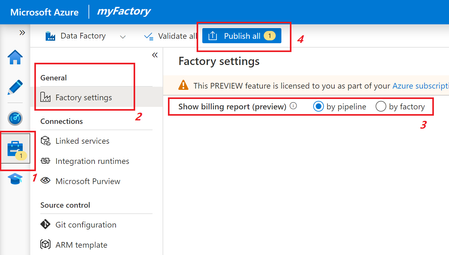
In this blog, Charlie Zhu walks you through the new granular billing option for Azure Data Factory and helps you better understand pipeline costs. We are bringing clarity and transparency into data pipelines operations with built-in per pipeline billing report so that you will know exactly how much each pipeline costs you.27KViews9likes20CommentsJoin us at Microsoft Azure Infra Summit 2026 for deep technical Azure infrastructure content
Microsoft Azure Infra Summit 2026 is a free, engineering-led virtual event created for IT professionals, platform engineers, SREs, and infrastructure teams who want to go deeper on how Azure really works in production. It will take place May 19-21, 2026. This event is built for the people responsible for keeping systems running, making sound architecture decisions, and dealing with the operational realities that show up long after deployment day. Over the past year, one message has come through clearly from the community: infrastructure and operations audiences want more in-depth technical content. They want fewer surface-level overviews and more practical guidance from the engineers and experts who build, run, and support these systems every day. That is exactly what Azure Infra Summit aims to deliver. All content is created AND delivered by engineering, targeting folks working with Azure infrastructure and operating production environments. Who is this for: IT professionals, platform engineers, SREs, and infrastructure teams When: May 19-21, 2026 - 8:00 AM–1:00 PM Pacific Time, all 3 days Where: Online Virtual Cost: Free Level: Most sessions are advanced (L300-400). Register here: https://aka.ms/MAIS-Reg Built for the people who run workloads on Azure Azure Infra Summit is for the people who do more than deploy to Azure. It is for the people who run it. If your day involves uptime, patching, governance, monitoring, reliability, networking, identity, storage, or hybrid infrastructure, this event is for you. Whether you are an IT professional managing enterprise environments, a platform engineer designing landing zones, an Azure administrator, an architect, or an SRE responsible for resilience and operational excellence, you will find content built with your needs in mind. We are intentionally shaping this event around peer-to-peer technical learning. That means engineering-led sessions, practical examples, and candid discussion about architecture, failure modes, operational tradeoffs, and what breaks in production. The promise here is straightforward: less fluff, more infrastructure. What to expect Azure Infra Summit will feature deep technical content in the 300 to 400 level range, with sessions designed by engineering to help you build, operate, and optimize Azure infrastructure more effectively. The event will include a mix of live and pre-recorded sessions and live Q&A. Throughout the three days, we will dig into topics such as: Hybrid operations and management Networking at scale Storage, backup, and disaster recovery Observability, SLOs, and day-2 operations Confidential compute Architecture, automation, governance, and optimization in Azure Core environments And more… The goal is simple: to give you practical guidance you can take back to your environment and apply right away. We want attendees to leave with stronger mental models, a better understanding of how Azure behaves in the real world, and clearer patterns for designing and operating infrastructure with confidence. Why this event matters Infrastructure decisions have a long tail. The choices we make around architecture, operations, governance, and resilience show up later in the form of performance issues, outages, cost, complexity, and recovery challenges. That is why deep technical learning matters, and why events like this matter. Join us I hope you will join us for Microsoft Azure Infra Summit 2026, happening May 19-21, 2026. If you care about how Azure infrastructure behaves in the real world, and you want practical, engineering-led guidance on how to build, operate, and optimize it, this event was built for you. Register here: https://aka.ms/MAIS-Reg Cheers! Pierre Roman6KViews2likes2Comments
We never really knew if our Azure followed CAF or Well-Architected — so we built something
For years we ran Azure environments professionally and CAF and WAF reviews were always the same story. A consultant every 12-18 months, a thick PDF, good intentions — and then nothing until the next one. The problem wasn't that we didn't care. It was that there was no lightweight way to track it continuously. Defender had some parts of CIS. WAF had the assessment tool. CAF had... a whitepaper and a spreadsheet we kept meaning to update. We couldn't answer basic questions like: are we getting better or worse? Which subscriptions are drifting? What would an auditor actually see if they looked at our CAF posture today? Eventually we got frustrated enough to build Anubion — it connects agentlessly to your Azure tenant and runs continuous checks across CIS, CAF, and WAF in one place, with findings prioritised and evidence stored over time. Happy to share more if anyone's interested. But also genuinely curious — how are other teams handling CAF and WAF tracking between formal assessments? If anyone is curious about their scores, you can sign up for at 14 day free trial. The setup is short and you only need a read-only service principal. Check out https://anubion.io/#request-access