open source
132 TopicsThe OpenVMM Project
What is OpenVMM? Virtualization platforms are made up of three key components: Firstly, there is the hypervisor – the privileged software that interfaces directly with the hardware to provide the low-level primitives required to execute virtual machines (VMs). Secondly, there is the Virtual Machine Manager (VMM) – the software that uses the hypervisor interfaces to provide the general capabilities required to run VMs and manage their lifecycle. Lastly, there is the host operating system on which the VMM runs, which provides networking and storage access. OpenVMM is an open-source, cross-platform VMM project written in Rust. Released under the MIT license and developed openly in the OpenVMM GitHub repository , it can serve as a key building block for all types of virtualization scenarios. OpenVMM is used in the OpenHCL paravisor, an execution environment that runs within the guest VM, and it can also be used as a traditional VMM on a host operating system. How Has OpenVMM Evolved Since Being Open Source? Since we open soured OpenVMM in 2024, our active developer community has grown to over 100 contributors with over 200 forks. The OpenVMM project has benefited from strong ongoing contributions from industry partners like Intel and Arm, which have helped the project evolve and mature in several aspects, including cross-platform virtualization, device emulation, testing infrastructure and confidential computing. Advancing Cross-Platform Virtualization Contributions have enhanced OpenVMM's support across architectures, host operating systems, and virtualization backends. Key enhancements include aarch64 support for the MSHV backend and correctness improvements for KVM-based virtualization. Expanding Device Model and Device Emulation Support Device support has grown to now include: - Emulated SMMUv3 for Arm-based VMs - Compute Express Link (CXL) emulation - PCIe NUMA and ACS configuration exposure - Modern VFIO device assignment interfaces for improved hardware passthrough - Full VLAN support for NetVSP networking Strengthening Testing and Engineering Infrastructure Several improvements have been made to the Petri testing framework based on community feedback. These include physical NVMe test plumbing, CXL coverage, transparent-huge-page enablement, and richer diagnostic reporting like halt reason error messages for easier debugging. In parallel, improvements in CI and build systems and release engineering have streamlined development workflows, including new build support for Azure Linux. Innovations in Confidential Computing One of the most significant areas of growth has been confidential computing. Thanks to contributions from Intel, we developed General Availability paravisor support for Intel TDX Confidential VMs in Azure in the open via over 50 GitHub issues and then focused on changes that have led to substantial performance gains, like reducing Confidential VM performance overhead from roughly 3% to about 1% in CPU/memory intensive workloads. Thanks to contributions from Arm, support for an entirely new confidential architecture, Arm CCA Realm is underway, with initial Arm CCA foundational enablement for OpenHCL and TMK test infrastructure already completed, and GICv3 support in OpenHCL and support for booting Linux guests using tmk_vmm almost complete. Collaboration with AMD continues to enhance support for AMD SEV-SNP Confidential VMs through paravisor performance optimizations and improved debugging capabilities like virtual NMI support and paravisor boot serial logging. We also continue growing paravisor attestation and sealing capabilities, like adding support for stateless Confidential VMs with hardware sealing policy. Growing Beyond the Core Project OpenVMM has also shown signs of broader ecosystem/product integration. Community members are exploring how OpenVMM can power adjacent technologies and products. For example, contributors within the Windows Subsystem for Linux (WSL) ecosystem are exploring using OpenVMM as VMM backend option for WSL VMs. As we develop new OpenVMM functionality in the open, we would love your feedback. You can learn more about this project on and how to use it on https://openvmm.dev. Why OpenVMM? The motivation behind building OpenVMM comes from three of its core characteristics: cross-platform, distributed and flexible, and its modern security architecture. Cross-Platform There is a need for a VMM that works consistently across Windows and Linux and across multiple hypervisors. Broad cross-platform support is one of the design principles of, as well as one of the key motivations for developing OpenVMM. OpenVMM supports a variety of host operating systems including Linux, Windows, and macOS, and a variety of virtualization backends including MSHV, WHP, KVM and hypervisor.framework. It also supports both x64 and AArch64 architectures. Distributed and Flexible OpenVMM is designed to be a collection of VMM components that can be combined to build specialized VMMs custom tailored to power specific scenarios. Although OpenVMM can run as a traditional VMM on the host, it is designed so that its runtime functionality can be split across multiple environments, like running in a paravisor inside a guest VM. In fact, our goal of running OpenVMM inside a paravisor environment, and this scenario’s unique threading model requirements, was one of the reasons OpenVMM was created. The ability to use OpenVMM in a variety of environments simultaneously is enabled by OpenVMM’s modular design and internal message-passing architecture. Components can be reused in different scenarios without being tied to the broader “block diagram”. OpenVMM is also flexible in terms of the wide range of scenarios in can support. It can optimize modern workloads while also supporting legacy workloads. For instance, today OpenVMM supports different boot modes: UEFI, BIOS and Linux Direct Boot, and it has wide device support across direct assigned devices, para-virtualized devices (both Virtio and VMBus), and emulated devices: vTPM, NVMe, serial UARTs and legacy x86 (i440BX + PIIX4 chipset, IDE HDD/Optical, Floppy, PCI, VGA graphics). In fact, Azure compatibility has also been a goal, which is why OpenVMM has support for the Microsoft Hypervisor ABI and all Hyper-V emulated and para-virtualized devices. Going back to OpenVMM’s modular design, one can choose a subset of the Hyper-V guest interface, or an alternate interface altogether, for new scenarios with different requirements. Modern Security Architecture OpenVMM aims to have a modern, secure design. It does this, firstly, by implementing as much virtualization functionality (emulation, instruction completion, paravirtualized devices, and memory management) in user mode as possible. This can improve security via hardware memory protection and enhanced exploit mitigations, and it also makes it easier to service the code, diagnose issues, and mitigate problems in the field, enabling faster patching of security vulnerabilities. Secondly, OpenVMM uses powerful process sandboxing, allowing unrelated VMM functionality to run in separate processes. On Windows, this sandboxing is backed by least-privileged app containers (LPAC), while on Linux it’s supported by kernel namespaces and (in the future) SeLinux. Lastly, like with many newer VMMs, OpenVMM is written in Rust, which reduces the opportunity for programming error leading to guest escape. With Safe Rust, programmers do not have to worry about type-safety or memory-safety... about the possibility of a dangling pointer, a use-after-free, or other kinds of Undefined Behaviors (which became known as nasal demons in 1992 for good reason). The OpenVMM community has been actively involved in Rust since the early days, driving the compiler and libraries forward. OpenVMM was one of the five case studies used by the Rust async working group to evaluate the utility of the stabilized MVP version of async functions in traits - OpenVMM is the Microsoft tool cited in Rust’s blog Stabilizing async in traits in 2023! There are many other great security initiatives in Rust that OpenVMM benefits from: ongoing efforts are regularly creating new open-source security tools for Rust developers, conducting audits and threat models and developing a collaborative team of Rust security experts. Conclusion Today, we covered why the OpenVMM project started and how it has grown since being open source. Microsoft is committed to working across open-source projects and supporting multiple VMMs for customers, alongside OpenVMM. Our goal is to give customers choices to find the solution that best meets their requirements and their workloads as well as to provide the strong performance and isolation capabilities of the Microsoft Hypervisor - which is used in Azure, on-prem, and Client scenarios - to a wide range of VMMs in various virtualization topologies and operating systems. For example, we are working on VMMs like Cloud-hypervisor and Hyperlight which power Azure workloads, and we are also investing in broad compatibility, getting a wide range of VMMs including QEMU to run with the Microsoft Hypervisor to support diverse Linux workloads in Azure. - Core OS Team.2.6KViews1like0CommentsAnnouncing the open sourcing of OpenHCL
From the beginning of the cloud computing era, virtualization technology has enabled compute workloads to run as virtual machines (VMs) in a server environment. As hardware has evolved, and new functionality has become available, the software stack has kept VMs running seamlessly, thanks to sophisticated advances in the hypervisor and virtualization software. Confidential Computing is a powerful technology for significantly improving the security of VMs running in the cloud. However, the trust boundary of a Confidential VM imposes a barrier that prevents the hypervisor from offering the rich virtualization services that VMs normally expect. Customers desiring the benefits of Confidential VMs are therefore forced to update the operating systems of their VMs to newer versions, which must be continually revised as Confidential VM technology maintains its path of rapid evolution. Microsoft has embraced a different approach that offers much more flexibility to customers through the use of a “paravisor”. A paravisor executes within the confidential trust boundary and provides the virtualization and device services needed by a general-purpose operating system (OS), enabling existing VM workloads to execute securely without requiring continual update of the OS to take advantage of innovative advances in Confidential Computing. As Confidential Computing evolves, the software stack can keep VMs running seamlessly thanks to the paravisor, in much the same way other advances in virtualization software kept VMs running seamlessly on ever evolving hardware. Introducing OpenHCL Microsoft developed the first paravisor in the industry, and for years, we have been enhancing the paravisor offered to Azure customers. This effort now culminates in the release of a new, open source paravisor, called OpenHCL. We plan to develop OpenHCL in the open here: microsoft/openvmm: Home of OpenVMM and OpenHCL (github.com). Today, OpenHCL can run on both x86-64 and ARM64 platforms, it has support for Intel TDX and AMD SEV-SNP, and it offers a rich set of powerful services to VMs including device emulation via standard device interfaces, device translation via standard device interfaces, diagnostics and support for guests that are not fully enlightened - such as Windows and older versions of Linux - to run via standard architectural interfaces. OpenHCL is used in Azure in new Azure Boost SKUs, and it will be used in future Confidential VM SKUs. In the past month alone, over 1.5 Million VMs were running with OpenHCL in Azure. Open for collaboration We have much more we plan to do with OpenHCL, and as we develop new functionality in the open, we would love to collaborate with you. You can learn more about OpenHCL in our extended blog OpenHCL: the new, open source paravisor - Microsoft Community Hub as well as in https://openvmm.dev. - Core OS team.2.7KViews1like0CommentsAzure HorizonDB: Enterprise-Ready Postgres, Engineered for the AI Era
Affan Dar, Vice President of Engineering, PostgreSQL at Microsoft Charles Feddersen, Partner Director of Program Management, PostgreSQL at Microsoft Today at Microsoft Build, we’re pleased to announce the public preview of Azure HorizonDB, a new enterprise-ready Postgres-compatible database service designed to meet the needs of modern AI applications, alongside a set of enhancements to our PostgreSQL tooling in Visual Studio Code to further streamline the developer experience. Postgres is rapidly solidifying its role as a foundational layer in modern data architectures, with accelerating adoption across industries. For developers, it has become the preferred platform for new application development, driven by its extensible architecture, mature extension ecosystem, and adherence to open standards and APIs. At the same time, enterprises are choosing Postgres to re-platform and modernize existing systems, taking advantage of its ability to support a broad range of operational workloads while enabling advanced capabilities such as vector-based data access all within a single, interoperable platform. A Postgres Platform Grounded in Security, Resilience, Scale, and Performance Azure HorizonDB is purpose-built to meet these demands, combining the flexibility developers expect from Postgres with the operational rigor enterprises require. It extends the core Postgres engine with cloud-native capabilities such as integrated identity, fine-grained network and security controls, and seamless lifecycle management, while preserving full compatibility with the open ecosystem of extensions and tools. At the same time, HorizonDB introduces advanced, natively integrated capabilities like vector data support and AI model management, enabling new classes of intelligent applications without sacrificing transactional integrity or developer productivity. These capabilities are backed by a platform designed for enterprise performance and scale. HorizonDB supports databases up to 128 TB, scales out with up to 15 read replicas for high-throughput workloads, and delivers sub-millisecond commit latency across availability zones for low-latency transactions and high availability. This combination is critical for modern applications that require consistent performance under load, including high-concurrency transactional systems, real-time AI-driven interactions, and globally distributed services. The result is a unified platform that scales from the first line of code to globally distributed, mission-critical systems. Enterprise adoption ultimately depends on trust in the platform itself. Azure HorizonDB delivers this with native integration into Microsoft Entra ID for centralized identity and access control, private endpoints for network isolation, and built-in encryption to protect data at rest and in transit. These capabilities are essential for meeting compliance requirements and enabling organizations to run mission-critical workloads with confidence, without added complexity. This foundation is critical for any application, but it becomes indispensable for AI, where secure access to data and controlled model interaction underpin every intelligent experience. Building on this, HorizonDB introduces a set of integrated AI capabilities designed to bring intelligence directly into the database. Run Fast, Memory-Efficient Vector Search with DiskANN HorizonDB brings high-performance vector search directly into Postgres through DiskANN with spherical quantization. This enables efficient, low-latency similarity search at scale while significantly reducing memory and storage overhead. Spherical quantization works by normalizing vectors and encoding them into compact representations that preserve angular distance, allowing the system to compare vectors efficiently with minimal loss in accuracy. The result is the ability to index and query large embedding datasets within the transactional engine itself, making vector search a first-class capability rather than an external dependency. "HorizonDB is compelling because it brings a PostgreSQL-compatible foundation, AI-native capabilities and enterprise-grade controls closer to the operational data layer." Jennings Balavari, Founder, Opsen AI Build Smarter Apps with Hybrid Search in Postgres HorizonDB supports hybrid search by combining vector similarity through pgvector with full-text search enabled via the pg_textsearch extension, allowing applications to match both semantic meaning and precise keyword relevance in a single query. This enables more accurate, context-aware results, such as blending intent-driven retrieval with exact term matching for search, recommendations, or RAG scenarios. By unifying these capabilities within Postgres, HorizonDB improves result quality while simplifying application design without the need for external search systems. Operationalize AI with Built-In AI Model Management Working with vectors requires models to generate, interpret, and evolve embeddings, making model lifecycle a core part of the application stack. HorizonDB introduces integrated AI model management to simplify how models are registered, versioned, and governed alongside data, including built-in support for generative GPT models and ranking models. For example, GPT models can be used to generate summaries, responses, or structured outputs directly from application data, while ranking models enable relevance scoring for search results or recommendations over vector results. By managing these models alongside the data they operate on, HorizonDB ensures consistency, traceability, and control, creating a unified environment where models and data evolve together. “As we build a multi-tenant, AI-driven commerce platform, HorizonDB has been particularly compelling in two areas: scale and how close AI capabilities are to the data itself. Running vector search, filtering, and model-driven workflows directly inside the database removes a lot of the complexity we’d normally manage across separate services." James Frawley, CIAO, ReFiBuy Bring AI into SQL with AI Functions With models managed in place, AI Functions provide a direct way to invoke them from within SQL and application logic. These functions are implemented through the azure_ai extension, which brings model invocation directly into the Postgres engine. This allows developers to embed inference into queries and transactions, eliminating the need for external orchestration. By bringing model execution closer to the data, AI Functions reduce latency, simplify application design, and make intelligent behavior a natural extension of existing Postgres workloads. "What stood out with HorizonDB is that it aligns closely with how we already think about the problem. Instead of stitching together multiple components, it brings transactional data, vector search, and AI capabilities into a single platform, which simplifies the architecture without forcing a complete rethink." Mohsin Shafqat, Director Software Engineering for Nasdaq Boardvantage®, Nasdaq Run Reliable, Event-Driven Workflows with AI Pipelines Finally, AI Pipelines operationalize these capabilities through reliable, event-driven workflows for model execution and data processing. Pipelines execute on data changes, enabling real-time asynchronous reactions without external orchestration and ensuring consistent, repeatable behavior as data evolves. Combined with model management and AI Functions, they turn embedded intelligence into something that can be run, scaled, and trusted in production, while inheriting the database’s high availability and failover characteristics for resilience. Pipelines can also be visualized and observed in real time through the Visual Studio Code extension for PostgreSQL, giving developers and operators immediate visibility into execution flow, state, and outcomes Modern Unified Experience for Data, AI, and Operations in VS Code As intelligence becomes a core part of the data platform, the developer and operator experience becomes equally critical. HorizonDB extends seamlessly into Visual Studio Code with enhanced PostgreSQL tooling that works across any Postgres deployment, not just HorizonDB. Features like AI-assisted query plans and integrated monitoring enable faster debugging and optimization, helping teams understand both database performance and AI-driven behaviors. At the same time, for Azure-based deployments, the experience is deeply integrated with platform capabilities, enabling management of networking configuration, server parameters, and server logs directly from the development environment, streamlining operations across application and infrastructure layers. Azure HorizonDB brings together enterprise-grade security, deep Postgres compatibility, and a modern AI-native data platform, all engineered for developers. It scales efficiently across workloads, from transactional systems to intelligent applications, while delivering a world-class, Azure-integrated experience in Visual Studio Code for both developers and operators. Ready to get started with Azure HorizonDB? Azure HorizonDB is now available in public preview in Australia East, Central US, Sweden Central, West US 2, and West US 3 regions. Additionally, East US, Canada Central, Indonesia Central, Italy North, Japan East, Korea Central, and Poland Central will be available in the coming weeks. You can get started today by creating a new HorizonDB instance using the Azure portal, API’s, or the Visual Studio Code extension for PostgreSQL to begin exploring these capabilities firsthand. To learn more, dive deeper into our documentation and sign-up today to try AI model management in a limited preview.Log Insights in Minutes: A Simpler pgBadger Workflow
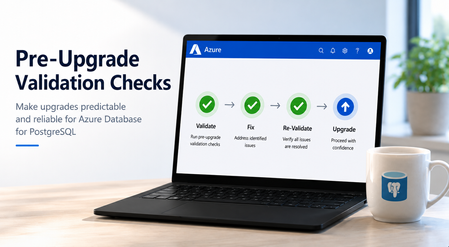
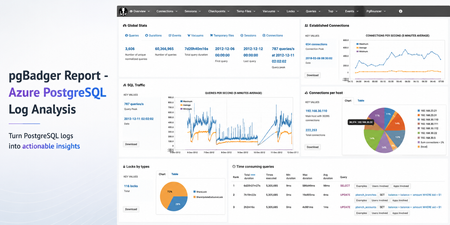
Sometimes the fastest way to understand a PostgreSQL workload is not another dashboard. It is a good log report. pgBadger is a PostgreSQL log analysis tool that turns raw PostgreSQL logs into an interactive HTML report. It helps summarize query activity, connection patterns, errors, temporary files, lock waits, autovacuum activity, and more. Earlier guidance for generating pgBadger reports from Azure Database for PostgreSQL Flexible Server focused on exporting logs through Diagnostic Settings, storing them in a storage account, and then using tools such as BlobFuse and jq to extract PostgreSQL log lines from JSON files. That workflow is still useful when customers centralize logs across multiple servers. However, if you are already using the Server logs feature in Azure Database for PostgreSQL Flexible Server, there is a much simpler path. In this post: You’ll learn how to generate a pgBadger HTML report from Azure Database for PostgreSQL Flexible Server by downloading native PostgreSQL .log files directly from the Azure portal. No storage account, BlobFuse mount, or JSON extraction required. Fast path Configure log_line_prefix . Enable Server logs for download. Download the PostgreSQL .log files. Run pgBadger with the matching prefix. Open pgbadger-report.html . Why use this workflow? With Server logs, you can download native PostgreSQL .log files directly from the Azure portal and run pgBadger locally. Older path Simpler path in this blog Diagnostic Settings → Storage account → BlobFuse → JSON extraction → pgBadger Server logs → Download .log files → pgBadger Area Older Diagnostic Settings workflow Server logs workflow Export path Diagnostic Settings to storage account Download .log files directly from the portal Format JSON payloads need extraction Native PostgreSQL .log files Extra tooling BlobFuse and jq JSON parsing None Best suited for Centralized or multi-server logging Quick per-server analysis Outcome Flexible, but more setup Faster path to pgBadger Recommended: Use the Server logs workflow when you want a fast, low-friction way to generate a pgBadger report from one Azure Database for PostgreSQL Flexible Server. When should you use this workflow? Use this workflow when... Use Diagnostic Settings when... You need a quick report for one Flexible Server. You centralize logs from many servers. You want to run pgBadger locally. You need long-term retention or workspace-level querying. You want to avoid JSON extraction. You already have automated log export pipelines. Before you start A machine where you can install or run pgBadger. A working Perl runtime. Git Bash on Windows, so the multi-line shell commands work as shown. Portal access to your Azure Database for PostgreSQL Flexible Server. Permission to update server parameters and enable Server logs. Important: pgBadger can only analyze what PostgreSQL logs capture. To populate query timing and slow-query sections in the report, enable log_min_duration_statement before collecting logs. Logs collected before that change will not include duration data. Workflow overview Task Type Rough effort Install or prepare pgBadger One-time setup per analysis machine 5–10 minutes Configure log_line_prefix One-time setup per server 2–3 minutes Enable Server logs One-time setup per server 2–3 minutes Download logs and run pgBadger Repeatable 2–5 minutes Install or prepare pgBadger on the machine where you will analyze logs. Configure log_line_prefix so pgBadger can parse each log line. Enable Server logs, so PostgreSQL logs are available for download. Download the logs and run pgBadger locally. 💡Pro tip: Start with a narrow log window first. Use one or two hourly log files, confirm the report looks right, and then expand the analysis window if needed. Step 1: Install pgBadger Before generating a report, you need pgBadger available on the machine where you plan to analyze the downloaded PostgreSQL log files. Run this on a Linux VM, WSL, or another Linux-based environment where you can install packages. Note: Azure Cloud Shell may work for quick testing, but package installation and build-tool availability can vary by session. For repeatable analysis, use a Linux VM, WSL, or another environment you control. Copy and run sudo apt-get update && sudo apt-get install -y git perl make gcc && \ git clone https://github.com/darold/pgbadger.git && \ cd pgbadger && \ perl Makefile.PL && \ make && \ sudo make install && \ pgbadger -V What good looks like: The install command completes successfully and pgbadger -V returns the installed pgBadger version. Step 2: Configure log_line_prefix This is a one-time server configuration step. The log_line_prefix parameter controls the beginning of each PostgreSQL log line. pgBadger uses this prefix to extract useful fields such as timestamp, user, database, and process ID. In the Azure portal, open your Flexible Server and go to Server parameters. Search for: Parameter log_line_prefix Set this value %m user=%u db=%d pid=%p: Then select Save. In Server parameters, confirm that the custom value is saved for log_line_prefix . Figure 1: Set log_line_prefix so pgBadger can correctly parse timestamp, user, database, and process ID from each log line. Prefix tokens Token Meaning %m Timestamp with milliseconds %u Username %d Database name %p Process ID After this change, log lines should look like this: Example log line 2026-06-22 19:00:00.070 UTC user=pgadmin db=highcpu pid=3805603: LOG: statement: SELECT 1 FROM pg_extension WHERE extname='pg_stat_statements' The matching pgBadger prefix for this log format is: Matching pgBadger prefix %m user=%u db=%d pid=%p: You will use this same value later in the pgBadger command. What good looks like: The server parameter is saved, and new PostgreSQL log lines begin with timestamp, user, database, and process ID fields that match the pgBadger prefix. Step 3: Enable Server logs for download This is also a one-time setup step. In the Azure portal, open your Flexible Server and go to Server logs. Enable: Portal setting Capture logs for download Set the retention period based on how long you want logs to remain available for download. For example, a 7-day retention period keeps logs available for download for 7 days. In Server logs, enable Capture logs for download and choose the retention window. Figure 2: Enable Capture logs for download and set a retention period long enough to cover the analysis window you want to inspect. What good looks like: After Server logs are enabled, hourly PostgreSQL log files appear in the Server logs blade and can be downloaded from the Azure portal. Once enabled, hourly log files appear in the Server logs blade. The files are named by date and hour, for example: Example log files postgresql_2026_06_22_19_00_00.log postgresql_2026_06_22_20_00_00.log Step 4: Download and organize the logs locally From the Server logs page, select the .log files for the time window you want to analyze and download them. For example, to analyze activity between 19:00 and 21:00 UTC, download: Example files to download postgresql_2026_06_22_19_00_00.log postgresql_2026_06_22_20_00_00.log On your local machine, create a folder for that analysis window. A simple convention is to use the Mon-DD format. Folder name Jun-22 Place the downloaded .log files inside that folder. Your local folder structure should look like this: Folder structure pgbadger-13.1/ pgbadger Jun-22/ postgresql_2026_06_22_19_00_00.log postgresql_2026_06_22_20_00_00.log Step 5: Generate the pgBadger report Open Git Bash from the folder where pgBadger is located. For example, if pgBadger is inside the pgbadger-13.1 folder, open Git Bash from that folder. # Action Command 1 Set the folder FOLDER=Jun-22 2 Confirm files ls -lh ./$FOLDER 3 Run pgBadger Use the full command below. Copy and run FOLDER=Jun-22 ls -lh ./$FOLDER perl -X ./pgbadger -f stderr \ --prefix '%m user=%u db=%d pid=%p:' \ ./$FOLDER/*.log \ -o ./$FOLDER/pgbadger-report.html Command breakdown Part of command Purpose perl -X ./pgbadger Runs pgBadger and suppresses non-critical Perl warnings. -f stderr Parses PostgreSQL stderr log files. --prefix '%m user=%u db=%d pid=%p:' Matches the log_line_prefix set on the server. ./$FOLDER/*.log Analyzes every .log file in the selected folder. -o ./$FOLDER/pgbadger-report.html Writes the HTML report into the same folder. When the command completes successfully, you should see output like this: Expected output Parsed 12134249 bytes of 12134249 (100.00%), queries: 26684, events: 83 LOG: Ok, generating html report... What good looks like: pgBadger finishes parsing the logs and creates pgbadger-report.html in the selected folder. Step 6: Open the report Open the generated report: Copy and run start ./$FOLDER/pgbadger-report.html The report opens in your default browser. The final report is created here: Generated report path Jun-22/pgbadger-report.html What the report can show The pgBadger report gives you a quick view into the workload shape for the selected log window. For example, in a sample run across two hourly log files, pgBadger summarized: Total number of queries. Number of unique normalized queries. Query traffic over time. Events such as errors and fatal messages. Session and connection patterns. Once the report opens, start with Global Stats to confirm the time range, total queries, normalized queries, and query peak. Figure 3: Start with Global Stats to validate the selected time range, total query count, normalized query count, and query peak. Query volume and normalized queries Many raw queries can often reduce to a smaller number of normalized query patterns. This helps identify whether the workload is spread across many different query shapes or dominated by a smaller set of repeated statements. Example: In this sample run, 26,684 queries reduced to 59 normalized query shapes. That suggests the workload is mostly a small set of repeated statements, which can help focus tuning effort. Traffic patterns The SQL Traffic section helps identify spikes, quiet periods, and workload changes over time. Figure 4: Use SQL Traffic to identify query spikes, quiet periods, and workload changes during the selected log window. Figure 5: Review the query breakdown to compare read vs. write volume and query-type distribution for the selected Server logs window. For example, if the report shows a steady baseline followed by a sharp spike, that spike can be correlated with application activity, batch jobs, synthetic tests, or operational events during the same time window. Query duration If query duration shows 0 ms or the slow query sections are empty, it usually means duration logging was not enabled when the logs were collected. In that case, pgBadger can still show query counts and events, but it cannot calculate the slowest queries, total execution time, average duration, or maximum duration. To unlock those timing sections, enable log_min_duration_statement , collect fresh logs, and rerun pgBadger. What pgBadger cannot infer from missing logs pgBadger reports are only as complete as the log data you provide. If PostgreSQL did not log duration, lock waits, temporary files, or autovacuum activity during the selected time window, pgBadger cannot reconstruct those details later. To analyze... Enable before collecting logs Slow queries log_min_duration_statement Lock waits log_lock_waits Temporary files log_temp_files Autovacuum activity log_autovacuum_min_duration Repeatable copy/paste block Reusable command block Change only FOLDER for each new analysis window. Copy and run FOLDER=Jun-22 ls -lh ./$FOLDER perl -X ./pgbadger -f stderr \ --prefix '%m user=%u db=%d pid=%p:' \ ./$FOLDER/*.log \ -o ./$FOLDER/pgbadger-report.html start ./$FOLDER/pgbadger-report.html For another date, change only this line: Update this value FOLDER=Jun-22 Examples: Example folder values FOLDER=Jun-23 FOLDER=Jul-01 FOLDER=Aug-15 Optional: Improve report quality pgBadger can only analyze the information captured in PostgreSQL logs. The default logs may be enough for query frequency, connection activity, and errors. For deeper performance troubleshooting, consider enabling additional logging parameters based on your scenario. Scenario Parameter Suggested value Notes Slow query analysis log_min_duration_statement 1000 Logs statements slower than 1 second. Short controlled test log_min_duration_statement 0 Logs every statement. Use carefully. Lock troubleshooting log_lock_waits on Helps identify lock waits. Temporary file analysis log_temp_files 0 Logs all temporary files. Autovacuum visibility log_autovacuum_min_duration 0 Useful during focused analysis. Useful parameters include: Recommended logging parameters log_lock_waits = on log_temp_files = 0 log_autovacuum_min_duration = 0 To capture query durations, configure: Duration logging log_min_duration_statement = 1000 This logs statements that run longer than 1000 milliseconds. For short test runs, you can temporarily use: Short test run only log_min_duration_statement = 0 Caution: Use log_min_duration_statement = 0 carefully on busy production servers. It logs every statement and can generate a large volume of logs. Duration matters: If duration logging is not enabled, pgBadger can still show query counts and events, but slowest-query, total duration, average duration, and maximum duration sections will be limited or empty. Common mistakes and quick fixes Symptom Likely cause Fix Report is empty Prefix mismatch Match --prefix with log_line_prefix . No duration data Duration logging was not enabled Set log_min_duration_statement before collecting logs. No files visible Server logs disabled or retention expired Enable capture and check retention. pgBadger command fails pgBadger is not in the current folder or path Run pgbadger -V to confirm installation. Common troubleshooting FAQs 1. Report is created but empty This usually means the pgBadger prefix did not match the actual log format. Check the first few lines: Copy and run head -5 ./$FOLDER/*.log Make sure the pgBadger --prefix matches the server’s log_line_prefix . 2. Report shows queries but no duration PostgreSQL logged statements but did not log durations. Enable one of the following, collect fresh logs, and rerun pgBadger: Parameter options log_min_duration_statement = 1000 # or temporarily for testing log_min_duration_statement = 0 3. No .log files are visible Confirm that Server logs are enabled: Portal setting Capture logs for download Also check the retention period. If the retention period has expired, older logs may no longer be available for download. 4. pgBadger command fails Confirm that pgBadger is available in the current folder or installed in your path. Copy and run pgbadger -V If you are running pgBadger from the local folder, use: Copy and run perl -X ./pgbadger Summary For customers already using Azure Database for PostgreSQL Flexible Server logs, the pgBadger workflow is straightforward: Install pgBadger. Configure log_line_prefix . Enable Server logs for download. Download the .log files. Place them in a local date-based folder. Run pgBadger with the matching prefix. Open pgbadger-report.html . Bottom line: Server logs give you the shortest path from Azure Database for PostgreSQL Flexible Server logs to a pgBadger report. Download the native .log files, run pgBadger with the matching prefix, and open the generated HTML report. References pgBadger - source and documentation GitHub pgBadger - project site Azure - Download server logs from the portal Flexible Server Azure - Logging concepts Flexible Server Azure - Configure server parameters via the portal PostgreSQL - log_line_prefix and logging parameters673Views2likes0CommentsEmpowering the AI Generation: Microsoft's Open-Source Initiative
In a world increasingly driven by open collaboration and community-driven innovation, Microsoft has undergone a remarkable transformation. The tech giant is on a mission to provide students, startups, AI developers, and entrepreneurs with the tools and resources they need to build groundbreaking solutions. Embracing open source is at the heart of this journey.7.3KViews3likes1CommentLast Call: Join Live the PostgreSQL Community at POSETTE: An Event for Postgres 2026 (T‑1 week)
In just one week, the PostgreSQL community gathers again for one of the most anticipated global moments of the year: POSETTE: An Event for Postgres 2026. From June 16–18, this free and fully virtual event brings together PostgreSQL contributors, engineers, architects, and practitioners across 4 livestreams, 44 talks, and 50 speakers. But you might be wondering, why should I participate in POSETTE during the livestreams? Why join it live? Explore the schedule and choose your livestreams on the official site: Join POSETTE: An Event for Postgres 2026 Why joining live makes all the difference Yes, every talk will be available afterward. But the real value of POSETTE: An Event for Postgres 2026 happens while it is unfolding live. Be part of the virtual hallway track Participating live gives you access to the #posetteconf Discord channel, where attendees and speakers interact in real time, asking questions, sharing perspectives, and comparing approaches. This is where conversations extend beyond the talks and where ideas are challenged and refined collectively. Learn and validate your thinking in real time POSETTE is not just about listening. It is about sharpening how you think about PostgreSQL: Are you partitioning effectively? Are you approaching replication with the right mental model? Are your performance strategies aligned with how PostgreSQL actually behaves? Joining live means you can test those ideas immediately with people who build and run PostgreSQL systems at scale. Connect with practitioners solving the same problems A recurring insight from POSETTE participants is how often they discover others facing the same challenges, whether around scaling, performance, or operability. That shared experience often leads to the most valuable takeaways: not just what works, but why. What makes this year’s speakers worth your time POSETTE: An Event for Postgres 2026 brings together a diverse set of voices: PostgreSQL core contributors Engineers and architects working on production systems Specialists in performance, replication, and security Developers shaping how PostgreSQL is used in modern applications Azure Database for PostgreSQL and Azure HorizonDB engineers and experts These are practitioners who have built, debugged, and scaled real systems, and who are ready to share what they learned. Learn directly from the POSETTE speakers who are shaping PostgreSQL Bruce Momjian: understanding PostgreSQL from the inside out Read Bruce Momjian’s interview Bruce Momjian, a co-founder and core member of the PostgreSQL Global Development Group, has spent decades helping people understand how PostgreSQL really works. His session on the write-ahead log (WAL) reflects that same focus: taking something fundamental but often misunderstood and making it approachable. If you want to move beyond “using” PostgreSQL and start truly understanding its internals, how durability, recovery, and replication actually function, this is a rare opportunity to learn directly from someone who has helped build the system. Chris Ellis: making PostgreSQL practical for developers Read Chris Ellis’s interview Chris Ellis focuses on how to turn PostgreSQL’s extensive feature set into practical design choices. His session on design patterns highlights a reality many developers face: PostgreSQL offers powerful primitives, but knowing how to combine them effectively is what makes the difference. His work consistently centers on simplifying application architecture by using the database well, rather than pushing complexity into application code. Chun Lin Goh: understanding performance in real environments Read Chun Lin Goh’s interview Chun Lin Goh brings a cloud architecture and observability perspective to PostgreSQL performance. His session on performance degradation in burstable environments shows how the database behaves under real-world infrastructure constraints. This is especially relevant if you run PostgreSQL in cloud environments, where system behaviour, not just query design,can have a major impact. Derk van Veen: lessons from real-world partitioning Read Derk van Veen’s interview Derk van Veen’s work is grounded in hands-on experience operating PostgreSQL at scale. His partitioning session focuses not just on how to do things right, but also on what can go wrong,and why. Partitioning decisions often look simple early on but have long-term consequences. Learning from real mistakes and trade-offs is what makes these sessions so valuable. Hari Kiran: thinking deeply about replication Read Hari Kiran’s interview Hari Kiran’s session explores logical decoding and replication, two foundational aspects of how PostgreSQL systems scale and integrate with other systems. If your work involves distributed systems, data pipelines, or event-driven architectures, understanding these mechanics is essential. Jimmy Angelakos: uncovering subtle behavior Read Jimmy Angelakos’s interview Jimmy Angelakos focuses on practical, often overlooked aspects of PostgreSQL behavior. His session on NOTIFY highlights how features that seem simple on the surface can introduce complexity in real systems. These are exactly the kinds of nuances that can save hours or days of debugging in production. Sakshi Nasha: securing PostgreSQL for production Read Sakshi Nasha’s interview Sakshi Nasha’s work emphasizes security and production readiness. Her session on securing PostgreSQL reflects a broader shift: as PostgreSQL becomes central to more systems, security needs to be built in from the start. Her perspective is especially relevant for teams moving from development environments into production systems. Taiob Ali: connecting community and real-world usage Read Taiob Ali’s interview Taiob Ali brings a strong community-driven perspective to PostgreSQL, shaped by experience as both a practitioner and an advocate. Sessions like his often help bridge the gap between concepts and how PostgreSQL is actually used across different teams and environments. Xuneng Zhou: an independent perspective from the ecosystem Read Xuneng Zhou’s interview As an independent PostgreSQL hacker, Xuneng Zhou represents a perspective deeply rooted in the open source ecosystem itself. That viewpoint often brings a focus on fundamentals, experimentation, and how PostgreSQL evolves over time, valuable context for anyone who wants to understand not just where PostgreSQL is today, but where it is heading. This is more than a conference POSETTE: An Event for Postgres 2026 is a shared moment for the PostgreSQL community. It is an opportunity to: Learn from practitioners and contributors Challenge assumptions and refine your thinking Understand where PostgreSQL is heading next Stepping into the livestream is not just about attending talks, it is about participating in that moment. Your next step: join live If PostgreSQL is part of your work, or becoming central to it, the best way to experience POSETTE: An Event for Postgres 2026 is live. Pick the sessions that matter to you. Add the livestreams to your calendar. Join the discussion as it happens. Start here: Check out the POSETTE schedule to figure out which livestreams & which talks are for you. For any other answer you may still have, don't forget to take a look at the Ultimate Guide to POSETTE: An Event for Postgres 2026 See you live at POSETTE Whether you are exploring PostgreSQL internals, building modern applications, or scaling production systems, POSETTE: An Event for Postgres 2026 is where those conversations come together. See you at POSETTE on 16-18 June 2026.193Views1like0CommentsIntroducing Durable Functions in PostgreSQL
By Abe Omorogbe, Senior PM | Pino De Candia, Principal Software Engineer | TJ Green, Principal Software Engineer Postgres will happily store your data, run your queries, and scale with you for years. But the moment you need to do more with that data, such as running multi-step transformation, scheduling nightly rollups, generating embeddings or waiting on an approval, you hit a wall. Postgres has no built-in way to run long-lived, fault-tolerant work. That's why we built pg_durable, a new open-source PostgreSQL extension that brings durable execution directly into the database. With pg_durable, Postgres doesn’t just store your data, it runs long-lived, fault-tolerant workflows on it, with built-in retries, parallelism, scheduling, and recovery. Instead of stitching together PL/pgSQL functions or building external orchestration systems, you can now define and run resilient workflows entirely in your database, backed by Postgres' durability and high availability. And on Azure HorizonDB, pg_durable also powers AI pipelines, enabling production-ready data and AI workflows, end-to-end, right inside the database. In this post, we'll cover: The hidden trap: blocking background work What pg_durable is and the DSL that drives it How this engine powers AI pipelines on HorizonDB Sample patterns worth exploring Getting started on HorizonDB, on your laptop, and in VS Code 🚀 Want to try it out? pg_durable ships in Azure HorizonDB, Microsoft's new PostgreSQL cloud service. The HorizonDB Preview is the fastest way to try pg_durable and AI pipelines together. Get started in HorizonDB → pg_durable visualization The hidden trap: blocking background work Most Postgres teams eventually reach a point where they need to run critical tasks on their data: transformations, nightly aggregations, database maintenance workflows, embedding jobs, or multi-step business processes. So, they do the natural thing and try to keep that work inside Postgres. They end up on a journey of increasing complexity and maintenance burden. First, just run the task as a function in your database You cram the whole workflow into one PL/pgSQL function: loop, transform, call APIs, write results, return. It looks simple until you have to run it in production. One connection stays tied up the whole time. Everything runs inside one big transaction, with long locks and no visibility into partial progress. If the connection drops or the database restarts, the whole run is gone. No per-step retries. No parallelism. No scheduling. No clean way to pause for human input. When it fails, you move it outside You push the workflow into an external service: a job queue, polling workers, state tables, step coordination, retry logic, crash-recovery sweeps, and cleanup jobs. What started as a few background tasks turns into a full distributed system. Before you’ve even touched the business logic, you’re building and operating infrastructure just to coordinate work that’s still fundamentally tied to your data. Both paths are workarounds for the same missing primitive: durable, asynchronous background work that lives where your data lives. That's the gap pg_durable fills. What pg_durable actually is pg_durable is a Postgres extension that consists of a DSL (Domain specific language) and the duroxide runtime hosted in a Postgres background worker. You describe a workflow as a small SQL expression, call df.start(...), and get an instance ID back immediately. The work runs off to the side in a background worker, so it never blocks your connection or transaction, and you can check progress later with df.status() and df.result(). The execution state lives in Postgres, which means it benefits from the database’s durability, HA, backups, and recovery. Additionally, the workflow definition does not have to live in the database: your application can send it to df.start(...) over a regular Postgres connection. 2: pg_durable orchestration of worker and schema Because execution is asynchronous, pg_durable automatically breaks a workflow into discrete steps. Each step runs in its own session and transaction, commits its progress, and hands off to the next instead of keeping one giant transaction open. Steps are checkpointed in Postgres and recovered by deterministic replay, so workflows survive crashes, restarts, and failovers and resume where they left off. If a step fails, only that step retries. The whole thing is expressed through a tiny DSL of composable operators: Operator Meaning ~> Sequential. run this, then that & Parallel. fan out, wait for all | Race. fan out, take the first to finish ?> / !> Conditional. if / else @> Loop. repeat durably, survive restarts |=> Capture a step's result into a variable (reuse with $) Advanced Functions df.if() Conditional branch df.loop() Repeat statements df.join() Execute in parallel, wait for all df.http() To call an allowlisted endpoint df.wait_for_schedule() For cron-style timing df.wait_for_signal() Pause for an external event Read more about all operators and functions in pg_durable Without pg_durable vs. with pg_durable The hand-rolled version of "run three aggregations in parallel, then refresh a dashboard with retries and crash recovery" usually means 300+ lines of queue tables, polling workers, state-machine rows, per-step retry logic, crash-recovery sweeps, and cleanup jobs. Plus, the runbook to operate it. The pg_durable version: SELECT df.start( 'SELECT count(*) FROM users' & 'SELECT count(*) FROM orders' & 'SELECT sum(amount) FROM orders' ~> 'REFRESH MATERIALIZED VIEW metrics', 'refresh-dashboard' ); You write the SQL. pg_durable owns the queue, the state, the coordination, the retries, and the crash recovery. Two ways to use pg_durable 1: Use pg_durable directly (works on Azure HorizonDB or any Postgres 17) Enable it and start orchestrating: CREATE EXTENSION pg_durable; SELECT df.start($$ SELECT 'Hello, durable world!' AS message $$); -- returns an instance ID immediately; the worker runs it asynchronously From there you compose: sequential pipelines, conditional branches, races for timeout-or-result, variable passing between steps, human-in-the-loop approvals, scheduled maintenance all in SQL, close to the data, with no new infrastructure. This is the "just use Postgres" answer to a problem teams usually solve by leaving Postgres. Because it's open source under the permissive PostgreSQL License, you can clone the repo and run it on your laptop, your server, or any cloud. 2: AI pipelines (HorizonDB capability) On HorizonDB, pg_durable becomes the foundation for something even more approachable: a managed, declarative AI pipeline surface in the azure_ai extension. pg_durable gives you the durable execution engine, while the ai.* API gives you an AI-shaped model of sources, steps, sinks, and triggers that compile into a durable graph. Traditional app-tier embedding pipelines fail in predictable ways: a transient API error mid-batch with no shared checkpoint, a worker that crashes after writing chunks but before marking the parent row processed, no clean way to re-embed just the rows that changed. Move that logic into HorizonDB and the source, the steps, the sink, and the run history are all SQL, protected by the same transactions, backups, and PITR (point-in-time recovery) your data already has. A complete chunk → embed AI pipeline is one definition: SELECT ai.create_pipeline( name => 'ai_pipeline', source => ai.table_source(table_name => 'documents_ai_pipeline'), steps => ARRAY[ ai.chunk(input => 'content'), ai.embed(model => 'default-embedding', input => 'chunk_text', dimensions => 1536) ], trigger => 'on_change', sink => ai.table_sink('documents_ai_pipeline_output') ); SELECT ai.run('ai_pipeline'); Each AI step becomes a durable node, so if ai.embed() fails, ai.chunk() doesn’t run again. And with trigger => 'on_change', the pipeline runs automatically as rows change, embedding only what’s new. Add a DiskANN index on the resulting table, and you have production-ready vector search end to end, entirely inside the database. Where pg_durable fits and where it doesn't If you've used external orchestrators such as Temporal or Airflow, your first reaction is probably: why would I put control flow in my database? Fair question. pg_durable isn't trying to be a universal orchestrator. Reach for pg_durable when the workflow is tightly coupled to Postgres state. The rows it reads and writes live in the same database, it benefits from the database's own durability, backups, and PITR, and you'd rather not stand up a separate system to coordinate work that never leaves the data tier. Think: embedding pipelines, ETL jobs, scheduled maintenance, and queue-style background jobs. Reach for a dedicated orchestrator when the workflow's center of gravity is outside Postgres, fanning across heterogeneous services, or running arbitrary application logic that does not map cleanly to SQL steps, branching, loops, or HTTP calls. Get started On Azure HorizonDB CREATE EXTENSION IF NOT EXISTS pg_durable; -- Execute a simple SQL query as a durable function SELECT df.start($$ SELECT 'Hello, durable world!' AS message $$); -- Returns: a1b2c3d4 (8-character instance ID) -- Get result of a specific instance SELECT df.result(<ID>); That's it: submit, walk away, inspect. Read the documentation for more details. In VS Code, with the PostgreSQL extension A dense one-liner of ~>, &, and |=> is precise once it clicks, but the learning curve is real so flatten it with tooling. Install the PostgreSQL extension for VS Code from the Marketplace: Connect to HorizonDB or your local Postgres directly from the extension Let Copilot write the SQL. The pg-durable-sql skill turns a plain-English description ("every night, archive orders older than 90 days") into correct pg_durable syntax. Run it and watch it. The extension renders pg_durable workflows and azure_ai pipelines as live graphs, definition and each run, so you can see every step, its timing, and exactly where a failure happened. Authoring, execution, run visualization, and inspection in one window and the same tooling works against any Postgres, not just HorizonDB. On your laptop Prefer to run it yourself? Clone microsoft/pg_durable, use the Codespace prebuild or VS Code Dev Container, and add the extension on any Postgres 17. Sample patterns worth exploring The scenario guide has a full catalog of scenarios; however, these are the three I would start with. ETL Pipeline: a multi-step data transformation where each step must be completed before the next begins. Failures should stop the pipeline. SELECT df.start( 'DELETE FROM target WHERE loaded_at < now() - interval ''7 days''' -- Step 1: Cleanup old ~> 'UPDATE staging SET processed_at = now() WHERE processed_at IS NULL' -- Step 2: Mark staging ~> 'INSERT INTO target (data, source_id) SELECT data, source_id FROM staging WHERE processed_at IS NOT NULL', -- Step 3: Load 'etl-pipeline' -- Label for easy identification ); If the database restarts mid-backfill, it picks up from the last checkpointed batch, not row zero. See full example Scheduled Data Sync: poll an external API or run a job on a schedule (hourly, daily, every 30 minutes). The job should run forever and survive restarts. (See full example): -- Scheduled sync: fetch data every 30 minutes (runs forever) SELECT df.start( @> ( -- @> creates an eternal loop -- Fetch from external API (df.http( 'https://httpbingo.org/json', 'GET' ) |=> 'response') -- Store the response ~> 'INSERT INTO external_data_sync (data) VALUES ($response::jsonb)' -- Wait for next scheduled run ~> df.wait_for_schedule('*/30 * * * *') -- Cron: every 30 minutes ), 'scheduled-data-sync' ); Human-in-the-loop approval: auto-apply routine changes, pause the risky ones until a person signals approval (See full example): SELECT df.start( 'SELECT amount > 10000 AS needs_review FROM invoices WHERE id = 42' |=> 'risky' ?> ( df.wait_for_signal('invoice-42') ~> 'UPDATE invoices SET status = ''paid'' WHERE id = 42' ) !> 'UPDATE invoices SET status = ''paid'' WHERE id = 42', 'invoice-approval' ); The workflow simply waits minutes or days until a reviewer releases it with the matching signal, then resumes. The community is already running with it pg_durable launched as open source and the community is already kicking the tires. The project was a top article on Hacker News on launch day and 1.7K stars on GitHub within its first few days of initial launch. Also Franck Pachot (PostgreSQL community veteran) published an independent walkthrough, Getting Started with pg_durable: durable workflows inside PostgreSQL within days of release. The repo is actively developed, and the maintainers are reading every issue and PR. If you want improvements in our DSL ergonomics, say so. If you want an operator that doesn't exist yet, open an issue. If you've got a scenario we haven't covered, send a PR. The syntax, the docs, and the rough edges all get better when people who run Postgres in production push back. So, clone it, and build something real. If you find rough edges, open an issue or send a PR at microsoft/pg_durable. We think you'll be surprised by how much it can take. Learn more pg_durable on GitHub Durable Functions on HorizonDB AI pipelines on HorizonDB3.6KViews2likes0CommentsSELECT * FROM build2026_sessions WHERE postgres = true;
Microsoft Build 2026 is around the corner, and this year it’s shaping up to be a big one for PostgreSQL experts and enthusiasts. If you’re a developer working with Postgres, or just love exploring new database technology, there's plenty to get excited about. Microsoft’s new cloud-first evolution of PostgreSQL, Azure HorizonDB, alongside sessions featuring Azure Database for PostgreSQL, will highlight how Postgres is powering the next wave of AI-driven applications. A new horizon in Postgres Build 2026 arrives at a time when the role of databases in modern apps is evolving rapidly. From enabling AI model integration to scaling seamlessly across the cloud, PostgreSQL developers today are dealing with more complex demands than ever. That’s why Azure HorizonDB – Microsoft’s new cloud-native PostgreSQL service – is generating so much buzz ahead of Build. What is Azure HorizonDB? In short, it’s a reimagined version of PostgreSQL designed for cloud-scale performance and AI-era workloads. Azure HorizonDB, introduces a distributed architecture that decouples compute and storage, delivering sub-millisecond latencies and three times the throughput of self-managed Postgres at massive scale. It aims to preserve Postgres’s beloved features and SQL ecosystem while adding next-generation capabilities: built-in vector indexing for high-speed AI/ML retrieval, the ability to run AI models and vector operations directly in the database, and multi-zone replication for resilience. For Postgres developers, this means less time stitching together external data stores or machine learning services – and more time building powerful apps on a unified platform that’s both familiar and built for the future. The bottom line: Microsoft Build 2026 is an ideal opportunity for developers to see Azure HorizonDB in action, learn best practices for modern PostgreSQL architectures, and understand how to leverage Postgres in new scenarios like generative AI and multi-agent applications. Read on for a rundown of sessions covering these topics, complete with what you’ll learn from each one. Top sessions for PostgreSQL databases on Azure Below are key sessions tailored for PostgreSQL users and those interested in Azure HorizonDB, with session types and highlights of what you’ll gain by attending. 🎤 Breakout: From Rows to Reasoning: Designing Databases for AI Apps and Agents (BRK223, 45 min, in-person and digital options) Discover how to architect databases that can power tomorrow’s intelligent applications. This technical breakout will show how AI-ready databases can move beyond plain transactions. You’ll see live demos of integrating transactional, analytical, and vector data in one unified platform, with Azure’s new database capabilities, including Azure HorizonDB. Learn how to simplify your stack by eliminating separate analytics engines or vector stores. The session will highlight patterns that reduce data movement and latency so your apps can efficiently reason over live data with minimal complexity. 🧪 Hands-on lab: Create Advanced Postgres-Powered Agentic Apps with Azure HorizonDB (LAB511, 75 min, in person and digital options) Roll up your sleeves and get hands-on building a real multi-agent AI application with Postgres. In this advanced lab, you’ll create a production-ready AI agent powered by Azure HorizonDB as an all-in-one data, search, and intelligence layer. Experiment with retrieval-augmented generation (RAG) by combining semantic vector search (DiskANN) with traditional SQL queries right inside the database. Implement hybrid search and agent workflows without resorting to external vector databases or glue code – thanks to HorizonDB’s built-in vector indexing and in-database AI model capabilities. This lab is perfect for developers who want to experience how HorizonDB can simplify your stack and boost performance for AI-driven apps. Multiple hands-on labs are offered to suite your schedule. 💻 Demo: Simplify App Dev with Cloud-Native PostgreSQL in Azure HorizonDB (DEM364, 25 min, in-person and digital options) See how to cut your development time and complexity with built-in AI and search features in Postgres. This fast-paced demo shows how Azure HorizonDB helps eliminate the need for separate search engines and AI services by pulling those capabilities straight into PostgreSQL. Expect to learn how you can run hybrid vector + keyword queries using SQL, integrate AI models directly from within the database, and apply full-text search (BM25) and semantic ranking to get smarter results. If you’re eager to deliver intelligent apps faster, with fewer moving parts, this session will show how HorizonDB simplifies your architecture without sacrificing performance. ⚡Lightning Talk: Cloud-Native PostgreSQL, Rebuilt for Scale: Azure HorizonDB (LTG413, 15 min, in-person only) Get a rapid-fire introduction to the architecture behind HorizonDB’s eye-popping performance. This short talk dives into how HorizonDB re-architects core PostgreSQL to deliver effortless scale out and blazing speed. Learn how decoupled compute and storage, predictive caching, and multi-region replication combine to achieve sub-millisecond query latencies and 3× higher throughput than standard Postgres. If you care about performance tuning and high-scale database design, don’t miss this quick primer on the tech under HorizonDB’s hood. 👥 Interactive Table Talk: Scaling PostgreSQL for AI Apps: Patterns and Tradeoffs (TT622, 45 min, in-person only) Bring your questions and ideas to this collaborative discussion. In this open round-table session with community and Microsoft experts, you’ll explore architecture patterns for scaling PostgreSQL to meet the demands of agent-based and AI-driven applications. Discuss real-world strategies for handling vector embeddings in Postgres, unifying relational and document data, integrating with AI models, and more. Compare the trade-offs between different scaling approaches – from monolithic to microservices, sharding strategies, and new technologies like HorizonDB – and learn where each design shines or struggles in production. Come ready to share your experiences and learn from others in the room. ▶️ On-Demand: Smarter PostgreSQL Migrations to Power Modern, Intelligent Apps (OD822, 30 min, digital only) Planning to migrate to Postgres or move your databases to Azure? Start here. This on-demand session focuses on new tools and proven strategies to migrate large-scale databases to Azure Database for PostgreSQL quickly and safely. You’ll see AI-assisted migration tools in action that minimize downtime and risk when moving terabytes of data. Just as importantly, you’ll learn how migrating to Azure unlocks advanced capabilities – from boosted performance and enhanced security to AI-ready features – helping you turn your newly migrated data into intelligent apps and services. On-demand session will be available to stream on the first day of Build. Meet the team: PostgreSQL expert meetups If you’re attending Build in person, stop by the Expert Meetup (EMU) area and head to the relational cloud databases booth. This is your chance to talk directly with the engineers and product teams behind PostgreSQL on Azure. Bring your questions about architecture decisions, scaling patterns, migrations, AI workloads, or anything else on your mind. Whether you want to sanity-check a design, dig deeper into something you saw in a session, or give direct feedback, the EMU space is designed for exactly that convo. How to get the most out of Build (and what to do next) With so much great content lined up, how do you decide where to start? It really depends on what you’re most excited about: Curious about AI and agentic apps: Start with From Rows to Reasoning, then go deeper with the Simplify App Dev with HorizonDB demo or get hands-on at the Azure HorizonDB labs to see how these ideas work in practice. Performance and scale are your focus: The short Lightning Talk on HorizonDB’s cloud-native architecture and the Table Talk on scaling Postgres will both provide unique insights and pro tips for running Postgres at massive scale. Planning a migration to PostgreSQL on Azure: Watch the Smarter PostgreSQL Migrations on-demand session to learn how to migrate large workloads with minimal downtime, and the benefits you can unlock after moving to Azure. Looking for real answers to your specific questions: Make time for the PostgreSQL Expert Meetup area to connect directly with the team. No matter which sessions you choose, Build 2026 promises to be an exciting event for the PostgreSQL developer community. Browse the session catalog, save the sessions that match your interests, and we’ll see you at Build.908Views2likes0Comments