ml
51 TopicsImprove Campaign Reach and Measurement with Azure Confidential Clean Rooms
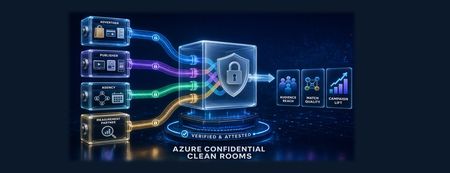
Why campaign performance now depends on trusted data collaboration For many years, third-party cookies helped advertisers, publishers, and measurement partners recognize users across parts of the open web. That model continues to evolve as browsers and mobile platforms introduce stronger privacy protections and limit access to certain cross-site and device-level identifiers. As a result, some advertisers and publishers are placing greater emphasis on the first-party data they collect directly to support audience activation and campaign measurement. Advertising partnerships may involve identifiers and behavioral data covered by privacy, data-protection, or industry rules. Data that has been altered to reduce direct identification—such as hashed email addresses or advertising identifiers—may still be linked to individuals and should not automatically be considered anonymous. Depending on the law and context, it may be treated as personally identifiable information (PII) or personal data under the European Union’s General Data Protection Regulation (GDPR). Organizations must have an appropriate legal basis and a clear purpose for using such data. The European Union’s Digital Markets Act (DMA) also affects how designated digital platforms combine certain personal data across services. In the United States, health information held by organizations covered by the Health Insurance Portability and Accountability Act (HIPAA) may be subject to additional restrictions, including for some marketing uses. The requirements for each collaboration depend on the parties, data, purpose, consent or authorization, and jurisdiction. Together, these changes create a practical challenge: campaign analysis increasingly depends on combining detailed records held by different organizations, but privacy, security, and governance obligations make unrestricted exchange of customer-level data difficult. Advertisers and publishers therefore need a controlled way to match audiences and measure outcomes using only authorized data—without exposing or freely sharing the underlying records. Azure Confidential Clean Rooms is designed to address this challenge. It allows each party’s detailed data to be used for an agreed analysis while helping protect raw data from access by other participants. This provides a controlled, verifiable environment for audience matching and campaign measurement without unrestricted file sharing. What campaign leaders should look for: the potential to broaden addressable audiences, strengthen evidence of campaign lift, reduce operational risk, and establish a repeatable model for trusted collaboration across media and measurement partners. Campaign decisions with secure multiparty analytics Azure Confidential Clean Rooms is a fully managed service that enables advertisers, publishers, agencies, and measurement partners to analyze sensitive datasets together while helping protect each participant’s raw data. The current preview supports analytics through Spark SQL queries agreed by the participants. These queries run in a hardware-protected environment called a Trusted Execution Environment (TEE), helping protect participants’ raw data from other collaborators and the Azure operator throughout its lifecycle. For a deeper explanation of the technology and architecture, see our earlier blog, Preview of multiparty analytics with Azure Confidential Clean Rooms. The following scenarios show how this model supports specific campaign decisions: Audience activation — Which high-value customers might this media partner reach? The advertiser contributes first-party customer data, such as securely transformed contact details, postal addresses, loyalty IDs, and purchase history. The publisher contributes its audience-matching data, on-site behavior, and consented interest or demographic segments. Azure Confidential Clean Rooms can compare identifiers that the participants have agreed to use for matching and release a reachable audience segment without exposing the underlying records. Campaign leaders can use the result to estimate potential reach and direct investment toward more relevant audiences. Identity enrichment — Can we improve match quality while protecting partner data? An agency or identity partner can contribute a third dataset to connect approved identifiers across email, mobile advertising IDs, devices, or households and add consented demographic or business attributes. Because the matching happens inside the confidential clean room, participants may improve match rates without exposing the identity partner’s underlying data or copying another party’s identifiers. Stronger matching can help expand reach and reduce media waste caused by fragmented customer identities. Measurement and attribution — Did the campaign contribute to additional business outcomes? The publisher contributes ad-exposure records, while the advertiser contributes outcomes such as purchases, order values, subscriptions, or app installs. Comparing these approved datasets can help measure unique reach and frequency, results across publishers, and the difference between groups that were and were not exposed to the campaign. For example, a retailer and a streaming publisher can compare exposure data with purchase outcomes to estimate campaign lift without revealing who saw a specific ad or made a purchase. This can give campaign leaders stronger evidence for campaign optimization and future budget allocation. These scenarios can help campaign leaders assess whether secure data collaboration may improve audience reach, matching quality, or confidence in campaign measurement. Why campaign leaders should consider Azure Confidential Clean Rooms The collaboration model is designed to give each participant greater control over how its data is accessed, used, and shared. Four capabilities are central to building trust among advertisers, publishers, agencies, and measurement partners: No centralized data pooling — Collaborators can keep source datasets in their own storage instead of copying them into a shared, permanent repository. The confidential environment verifies that expected code is running before it securely retrieves authorized data for temporary processing. This can reduce unnecessary data movement and exposure while supporting an approved analysis across partners. Controlled release of approved results — Before analysis begins, collaborators can agree which data may be used, approve the analysis, and specify who may receive the results. Safeguards can also prevent results for very small groups from being released, helping reduce the risk of identifying an individual. Verifiable governance and tamper-resistant audit trails — Participants can verify key properties of the environment instead of relying only on the clean-room provider’s claims. Open-source components and hardware-backed verification help participants confirm that the expected Microsoft-provided code is running. Tamper-resistant audit trails generated in the confidential environment can support compliance reviews. Data protection throughout the process — Each party can encrypt its data before it leaves its environment. Participants allow access to encryption keys only after the confidential environment verifies that expected code is running. Try Azure Confidential Clean Rooms Consider a campaign where better partner data could help improve audience reach, matching quality, or measurement confidence. Sign up to participate in a preview of multiparty analytics with Azure Confidential Clean Rooms. The Microsoft team will contact you to discuss the campaign scenario, participating datasets, and governance requirements. Learn more Sign-up: Preview of multiparty analytics with Azure Confidential Clean Rooms Preview blog: Multiparty analytics with Azure Confidential Clean Rooms Azure documentation: Confidential Clean RoomsPreview of multiparty analytics with Azure Confidential Clean Rooms
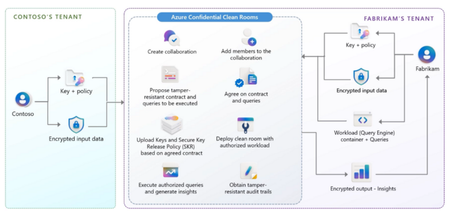
Today, we are excited to announce the preview of multiparty analytics feature of Azure Confidential Clean Rooms, a fully managed service that allows customers and their partners to securely analyze privacy-sensitive datasets from multiple parties. It uses confidential compute enabled Apache Spark-based big-data analytics (Spark SQL) which helps protect their raw data from other collaborators and from the Azure operator by performing computations in a Trusted Execution Environment (TEE). Privacy-sensitive datasets include personally identifiable information (PII), protected health information (PHI) and cryptographic secrets. Organizations across industries are increasingly looking to supplement their data with data from business partners, to build a complete view of their business. For example, brands, publishers, and their partners need to collaborate using datasets containing Intellectual Property (IP) to improve the relevance of their campaigns. Confidential data clean rooms help solve this challenge by enabling organizations to share and analyze granular datasets in a secure environment that helps prevent raw data exfiltration—protecting intellectual property, preserving customer privacy, and addressing concerns around regulatory compliance. You can sign up for the preview here Key Features Fully Managed: Azure takes care of the infrastructure provisioning and scaling with no user intervention. This significantly reduces your onboarding effort allowing you to focus on the queries and insights, not on infra management. Confidential Spark SQL: Spark SQL allows you to query large datasets and run complex queries in a distributed computing environment. In the confidential computing enabled version, the Spark driver and executors are fully attested policy-governed enclaves running as virtual nodes on confidential Azure Container Instances (ACI) which helps prevent exfiltration of collaborators’ data during query execution. Governance: Helps manage membership to cleanrooms, enables and verifies approval for queries from relevant collaborators before executing them and verifies consent to access sensitive collaborator data. It also helps generate tamper-resistant audit trails containing salient clean room events. This is made possible with the help of an implementation of the Confidential Consortium Framework (CCF). Telemetry: Throughout every clean-room run, detailed logs are streamed out in real time to monitor performance, troubleshoot issues, and keep the analytics healthy — all without ever exposing the collaborators’ data at any time. Verifiable trust: Cryptographic remote attestation viz. full attestation based on confidential hardware reports allows independent verification of the TEE along with along with all components that are part of it, without just trusting the cloud provider, before sensitive data and decryption keys are made available to the TEE Open-source containers: All Microsoft provided cleanroom containers and sidecars are open-sourced here and can be verified for provenance and integrity guarantees using GitHub artifact attestation Use Cases Multi-party confidential big-data analytics unlocks value in scenarios where data sensitivity, regulatory pressure, or competitive concerns previously blocked collaboration. These are some early scenarios that can benefit from this. Media & Advertising Collaboration of advertiser CRM data with publisher data for audience targeting and segment activation. Collaboration of audience data with measurement partners for measurement and attribution. Banking & Finance Collaboration between banks and insurance firms to upsell relevant products to existing bank customers without sharing raw data from either side Collaboration with retailers to generate customized offers for bank customers, without exposing either party’s underlying data. Government & Public Sector Secure collaboration of data across government departments to deliver better citizen welfare outcomes. Secure collaboration between government and private enterprises on shared-interest workloads such as traffic monitoring and weather systems. Healthcare Enable healthcare firms — including biopharma organizations — to combine their data with third-party institutions to accelerate clinical development, like identifying eligible participants for a clinical trial, without exposing underlying patient data. Combine patient datasets across hospitals to study disease patterns or outcomes without exposing sensitive protected health information. "A higher standard for protecting user privacy and trust, the phase-out of third-party cookies, and global regulations demand more sophisticated data collaboration tools to support advertising marketplaces. Azure Confidential Cleanrooms (ACCR) provides a secure, feature-rich, and flexible foundation to implement privacy-preserving functions and enable insights without sharing privacy-sensitive data outside of organization boundaries. Built on the Azure Confidential Compute (ACC) platform and offering cohesion with Azure's diverse set of services, ACCR offers the attestation, audit, fine-grained access control, and verifiable trust tools required for secure and privacy-safe data collaboration in today's world." — Andrei Mackenzie, Engineering Manager, Microsoft AI "Azure Confidential Clean Rooms enabled our team to evaluate how clean room capabilities can support secure, governed data collaboration at scale. Through the Proof-of-Concept (PoC), we explored how privacy-preserving workflows, trusted access controls, and scalable compute can create a stronger foundation for responsibly leveraging first-party data. This helps reduce operational friction while supporting business growth, improving customer engagement, and enabling more relevant customer experiences." — Nic Dregne, Director, Microsoft AdTech Engineering Beyond Spark SQL Realizing other multi-party scenarios like custom analytics, ML training and inferencing on Azure Confidential Clean Rooms is in our roadmap. If you have such a scenario to be realized, you can fill in and submit the preview signup form with the details of your scenario and we’ll get back to you. Learn More · Signup for the preview of Azure Confidential Clean Rooms for Analytics · Confidential Consortium Framework (CCF) · Virtual Nodes on Azure Container Instances
Data Driven Analytics for Responsible Business Solutions, learning how to work with Power BI
Introduction In this blog post, we will be showcasing the project that we have worked on for the last couple of weeks. Here, we analysed a dataset using Power BI and its machine learning capabilities. For this, we were given the fictitious case of VenturaGear. The company was faced with the challenge of new competition, and it was our job to provide a data-driven insight into customer behaviour, feedback, and preferences. The objective was to support more effective customer targeting by identifying patterns and segments that could inform strategic decision-making, while ensuring ethical and responsible use of data. Before we jump into the course and our final results, we would like to introduce ourselves and the roles we had. Product Owner: Kylie Eggen Hello everyone! My name is Kylie, and I'm currently busy finishing my Master Responsible Digitalisation. During the DARBS course, I had the role of the product owner. This allowed me to develop a deeper understanding of both data analysis and the ethics of handling sensitive data. The course provides you with skills that could be useful in your future career, which is very nice. I liked the learning experience a lot and will definitely use it in the future! Kylie Eggen | LinkedIn Data Analyst: Ha Nguyen I am currently in the final stage of my Master’s degree in Responsible Digitalisation, focusing on the ethical and strategic use of data-driven technologies. With five years of experience using Excel for data analysis, I have developed a strong foundation in data handling and visualisation. This course allows me to expand my skills by learning to create interactive dashboards and generate actionable insights using Power BI. These competencies strengthen my ability to support responsible, data-driven decision-making in my future professional career. Ha Nguyen | LinkedIn Data Analyst: Rianne van Ee Hello! My name is Rianne, and I am currently in the process of completing my Master’s degree in Responsible Digitalisation. I chose this specialisation because I am very interested in new technologies and different perspectives. I am very interested in data analysis and learning about new software, so the DARBS course was very interesting to me. I am excited to apply my new skills in a professional environment. Rianne van Ee | LinkedIn Data Visualisation Consultant: Aya Torqui Hello! My name is Aya Torqui, and I am a Master’s student in Responsible Digitalisation at Radboud University. One of the reasons I chose this specialisation is my strong interest in how companies transform raw and sometimes ambiguous data into valuable business decisions. The DARBS course, therefore, provided the perfect opportunity for me to gain new and deeper insights into this process. In my role as a Data Visualisation Consultant, I developed new skills not only in designing visually attractive and interesting dashboards, but also in communicating a meaningful and coherent story through them. I am grateful for the opportunity to have developed these skills during the course, and I look forward to further broadening and strengthening them in my future career. Aya Torqui | LinkedIn Data Visualisation Consultant: Ting Yu Hi! My name is Ting Yu. I am currently a Master’s student of Civil Law and Responsible Digitalisation. I found the DARBS course quite interesting, and it was a whole new experience for me, because I learned that numbers are not boring. With a dashboard, it is possible to tell a story and help organisations. What I also really liked about this course was the creative side. Not only was it fun to play around with different charts and colour schemes for the dashboard, but also the video we had to make! I am curious to see what the future possibilities are. Ting Yu | LinkedIn Project Overview The goal of this project was to provide data-driven managerial recommendations to the fictitious company, VenturaGear. Eventually, it was our task to deliver a final report and a video blog in which we discussed their data and gave them recommendations on how to improve. Our focus was on supporting more effective customer targeting by identifying patterns and segments that could inform strategic decision-making. During the process, one of our main goals was to keep the data analysis responsible and ethical. Project Journey The course followed a nice structure, allowing us to learn about PowerBi gradually and expand our skills and knowledge over a couple of weeks. We started off by completing lab work. Every week we completed several online courses, and spent one lecture applying the knowledge from these courses in a lab work assignment. After a few weeks, we applied our knowledge in a milestone assignment. This was the first time we really applied our newfound skills in a practical manner. This was a really nice opportunity to see whether we could actually apply what we learned. This also came with a machine learning aspect. Even though we had a short introduction to the topic in class, none of us had worked with machine learning before. We were able to apply the knowledge we gathered about learning how to use a new system, like Power BI, on another system, in this case, machine learning. While we really struggled here at the start, after some time we figured it out and were able to work with the technology. This milestone assignment was the perfect preparation for the actual final assignment, which also had this machine learning aspect. We now knew where to start, what data to include, etc. We now also knew what to consider when looking at the ethical side of things. Like what information needs to be anonymised, or left out completely. Eventually, all our newfound knowledge was combined into making the final assignment and video blog. Technical Details Microsoft Power BI served as the main analytical environment throughout the project. We began by importing multiple CSV datasets into Power BI and preparing the data using Power Query. This involved cleaning duplicate records, correcting formatting inconsistencies, and transforming variables to ensure accurate calculations and reliable analysis. We then created a relational data model connecting key tables such as sales transactions, product information, customer behaviour, and sales reasons. Establishing these relationships allowed us to analyse data across multiple dimensions and generate deeper insights into customer activity and online purchasing patterns. Interactive dashboards were developed using Power BI’s visualisation tools, accessible colour themes, and slicers, allowing users to explore insights dynamically. Rather than presenting static results, the dashboard encouraged managers to interact with the data and investigate patterns independently. In addition to descriptive analytics, we applied a machine learning model (XGBoost) to identify factors influencing the sales of the top revenue-generating products. This introduced us to predictive analytics and highlighted the importance of feature selection, handling missing values, and critically interpreting model outputs. Combining visualisation with machine learning enabled us to move beyond reporting toward data-driven decision support. Results and Outcomes Before we could analyse our data, we ran into a few problems. Firstly, our unit prices seemed to be inflated in the dataset. The decimal was removed, leading to unreasonably high prices. To solve this, we recalculated the LineTotal, using the formula that can be seen below. Another problem we ran into was that we seemed to have a lot of missing data. We noticed this while looking at the sales reasons. A third of the data ended up blank. We ended up excluding the blank values, so that we were still able to analyse the remaining data. To really effectively target customers, we felt it was important to analyse the reasons people made their purchases. Through our analysis, we found that for VentureGear, the biggest contributor was price. We found that VenturaGear mainly made its sales in Australia. Lesson Learned Working with new systems The main lesson that we learned is how to start using a new system. The way in which we were taught how to use Power BI showed us a nice way of approaching new things. We believe this can be useful in other areas of our professional lives. 2. Data analysis Most of us were a little intimidated when we first heard that we were going to be analysing data through a new program. However, once we started, we noticed that when we all put our minds to it, it is quite manageable. We have all gained some understanding of data analysis and how to visualise this. 3. Teamwork A big factor during this project was teamwork. Our team was divided up into different roles. That meant that there was teamwork between the two data analysts and data visualisation consultants, but also between different roles. We found it to be really important to have teamwork between all these actors. We noticed that the further we got into the project, the smoother this interaction went. Collaboration and Teamwork On this project, we worked as a team. Our team consists of five people. Kylie Eggen was the Product Owner. Her role was to take care of the overview of the project. Ha Nguyen and Rianne van Ee were the Data Analysts for this project. Aya Torqui and Ting Yu were the Data Visualisation Consultants. We mostly stuck to our roles, but noticed that everything needed to happen in collaboration. So even though we were all mainly busy with our own roles, we were all involved in each other as well. We noticed this really helped in making the project a coherent whole. Future Development While this project generated valuable insights, there are several opportunities for further development. A potential next step would be integrating real-time data into Power BI. Expanding the dashboard with automated data refresh will allow managers to track performance continuously and respond more quickly to changing customer behaviour. Another area for future development involves extending the machine learning component. Rather than focusing only on identifying predictors of key revenue-generating products, the model could be expanded to include customer segmentation, such as grouping customers into categories like high-value customers, discount-sensitive buyers, or frequent online shoppers. In addition, the model could be developed further to support purchase prediction, enabling forecasts of seasonal demand, identifying customers likely to make repeat purchases, and determining which products are most preferred by specific customer groups. These enhancements would provide a more dynamic understanding of customer behaviour and support more targeted, data-driven decision-making. Incorporating more complete behavioural data or improving survey participation rates would also help reduce missing values and increase the reliability of insights. And finally, for future research, the organisation could consider introducing clear consent options on the web shop to help customers better understand what data is being collected. These options would also allow customers to choose what information they want to share, improving transparency and strengthening customer trust. Conclusion This project allowed us to learn how data analytics can help organisations make smarter and more responsible business decisions. Using Power BI, we transformed complex customer and sales data into clear, interactive insights that help managers better understand online behaviour, purchasing motivations, and performance trends. Beyond building technical skills, we also learned how important data quality, transparency, and ethical considerations are when working with sensitive customer data. Throughout the project, we discovered that data analysis is an iterative process that requires continuous evaluation, critical thinking, and careful interpretation of results. Most importantly, we realised that meaningful analytics is never an individual effort but a collaborative process, where teamwork and shared problem-solving play a key role in turning data into valuable insights. Overall, this project strengthened our ability to bridge technical analytics with responsible digitalisation principles. By combining business understanding, visualisation skills, and ethical awareness, we gained a clearer perspective on how tools like Power BI can enable professionals to create meaningful, data-driven solutions that are both impactful and responsible. Call to Action After experiencing this learning journey, we encourage you to engage with tools such as Power BI. As our teacher told us, ‘‘You are going to hit a wall.’’ That is exactly what happened to us, but pushing through those moments allowed us to create a deeper understanding and develop new skills. At the same time, we tried to stay aware of the ethical implications of working with data. During the project, we always ensured to stay transparent and responsible in our analysis. We encourage you to challenge yourself! Experiment with new technologies and step outside of your comfort zone. What we also think you should remember is that a strong analysis is not only dependent on technical skills, but it is also about staying transparent, responsible, and trustworthy. On behalf of group 3, thank you for taking the time to read our summary. Wehope it has been useful. Feel free to reach out for any remaining questions! 274Views1like0Comments
Confidential agentic AI on Azure helps ServiceNow respond to sales commission inquiries in seconds
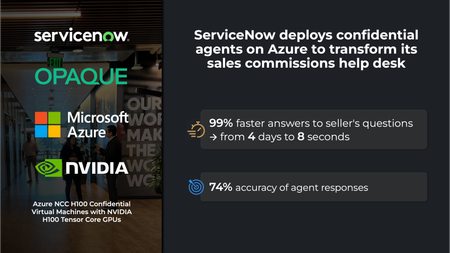
Introduction AI is transforming how businesses operate and innovate, unlocking opportunities across industries to pioneer new business models, solve previously intractable challenges, and create breakthrough experiences. ServiceNow is at the forefront, deploying powerful, confidential AI agents leveraging confidential computing. Their sales commission help desk faced mounting challenges, supporting their sales force. With thousands of commission inquiries annually requiring access to sales compensation plan information, the help desk needed a solution to accelerate response times while maintaining strict data privacy and security standards. Applications ServiceNow Digital Technology leverages cutting-edge AI to streamline business operations, increase operational efficacy, and enhance employee experiences. The sales commission help desk handles inquiries ranging from policy questions to payout explanations, requiring aggregation and analysis of sensitive data from multiple systems. The manual process of responding to these inquiries—which involves gathering, anonymizing, and analyzing sensitive employee data, sales quotas, and commission structures—created bottlenecks, with resolution times stretching to days for the most complex cases. Use Cases To address ongoing commission management challenges, ServiceNow’s Digital Technology team partnered with Opaque Systems and Azure confidential computing team to design, build, and implement Confidential Agents that enable secure, autonomous AI systems with cryptographic privacy guarantees and auditability. The solution provides their help desk team with instantaneous access to encrypted personal commission data across multiple systems, while AI agents automatically analyze requests and generate custom responses. By integrating securely with various data sources, the system maintains strict privacy controls and compliance while delivering rapid, trusted insights. Every action taken by the AI agents is cryptographically verified, creating an immutable record of data access and usage. This generates detailed audit trails that meet compliance and strengthen governance protocols. Through hardware-based encryption on Azure NCCads H100 v5 confidential virtual machines augmented by NVIDIA H100 Tensor Core GPUs for accelerated computing running on their Microsoft Azure subscription service, the services built by ServiceNow can now harness the full power of AI technology without compromising on capabilities. Opaque’s Confidential AI Platform unlocks new performance potential of AI models that demand high-performing computational resources for all the commission requests, while maintaining robust protection of compensation data, setting a new standard for secure, efficient commission management. Accelerate, Reclaim, and Save Opaque's Confidential AI Agents architecture was uniquely built with NVIDIA H100s to help ServiceNow’s transformation. Once AI agents are connected to sensitive data, every aspect of agent operation maintains verifiable privacy and security, including real-time attestation that verifies agent authenticity and integrity, comprehensive audit trails of all agent actions and data interactions, cryptographic enforcement of data access and usage policies, and protection of valuable agent models and intellectual property. This combination of autonomous capability and verifiable privacy and security makes it ideal for ServiceNow to leverage for sensitive sales commission data while maintaining the highest standards of privacy and trust. The implementation of Opaque's Confidential AI Agents delivered strong results across ServiceNow's sales operations. Average response times decreased from 4 days to just 8 seconds, dramatically improving service delivery. Sellers can find quick summaries of Sales Success Center material and links to learn more. They also reported a 74% accuracy rate of agent responses, demonstrating high relevancy. Beyond operational improvements, ServiceNow improved operating costs while simultaneously strengthening their security posture through confidential computing. Most importantly, this has freed up the help desk team to focus on more strategic, high-value work while delivering faster, more accurate support to the sales force, creating a virtuous cycle of improved efficiency and satisfaction. Learn more Azure confidential VMs with NVIDIA H100 Tensor Core GPUs Azure confidential GPU Options Opaque’s Confidential AI Platform NVIDIA H100 Tensor Core GPUsPreview of Azure Confidential Clean Rooms for secure multiparty data collaboration
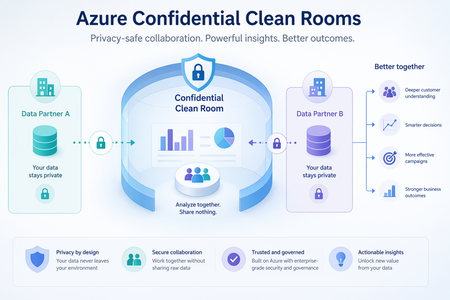
Today, we are excited to announce the preview of Azure Confidential Clean Rooms, a cutting-edge solution designed for organizations that require secure multi-party data collaboration. With Confidential Clean Rooms, you can share privacy sensitive data such as personally identifiable information (PII), protected health information (PHI) and cryptographic secrets confidently, thanks to robust trust guarantees that help ensure that your data remains protected throughout its lifecycle from other collaborators and from Azure operators. This secure data sharing is powered by confidential computing, which helps protect data in-use by performing computations in hardware-based, attested Trusted Execution Environments (TEEs). These TEEs help prevent unauthorized access or modification of application code and data during use. Organizations across industries need to perform multi-party data collaboration with business partners, outside organizations, and even within company silos to improve business outcomes and bolster innovation. Confidential Clean Rooms help derive true value from such collaborations by enabling granular and private data to be shared while providing safeguards on data exfiltration hence protecting the intellectual property of the organization and the privacy of its customers and addressing concerns around regulatory compliance. Whether you’re a data scientist looking to securely fine-tune your ML model with sensitive data from other organizations, or a data analyst wanting to perform secure analytics on joint data with your partner organizations, Confidential Clean Rooms will help you achieve the desired results. You can sign up for the preview here Key Features Secure Collaboration and Governance: Allows collaborators to create tamper-resistant contracts that contain the constraints which will be enforced by the clean room. Governance verifies validity of those constraints before allowing data to be released into clean rooms and helps generate tamper-resistant audit trails. This is made possible with the help of an implementation of the Confidential Consortium Framework CCF). Enhanced Data Privacy: Provides a sandboxed execution environment which allows only authorized workloads to execute and prevents any unauthorized network or IO operations from within the clean room. This helps keep your data secure throughout the workload execution. This is possible with the help of deploying clean rooms in confidential containers on Azure Container Instances (ACI) which provides container group level integrity with runtime enforcement of the same. Verifiable trust at each step with the help of cryptographic remote attestation forms the cornerstone of Confidential Clean Rooms. Salient Use Cases Azure Confidential Clean Rooms caters to use cases spanning multiple industries. Healthcare: For fine-tuning and inferencing with predictive healthcare machine-learning (ML) models and for joint data analysis for advancing pharmaceutical research. This can help protect the privacy of patients and intellectual property of organizations while demonstrating regulatory compliance. Finance: For financial fraud detection through analysis of combined data across banks and other financial institutions and for providing personalized offers to customers through secure analysis of transaction data and purchase data in retail outlets Media and Advertising: For improving marketing campaign effectiveness by combining data across advertisers, ad-techs, publishers and measurement firms for audience targeting and attribution and measurement Retail: For enhanced personalized marketing and improved inventory and supply chain management Government and Public Sector Organizations: For analysis of high security data across multiple government and public sector organizations to streamline benefits for citizens Customer Testimonials We are already partnering with several organizations to accelerate their secure multi-party collaboration journey with confidential clean rooms. Confidential computing in healthcare allows secure data processing within isolated environments, called 'clean rooms', protecting sensitive patient data during AI model development, validation and deployment. Apollo Hospitals uses Azure Confidential Clean Rooms to enhance data privacy, encrypt data, and securely train AI models. The benefits include secure collaboration, anonymized patient privacy, intellectual property protection, and enhanced cybersecurity. Apollo’s pilot with Confidential Clean Rooms showed promising results, and future efforts aim to scale secure AI solutions, ensuring patient safety, privacy, and compliance as the healthcare industry advances technologically. - Dr. Sujoy Kar, Chief Medical Information Officer and Vice President, Apollo Hospitals Azure Confidential Clean Rooms is a game changer to make collaborations on sensitive data both seamless and secure. When combined with Sarus, any data processing job is automatically analyzed using the most advanced privacy technology. Once validated, they are processed securely in Confidential Clean Rooms protecting both the privacy of data and the confidentiality of the analysis itself. This eliminates administrative overheads and makes it very easy to build advanced data processing pipelines. With our partner EY, we're already leveraging it to help international banks improve AML practices without compromising privacy. - Maxime Agostini, CEO & Cofounder of Sarus Read here to learn more about how Sarus is using Confidential Clean Rooms. As co-leaders on this Data Consortium Pilot, we are thrilled to be working with industry partners, Sarus and Microsoft, to drive this initiative forward. By combining Sarus’ privacy preserving technologies and Microsoft’s Azure Confidential Clean Rooms, not only does this project push the edge of technology innovation, but it strives to address a pivotal issue that affects us as Canadians. Through this work, we aim to help financial services organizations and regulators navigate the complexities of private and personal data sharing, without compromising the integrity of the data, and adhering to all relevant privacy regulations. For the purposes of this pilot, we are focusing our efforts on how this technology can play a pivotal role in helping better detect cases of human trafficking, however, we recognize that it can be used to help organizations for multiple other use cases, and cross industries, including health care and government & public sector. - Jessica Hansen, Privacy Partner EY Canada, and Dana Ohab, AI & Data Partner EY Canada Retrieval-Augmented Generation (RAG) applications accessing Large Language Models (LLMs) are common in private AI workflows, but managing secure access to sensitive data can be complex. SafeLiShare’s integration of its LLM Secure Data Proxy (SDP) with Azure Confidential Clean Rooms (ACCR) simplifies access control and token management. The joint solution helps ensure runtime security through advanced Public Key Infrastructure (PKI) and centralized policy management in Trusted Execution Environments (TEEs), enforcing strict access policies and admission controls to guarantee authorized access to sensitive data. This integration establishes trust bindings between the Identity Provider (IDP), applications, and data, safeguarding each layer without compromise. It also enables secure creation, sharing, and management of applications and data assets, ensuring compliance in high-performance AI environments. - Cynthia Hsieh, VP of Marketing, SafeLiShare Read here to learn more about how SafeLiShare is using Confidential Clean Rooms. Learn More Signup for the preview of Azure Confidential Clean Rooms Confidential Consortium Framework (CCF) Confidential containers on Azure Container Instances (ACI)Advanced Time Series Anomaly Detector in Fabric
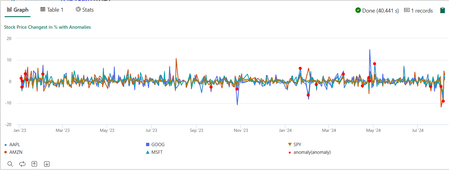
Anomaly Detector, one of Azure AI services, enables you to monitor and detect anomalies in your time series data. This service is being retired by October 2026, and as part of the migration process the anomaly detection algorithms were open sourced and published by a new Python package and we offer a time series anomaly detection workflow in Microsoft Fabric data platform.3.2KViews2likes0CommentsTraining a Time-Series Forecasting Model Using Automated Machine Learning
Imagine having the power to predict the unpredictable, to foresee the future of your business, your health, or your environment. What if you could unlock the secrets of time itself? Welcome to the world of time-series forecasting, where machine learning meets magic. Join us to discover how Automated Machine Learning can revolutionize your understanding of the future and uncover the hidden patterns that shape our world. Read on to unlock the secrets of time, and unleash the power of prediction.9.7KViews0likes0CommentsData-driven Analytics for Responsible Business Solutions, a Power BI introduction course:
Want to gain inside on how students at Radboud University are introduced, in a praticle manner, to Power BI? Check out our learning process and final project. For a summary of our final solution watch our Video Blog and stick around till the end for some "wise words"!2.6KViews0likes1Comment