microsoft 365 defender
111 Topics
How to exclude Blocked sender's form End user quarantine notification/Digest
@All We have end user notification policy in place. Whenever user blocks a sender from Quarantine notification/Digest and next day if we receive email from same sender, it's in quarantine then again quarantine notification/digest will say same stating email from xyz is in quarantine eventhought it was blocked yesterday by same user. This seems to be by design: https://learn.microsoft.com/en-us/microsoft-365/security/office-365-security/quarantine-quarantine-notifications?view=o365-worldwide As article say to create a Transport Rule. I created one with Condition as header matches following keywords or phrases Header x-forefrontAntispamreport & Value = SFV:SKN. How this not work, I am not sure if transport rule does not accept this header feild( Because some rule works when I say header = From) or its something to do with priority. Oall am trying to achieve here is once sender is blocked by user in Enduser quarantine notification then onwards that sender should not be shown again in notification. I think we need to some how delete/emails from blocked senders in quarantine However i only can think of transport rule as of now but that's not working. Any suggestions/thoughts are appreciated, Thank you.3.1KViews4likes2Comments
Enable per‑user language selection for phishing simulation emails and landing pages
We use Attack Simulation Training to deliver phishing simulations to a global, multilingual user base. While Microsoft Defender supports multi‑language content, phishing simulation emails and landing pages are currently delivered in a single selected language per campaign. We are requesting a feature that allows phishing simulation emails and associated landing pages (including credential‑harvest pages) to automatically render in each user’s preferred language, based on: Outlook mailbox language settings, and/or Microsoft Entra ID user language preferences This capability would: Improve realism and accuracy of phishing simulations Ensure users experience simulations in the same language they normally work in Improve behavioral measurement in global organizations Reduce the need to create and manage multiple parallel simulations by language Providing consistent, per‑user language alignment across simulation emails, landing pages, and follow‑up training would significantly enhance the effectiveness of Attack Simulation Training for large, multilingual enterprises.190Views2likes2Comments
No way to automate restoring user‑reported emails after “no threats found”
When a user reports an email as phishing in Defender, the message gets moved to Deleted Items. After we triage it, if we mark it as “no threats found,” there’s no way to push it back to the user’s inbox as part of that workflow. That creates a bit of a broken experience: User is told the email is safe with our customized email response, but has to go find it themselves In a lot of cases they don’t (Outlook search won’t find it) We end up with follow‑ups like “where did it go?” Technically we could restore the email as part of our triage process, but that just shifts the effort onto the SOC. It doesn’t scale, and it’s not really the right place for that work. We have tried to create an automation to do this, but we have not been able to create an advanced hunting query based on our triage result that can then trigger an action to restore it to the mailbox. So we end up choosing between: Users having a bad experience, or Analysts doing manual mailbox work Neither is ideal. Other platforms (like Proofpoint) handle this end‑to‑end — once something is confirmed clean, it can be returned to the user automatically. Right now Defender stops at classification instead of completing the workflow. Is there a reason this isn’t wired in, or anything on the roadmap to address it?
All Excel Macro Files Suddenly Flagged as Malware (X97M/Slacker.gen!A) Across M365 Starting April 16
Starting around 8 PM GMT+8 on April 16, 2025, macro-enabled Excel files with extensions such as .xlsm, .xlsb, or .xls began being automatically flagged as malware, specifically identified as X97M/Slacker.gen!A—when opened or edited in SharePoint, OneDrive, or Teams. Before this, the same files were not flagged as malicious, even when opened or edited, and this behavior had remained consistent for several months. This issue affects our entire tenant, with over 800 files being flagged as malware under the name X97M/Slacker.gen!A. These files are located across various locations and have been modified by different users. We are a Cloud-only tenant, and we have not done any configuration changes in Threat Policies for the past few months.1.7KViews1like0Comments
Automated Investigation and Response
Upgraded to Defender for 365 P2 based on the idea of setting automated responses to certain alerts. That's how it was described. Now I'm trying to enable and configure it. The documentation has bounced me around 20 different articles for XDR, Defender Enterprise, Defender for Business... I do not see anywhere to configure the automation in Defender. One doc points me here for making sure it's enabled. when I open this, and go down to Automation, it's simply an empty list of device groups. We don't use Device groups - we don't use Defender Endpoint. Has anyone configured this in a non-XDR environment? What I'm encountering and what was advertised seem very different...Setting up Admin Quarantine
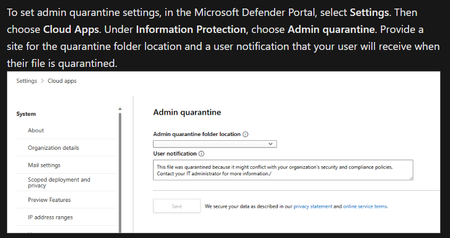
Hi, We are looking to set up admin quarantine as per the instructions in here: https://learn.microsoft.com/en-us/defender-cloud-apps/use-case-admin-quarantine We have followed this step by setting up a location for admin quarantine: However, when editing the 'Malware Detection' rule in Defender we do not get an option for 'Put in admin quarantine', only 'Put in user quarantine': Does anyone have any idea how to resolve this? Thank you.
Anti-malware policy doesn't block files
Hello Microsoft Community, We have recently found that Anti-malware policy doesn't block files that are set to be blocked by the policy. For example, when we send an *.ics file with a cmd/exe/jse/rdp and other files inside of the ics, the email is not blocked and is delivered to users. We did several tests with external security vendor by sending real malwares, ransomwares and exploits attached to the ics and all of them passed the filtering system. Is anyone aware of the issue? Doesn't MDO scans nested files?! This has happened with a few tenants. Those tenants have Microsoft E5 licenses.
MS 365 Defender - What permissions are needed to move and delete emails in Explorer?
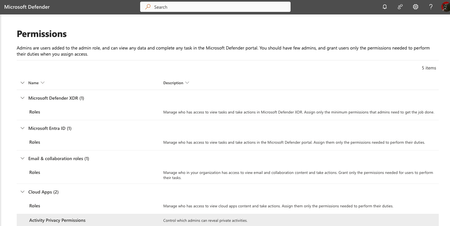
I need a tech with limited permissions to be able to https://learn.microsoft.com/en-us/defender-office-365/remediate-malicious-email-delivered-office-365 These are the options I have in Admin. I tried a bunch of recommended actions, yet I don't seem to have the correct Admin portals as shown https://learn.microsoft.com/en-us/defender-xdr/manage-rbac. For example, I don't have MS 365 Defender Permissions Group shown in the video:5.1KViews1like4CommentsClarification on Microsoft Teams Encryption: E2EE vs. Default Encryption
I’m seeking some clarity on the differences between the end-to-end encryption (E2EE) offered with the Teams Premium license and the default encryption for data at rest and in transit within Microsoft Teams. From what I understand, Teams data is already encrypted both in transit and at rest by default. However, I’m unsure how the E2EE provided under the Teams Premium license differs from this standard encryption. Could someone explain in simple terms the specific differences between these two encryption methods? I’m particularly interested in understanding how I can effectively communicate these differences to my clients, who may not be very technical but need to grasp the security advantages of the Premium license.Solved
URL clicks not being tracked
Hi, I have url rewrite and defender EDR in the environment. It seems like clicks are missing tracking information. Both in hunting queries and the actual url and domain page show no clicks and i know for a fact users clicked it. URL is external and it is rewritten, i checked in the email to confirm, i even clicked the url myself and nothing is tracked. Also how do you translate a rewritten url to url without clicking on it? Any suggestions?1.6KViews1like2Comments