isolation
1 TopicIntroducing Layered Ingress Sharding: Achieving Single-Tenant Isolation in Multi-Tenant Services
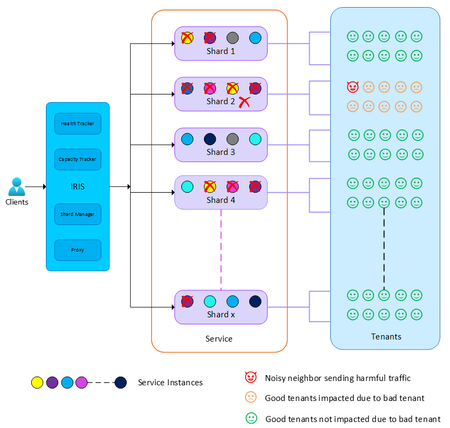
Abhishek Tiwari, Vice President of Engineering, Azure Networking Amit Srivastava, Partner Director of PM, Azure Networking Varun Chawla, Partner Director of Engineering, Azure Networking Links to the three-part AFD blog series: Part 1 Part 2 Part 3 Why Multi‑Tenant Isolation Is Still Hard at Hyperscale Modern cloud platforms thrive on multitenancy. By sharing infrastructure across tenants, services like Azure Front Door (AFD) can deliver massive scale, global reach, and cost efficiency. At hyperscale, however, this efficiency comes with a hard truth: rare failures are inevitable, and their blast radius matters more than their frequency. When hundreds of thousands of tenants share a global data plane, a single misbehaving tenant, configuration regression, or zero-day exploit can turn a low probability event into a high impact outage. Over the years, the industry has developed many protections — rate limiting, circuit breakers, fair share scheduling, crash protection, and various sharding strategies. These techniques dramatically reduce average case risk, but they still struggle to bound worst case impact. In particular, they fall short of delivering what customers intuitively expect: single tenant isolation semantics (the guarantee that one tenant’s failure does not affect another) without requiring dedicated per-tenant infrastructure. At Azure Front Door, we’ve been working on a new architectural approach that directly targets worst case blast radius. Today, I’m excited to introduce Layered Ingress Sharding, a sharding strategy designed to enable single tenant fault isolation for largescale multitenant services. From Traditional Sharding to Ingress Sharding Traditional partitioning assigns each tenant to a fixed shard. This limits blast radius, but tenants in the same shard can still experience complete outages when that shard fails. Shuffle sharding improves on this by assigning each tenant to a subset of instances, where subsets partially overlap, dramatically reducing the probability of widespread impact. However, shuffle sharding still allows 100% availability loss for tenants in the affected shard, relies heavily on client retries, and introduces nontrivial capacity loss in overlapping shards. To address these limitations, we introduced Ingress Sharding. With ingress sharding, an ingress controller, which we call IRIS (Intelligent Routing with Ingress Sharding), sits directly on the data path. Ingress sharding uses shuffle sharding to construct shards from service instances; IRIS operates on top of these shards to perform tenant-aware, capacity-aware routing rather than introducing a new shard construction algorithm. IRIS identifies the tenant for each incoming connection and deterministically maps that tenant to a shard. Instead of relying on clients to retry when a shard is unhealthy, IRIS actively: Monitors the health of service instances Tracks available capacity in real time Retries and reroutes traffic internally Steers traffic away from unhealthy or overloaded instances Dynamically expands the set of service instances used for oversized tenants when sustained load exceeds a single shard’s capacity In effect, IRIS turns shard selection into a real-time, capacity-aware decision that is reevaluated for every new connection. This moves fault resilience and load balancing inside the platform, rather than pushing that burden onto clients. Ingress sharding significantly improves isolation and resilience, but on its own, a tenant can still experience a complete loss of availability if all instances in its shard are affected. Introducing Layers: Isolation Through Independence Layered Sharding adds a new dimension to multitenant isolation. In Layered Sharding, the service is divided into multiple independent layers. A layer represents an independent serving dimension of the system capable of handling tenant traffic independently. This technique was developed to reduce blast radius by changing how tenants are assigned across shards, rather than changing the underlying shard construction within a single layer. A key design goal is that layered sharding is orthogonal to the underlying sharding strategy. It works with existing approaches, whether that is standard partitioning-based sharding, shuffle sharding, or other shard assignment schemes used within a layer. Within each layer: Service instances are grouped into shards using an existing sharding technique (for example, traditional partitioning or shuffle sharding) Each tenant is assigned to a shard independently in that layer Crucially, tenant-to-shard assignments are randomized and independent across layers. This independence is what gives layered sharding its isolation properties, regardless of the specific sharding algorithm used within a single layer. The definition of a layer itself is intentionally flexible and service dependent. In Azure Front Door, each server naturally acts as one layer. In other services, a layer might correspond to a cluster, a scale unit, a fault domain, or even a regional partition — any unit capable of serving tenant traffic independently while preserving uniform load distribution. The result is powerful: even if a tenant’s traffic causes failures in one shard in one layer, it is statistically unlikely that the same tenant will collide with the same peers across many layers. Instead of experiencing a full outage, other tenants see at most a small, transient reduction in capacity, often invisible with standard retry behavior. Layered sharding alone already reduces availability impact across tenants. But when combined with ingress sharding, it enables something fundamentally stronger. Layered Ingress Sharding Layered Ingress Sharding integrates two complementary ideas: Layered Sharding spreads tenants across many independent layers with randomized shard assignments. Ingress Sharding dynamically routes traffic to healthy service instances across layers using real‑time health and capacity signals. The key blast radius reduction that enables single tenant isolation comes from the combination of independent shard randomization across layers with active, intelligent traffic steering. When a tenant misbehaves due to harmful traffic, a bad configuration, or an unknown vulnerability, IRIS detects unhealthy service instances and automatically routes traffic to healthy shards in other layers. Because shard assignments are independent, IRIS can always find unaffected capacity for well-behaved tenants. The resulting behavior is a fundamental shift in multitenant failure dynamics: Outages remain localized to the misbehaving tenant Healthy tenants continue to serve traffic Blast radius shrinks from fleetwide to tenant-local In effect, a shared multi‑tenant system begins to behave like it has single tenant‑ isolation semantics, without abandoning multitenancy. Why the Math Works The guarantees behind layered ingress sharding are not heuristic, they’re statistical. Because tenant-to-shard assignments are randomized independently across layers, the probability that two tenants repeatedly collide in the same shard follows a binomial distribution. With production representative configurations, tens of layers and shuffle-sharded service instances, the probability that an arbitrary tenant experiences a user-visible failure due to another tenant drops below what standard client retries already mask. Instead of asking “Can a noisy neighbor impact me?”, the system answers “What is the probability that a single connection attempt is unlucky across all layers?” and that probability decreases exponentially as the number of layers increases. This allows us to trade catastrophic outages for rare, isolated, and standard retry-mitigated events. A Hidden Benefit: Identifying Bad Tenants Layered ingress sharding provides an additional, powerful side benefit: automated identification of misbehaving tenants. Because shard assignments are computed independently across layers, a tenant that is consistently responsible for failures appears as a common factor across impacted shards and service instances. By correlating signals across layers, the platform can accurately identify the offending tenant and apply targeted mitigations such as isolation, throttling, or traffic steering without relying on coarse-grained circuit breakers that penalize everyone. This dramatically improves response time under high load or adversarial conditions while preserving availability for unaffected tenants. Beyond Azure Front Door While Layered Ingress Sharding was developed in the context of Azure Front Door, the underlying principle is broadly applicable. Any large‑scale multi‑tenant system that: Serves many tenants from shared infrastructure Can distribute traffic uniformly across independent layers Can enforce shard-level isolation within each layer can benefit from this approach. Layers don’t have to be servers they could be clusters, scale units, or regional partitions. The key is independent assignment across layers combined with intelligent ingress routing. We believe this pattern represents a reusable architectural strategy for building resilient, hyperscale, multi‑tenant services. Closing Thoughts Multi‑tenancy doesn’t have to mean shared fate. Layered Ingress Sharding shows that by combining probabilistic isolation with intelligent ingress routing, we can build systems where failures are expected, bounded, and automatically contained, even at hyperscale. Rather than eliminating failure, this approach mathematically constrains its impact. And in large‑scale multi‑tenant platforms, that distinction makes all the difference.