iot
355 TopicsResource Guide: Making Physical AI Practical for Real‑World Industrial Operations
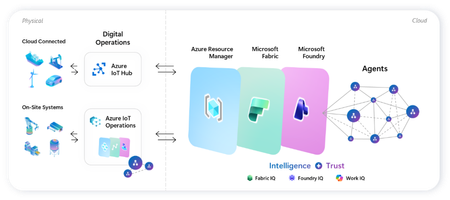
Microsoft's adaptive cloud approach brings cloud, edge, data, and AI together to help organizations turn operational technology (OT) data into intelligent action, without requiring everything to live in the cloud. At the center of this approach are key technologies that connect physical operations to cloud-scale data, analytics, and AI: Key Purpose Offering Direct-to-cloud device management + telemetry ingestion Azure IoT Hub Industrial connectivity + edge data plane Azure IoT Operations Unified analytics + real-time intelligence Microsoft Fabric On-device AI inferencing runtime Microsoft Foundry Industry recognition Microsoft named a Leader in the 2026 Gartner® Magic Quadrant™ for Global Industrial AIoT Platforms Read the announcement See it all come together Before diving into each component, watch this end-to-end demo showing how Azure IoT Operations, Azure IoT Hub, Microsoft Fabric, and Foundry Local work as one stack across the edge-to-cloud lifecycle - Making industrial AI practical for real-world operations with adaptive cloud. How these components work together Azure IoT Operations and Azure IoT Hub collect real-time data from operational assets and send semantically-ready, modeled data to Microsoft Fabric, where it's contextualized with enterprise data for downstream analytics. Microsoft Foundry extends to the edge through Foundry Local, so the same tooling used to deploy and manage AI models in the cloud applies to edge use cases. All of it integrates into Azure Resource Manager, bringing OT devices, assets, and edge AI models into the same management and security paradigm as every other Azure-managed resource. This blog walks through where to get started with each product capability: 1. Manage Cloud-Connected Devices and Telemetry with Azure IoT Hub Azure IoT Hub is a fully managed cloud service that enables secure bidirectional communication, device-to-cloud telemetry ingestion, cloud-to-device command execution, per-device authentication, remote management and more. Telemetry from IoT Hub can also be routed downstream into analytics platforms like Microsoft Fabric for visualization or AI modeling. Recommended Usage: Devices that utilize IoT Hub are distributed, stand-alone devices with fixed-functions. These devices typically do not require cloud-managed containerized workloads or cloud-managed proximal industrial protocol connectivity. Examples of appropriate device-to-cloud IoT Hub endpoint devices include water monitoring stations, vehicle telematics, distributed fluid level sensors, etc. Resources Current in-market services overview: IoT Hub: What is Azure IoT Hub? - Azure IoT Hub DPS: Overview of Azure IoT Hub Device Provisioning Service - Azure IoT Hub Device Provisioning Service ADU: Introduction to Device Update for Azure IoT Hub Building scalable solutions with Azure IoT platform: Best practices for large-scale IoT deployments - Azure IoT Hub Device Provisioning Service Scale Out an Azure IoT Hub-based Solution to Support Millions of Devices - Azure Architecture Center Azure IoT Hub scaling Try out our preview of new IoT Hub capabilities (integration with Azure Device Registry and Certificate Management) Learn more about these capabilities on our blog post: Azure IoT Hub + Azure Device Registry (Preview Refresh): Device Trust and Management at Fleet Scale… Integration with Azure Device Registry (preview): Integration with Azure Device Registry (preview) - Azure IoT Hub Microsoft-backed X.509 certificate management (preview): What is Microsoft-backed X.509 Certificate Management (Preview)? - Azure IoT Hub How to start with the preview: Deploy IoT Hub with ADR integration and certificate management (Preview) - Azure IoT Hub 2. Connect Industrial Assets with Azure IoT Operations Azure IoT Operations provides a unified data plane for the edge that runs on Azure Arc–enabled Kubernetes clusters and supports open industrial standards. It allows organizations to connect and capture equipment telemetry, normalize OT data locally, route hot-path signals to real-time analytics, securely manage layered industrial networks, and more. Edge‑processed data can then be sent upstream to Microsoft Fabric for AI‑driven analysis. Recommended Usage: Azure IoT Operations is intended to be the data plane for an adaptive cloud deployment extending the management, data, and AI capabilities of the Microsoft cloud to an on-prem device. This device binds to these cloud planes providing a platform for local data processing and intermittent connectivity. The target for these devices range from a small-gateway-style PC to a full data center. Azure IoT Operations endpoints enable cloud-managed containerized workloads and cloud-managed proximal industrial protocol connectivity. Examples of appropriate adaptive cloud and Azure IoT Operations endpoints include, on-robot computers, industrial machine controllers, retail store sensor/vision processing, and top-of-factory site infrastructure for line of business applications. Resources Azure IoT Operations Overview Azure IoT Operations Documentation Hub Releases · Azure/azure-iot-operations Quickstart: explore-iot-operations/quickstart at main · Azure-Samples/explore-iot-operations Latest release update: Open-source framework for scaling robotics from simulation to production on Azure + NVIDIA: microsoft/physical-ai-toolchain Demo video showcasing this in action: Making industrial AI practical for real-world operations with adaptive cloud How we built the demo: explore-iot-operations/quickstart at main · Azure-Samples/explore-iot-operations Edge-AI: microsoft/edge-ai: Production-ready Infrastructure as Code, applications, pluggable components, and… Latest Announcements & Blogs Making Physical AI Practical for Real-World Industrial Operations: Part 1 | Microsoft Community Hub Making Physical AI Practical for Real-World Industrial Operations: Part 2 | Microsoft Community Hub Introducing small form factor infrastructure: embed intelligence into physical systems Unlock Industrial Intelligence | Microsoft Hannover Messe 2026 From pilots to production: How Microsoft and partners are accelerating intelligent operations Partner Solutions How Mesh Systems Builds on Azure IoT Hub and Azure IoT Operations to Accelerate Industrial AI | Microsoft Community Hub Unlocking the Human Telemetry Layer for Safer Industrial Operations | Microsoft Community Hub Unlocking Smart Manufacturing: Siemens Industrial Edge Meets Azure IoT Operations Solving the Data Challenge for Manufacturers with Sight Machine & Azure IoT Operations | Microsoft Community Hub Microsoft and Rockwell Automation: Transforming Industrial AI Together | Microsoft Community Hub 3. Advanced Analytics with Microsoft Fabric Microsoft Fabric delivers a unified, end‑to‑end analytics platform that transforms streaming OT telemetry into real‑time insights and live dashboards. Fabric Operations Agents monitor industrial signals to recommend targeted actions, while Fabric IQ provides a shared semantic foundation that enables AI agents to reason over enterprise data with business context. Together, Fabric turns live industrial data into AI‑powered operational intelligence. Resources Get Started with Microsoft Fabric Learning Path Fabric Real-Time Intelligence documentation - Microsoft Fabric | Microsoft Learn Create and Configure Operations Agents - Microsoft Fabric | Microsoft Learn Fabric IQ documentation - Microsoft Fabric | Microsoft Learn 4.Run AI Models On‑Device with Foundry Local Foundry Local extends on‑device AI to Arc‑enabled Kubernetes edge clusters, providing a Microsoft‑validated inferencing layer for running AI models in industrial, disconnected or sovereign environments. Resources Foundry Local on Azure Local Documentation Participate in Foundry Local on Azure Local preview form Foundry Local on Azure Local: HELM deployment Demo Customer Stories Chevron: Chevron plans facilities of the future with Azure IoT Operations Husqvarna: Husqvarna Group Boosts Operational Efficiency with Azure Adaptive Cloud Ecopetrol: Azure IoT Operations and Azure IoT for energy help Ecopetrol optimize energy distribution while lowering operational costs P&G: Procter & Gamble cuts model deployment time up to 90% with Azure IoT Operations Toyota: Toyota Industries innovates its paint shop processes with Azure industrial AI and Azure IoT Hub1.4KViews3likes0Comments
Need help with updating disconnected devices
hey, I am new to azure and IOT and I need help with knowing how to do this. The scenario is that: I have a set of Linux devices that can't be connected to the internet ever, these devices should be connected to another device (will have internet) which will act as parent to all these disconnected devices. The challenge is to update these child devices using Azure IOT, the updates will be deployed in the hub, and it has to passed to child devices via parent device and automatically needs to be installed in the child devices. The parent might not require this update or might. How will I do this? also I can't use any scripting mechanisms. Now when I surfed a bit through azure documentation, I found out that I can use device update for this, What I found was: 1) setup every device in IOT hub 2)set the device with internet as parent and others a child 3)set up MCC module in parent 4)Connect the devices physically (Lan or Wi-Fi) 5)Roll out updates Now I don't know whether this is true or not, it's just my understanding. I am having few doubts: 1)do we also add the child devices (disconnected devices in IOT hub), if yes what if we have 1000 devices? (I'm asking about scalability) 2)How do I actually physically connect the parent and child devices, do I just plug in Lan/Wi-Fi, or do I have to do anything else? 3)How to add MCC Module? 4)how does this actually works? is it feasible?297Views0likes1CommentCan Military AI wearables and IoT devices be manipulated to harm health, beyond data manipulation?
There is a question that has been on my mind for a while, all countries are now in an artificial intelligence race and have integrated them into war systems, data manipulation etc. I am sure that everyone has already come to mind, but a different topic of discussion came to my mind and I am curious about your opinions. For example, there is an artificial intelligence-supported IoT devices in a soldier's glasses or helmet, even if you know it now, artificial intelligence-supported wearable smart technologies work in a war environment, it allows his friend to see his health status or if there is any trap there, he reports it to the soldier and be warned. However, what happens if these systems are managed by malicious people in such a way that they are exposed to more radiation than normal, I also researched the physics layer of this, although there are thoughts such as matter cannot be created from nothing, etc., I found it in sources to support my opinion, but I could not find any view with any validity. Soldiers already have intense stress management and can get tired or distracted during their sleep deprived period, although they are used to these conditions. Can anyone who is malicious can take advantage of the ground created by conditions such as insomnia by increasing that radiation and cause more lack of attention and headaches? Although this does not pose a complete vital danger or seems that there is no valid gain in a war, let's think about it like this, an artificial intelligence decision should always be in the hands of the operator at critical moments, but if a soldier is in an intense conflict environment and feels more stress with the fatigue of that radiation, how much can he adapt to this decision, can't a person's brain be manipulated in these conditions, can't it be made different decisions, maybe his health can't be badly affected? In fact, if this was done with a supply chain attack, wouldn't it be even more effective with all this radiation increase if this condition was provided in advance for most of the soldiers? I know it may sound ridiculous, but at least when you think about it, it seems theoretically possible :d I would like to hear your thoughts.202Views0likes0CommentsMicrosoft Industrial AI Partner Guide: Choosing the Right Data Expertise for Every Stage
As organizations scale Industrial AI, the challenge shifts from technology selection to deciding who should lead which part of the journey -- and when. Which partners should establish secure connectivity? Who enables production grade, AI ready industrial data? When do systems integrators step in to scale globally? This Partner Guide helps customers navigate these decisions with clarity and confidence: Identify which partners align to their current digital transformation and Industrial AI scenarios leveraging Azure IoT and Azure IoT Operations Confidently combine partners over time as they evolve from connectivity to intelligence to autonomous operations This guide focuses on the Industrial AI data plane – the partners and capabilities that extract, contextualize, and operationalize industrial data so it can reliably power AI at scale. It does not attempt to catalog or prescribe end‑to‑end Industrial AI applications or cloud‑hosted AI solutions. Instead, it helps customers understand how industrial partners create the trusted, contextualized data foundation upon which AI solutions can be built. Common Customer Journey Steps 1. Modernize Connectivity & Edge Foundations The industrial transformation journey starts with securely accessing operational data without touching deterministic control loops. Customers connect automation systems to a scalable, standards-based data foundation that modernizes operations while preserving safety, uptime and control. Outcomes customers realize Standardized OT data access across plants and sites Faster onboarding of legacy and new assets Clear OT–IT boundaries that protect safety and uptime Partner strengths at this stage Industrial hardware and edge infrastructure providers Protocol translation and OT connectivity Automation and edge platforms aligned with Azure IoT Operations 2. Accelerate Insights with Industrial AI With a consistent edge-to-cloud data plane in place, customers move beyond dashboards to repeatable, production-grade Industrial AI use cases. Customers rely on expert partners to turn standardized operational data into AI‑ready signals that can be consumed by analytics and AI solutions at scale across assets, lines, and sites. Outcomes customers realize Improved Operational efficiency and performance Adaptive facilities and production quality intelligence Energy, safety, and defect detection at scale Partner strengths at this stage Industrial data services that contextualize and standardize OT signals for AI consumption Domain-specific acceleration for common Industrial AI scenarios Data pipelines integrated with Azure IoT Operations and Microsoft Fabric 3. Prepare for Autonomous Operations As organizations advance toward closed‑loop optimization, the focus shifts to safe, scalable autonomy. Customers depend on partners to align data, infrastructure, and operational interfaces, while ensuring ongoing monitoring, governance, and lifecycle management across the full operational estate. Outcomes customers realize Proven reference architectures deployed across plants AI‑ready data foundations that adapt as operations scale Coordinated interaction between OT systems, AI models, and cloud intelligence Partner strengths at this stage Industrial automation leadership and control system expertise Edge infrastructure optimized and ready for Industrial AI scale Systems integrators enabling end‑to‑end implementation and repeatability Data Intelligence Plane of Industrial AI - Partner Matrix This matrix highlights which partners have the deepest expertise in accessing, contextualizing, and operationalizing industrial data so it can reliably power AI at scale. The matrix is not a catalog of end‑to‑end Industrial AI applications; it shows how specialized partners contribute data, infrastructure, and integration capabilities on a shared Azure foundation as organizations progress from connectivity to insight to autonomous operations. How to use this matrix: Start with your scenario → identify primary partner types → layer complementary partners as you scale. Partner Type Adaptive Cloud Primary Solution Example Scenarios Geography Advantech Industrial Hardware, Industrial Connectivity LoRaWAN gateway integration + Azure IoT Operations Industrial edge platforms with built in connectivity, industrial compute, LoRaWAN, sensor networks Global Accenture GSI Industrial AI, Digital Transformation, Modernization OEE, predictive maintenance, real-time defect detection, optimize supply chains, intelligent automation and robotics, energy efficiency Global Avanade GSI Factory Agents and Analytics based on Manufacturing Data Solutions Yield / Quality optimization, OEE, Agentic Root Cause Analysis and process optimization; Unified ISA-95 Manufacturing Data estate on MS Fabric Global Belden Industrial Connectivity, Networking, Security Belden Horizon Data Operations (BHDO) + LioN-X with Azure IoT Operations OT-IT convergence, network orchestration and monitoring, ruggedized ethernet and switching, industrial WiFi, multi-vendor protocol connectivity, OT security, OPC UA Global Capgemini GSI The new AI imperative in manufacturing OEE, maintenance, defect detection, energy, robotics Global DXC GSI Intelligent Boost AI and IoT Analytics Platform 5G Industrial Connectivity, Defect detection, OEE, safety, energy monitoring Global Innominds SI Intelligent Connected Edge Platform Predictive maintenance, AI on edge, asset tracking North America, EMEA Litmus Automation Industrial Connectivity, Industrial Data Ops Litmus Edge + Azure IoT Operations Edge Data, Smart manufacturing, IIoT deployments at scale Global, North America Mesh Systems GSI & ISV Azure IoT & Azure IoT Operations implementation services and solutions (including Azure IoT Operations-aligned connector patterns) Device connectivity and management, data platforms, visualization, AI agents, and security North America, EMEA Nortal GSI Data-driven Industry Solutions IT/OT Connectivity, Unified Namespace, Digital Twins, Optimization, Edge, Industrial Data, Real‑Time Analytics & AI EMEA, North America & LATAM NVIDIA Technology Partner Accelerated AI Infrastructure; Open libraries, models, frameworks, and blueprints for AI development and deployment. Cross industry digitalization and AI development and deployment: Generative AI, Agentic AI, Physical AI, Robotics Global Oracle ISV Oracle Fusion Cloud SCM + Azure IoT Operations Real-time manufacturing Intelligence, AI powered insights, and automated production workflows Global Rockwell Automation Industrial Automation FactoryTalk Optix + Azure IoT Operations Factory modernization, visualization, edge orchestration, DataOps with connectivity context at scale, AI ops and services, physical equipment, MES Global Schneider Electric Industrial Automation Industrial Edge Physical equipment, Device modernization, energy, grid Global Siemens Industrial Automation & Software Industrial Edge + Azure IoT Operations reference architecture Industrial edge infrastructure at scale, OT/IT convergence, DataOps, Industrial AI suite, virtualized automation. Global Sight Machine ISV Integrated Industrial AI Stack Industrial AI, bottling, process optimization Global Softing Industrial Industrial Connectivity edgeConnector + Azure IoT Operations OT connectivity, multi-vendor PLC- and machine data integration, OPC UA information model deployment EMEA, Global TCS GSI Sensor to cloud intelligence Operations optimization, healthcare digital twin experiences, supply chain monitoring Global This Ecosystem Model enables Industrial AI solutions to scale through clear roles, respected boundaries and composable systems: Control systems continue to be driven by automation leaders Safety‑critical, deterministic control stays with industrial automation partners who manage real‑time operations and plant safety. Customers modernize analytics and AI while preserving uptime, reliability, and operational integrity. Data, AI, and analytics scale independently A consistent edge to cloud data plane supports cloud scale analytics and AI, accelerating insight delivery without entangling control systems or slowing operational change. This separation allows customers and software providers to build AI solutions on top of a stable, industrial‑grade data foundation without redefining control system responsibilities. Specialized partners align solutions across the estate Partners contribute focused expertise across connectivity, analytics, security, and operations, assembling solutions that reduce integration risk, shorten deployment cycles, and speed time to value across the operational estate. From vision to production Industrial AI at scale depends on turning operational data into trusted, contextualized intelligence safely, repeatably, and across the enterprise. This guide shows how industrial partners, aligned on a shared Azure foundation, create the data plane that enables AI solutions to succeed in production. When data is ready, intelligence scales. Call to action: Use this guide to identify the partners and capabilities that best align to your current Industrial AI needs and take the next step toward production‑ready outcomes on Azure.2.1KViews4likes0CommentsScaling Industrial AI at the Edge with Helin and Azure IoT
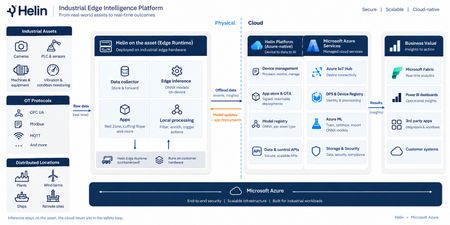
Remote industrial sites generate operational data continuously, but the ability to act on that data in near real time can be challenging. Bandwidth is often limited; connectivity is inconsistent, and the analysis needed to turn raw signals into insight typically depends on cloud connection. When worker safety is on the line, that gap matters even more, since a person entering a hazardous zone has to be detected and flagged on site independent of a cloud connection. Meeting those conditions calls for a secure, repeatable foundation, one that trains models in the cloud, runs inference locally, governs distributed edge devices, and turns the right signals into insight. Helin Data built that foundation: an edge-to-cloud platform that combines local inference, industrial data collection, and fleet observability on Azure. RedZone, Helin's vision AI application for hazardous-zone monitoring, is the first proof point of this platform. It uses the CCTV cameras already installed on a rig to detect when a person enters a defined danger zone around active equipment, triggering a local alert through an on-site interface and status lights, and logging the event for later safety and operational analysis. Because inference runs at the edge, RedZone can detect and alert without waiting on a connection to the cloud, while Azure handles centralized management, analysis, and model lifecycle activities. What sets this solution apart Designed for constrained environments – Inference runs directly on the edge box, so RedZone keeps detecting and alerting even through network outages, with no dependence on the cloud at runtime. Only priority events and metadata detected by RedZone sync to Azure, which keeps bandwidth use low on a constrained connection such as satellite connectivity used at some offshore sites. Secure, scalable fleet governance – Devices onboard automatically through Device Provisioning Service (DPS) with per-device X.509 certificates. Every device is listed in Azure Device Registry (in preview) and projected as native ARM resources, so updates and configuration changes can be targeted, governed, and audited using standard Azure tooling. Helin adds multi-level security, including public key infrastructure (PKI), data encryption, and industry-trusted authentication, protecting data as it moves from the rig to the cloud. Helin's observability layer spans device health, firmware updates, application status, and the data pipeline, so organizations can promptly identify and investigate potential issues across the edge-to-cloud pipeline. A closed edge-to-cloud AI loop – Models are trained and versioned in Azure Machine Learning, then deployed to the edge for local inference. Detections stream back into Microsoft Fabric, where the data can inform model evaluation and future model versions, closing the loop between the field and the cloud. A reusable application foundation – RedZone runs on the same platform and loop that can be adapted for additional customer scenarios. A different hazard, a different zone, or a different operational question can become its own application. Delivering a governed device fleet Azure IoT Hub and DPS provide secure device connectivity, messaging, and automated provisioning. The Azure IoT Hub integration with Azure Device Registry, currently in public preview, represents devices as Azure resources, providing a foundation for Azure-native fleet inventory and governance. Together, these services help Helin onboard, connect, and manage distributed edge deployments. Azure Device Registry (public preview with Azure IoT Hub): Provides the management plane, representing each device as an Azure Resource Manager resource so it can be governed with the same patterns used for other Azure resources including role-based access control, resource groups, tags, and resource-level management, with namespaces acting as the organizational and security boundary. Azure Device Registry integration with Azure IoT Hub and Microsoft-backed X.509 certificate management is in public preview and is not recommended for production workloads. Azure IoT Hub and DPS: Deliver secure onboarding and bidirectional messaging between the devices and the cloud. Helin Data Edge Inference and Data Collector: Runs vision AI inference at the edge and connects into the industrial control systems already on site, so each detection carries operational context. Industrial data is collected, contextualized, buffered, and filtered locally before important signals are sent to Azure. Microsoft Fabric: Ingests telemetry and turns it into an operational model for analysis and reporting, giving organizations clearer insight into their operations. Customer Impact This solution is already proven in a demanding industrial environment. When Helin Data implemented RedZone on Noble’s Maersk Discoverer rig, RedZone detected a person entering a hazardous zone and raised an alert in roughly 150 milliseconds. Processing the detection locally is particularly important offshore, where limited connectivity makes a cloud-dependent response impractical. Helin’s broader edge platform is already supporting Noble across its operations. The offshore drilling contractor, which operates a fleet of more than 40 rigs, uses Helin’s Remote CCTV Manager to provide authorized personnel with live video from more than 20 rigs. Reduced resolution streams sync to Noble’s secure Azure environment for viewing while full resolution recordings stay at the rig to reduce bandwidth use. Together, these examples demonstrate the broader platform pattern: process high-volume data locally, transmit the signals that matter, and centrally manage applications deployed across a distributed industrial fleet. Closing RedZone shows what becomes possible when Azure IoT Hub is used as more than a device-connectivity service. Combined with secure provisioning, Azure-native device governance, edge inference, model lifecycle management, and Microsoft Fabric, it becomes part of a repeatable platform for building and operating industrial AI applications at scale. For customers, the value extends beyond a single safety scenario. The same foundation can support new applications across worker safety, operational visibility, process improvement, and other industrial use cases, without rebuilding the underlying device and data infrastructure each time. Helin brings the industrial application expertise; Azure provides the scalable foundation on which those applications can be deployed, governed, and continuously improved. Take the next step Read the customer case study, Improving safety across a fleet of drilling rigs Learn more about RedZone in Seeing the Human Layer: Helin Brings Edge Vision AI to Industrial Operations on Azure. Explore Helin’s Intelligent Edge Application Platform is now available in Azure Marketplace Resources Deploy Azure IoT Hub with Device Registry integration and certificate management (preview) Azure IoT Hub Documentation Product documentation | Helin Documentation625Views0likes1CommentHow Mesh Systems Builds on Azure IoT Hub and Azure IoT Operations to Accelerate Industrial AI
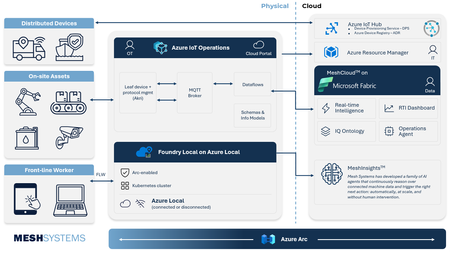
Manufacturers generate vast amounts of operational data, yet its complexity and fragmentation across historians, Operational Technology (OT) systems, and cloud platforms can slow AI adoption at scale. As organizations invest in AI to enhance productivity, quality, and decision making, the ability to connect and contextualize operational data becomes critical. Azure IoT Hub, Azure IoT Operations, and Mesh address this challenge together, spanning the full path from device connectivity to actionable AI-powered insights. Mesh brings deep Azure IoT platform experience and a practical path to industrial AI, with MeshCloud built on Azure IoT Hub, an open-source .NET Akri framework for Azure IoT Operations, and MeshInsights delivering generative AI-powered operational intelligence. This expertise is backed by a long history with Azure; Mesh launched its first IoT solution on Azure in private preview in 2009 and remained an early adopter of every major Azure IoT service since. Together, Azure IoT Hub, Azure IoT Operations, and Mesh give manufacturers a streamlined way to unify operational data and apply AI where it matters most. Unlocking legacy data with Mesh's Akri Connector Industrial organizations often struggle to modernize operations because critical operational data sits isolated inside historians and legacy Operational Technology (OT) systems. Many manufacturers are also wary of integrations that create new dependencies and limit future flexibility. Azure IoT Operations addresses this through an open architecture built around Akri, connecting industrial data sources while preserving interoperability across hardware and software environments. Mesh built on this foundation with its Akri Historian Connector, bringing historian and legacy operational data into Azure IoT Operations through prebuilt connectivity rather than source-by-source integration work. The result is faster access to operational data ready for analytics, AI, and industrial automation. The key features of this connector include: Restart-safe data continuity: Manufacturers can trust that operational data keeps flowing even through outages or restarts, with no data loss and no time spent recovering or reprocessing data. Secure, flexible authentication: Modern and legacy industrial systems connect under one security model, meeting enterprise-grade authentication standards without restructuring existing infrastructure. A foundation other connectors can be built on: The underlying framework handles the heavy lifting, so teams only need to build what's unique to each new OT data source. This means faster time to value for every new data source. Built in alignment with Azure IoT Operations roadmap: The connector stays up to date automatically, as new Azure IoT Operations features become available. This means manufacturers have access to the latest capabilities as the platform evolves. Together, Mesh and Azure IoT Operations give organizations a production-ready path from the shop floor into Azure IoT Operations and onward to Microsoft Fabric. Delivering Scalable Connected Products with Azure IoT Hub and MeshCloud MeshCloud helps manufacturers move from connected product pilots to fleet scale deployments faster by providing a platform build on Azure IoT Hub and other Azure native services. Azure IoT Hub provides per-device identity, support for MQTT, AMQP, and HTTPS, and built-in capabilities like device twins, direct methods, and rules-based message routing. Azure Device Provisioning Service (DPS) extends this foundation with zero-touch, just-in-time onboarding using X.509, TPM, or symmetric key attestation. Mesh operates as one cohesive engineering practice across the full connected product lifecycle, delivering hardware, firmware, wireless, edge, and cloud integration natively for Azure IoT Hub and Azure IoT Operations. That end-to-end scope is what MeshCloud, their Azure-native connected product platform, brings together. MeshCloud embeds Azure IoT Hub and DPS into an Azure-native connected product platform, giving organizations a faster path to connected product delivery without sacrificing control, scale, or solution ownership. The platform comes together across four layers: Edge to cloud: Connected devices, from MCU controllers to tablets and phones, register and authenticate through DPS and connect securely to IoT Hub, giving organizations a direct, secure line from shop floor to enterprise systems. Messaging and command: Event Hubs and Container Apps move telemetry and commands between devices and the cloud, with asset and ontology data exposed for digital twin management and device control. IT and operations: Azure Monitor, OpenTelemetry, Microsoft Entra, and Application Gateway bring platform observability, identity management, and secure ingress together, equipping IT and operations teams with a unified way to manage and secure the environment. Analytics and visualization: Telemetry flows into Azure Data Explorer and Microsoft Fabric for processing and storage, with Grafana, Power BI, and a Device Health UI giving teams fleet-wide visibility. This architecture enables organizations to move from pilot projects to fleet-scale deployments using Azure-native services, while maintaining interoperability across devices, connectivity protocols, and analytics platforms. For manufacturers, this means less time integrating infrastructure and more time delivering operational insights, connected services, and AI-powered workflows. Advancing Industrial Intelligence with MeshInsights As organizations connect more assets and operational systems, the next challenge becomes turning information into consistent actions and decisions. Microsoft Azure provides the cloud, data, and AI foundation for intelligent operational workflows, while giving organizations control over their data and business processes. Mesh extends this foundation through MeshInsights. MeshInsights is Mesh's AI agent offering for connected-product manufacturers. Mesh works with organizations to define a specific operational decision worth automating, such as classifying an alert or determining the right service response, and builds an evaluation standard from real telemetry, service history, and expert-validated examples. AI agents are then developed and measured against that standard, acting automatically on high-confidence cases and routing the rest to the organization's own experts. This extends connected systems beyond monitoring and reporting into trusted, auditable operational decisions. By combining Azure IoT platform services with MeshInsights, Mesh helps organizations move from connected infrastructure to autonomous, AI-driven action without changing where their data lives or who owns the architecture. Why This Matters Industrial transformation increasingly depends on strong collaboration between hyperscale cloud platforms and ecosystem partners who bring operational expertise, deployment acceleration, and industry-specific engineering capabilities. Mesh Systems demonstrates how partners can build differentiated value on top of Azure IoT platform services while helping organizations accelerate deployment timelines, standardize industrial data architectures, and operationalize AI across connected environments. Organizations are already putting this value to work in everyday operations. BUNN's cloud-connected coffee machines now give technicians a head start before every service call. As Kurt Powell, Executive Vice President at BUNN, put it: "With this solution, we know exactly which component to fix before we get there." WLS Lighting Systems has turned that same visibility into measurable savings at scale. Built on MeshCloud and Azure IoT, WLS's netLiNK gives property owners remote monitoring and control over individual light fixtures. Kevin Fletcher, President National Accounts at WLS, shared that the company has saved customers a little over $50 million in electrical costs since bringing netLiNK to market. Together, Azure IoT Hub, Azure IoT Operations, and Mesh Systems help manufacturers reduce integration complexity and operationalize industrial data, creating a foundation for AI driven operations spanning plant, edge, and cloud. The result: manufacturers spend less time on integration and more time improving productivity, resiliency, and decision making across their operations. Learn More Explore Mesh Systems solutions on Azure Marketplace: https://marketplace.microsoft.com/en-us/product/saas/mesh-systems.cloud?tab=Overview Read customer success stories: https://meshsystems.com/case-study-eaton-1/ Learn more about Azure IoT Operations: https://azure.microsoft.com/products/iot-operations/604Views1like0CommentsDirect IoT Hub-to-Fabric message routing, with context preserved via CloudEvents, in Public Preview
Announcing Public Preview of Microsoft Fabric Eventstreams as a native Azure IoT Hub routing endpoint. Customers can now send device telemetry directly into Fabric without building custom integration pipelines, using the same routing rules, filters, and enrichments configurable in IoT Hub. Events are delivered using the CloudEvents envelope, which preserves critical metadata for downstream analytics.535Views1like1CommentAzure IoT Edge 1.6 LTS is now available
IoT Edge 1.6 is built on .NET 10, which is an LTS release supported through November 14, 2028. IoT Edge 1.6 is supported for that same window. So if you're planning for the long term, 1.6 is the version to move to. For context, IoT Edge 1.5 LTS is supported through November 10, 2026 (it tracks .NET 8). If you're on 1.5, you have a clear, supported path forward, and we recommend planning your move to 1.6. How to upgrade from 1.5 Moving from 1.5 to 1.6 is a minor release upgrade, so update both the security daemon and the runtime containers: Update the IoT Edge security daemon on the device. sudo apt-get update && sudo apt-get install aziot-edge Update the runtime container tags in your deployment manifest. Point edgeAgent and edgeHub at 1.6, for example "mcr.microsoft.com/azureiotedge-hub:1.6", and apply the deployment. Verify the versions match. iotedge version && iotedge check Full steps are in Update IoT Edge. (Worth noting: 1.6 drops support for Debian 11. 1.5 continues to support Debian 11 through August 2026 if you need more time.) Release notes are on the Azure IoT Edge releases page. Give it a try.457Views0likes0Comments
Update bootloader in Win10 Iot Ent LTSC (21H2) applied images?
The product I work on uses Windows 10 IoT Enterprise LTSC (21H2). I am trying to update the bootloader in the extracted and applied images to the version signed in 2023, to work around the issue with the default bootloader signatures expiring in 2026 (see KB5012170). KB5012170 updates the bootloader on an installed system. I can apply this hotfix to an installed device, and the bootloader on the hidden partition indeed gets updated. However, if I sysprep and extract the image from this machine, and apply it to a new machine, after using bcdboot to set the boot image, the new machine ends up with the old expiring bootloader installed. It seems KB5012170 only updates the "live" version of the bootloader on the hidden partition. It does not update the bootloader that ends up in the extracted image? Updating to Windows 10 IoT 22H2 or Windows 11 IoT is not an option for us for now. I do not want to have to require users to always install KB5012170 every time they install our product moving forward. I would like newly created images of our product to contain the updated bootloader by default. But I cannot find a way to do this. KB5012170 seems to be the only way to get the updated bootloader for our edition of Windows. Is there another way to get the updated bootloader I am missing? Is there a tool or trick that I am missing that would allow us to update the bootloader in the extracted, applied image without requiring a subsequent install of KB5012170?457Views0likes2CommentsAzure IoT guidance for DigiCert Global Root G1 trust-store updates in sovereign clouds
At a glance The technology industry is retiring trust in an older root certificate - the DigiCert Global Root G1. As operating systems, firmware images, and CA certificate bundles update over time, some clients may stop trusting this older root. This can affect both your Azure IoT devices and the applications that connect to Azure IoT service APIs. If those devices or application hosts run on Linux or rely on a system trust store that receives periodic updates, this post explains what you might see and the simple steps to stay connected. This guidance is relevant only for a subset of Azure IoT customers using Azure Government (Fairfax) or Azure China (Mooncake) environments, and only if devices or applications adopt operating system, firmware, or trust-store updates that remove trust for the DigiCert Global Root G1 certificate. Azure public cloud customers are not affected because Azure IoT public cloud endpoints already use newer certificate chains. This is a client-side trust-store change, not a security incident, service outage, or certificate expiration event. Scope: Azure public cloud customers are not affected. This guidance applies only to specific Azure Government (Fairfax) and Azure China (Mooncake) scenarios where updated client trust stores no longer trust DigiCert Global Root G1. Could this affect my deployment? For most Azure IoT customers, the answer is no. If you use Azure IoT in the Azure public (commercial) cloud, you are not affected by this change. Azure IoT public cloud endpoints already use newer certificate chains and do not rely on the DigiCert Global Root G1 certificate. This guidance is relevant only for a subset of customers using Azure Government (Fairfax) or Azure China (Mooncake) environments, and only if: Your devices or applications rely on operating system trust stores. You recently applied Linux operating system, firmware, container image, OpenSSL, NSS, or CA certificate bundle updates. You began seeing TLS connectivity or provisioning errors after those updates were installed. If your devices continue to connect normally and you have not observed any TLS-related issues following recent updates, no action is required at this time What should I do? If your devices and applications are connecting normally, no action is required. If you manage Linux-based devices or applications that rely on operating system trust stores, we recommend validating OS, firmware, and CA bundle updates in a test environment before production rollout. If connectivity issues appear following a trust-store update, contact Microsoft Support for assistance. What you may observe After an operating system, firmware, or CA-certificate-bundle update, an affected device or application may show the symptoms below. These typically appear first in test or QA environments, because fleets and application environments usually stage updates before production. Failure to connect to Azure IoT during the TLS handshake. A certificate trust, “untrusted root,” or “unknown CA” error. Telemetry, provisioning, or service-API calls stop, while clients still running the previous trust store keep working normally. Why it could happen Your device or application validates the Azure IoT server certificate against the list of trusted root certificates in its local trust store. As updates remove the older DigiCert Global Root G1 from that store, a client that still expects it may reject the connection - even though the server certificate is valid. The change is on the client side, in the trust store, not in the Azure service. What you should check If you see connectivity or provisioning failures, confirm the following: Was there a recent OS, firmware, or CA-bundle update on the affected devices or application hosts? Do clients still running the previous trust store continue to connect? If so, the cause is a trust-store change. Is the error a certificate or trust error rather than an authentication error? What we recommend A few simple steps keep your devices and applications connected through this change: Validate firmware and OS updates in a test ring before production rollout, the single most effective way to catch trust-store changes early. If clients begin failing after such an update, pause the rollout and, where feasible, roll back the update on the affected device or application host to restore connectivity. Contact Microsoft Support if you see connectivity or provisioning failures following an OS, firmware, or CA-bundle update. Support can confirm the cause and guide you through the appropriate next steps for your configuration. Questions If you have questions, contact Microsoft Support or your Microsoft account team.383Views0likes0Comments