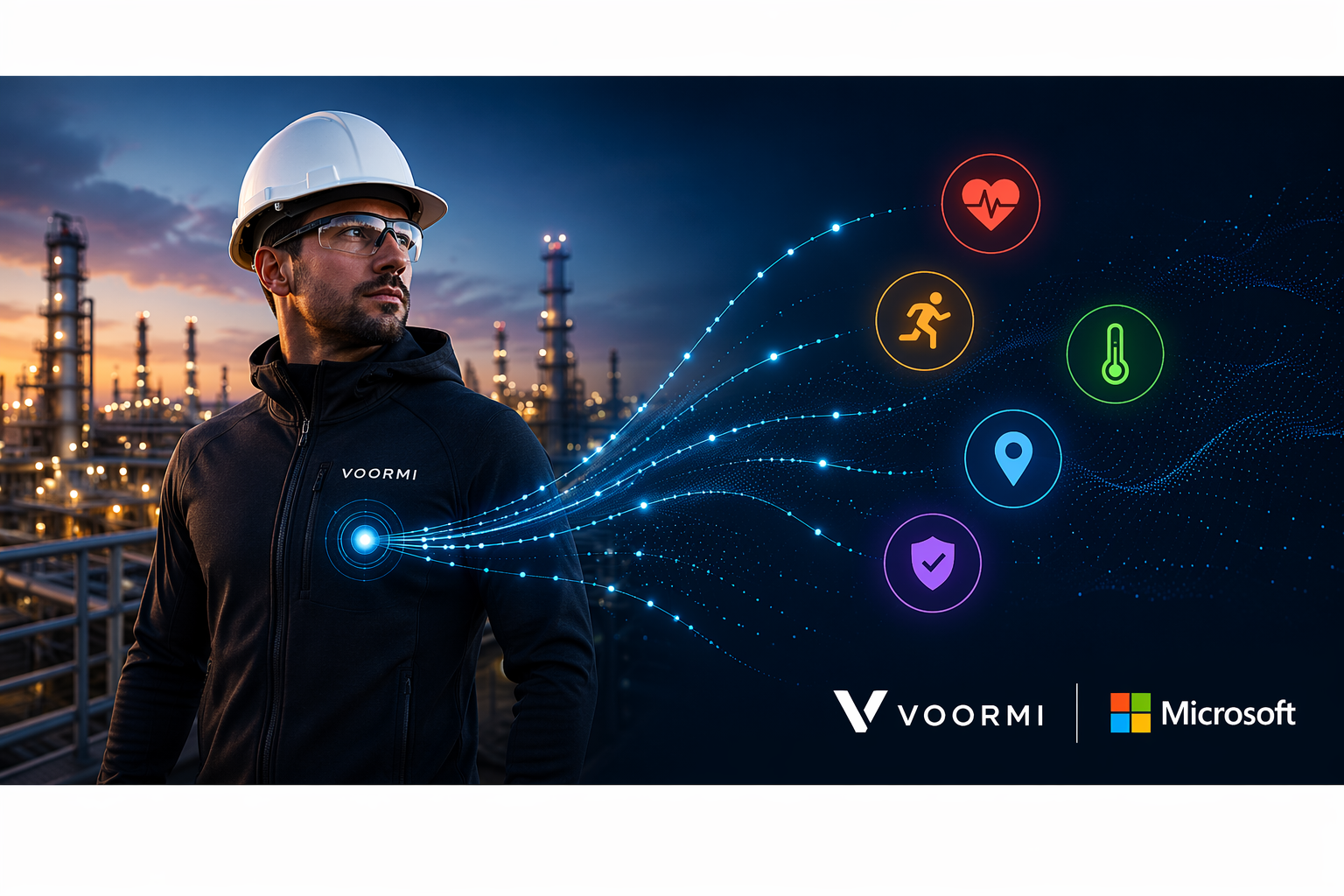
VOORMI and Microsoft bring connected worker intelligence into Azure IoT for safer, smarter industrial operations
What if we could track human health & safety conditions as precisely as we do with machines, and take immediate actions to protect our greatest asset, our people? Many industrial organizations still lack visibility into real-time human conditions, even as worker safety and operational risk remain major investment priorities. One of the most important operational signals has largely remained outside the industrial data estate: the human telemetry.
VOORMI and Microsoft have joined forces to fill this gap in understanding real human conditions. Through the Mij™ platform, VOORMI brings human telemetry into Azure IoT, enabling enterprises to integrate worker conditions such as heat stress and fatigue into the same operational architecture already used for machines and industrial systems. VOORMI, SWNR’s performance apparel brand, is among the first to bring this technology into garments designed for real industrial field conditions.
This integration brings their proprietary wearable technology directly into high-impact worker safety and field operations scenarios. The partnership helps establish a new telemetry layer for industrial operations, allowing human, machine, and environmental signals to converge and drive safer operations, real-time awareness, and adaptive AI workflows.
Bringing the Human Signal into Industrial AI with Azure
Industrial organizations increasingly recognize that many safety, productivity, and operational challenges occur at the intersection of people and machines. Workers operate in high-heat environments, hazardous conditions, remote sites, and physically demanding field scenarios where situational awareness matters in real time.
Historically, worker telemetry has remained fragmented across proprietary wearable platforms and disconnected safety systems, creating governance and operational challenges for enterprise IT and OT teams. Mij™ is designed differently, integrating directly into customer-controlled Azure environments through Azure IoT Operations running at the edge or Azure IoT Hub in the cloud rather than introducing another isolated platform. Running intelligence at the edge enables virtual safety agents and operational workflows to execute closer to the worker, supporting low-latency responses, local interaction with OT systems, and operational resilience even in disconnected or bandwidth-constrained environments. This gives enterprises flexibility to support real-time worker safety responses at the edge while also enabling long-term analytics, reporting, and operational intelligence through Microsoft Fabric.
Telemetry from garment-integrated sensors flows through edge gateways into Azure services including Azure IoT Operations, Azure Data Explorer, Azure Managed Grafana, and Microsoft Fabric. The result is a unified operational environment where worker telemetry can live beside machine, site, and environmental data under the customer’s existing identity, security, governance, and analytics model.
The vision is simple and transformative: make human telemetry a trusted, first-class industrial data source.
Azure Digital Operations as the Intelligence Layer
The reference architecture demonstrates how Azure IoT Operations can serve as a scalable operational intelligence layer for worker safety and connected operations scenarios across manufacturing, energy, and field environments.
Mij™-enabled garments broadcast Bluetooth Low Energy (BLE) telemetry that can be processed locally through edge gateways and routed into Azure IoT Operations using MQTT and dataflows. Data is then operationalized through Azure Data Explorer and visualized using Azure Managed Grafana dashboards for field operations, worker safety, fleet health, gateway monitoring, and operational readiness scenarios. Telemetry can also be made available to Foundry Local-hosted GenAI agents to support real-time, context aware safety guidance, such as prompting workers operating in high-heat conditions to hydrate or seek cooler environments.
While Mij™-enabled garments are the initial implementation, the edge device-to-cloud architecture creates a broader onboarding point for additional wearable, sensor, and field telemetry scenarios over time. This allows enterprises to bring more human and operational signals into a unified Azure-native operational environment.
The architecture also supports flexible ingestion patterns for environments where dedicated edge gateways are not practical. Using Microsoft Entra External ID, Azure Container Apps, and Azure IoT Hub, telemetry can securely flow into Azure services without exposing operational infrastructure credentials to client devices. This pattern aligns with the broader Azure adaptive cloud approach: enabling customers to run distributed edge-native services on Arc-enabled Kubernetes infrastructure while maintaining centralized security, governance, and analytics capabilities across the enterprise.
Depending on customer architecture preferences, telemetry can be processed through Azure IoT Operations at the edge or ingested directly through Azure IoT Hub for cloud-first analytics and downstream processing in services such as Microsoft Fabric. Edge processing also enables real-time sensor fusion across worker telemetry, ambient environmental conditions, machine parameters, and site-level operational signals, supporting faster safety interventions and more context-aware operational decisions. This gives enterprises flexibility in how they balance edge processing, operational responsiveness, governance and privacy requirements.
Enabling the Next Generation of Industrial Workflows
The long-term opportunity extends well beyond visualization dashboards. As worker telemetry becomes part of the operational fabric, enterprises can begin building more adaptive and intelligent workflows across worker safety, field readiness, incident response, compliance, environmental monitoring, and industrial AI systems. Human telemetry can provide critical real-time context that complements machine and environmental signals enabling more responsive operations and eventually more autonomous decision-support experiences. By bringing human telemetry into enterprise AI and analytics workflows, organizations can build more adaptive operational systems that improve worker safety, situational awareness, and real-time decision making at scale.
This partnership reflects a broader industry shift: industrial transformation is no longer only about connected machines. It is about connected operations where people, equipment, environments, and AI systems participate in a shared operational intelligence layer.
With SWNR’s Mij™platform and Azure IoT Operations, Microsoft and VOORMI are helping unlock that future.
Learn more:
Mij™ product page: https://swnrtechnologies.com/pages/mij
Learn more about Azure IoT Operations: Documentation & Getting Started
See what’s new with Azure IoT Hub: Preview Documentation
To get started with a pilot, contact: pilots@swnrtechnologies.com

 Microsoft