hyper-v
434 Topics
Assign IP Address for Windows Server 2025 VM on Hyper-V
I have built my first Windows Server 2025 VM on HyperV and trying to assign an IP address. I want the VM's to be like an actual server so I Created an external vswitch. The HyperV server IP is 172.16.1.41 with a physical gateway of 172.16.1.5. I have tried to assign the new VM with 172.16.1.42/255.255.255.0 and the Gateway is 172.16.1.5 also. However, I cannot get a positive ping. Do I need another VSWITCH configured or what am I missing?232Views0likes5CommentsWindows Server 2022 Hyper-V : vmconnect introuvable pour accéder à la console VM (Server Core)
Contexte Windows Server 2022 [Standard/Datacenter — à préciser], rôle Hyper-V installé. J'ai créé une VM invitée Linux nommée « Wazuh » (installation d'une plateforme SIEM), elle démarre correctement. ce serveur est une VM imbriquée dans un autre hyperviseur type VMware Workstation. je suis en simple groupe de travail (workgroup). Ce que je constate PS C:\Users\Administrator> Start-VM -Name 'Wazuh' PS C:\Users\Administrator> vmconnect localhost Wazuh vmconnect : The term 'vmconnect' is not recognized as the name of a cmdlet, function, script file, or operable program. Check the spelling of the name, or if a path was included, verify that the path is correct and try again. At line:1 char:1 + vmconnect localhost Wazuh + ~~~~~~~~~ + CategoryInfo : ObjectNotFound: (vmconnect:String) [], CommandNotFoundException + FullyQualifiedErrorId : CommandNotFoundException PS C:\Users\Administrator> Get-VM -Name 'Wazuh' | Select-Object State, Status State Status ----- ------ Running Operating normally PS C:\Users\Administrator> vmconnect localhost Wazuh vmconnect : The term 'vmconnect' is not recognized as the name of a cmdlet, function, script file, or operable program... La VM est bien « Running / Operating normally » selon Get-VM, donc le souci n'est pas la VM elle-même mais l'accès à sa console. Ce que j'ai déjà essayé Get-WindowsFeature *Hyper-V* → [colle ici la sortie exacte que tu as obtenue] Install-WindowsFeature -Name RSAT-Hyper-V-Tools -IncludeAllSubFeature → toujours pas de vmconnect.exe fonctionnel après coup Je soupçonne que ce serveur est installé en mode Server Core (pas d'interface graphique locale), et j'ai lu que la conversion Core → Desktop Experience n'est plus possible après coup depuis Server 2016. Ma question pour la communauté Est-il vraiment impossible d'obtenir une console graphique locale (vmconnect / Hyper-V Manager) sur un Server Core, même une fois les outils de gestion Hyper-V installés ? Quelle est la méthode la plus fiable pour accéder à la console d'une VM Hyper-V hébergée sur un Server Core, en environnement non-domaine (workgroup) : Windows Admin Center, Hyper-V Manager distant (config WinRM/TrustedHosts), ou faut-il simplement réinstaller en Desktop Experience ? Si quelqu'un a déjà mis en place Windows Admin Center ou du Hyper-V Manager distant sur un lab en groupe de travail (sans AD), un retour d'expérience serait très utile. Merci d'avance !215Views0likes1Comment
Migrating from VMware to Hyper-v
Hi, I've recently deployed a new 3x node Hyper-v cluster running Windows Server 2025. I have an existing VMware cluster running exsi 7.x. What tools or approach have you guys used to migrate from VMware to Hyper-v? I can see there are many 3rd party tools available, and now the Windows Admin Center appears to also support this. Having never done this before (vmware to hyper-v) I'm not sure what the best method is, does anyone here have any experience and recommendations pls?4.6KViews0likes6Comments
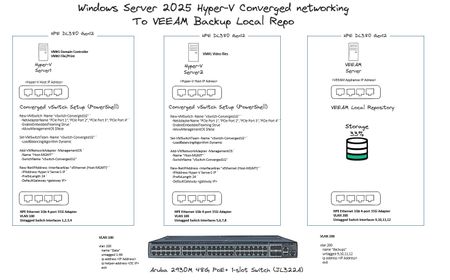
Hyper-V Converged Networking for VEEAM Backups
Hi All, As per the image below, I have 3 x HPE DL380 Gen 12 Servers, Server1 and Server2 are ADDS domain joined, VEEAM Local Repo is not. For the converged networking to work, is there anything else I need to perform in terms of additional power-shell commands, VLAN tagging etc? Thanks!260Views0likes2Comments
Unable to Build Switchless Storage using Network ATC
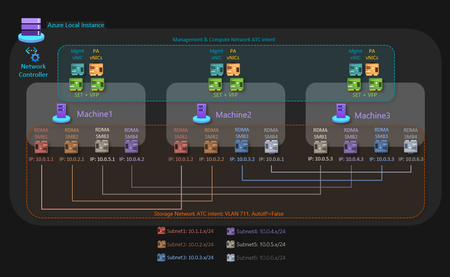
3-Node HV/S2D Cluster using Switchless Storage and Network ATC getting Network HUD Error I have a Dell 3-node server cluster being used to host Hyper-V with S2D. Each node is identical and certified to pass S2D requirements. The networking consists of 2 onboard 1 Gbps and 2 quad-port PCI(e) NICs at 10/25 Gbps. The 2 onboard ports are being used for the management intent, 2 ports from each of those NICs are being connected to 2 top-of-rack switches for the compute intent at a total of 12 10 Gbps connections, and the other 2 ports from each of those NICs are being connected directly to the other nodes in a dual mesh method for the storage intent at a total of 6 25 Gbps connections. Very similar to the Microsoft diagram for a three-node storage switchless, dual TOR, dual link deployment network reference pattern for Azure Local, but I am using Windows Server 2025 Datacenter, not Azure Local. The problem I am encountering is when I attempt to create the switchless storage intent, I get an error (shown below) that reads "Failed to fetch physical NIC mapping from the Network HUD service. Please diagnose..." If I leave off the switchless option, it builds without issue. The error only occurs when I attempt to use the switchless option. I tried without configuring the NIC IP addresses first, as well as trying configuring the NIC IP addresses beforehand. I tried without having a cluster built first, as well as building a failover cluster without storage before running the network intent command. The error I posted below shows my last attempt after having the NICs configured with IP addresses and having a failover cluster established before running the command. The error has remained the same throughout the process. Has anyone else run into an issue like this with switchless storage? It seems like everything that I am trying to do is within scope and should be a supported solution. My fallback plan is to use my existing switches, but that drops my connection speeds down from 25 Gbps to 10 Gbps due to hardware limitations.418Views0likes4Comments
PS script for moving clustered VMs to another node
Windows Server 2022, Hyper-V, Failover cluster We have a Hyper-V cluster where the hosts reboot once a month. If the host being rebooted has any number of VMs running on it the reboot can take hours. I've proven this by manually moving VM roles off of the host prior to reboot and the host reboots in less than an hour, usually around 15 minutes. Does anyone know of a powershell script that will detect clustered VMs running on the host and move them to another host within the cluster? I'd rather not reinvent this if someone's already done it.341Views0likes3CommentsAnnouncing Trusted Launch for Virtual Machines for Windows Server Insiders
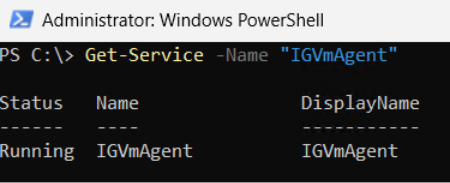
Trusted Launch for virtual machines We are excited to announce Trusted Launch for virtual machines (TVMs) in Windows Server Insider Preview. Trusted Launch is a security feature you can enable when creating Hyper-V Generation 2 VMs. It enables Secure Boot, installs a virtual Trusted Platform Module (vTPM), protects vTPM state at rest, and supports boot integrity verification (ability to verify if the VM started in a well-known good state). Further, when the VM runs in a Failover Cluster, the vTPM state is automatically made available when the VM live migrates or fails over to other nodes in the cluster – this ensures the VM remains available after migration or failover. This is unlike a Generation 2 VM with a vTPM, which will not start after migration or failover to another node in the cluster – the TPM state protection key needs to be moved to the destination node manually so the VM can start. With boot integrity verification, the entire boot path is measured and boot integrity is verified by Microsoft Azure Attestation service. This helps detect any alterations to the boot path or boot components. Such alterations, e.g. implanting malware in the boot path, can be detected by boot integrity verification. Increasingly attackers prefer implanting malware in the boot path for a variety of reasons: the OS layer is usually well protected, while firmware – as highly privileged code – can be used to alter what gets loaded (boot loader and drivers). Such alterations are not easily detectable by anti-virus software running at the OS layer. Boot integrity verification helps detect such alterations so a relying party (such as an app or service) can take suitable remediation actions, e.g. shutting down the VM. Boot integrity verification is an important part of establishing trust by verifying that the virtual machine started in a well-known good state. Insider preview TVMs are available for preview starting with Windows Server Insider preview build 29621. This initial preview only supports some of the Trusted Launch capabilities: Secure boot, vTPM, and vTPM state protection (at rest). You can create and manage TVMs using PowerShell. Guest state protection: The guest state (including the vTPM state) for each TVM is protected using a unique key that is stored in a KSP (Key Storage Provider) local to the server. Without this key, the VM will not start. Moving the VM to another server is not supported in this release. Not supported in this release: Moving TVMs to another server. TVMs in Failover Clusters or Hyper-V Replica. Boot integrity verification. Support for TVMs in Windows Admin Center (WAC). Instructions At a high-level, the steps involve: Install Windows Server Insider preview build on your server Enable Hyper-V Enable Trusted Launch feature Verify guest state protection 1. Install Windows Server Insider preview build Trusted Launch for virtual machines is available starting with the Windows Insider preview build number 29621. Install this build or a later build on your server. (Join Windows Server Insiders if you haven’t already!) 2. Enable Hyper-V (if it is not already enabled) Install-WindowsFeature -Name Hyper-V -IncludeManagementTools -Restart After enabling Hyper-V, the server needs to be restarted. 3. Set registry key property value (required to enable the Trusted Launch feature) New-Item -Path "HKLM:\SOFTWARE\Microsoft\AszIgvmAgent" -Force New-ItemProperty -Path "HKLM:\SOFTWARE\Microsoft\AszIgvmAgent" -Name "TvmWinServer" -Value 1 -PropertyType DWord -Force Setting the above regkey informs relevant system components that the Trusted Launch feature is being used in a Windows Server environment. 4. Enable Trusted Launch feature Enable-WindowsOptionalFeature -Online -FeatureName "IsolatedGuestVm" -NoRestart 5. Verify if IgvmAgent is running IgvmAgent (Isolated Guest Virtual Machine agent) is a system-level service that helps support Trusted Launch capabilities. Get-Service -Name "IGVmAgent" The output should show Status as Running. If the Status is Running, you can skip to next step. If the Status is not Running, please report the issue. Add the following event logs to the report: Event Viewer: Applications and Services Logs => Microsoft => Windows => IGVmAgent => Operational Event Viewer: Applications and Services Logs => Microsoft => Windows => IGVmSystem => Operational You can open Event Viewer via the Run dialog: Press Win + R → type "eventvwr.msc" → press Enter 6. Create an external virtual switch (if you don't already have one you can use) Create and configure a virtual switch with Hyper-V | Microsoft Learn To see available external virtual switches: (Get-VMSwitch | Where-Object { $_.SwitchType -eq "External" }).Name 7. Create TVM If you already have a virtual hard disk (VHD or VHDX) for a Gen 2 VM with an installed guest OS, run: New-VM -Name <VMName> -Generation 2 -GuestStateIsolationType TrustedLaunch -SwitchName <virtual switch name> -VHDPath <path to vhdx> -Path <path to where VM config files will be stored> Else, run: New-VM -Name <VMName> -SwitchName <virtual switch name> -NewVHDPath <path to where new VHD will be stored> -NewVHDSizeBytes 40GB -Generation 2 -GuestStateIsolationType TrustedLaunch -Path <path to where VM config files will be stored> Then, add to the VM a virtual DVD drive containing an ISO image for the guest OS (Windows or Linux OS-compatible with Hyper-V Gen 2 virtual machine). Add-VMDvdDrive -VMName <VMName> -Path <Guest OS ISO image path> Note: The guest OS will be installed when the VM starts up. When connecting to the VM you will be prompted to install the guest OS from the DVD drive. Make sure that the DVD drive is at the top of the boot order specified in the firmware so the VM will boot from the DVD drive. For more information, see New-VM. 8. Verify VM guest state isolation type (Get-VM -name <VMName>).GuestStateIsolationType should return "TrustedLaunch". 9. Verify guest state protection To verify guest state protection, stop IGVmAgent service and restart the VM. Without IGVmAgent in Running state, a TVM with guest state protection will not start. Call to action Trusted Launch brings foundational VM security — Secure Boot, a vTPM, and protected guest state — to Windows Server, helping safeguard your VMs against boot-level and firmware threats. Please try out TVMs and provide your feedback via the Windows Server Insiders Forum. — Christina Curlette and Ram Jeyaraman (and the Windows Server team)Windows Server 2025 Failover Cluster Live Migration Issue
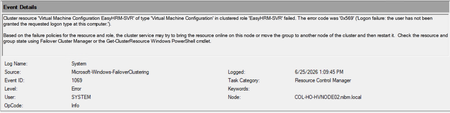
Hi Everyone, I am facing an issue in a Hyper-V Failover Cluster environment where Live Migration intermittently fails due to a service logon-related problem. The environment was previously working normally, but now whenever we attempt to Live Migrate a VM between cluster nodes, the migration fails unless we manually run “gpupdate /force” on the Hyper-V host first. After running gpupdate /force, the migration works temporarily, but the issue returns again during the next migration attempt. This makes it appear that some policy or permission is not being applied consistently on the cluster nodes. During troubleshooting, I attempted to add “NT VIRTUAL MACHINE\Virtual Machines” to the “Log on as a service” policy under Local Security Policy > Local Policies > User Rights Assignment. However, the account does not appear or resolve in the Object Picker when trying to add it manually. At this stage, I am trying to understand whether this is related to a domain GPO overwriting local policy settings, a Failover Cluster permission issue, or something specific to Hyper-V virtual machine accounts. Has anyone encountered a similar issue where Live Migration only works after running gpupdate /force? Also, is there a correct method to add “NT VIRTUAL MACHINE\Virtual Machines” to the “Log on as a service” policy, or should this permission already exist by default on Hyper-V hosts? Any guidance or recommendations would be greatly appreciated.275Views0likes1Comment