hybrid
15 TopicsAnnouncing flexible provisioning for SQL Server on Linux Azure VMs (Public Preview)
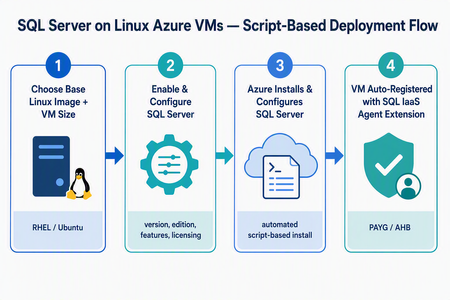
What’s changing We’re introducing a new script-based deployment experience for provisioning SQL Server on Linux Azure Virtual Machines (VMs). This experience replaces the earlier model that relied on pre-created SQL Server on Linux Marketplace images, which have been deprecated. Pre-created SQL Server on Linux Marketplace images are no longer available for new provisioning through the Azure portal, the Azure SQL hub, Azure CLI, or PowerShell. Instead, SQL Server is now installed and configured during VM provisioning using a flexible, automated, script-based workflow. The result is a more adaptable and supportable deployment model that keeps SQL Server on Linux Azure VMs fully supported, reduces image-maintenance overhead, and makes it easier to adopt the latest Linux distributions, VM families, and configuration options - all while giving you more control over your SQL Server setup. Why the new model matters Greater flexibility and control — choose your Linux distribution, SQL Server version, edition, and even bring your own mssql.conf to tailor the configuration. Faster access to innovation — new Linux versions and Azure capabilities are picked up automatically, without waiting for a new baked image to be published. Automatic registration built in — every VM is registered with the SQL IaaS Agent extension by default, unlocking licensing flexibility, compliance, and richer visibility. A dynamic, guided UI — the portal enables or disables options based on supported operating system, SQL Server, and licensing combinations, so you only see valid choices. Supported Linux distributions The script-based deployment experience supports the following distributions, and future versions are picked up automatically as they become supported — no manual intervention required: Distribution Supported versions Red Hat Enterprise Linux (RHEL) RHEL 9, RHEL 10 (and future versions) Ubuntu Ubuntu 22.04, Ubuntu 24.04, Ubuntu 26.04 (and future versions) Automatic registration applies to both Red Hat Enterprise Linux and Ubuntu, across all their supported versions. Automatic registration with the SQL IaaS Agent extension SQL Server on Linux VMs deployed through this experience are automatically registered with the SQL Server IaaS Agent extension. Registration creates a SQL virtual machine resource in Azure (separate from the VM resource) and unlocks: Licensing flexibility — choose Pay-As-You-Go (PAYG) or Azure Hybrid Benefit (AHB), and switch between them anytime with no downtime. Compliance — a simplified way to meet Azure Hybrid Benefit product-term requirements without per-resource registration forms. Visibility and telemetry — clear license-type visibility, subscription-level tracking, and better operational insight from the Azure portal, CLI, or PowerShell. Note: Automatic registration is enabled by default during deployment. You can unregister or re-register a VM after deployment through the Azure portal, Azure CLI, or PowerShell. The end-to-end flow at a glance Experience: The “Create a virtual machine” tab Use this flow if you’re starting from the familiar VM creation experience in the Azure portal. In the Azure portal, go to Virtual machines (or Create a resource → Virtual machine) and select Create. On the Basics tab, select your project details (subscription, resource group), instance details, and a supported Linux base image — RHEL 9, RHEL 10, Ubuntu 22.04, or Ubuntu 24.04. Choose your VM size, authentication, and inbound ports as usual. Go to the Advanced tab and select the Install SQL Server checkbox. This enables SQL Server provisioning on the VM. A new SQL Server settings tab becomes available. Open it to configure your SQL Server deployment: SQL Server version — e.g., SQL Server 2025 or SQL Server 2022. Edition — Enterprise, Standard, Developer, Express, and Evaluation editions (options adjust to the selected version). Licensing model — Pay-As-You-Go (PAYG, default) or Azure Hybrid Benefit (AHB). Advanced configuration — Upload a custom mssql.conf file to set SQL connectivity, Azure Key Vault integration, and the tuned performance profile. Select Review + create, review the configuration summary, and select Create. Azure provisions the VM, then automatically installs and configures SQL Server and registers the VM with the SQL IaaS Agent extension. Managing licensing after deployment Because your VM is registered with the SQL IaaS Agent extension, you can change the licensing model anytime — with no downtime and no restart of the VM or SQL Server service. Azure portal: Go to the SQL virtual machine resource → Settings → SQL Server configuration → Manage. Azure CLI az sql vm update -n <VM_NAME> -g <RESOURCE_GROUP> --license-type AHUB Azure PowerShell: Set-AzSqlVM -Name <VM_NAME> -ResourceGroupName <RESOURCE_GROUP> -LicenseType AHUB Note: Switching between PAYG and AHB is immediate, incurs no additional cost, and does not restart the VM or the SQL Server service. Wrapping up The move to script-based deployment modernizes how you provision SQL Server on Linux Azure VMs. By replacing deprecated pre-created Marketplace images with a flexible, automated, script-based flow — and by registering every VM with the SQL IaaS Agent extension automatically — you get more choice, faster access to new Linux and SQL Server versions, and a cleaner path to licensing flexibility, compliance, and visibility. Whether you start from the Create a virtual machine tab or the Azure SQL hub, you get the same guided experience across RHEL 9, RHEL 10, Ubuntu 22.04, Ubuntu 24.04, and future versions. Ready to try it? Head to a Create a virtual machine option in the Azure portal. We’d love your feedback — let us know how the new experience works for your workloads in the comments.143Views1like0CommentsMove to Modern SQL Server Licensing with Confidence
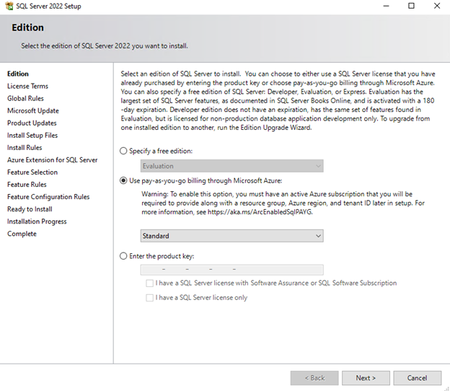
Why eligible customers should move to pay-as-you-go licensing (PAYG) For eligible SQL Server workloads, PAYG should be the preferred licensing approach when moving away from licenses and Software Assurance. It aligns billing with measured usage, adapts as the estate changes, and reduces the operational burden of managing fixed license quantities. The transition requires deliberate resource-configuration updates, but the result is a more flexible and manageable licensing model. Align cost with measured usage: Adopt consumption-based billing for eligible SQL Server resources instead of maintaining fixed license allocations. Scale without repeated license true-ups: Let billing adjust as workloads are added, removed, migrated, resized, or used intermittently. Manage licensing through Azure: Use Azure-based controls to review resource-level licensing and improve visibility across the estate. Reduce license administration: Spend less time tracking fixed quantities and aligning individual resources with license inventory. Optimize committed consumption: After establishing stable PAYG usage, evaluate applicable Azure savings plans or reservations to help reduce costs. Guidance for transitioning your resource settings Once your organization decides to adopt PAYG for eligible SQL Server workloads, update the license configuration on each resource so billing reflects that decision. A commercial or licensing change alone does not update resource-level settings. Plan this configuration work as part of the transition rather than treating it as a follow-up. Starting early gives teams time to validate security, networking, Azure Arc connectivity, billing, and operational processes before switching the broader estate. Automate the transition to pay-as-you-go SQL licensing at scale Choose the transition approach that fits your estate PowerShell for a controlled bulk change Use PowerShell when you need a targeted transition across a defined tenant, subscription, resource group, or resource scope. Discover and review resources before making changes. Test the transition with a limited scope. Update eligible resources in bulk when the organization is ready. Validate the resulting license configuration and billing signals. Azure Policy for ongoing governance Use Azure Policy to transition existing SQL resources to PAYG and continuously enforce the desired licensing configuration. Azure Policy helps identify configuration drift, maintain compliance, and automatically remediate non-compliant resources at scale. Define the approved license configuration for eligible resources. Assign policy at the appropriate subscription or resource group scope. Monitor compliance through centralized Azure views. Remediate resources that drift from the approved configuration. Recommended path to PAYG Commit to the PAYG target. Confirm which eligible workloads will move and identify the teams responsible for licensing, Azure, security, networking, and SQL operations. Prepare the estate. For SQL Server running outside of Azure, connect to Azure Arc. Inventory eligible SQL resources and confirm that Azure Arc connectivity and required organizational approvals are in place. Prove the transition. Test resource updates and billing behavior in a limited resource group or subscription. Move at scale. Use PowerShell for a controlled bulk transition, then apply Azure Policy for ongoing governance where appropriate. Verify and operate. Review the resulting configuration, monitor compliance, and reassess as the SQL estate grows or changes. Evaluate commitment-based savings. After establishing a stable PAYG usage pattern, assess whether an applicable Azure savings plan or reservation could reduce costs. Review eligibility, coverage, and commitment terms with your Microsoft representative. Learn more Automate the transition to pay-as-you-go SQL licensing at scale Manage licensing and billing of SQL Server enabled by Azure Arc Pricing guidance for SQL Server on Azure VMs Azure SQL Database pricing Eligibility, billing treatment, prerequisites, and available licensing options vary by resource and licensing arrangement. Review the applicable Microsoft terms and product guidance, and consult your Microsoft representative or licensing specialist as needed.734Views0likes2CommentsSQL Server 2016 Extended Security Updates: Stay Protected While You Modernize
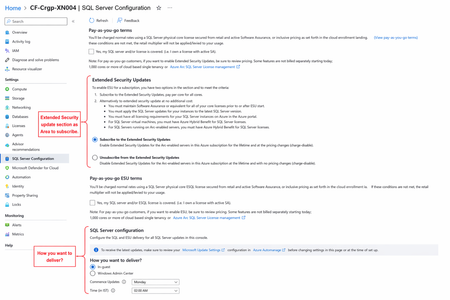
SQL Server 2016 reaches the end of extended support on July 14, 2026. After that date, instances that remain on SQL Server 2016 no longer receive regular security updates unless they are covered through Extended Security Updates (ESUs)). ESUs provide a time-bound security bridge for customers who need to maintain existing workloads while they upgrade to a supported SQL Server release or modernize to Azure SQL. SQL Server 2016 Extended Security Updates can be managed across multiple deployment models, including SQL Server enabled by Azure Arc for on-premises and other clouds, and SQL Server on Azure Virtual Machines. This provides a consistent protection path while customers assess modernization options and operational readiness. Today, we are making the Extended Security Updates subscription experience available in Azure so customers can enroll ahead of SQL Server 2016 reaching end of support, and be ready to receive Extended Security Updates when they are released. Why this matters now SQL Server follows a fixed lifecycle policy with mainstream support followed by extended support. Once SQL Server 2016 exits extended support, Extended Security Updates become the only for continued security coverage on that version. Extended Security Updates are intended as a temporary option for risk reduction, not as a long-term alternative to upgrade or modernization. For many production environments, the constraint is not awareness of the deadline but the complexity of the upgrade path. Application dependencies, validation requirements, change windows, and compliance controls sometimes make immediate migration impractical. Extended Security Updates help teams maintain security coverage during that transition period while they sequence remediation, testing, and platform changes. How SQL Server 2016 Extended Security Updates work Support window: SQL Server 2016 exits extended support on July 14, 2026. Extended Security Updates are available for up to three additional years, with coverage periods defined by the SQL Server 2016 lifecycle schedule through July 17, 2029. Supported scope and update model Eligible versions: SQL Server 2016. Extended Security Updates are also available for SQL Server 2014 until July 12, 2027. Eligible editions: Standard and Enterprise Update content: Extended Security Updates deliver critical security updates when applicable. They do not include new features, non-security bug fixes, non-critical security updates, or design changes. Operational note: SQL Server ESUs are not published on a fixed monthly cadence. They are released when qualifying vulnerabilities require a release. For Azure Arc-connected environments, Extended Security Updates subscriptions can be aligned to the deployment model, including virtual cores for VM-based deployments and physical cores for host-based scenarios. This gives organizations flexibility to match ESU coverage to how SQL Server is deployed and managed. How to acquire Extended Security Updates coverage Customers can acquire SQL Server ESU coverage in different ways depending on where SQL Server is running and how they prefer to purchase. For on-premises, edge, and other cloud environments, SQL Server enabled by Azure Arc provides the control plane to onboard instances, manage eligibility, and apply ESU subscription settings. For workloads already running on Azure Virtual Machines, customers can subscribe to ESU coverage through Azure-based controls. Customers can purchase that coverage as pay-as-you-go through Azure or through Volume Licensing on an annual basis for eligible licenses with active Software Assurance. When customers choose Volume Licensing, Azure Arc registration is still required to activate access to ESUs. SQL Server enabled by Azure Arc: Use Azure Arc to onboard eligible SQL Server instances outside Azure, manage Extended Security Updates subscription settings, and support both connected and qualifying disconnected scenarios. SQL Server on Azure Virtual Machines: Use Azure-based controls to subscribe to Extended Security Updates coverage for workloads running on Azure Virtual Machines. For SQL Server 2016, this now requires a paid ESU subscription rather than the previous no-additional-cost experience. Supported regions: Subscribing to Extended Security Updates for SQL Server on Azure VMs is only available in the supported regions listed. To subscribe to ESUs in an unsupported region, contact Microsoft Support to determine the appropriate ESU acquisition path. Volume Licensing: If you cannot subscribe to Extended Security Updates via Azure Arc, you can purchase through the Volume Licensing channel on an annual basis for eligible licenses with active Software Assurance. Talk to your Microsoft seller for more information. Azure Arc registration is still required to activate access to ESUs. Migrate to Azure SQL: Customers that are ready to modernize further can move to Azure SQL Database or Azure SQL Managed Instance, which removes Extended Security Updates dependency by moving to fully supported, cloud-managed SQL services. The following diagram summarizes how customers can obtain SQL Server 2016 Extended Security Updates coverage through Azure Arc and Azure Virtual Machines. What to do next Organizations still running SQL Server 2016 should use the remaining support window to assess estate readiness, determine the right Extended Security Updates subscription model, and define the target modernization path for each workload. For some environments, that means upgrading in place to a supported SQL Server version. For others, it means migrating and upgrading to Azure Virtual Machines or Azure SQL to simplify long-term operations. The important step is to make the transition plan executable before support ends. Learn more SQL Server end of support options SQL Server Extended Security Updates enabled by Azure Arc SQL Server enabled by Azure Arc Extend support for SQL Server with Azure VM SQL Server on Azure VM overview Migrate to Azure SQL4KViews0likes7CommentsUnlocking Enterprise AI: SQL Server 2025 and NVIDIA Nemotron RAG Accelerate AI
Today, most of the world’s data still remains untapped, sitting in databases, documents, and systems across organizations. Enterprises are racing to unlock this data’s value by building the next wave of generative AI applications—solutions that can answer questions, summarize documents, and drive smarter decisions. At the heart of these innovations are retrieval-augmented generation (RAG) pipelines, which enable users to interactively engage with large amount of data that continuously evolves. Yet, as promising as RAG pipelines are, enterprises face real challenges in making them work at scale. Handling both structured and unstructured data, processing massive volumes efficiently, and ensuring privacy and security are just a few hurdles. This is where the integration between SQL Server 2025 and NVIDIA Nemotron RAG models, deployed as NVIDIA NIM microservices, comes in, offering a new approach that streamlines AI deployment and delivers enterprise-grade performance—whether you’re running workloads in the cloud or on-premises. “As AI becomes core to every enterprise, organizations need efficient and compliant ways to bring intelligence to their data,” said Joey Conway, Senior Director of Generative AI software at NVIDIA. “With SQL Server 2025’s built-in AI and NVIDIA Nemotron RAG, deployed as NIM microservices, enterprises can deploy and run AI models close to their data on premises or in the cloud without complex integration, accelerating innovation while maintaining data sovereignty and control.” Overcoming the complexity of generating embeddings at scale Customer challenge Building responsive AI applications using RAG requires converting SQL data into vector embeddings—a process that feeds huge amounts of text through complex neural networks. This is inherently parallel and compute-intensive, often creating performance bottlenecks that prevent real-time data indexing. The result? Slow applications and poor user experiences. Moreover, enterprises need flexibility. Different embedding models excel at different tasks—semantic search, recommendations, classification—and each comes with its own tradeoffs in accuracy, speed, and cost. Businesses want to mix and match models, balance premium performance with budget constraints, and stay resilient against model deprecation or API changes. Furthermore, rapid experimentation and adaptation are key to staying ahead and thus developers want models that offer flexible customization and full transparency. The Solution: SQL Server 2025 + NVIDIA Nemotron RAG SQL Server 2025 brings AI closer to your data, allowing you to natively and securely connect to any model hosted anywhere. You can generate embeddings directly in SQL using extensions to T-SQL —no need for new languages, frameworks, or third-party tools. By connecting SQL Server 2025 to the llama-nemotron-embed-1b-v2 embedding model from NVIDIA, you eliminate bottlenecks and deliver the massive throughput needed for real-time embedding generation. llama-nemotron-embed-1b-v2 is a best in class embedding model that offers multilingual and cross-lingual text question-answering retrieval with long context support and optimized data storage. This model is part of NVIDIA Nemotron RAG models, a collection of extraction, embedding, reranking models, fine-tuned with the Nemotron RAG datasets and scripts, to achieve the best accuracy. These models offer flexible customization, enabling easy fine-tuning and rapid experimentation. They also offer full transparency with open access to models, datasets, and scripts. Llama-nemotron-embed-1b-v2 is the model of choice for embedding workflows, but this high-speed inference pipeline is not limited to this model and can potentially call any optimized AI model as an NVIDIA NIM microservice, seamlessly powering every stage of the RAG pipeline. From multimodal data ingestion and advanced retrieval to reranking, all operations run directly on your data within SQL Server. Such RAG systems can be applied across a wide range of use cases, enabling intelligent, context-aware applications across industries. Customer Benefits: With GPU acceleration and built-in AI of SQL Server 2025, you can achieve optimal inference, ensuring performance that meets the demands of modern applications. Our flexible approach lets you mix and match models to suit different use cases, striking the right balance between accuracy and cost. And with open models that enable vendor flexibility and rapid adaptation, you gain resilience to stay ahead of the curve in an ever-changing AI landscape. Streamlining AI Model Deployment with Enterprise-Grade Confidence Customer Challenge Integrating advanced AI models into enterprise workflows has historically been slow and complex. Specialized teams must manage intricate software dependencies, configure infrastructure, and handle ongoing maintenance—all while navigating the risks of deploying unsupported models in mission-critical environments. This complexity slows innovation, drains engineering resources, and increases risk. The Solution: Simplified, Secure Model Deployment with NVIDIA NIM This collaboration simplifies and de-risks AI deployment. The llama-nemotron-embed-1b-v2 model is available as an NVIDIA NIM microservice for secure, reliable deployment across multiple Azure compute platforms. Prebuilt NIM containers for a broad spectrum of AI models and can be deployed with a single command for easy integration into enterprise-grade AI applications using built-in REST APIs of SQL Server 2025 and just a few lines of code, regardless where you run SQL Server workloads and NVIDIA NIM, on premises or in the cloud. NIM containers package the latest AI models together with the best inference technology from NVIDIA and the community and all dependencies into a ready-to-run container, abstracting away the complexity of environment setup so customers can spin up AI services quickly. Furthermore, NVIDIA NIM is enterprise-grade and is continuously managed by NVIDIA with dedicated software branches, rigorous validation processes, and support. As a result, developers can confidently integrate state-of-the-art AI into their data applications. This streamlined approach significantly reduces development overhead and provides the reliability needed for mission-critical enterprise systems. NVIDIA NIM containers are discoverable and deployable via Microsoft Azure AI Foundry’s model catalog. Customer Benefits Rapid deployment with minimal setup means you can start leveraging AI without specialized engineering, and SQL Server 2025 makes it even easier with built-in support for AI workloads and native REST APIs. Enterprise-grade security and monitoring ensure safe, reliable operations, while SQL Server’s integration with Entra ID and advanced compliance features provide added protection. Direct integration into SQL workflows reduces complexity and risk, and with SQL Server’s hybrid flexibility, you can run seamlessly across on-premises and cloud environments—simplifying modernization while maintaining control. Innovating Without Compromise on Security or Flexibility Customer Challenge Organizations in regulated industries often face a tough choice: adopt powerful AI or maintain strict data residency and compliance. Moving sensitive data to external services is often not an option, and many companies run AI inference workloads both in the cloud and on-premises to balance scalability, privacy, regulatory compliance, and low-latency requirements. The Solution: Flexible, Secure Integration—On-Premises and Cloud SQL Server 2025 enables organizations in regulated environments to securely integrate locally hosted AI models, ensuring data residency and compliance while minimizing network overhead. This architecture boosts throughput by keeping sensitive data on-premises and leveraging SQL Server’s native extensibility for direct model invocation. With SQL Server 2025 and Nemotron RAG, deployed as NVIDIA NIM microservices, you get the best of both worlds. This solution can be seamlessly deployed in the cloud with serverless NVIDIA GPUs on Azure Container Apps (ACA) or on-premises with NVIDIA GPUs on Azure Local. Sensitive data never leaves your secure environment, allowing you to harness the full power of Nemotron models while maintaining complete data sovereignty and meeting the strictest compliance mandates. Customer Benefits SQL Server 2025 helps you maintain compliance by supporting data residency and meeting regulatory standard requirements across regions. Sensitive data stays protected on-premises with enterprise-grade security, including consistent access controls, ledger support, and advanced encryption to minimize risk. At the same time, SQL Server’s hybrid flexibility lets you deploy AI workloads wherever they’re needed—on-premises, in the cloud, or across a hybrid environment—while leveraging built-in AI features like vector search and secure integration with locally hosted models for performance and control. Conclusion: Powering the Next Wave of Enterprise AI The collaboration between Microsoft and NVIDIA is more than a technical integration. It’s designed to help enterprises overcome the toughest challenges in AI deployment. By streamlining vector embedding and vector search, delivering enterprise-grade performance, and enabling secure, flexible integration across cloud and on-premises environments, this joint solution empowers organizations to unlock the full value of their data. Whether you’re building conversational AI, automating document analysis, or driving predictive insights, SQL Server 2025 and NVIDIA Nemotron RAG models, deployed as NIM, provide the tools you need to innovate with confidence. The future of enterprise AI is here and it’s flexible, secure, and built for real business impact. Get started today: Learn more about SQL Server 2025 and download it today Learn more about our joint solution from NVIDIA’s Technical Blog GitHub: Microsoft SQL Server 2025 and NVIDIA Nemotron RAG1.7KViews1like0CommentsReimagining Data Excellence: SQL Server 2025 Accelerated by Pure Storage
SQL Server 2025 is a leap forward as enterprise AI-ready database, unifying analytics, modern AI application development, and mission-critical engine capabilities like security, high availability and performance from ground to cloud. Pure Storage’s all-Flash solutions are engineered to optimize SQL Server workloads, offering faster query performance, reduced latency, and simplified management. Together it helps customers accelerate the modernization of their data estate.1.5KViews2likes1CommentMicrosoft at PASS Data Community Summit 2025
Microsoft is excited to be back as the Sapphire Sponsor for this year’s PASS Data Community Summit, together with AMD. It’ll be a week packed with keynotes, learning pathways, sessions, breakfast, giveaways and more! Our experts and engineers will be there and ready to share all things SQL Server 2025, cover the latest from Azure SQL, Microsoft Fabric and more—delivered on a foundation of AMD-powered innovation. Whether your goals are modernizing for performance and AI readiness or building intelligent apps and agents, we’ll have you covered. Join us to “Connect, Share and Learn” alongside the rest of your peers at the PASS community. CVP of Azure Databases, Shireesh Thota, is back as the keynote speaker, and will be joined by leaders across Microsoft Data including Priya Sathy and Bob Ward—highlighting how Microsoft and AMD are shaping the future of data together. Join us on Day 2, Thursday, November 20 th . Come back and check as new sessions are added: Learning Pathways: Becoming Azure SQL DBA – High Availability and BCDR Dr. Dani Ljepava, Bob Ward, John Morehouse Learn how to evolve your Azure SQL DBA skills in the domain of High Availability (HA), Business Continuity and Disaster Recovery (BCDR) from the perspective of on-premises DBA’s. Becoming Azure SQL DBA – Security, Compliance, Threats, Connectivity Pam Lahoud, Joey Dantoni Evolve your Azure SQL DBA skills in the domain of security, compliance, authentication and connectivity, from the perspective of an on-premises DBA now supporting databases in Azure. Becoming Azure SQL DBA – Performance Monitoring, Tuning, and Alerting Erin Stellato, Pam Lahoud, Monica Morehouse (Rathbun) Extend your Azure SQL DBA skills in the domain of performance monitoring, tuning, and alerting from the perspective of on-premises DBA. Becoming Azure SQL DBA – Copilot and AI Davide Mauri, Erin Stellato Unlock the future of data productivity with a hands-on exploration of AI-powered Copilots! We’ll dive into Copilot in SQL Server Management Studio (SSMS), Microsoft Copilot in Azure with NL2SQL and SQL, and Copilot for SQL Databases in Microsoft Fabric. Becoming an Azure SQL DBA - New Opportunities for DBAs in Azure Bob Ward, Dr. Dani Ljepava, Erin Stellato, Pam Lahoud Explore new skill development opportunities as an Azure SQL DBA. Many traditional SQL Server DBA tasks have been partially or fully delegated to Microsoft, and this shift in responsibilities provides a great opportunity to invest in developing new cloud skills that will help you excel as an Azure SQL DBA champion. General Sessions Breakfast with the Microsoft Data Leadership Team JUST ADDED! Shireesh Thota, Priya Sathy, Bob Ward, Erin Stellato Get your day started early at PASS Data Community Summit with a free breakfast and a Q&A session with a panel of leaders across Microsoft hosted by Bob Ward. Tell us what is top of mind for you across SQL Server, Azure SQL, Microsoft Fabric and topics like AI. This is always one of the most popular sessions at the PASS Data Community Summit, so you won’t want to miss it! Lunch and Learn with Bob Ward JUST ADDED! Join us for a lunch and learn with Bob Ward as he covers all things SQL and dives into his latest release: SQL Server 2025 Unveiled: The AI-Ready Enterprise Database with Microsoft Fabric Integration. Space will be extremely limited, bring your lunch and join this exclusive session! Inside SQL Server 2025 Bob Ward Join Bob Ward and friends to go deep into the next major release of SQL Server, SQL Server 2025, the Enterprise AI-ready database. You will learn the fundamentals and a deep dive of all the new capabilities in the release so you can plan and make key decisions on when and how to upgrade. SQL Database in Fabric: The Unified Database for AI Apps and Analytics JUST ADDED! Amar Digamber Patil, Yo-Lei Chen, Basudep Sarkar Discover how SQL in Fabric brings transactional and analytical workloads together in one cloud-native database. In this session, we’ll show how developers and data teams can simplify AI-driven application development with near real-time insights and built-in AI, seamless OneLake integration, and end-to-end analytics—all in a single, unified experience. Building Scalable, Secure AI Apps with Azure SQL Hyperscale Build AI apps that run securely and scale with your needs with Azure SQL Database Hyperscale. We’ll cover native vector indexes for semantic search, read scale‑out for low‑latency RAG, using the model of your choice, from T‑SQL. Ecosystem sessions Smarter GitHub Copilot + SSMS 22 Erin Stellato Discover how GitHub Copilot is transforming the way you write T-SQL and optimize your SQL databases inside SQL Server Management Studio (SSMS) 22. In this session, we’ll showcase the newest SSMS 22 features alongside real-world demos of GitHub Copilot, highlighting how AI assistance can speed up query writing, reduce errors, and boost productivity. Booth Experiences What: Book signing "SQL Server 2025 Unveiled" with Bob Ward When: Wednesday, November 19th evening reception Where: Microsoft and AMD booth (#404) Join us as we celebrate the release of "SQL Server 2025 Unveiled" at the PASS Summit evening reception! Limited to the first 200 attendees. Now on demand! Get a jump start on your PASS experience. "The AI Opportunity: From Ground to Cloud" webinar is now available on demand! Get an early preview of the sessions at PASS Summit and a closer look into SQL Server 2025. Hosted by Redgate’s Kellyn Gorman and Bob Ward, sign up and watch today! --Exclusive Offer for PASS Attendees-- As a special offer from Microsoft, use the code AZURE150 to receive $150 off your 3-day conference pass. Don’t miss this opportunity to connect, grow, and learn with the community. Register today779Views0likes0CommentsAzure Arc enabled SQL Server - determine your Azure SQL target with ease and confidence
Selecting the best Azure SQL target for your Azure Arc enabled SQL Server with confidence is now easier. All of this while you continue to manage secure and govern your SQL Server estate from Azure.2.5KViews2likes0Comments