gitops
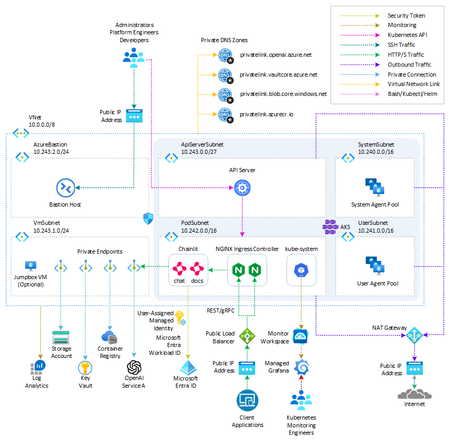
16 TopicsCreate an Azure OpenAI, LangChain, ChromaDB, and Chainlit chat app in AKS using Terraform
This sample shows how to create two AKS-hosted chat applications that use OpenAI, LangChain, ChromaDB, and Chainlit using Python and deploy them to an AKS environment built in Terraform.29KViews12likes4Comments
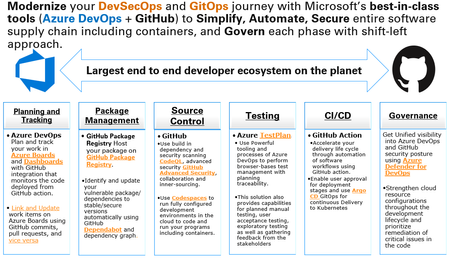
Modernize DevSecOps and GitOps journey with Microsoft’s Unified solution (Azure DevOps + GitHub)
Modernize your DevSecOps and GitOps journey with Microsoft’s Unified solution and best-in-class tools (Azure DevOps + GitHub) to Simplify, Automate, Secure entire software supply chain including containers, and Govern each phase with shift-left approach.Announcing Private Preview: ArgoCD through Microsoft GitOps
We're excited to announce the Private Preview for Microsoft GitOps ArgoCD. Delivered as a cluster extension across Azure Kubernetes Service (AKS) and Azure Arc-enabled Kubernetes, Microsoft GitOps delivers a consistent and robust management, security, and deployment experience for ArgoCD across your heterogeneous environments. This capability complements Microsoft GitOps existing support for Flux, which is currently in General Availability. By signing up for the Private Preview, you'll get access to the ArgoCD cluster extension and the opportunity to connect with and provide feedback to the Microsoft GitOps product group. Sign up today at https://aka.ms/MicrosoftGitOpsPreviewSignup. Advantages of the current Microsoft GitOps experience for ArgoCD include: Simplified, templatized deployment as a cluster extension Managed and automated upgrade reducing overhead Official supportability and security for enterprise readiness Integration with Azure identity and authentication We look forward to continuing to deliver on an exceptional Microsoft GitOps experience across ArgoCD and Flux for customers running containerized workloads not only on Azure, but also on on-premises and other public clouds through Azure Arc.3.8KViews0likes0Comments
Give us your thoughts on running Kubernetes anywhere for a chance to win a $300 USD gift card!
Do you work with Kubernetes? Are you interested in improving Kubernetes experience across hybrid and multicloud environments? Take the survey below for a chance to win a $300 USD virtual gift card! Must be 18 or older. Survey ends on May 10, 2023.3.6KViews0likes0CommentsIntroducing GitHub Enterprise Local (Preview): DevOps for Sovereign and Private Cloud Environments
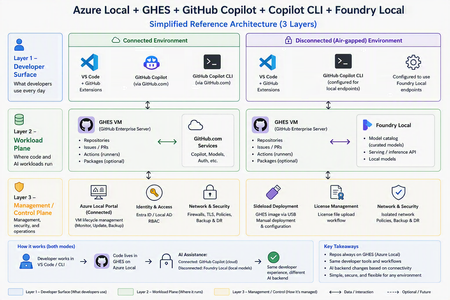
Across the world, many organizations, particularly in government, defense, financial services, and critical infrastructure, must operate within strict sovereign boundaries, often due to regulatory, security, or disconnected environment requirements. Microsoft’s Sovereign Private Cloud is a customer operated cloud model designed for scenarios where sovereignty, operational control, and resiliency are non negotiable. It enables organizations to operate securely and at scale, even in restricted or disconnected environments, while maintaining governance aligned with regulatory and national obligations. Azure Local is the foundation that makes this possible. With Azure Local, organizations can run critical workloads—including virtual machines, Kubernetes, virtual desktop infrastructure, and AI workloads—on infrastructure they own and control, while still benefiting from Azure consistent management, governance, and lifecycle operations. We’re continuing to expand the set of workloads and capabilities supported on Azure Local to meet the needs of organizations operating in sovereign and highly regulated environments. With Microsoft 365 Local, Azure Local now extends beyond infrastructure to support communication and collaboration workloads, enabling productivity and resiliency even in disconnected or restricted conditions. And with Foundry Local, we are supporting modern AI workloads on Azure Local, bringing advanced AI capabilities to infrastructure customers own and operate. We are excited to announce the public preview of GitHub Enterprise Local, which brings GitHub’s enterprise developer platform into sovereign and private cloud environments. GitHub Enterprise Local is fully hosted on customer owned infrastructure, enabling organizations to modernize application development while keeping source code, build pipelines, and development artifacts entirely within their own operational boundaries. What Is GitHub Enterprise Local? GitHub Enterprise Local enables organizations to deploy GitHub Enterprise Server (GHES) entirely within customer‑owned infrastructure using Azure Local as the underlying private cloud platform. The solution is delivered as a prebuilt virtual machine image that runs on Azure Local and operates fully within the customer’s security and network perimeter. All repositories, metadata, CI/CD workflows, and artifacts remain on‑premises. GitHub Enterprise Local is designed to run without internet connectivity by default, making it suitable for both connected and fully disconnected or air‑gapped environments. At the same time, it preserves a GitHub‑consistent experience for developers, allowing teams to continue using familiar workflows for source control, collaboration, and automation. Developer and Platform Capabilities GitHub Enterprise Local provides a comprehensive set of enterprise developer platform capabilities. Teams can host private repositories, manage organizations, and collaborate through pull requests, branch protection rules, and structured code reviews. Issues, wikis, and project collaboration features are also available, enabling end‑to‑end development workflows within the same platform. GitHub Enterprise Local can run on either a single-node or multi-node Azure Local instance depending on customer needs. Single‑node Azure Local runs GHES as a standalone VM, ideal for preview, PoC, and low‑risk scenarios focused on simplicity and cost efficiency. For production-oriented deployments, the same single GHES VM can run on a multi‑node Azure Local cluster, where Azure Local provides VM‑level high availability and failover. For automation and delivery, GitHub Enterprise Local supports GitHub Actions using self‑hosted runners. This allows organizations to build and run CI/CD pipelines entirely within their own environments, with full control over execution context, dependencies, and network access. GitHub Packages can be used for artifact management, supporting common ecosystems such as npm, NuGet, Maven, and container images. GitHub Enterprise Local extends modern development workflows with AI assisted experiences while keeping sensitive data within customer-controlled environments. Developers can use GitHub Copilot in several ways, including as a standalone experience, through Copilot CLI, and in VS Code. They can choose GitHub-managed models by connecting to GitHub.com, or connecting directly to model providers from Copilot CLI, allowing source code to avoid passing through GitHub Cloud. Foundry Local provides an on-premises inference layer that keeps prompts, code context, and model execution inside organizational boundaries. Together, these capabilities create a clear integration path across code automation and AI application development, enabling organizations to modernize the developer experience while preserving operational control, compliance, and auditability. Developer AI Workflow Architecture This architecture demonstrates how GitHub Enterprise Local serves as the secure, customer-managed foundation for source control, collaboration, and workflow orchestration, enabling developers to layer AI-assisted capabilities through GitHub Copilot, GitHub CLI, and Foundry Local—while ensuring that code, data, and AI execution remain fully within organizational boundaries. Architecture Overview GitHub Enterprise Local follows a layered architecture model. Infrastructure Layer Azure Local forms the foundation, deployed on Azure Local–certified hardware. It provides: The virtualization platform for running GitHub Enterprise Local Infrastructure availability and update management Customer‑controlled networking, identity, and security policies Azure Arc‑enabled management for infrastructure lifecycle operations GitHub Enterprise Local Appliance Layer GitHub Enterprise Server (GHES) is deployed as a prebuilt virtual machine image on Azure Local. This VM includes: The GHES application stack Persistent data disks for repositories and metadata Support for replica‑based failover configurations, depending on customer requirements All application data remains within customer infrastructure boundaries. Operations Layer Operational responsibilities are clearly separated: Azure Local administrators manage the Azure Local infrastructure through Azure GitHub administrators manage GHES configuration, upgrades, user access, and ongoing maintenance through the GitHub Management control and site admin dashboard This separation aligns with common enterprise operational models. Connectivity Modes and Deployment Scenarios GHES is designed to operate fully offline, making it suitable for air‑gapped and restricted environments. Azure Local complements this capability by supporting both connected and fully disconnected operational modes. In connected environments, customers can take advantage of centralized management and monitoring of GHES appliance. In disconnected environments, the entire solution can operate in complete isolation, ensuring compliance with strict sovereignty or security mandates. This flexibility allows organizations to adopt a deployment model that aligns with their regulatory, operational, and security requirements. Hardware and Capacity Planning GitHub Enterprise Local virtual machine sizing depends on customer use cases, including: Number of developers Repository size and growth CI/CD pipeline frequency Artifact storage requirements Azure Local supports running GitHub Enterprise Local on both Integrated and Premier hardware solutions, provided sufficient capacity is available. Customers should plan compute, memory, storage, and network resources accordingly. Minimum recommended requirements Billing Overview GitHub Enterprise Local combines user-based application licensing, Azure Local infrastructure-based billing, and separate pricing for AI services such as Copilot and Foundry. GitHub Enterprise Local is billed per user seat. (GitHub Enterprise license) Azure Local is billed per physical CPU core. (Azure Local Billing) Copilot and Foundry have separate service-based pricing. (GitHub Copilot Plans & pricing) Public Preview Access GitHub Enterprise Local on Azure Local is available today in public preview. Customers can request access by completing the public preview registration form. Submissions are reviewed as part of the preview onboarding process. Participate in public preview: GitHub Enterprise Local Preview Sign-Up Learn More GitHub Enterprise Local documentation3KViews1like0Comments