frontier firm
20 TopicsPartner Blog | Introducing Microsoft 365 E7: The Frontier Suite
Frontier Firms—those who adopt an AI-first approach as a core part of their business strategy—are shaping the future of work, which is increasingly fueled by agentic AI. As customers move toward Frontier Transformation, you can help them seize the agentic moment with the premium Microsoft 365 E7 plan, generally available on May 1, 2026. Microsoft 365 E7 is the Frontier Suite, designed for a human-led, agent-operated enterprise, turning human intent into AI action that functions securely and at scale. To accomplish this, Microsoft 365 E7 includes access to Microsoft Agent 365—the control plane to govern and scale agents. Microsoft 365 E7 bundles Microsoft 365 E5, Microsoft 365 Copilot, Entra Suite, and Agent 365 to serve customers who are ready to scale AI with governance and security. This means your customers will have AI-powered productivity apps with advanced security and AI capabilities, grounded in intelligence and trust. You can help your customers make the most of the agentic AI opportunity and unlock new monetization streams with the premium Microsoft 365 E7 plan. Starting on April 1, 2026, to accelerate Microsoft 365 E5 to Microsoft 365 E7 upsell and Agent 365 adoption, Copilot + Power Accelerate will include Agent 365 across Immersion Briefings, Envisioning and proof of concept (PoC) engagements, and Deployment Accelerators. Microsoft 365 E7 and Agent 365 will also be included as eligible workloads for core tier one strategic product accelerators and growth levers in Cloud Solution Provider (CSP) incentives. The AI future is here. Encourage your customers to upgrade to Microsoft 365 E7 so they can move faster and deploy AI with confidence. Read more in our blog post20KViews4likes8CommentsScaling Seller Impact with ASPX Insights: From Data Access to AI-Driven Execution
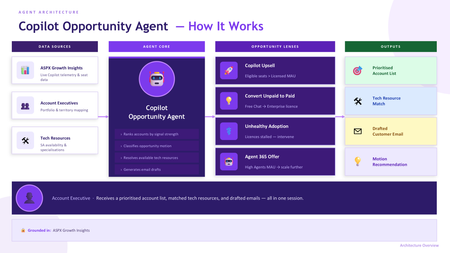
ASPX Insights in Partner Center Most sellers are not constrained by opportunity; they are constrained by time and signal. With up to 70% of effort spent on administrative work, portfolio coverage continues to expand while insight quality declines. Sellers are forced to manually interpret fragmented telemetry across multiple systems, slowing decision-making and reducing precision in where they focus. The result is missed revenue signals, delayed interventions, and inconsistent execution at scale. Productivity is not just about efficiency, it is about enabling every seller to consistently identify and act on the highest-value opportunity, in real time. To drive consistent, data-led growth across Security and AI Business Solutions, partners should connect to ASPX Insights within Partner Center. This provides direct access to adoption propensity models, customer telemetry, and actionable account-level insights across Microsoft 365 Copilot, E7, and Agent 365 scenarios. Access to ASPX Insights is only the starting point. The real value comes from how you operationalise that data and surface it directly to sellers in the flow of work. The most effective pattern is to build a lightweight “opportunity agent” that connects to ASPX data via API and translates telemetry into clear actions. This ensures your sales teams have the right conversation with the right customer at the right time - Conversations that are backed by intelligent insights to help guide your customer's on their AI and security journey. The Architecture ASPX Insights is powered by Partner Center data and exposes rich telemetry and propensity signals that can be accessed programmatically. This allows partners to move beyond dashboards and embed insights directly into seller workflows. As demonstrated in internal adoption patterns, partners can connect to ASPX via API and pull Customer-level adoption and usage telemetry Copilot, Security, and Agent usage signals Propensity scores for expansion, adoption, and conversion Licensing, whitespace, and engagement indicators The M365 Partner API – AI Business Solutions & Security Insights allows partners to ground an agent in real, actionable data rather than static pipeline assumptions. By pulling live telemetry and seat-level signals directly into the agent, the solution continuously reflects actual customer usage patterns - who is adopting, who is stalled, and where there is untapped potential. This means opportunity identification is no longer based on periodic reporting or manual interpretation, but on near real-time behavioural insight. As a result, account prioritisation, upsell motions, and intervention strategies are driven by evidence rather than instinct, enabling account teams to act with precision and focus on the highest-impact opportunities across their portfolio. The agent should act as a translation layer between raw telemetry and seller action. The goal is not to expose more data, but to remove ambiguity and tell the seller exactly where to focus. A simple architecture looks like this: Data layer Ingest ASPX Insights data via API on a daily or scheduled basis. Optionally store monthly snapshots to track trends and smooth out variability. This creates both real-time signal and historical context. With the data layer you have a couple of options. You can integrate directly into Partner Centre ASPX Insights by using the API. This is technically complex and may have a longer lead time to see results. Alternatively, to see results with less complexity, you can simply download snapshots of the data monthly from ASPX Insights in Partner Centre. This is manual but easy to achieve and offers a shorter time to value for your agent. Scoring layer Use ASPX propensity outputs directly or combine them with your own logic to rank accounts across a small set of opportunity lenses Expansion ready (Copilot scale) Conversion ready (free to paid) At risk (low adoption vs paid licenses) Transformation ready (Agent 365 and advanced AI scenarios) These align directly with the machine learning models and signals already surfaced in ASPX. Action layer Translate scores into next best actions Who to engage Why now What motion to run (sell, enable, expand, govern) This is where agents create value. Sellers should not see raw dashboards. They should see prioritised accounts and recommended actions. Internal Adoption Path The key design principle is simple: bring insight into the tools sellers already use. CRM integration Push ranked accounts and recommendations directly into CRM as opportunities, tasks, or account insights. This ensures data becomes part of pipeline management, not a separate activity. Copilot / Agent interface Expose the agent through Microsoft 365 Copilot or a custom chat interface where sellers can ask Which customers should I prioritise this week Which accounts are ready for Copilot or E7 expansion Where are my adoption risks The agent queries the ASPX-backed dataset and returns structured recommendations in seconds. Proactive notifications Trigger alerts based on signal changes Spikes in Copilot usage Drops in adoption for paid tenants New high-propensity accounts entering threshold This shifts sellers from reactive to proactive engagement. Portfolio dashboards (secondary) Maintain dashboards for leadership and planning, but not as the primary interaction model for sellers. Dashboards support strategy, agents drive execution. Extending into E7 and Agent 365 scenarios Once the agent is connected to ASPX, partners can extend the same model across broader solution plays E7 opportunities Use signals such as usage depth, licensing posture, and workload adoption to identify customers progressing toward advanced security and compliance requirements. The agent can flag these accounts as ready for E7-led conversations. Agent 365 opportunities Combine Copilot maturity with agent usage signals to identify customers moving beyond productivity into process automation. These are high-value transformation plays where partners should proactively engage. This ensures sellers are not operating in silos but are guided toward the next logical workload based on real behavior, not assumptions. Where to Next If you lead a partner sales team, connect to ASPX Insights and see how these insights can empower your sales teams to achieve more. Check out our ready made ASPX Insights agent in Github.1KViews3likes5CommentsBeyond Tokens: Rethinking AI Economics with Microsoft Foundry
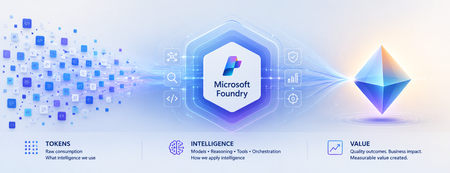
Beyond Tokens: Rethinking AI Economics with Microsoft Foundry From the cost of intelligence to the value of outcomes Enterprise AI has an accounting problem. Executives expect agentic AI to return roughly 171% on investment, according to one widely cited survey. Yet McKinsey finds only about 39% of organizations can attribute any earnings impact to AI at all. Both numbers can be true at once — because the gap between them is not a technology gap. It is a measurement gap. For the first few years of generative AI, one number dominated the economics conversation: tokens. How many tokens did a model consume? What was the cost per million tokens? Could a smaller model perform the same task? Those questions mattered when enterprises were experimenting with AI. They are no longer enough as AI moves into production. An enterprise agent doesn't simply consume tokens. It reasons, retrieves context, invokes tools, calls APIs, verifies its work, retries unsuccessful actions and sometimes escalates exceptions to humans. The model call might cost pennies. The business outcome could cost considerably more. Which leads to an increasingly important question: What is the right economic unit for intelligence? From AI experimentation to economic accountability The first wave of enterprise AI was about possibility: Can AI do this? The next wave is about production, as AI becomes embedded in software engineering, customer service, finance, healthcare and supply chains. And production changes the question: Should AI do this and at what cost? Microsoft has moved decisively onto this ground. In August 2026, the Microsoft Foundry team launched its Economics of Agent Optimization series, arguing that "tokens have become the new unit of technology spend" and that AI should be run as a managed investment system. On the latest earnings call, Satya Nadella described Microsoft's objective as "advancing the frontier on the cost-to-outcome curve, ensuring every customer can turn tokens into business results." The discipline is going mainstream too: 98% of FinOps teams now manage AI spend, up from 31% two years ago. Microsoft's series is largely about the numerator of that curve - making every request, agent and dollar more efficient. This article is about the denominator: what an outcome is, what it truly costs, and what it is worth. The evolution of Microsoft Foundry reflects the same shift. At Build 2026, Microsoft expanded the conversation beyond building agents toward tracing behavior, evaluating quality, monitoring production performance, optimizing agents and connecting their operation to ROI. Think of the progression as: Trace → Evaluate → Monitor → Optimize → ROI This is more than a technology roadmap. It represents a shift from observing AI as technology to managing AI as an economic asset. Tokens became the unit of spend. They were never the unit of value. Consider two AI agents handling the same customer-service workflow. Agent A costs $0.08 per interaction. Agent B costs $0.20. Agent A appears cheaper. But suppose Agent A successfully resolves only 55% of cases, while Agent B resolves 90%. The remainder require retries, additional reasoning or human intervention. Which agent is actually cheaper? The inexpensive interaction may produce the expensive resolution. This illustrates a fundamental problem: We often measure AI where it is consumed rather than where value is created. Tokens are a unit of consumption. Businesses operate in outcomes. A customer-service leader cares about issues resolved. An engineering leader cares about high-quality software reaching production. A finance leader cares about reconciliations completed accurately. The economic denominator needs to move closer to the business. The AI Economic Ladder I think of this evolution as an AI Economic Ladder: Tokens → Interactions → Tasks → Outcomes → Value Each step moves measurement closer to what the enterprise actually cares about. At the token level: What intelligence did we consume? At the interaction level: What did each AI run cost? At the task level: What did it cost to complete the work? At the outcome level: What did a successful result cost? At the value level: Was the outcome worth creating? An AI system can become more efficient at every technical metric while creating little economic value. Conversely, an expensive AI workflow could be extraordinarily valuable if it prevents revenue leakage, reduces operational risk or accelerates a critical business process. The objective isn't cheaper AI. It is better economics. Not every completed task is a successful outcome There is another complication. If an agent completes a workflow, should we count it as a successful outcome? Not necessarily. A meaningful outcome needs three characteristics: Completed. Quality-gated. Attributable. It must reach its intended end state, meet an explicit standard for quality, accuracy, safety or business acceptability, and be attributable to the agent or workflow that produced it. That gives us a more meaningful measure: Cost per Successful Outcome = Fully Loaded AI Workflow Cost / Completed, Quality-Gated, Attributable Outcomes The denominator becomes real only when named in business language: cost per prior authorization resolved in healthcare, per pull request triaged and tested in engineering, per disputed invoice reconciled in finance operations. If you cannot name the outcome in a sentence the process owner recognizes, you are not ready to measure it. The quality gate matters. With AI, "the system ran successfully" and "the system produced a good outcome" are not the same thing. Microsoft Foundry's tracing and evaluation capabilities become economically important for precisely this reason. Evaluation isn't merely quality control. It helps determine what gets counted as value. What does an AI outcome really cost? The true economic footprint goes far beyond inference: Model + Reasoning + Grounding + Tools + Orchestration + Infrastructure + Retries + Evaluation + Governance + Human Intervention Human intervention is particularly easy to overlook. Every time someone must review, correct, approve or recover an AI-generated outcome, the economics change. The same applies to verification. An agent reaching an acceptable result in three steps has different economics from one requiring fifteen steps and multiple retries. And verification is not a rounding error — it is the bulk of the bill. McKinsey's 2026 analysis of production agentic workflows found roughly 60% of an agentic task's cost is tied to refining answers — checking, repairing, re-verifying — not generating the initial response. Most of what you pay for is not intelligence. It is assurance. This means quality and economics are connected. The quality bar you set influences the cost you pay. The challenge isn't simply minimizing consumption. It is finding the right balance between quality, cost, speed and risk. Cost per outcome is only half the equation Now imagine two agents. Both cost $5 per successful outcome. One saves an employee ten minutes of administrative work. The other prevents $500 in revenue leakage. Their cost efficiency is identical. Their economics clearly aren't. So we need to move another step up the ladder: from Cost per Outcome to Value per Outcome. The question isn't only how cheaply AI can complete the work. It is: How much economic value does this outcome create relative to the intelligence required to produce it? Now the CIO, CFO, CAIO and business leader have a common conversation. Give every outcome an Intelligence Budget Not every problem deserves the smartest model available. Classifying an email may require relatively little intelligence. Resolving a complicated customer complaint may justify more context and reasoning. Assessing the risks in a multimillion-dollar contract may justify sophisticated reasoning, multiple validations and human review. Every business outcome therefore has an economically rational amount of intelligence worth spending on it. Call it an Intelligence Budget. This changes the architecture question from which model should we standardize on, to: What combination of model, reasoning, context, tools and human judgment does this outcome deserve? This is where Microsoft Foundry's model router becomes interesting. Individual requests can be dynamically routed so simpler work doesn't consume the same model resources as complex reasoning. If the Intelligence Budget is the economic principle, intelligent routing is one way of operationalizing it. The future enterprise AI architecture won't be about one model doing everything. It will route intelligence according to the economics, quality and risk of the outcome. Making AI economics observable None of this works without visibility. An AI system can be technically healthy and economically unhealthy — responsive and error-free while repeatedly choosing inefficient reasoning paths, invoking unnecessary tools or producing outputs requiring expensive human correction. AI economics and AI observability are becoming inseparable. Microsoft Foundry increasingly connects these disciplines. Tracing shows what an agent did. Evaluation determines whether it met required criteria. Observability helps monitor production behavior. Agent optimizer can test improvements across prompts, skills and models. Microsoft's emerging ROI capabilities take the next step by connecting operating costs with measures such as task completion, time saved and cost efficiency. Attribution is the bridge to the finance conversation. Teams place Azure API Management in front of Foundry endpoints as an AI Gateway, stream token telemetry into Application Insights, and use Entra Agent ID to give every agent run a discrete identity that maps cost to its cost center. Microsoft Agent 365 extends the discipline tenant-wide — spending policies, budget caps and departmental chargeback across Microsoft and third-party agents. Together, they create something enterprises have historically lacked: A feedback loop between how intelligence is consumed and what that intelligence accomplishes. The paradox of cheaper intelligence There is another reason AI economics will become more important as models get cheaper. The Jevons paradox suggests that when technology makes a resource cheaper and more efficient, total consumption can actually increase. AI may experience the same effect. Cheaper intelligence enables more agents, more reasoning and more workflows that were previously uneconomic. So we could see cost per unit of intelligence fall while total intelligence consumed rises. Cheaper AI may therefore produce larger AI bills. That isn't necessarily bad — provided value grows faster than consumption. The objective isn't minimum AI consumption. It is maximum economic value from AI consumption. From workload economics to portfolio economics As AI scales, economics becomes a capital-allocation question. I see three levels. Workload Economics: Is this AI system running efficiently? Outcome Economics: Is it producing quality outcomes economically? Portfolio Economics: Where should we put our next AI dollar? That final question will become increasingly important. An enterprise with hundreds of AI initiatives shouldn't assume every one deserves continued investment. Some should scale. Some need optimization. Some should be redesigned or consolidated. And some should be stopped. The ability to experiment cheaply created the first explosion of enterprise AI. The discipline to allocate capital intelligently will determine what scales. Who owns AI economics? Once an agent becomes part of how work gets done, its economics cannot remain purely an IT metric. The business understands the value of the outcome. Technology understands the architecture and optimization levers. Finance brings economic discipline and comparability. That suggests a shared model: Business owns the outcome. Technology owns the optimization levers. Finance owns the economic discipline. AI economics ultimately isn't just a technology-cost conversation. It is a business-performance and capital-allocation conversation. From abundant intelligence to intelligent economics We are entering an era where intelligence is becoming an increasingly abundant, programmable and variable-cost resource. Microsoft Foundry and the broader Microsoft AI stack are making it easier to build, evaluate, observe, optimize and govern that intelligence. But abundant intelligence does not guarantee abundant value. Enterprises still need to decide where AI belongs, how much intelligence each problem deserves, what defines a successful outcome, when humans should remain involved and which AI investments deserve more capital. The winners won't necessarily use the cheapest models. They won't consume the fewest tokens. And they won't be the organizations that build the most agents. They will become exceptionally good at moving up the AI Economic Ladder: from consumption, to outcomes, to value. Because the next era of AI won't be won by organizations that buy intelligence most cheaply. It will be won by those that convert intelligence into value most efficiently. Where to start: the first 90 days Define the denominator for your top three agents — what counts as done, what quality gate applies, who signs off. Instrument attribution — Azure API Management as an AI Gateway, token telemetry to Application Insights, Entra Agent ID on every run. Wire evaluations into the cost pipeline so only quality-gated outcomes count. Set Intelligence Budgets — model router per request, agent optimizer against your evaluators, Agent 365 policies as circuit breakers. Stand up a joint monthly review — business, technology and finance on one dashboard: outcomes delivered, cost per outcome, value per outcome. Frequently asked questions What is Cost per Successful Outcome in enterprise AI? The fully loaded cost of an AI workload divided by outputs that were completed, quality-gated and attributable - for example, cost per prior authorization resolved or per pull request triaged. It turns token metrics into the unit economics of AI-performed work. What is an Intelligence Budget? The economically rational amount of intelligence - model capability, reasoning, context, tools and human review — worth spending on a given outcome, based on its value and risk. Model router in Microsoft Foundry is one way to operationalize it. Why do AI agents cost more than single model calls? One agent task can involve planning, tool calls, retries and verification - many model calls with compounding context. Research on production agentic workflows attributes roughly 60% of task cost to refining and verifying answers, not generating the first response. Will falling model prices make AI cost management unnecessary? No. By the Jevons paradox, cheaper intelligence expands consumption, so total AI spend typically rises as unit prices fall. The discipline that matters is maximizing value per unit of intelligence. Who should own AI economics? A shared model: the business owns the outcome and its value, technology owns the optimization levers, and finance owns the economic discipline and review cadence. #MicrosoftFoundry #Agent365 #AzureAI #FinOps #AgenticAI #AIAgents #Azure #MicrosoftCostManagement #AIEconomics #Tokens References Microsoft Azure Blog: "The Economics of Agent Optimization: From pilots to measurable returns" (August 12, 2026) Microsoft FY26 Q4 earnings call (Satya Nadella, July 2026) McKinsey — "Cost versus value: managing agentic AI system performance" (July 2026) FinOps Foundation — State of FinOps 2026; Microsoft Learn — Model router for Microsoft Foundry; Agent optimizer; Foundry Control Plane cost optimization820Views1like2CommentsFrontier Transformation campaign in a box now available in Partner Marketing Center
AI transformation is moving beyond isolated experimentation to organization-wide initiatives and customers are looking for partners who can help them scale. Organizations scaling AI are seeing measurable gains across productivity, efficiency, and customer engagement. To support this shift, the Frontier Transformation campaign in a box provides a ready-to-launch, co-branded marketing campaign aligned to Microsoft AI solutions. This campaign is aligned with the Frontier Success framework and engages customers as they advance in their AI maturity, with messaging that connects AI capabilities to real business context while reinforcing trust, governance, and security. Available in Partner Marketing Center Pro, the Frontier Transformation campaign in a box empowers you to go market faster, support lead generation, and build pipeline. Partner Marketing Center Pro is available to partners who have purchased a partner benefits package, attained a Solutions Partner designation or are enrolled in ISV Success. Explore Frontier Transformation campaign in a box.156Views1like0CommentsGet ready to lead Frontier Transformation: Earn your badge and attend the summit
If you’re a solution engineer or architect building AI agents across the Frontier stack—including Microsoft Foundry, Microsoft Copilot Studio, Microsoft 365 Copilot, GitHub Copilot, Microsoft Fabric, and Agent 365—now’s the perfect time to validate your expertise with the Frontier Transformation Engineer badge. Through certifications, project-ready execution, and advanced training, this applied skilling journey hones your capabilities in designing, building, and operating production-ready agentic AI solutions—so you can lead customers from AI experimentation to secure implementation. Learn more about how to engineer a Frontier partner practice in our latest blog post. Want to fast-track your badge completion? Join us at the Frontier Transformation Engineer Summit on June 9 for a live, expert-led skilling experience where you’ll explore how to use Microsoft Agent Factory at scale, build your expertise, showcase organizational readiness, and lead Frontier Transformation for your customers.909Views1like0CommentsMake this your year for Frontier Transformation: Earn your badge and join us at the summit
If you’re a solution engineer or architect building AI agents across the Frontier stack—including Microsoft Foundry, Microsoft Copilot Studio, Microsoft 365 Copilot, GitHub Copilot, Microsoft Fabric, and Microsoft Agent 365—now’s the perfect time to validate your expertise with the Frontier Transformation Engineer badgehttps://aka.ms/FrontierPartnerSkilling. Through certifications, project-ready execution, and advanced training, this applied skilling journey hones your capabilities in designing, building, and operating production-ready agentic AI solutions—so you can lead customers from AI experimentation to secure implementation. Learn more about how to engineer a Frontier partner practice in our latest blog post. Want to fast-track your badge completion? Join us at the Frontier Transformation Engineer Summit on June 9 for a live, expert-led skilling experience where you’ll explore how to use Microsoft Agent Factory at scale, build individual expertise, showcase organizational readiness, and lead Frontier Transformation for your customers. Plus, make sure you’re registered for MCAPS Start for Partners on July 22 to get the insights and playbooks to sharpen your focus and position your practice where the momentum is strongest. Register now343Views1like0Comments
From insight to action: how Adobe and Microsoft are helping marketers move faster with AI
Today’s marketing leaders are under pressure to do more than ever—deliver meaningful personalization, accelerate execution, and prove measurable business impact. At the same time, teams are navigating increasing complexity: fragmented data, disconnected tools, and insights that arrive too late to act on. AI can change this—but only when it’s embedded directly into how people already work. That’s why Microsoft and Adobe are deepening our partnership: bringing customer experience intelligence, AI-powered workflows, and enterprise-grade AI directly into Microsoft 365 Copilot—so teams can move from insight to alignment to execution in one continuous workflow. The result is faster decisions, more coordinated execution, and clearer business outcomes—without breaking flow or context. Bringing customer experience intelligence into the flow of work Marketing teams don’t struggle because they lack data. They struggle because insights live in one place, collaboration in another, and execution somewhere else entirely. That disconnect slows teams down and creates unnecessary friction between analysis and action. Together, Adobe and Microsoft are changing that dynamic by connecting Adobe’s customer experience capabilities with Microsoft 365 Copilot and Copilot Cowork—so insight, collaboration, and next-best action can happen where work already happens: in Copilot Chat and in everyday apps like Teams, Word, and PowerPoint. Marketers can ask questions, explore insights, align with teammates, and take action without jumping between tools—turning intelligence into impact at the moment it matters. Adobe Marketing Agent for Microsoft 365 Copilot: now generally available A major milestone in this journey is the general availability of the Adobe Marketing Agent for Microsoft 365 Copilot, now available via Microsoft Commercial Marketplace. The Adobe Marketing Agent brings Adobe customer experience intelligence directly into Copilot, enabling marketing teams to: Accelerate time from insight to decision Move seamlessly from analysis to execution Keep humans firmly in control, with AI supporting—not replacing—decision‑making Importantly, the agent is enterprise-ready by design. IT administrators can deploy and manage the experience through the Microsoft 365 admin center, ensuring security, governance, and compliance at scale. Expanding executive experiences with Copilot Cowork Looking ahead, Adobe skills designed for customer experience orchestration will be accessible in Copilot Cowork—in a future release. This upcoming experience will enable customer experience leaders to engage with customer experience insights in a more direct, conversational way, bringing strategic visibility into the same Copilot environments where decisions are made and actions are coordinated. Built on Azure to scale securely and responsibly The technology foundation of this innovation is Azure. Adobe Experience Platform, Adobe Experience Platform Agent Orchestrator, and Adobe AI Agents are built on Azure and leverage Azure AI models, providing the scalability, security, and reliability enterprises require. By running on Azure, these agentic experiences benefit from Microsoft’s global infrastructure, enterprise‑grade security, and responsible AI commitments—supporting customer trust as organizations scale AI across their business. Designed for interoperability across agent ecosystems Modern enterprises don’t operate in a single ecosystem—and their agents shouldn’t either. Adobe agents are built to interoperate with agents created using Microsoft Azure AI Foundry or Copilot Studio, enabling customers to orchestrate richer, cross‑functional workflows across marketing, sales, service, and operations. This architecture is designed to enable organizations to compose agentic solutions that reflect how work actually happens—across systems, teams, and business processes. Moving from experimentation to execution This partnership reflects a broader shift in how organizations adopt AI—moving from experimentation to embedded, enterprise‑ready execution. By bringing the full power of Adobe Experience Platform together with Microsoft’s AI platform, cloud infrastructure, and Copilot experiences, we’re helping teams move faster with clarity, confidence, and control. This is how AI becomes not just powerful—but practical. Learn more Adobe + Microsoft partnership page Adobe Marketing Agent for Microsoft Copilot page366Views1like0CommentsPartner Blog | Frontier Transformation starts here: Save the date for MCAPS Start for Partners
Customers are moving toward Frontier Transformation, and they are looking to Microsoft partners to turn AI from isolated experimentation into a repeatable operating capability embedded into how work gets done. Value does not scale automatically, but complexity does. Partners who win in FY27 will be the ones who can operationalize AI with intelligence grounded in real work and trust built in from day one, including security, governance, and responsible AI. MCAPS Start for Partners is built to give you early clarity on what Microsoft will prioritize in FY27 so you can translate strategy into execution. It is the annual moment to align with Microsoft priorities at the start of the fiscal year so that you begin on the same page around investments and go-to-market motions that will shape customer conversations throughout the year. Save the date to join us virtually on Wednesday, July 22, 2026, to align on what is changing, what is net-new, and where Microsoft will focus. You will hear directly from Microsoft leaders and leave with practical next steps you can activate with your teams in the first weeks of FY27 across co-sell engagement, Microsoft Marketplace motions, incentives, and skilling. Registration opens in May. Download the calendar invite now to save the date for the event. The shift partners are observing: Frontier Transformation moves from pilots to operating capability Across industries, customers are pushing for outcomes, not pilots. They want solutions that can be operationalized, governed, and scaled across business units. Expectations are also rising around security, compliance, and responsible AI as AI moves closer to core business processes. For partners, this is a clear signal. Differentiation increasingly comes from repeatable delivery models, strong governance, and responsible AI practices built into your approach from day one. Customers want confidence that AI is not just deployed but is also managed, secured, and monitored in ways that stand up to real-world use. Starting FY27 aligned to Microsoft priorities can sharpen your focus, guide where you invest, and accelerate your ability to engage customers with a clear execution model. Continue reading here216Views1like0Comments
Spotlight On... AI Transformation & the Frontier Firm Playbook
Introduction AI transformation is not a single launch – it’s a multi‑phase journey that blends strategy, change management, and measurable business outcomes. The Frontier Firm Playbook captures how leading organizations move from AI pilots to pervasive impact by aligning use cases to business value, scaling responsibly, and building momentum with the right metrics. This article shares how to apply that playbook in practice – and how Viva Glint and Viva Pulse together serve as the employee listening and insights backbone of the transformation, capturing signals of readiness, trust, adoption, and impact that usage telemetry alone cannot reveal. Pulse enables rapid, scenario‑specific feedback early and often, while Glint provides the enterprise‑grade analytics, benchmarking, and trend analysis required to govern and scale AI transformation. Why Follow the Frontier Firm Playbook? Frontier Firms are those that consistently turn AI’s potential into a durable competitive advantage. What sets them apart is how they manage the transformation: Intentional sequencing: They sequence initiatives from foundational readiness to pilot-scenario quick wins, to scaled adoption. Measuring what matters: They go beyond raw deployment counts – tracking usage, behavior change, and business outcomes together. Building trust & capability: They invest in upskilling, clear communication, and responsible AI guardrails to foster confidence and competence. Continuous feedback loops: They continuously listen to employees (and customers), using feedback to refine the program as it evolves. Crucially, Frontier Firms treat AI adoption as an organization-wide people transformation, not just a tech rollout. HR: Co-Owner of the Journey In successful AI transformations, HR is a named co‑owner of the Frontier Firm journey alongside IT and business leadership. That’s because lasting AI-powered change depends on new behaviors, skills, and cultural shifts at scale – domains where HR excels: Workforce transformation: AI adoption reshapes roles, skills, incentives, manager routines, and culture. HR functions as the strategic enabler for these workforce changes, ensuring people are prepared and supported. Skills and enablement: HR drives role-based training, upskilling, and change communications, so employees feel confident and know why and how to use AI. Employee listening & trust: HR uses Viva Glint and Pulse to gauge sentiment, trust, and pain points, giving leaders evidence to steer the change effectively. Bottom line: AI transformation is as much about people as technology. Empowering HR to co-lead – backed by robust employee insights – greatly increases the odds of success. Viva Glint & Pulse: A Layered Listening Model Frontier Firms use a layered listening approach. Viva Pulse captures fast, situational feedback during early rollout and experimentation, while Viva Glint consolidates sentiment, comments, and outcomes into a durable insight layer that leaders use to steer, govern, and scale AI adoption. Different data sets answer different questions: Telemetry (e.g., Copilot usage stats and license dispersion) shows what is happening – who is using AI, how often, in which apps. Business outcomes (KPIs like productivity or quality metrics) show what changed as a result of AI. Glint and Pulse measure why those results are happening in a way to guide direct action to address the feedback – revealing human factors like confidence, trust, friction points, and enablement gaps. Simply put, Glint and Pulse track workforce sentiment and adoption motivators throughout the AI journey, allowing organizations to continuously check in with employees and to leverage advanced analytics to uncover key insights. This real-time input highlights challenges or wins that metrics alone can't provide—such as identifying whether low usage stems from inadequate training, apprehension about AI, or workflow mismatch. By using Glint and Pulse, HR and leaders gain a trusted, central gauge of organizational readiness and sentiment. This allows them to address issues (e.g., low confidence or ethical concerns) proactively and to celebrate successes (e.g., improved productivity and morale) with credible data. The Frontier Firm Phases & What to Measure Successful AI transformation follows a deliberate, phased path. Frontier Firms progress through three stages: Foundation, Expansion, and Frontier. Across all phases, Frontier Firms follow a consistent measurement journey: early readiness feedback (Pulse), deep sentiment and trend analysis (Glint), and usage/outcome correlation (Viva Insights + Copilot reports). Phase 1: Foundation Goal: Ensure the organization is prepared — strategically and culturally — to adopt AI. Frontier Firms start by aligning AI scenarios to business priorities and establishing clear guardrails. Just as importantly, they assess whether employees understand why AI matters and feel confident using it. What to measure: Employee confidence and trust in AI Enterprise cultural readiness Awareness of priority AI scenarios and enablement coverage Awareness of strategic mission aligned to AI investments Early signals of hesitation, risk, or uneven preparedness HR’s role: HR co‑owns this phase by shaping the change narrative, segmenting the workforce for targeted enablement, and ensuring managers are equipped to lead adoption. Phase 2: Expansion Goal: Prove value quickly in a small number of high‑impact scenarios. In this phase, Frontier Firms focus on 2–4 pilot scenarios that demonstrate tangible benefits and build confidence across the organization. What to measure: Copilot usage depth and repeat use in pilot groups Self‑reported time savings and quality improvements Employee feedback on usefulness, accuracy, and friction HR’s role: HR partners with business leaders to reinforce new habits through role‑based learning, manager routines, and peer sharing. Phase 3: Frontier Goal: Embed AI into everyday work and sustain momentum responsibly. Once value is proven, Frontier Firms scale adoption with consistent enablement, governance, and continuous listening. What to measure: Adoption patterns by role, team, and region Links between AI usage, employee experience, and strategic business outcomes Ongoing trust, confidence, and enablement effectiveness HR’s role: HR helps embed AI into role expectations, capability models, and performance conversations, ensuring adoption is sustainable and inclusive. Why this matters Across all three phases, telemetry shows what's happening — but employee sentiment explains why. By pairing usage and outcome data with workforce sentiment, Frontier Firms reduce transformation risk, accelerate value realization, and scale AI with confidence. Your AI Transformation Measurement Stack To manage an AI transformation, you will draw on multiple sources of data and insights. Viva Glint and Pulse sit at the center of this measurement strategy, complemented by usage analytics and workplace analytics across Viva. The table below summarizes how each tool or signal contributes: Measurement Tool / Signal Role in AI Transformation (What It Captures) Viva Glint and Pulse – Copilot Survey Templates Employee sentiment and readiness. Pulse is typically used for early and recurring checks tied to specific Copilot/AI Transformation moments, while Glint is used to aggregate, analyze, and correlate sentiment with usage and outcomes over time. Purpose-built surveys templates for Readiness, Adoption, Impact can be deployed in Viva Glint or Pulse designed to capture baseline and ongoing sentiment on AI: e.g., awareness, confidence, trust, perceived usefulness, and enablement effectiveness. Reveals why people are or are not adopting. M365 Copilot usage & adoption analytics Usage telemetry. Dashboard and admin reports showing who is using Copilot, how often, and in which scenarios (when available). Key metrics include active users, active days per user, and usage trends by team or role. Shows what AI usage looks like across the org. Viva Glint + Insights – Workplace Patterns report Work pattern changes. Analyzes how work habits are shifting as AI is adopted: meeting hours, focus time, after-hours workload, cross-collaboration patterns, etc. Compare teams using Copilot vs. those not using it to see if work is getting streamlined (e.g., fewer meetings, more focus time). Viva Glint + Copilot – Employee Experience Outcomes report Experience vs. adoption link. Combines the above data to see if higher AI adoption correlates with improved employee experience. For example, do people who use Copilot feel they “can do my best work” more often? Is workload perception changing? Understanding sentiment with Copilot also helps us uncover: -high adoption but low satisfaction signaling, e.g., the need for more enablement -low usage/low satisfaction signaling, e.g., the need to explore deeper barriers and root causes Viva Glint + Engage - Ambient Signals report (in development) Integrated telemetry + outcomes + sentiment. In development: advanced analytics to link behavioral data with outcomes and sentiment in real time. This can pinpoint moments that matter – e.g., correlating a spike in AI usage with a boost in productivity or identifying where low trust feedback coincides with low adoption. Viva Glint - Employee Feedback agent (in development) Continuous listening at scale. In development: an on-demand, conversational feedback tool enabling quick pulse checks on specific topics. For instance, a manager could ask their team about a new Copilot feature, and an AI-driven summary of responses would feed into the program's next steps. Together, these tools provide a 360° view of your AI initiative. But it is the voice of your employees, the qualitative “why” layer as measured by Glint and Pulse, that gives context to the quantitative numbers. It ensures you do not misinterpret raw data and helps HR and leaders make informed adjustments (whether that's more training, tweaking a use case, or communicating success stories to build confidence). Example 90‑Day Plan To illustrate how all these pieces come together, here is an example of a 90-day rollout plan that can be piloted with a subset of the employee population before rolling out function –specific or enterprise-wide initiatives for kicking off the Frontier Firm journey: Weeks 0–4: Awareness & Readiness Deploy short readiness and expectation surveys using Viva Pulse to capture early sentiment on AI confidence, trust, and perceived value. Use Viva Insights to establish baseline Copilot usage and adoption patterns. Segment early adopters to inform a targeted pilot rollout strategy. Set clear adoption and experience success metrics and develop enablement materials. Weeks 5-8: Pilot, Learn, and Adjust Launch pilots with defined scenarios and success criteria. Continue Pulse check‑ins to monitor usefulness, friction, and enablement gaps. Analyze sentiment heatmaps and early resistance signals to refine the pilot approach. Begin correlating early sentiment with usage using Copilot Employee Experience Outcomes data where available. Weeks 9-12: Scale with Confidence Conduct Viva Glint engagement or Copilot Impact surveys to measure sustained confidence, trust, and enablement. Correlate Glint sentiment insights with usage and Workplace Patterns data to identify what is driving (or blocking) adoption. Identify success stories and positive adoption signals to amplify across the organization. Establish a recurring measurement rhythm using Glint and Pulse as the systems of record for ongoing governance. Throughout these 90 days, the insights from Glint, Pulse and other analytics are crucial – they ensure you’re not just checking technical metrics but truly understanding how employees are experiencing the change. Early feedback helps you iterate the program for greater success in subsequent waves. “What Good Looks Like”: Key Success Signals How will you know if your AI transformation is on track? Here are some leading indicators that Frontier Firms watch for: Adoption: ~60–70% of target users actively using AI at least weekly by the second month, with the average frequency of use per user rising steadily. This shows not only broad uptake but deeper habitual use. Employee Experience: Improvement in employee survey ratings on items like “I can do my best work” or “I have the tools and support I need,” indicating that people feel more effective and supported with AI. Productivity Gains: Measurable time savings in key workflows – for example, a 10–20% reduction in routine meeting time for pilot teams, faster completion of tasks like document preparation or case notes, etc. Quality Improvements: Signs of higher quality output in pilot areas, such as fewer revision cycles required or fewer escalations and errors in AI-assisted processes. Confidence & Trust: Increasing user-reported accuracy ratings and confidence in AI recommendations over time, reflecting growing trust as the technology proves its value. Sustainability: A growing and active community of champions, an expanding library of shared best-practice prompts, and a visible improvement backlog for the AI program. These all indicate that the initiative is building self-sustaining momentum beyond the initial push. These metrics should be interpreted in combination. For instance, a jump in usage is encouraging – but if experience or trust scores drop, it flags a risk (perhaps people feel pressure to use AI without support). That's why Glint’s qualitative insights are so vital to pair with quantitative metrics. Frontier Firms watch both, ensuring increased AI adoption also means employees feel more effective and empowered, not frustrated or threatened. Common Pitfalls (and How to Avoid Them) Even with a solid plan, there are missteps to guard against. Here are a few common pitfalls in AI transformation – and how Frontier Firms avoid them: Staying vigilant about these pitfalls will help ensure your AI initiative delivers sustained results. In particular, never underestimate the people side – unaddressed fears or lack of support can derail even the best technology. By measuring and responding to the human signals, you mitigate transformation risks (e.g., catching early signs of fatigue or compliance concerns) and strengthen your case for scaling AI responsibly. Resources Embarking on the Frontier Firm journey requires both strategic vision and tactical execution. Here are some resources to help you move forward: Frontier Firm Playbook – Detailed guidance on AI transformation patterns, example scenarios, and maturity stages (Microsoft’s playbook) Frontier Firm Scenarios – A library of industry-specific AI use cases to spark ideas By following the Frontier Firm Playbook – and leveraging Glint and Pulse to keep a finger on the pulse of your organization – you can turn AI from a promising experiment into a sustainable, enterprise-wide capability. The result is not just successful AI adoption, but a more engaged, empowered workforce ready to innovate continuously. Good luck on your journey to becoming a Frontier Firm!992Views1like0CommentsPartner Blog | Lead SMBs into the AI frontier with Microsoft 365 Copilot Business
In today’s fast-changing digital landscape, the Microsoft partner ecosystem is the catalyst for building Frontier Firms that lead with AI, embrace innovation, and deliver transformative outcomes for enterprise customers. To illustrate this, the Enterprise Partner Solutions (EPS) Asia Regional Leadership Team (RLT) has launched a new series called Frontier Forward: Asia Edition focused on how partners are creating impactful solutions across Asia. About the Frontier Forward series By interviewing executives from key partner organizations, we spotlight successful joint initiatives and tangible results that matter to enterprise customers. Follow along to learn how partners have developed strategies that accelerate transformation and create customer value. Continue reading here118Views1like0Comments