foundry local
12 TopicsYour Entire Agentic AI Workflow, Now Inside VS Code: New Course Available
If you build with AI, you know the tax: jumping between a browser portal to pick a model, a terminal to run it, a separate playground to test a prompt, and finally your editor to write the code. Every context switch is a small drain on focus—and it adds up. What if the whole loop lived in the one tool you never leave? That's the promise of the Foundry Toolkit for Visual Studio Code, and it's exactly what our new VS Code Learn: Foundry Toolkit video series is here to show youMastering Query Fields in Azure AI Document Intelligence with C#
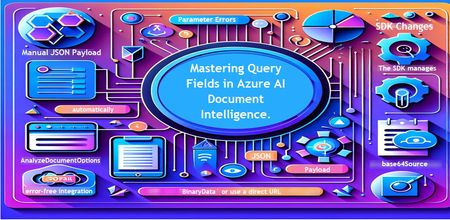
Introduction Azure AI Document Intelligence simplifies document data extraction, with features like query fields enabling targeted data retrieval. However, using these features with the C# SDK can be tricky. This guide highlights a real-world issue, provides a corrected implementation, and shares best practices for efficient usage. Use case scenario During the cause of Azure AI Document Intelligence software engineering code tasks or review, many developers encountered an error while trying to extract fields like "FullName," "CompanyName," and "JobTitle" using `AnalyzeDocumentAsync`: The error might be similar to Inner Error: The parameter urlSource or base64Source is required. This is a challenge referred to as parameter errors and SDK changes. Most problematic code are looks like below in C#: BinaryData data = BinaryData.FromBytes(Content); var queryFields = new List<string> { "FullName", "CompanyName", "JobTitle" }; var operation = await client.AnalyzeDocumentAsync( WaitUntil.Completed, modelId, data, "1-2", queryFields: queryFields, features: new List<DocumentAnalysisFeature> { DocumentAnalysisFeature.QueryFields } ); One of the reasons this failed was that the developer was using `Azure.AI.DocumentIntelligence v1.0.0`, where `base64Source` and `urlSource` must be handled internally. Because the older examples using `AnalyzeDocumentContent` no longer apply and leading to errors. Practical Solution Using AnalyzeDocumentOptions. Alternative Method using manual JSON Payload. Using AnalyzeDocumentOptions The correct method involves using AnalyzeDocumentOptions, which streamlines the request construction using the below steps: Prepare the document content: BinaryData data = BinaryData.FromBytes(Content); Create AnalyzeDocumentOptions: var analyzeOptions = new AnalyzeDocumentOptions(modelId, data) { Pages = "1-2", Features = { DocumentAnalysisFeature.QueryFields }, QueryFields = { "FullName", "CompanyName", "JobTitle" } }; - `modelId`: Your trained model’s ID. - `Pages`: Specify pages to analyze (e.g., "1-2"). - `Features`: Enable `QueryFields`. - `QueryFields`: Define which fields to extract. Run the analysis: Operation<AnalyzeResult> operation = await client.AnalyzeDocumentAsync( WaitUntil.Completed, analyzeOptions ); AnalyzeResult result = operation.Value; The reason this works: The SDK manages `base64Source` automatically. This approach matches the latest SDK standards. It results in cleaner, more maintainable code. Alternative method using manual JSON payload For advanced use cases where more control over the request is needed, you can manually create the JSON payload. For an example: var queriesPayload = new { queryFields = new[] { new { key = "FullName" }, new { key = "CompanyName" }, new { key = "JobTitle" } } }; string jsonPayload = JsonSerializer.Serialize(queriesPayload); BinaryData requestData = BinaryData.FromString(jsonPayload); var operation = await client.AnalyzeDocumentAsync( WaitUntil.Completed, modelId, requestData, "1-2", features: new List<DocumentAnalysisFeature> { DocumentAnalysisFeature.QueryFields } ); When to use the above: Custom request formats Non-standard data source integration Key points to remember Breaking changes exist between preview versions and v1.0.0 by checking the SDK version. Prefer `AnalyzeDocumentOptions` for simpler, error-free integration by using built-In classes. Ensure your content is wrapped in `BinaryData` or use a direct URL for correct document input: Conclusion Using AnalyzeDocumentOptions provides a cleaner and more reliable way to work with query fields in Azure AI Document Intelligence using C#. By aligning with the latest SDK approach, developers can simplify implementation, reduce common errors, and improve code maintainability. Keeping up with SDK enhancements and recommended practices ensures more accurate and efficient document data extraction. As Azure AI capabilities continue to evolve, adopting modern integration patterns will help you build scalable and future-ready document processing solutions with greater confidence. Reference Official AnalyzeDocumentAsync Documentation. Official Azure SDK documentation. Azure Document Intelligence C# SDK support add-on query field.500Views0likes0CommentsIf You're Building AI on Azure, ECS 2026 is Where You Need to Be
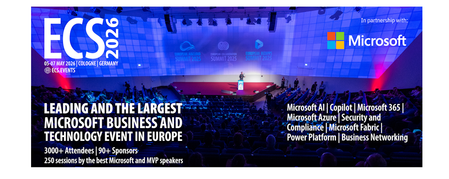
Let me be direct: there's a lot of noise in the conference calendar. Generic cloud events. Vendor showcases dressed up as technical content. Sessions that look great on paper but leave you with nothing you can actually ship on Monday. ECS 2026 isn't that. As someone who will be on stage at Cologne this May, I can tell you the European Collaboration Summit combined with the European AI & Cloud Summit and European Biz Apps Summit is one of the few events I've seen where engineers leave with real, production-applicable knowledge. Three days. Three summits. 3,000+ attendees. One of the largest Microsoft-focused events in Europe, and it keeps getting better. If you're building AI systems on Azure, designing cloud-native architectures, or trying to figure out how to take your AI experiments to production — this is where the conversation is happening. What ECS 2026 Actually Is ECS 2026 runs May 5–7 at Confex in Cologne, Germany. It brings together three co-located summits under one roof: European Collaboration Summit — Microsoft 365, Teams, Copilot, and governance European AI & Cloud Summit — Azure architecture, AI agents, cloud security, responsible AI European BizApps Summit — Power Platform, Microsoft Fabric, Dynamics For Azure engineers and AI developers, the European AI & Cloud Summit is your primary destination. But don't ignore the overlap, some of the most interesting AI conversations happen at the intersection of collaboration tooling and cloud infrastructure. The scale matters here: 3,000+ attendees, 100+ sessions, multiple deep-dive tracks, and a speaker lineup that includes Microsoft executives, Regional Directors, and MVPs who have built, broken, and rebuilt production systems. The Azure + AI Track - What's Actually On the Agenda The AI & Cloud Summit agenda is built around real technical depth. Not "intro to AI" content, actual architecture decisions, patterns that work, and lessons from things that didn't. Here's what you can expect: AI Agents and Agentic Systems This is where the energy is right now, and ECS is leaning in. Expect sessions covering how to design agent workflows, chain reasoning steps, handle memory and state, and integrate with Azure AI services. Marco Casalaina, VP of Products for Azure AI at Microsoft, is speaking if you want to understand the direction of the Azure AI platform from the people building it, this is a direct line. Azure Architecture at Scale Cloud-native patterns, microservices, containers, and the architectural decisions that determine whether your system holds up under real load. These sessions go beyond theory you'll hear from engineers who've shipped these designs at enterprise scale. Observability, DevOps, and Production AI Getting AI to production is harder than the demos suggest. Sessions here cover monitoring AI systems, integrating LLMs into CI/CD pipelines, and building the operational practices that keep AI in production reliable and governable. Cloud Security and Compliance Security isn't optional when you're putting AI in front of users or connecting it to enterprise data. Tracks cover identity, access patterns, responsible AI governance, and how to design systems that satisfy compliance requirements without becoming unmaintainable. Pre-Conference Deep Dives One underrated part of ECS: the pre-conference workshops. These are extended, hands-on sessions typically 3–6 hours that let you go deep on a single topic with an expert. Think of them as intensive short courses where you can actually work through the material, not just watch slides. If you're newer to a particular area of Azure AI, or you want to build fluency in a specific pattern before the main conference sessions, these are worth the early travel. The Speaker Quality Is Different Here The ECS speaker roster includes Microsoft executives, Microsoft MVPs, and Regional Directors, people who have real accountability for the products and patterns they're presenting. You'll hear from over 20 Microsoft speakers: Marco Casalaina — VP of Products, Azure AI at Microsoft Adam Harmetz — VP of Product at Microsoft, Enterprise Agent And dozens of MVPs and Regional Directors who are in the field every day, solving the same problems you are. These aren't keynote-only speakers — they're in the session rooms, at the hallway track, available for real conversations. The Hallway Track Is Not a Cliché I know "networking" sounds like a corporate afterthought. At ECS it genuinely isn't. When you put 3,000 practitioners, engineers, architects, DevOps leads, security specialists in one venue for three days, the conversations between sessions are often more valuable than the sessions themselves. You get candid answers to "how are you actually handling X in production?" that you won't find in documentation. The European Microsoft community is tight-knit and collaborative. ECS is where that community concentrates. Why This Matters Right Now We're in a period where AI development is moving fast but the engineering discipline around it is still maturing. Most teams are figuring out: How to move from AI prototype to production system How to instrument and observe AI behaviour reliably How to design agent systems that don't become unmaintainable How to satisfy security and compliance requirements in AI-integrated architectures ECS 2026 is one of the few places where you can get direct answers to these questions from people who've solved them — not theoretically, but in production, on Azure, in the last 12 months. If you go, you'll come back with practical patterns you can apply immediately. That's the bar I hold events to. ECS consistently clears it. Register and Explore the Agenda Register for ECS 2026: ecs.events Explore the AI & Cloud Summit agenda: cloudsummit.eu/en/agenda Dates: May 5–7, 2026 | Location: Confex, Cologne, Germany Early registration is worth it the pre-conference workshops fill up. And if you're coming, find me, I'll be the one talking too much about AI agents and Azure deployments. See you in Cologne.GitHub Copilot SDK and Hybrid AI in Practice: Automating README to PPT Transformation
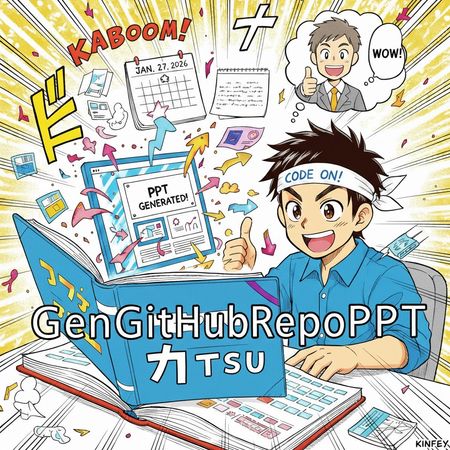
Introduction In today's rapidly evolving AI landscape, developers often face a critical choice: should we use powerful cloud-based Large Language Models (LLMs) that require internet connectivity, or lightweight Small Language Models (SLMs) that run locally but have limited capabilities? The answer isn't either-or—it's hybrid models—combining the strengths of both to create AI solutions that are secure, efficient, and powerful. This article explores hybrid model architectures through the lens of GenGitHubRepoPPT, demonstrating how to elegantly combine Microsoft Foundry Local, GitHub Copilot SDK, and other technologies to automatically generate professional PowerPoint presentations from GitHub README files. 1. Hybrid Model Scenarios and Value 1.1 What Are Hybrid Models? Hybrid AI Models strategically combine locally-running Small Language Models (SLMs) with cloud-based Large Language Models (LLMs) within the same application, selecting the most appropriate model for each task based on its unique characteristics. Core Principles: Local Processing for Sensitive Data: Privacy-critical content analysis happens on-device Cloud for Value Creation: Complex reasoning and creative generation leverage cloud power Balancing Cost and Performance: High-frequency, simple tasks run locally to minimize API costs 1.2 Typical Hybrid Model Use Cases Use Case Local SLM Role Cloud LLM Role Value Proposition Intelligent Document Processing Text extraction, structural analysis Content refinement, format conversion Privacy protection + Professional output Code Development Assistant Syntax checking, code completion Complex refactoring, architecture advice Fast response + Deep insights Customer Service Systems Intent recognition, FAQ handling Complex issue resolution Reduced latency + Enhanced quality Content Creation Platforms Keyword extraction, outline generation Article writing, multilingual translation Cost control + Creative assurance 1.3 Why Choose Hybrid Models? Three Core Advantages: Privacy and Security Sensitive data never leaves local devices Compliant with GDPR, HIPAA, and other regulations Ideal for internal corporate documents and personal information Cost Optimization Reduces cloud API call frequency Local models have zero usage fees Predictable operational costs Performance and Reliability Local processing eliminates network latency Partial functionality in offline environments Cloud models ensure high-quality output 2. Core Technology Analysis 2.1 Large Language Models (LLMs): Cloud Intelligence Representatives What are LLMs? Large Language Models are deep learning-based natural language processing models, typically with billions to trillions of parameters. Through training on massive text datasets, they've acquired powerful language understanding and generation capabilities. Representative Models: Claude Sonnet 4.5: Anthropic's flagship model, excelling at long-context processing and complex reasoning GPT-5.2 Series: OpenAI's general-purpose language models Gemini: Google's multimodal large models LLM Advantages: ✅ Exceptional text generation quality ✅ Powerful contextual understanding ✅ Support for complex reasoning tasks ✅ Continuous model updates and optimization Typical Applications: Professional document writing (technical reports, business plans) Code generation and refactoring Multilingual translation Creative content creation 2.2 Small Language Models (SLMs) and Microsoft Foundry Local 2.2.1 SLM Characteristics Small Language Models typically have 1B-7B parameters, designed specifically for resource-constrained environments. Mainstream SLM Model Families: Microsoft Phi Family (Phi Family): Inference-optimized efficient models Alibaba Qwen Family (Qwen Family): Excellent Chinese language capabilities Mistral Series: Outstanding performance with small parameter counts SLM Advantages: ⚡ Low-latency response (millisecond-level) 💰 Zero API costs 🔒 Fully local, data stays on-device 📱 Suitable for edge device deployment 2.2.2 Microsoft Foundry Local: The Foundation of Local AI Foundry Local is Microsoft's local AI runtime tool, enabling developers to easily run SLMs on Windows or macOS devices. Core Features: OpenAI-Compatible API # Using Foundry Local is like using OpenAI API from openai import OpenAI from foundry_local import FoundryLocalManager manager = FoundryLocalManager("qwen2.5-7b-instruct") client = OpenAI( base_url=manager.endpoint, api_key=manager.api_key ) Hardware Acceleration Support CPU: General computing support GPU: NVIDIA, AMD, Intel graphics acceleration NPU: Qualcomm, Intel AI-specific chips Apple Silicon: Neural Engine optimization Based on ONNX Runtime Cross-platform compatibility Highly optimized inference performance Supports model quantization (INT4, INT8) Convenient Model Management # View available models foundry model list # Run a model foundry model run qwen2.5-7b-instruct-generic-cpu:4 # Check running status foundry service ps Foundry Local Application Value: 🎓 Educational Scenarios: Students can learn AI development without cloud subscriptions 🏢 Enterprise Environments: Process sensitive data while maintaining compliance 🧪 R&D Testing: Rapid prototyping without API cost concerns ✈️ Offline Environments: Works on planes, subways, and other no-network scenarios 2.3 GitHub Copilot SDK: The Express Lane from Agent to Business Value 2.3.1 What is GitHub Copilot SDK? GitHub Copilot SDK, released as a technical preview on January 22, 2026, is a game-changer for AI Agent development. Unlike other AI SDKs, Copilot SDK doesn't just provide API calling interfaces—it delivers a complete, production-grade Agent execution engine. Why is it revolutionary? Traditional AI application development requires you to build: ❌ Context management systems (multi-turn conversation state) ❌ Tool orchestration logic (deciding when to call which tool) ❌ Model routing mechanisms (switching between different LLMs) ❌ MCP server integration ❌ Permission and security boundaries ❌ Error handling and retry mechanisms Copilot SDK provides all of this out-of-the-box, letting you focus on business logic rather than underlying infrastructure. 2.3.2 Core Advantages: The Ultra-Short Path from Concept to Code Production-Grade Agent Engine: Battle-Tested Reliability Copilot SDK uses the same Agent core as GitHub Copilot CLI, which means: ✅ Validated in millions of real-world developer scenarios ✅ Capable of handling complex multi-step task orchestration ✅ Automatic task planning and execution ✅ Built-in error recovery mechanisms Real-World Example: In the GenGitHubRepoPPT project, we don't need to hand-write the "how to convert outline to PPT" logic—we simply tell Copilot SDK the goal, and it automatically: Analyzes outline structure Plans slide layouts Calls file creation tools Applies formatting logic Handles multilingual adaptation # Traditional approach: requires hundreds of lines of code for logic def create_ppt_traditional(outline): slides = parse_outline(outline) for slide in slides: layout = determine_layout(slide) content = format_content(slide) apply_styling(content, layout) # ... more manual logic return ppt_file # Copilot SDK approach: focus on business intent session = await client.create_session({ "model": "claude-sonnet-4.5", "streaming": True, "skill_directories": [skills_dir] }) session.send_and_wait({"prompt": prompt}, timeout=600) Custom Skills: Reusable Encapsulation of Business Knowledge This is one of Copilot SDK's most powerful features. In traditional AI development, you need to provide complete prompts and context with every call. Skills allow you to: Define once, reuse forever: # .copilot_skills/ppt/SKILL.md # PowerPoint Generation Expert Skill ## Expertise You are an expert in business presentation design, skilled at transforming technical content into easy-to-understand visual presentations. ## Workflow 1. **Structure Analysis** - Identify outline hierarchy (titles, subtitles, bullet points) - Determine topic and content density for each slide 2. **Layout Selection** - Title slide: Use large title + subtitle layout - Content slides: Choose single/dual column based on bullet count - Technical details: Use code block or table layouts 3. **Visual Optimization** - Apply professional color scheme (corporate blue + accent colors) - Ensure each slide has a visual focal point - Keep bullets to 5-7 items per page 4. **Multilingual Adaptation** - Choose appropriate fonts based on language (Chinese: Microsoft YaHei, English: Calibri) - Adapt text direction and layout conventions ## Output Requirements Generate .pptx files meeting these standards: - 16:9 widescreen ratio - Consistent visual style - Editable content (not images) - File size < 5MB Business Code Generation Capability This is the core value of this project. Unlike generic LLM APIs, Copilot SDK with Skills can generate truly executable business code. Comparison Example: Aspect Generic LLM API Copilot SDK + Skills Task Description Requires detailed prompt engineering Concise business intent suffices Output Quality May need multiple adjustments Professional-grade on first try Code Execution Usually example code Directly generates runnable programs Error Handling Manual implementation required Agent automatically handles and retries Multi-step Tasks Manual orchestration needed Automatic planning and execution Comparison of manual coding workload: Task Manual Coding Copilot SDK Processing logic code ~500 lines ~10 lines configuration Layout templates ~200 lines Declared in Skill Style definitions ~150 lines Declared in Skill Error handling ~100 lines Automatically handled Total ~950 lines ~10 lines + Skill file Tool Calling & MCP Integration: Connecting to the Real World Copilot SDK doesn't just generate code—it can directly execute operations: 🗃️ File System Operations: Create, read, modify files 🌐 Network Requests: Call external APIs 📊 Data Processing: Use pandas, numpy, and other libraries 🔧 Custom Tools: Integrate your business logic 3. GenGitHubRepoPPT Case Study 3.1 Project Overview GenGitHubRepoPPT is an innovative hybrid AI solution that combines local AI models with cloud-based AI agents to automatically generate professional PowerPoint presentations from GitHub repository README files in under 5 minutes. Technical Architecture: 3.2 Why Adopt a Hybrid Model? Stage 1: Local SLM Processes Sensitive Data Task: Analyze GitHub README, extract key information, generate structured outline Reasons for choosing Qwen-2.5-7B + Foundry Local: Privacy Protection README may contain internal project information Local processing ensures data doesn't leave the device Complies with data compliance requirements Cost Effectiveness Each analysis processes thousands of tokens Cloud API costs are significant in high-frequency scenarios Local models have zero additional fees Performance Qwen-2.5-7B excels at text analysis tasks Outstanding Chinese support Acceptable CPU inference latency (typically 2-3 seconds) Stage 2: Cloud LLM + Copilot SDK Creates Business Value Task: Create well-formatted PowerPoint files based on outline Reasons for choosing Claude Sonnet 4.5 + Copilot SDK: Automated Business Code Generation Traditional approach pain points: Need to hand-write 500+ lines of code for PPT layout logic Require deep knowledge of python-pptx library APIs Style and formatting code is error-prone Multilingual support requires additional conditional logic Copilot SDK solution: Declare business rules and best practices through Skills Agent automatically generates and executes required code Zero-code implementation of complex layout logic Development time reduced from 2-3 days to 2-3 hours Ultra-Short Path from Intent to Execution Comparison: Different ways to implement "Generate professional PPT" 3. Production-Grade Reliability and Quality Assurance Battle-tested Agent engine: Uses the same core as GitHub Copilot CLI Validated in millions of real-world scenarios Automatically handles edge cases and errors Consistent output quality: Professional standards ensured through Skills Automatic validation of generated files Built-in retry and error recovery mechanisms 4. Rapid Iteration and Optimization Capability Scenario: Client requests PPT style adjustment The GitHub Repo https://github.com/kinfey/GenGitHubRepoPPT 4. Summary 4.1 Core Value of Hybrid Models + Copilot SDK The GenGitHubRepoPPT project demonstrates how combining hybrid models with Copilot SDK creates a new paradigm for AI application development. Privacy and Cost Balance The hybrid approach allows sensitive README analysis to happen locally using Qwen-2.5-7B, ensuring data never leaves the device while incurring zero API costs. Meanwhile, the value-creating work—generating professional PowerPoint presentations—leverages Claude Sonnet 4.5 through Copilot SDK, delivering quality that justifies the per-use cost. From Code to Intent Traditional AI development required writing hundreds of lines of code to handle PPT generation logic, layout selection, style application, and error handling. With Copilot SDK and Skills, developers describe what they want in natural language, and the Agent automatically generates and executes the necessary code. What once took 3-5 days now takes 3-4 hours, with 95% less code to maintain. Automated Business Code Generation Copilot SDK doesn't just provide code examples—it generates complete, executable business logic. When you request a multilingual PPT, the Agent understands the requirement, selects appropriate fonts, generates the implementation code, executes it with error handling, validates the output, and returns a ready-to-use file. Developers focus on business intent rather than implementation details. 4.2 Technology Trends The Shift to Intent-Driven Development We're witnessing a fundamental change in how developers work. Rather than mastering every programming language detail and framework API, developers are increasingly defining what they want through declarative Skills. Copilot SDK represents this future: you describe capabilities in natural language, and AI Agents handle the code generation and execution automatically. Edge AI and Cloud AI Integration The evolution from pure cloud LLMs (powerful but privacy-concerning) to pure local SLMs (private but limited) has led to today's hybrid architectures. GenGitHubRepoPPT exemplifies this trend: local models handle data analysis and structuring, while cloud models tackle complex reasoning and professional output generation. This combination delivers fast, secure, and professional results. Democratization of Agent Development Copilot SDK dramatically lowers the barrier to building AI applications. Senior engineers see 10-20x productivity gains. Mid-level engineers can now build sophisticated agents that were previously beyond their reach. Even junior engineers and business experts can participate by writing Skills that capture domain knowledge without deep technical expertise. The future isn't about whether we can build AI applications—it's about how quickly we can turn ideas into reality. References Projects and Code GenGitHubRepoPPT GitHub Repository - Case study project Microsoft Foundry Local - Local AI runtime GitHub Copilot SDK - Agent development SDK Copilot SDK Getting Started Tutorial - Official quick start Deep Dive: Copilot SDK Build an Agent into Any App with GitHub Copilot SDK - Official announcement GitHub Copilot SDK Cookbook - Practical examples Copilot CLI Official Documentation - CLI tool documentation Learning Resources Edge AI for Beginners - Edge AI introductory course Azure AI Foundry Documentation - Azure AI documentation GitHub Copilot Extensions Guide - Extension development guide2.1KViews3likes2CommentsoBeaver — A Beaver That Runs LLMs on Your Machine 🦫
Hi there! I'm the creator of oBeaver. This project started from a pretty simple desire: I wanted to run large language models on my own computer. No data sent to the cloud. No API keys. No per-call charges. I'm guessing you've had the same thought. There are already great tools out there — Ollama being the most prominent. But in my day-to-day work, I spend a lot of time in the ONNX ecosystem — the cross-platform reach of ONNX Runtime, its native NPU support, the turnkey experience of Microsoft Foundry Local. It kept nagging at me: the ONNX ecosystem deserves a more complete local inference toolkit. That's how oBeaver was born. Here are the links if you want to jump straight in: GitHub: https://github.com/microsoft/obeaver Docs: https://microsoft.github.io/obeaver Up and Running in Three Minutes Getting started with oBeaver is dead simple. You need Python 3.12+, then it's clone, install, chat: git clone https://github.com/microsoft/obeaver.git cd obeaver pip install -e . # Initialize the model directory (auto-creates ort/, foundrylocal/, cache_dir/ sub-folders) obeaver init # Make sure everything looks good obeaver check If you're on macOS or Windows, install Foundry Local and you're one command away from chatting with a model: obeaver run phi-4-mini The first run downloads the model automatically — give it a minute. After that, it's instant. On Linux, or if you want to use models from Hugging Face, the ORT engine has you covered: # Convert Qwen3-0.6B from Hugging Face to ONNX format obeaver convert Qwen/Qwen3-0.6B # Run it with the ORT engine obeaver run --engine ort ./models/ort/Qwen3-0.6B_ONNX_INT4_CPU Want to turn your model into an HTTP service? One line: obeaver serve Phi-4-mini Then point any OpenAI-compatible client at it — just change one base_url and your existing code works as-is: from openai import OpenAI client = OpenAI(base_url="http://127.0.0.1:18000/v1", api_key="unused") response = client.chat.completions.create( model="Phi-4-mini", messages=[{"role": "user", "content": "What is the capital of France?"}], stream=True, ) for chunk in response: print(chunk.choices[0].delta.content or "", end="", flush=True) LangChain, LlamaIndex, Microsoft Agent Framework, CrewAI — anything that speaks the OpenAI protocol plugs right in. This was a non-negotiable design principle from day one: local inference shouldn't be an island; it should fit seamlessly into your existing dev workflow. "Why Not Just Use Ollama?" I get this question a lot, and it deserves a straight answer. Ollama is a fantastic project. It pioneered the "one command to run a model" experience and made local LLM inference accessible to everyone. If all you need is a quick way to chat with a model locally, Ollama is still a wonderful choice. oBeaver itself draws heavy inspiration from it. But Ollama and oBeaver take different technical paths. Ollama is built on llama.cpp and uses the GGUF model format. oBeaver is built on ONNX Runtime and uses the ONNX model format. Behind these two formats are two very different philosophies. GGUF: Grab and Go GGUF's strength is ultimate portability. One file bundles everything — weights, tokenizer, metadata. Hugging Face is packed with pre-quantized GGUF models ready to download and run. Quantization options are rich (Q2_K through Q8_0), and the community is incredibly active. For individual developers, this "grab and go" experience is hard to beat. ONNX: Convert Once, Accelerate Everywhere ONNX shines in a different dimension. As a cross-platform industrial standard, ONNX Runtime has something called Execution Providers — the same ONNX model, without any changes, can run on CPU, GPU, and even NPU. This matters more than it might seem at first glance. With chips like Intel Core Ultra, Qualcomm Snapdragon X, and Apple Neural Engine becoming mainstream, NPUs are quickly becoming standard hardware in AI PCs. ONNX Runtime already supports NPU acceleration natively, while the GGUF ecosystem doesn't have this capability yet. This means ONNX naturally adapts to a far wider range of devices — from servers to laptops, from desktops to edge devices, even phones and IoT endpoints. The ONNX model you run on CPU today can be accelerated on an NPU-equipped machine tomorrow — no re-conversion, no code changes, just switch the Execution Provider. ONNX does have a higher barrier to entry — models need to be converted first. But oBeaver's built-in obeaver convert command, powered by Microsoft's Olive toolkit, reduces that to a single line. Another project worth mentioning is oMLX, which also explores local inference in the ONNX ecosystem, but focuses specifically on Apple Silicon. oBeaver aims to be more comprehensive — spanning macOS, Windows, and Linux, covering text chat, embeddings, and vision-language scenarios. Here's a quick comparison of all three: Ollama oMLX oBeaver Model format GGUF ONNX ONNX Inference backend llama.cpp ONNX Runtime Foundry Local + ORT GenAI Platforms macOS/Linux/Windows macOS macOS/Windows/Linux NPU acceleration ❌ ❌ ✅ Embedding models ✅ ✅ ✅ VL models ✅ ✅ ✅ Function Calling ✅ ✅ ✅ Docker deployment ✅ ✅ ✅ I'm not saying oBeaver is better than Ollama. They serve different needs. But if your work involves the ONNX ecosystem, NPU acceleration, or a combination of embedding and multimodal capabilities, oBeaver offers a path that Ollama doesn't currently cover. Why a "Dual Engine"? This is oBeaver's most distinctive design decision, and the one I spent the most time thinking about. oBeaver has two inference engines under the hood: Foundry Local and ONNX Runtime GenAI (ORT). Why not just pick one? Because reality is messier than ideals. Foundry Local is Microsoft's local inference runtime, and the experience is lovely — pass a catalog alias like Phi-4-mini, and it auto-downloads, loads, and runs the model with smart hardware scheduling (NPU > GPU > CPU). But it has two clear limitations: first, the model catalog is still small, mostly centered around Microsoft's Phi family; second, it only supports macOS and Windows — Linux users are left out. ONNX Runtime GenAI fills exactly those gaps. It supports macOS, Windows, and Linux — all three platforms. And with obeaver convert, you can transform almost any model on Hugging Face into ONNX format, giving you a much wider model selection. Right now, oBeaver can already run models from Phi, Qwen, Gemma, GLM, and other SLM families through the ORT engine. On top of that, the ORT engine powers capabilities that Foundry Local simply can't do: Embedding models — The ORT engine includes a dedicated embedding engine supporting Qwen3-Embedding and EmbeddingGemma, perfect for local RAG pipelines: # Start the embedding service obeaver serve-embed ./models/Qwen3-Embedding-0.6B from openai import OpenAI client = OpenAI(base_url="http://127.0.0.1:18001/v1", api_key="unused") response = client.embeddings.create( model="Qwen3-Embedding-0.6B", input=["Hello, world!", "Embeddings are useful."], ) for item in response.data: print(f"index={item.index} dim={len(item.embedding)}") Vision-Language models (VL) — When the ORT engine detects vision.onnx in a model directory, it automatically switches to VL mode. Currently supported: Qwen-2.5-VL-3B and Qwen-3-VL-2B. You can send images alongside text for multimodal understanding: obeaver serve ./models/Qwen3-VL-2B-Instruct_VL_ONNX_INT4_CPU Converting a VL model is just one command too: obeaver convert Qwen/Qwen2.5-VL-3B-Instruct --type vl So the dual engine isn't redundancy — it's the optimal choice given reality: Foundry Local covers only macOS/Windows; ORT GenAI covers all platforms. Foundry Local has fewer models but zero friction; ORT GenAI has more models and more flexibility. oBeaver automatically picks the right engine for your platform and task — Foundry Local by default on macOS/Windows, ORT on Linux, auto-switching to ORT for embedding or VL workloads. You can always override with --engine ort. In short: Foundry Local handles the "just works" path, ORT handles the "I need more" path. Together, they give oBeaver an answer for every platform and every scenario. Cloud-Native? Of Course oBeaver isn't just a local toy. Deployment was baked into the design from the start. The architecture is cleanly layered: CLI (Typer) → FastAPI Server → pluggable inference engines. We ship a Docker image supporting both linux/amd64 and linux/arm64 (Apple Silicon included): # Build the image docker buildx build --platform=linux/amd64 \ -f docker/Dockerfile.cpu -t obeaver-cpu . # Start the API server docker run -d --rm -p 18000:18000 \ -v /path/to/models:/models \ obeaver-cpu serve -m /models -E ort --host 0.0.0.0 --port 18000 Local dev, CI/CD pipelines, headless servers, Kubernetes clusters — it all works. Combined with the OpenAI-compatible API, you can develop against oBeaver locally and switch to a cloud endpoint in production by changing a single URL. Not a single line of application code needs to change. Not Just a CLI — There's a Dashboard Too So far everything I've shown has been terminal commands. But sometimes you just want a visual interface — especially when you're evaluating models, comparing performance, or showing a demo. oBeaver ships with a built-in web dashboard. One command to launch: obeaver dashboard # Foundry Local engine (macOS/Windows) obeaver dashboard -e ort # ORT engine (scans local ONNX models) Open http://127.0.0.1:1573/ and you'll see something like this: It's a real-time monitoring and chat interface rolled into one. Here's what you get: Model Selector — Switch between your cached models on the fly. If a model supports NPU acceleration, it's marked with a ⚡ badge. With Foundry Local, you'll see the models from your local catalog: With the ORT engine, it scans your model directory for all available ONNX models: Chat + Live Benchmarking — Send messages and get streaming responses, with real-time performance stats right in the interface — TTFT (Time to First Token), tokens per second, total token count. This makes it incredibly easy to benchmark different models side by side: System Monitoring — Real-time memory gauges for CPU, GPU, NPU, and process memory. A system info bar shows the current model, engine type, platform, and health status at a glance. Inference Parameters — Adjust temperature, top-p, top-k, and max tokens with built-in presets, all without restarting the server. VL Mode — When you load a Vision-Language model in the ORT dashboard, the interface automatically switches to a dedicated VL mode where you can provide an image URL alongside your text prompt: And more — Conversation history with save/load, system prompt configuration, live server logs showing every request with method/path/status/timing, and export to JSON or Markdown. The dashboard isn't a separate product — it's just obeaver dashboard. Everything runs locally, nothing phones home. It's particularly useful when you want to quickly evaluate how a model performs on your hardware before committing to it in your application. Being Honest: CPU Only for Now oBeaver is currently in Tech Preview, and I want to be upfront about this — it only supports CPU inference right now. This is a deliberate, stage-by-stage choice. We wanted to make sure the entire toolchain — model conversion, inference, API serving, Docker deployment — is rock solid on CPU first. Almost every machine has a CPU; it's the best baseline for validating the complete workflow. But GPU and NPU support are coming soon. They're at the very top of the roadmap. ONNX Runtime already ships mature CUDA (GPU) and QNN/OpenVINO (NPU) Execution Providers. Foundry Local already has NPU > GPU > CPU auto-scheduling built in. What oBeaver needs to do is integrate these into its engine selection logic and model conversion pipeline — and that work is actively underway. Ultimately, one of the key reasons oBeaver chose the ONNX path is the NPU future. The AI PC era is arriving, and when NPUs become standard hardware, ONNX will be the ecosystem most ready for it. Acknowledgements oBeaver is inspired by and builds upon the ideas from the following excellent projects: Project Description Ollama Run large language models locally with a simple CLI OMLX Run large language models on Apple Silicon, ONNX-based vLLM High-throughput and memory-efficient inference engine for LLMs Foundry Local Microsoft's local model inference runtime with NPU/GPU/CPU acceleration ONNX Runtime GenAI Generative AI extensions for ONNX Runtime Olive Microsoft's model optimization toolkit for ONNX Runtime I Need Your Feedback That's the tour. But oBeaver is still in its early days, and there's so much room to improve. As the creator of this project, what I fear most isn't criticism — it's silence. So I genuinely hope you'll give it a try and let me know what you think: Which models do you most want to run? How urgent is GPU / NPU acceleration for your use case? What do you think of the dual-engine design — does it add value, or does it add complexity? In your real-world projects, what's the biggest pain point with local inference? What else does the Docker story need? Helm Charts? Compose files? GitHub Issues, PRs, or just reaching out on social media — any form of feedback is deeply appreciated. The name oBeaver comes from the beaver — nature's most remarkable engineer. Beavers build dams stick by stick, creating the environment they need to thrive. I hope oBeaver can help you do the same: build your local AI infrastructure, one piece at a time, on your own hardware. Build local. Dam the cloud. 🦫 GitHub: https://github.com/microsoft/obeaver Docs: https://microsoft.github.io/obeaver If you find oBeaver useful, a ⭐ on GitHub means the world to us!Build a Fully Offline AI App with Foundry Local and CAG
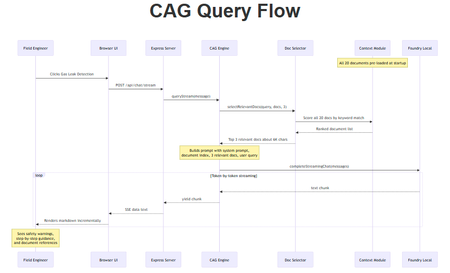
A hands-on guide to building an on-device AI support agent using Context-Augmented Generation, JavaScript, and Foundry Local. You have probably heard the AI pitch: "just call our API." But what happens when your application needs to work without an internet connection? Perhaps your users are field engineers standing next to a pipeline in the middle of nowhere, or your organisation has strict data privacy requirements, or you simply want to build something that works without a cloud bill. This post walks you through how to build a fully offline, on-device AI application using Foundry Local and a pattern called Context-Augmented Generation (CAG). By the end, you will have a clear understanding of what CAG is, how it compares to RAG, and the practical steps to build your own solution. The finished application: a browser-based AI support agent that runs entirely on your machine. What Is Context-Augmented Generation? Context-Augmented Generation (CAG) is a pattern for making AI models useful with your own domain-specific content. Instead of hoping the model "knows" the answer from its training data, you pre-load your entire knowledge base into the model's context window at startup. Every query the model handles has access to all of your documents, all of the time. The flow is straightforward: Load your documents into memory when the application starts. Inject the most relevant documents into the prompt alongside the user's question. Generate a response grounded in your content. There is no retrieval pipeline, no vector database, and no embedding model. Your documents are read from disc, held in memory, and selected per query using simple keyword scoring. The model generates answers grounded in your content rather than relying on what it learnt during training. CAG vs RAG: Understanding the Trade-offs If you have explored AI application patterns before, you have likely encountered Retrieval-Augmented Generation (RAG). Both CAG and RAG solve the same core problem: grounding an AI model's answers in your own content. They take different approaches, and each has genuine strengths and limitations. CAG (Context-Augmented Generation) How it works: All documents are loaded at startup. The most relevant ones are selected per query using keyword scoring and injected into the prompt. Strengths: Drastically simpler architecture with no vector database, no embeddings, and no retrieval pipeline Works fully offline with no external services Minimal dependencies (just two npm packages in this sample) Near-instant document selection with no embedding latency Easy to set up, debug, and reason about Limitations: Constrained by the model's context window size Best suited to small, curated document sets (tens of documents, not thousands) Keyword scoring is less precise than semantic similarity for ambiguous queries Adding documents requires an application restart RAG (Retrieval-Augmented Generation) How it works: Documents are chunked, embedded into vectors, and stored in a database. At query time, the most semantically similar chunks are retrieved and injected into the prompt. Strengths: Scales to thousands or millions of documents Semantic search finds relevant content even when the user's wording differs from the source material Documents can be added or updated dynamically without restarting Fine-grained retrieval (chunk-level) can be more token-efficient for large collections Limitations: More complex architecture: requires an embedding model, a vector database, and a chunking strategy Retrieval quality depends heavily on chunking, embedding model choice, and tuning Additional latency from the embedding and search steps More dependencies and infrastructure to manage Want to compare these patterns hands-on? There is a RAG-based implementation of the same gas field scenario using vector search and embeddings. Clone both repositories, run them side by side, and see how the architectures differ in practice. When Should You Choose Which? Consideration Choose CAG Choose RAG Document count Tens of documents Hundreds or thousands Offline requirement Essential Optional (can run locally too) Setup complexity Minimal Moderate to high Document updates Infrequent (restart to reload) Frequent or dynamic Query precision Good for keyword-matchable content Better for semantically diverse queries Infrastructure None beyond the runtime Vector database, embedding model For the sample application in this post (20 gas engineering procedure documents on a local machine), CAG is the clear winner. If your use case grows to hundreds of documents or requires real-time ingestion, RAG becomes the better choice. Both patterns can run offline using Foundry Local. Foundry Local: Your On-Device AI Runtime Foundry Local is a lightweight runtime from Microsoft that downloads, manages, and serves language models entirely on your device. No cloud account, no API keys, no outbound network calls (after the initial model download). In this sample, your application is responsible for deciding which model to use, and it does that through the foundry-local-sdk . The app creates a FoundryLocalManager , asks the SDK for the local model catalogue, and then runs a small selection policy from src/modelSelector.js . That policy looks at the machine's available RAM, filters out models that are too large, ranks the remaining chat models by preference, and then returns the best fit for that device. Why does it work this way? Because shipping one fixed model would either exclude lower-spec machines or underuse more capable ones. A 14B model may be perfectly reasonable on a 32 GB workstation, but the same choice would be slow or unusable on an 8 GB laptop. By selecting at runtime, the same codebase can run across a wider range of developer machines without manual tuning. What makes it particularly useful for developers: No GPU required — runs on CPU or NPU, making it accessible on standard laptops and desktops Native SDK bindings — in-process inference via the foundry-local-sdk npm package, with no HTTP round-trips to a local server Automatic model management — downloads, caches, and loads models automatically Dynamic model selection — the SDK can evaluate your device's available RAM and pick the best model from the catalogue Real-time progress callbacks — ideal for building loading UIs that show download and initialisation progress The integration code is refreshingly minimal. Here is the core pattern: import { FoundryLocalManager } from "foundry-local-sdk"; // Create a manager and get the model catalogue const manager = FoundryLocalManager.create({ appName: "my-app" }); // Auto-select the best model for this device based on available RAM const models = await manager.catalog.getModels(); const model = selectBestModel(models); // Download if not cached, then load into memory if (!model.isCached) { await model.download((progress) => { console.log(`Download: ${progress.toFixed(0)}%`); }); } await model.load(); // Create a chat client for direct in-process inference const chatClient = model.createChatClient(); const response = await chatClient.completeChat([ { role: "system", content: "You are a helpful assistant." }, { role: "user", content: "How do I detect a gas leak?" } ]); That is it. No server configuration, no authentication tokens, no cloud provisioning. The model runs in the same process as your application. The download step matters for a simple reason: offline inference only works once the model files exist locally. The SDK checks whether the chosen model is already cached on the machine. If it is not, the application asks Foundry Local to download it once, store it locally, and then load it into memory. After that first run, the cached model can be reused, which is why subsequent launches are much faster and can operate without any network dependency. Put another way, there are two cooperating pieces here. Your application chooses which model is appropriate for the device and the scenario. Foundry Local and its SDK handle the mechanics of making that model available locally, caching it, loading it, and exposing a chat client for inference. That separation keeps the application logic clear whilst letting the runtime handle the heavy lifting. The Technology Stack The sample application is deliberately simple. No frameworks, no build steps, no Docker: Layer Technology Purpose AI Model Foundry Local + auto-selected model Runs locally via native SDK bindings; best model chosen for your device Back end Node.js + Express Lightweight HTTP server, everyone knows it Context Markdown files pre-loaded at startup No vector database, no embeddings, no retrieval step Front end Single HTML file with inline CSS No build step, mobile-responsive, field-ready The total dependency footprint is two npm packages: express and foundry-local-sdk . Architecture Overview The four-layer architecture, all running on a single machine. The system has four layers, all running in a single process on your device: Client layer: a single HTML file served by Express, with quick-action buttons and a responsive chat interface Server layer: Express.js starts immediately and serves the UI plus an SSE status endpoint; API routes handle chat (streaming and non-streaming), context listing, and health checks CAG engine: loads all domain documents at startup, selects the most relevant ones per query using keyword scoring, and injects them into the prompt AI layer: Foundry Local runs the auto-selected model on CPU/NPU via native SDK bindings (in-process inference, no HTTP round-trips) Building the Solution Step by Step Prerequisites You need two things installed on your machine: Node.js 20 or later: download from nodejs.org Foundry Local: Microsoft's on-device AI runtime: winget install Microsoft.FoundryLocal Foundry Local will automatically select and download the best model for your device the first time you run the application. You can override this by setting the FOUNDRY_MODEL environment variable to a specific model alias. Getting the Code Running # Clone the repository git clone https://github.com/leestott/local-cag.git cd local-cag # Install dependencies npm install # Start the server npm start Open http://127.0.0.1:3000 in your browser. You will see a loading overlay with a progress bar whilst the model downloads (first run only) and loads into memory. Once the model is ready, the overlay fades away and you can start chatting. Desktop view Mobile view How the CAG Pipeline Works Let us trace what happens when a user asks: "How do I detect a gas leak?" The query flow from browser to model and back. 1 Server starts and loads documents When you run npm start , the Express server starts on port 3000. All .md files in the docs/ folder are read, parsed (with optional YAML front-matter for title, category, and ID), and grouped by category. A document index is built listing all available topics. 2 Model is selected and loaded The model selector evaluates your system's available RAM and picks the best model from the Foundry Local catalogue. If the model is not already cached, it downloads it (with progress streamed to the browser via SSE). The model is then loaded into memory for in-process inference. 3 User sends a question The question arrives at the Express server. The chat engine selects the top 3 most relevant documents using keyword scoring. 4 Prompt is constructed The engine builds a messages array containing: the system prompt (with safety-first instructions), the document index (so the model knows all available topics), the 3 selected documents (approximately 6,000 characters), the conversation history, and the user's question. 5 Model generates a grounded response The prompt is sent to the locally loaded model via the Foundry Local SDK's native bindings. The response streams back token by token through Server-Sent Events to the browser. A response with safety warnings and step-by-step guidance The sources panel shows which documents were used Key Code Walkthrough Loading Documents (the Context Module) The context module reads all markdown files from the docs/ folder at startup. Each document can have optional YAML front-matter for metadata: // src/context.js export function loadDocuments() { const files = fs.readdirSync(config.docsDir) .filter(f => f.endsWith(".md")) .sort(); const docs = []; for (const file of files) { const raw = fs.readFileSync(path.join(config.docsDir, file), "utf-8"); const { meta, body } = parseFrontMatter(raw); docs.push({ id: meta.id || path.basename(file, ".md"), title: meta.title || file, category: meta.category || "General", content: body.trim(), }); } return docs; } There is no chunking, no vector computation, and no database. The documents are held in memory as plain text. Dynamic Model Selection Rather than hard-coding a model, the application evaluates your system at runtime: // src/modelSelector.js const totalRamMb = os.totalmem() / (1024 * 1024); const budgetMb = totalRamMb * 0.6; // Use up to 60% of system RAM // Filter to models that fit, rank by quality, boost cached models const candidates = allModels.filter(m => m.task === "chat-completion" && m.fileSizeMb <= budgetMb ); // Returns the best model: e.g. phi-4 on a 32 GB machine, // or phi-3.5-mini on a laptop with 8 GB RAM This means the same application runs on a powerful workstation (selecting a 14B parameter model) or a constrained laptop (selecting a 3.8B model), with no code changes required. This is worth calling out because it is one of the most practical parts of the sample. Developers do not have to decide up front which single model every user should run. The application makes that decision at startup based on the hardware budget you set, then asks Foundry Local to fetch the model if it is missing. The result is a smoother first-run experience and fewer support headaches when the same app is used on mixed hardware. The System Prompt For safety-critical domains, the system prompt is engineered to prioritise safety, prevent hallucination, and enforce structured responses: // src/prompts.js export const SYSTEM_PROMPT = `You are a local, offline support agent for gas field inspection and maintenance engineers. Behaviour Rules: - Always prioritise safety. If a procedure involves risk, explicitly call it out. - Do not hallucinate procedures, measurements, or tolerances. - If the answer is not in the provided context, say: "This information is not available in the local knowledge base." Response Format: - Summary (1-2 lines) - Safety Warnings (if applicable) - Step-by-step Guidance - Reference (document name + section)`; This pattern is transferable to any safety-critical domain: medical devices, electrical work, aviation maintenance, or chemical handling. Adapting This for Your Own Domain The sample project is designed to be forked and adapted. Here is how to make it yours in three steps: 1. Replace the documents Delete the gas engineering documents in docs/ and add your own markdown files. The context module handles any markdown content with optional YAML front-matter: --- title: Troubleshooting Widget Errors category: Support id: KB-001 --- # Troubleshooting Widget Errors ...your content here... 2. Edit the system prompt Open src/prompts.js and rewrite the system prompt for your domain. Keep the structure (summary, safety, steps, reference) and update the language to match your users' expectations. 3. Override the model (optional) By default the application auto-selects the best model. To force a specific model: # See available models foundry model list # Force a smaller, faster model FOUNDRY_MODEL=phi-3.5-mini npm start # Or a larger, higher-quality model FOUNDRY_MODEL=phi-4 npm start Smaller models give faster responses on constrained devices. Larger models give better quality. The auto-selector picks the largest model that fits within 60% of your system RAM. Building a Field-Ready UI The front end is a single HTML file with inline CSS. No React, no build tooling, no bundler. This keeps the project accessible to beginners and easy to deploy. Design decisions that matter for field use: Dark, high-contrast theme with 18px base font size for readability in bright sunlight Large touch targets (minimum 48px) for operation with gloves or PPE Quick-action buttons for common questions, so engineers do not need to type on a phone Responsive layout that works from 320px to 1920px+ screen widths Streaming responses via SSE, so the user sees tokens arriving in real time The mobile chat experience, optimised for field use. Visual Startup Progress with SSE A standout feature of this application is the loading experience. When the user opens the browser, they see a progress overlay showing exactly what the application is doing: Loading domain documents Initialising the Foundry Local SDK Selecting the best model for the device Downloading the model (with a percentage progress bar, first run only) Loading the model into memory This works because the Express server starts before the model finishes loading. The browser connects immediately and receives real-time status updates via Server-Sent Events. Chat endpoints return 503 whilst the model is loading, so the UI cannot send queries prematurely. // Server-side: broadcast status to all connected browsers function broadcastStatus(state) { initState = state; const payload = `data: ${JSON.stringify(state)}\n\n`; for (const client of statusClients) { client.write(payload); } } // During initialisation: broadcastStatus({ stage: "downloading", message: "Downloading phi-4...", progress: 42 }); This pattern is worth adopting in any application where model loading takes more than a few seconds. Users should never stare at a blank screen wondering whether something is broken. Testing The project includes unit tests using the built-in Node.js test runner, with no extra test framework needed: # Run all tests npm test Tests cover configuration, server endpoints, and document loading. Use them as a starting point when you adapt the project for your own domain. Ideas for Extending the Project Once you have the basics running, there are plenty of directions to explore: Conversation memory: persist chat history across sessions using local storage or a lightweight database Hybrid CAG + RAG: add a vector retrieval step for larger document collections that exceed the context window Multi-modal support: add image-based queries (photographing a fault code, for example) PWA packaging: make it installable as a standalone offline application on mobile devices Custom model fine-tuning: fine-tune a model on your domain data for even better answers Ready to Build Your Own? Clone the CAG sample, swap in your own documents, and have an offline AI agent running in minutes. Or compare it with the RAG approach to see which pattern suits your use case best. Get the CAG Sample Get the RAG Sample Summary Building a local AI application does not require a PhD in machine learning or a cloud budget. With Foundry Local, Node.js, and a set of domain documents, you can create a fully offline, mobile-responsive AI agent that answers questions grounded in your own content. The key takeaways: CAG is ideal for small, curated document sets where simplicity and offline capability matter most. No vector database, no embeddings, no retrieval pipeline. RAG scales further when you have hundreds or thousands of documents, or need semantic search for ambiguous queries. See the local-rag sample to compare. Foundry Local makes on-device AI accessible: native SDK bindings, in-process inference, automatic model selection, and no GPU required. The architecture is transferable. Replace the gas engineering documents with your own content, update the system prompt, and you have a domain-specific AI agent for any field. Start simple, iterate outwards. Begin with CAG and a handful of documents. If your needs outgrow the context window, graduate to RAG. Both patterns can run entirely offline. Clone the repository, swap in your own documents, and start building. The best way to learn is to get your hands on the code. This project is open source under the MIT licence. It is a scenario sample for learning and experimentation, not production medical or safety advice. local-cag on GitHub · local-rag on GitHub · Foundry LocalBuilding Your First Local RAG Application with Foundry Local
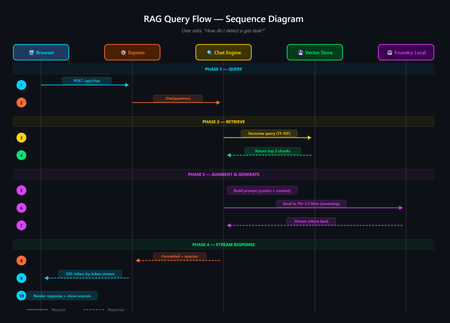
A developer's guide to building an offline, mobile-responsive AI support agent using Retrieval-Augmented Generation, the Foundry Local SDK, and JavaScript. Imagine you are a gas field engineer standing beside a pipeline in a remote location. There is no Wi-Fi, no mobile signal, and you need a safety procedure right now. What do you do? This is the exact problem that inspired this project: a fully offline RAG-powered support agent that runs entirely on your machine. No cloud. No API keys. No outbound network calls. Just a local language model, a local vector store, and your own documents, all accessible from a browser on any device. In this post, you will learn how it works, how to build your own, and the key architectural decisions behind it. If you have ever wanted to build an AI application that runs locally and answers questions grounded in your own data, this is the place to start. The finished application: a browser-based AI support agent that runs entirely on your machine. What Is Retrieval-Augmented Generation? Retrieval-Augmented Generation (RAG) is a pattern that makes AI models genuinely useful for domain-specific tasks. Rather than hoping the model "knows" the answer from its training data, you: Retrieve relevant chunks from your own documents using a vector store Augment the model's prompt with those chunks as context Generate a response grounded in your actual data The result is fewer hallucinations, traceable answers with source attribution, and an AI that works with your content rather than relying on general knowledge. If you are building internal tools, customer support bots, field manuals, or knowledge bases, RAG is the pattern you want. RAG vs CAG: Understanding the Trade-offs If you have explored AI application patterns before, you have likely encountered Context-Augmented Generation (CAG). Both RAG and CAG solve the same core problem: grounding an AI model's answers in your own content. They take different approaches, and each has genuine strengths and limitations. RAG (Retrieval-Augmented Generation) How it works: Documents are split into chunks, vectorised, and stored in a database. At query time, the most relevant chunks are retrieved and injected into the prompt. Strengths: Scales to thousands or millions of documents Fine-grained retrieval at chunk level with source attribution Documents can be added or updated dynamically without restarting Token-efficient: only relevant chunks are sent to the model Supports runtime document upload via the web UI Limitations: More complex architecture: requires a vector store and chunking strategy Retrieval quality depends on chunking parameters and scoring method May miss relevant content if the retrieval step does not surface it CAG (Context-Augmented Generation) How it works: All documents are loaded at startup. The most relevant ones are selected per query using keyword scoring and injected into the prompt. Strengths: Drastically simpler architecture with no vector database or embeddings All information is always available to the model Minimal dependencies and easy to set up Near-instant document selection Limitations: Constrained by the model's context window size Best suited to small, curated document sets (tens of documents) Adding documents requires an application restart Want to compare these patterns hands-on? There is a CAG-based implementation of the same gas field scenario using whole-document context injection. Clone both repositories, run them side by side, and see how the architectures differ in practice. When Should You Choose Which? Consideration Choose RAG Choose CAG Document count Hundreds or thousands Tens of documents Document updates Frequent or dynamic (runtime upload) Infrequent (restart to reload) Source attribution Per-chunk with relevance scores Per-document Setup complexity Moderate (ingestion step required) Minimal Query precision Better for large or diverse collections Good for keyword-matchable content Infrastructure SQLite vector store (single file) None beyond the runtime For the sample application in this post (20 gas engineering procedure documents with runtime upload), RAG is the clear winner. If your document set is small and static, CAG may be simpler. Both patterns run fully offline using Foundry Local. Foundry Local: Your On-Device AI Runtime Foundry Local is a lightweight runtime from Microsoft that downloads, manages, and serves language models entirely on your device. No cloud account, no API keys, no outbound network calls (after the initial model download). What makes it particularly useful for developers: No GPU required: runs on CPU or NPU, making it accessible on standard laptops and desktops Native SDK bindings: in-process inference via the foundry-local-sdk npm package, with no HTTP round-trips to a local server Automatic model management: downloads, caches, and loads models automatically Hardware-optimised variant selection: the SDK picks the best variant for your hardware (GPU, NPU, or CPU) Real-time progress callbacks: ideal for building loading UIs that show download and initialisation progress The integration code is refreshingly minimal: import { FoundryLocalManager } from "foundry-local-sdk"; // Create a manager and discover models via the catalogue const manager = FoundryLocalManager.create({ appName: "gas-field-local-rag" }); const model = await manager.catalog.getModel("phi-3.5-mini"); // Download if not cached, then load into memory if (!model.isCached) { await model.download((progress) => { console.log(`Download: ${Math.round(progress * 100)}%`); }); } await model.load(); // Create a chat client for direct in-process inference const chatClient = model.createChatClient(); const response = await chatClient.completeChat([ { role: "system", content: "You are a helpful assistant." }, { role: "user", content: "How do I detect a gas leak?" } ]); That is it. No server configuration, no authentication tokens, no cloud provisioning. The model runs in the same process as your application. The Technology Stack The sample application is deliberately simple. No frameworks, no build steps, no Docker: Layer Technology Purpose AI Model Foundry Local + Phi-3.5 Mini Runs locally via native SDK bindings, no GPU required Back end Node.js + Express Lightweight HTTP server, everyone knows it Vector Store SQLite (via better-sqlite3 ) Zero infrastructure, single file on disc Retrieval TF-IDF + cosine similarity No embedding model required, fully offline Front end Single HTML file with inline CSS No build step, mobile-responsive, field-ready The total dependency footprint is three npm packages: express , foundry-local-sdk , and better-sqlite3 . Architecture Overview The five-layer architecture, all running on a single machine. The system has five layers, all running on a single machine: Client layer: a single HTML file served by Express, with quick-action buttons and a responsive chat interface Server layer: Express.js starts immediately and serves the UI plus SSE status and chat endpoints RAG pipeline: the chat engine orchestrates retrieval and generation; the chunker handles TF-IDF vectorisation; the prompts module provides safety-first system instructions Data layer: SQLite stores document chunks and their TF-IDF vectors; documents live as .md files in the docs/ folder AI layer: Foundry Local runs Phi-3.5 Mini on CPU or NPU via native SDK bindings Building the Solution Step by Step Prerequisites You need two things installed on your machine: Node.js 20 or later: download from nodejs.org Foundry Local: Microsoft's on-device AI runtime: winget install Microsoft.FoundryLocal The SDK will automatically download the Phi-3.5 Mini model (approximately 2 GB) the first time you run the application. Getting the Code Running # Clone the repository git clone https://github.com/leestott/local-rag.git cd local-rag # Install dependencies npm install # Ingest the 20 gas engineering documents into the vector store npm run ingest # Start the server npm start Open http://127.0.0.1:3000 in your browser. You will see the status indicator whilst the model loads. Once the model is ready, the status changes to "Offline Ready" and you can start chatting. Desktop view Mobile view How the RAG Pipeline Works Let us trace what happens when a user asks: "How do I detect a gas leak?" The query flow from browser to model and back. 1 Documents are ingested and indexed When you run npm run ingest , every .md file in the docs/ folder is read, parsed (with optional YAML front-matter for title, category, and ID), split into overlapping chunks of approximately 200 tokens, and stored in SQLite with TF-IDF vectors. 2 Model is loaded via the SDK The Foundry Local SDK discovers the model in the local catalogue and loads it into memory. If the model is not already cached, it downloads it first (with progress streamed to the browser via SSE). 3 User sends a question The question arrives at the Express server. The chat engine converts it into a TF-IDF vector, uses an inverted index to find candidate chunks, and scores them using cosine similarity. The top 3 chunks are returned in under 1 ms. 4 Prompt is constructed The engine builds a messages array containing: the system prompt (with safety-first instructions), the retrieved chunks as context, the conversation history, and the user's question. 5 Model generates a grounded response The prompt is sent to the locally loaded model via the Foundry Local SDK's native chat client. The response streams back token by token through Server-Sent Events to the browser. Source references with relevance scores are included. A response with safety warnings and step-by-step guidance The sources panel shows which chunks were used and their relevance Key Code Walkthrough The Vector Store (TF-IDF + SQLite) The vector store uses SQLite to persist document chunks alongside their TF-IDF vectors. At query time, an inverted index finds candidate chunks that share terms with the query, then cosine similarity ranks them: // src/vectorStore.js search(query, topK = 5) { const queryTf = termFrequency(query); this._ensureCache(); // Build in-memory cache on first access // Use inverted index to find candidates sharing at least one term const candidateIndices = new Set(); for (const term of queryTf.keys()) { const indices = this._invertedIndex.get(term); if (indices) { for (const idx of indices) candidateIndices.add(idx); } } // Score only candidates, not all rows const scored = []; for (const idx of candidateIndices) { const row = this._rowCache[idx]; const score = cosineSimilarity(queryTf, row.tf); if (score > 0) scored.push({ ...row, score }); } scored.sort((a, b) => b.score - a.score); return scored.slice(0, topK); } The inverted index, in-memory row cache, and prepared SQL statements bring retrieval time to sub-millisecond for typical query loads. Why TF-IDF Instead of Embeddings? Most RAG tutorials use embedding models for retrieval. This project uses TF-IDF because: Fully offline: no embedding model to download or run Zero latency: vectorisation is instantaneous (it is just maths on word frequencies) Good enough: for 20 domain-specific documents, TF-IDF retrieves the right chunks reliably Transparent: you can inspect the vocabulary and weights, unlike neural embeddings For larger collections or when semantic similarity matters more than keyword overlap, you would swap in an embedding model. For this use case, TF-IDF keeps the stack simple and dependency-free. The System Prompt For safety-critical domains, the system prompt is engineered to prioritise safety, prevent hallucination, and enforce structured responses: // src/prompts.js export const SYSTEM_PROMPT = `You are a local, offline support agent for gas field inspection and maintenance engineers. Behaviour Rules: - Always prioritise safety. If a procedure involves risk, explicitly call it out. - Do not hallucinate procedures, measurements, or tolerances. - If the answer is not in the provided context, say: "This information is not available in the local knowledge base." Response Format: - Summary (1-2 lines) - Safety Warnings (if applicable) - Step-by-step Guidance - Reference (document name + section)`; This pattern is transferable to any safety-critical domain: medical devices, electrical work, aviation maintenance, or chemical handling. Runtime Document Upload Unlike the CAG approach, RAG supports adding documents without restarting the server. Click the upload button to add new .md or .txt files. They are chunked, vectorised, and indexed immediately. The upload modal with the complete list of indexed documents. Adapting This for Your Own Domain The sample project is designed to be forked and adapted. Here is how to make it yours in four steps: 1. Replace the documents Delete the gas engineering documents in docs/ and add your own markdown files. The ingestion pipeline handles any markdown content with optional YAML front-matter: --- title: Troubleshooting Widget Errors category: Support id: KB-001 --- # Troubleshooting Widget Errors ...your content here... 2. Edit the system prompt Open src/prompts.js and rewrite the system prompt for your domain. Keep the structure (summary, safety, steps, reference) and update the language to match your users' expectations. 3. Tune the retrieval In src/config.js : chunkSize: 200 : smaller chunks give more precise retrieval, less context per chunk chunkOverlap: 25 : prevents information falling between chunks topK: 3 : how many chunks to retrieve per query (more gives more context but slower generation) 4. Swap the model Change config.model in src/config.js to any model available in the Foundry Local catalogue. Smaller models give faster responses on constrained devices; larger models give better quality. Building a Field-Ready UI The front end is a single HTML file with inline CSS. No React, no build tooling, no bundler. This keeps the project accessible to beginners and easy to deploy. Design decisions that matter for field use: Dark, high-contrast theme with 18px base font size for readability in bright sunlight Large touch targets (minimum 44px) for operation with gloves or PPE Quick-action buttons that wrap on mobile so all options are visible without scrolling Responsive layout that works from 320px to 1920px+ screen widths Streaming responses via SSE, so the user sees tokens arriving in real time The mobile chat experience, optimised for field use. Testing The project includes unit tests using the built-in Node.js test runner, with no extra test framework needed: # Run all tests npm test Tests cover the chunker, vector store, configuration, and server endpoints. Use them as a starting point when you adapt the project for your own domain. Ideas for Extending the Project Once you have the basics running, there are plenty of directions to explore: Embedding-based retrieval: use a local embedding model for better semantic matching on diverse queries Conversation memory: persist chat history across sessions using local storage or a lightweight database Multi-modal support: add image-based queries (photographing a fault code, for example) PWA packaging: make it installable as a standalone offline application on mobile devices Hybrid retrieval: combine TF-IDF keyword search with semantic embeddings for best results Try the CAG approach: compare with the local-cag sample to see which pattern suits your use case Ready to Build Your Own? Clone the RAG sample, swap in your own documents, and have an offline AI agent running in minutes. Or compare it with the CAG approach to see which pattern suits your use case best. Get the RAG Sample Get the CAG Sample Summary Building a local RAG application does not require a PhD in machine learning or a cloud budget. With Foundry Local, Node.js, and SQLite, you can create a fully offline, mobile-responsive AI agent that answers questions grounded in your own documents. The key takeaways: RAG is ideal for scalable, dynamic document sets where you need fine-grained retrieval with source attribution. Documents can be added at runtime without restarting. CAG is simpler when you have a small, stable set of documents that fit in the context window. See the local-cag sample to compare. Foundry Local makes on-device AI accessible: native SDK bindings, in-process inference, automatic model selection, and no GPU required. TF-IDF + SQLite is a viable vector store for small-to-medium collections, with sub-millisecond retrieval thanks to inverted indexing and in-memory caching. Start simple, iterate outwards. Begin with RAG and a handful of documents. If your needs are simpler, try CAG. Both patterns run entirely offline. Clone the repository, swap in your own documents, and start building. The best way to learn is to get your hands on the code. This project is open source under the MIT licence. It is a scenario sample for learning and experimentation, not production medical or safety advice. local-rag on GitHub · local-cag on GitHub · Foundry Local5.9KViews2likes0CommentsBuilding an Offline AI Interview Coach with Foundry Local, RAG, and SQLite
How to build a 100% offline, AI-powered interview preparation tool using Microsoft Foundry Local, Retrieval-Augmented Generation, and nothing but JavaScript. Foundry Local 100% Offline RAG + TF-IDF JavaScript / Node.js Contents Introduction What is RAG and Why Offline? Architecture Overview Setting Up Foundry Local Building the RAG Pipeline The Chat Engine Dual Interfaces: Web & CLI Testing Adapting for Your Own Use Case What I Learned Getting Started Introduction Imagine preparing for a job interview with an AI assistant that knows your CV inside and out, understands the job you're applying for, and generates tailored questions, all without ever sending your data to the cloud. That's exactly what Interview Doctor does. Interview Doctor's web UI, a polished, dark-themed interface running entirely on your local machine. In this post, I'll walk you through how I built an interview prep tool as a fully offline JavaScript application using: Foundry Local — Microsoft's on-device AI runtime SQLite — for storing document chunks and TF-IDF vectors RAG (Retrieval-Augmented Generation) — to ground the AI in your actual documents Express.js — for the web server Node.js built-in test runner — for testing with zero extra dependencies No cloud. No API keys. No internet required. Everything runs on your machine. What is RAG and Why Does It Matter? Retrieval-Augmented Generation (RAG) is a pattern that makes AI models dramatically more useful for domain-specific tasks. Instead of relying solely on what a model learned during training (which can be outdated or generic), RAG: Retrieves relevant chunks from your own documents Augments the model's prompt with those chunks as context Generates a response grounded in your actual data For Interview Doctor, this means the AI doesn't just ask generic interview questions, it asks questions specific to your CV, your experience, and the specific job you're applying for. Why Offline RAG? Privacy is the obvious benefit, your CV and job applications never leave your device. But there's more: No API costs — run as many queries as you want No rate limits — iterate rapidly during your prep Works anywhere — on a plane, in a café with bad Wi-Fi, anywhere Consistent performance — no cold starts, no API latency Architecture Overview Complete architecture showing all components and data flow. The application has two interfaces (CLI and Web) that share the same core engine: Document Ingestion — PDFs and markdown files are chunked and indexed Vector Store — SQLite stores chunks with TF-IDF vectors Retrieval — queries are matched against stored chunks using cosine similarity Generation — relevant chunks are injected into the prompt sent to the local LLM Step 1: Setting Up Foundry Local First, install Foundry Local: # Windows winget install Microsoft.FoundryLocal # macOS brew install microsoft/foundrylocal/foundrylocal The JavaScript SDK handles everything else — starting the service, downloading the model, and connecting: import { FoundryLocalManager } from "foundry-local-sdk"; import { OpenAI } from "openai"; const manager = new FoundryLocalManager(); const modelInfo = await manager.init("phi-3.5-mini"); // Foundry Local exposes an OpenAI-compatible API const openai = new OpenAI({ baseURL: manager.endpoint, // Dynamic port, discovered by SDK apiKey: manager.apiKey, }); ⚠️ Key Insight Foundry Local uses a dynamic port never hardcode localhost:5272 . Always use manager.endpoint which is discovered by the SDK at runtime. Step 2: Building the RAG Pipeline Document Chunking Documents are split into overlapping chunks of ~200 tokens. The overlap ensures important context isn't lost at chunk boundaries: export function chunkText(text, maxTokens = 200, overlapTokens = 25) { const words = text.split(/\s+/).filter(Boolean); if (words.length <= maxTokens) return [text.trim()]; const chunks = []; let start = 0; while (start < words.length) { const end = Math.min(start + maxTokens, words.length); chunks.push(words.slice(start, end).join(" ")); if (end >= words.length) break; start = end - overlapTokens; } return chunks; } Why 200 tokens with 25-token overlap? Small chunks keep retrieved context compact for the model's limited context window. Overlap prevents information loss at boundaries. And it's all pure string operations, no dependencies needed. TF-IDF Vectors Instead of using a separate embedding model (which would consume precious memory alongside the LLM), we use TF-IDF, a classic information retrieval technique: export function termFrequency(text) { const tf = new Map(); const tokens = text .toLowerCase() .replace(/[^a-z0-9\-']/g, " ") .split(/\s+/) .filter((t) => t.length > 1); for (const t of tokens) { tf.set(t, (tf.get(t) || 0) + 1); } return tf; } export function cosineSimilarity(a, b) { let dot = 0, normA = 0, normB = 0; for (const [term, freq] of a) { normA += freq * freq; if (b.has(term)) dot += freq * b.get(term); } for (const [, freq] of b) normB += freq * freq; if (normA === 0 || normB === 0) return 0; return dot / (Math.sqrt(normA) * Math.sqrt(normB)); } Each document chunk becomes a sparse vector of word frequencies. At query time, we compute cosine similarity between the query vector and all stored chunk vectors to find the most relevant matches. SQLite as a Vector Store Chunks and their TF-IDF vectors are stored in SQLite using sql.js (pure JavaScript — no native compilation needed): export class VectorStore { // Created via: const store = await VectorStore.create(dbPath) insert(docId, title, category, chunkIndex, content) { const tf = termFrequency(content); const tfJson = JSON.stringify([...tf]); this.db.run( "INSERT INTO chunks (...) VALUES (?, ?, ?, ?, ?, ?)", [docId, title, category, chunkIndex, content, tfJson] ); this.save(); } search(query, topK = 5) { const queryTf = termFrequency(query); // Score each chunk by cosine similarity, return top-K } } 💡 Why SQLite for Vectors? For a CV plus a few job descriptions (dozens of chunks), brute-force cosine similarity over SQLite rows is near-instant (~1ms). No need for Pinecone, Qdrant, or Chroma — just a single .db file on disk. Step 3: The RAG Chat Engine The chat engine ties retrieval and generation together: async *queryStream(userMessage, history = []) { // 1. Retrieve relevant CV/JD chunks const chunks = this.retrieve(userMessage); const context = this._buildContext(chunks); // 2. Build the prompt with retrieved context const messages = [ { role: "system", content: SYSTEM_PROMPT }, { role: "system", content: `Retrieved context:\n\n${context}` }, ...history, { role: "user", content: userMessage }, ]; // 3. Stream from the local model const stream = await this.openai.chat.completions.create({ model: this.modelId, messages, temperature: 0.3, stream: true, }); // 4. Yield chunks as they arrive for await (const chunk of stream) { const content = chunk.choices[0]?.delta?.content; if (content) yield { type: "text", data: content }; } } The flow is straightforward: vectorize the query, retrieve with cosine similarity, build a prompt with context, and stream from the local LLM. The temperature: 0.3 keeps responses focused — important for interview preparation where consistency matters. Step 4: Dual Interfaces — Web & CLI Web UI The web frontend is a single HTML file with inline CSS and JavaScript — no build step, no framework, no React or Vue. It communicates with the Express backend via REST and SSE: File upload via multipart/form-data Streaming chat via Server-Sent Events (SSE) Quick-action buttons for common follow-up queries (coaching tips, gap analysis, mock interview) The setup form with job title, seniority level, and a pasted job description — ready to generate tailored interview questions. CLI The CLI provides the same experience in the terminal with ANSI-coloured output: npm run cli It walks you through uploading your CV, entering the job details, and then generates streaming questions. Follow-up questions work interactively. Both interfaces share the same ChatEngine class, they're thin layers over identical logic. Edge Mode For constrained devices, toggle Edge mode to use a compact system prompt that fits within smaller context windows: Edge mode activated, uses a minimal prompt for devices with limited resources. Step 5: Testing Tests use the Node.js built-in test runner, no Jest, no Mocha, no extra dependencies: import { describe, it } from "node:test"; import assert from "node:assert/strict"; describe("chunkText", () => { it("returns single chunk for short text", () => { const chunks = chunkText("short text", 200, 25); assert.equal(chunks.length, 1); }); it("maintains overlap between chunks", () => { // Verifies overlapping tokens between consecutive chunks }); }); npm test Tests cover the chunker, vector store, config, prompts, and server API contract, all without needing Foundry Local running. Adapting for Your Own Use Case Interview Doctor is a pattern, not just a product. You can adapt it for any domain: What to Change How Domain documents Replace files in docs/ with your content System prompt Edit src/prompts.js Chunk sizes Adjust config.chunkSize and config.chunkOverlap Model Change config.model — run foundry model list UI Modify public/index.html — it's a single file Ideas for Adaptation Customer support bot — ingest your product docs and FAQs Code review assistant — ingest coding standards and best practices Study guide — ingest textbooks and lecture notes Compliance checker — ingest regulatory documents Onboarding assistant — ingest company handbooks and processes What I Learned Offline AI is production-ready. Foundry Local + small models like Phi-3.5 Mini are genuinely useful for focused tasks. You don't need vector databases for small collections. SQLite + TF-IDF is fast, simple, and has zero infrastructure overhead. RAG quality depends on chunking. Getting chunk sizes right for your use case is more impactful than the retrieval algorithm. The OpenAI-compatible API is a game-changer. Switching from cloud to local was mostly just changing the baseURL . Dual interfaces are easy when you share the engine. The CLI and Web UI are thin layers over the same ChatEngine class. ⚡ Performance Notes On a typical laptop (no GPU): ingestion takes under 1 second for ~20 documents, retrieval is ~1ms, and the first LLM token arrives in 2-5 seconds. Foundry Local automatically selects the best model variant for your hardware (CUDA GPU, NPU, or CPU). Getting Started git clone https://github.com/leestott/interview-doctor-js.git cd interview-doctor-js npm install npm run ingest npm start # Web UI at http://127.0.0.1:3000 # or npm run cli # Interactive terminal The full source code is on GitHub. Star it, fork it, adapt it — and good luck with your interviews! Resources Foundry Local — Microsoft's on-device AI runtime Foundry Local SDK (npm) — JavaScript SDK Foundry Local GitHub — Source, samples, and documentation Local RAG Reference — Reference RAG implementation Interview Doctor (JavaScript) — This project's source codeBuilding real-world AI automation with Foundry Local and the Microsoft Agent Framework
A hands-on guide to building real-world AI automation with Foundry Local, the Microsoft Agent Framework, and PyBullet. No cloud subscription, no API keys, no internet required. Why Developers Should Care About Offline AI Imagine telling a robot arm to "pick up the cube" and watching it execute the command in a physics simulator, all powered by a language model running on your laptop. No API calls leave your machine. No token costs accumulate. No internet connection is needed. That is what this project delivers, and every piece of it is open source and ready for you to fork, extend, and experiment with. Most AI demos today lean on cloud endpoints. That works for prototypes, but it introduces latency, ongoing costs, and data privacy concerns. For robotics and industrial automation, those trade-offs are unacceptable. You need inference that runs where the hardware is: on the factory floor, in the lab, or on your development machine. Foundry Local gives you an OpenAI-compatible endpoint running entirely on-device. Pair it with a multi-agent orchestration framework and a physics engine, and you have a complete pipeline that translates natural language into validated, safe robot actions. This post walks through how we built it, why the architecture works, and how you can start experimenting with your own offline AI simulators today. Architecture The system uses four specialised agents orchestrated by the Microsoft Agent Framework: Agent What It Does Speed PlannerAgent Sends user command to Foundry Local LLM → JSON action plan 4–45 s SafetyAgent Validates against workspace bounds + schema < 1 ms ExecutorAgent Dispatches actions to PyBullet (IK, gripper) < 2 s NarratorAgent Template summary (LLM opt-in via env var) < 1 ms User (text / voice) │ ▼ ┌──────────────┐ │ Orchestrator │ └──────┬───────┘ │ ┌────┴────┐ ▼ ▼ Planner Narrator │ ▼ Safety │ ▼ Executor │ ▼ PyBullet Setting Up Foundry Local from foundry_local import FoundryLocalManager import openai manager = FoundryLocalManager("qwen2.5-coder-0.5b") client = openai.OpenAI( base_url=manager.endpoint, api_key=manager.api_key, ) resp = client.chat.completions.create( model=manager.get_model_info("qwen2.5-coder-0.5b").id, messages=[{"role": "user", "content": "pick up the cube"}], max_tokens=128, stream=True, ) from foundry_local import FoundryLocalManager import openai manager = FoundryLocalManager("qwen2.5-coder-0.5b") client = openai.OpenAI( base_url=manager.endpoint, api_key=manager.api_key, ) resp = client.chat.completions.create( model=manager.get_model_info("qwen2.5-coder-0.5b").id, messages=[{"role": "user", "content": "pick up the cube"}], max_tokens=128, stream=True, ) The SDK auto-selects the best hardware backend (CUDA GPU → QNN NPU → CPU). No configuration needed. How the LLM Drives the Simulator Understanding the interaction between the language model and the physics simulator is central to the project. The two never communicate directly. Instead, a structured JSON contract forms the bridge between natural language and physical motion. From Words to JSON When a user says “pick up the cube”, the PlannerAgent sends the command to the Foundry Local LLM alongside a compact system prompt. The prompt lists every permitted tool and shows the expected JSON format. The LLM responds with a structured plan: { "type": "plan", "actions": [ {"tool": "describe_scene", "args": {}}, {"tool": "pick", "args": {"object": "cube_1"}} ] } The planner parses this response, validates it against the action schema, and retries once if the JSON is malformed. This constrained output format is what makes small models (0.5B parameters) viable: the response space is narrow enough that even a compact model can produce correct JSON reliably. From JSON to Motion Once the SafetyAgent approves the plan, the ExecutorAgent maps each action to concrete PyBullet calls: move_ee(target_xyz) : The target position in Cartesian coordinates is passed to PyBullet's inverse kinematics solver, which computes the seven joint angles needed to place the end-effector at that position. The robot then interpolates smoothly from its current joint state to the target, stepping the physics simulation at each increment. pick(object) : This triggers a multi-step grasp sequence. The controller looks up the object's position in the scene, moves the end-effector above the object, descends to grasp height, closes the gripper fingers with a configurable force, and lifts. At every step, PyBullet resolves contact forces and friction so that the object behaves realistically. place(target_xyz) : The reverse of a pick. The robot carries the grasped object to the target coordinates and opens the gripper, allowing the physics engine to drop the object naturally. describe_scene() : Rather than moving the robot, this action queries the simulation state and returns the position, orientation, and name of every object on the table, along with the current end-effector pose. The Abstraction Boundary The critical design choice is that the LLM knows nothing about joint angles, inverse kinematics, or physics. It operates purely at the level of high-level tool calls ( pick , move_ee ). The ActionExecutor translates those tool calls into the low-level API that PyBullet provides. This separation means the LLM prompt stays simple, the safety layer can validate plans without understanding kinematics, and the executor can be swapped out without retraining or re-prompting the model. Voice Input Pipeline Voice commands follow three stages: Browser capture: MediaRecorder captures audio, client-side resamples to 16 kHz mono WAV Server transcription: Foundry Local Whisper (ONNX, cached after first load) with automatic 30 s chunking Command execution: transcribed text goes through the same Planner → Safety → Executor pipeline The mic button (🎤) only appears when a Whisper model is cached or loaded. Whisper models are filtered out of the LLM dropdown. Web UI in Action Pick command Describe command Move command Reset command Performance: Model Choice Matters Model Params Inference Pipeline Total qwen2.5-coder-0.5b 0.5 B ~4 s ~5 s phi-4-mini 3.6 B ~35 s ~36 s qwen2.5-coder-7b 7 B ~45 s ~46 s For interactive robot control, qwen2.5-coder-0.5b is the clear winner: valid JSON for a 7-tool schema in under 5 seconds. The Simulator in Action Here is the Panda robot arm performing a pick-and-place sequence in PyBullet. Each frame is rendered by the simulator's built-in camera and streamed to the web UI in real time. Overview Reaching Above the cube Gripper detail Front interaction Side layout Get Running in Five Minutes You do not need a GPU, a cloud account, or any prior robotics experience. The entire stack runs on a standard development machine. # 1. Install Foundry Local winget install Microsoft.FoundryLocal # Windows brew install foundrylocal # macOS # 2. Download models (one-time, cached locally) foundry model run qwen2.5-coder-0.5b # Chat brain (~4 s inference) foundry model run whisper-base # Voice input (194 MB) # 3. Clone and set up the project git clone https://github.com/leestott/robot-simulator-foundrylocal cd robot-simulator-foundrylocal .\setup.ps1 # or ./setup.sh on macOS/Linux # 4. Launch the web UI python -m src.app --web --no-gui # → http://localhost:8080 Once the server starts, open your browser and try these commands in the chat box: "pick up the cube": the robot grasps the blue cube and lifts it "describe the scene": returns every object's name and position "move to 0.3 0.2 0.5": sends the end-effector to specific coordinates "reset": returns the arm to its neutral pose If you have a microphone connected, hold the mic button and speak your command instead of typing. Voice input uses a local Whisper model, so your audio never leaves the machine. Experiment and Build Your Own The project is deliberately simple so that you can modify it quickly. Here are some ideas to get started. Add a new robot action The robot currently understands seven tools. Adding an eighth takes four steps: Define the schema in TOOL_SCHEMAS ( src/brain/action_schema.py ). Write a _do_<tool> handler in src/executor/action_executor.py . Register it in ActionExecutor._dispatch . Add a test in tests/test_executor.py . For example, you could add a rotate_ee tool that spins the end-effector to a given roll/pitch/yaw without changing position. Add a new agent Every agent follows the same pattern: an async run(context) method that reads from and writes to a shared dictionary. Create a new file in src/agents/ , register it in orchestrator.py , and the pipeline will call it in sequence. Ideas for new agents: VisionAgent: analyse a camera frame to detect objects and update the scene state before planning. CostEstimatorAgent: predict how many simulation steps an action plan will take and warn the user if it is expensive. ExplanationAgent: generate a step-by-step natural language walkthrough of the plan before execution, allowing the user to approve or reject it. Swap the LLM python -m src.app --web --model phi-4-mini Or use the model dropdown in the web UI; no restart is needed. Try different models and compare accuracy against inference speed. Smaller models are faster but may produce malformed JSON more often. Larger models are more accurate but slower. The retry logic in the planner compensates for occasional failures, so even a small model works well in practice. Swap the simulator PyBullet is one option, but the architecture does not depend on it. You could replace the simulation layer with: MuJoCo: a high-fidelity physics engine popular in reinforcement learning research. Isaac Sim: NVIDIA's GPU-accelerated robotics simulator with photorealistic rendering. Gazebo: the standard ROS simulator, useful if you plan to move to real hardware through ROS 2. The only requirement is that your replacement implements the same interface as PandaRobot and GraspController . Build something completely different The pattern at the heart of this project (LLM produces structured JSON, safety layer validates, executor dispatches to a domain-specific engine) is not limited to robotics. You could apply the same architecture to: Home automation: "turn off the kitchen lights and set the thermostat to 19 degrees" translated into MQTT or Zigbee commands. Game AI: natural language control of characters in a game engine, with the safety agent preventing invalid moves. CAD automation: voice-driven 3D modelling where the LLM generates geometry commands for OpenSCAD or FreeCAD. Lab instrumentation: controlling scientific equipment (pumps, stages, spectrometers) via natural language, with the safety agent enforcing hardware limits. From Simulator to Real Robot One of the most common questions about projects like this is whether it could control a real robot. The answer is yes, and the architecture is designed to make that transition straightforward. What Stays the Same The entire upper half of the pipeline is hardware-agnostic: The LLM planner generates the same JSON action plans regardless of whether the target is simulated or physical. It has no knowledge of the underlying hardware. The safety agent validates workspace bounds and tool schemas. For a real robot, you would tighten the bounds to match the physical workspace and add checks for obstacle clearance using sensor data. The orchestrator coordinates agents in the same sequence. No changes are needed. The narrator reports what happened. It works with any result data the executor returns. What Changes The only component that must be replaced is the executor layer, specifically the PandaRobot class and the GraspController . In simulation, these call PyBullet's inverse kinematics solver and step the physics engine. On a real robot, they would instead call the hardware driver. For a Franka Emika Panda (the same robot modelled in the simulation), the replacement options include: libfranka: Franka's C++ real-time control library, which accepts joint position or torque commands at 1 kHz. ROS 2 with MoveIt: A robotics middleware stack that provides motion planning, collision avoidance, and hardware abstraction. The move_ee action would become a MoveIt goal, and the framework would handle trajectory planning and execution. Franka ROS 2 driver: Combines libfranka with ROS 2 for a drop-in replacement of the simulation controller. The ActionExecutor._dispatch method maps tool names to handler functions. Replacing _do_move_ee , _do_pick , and _do_place with calls to a real robot driver is the only code change required. Key Considerations for Real Hardware Safety: A simulated robot cannot cause physical harm; a real robot can. The safety agent would need to incorporate real-time collision checking against sensor data (point clouds from depth cameras, for example) rather than relying solely on static workspace bounds. Perception: In simulation, object positions are known exactly. On a real robot, you would need a perception system (cameras with object detection or fiducial markers) to locate objects before grasping. Calibration: The simulated robot's coordinate frame matches the URDF model perfectly. A real robot requires hand-eye calibration to align camera coordinates with the robot's base frame. Latency: Real actuators have physical response times. The executor would need to wait for motion completion signals from the hardware rather than stepping a simulation loop. Gripper feedback: In PyBullet, grasp success is determined by contact forces. A real gripper would provide force or torque feedback to confirm whether an object has been securely grasped. The Simulation as a Development Tool This is precisely why simulation-first development is valuable. You can iterate on the LLM prompts, agent logic, and command pipeline without risk to hardware. Once the pipeline reliably produces correct action plans in simulation, moving to a real robot is a matter of swapping the lowest layer of the stack. Key Takeaways for Developers On-device AI is production-ready. Foundry Local serves models through a standard OpenAI-compatible API. If your code already uses the OpenAI SDK, switching to local inference is a one-line change to base_url . Small models are surprisingly capable. A 0.5B parameter model produces valid JSON action plans in under 5 seconds. For constrained output schemas, you do not need a 70B model. Multi-agent pipelines are more reliable than monolithic prompts. Splitting planning, validation, execution, and narration across four agents makes each one simpler to test, debug, and replace. Simulation is the safest way to iterate. You can refine LLM prompts, agent logic, and tool schemas without risking real hardware. When the pipeline is reliable, swapping the executor for a real robot driver is the only change needed. The pattern generalises beyond robotics. Structured JSON output from an LLM, validated by a safety layer, dispatched to a domain-specific engine: that pattern works for home automation, game AI, CAD, lab equipment, and any other domain where you need safe, structured control. You can start building today. The entire project runs on a standard laptop with no GPU, no cloud account, and no API keys. Clone the repository, run the setup script, and you will have a working voice-controlled robot simulator in under five minutes. Ready to start building? Clone the repository, try the commands, and then start experimenting. Fork it, add your own agents, swap in a different simulator, or apply the pattern to an entirely different domain. The best way to learn how local AI can solve real-world problems is to build something yourself. Source code: github.com/leestott/robot-simulator-foundrylocal Built with Foundry Local, Microsoft Agent Framework, PyBullet, and FastAPI.From Cloud to Chip: Building Smarter AI at the Edge with Windows AI PCs
As AI engineers, we’ve spent years optimizing models for the cloud, scaling inference, wrangling latency, and chasing compute across clusters. But the frontier is shifting. With the rise of Windows AI PCs and powerful local accelerators, the edge is no longer a constraint it’s now a canvas. Whether you're deploying vision models to industrial cameras, optimizing speech interfaces for offline assistants, or building privacy-preserving apps for healthcare, Edge AI is where real-world intelligence meets real-time performance. Why Edge AI, Why Now? Edge AI isn’t just about running models locally, it’s about rethinking the entire lifecycle: - Latency: Decisions in milliseconds, not round-trips to the cloud. - Privacy: Sensitive data stays on-device, enabling HIPAA/GDPR compliance. - Resilience: Offline-first apps that don’t break when the network does. - Cost: Reduced cloud compute and bandwidth overhead. With Windows AI PCs powered by Intel and Qualcomm NPUs and tools like ONNX Runtime, DirectML, and Olive, developers can now optimize and deploy models with unprecedented efficiency. What You’ll Learn in Edge AI for Beginners The Edge AI for Beginners curriculum is a hands-on, open-source guide designed for engineers ready to move from theory to deployment. Multi-Language Support This content is available in over 48 languages, so you can read and study in your native language. What You'll Master This course takes you from fundamental concepts to production-ready implementations, covering: Small Language Models (SLMs) optimized for edge deployment Hardware-aware optimization across diverse platforms Real-time inference with privacy-preserving capabilities Production deployment strategies for enterprise applications Why EdgeAI Matters Edge AI represents a paradigm shift that addresses critical modern challenges: Privacy & Security: Process sensitive data locally without cloud exposure Real-time Performance: Eliminate network latency for time-critical applications Cost Efficiency: Reduce bandwidth and cloud computing expenses Resilient Operations: Maintain functionality during network outages Regulatory Compliance: Meet data sovereignty requirements Edge AI Edge AI refers to running AI algorithms and language models locally on hardware, close to where data is generated without relying on cloud resources for inference. It reduces latency, enhances privacy, and enables real-time decision-making. Core Principles: On-device inference: AI models run on edge devices (phones, routers, microcontrollers, industrial PCs) Offline capability: Functions without persistent internet connectivity Low latency: Immediate responses suited for real-time systems Data sovereignty: Keeps sensitive data local, improving security and compliance Small Language Models (SLMs) SLMs like Phi-4, Mistral-7B, Qwen and Gemma are optimized versions of larger LLMs, trained or distilled for: Reduced memory footprint: Efficient use of limited edge device memory Lower compute demand: Optimized for CPU and edge GPU performance Faster startup times: Quick initialization for responsive applications They unlock powerful NLP capabilities while meeting the constraints of: Embedded systems: IoT devices and industrial controllers Mobile devices: Smartphones and tablets with offline capabilities IoT Devices: Sensors and smart devices with limited resources Edge servers: Local processing units with limited GPU resources Personal Computers: Desktop and laptop deployment scenarios Course Modules & Navigation Course duration. 10 hours of content Module Topic Focus Area Key Content Level Duration 📖 00 Introduction to EdgeAI Foundation & Context EdgeAI Overview • Industry Applications • SLM Introduction • Learning Objectives Beginner 1-2 hrs 📚 01 EdgeAI Fundamentals Cloud vs Edge AI comparison EdgeAI Fundamentals • Real World Case Studies • Implementation Guide • Edge Deployment Beginner 3-4 hrs 🧠 02 SLM Model Foundations Model families & architecture Phi Family • Qwen Family • Gemma Family • BitNET • μModel • Phi-Silica Beginner 4-5 hrs 🚀 03 SLM Deployment Practice Local & cloud deployment Advanced Learning • Local Environment • Cloud Deployment Intermediate 4-5 hrs ⚙️ 04 Model Optimization Toolkit Cross-platform optimization Introduction • Llama.cpp • Microsoft Olive • OpenVINO • Apple MLX • Workflow Synthesis Intermediate 5-6 hrs 🔧 05 SLMOps Production Production operations SLMOps Introduction • Model Distillation • Fine-tuning • Production Deployment Advanced 5-6 hrs 🤖 06 AI Agents & Function Calling Agent frameworks & MCP Agent Introduction • Function Calling • Model Context Protocol Advanced 4-5 hrs 💻 07 Platform Implementation Cross-platform samples AI Toolkit • Foundry Local • Windows Development Advanced 3-4 hrs 🏭 08 Foundry Local Toolkit Production-ready samples Sample applications (see details below) Expert 8-10 hrs Each module includes Jupyter notebooks, code samples, and deployment walkthroughs, perfect for engineers who learn by doing. Developer Highlights - 🔧 Olive: Microsoft's optimization toolchain for quantization, pruning, and acceleration. - 🧩 ONNX Runtime: Cross-platform inference engine with support for CPU, GPU, and NPU. - 🎮 DirectML: GPU-accelerated ML API for Windows, ideal for gaming and real-time apps. - 🖥️ Windows AI PCs: Devices with built-in NPUs for low-power, high-performance inference. Local AI: Beyond the Edge Local AI isn’t just about inference, it’s about autonomy. Imagine agents that: - Learn from local context - Adapt to user behavior - Respect privacy by design With tools like Agent Framework, Azure AI Foundry and Windows Copilot Studio, and Foundry Local developers can orchestrate local agents that blend LLMs, sensors, and user preferences, all without cloud dependency. Try It Yourself Ready to get started? Clone the Edge AI for Beginners GitHub repo, run the notebooks, and deploy your first model to a Windows AI PC or IoT devices Whether you're building smart kiosks, offline assistants, or industrial monitors, this curriculum gives you the scaffolding to go from prototype to production.