flatcar
8 TopicsNow Generally Available: Built-in CIS Benchmark Auditing for Linux on Azure
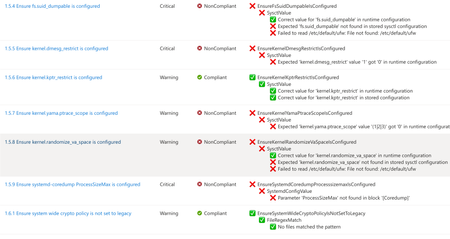
A few months ago, in From Policy to Practice: Built-in CIS Benchmarks on Azure – Flexible, Hybrid-Ready, we introduced a new way to bring Center for Internet Security (CIS) Benchmarks to your Linux estate using Azure Policy with Machine Configuration. It builds on the broader customizable security baseline policies in Machine Configuration capability. Today we're excited to share the next milestone: the audit capability for CIS Benchmarks on Linux is now Generally Available (GA). This release is officially powered by kompli - our native Linux compliance and hardening engine for CIS, STIG, and custom baselines. kompli is the evolution of the engine that drove the preview, now established as the dedicated home for this capability going forward. What "GA" means for you The audit experience is now ready for production use. You can continuously assess your Linux workloads against official, CIS-certified benchmarks - at scale, across Azure and hybrid environments through Azure Arc - and get clear, CIS-style compliance reporting directly in Azure Policy and Azure Resource Graph. If you've read the previous post, the how hasn't changed, so we'll keep this one short: Automated compliance assessment - continuously monitor Linux systems against official CIS benchmarks. Tailored benchmarks - customize evaluations with exceptions and custom parameters, no code changes required. Compliance reporting - detailed, CIS-style reports across your fleet. Hybrid-ready - the same baselines apply to Azure VMs and Arc-enabled servers on-premises or in other clouds. All supported benchmarks are CIS Benchmark Assessment Certified and stay in parity with the content published on the CIS website. Supported distributions and benchmark versions With this release, audit is GA across the following distributions, covering Level 1 + Level 2 Server profiles: Distribution CIS Benchmark Version(s) Profiles Audit Ubuntu 20.04 / 22.04 / 24.04 LTS + Pro v3.0.0 / v2.0.0 + v3.0.0 / v1.0.0 L1 + L2 Server ✓ Red Hat Enterprise Linux 8 / 9 / 10 v3.0.0 + v4.0.0 / v2.0.0 / v1.0.1 L1 + L2 Server ✓ AlmaLinux 8 / 9 v3.0.0 + v4.0.0 / v2.0.0 L1 + L2 Server ✓ Rocky Linux 8 / 9 v2.0.0 + v3.0.0 / v2.0.0 L1 + L2 Server ✓ Oracle Linux 8 / 9 v3.0.0 + v4.0.0 / v2.0.0 L1 + L2 Server ✓ Debian 11 / 12 v2.0.0 / v1.1.0 L1 + L2 Server ✓ SUSE Linux Enterprise 12 / 15 v3.2.1 / v2.0.1 L1 + L2 Server ✓ AKS Optimized Azure Linux 3 v1.0.0 L1 + L2 Server ✓ This GA covers the audit (assessment) capability. Looking ahead, STIG benchmarks are coming next, followed by a granular per-rule auto-remediation capability with dynamic scope assignments. You can run these benchmarks against your own hardened images, against CIS hardened images, and against custom images built on top of vanilla distros — as long as /etc/os-release retains its original content. We're also working with vendors to minimize deviations. Getting started Open Azure Policy in the Azure portal. Under Authoring, select the new Machine Configuration blade. Choose Official Center for Internet Security (CIS) Benchmarks for Linux Workloads, then Modify Settings to pick the distributions you want to assess. Full documentation, including per-distribution rule details, supported parameters, and any known deviations from the official CIS toolset, is available here: Overview: CIS Security Benchmarks for Linux Workloads Per-distribution references: AlmaLinux, Azure Linux, Debian, Oracle Linux, Red Hat Enterprise Linux, Rocky Linux, SUSE Linux Enterprise, and Ubuntu - all linked from the overview page. We're building this with you As part of this GA release, we've also expanded the set of exposed rule parameters compared to the preview - giving you more out-of-the-box customization across rules and distributions. That said, our customer-driven approach still stands: we keep the experience clean by enabling parameters based on real demand, so if there's a rule, benchmark version, or distribution you'd like parameters enabled for - or any feedback on rules, evaluations, or distro coverage - let us know: Open a GitHub issue in the kompli repository Open an Azure support case Try it out, tell us what you think, and help shape what we build next.559Views1like0CommentsIntroducing kars - an Agent Reference Stack for Kubernetes
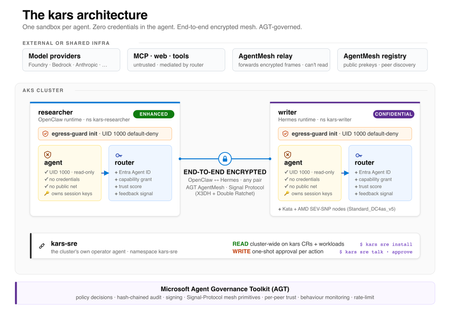
kars is an open-source, Kubernetes-native runtime for AI agents on Azure. It treats every agent as untrusted code - per-pod kernel isolation, zero credentials in the agent process, and an end-to-end encrypted inter-agent mesh - and governs agents on any framework with one set of Kubernetes policies via the Microsoft Agent Governance Toolkit. kars dev runs a governed agent on your laptop in minutes.2.7KViews1like2CommentsWhat IT teams need to know about Linux Secure Boot certificates expiring in 2026
If your organization does not use UEFI Secure Boot on Linux systems, this transition does not affect your boot path. You can stop reading now. If you do use Secure Boot, here is what you need to know. The Microsoft Corporation UEFI CA (Certificate Authority) 2011 expires on June 27, 2026 (June 26 local time in some time zones). Expiration alone does not stop anything from booting and does not render a system insecure. Existing 2011-signed shims keep working on systems that still trust the 2011 CA. The real risk is narrower: once an operating system vendor ships a shim signed only by the Microsoft UEFI CA 2023, any system whose firmware does not already trust the 2023 CA will fail to boot. The work for you is to confirm, before that update reaches your systems, that your systems trust the 2023 CA. If you want the history of why a Microsoft certificate sits in the Linux Secure Boot path at all, skip to the end. Terms used in this post You may see three Microsoft Secure Boot certificate authorities discussed in 2026 guidance. This post focuses on the Microsoft UEFI CA 2011, which is the CA used for third-party UEFI boot applications such as the Linux shim. The other expiring Microsoft Secure Boot certificates are the Microsoft Corporation KEK CA 2011, which is used to authorize updates to Secure Boot databases, and the Microsoft Windows Production PCA 2011, which is used for Windows boot components. Windows systems have a separate update path for those certificates; this post covers only the Linux boot chain. The 2023 update also separates two uses that were both covered by the Microsoft UEFI CA 2011. The Microsoft UEFI CA 2023 is for third-party UEFI boot applications, including the Linux shim. The Microsoft Option ROM UEFI CA 2023 is for third-party option ROMs, such as firmware on some add-in cards. This post is about the Linux bootloader path, but physical systems that rely on signed option ROMs may need to check that path too. Microsoft began returning 2023-signed Linux shim binaries to operating system vendors in October 2025, and since then a submitted shim comes back signed by both the 2011 CA and the 2023 CA. Once the 2011 CA expires, Microsoft can only sign with the 2023 CA. In UEFI Secure Boot terminology, db is the allowed signature database, dbx is the forbidden or revoked signature database, and KEK contains keys that can authorize updates to db and dbx . SBAT is a shim ecosystem mechanism for revoking boot components by generation. SBAT is related to Secure Boot revocation, but it is separate from the CA expiration itself. For brevity, the rest of this post uses operating system vendor to include Linux distributions and other vendors that ship and support Linux boot components. Microsoft returns signed shims to that submitting operating system vendor. It does not push shim updates to end users or IT departments. Those reach systems through the normal operating system, package, image, or platform update channels. What is not happening Expiration is not revocation, and it does not cause an immediate boot failure. The 2011 CA expiring does not make existing 2011-signed shims stop booting on June 27, 2026. UEFI Secure Boot validates a signature against the trust database and revocation state, not against the certificate's validity period. The image-validation process in the UEFI specification bases the decision on whether the image's hash or signing certificate is present in the authorized database ( db ) and absent from the forbidden database ( dbx ). It does not check whether the certificate has expired. Firmware bugs are always possible, but expiration by itself should not invalidate an already-signed shim. There is also no current plan to revoke the Microsoft UEFI CA 2011. Expiration means Microsoft can no longer sign new binaries with that certificate. Revocation would mean telling systems not to trust binaries signed with it. Revocation is not the plan. For the same reason, do not remove the 2011 CA from a system's Secure Boot db . Removing it strips that trust path. Removal is not required for this transition, and existing boot components may still depend on the 2011 CA. No operating system vendor has to move to a 2023-signed shim on the expiration date. An operating system vendor may keep shipping a 2011-signed shim (if one is available), ship a 2023-only shim, or ship one carrying both signatures. That decision belongs to the operating system vendor. What can break The failure case is a mismatch between the shim signature and the firmware trust database. The moment to worry about is not the expiration date. It is when a system first receives a 2023-only shim. That leaves a remediation window: the time between the expiration date and the first 2023-only shim reaching a given system. How long it lasts depends on your operating system vendor's packaging decisions, any security fix that forces a new shim release, and how easily you can update firmware or VM Secure Boot state on the affected platforms. The transition comes down to one table: Firmware trust database 2011-only shim 2023-only shim Dual-signed shim 2011 CA only Boots, but depends on continued 2011 trust Does not boot Should boot 2023 CA only Does not boot Boots Should boot Both 2011 and 2023 CAs Boots Boots Boots The table is deliberately simple. Real systems also have dbx revocations, SBAT policy, firmware bugs, operating system vendor packaging choices, and platform-specific update paths. But this is the core compatibility problem. Dual-signed shims help bridge the transition, because the same shim can validate through either CA. However, they are not a guarantee. Some firmware mishandles multiple signatures and evaluates only one of them, revocation and vendor support still apply, and the operating system vendor decides whether to ship and support a dual-signed shim at all. This kind of failure happens early, before the operating system loads. Recovery means restoring a trusted boot path or following your operating system, hardware, or platform vendor's recovery guidance. It is not a package rollback inside a running system. Who should pay closest attention This transition matters most where the operating system, firmware, and update path may not move together. If you run a maintained operating system on maintained hardware or a maintained virtualization platform, the normal vendor update path may handle most of it. Closer attention is worthwhile where that path is missing, delayed, customized, or hard to validate. Older hardware is the first case. Some systems need a firmware update before they can trust the 2023 CA, and support can vary by model even within one hardware vendor's portfolio. Check each model you operate rather than assuming one answer covers the fleet. Long-lived virtual machines are the second. VM firmware is still firmware. A VM's Secure Boot state depends on when it was created, which platform firmware it uses, and which UEFI variables have changed since. Firmware is not just another package update, so a long-lived VM may never have received the relevant firmware or database updates unless the administrator or platform applied them. Your cloud or virtualization provider should be able to say how the 2023 CA is handled for new VMs, existing VMs, and imported or custom images. For Azure Trusted Launch and Confidential VMs specifically, Microsoft has published guidance on identifying and updating affected instances. Older operating system releases need more careful validation. Some lack current Secure Boot tooling, current fwupd daemon behavior, or a supported path for updating UEFI trust databases. A command that works on one release may not be supported on another. Custom fleets are their own category: systems built from custom images, frozen package mirrors, pinned bootloader versions, or local Secure Boot policy changes. The more an environment differs from the vendor's default update path, the more you need to verify the actual firmware trust database and installed shim directly. Smaller operating system vendors and long-tail distributions are worth checking too, especially if they submit shim updates infrequently or have not finished their 2023 signing transition. No single authoritative public list tells you which releases have completed this work. Who is responsible for what There is no single Linux Secure Boot owner who can make every system safe for the transition. The operating system vendor controls which shim and boot components it ships. It also controls whether its update process checks the firmware trust database before installing a 2023-only shim. The Linux community runs a community-driven shim-review process for shim submissions. That process is the primary review gate before an operating system vendor requests a Microsoft signature. It is not a support channel for individual systems or fleets. The hardware vendor, firmware vendor, or virtual machine platform controls which trust anchors are present by default and how firmware updates are delivered. In a physical machine, that may mean a BIOS or firmware update. In a VM, it may mean platform firmware defaults, guest-visible UEFI variables, or a provider-specific remediation process. Microsoft controls the Microsoft UEFI signing service and the Microsoft UEFI CAs. After shim-review approval, Microsoft verifies the submitter's relationship to the operating system vendor, runs some additional checks, signs submitted shims, and returns the signed artifacts to the submitting operating system vendor. Microsoft does not choose when each operating system vendor ships a new shim to its customers. Your organization controls the systems it administers. In practice, that means checking whether Secure Boot is enabled, checking which certificates are trusted, following guidance from the relevant operating system vendor, and following guidance from the hardware vendor or VM provider. This is why the right answer for any specific system depends on its operating system vendor, hardware vendor, and platform. This post explains the model. Only those vendors can tell you what is supported for your systems. What to check The exact commands vary by operating system vendor, package set, and platform. Treat the examples below as illustrations, not guaranteed instructions for every Linux system. IT departments should validate commands against vendor documentation before using them in production automation. At fleet scale, the useful starting point is an inventory rather than a one-time manual check. Useful fields include whether Secure Boot is enabled, which Microsoft UEFI CAs are present in the firmware trust database, which CA signed the installed shim, the operating system release, the hardware model or VM platform, the update channel, and whether the system comes from a custom image or vendor image. Set up representative canary systems before any broad rollout. A canary set should cover the differences that matter in your fleet: hardware model, VM platform, operating system release, image lineage, and update channel. The aim is to avoid discovering a firmware or shim mismatch for the first time during a broad production update, not to build a new certification program. First, check whether Secure Boot is enabled: sudo mokutil --sb-state If Secure Boot is disabled, this certificate transition does not affect that system's current boot path. Next, check which Microsoft UEFI CAs are in the firmware trust database: sudo mokutil --db Look for entries such as: Microsoft Corporation UEFI CA 2011 Microsoft UEFI CA 2023 If both are present, the system is prepared for a future 2023-signed shim. If only the 2011 CA is present, check guidance from the relevant operating system vendor and platform provider before accepting a 2023-only shim update. On physical systems, also check whether the platform relies on signed third-party option ROMs. Those may require the Microsoft Option ROM UEFI CA 2023 in addition to the Microsoft UEFI CA 2023 used for boot applications. This is another reason hardware guidance can vary by model. Administrators can also inspect the signature on the shim currently installed on a system. On Enterprise Linux and related distributions, pesign is often used: sudo dnf install pesign sudo pesign -S -i /boot/efi/EFI/<vendor-or-distribution>/shimx64.efi On Debian, Ubuntu, and related distributions, sbverify from sbsigntools is often used: sudo apt install sbsigntools sudo sbverify --list /boot/efi/EFI/<vendor-or-distribution>/shimx64.efi The path to shim may differ. Some systems use a different EFI path, a different architecture suffix, or a different bootloader arrangement. Vendor documentation is the right source for exact commands. How updates may be delivered Many operating system vendors use the Linux Vendor Firmware Service (LVFS) and fwupd for firmware-related updates, including some UEFI Secure Boot database updates. Not every vendor enables the same tooling, and not every platform supports the same update mechanism. Common examples include: sudo fwupdmgr update sudo fwupdmgr security sudo fwupdmgr get-devices Some systems may require a firmware update from the hardware vendor. Some may support a standalone UEFI database update. Some may not support a safe standalone update at all. Some hardware and firmware vendors block standalone database updates because earlier failures showed that the update could break systems. Updating the Secure Boot allowed signature database ( db ) also depends on authorization from keys in KEK . That is one reason these updates often require cooperation from the firmware, hardware, or VM platform vendor. Administrators should not assume that possession of a certificate file is enough to update a system safely. Do not force a Secure Boot database update just because a command exists. Follow the guidance for the specific hardware, VM platform, or operating system vendor. Forcing an update can force a physical reboot of a machine or destroy the system. After the first inventory pass, keep watching the operating system vendor's security advisories and bootloader package updates. Questions for your vendors The right questions depend on the system, but these are the kinds of answers IT departments should look for from operating system vendors, hardware vendors, and VM providers: Does this operating system release currently ship a 2011-signed, 2023-signed, or dual-signed shim? If the vendor plans to ship a 2023-only shim, will the update process check whether the system trusts the 2023 CA before installing it? How is the Microsoft UEFI CA 2023 delivered for this hardware model, VM platform, or image? Is a standalone Secure Boot database update supported, or must the update arrive through a firmware update? Does support vary by hardware model, firmware version, VM generation, image type, or operating system release? What should administrators monitor for shim, GRUB, SBAT, db , KEK , or dbx updates related to this transition? What is the recommended validation path before broad deployment? What is the supported recovery path if a system receives an incompatible shim or firmware update and fails to boot? What to do now If an IT department administers Linux systems that use Secure Boot, the useful work is straightforward: Use the checks above to inventory Secure Boot state, trusted CAs, and installed shim signatures across representative systems. Identify the parts of the fleet most likely to diverge from default vendor paths, including older hardware, long-lived VMs, older operating system releases, custom images, and pinned bootloader packages. Read operating system, hardware, and VM provider guidance before accepting 2023-only shim updates or applying firmware and Secure Boot database updates. Test representative canary systems before rolling out shim or firmware changes broadly. Monitor operating system vendor advisories for shim and bootloader updates related to the transition. Avoid forcing low-level firmware or UEFI variable updates unless vendor guidance says to do so. How Linux got here UEFI Secure Boot was introduced to let firmware verify boot components before executing them. The firmware contains a trust database. If a bootloader is signed by a trusted certificate and is not blocked by revocation policy, the firmware can execute it. In the PC ecosystem, Microsoft has long operated the signing infrastructure used by Windows and by many third-party UEFI boot components. Linux operating system vendors do not have Microsoft sign the Linux kernel directly. Instead, they use a small first-stage bootloader called shim. The Linux shim is signed by Microsoft so firmware will start it. The shim then validates the next boot component, usually GRUB or another vendor-controlled bootloader, using keys controlled by the operating system vendor, not Microsoft. That structure lets Linux operating system vendors participate in the UEFI Secure Boot ecosystem while keeping control over their own boot chains. The shim code is developed publicly, and shim signing uses the community-run shim-review process before the Microsoft signing step. That split is important. The Linux community reviews shim submissions, and Microsoft operates the signing service that applies a signature firmware will trust. The certificate rotation affects this first handoff. Firmware must trust the CA that signed shim. If a future shim is signed only by the 2023 CA, the firmware needs the 2023 CA in its trust database. A system that keeps booting with a 2011-signed shim is not automatically broken or insecure on the expiration date. A system that moves to a 2023-signed shim needs to trust the 2023 CA; plan for that transition.2.4KViews2likes0Comments
Introducing Azure Container Linux (ACL)
Today at Microsoft Build 2026, we’re announcing the general availability of Azure Container Linux (ACL): a secure, immutable container host designed to help platform teams run Kubernetes workloads at scale on Azure Kubernetes Service (AKS) with greater consistency, reduced operational overhead, and a stronger default security posture. This release builds on Microsoft’s long-standing commitment to the Flatcar Container Linux ecosystem as a foundation for secure, minimal, and container-optimized operating systems. This commitment includes the acquisition of Kinvolk in 2021, bringing deep expertise in Flatcar development and cloud-native systems into Azure, and the subsequent donation of Flatcar to the Cloud Native Computing Foundation (CNCF), ensuring its continued growth as a community-driven project. Flatcar has played a critical role in helping customers run cloud-native infrastructure at scale, introducing an immutable, minimal OS model that reduces configuration drift, minimizes attack surface, and simplifies lifecycle management. As customer needs continue to grow, there is an increasing demand for deeper integration with cloud platforms, stronger default security enforcement, and a more tightly managed supply chain experience in managed environments like AKS. Building on this foundation, Azure Container Linux (ACL) represents the next evolution of this approach. ACL is intentionally built downstream of Flatcar to preserve compatibility with its ecosystem and leverage its mature, battle-tested design. ACL integrates Azure Linux binaries as the core foundation, providing consistency and compatibility with other Azure Linux use cases (including Azure Linux VMs), while bringing enterprise-hardened security and supportability into the platform. Looking ahead, ACL will further incorporate optional advanced code integrity capabilities from Azure Linux with OS Guard. We remain committed to the Flatcar community and will continue contributing innovations upstream while bringing a fully managed, enterprise-ready product to customers through ACL. Why a Trusted, Immutable Host Model Matters for AKS As Kubernetes adoption scales, platform teams face increasing complexity in managing node-level consistency, security, and lifecycle operations across large fleets. Traditional OS models introduce challenges such as: Configuration drift across nodes, leading to inconsistent behavior and harder-to-debug issues Fragmented update mechanisms that increase operational overhead and risk during upgrades Expanding attack surface due to unnecessary packages and mutable system state Limited visibility and guarantees around the provenance and integrity of OS components In managed environments like AKS, these challenges are amplified as teams look to operate clusters reliably at scale while meeting stricter security and compliance requirements. Azure Container Linux: Built for Consistency and Trust ACL addresses these challenges with a fully image-based operating system model that eliminates configuration drift, ensuring consistent behavior across nodes. Updates are delivered through AKS node image upgrades, providing a consistent and repeatable way to roll out OS changes across clusters without relying on in-place modifications. By standardizing how nodes are built, updated, and operated, ACL helps ensure clusters remain in a known-good, reproducible state over time, even as they scale. Over time, this model will continue to evolve to support A/B update mechanisms to further improve reliability, speed, and operational efficiency. Secure from the Start, and Designed for the Future ACL is engineered with a hardened security posture from the moment it boots. Its immutable design protects the integrity of the operating system, prevents unauthorized changes, and ensures consistent, reproducible behavior across your Kubernetes fleet. By removing unnecessary components and tightly constraining how the system can be modified, ACL reduces the attack surface and provides a strong foundation for running production workloads with confidence. Under the hood, ACL incorporates several safeguards that reinforce its secure-by-default model: Read-only /usr filesystem to prevent tampering with core system components. A minimal package set purpose-built for container workloads, reducing CVE exposure. Mandatory access control with SELinux, enforcing strict least-privilege policies. Trusted Launch using a Unified Kernel Image (UKI) to bundle the kernel, initramfs, and kernel command line into a single signed artifact, ensuring integrity from the earliest stage. Signed Azure Linux RPMs delivered through a trusted, end-to-end Microsoft supply chain. Going forward, we will continue to evolve ACL’s security posture as we bring over additional innovations from Azure Linux with OS Guard. This includes integrating code integrity into the ACL image, using the Integrity Policy Enforcement (IPE) Linux security module, to ensure that only binaries from trusted, signed volumes are allowed to execute. IPE will also extend to container images, ensuring that only binaries matching a trusted signature can be executed from verified dm-verity backed layers. Where applicable, we are committed to contributing these advancements upstream to the Flatcar project, helping strengthen the ecosystem and ensuring that improvements benefit the broader cloud-native community. Differentiating between Azure Container Linux and Existing Container Hosts on AKS AKS now provides multiple generally available Linux OS options, including general-purpose container hosts (Azure Linux and Ubuntu) and an immutable container host (Azure Container Linux). While all options are fully supported by Microsoft, they are designed to address distinct operational and security use cases. The sections below highlight the key differences to help you choose and position the right OS for your scenario. General Purpose OS Azure Container Linux Filesystem Writable (read-write) Immutable (read-only) /usr with dm-verity guarantees Focus on Extensibility, flexibility, and choice. Out of the box security and compliance guarantees. Mandatory Access Control AppArmor (optional) SELinux (enforcing by default)* Secure Boot Optional (supported with certain VM sizes) Supported by default with UKI (Unified Kernel Image) Updates Package and Image based updates supported Only image-based updates supported (A/B update support on the roadmap) *SELinux policies are subject to change over time based on customer feedback. Day‑1 Ecosystem Partner Support Azure Container Linux is launching with support from a broad ecosystem of security, monitoring, networking, and data partners. The following partners are expected to offer support or validated integrations at Day‑1 availability: Dynatrace – application performance monitoring and observability. Aquasec – database platform support on ACL. Qualys - vulnerability, compliance, and container security. Upwind - runtime cloud security and risk prioritization. Elastic - logs, metrics, and observability for Kubernetes. Isovalent – Kubernetes networking, observability, and security powered by eBPF (Cilium). If you’re interested in becoming a supported Azure Container Linux partner, please reach out to: AzureLinuxPartners@microsoft.com What Customers Are Saying Early customer feedback highlights the real‑world impact of Azure Container Linux on improving security posture and operational consistency at scale. “We’ve found working closely with the Microsoft product team throughout the Azure Container Linux preview to be invaluable. The product's immutability, minimal footprint, and built‑in security controls (such as SELinux and Trusted Launch) will strengthen our AKS security posture across every deployment instance in Nationwide. Furthermore, its focus on secure‑by‑design foundations is especially timely as we face advanced threat detection capabilities within the industry.” - Enterprise Container Platform, Cloud - Nationwide Engineered for AKS from Day One Azure Container Linux is deeply integrated with AKS to ensure a seamless operational experience. It is compatible with many critical AKS extensions and add‑ons, and works smoothly with existing application containers and deployment workflows. ACL is available across AMD64 and Arm64 architectures, ensuring consistent behavior across environments, and includes support for GPU-enabled workloads. Enabling ACL is as simple as specifying the following in your node pool configuration: --os-sku AzureContainerLinux Whether you're onboarding new clusters or migrating existing ones, ACL is designed to integrate into your environment with minimal friction. A Clear Path Forward for AKS Preview Users With the release of Azure Container Linux, AKS will transition to offer one unified immutable host offering. This work started with our use of Flatcar Container Linux in Preview and now continues with the GA release of ACL. As part of this release, Flatcar will no longer be available via --os-sku on AKS. Please note, this change applies specifically to the AKS preview experience; Flatcar is not being retired. Later this year we will complete the convergence of our immutable OS offerings by incorporating remaining kernel and runtime features of the current OS Guard preview into ACL. At that time, existing users of OS Guard will receive a guided transition to ACL, ensuring operational continuity while consolidating to a single container host. Get Started with Azure Container Linux ACL is GA and available today for all AKS customers. To begin using ACL in your clusters and explore documentation, best practices, and deployment guidance, visit: aka.ms/azurecontainerlinux ACL represents the future of secure, cloud-optimized Linux on AKS—building on the proven foundation of Flatcar, advancing it with Azure Linux innovations, and contributing back to the open-source ecosystem that customers depend on. We’re thrilled to bring this new foundation to our customers and can’t wait to see what you build with it. Learn More //Build Session: Build, deploy, and run Linux workloads on Azure Azure Container Linux documentation: https://aka.ms/azurecontainerlinux Azure Container Linux on GitHub: https://github.com/microsoft/azure-container-linux Azure Linux product page: https://aka.ms/AzureLinuxProduct Azure Linux documentation: https://aka.ms/azurelinux Joining the ISV partner program: AzureLinuxPartners@microsoft.com1.3KViews2likes0CommentsFour open source projects to explore at Microsoft Build
Open source is where developers experiment, collaborate, and turn new ideas into tools that others can build on. At Microsoft Build, we’re creating a dedicated space for that energy: the Open Source Zone. This year, the Open Source Zone will bring together maintainers, contributors, and developers working on some of the most interesting open source projects in AI. Whether you’re building agents, experimenting with local models, exploring prompt workflows, or looking for practical ways to bring AI into your development process, this is a place to meet the people behind the projects and see what they’re building. The Open Source Zone is inspired by similar community spaces we’ve hosted at GitHub Universe: hands-on, conversation-driven, and centered on the people and projects moving open source forward. Meet the projects OpenClaw OpenClaw, originally Clawbot, formerly Clawdbot and briefly Moltbot,before landing on its current name (because naming is hard), is a personal AI assistant project built for developers who want more control over how AI agents run across tools, devices, and workflows. Its repository describes it as “your own personal AI assistant” across operating systems and platforms, with support for agent workspaces, skills, and device nodes. It has also become one of the fastest-growing open source projects on GitHub, with over 370,000 stars to date. At the Open Source Zone, attendees can learn how OpenClaw approaches personal agents, extensibility, and local-first experimentation. AutoGPT AutoGPT is one of the best-known open source projects in the autonomous agent space. The project’s mission is to make AI accessible for everyone to use and build on, with tools for building, testing, and delegating work to agents. Visit AutoGPT in the Open Source Zone to learn how the project is evolving agent development, benchmarking, frontend experiences, and practical workflows for building agent-powered applications. Come for the autonomous agents; stay for the very human maintainers. AutoGPT is also a member of GitHub’s Secure Open Source Fund, with a goal of enhancing AI security across the open source ecosystem. Open WebUI Open WebUI is a self-hosted, extensible AI platform for working with large language models. The project supports Ollama and OpenAI-compatible APIs and includes built-in RAG capabilities, making it a strong option for developers and organizations exploring local, private, or provider-flexible AI experiences. At Build, the Open WebUI team will show how developers can run, customize, and extend AI interfaces for their own environments. prompts.chat prompts.chat, formerly Awesome ChatGPT Prompts, is a curated collection of prompt examples for AI chat models. The project is designed to help people discover, share, and build better prompts for modern AI assistants. Created by Fatih Kadir Akın, a GitHub Star from Istanbul, prompts.chat reflects his work at the intersection of open source, developer education, and AI-assisted development. Fatih leads Developer Relations at Teknasyon, has authored books on JavaScript and prompt engineering, and is active in the community as a speaker, organizer, and contributor. Stop by to explore prompt libraries, prompt engineering resources, self-hosting options, and ways the community is making prompting more reusable and collaborative. Register for Microsoft Build Microsoft Build takes place June 2–3, 2026, in San Francisco and online. In-person passes are available, and online registration is free for livestreamed keynote and select session access. Register for Microsoft Build and come visit the Open Source Zone to meet the teams behind OpenClaw, AutoGPT, Open WebUI, and prompts.chat. We’ll see you there. <3952Views0likes0Comments
Project Pavilion Presence at KubeCon EU 2026
KubeCon + CloudNativeCon Europe 2026 took place from 23 to 26 March at RAI Amsterdam, and it was a strong one. The themes running through the week reflected where the cloud native community is right now: AI moving from experimentation into production, platform engineering continuing to mature, and security and sovereignty top of mind for organizations across Europe. Microsoft was there throughout, and once again supported a range of open source projects in the Project Pavilion. The Project Pavilion is a dedicated, vendor-neutral space on the show floor reserved for CNCF projects. It is where the work gets talked about honestly. Maintainers and contributors meet directly with end users, share what they are building, get real feedback on what is and is not working, and have the kinds of technical conversations that are hard to have anywhere else. For open source communities, it is one of the most valuable parts of the event. Why Our Presence Matters Microsoft's products and services are built on and alongside many of the technologies represented in the pavilion, and the health of these communities matters to us directly. Showing up means our teams hear firsthand what is working, what is missing, and where these projects need to go next. It also means we get to contribute as community members, not just as a company name on a sponsor board. That distinction matters to us, and to the communities we are part of. Microsoft-Supported Pavilion Projects Confidential Containers Representative: Jeremi Piotrowski The Confidential Containers booth gave attendees a chance to learn more about the project and its approach to protecting workloads using hardware-based trusted execution environments. Jeremi was on hand throughout the kiosk hours, fielding questions from interested users and developers exploring confidential computing in Kubernetes environments. Conversations touched on use cases around data privacy, regulated workloads, and the role Confidential Containers plays in the broader cloud-native security landscape. Drasi Representative: Daniel Gerlag and Nandita Valsan The Drasi team had a busy time in the pavilion, engaging around 40 attendees across two kiosk shifts in focused technical conversations. Most visitors were developers and platform engineers curious about change-driven architectures and real-time data processing. There was strong positive feedback on the newly introduced Drasi Server modes and embeddable library, which complement Drasi for Kubernetes. The team came away with useful validation of current design decisions and good input for the roadmap ahead. Envoy Representative: Mikhail Krinkin The Envoy booth was staffed for the full duration of KubeCon EU by maintainers from Microsoft, Google, Isovalent, and Tetrate, reflecting the broad and healthy contributor base behind the project. The biggest topic at the booth was migration from ingress-nginx to Gateway API implementations. The archival of ingress-nginx pushed a lot of users into making changes they were not quite ready for, and questions ranged from technical specifics like HTTP default differences between Envoy and Nginx, to more foundational questions about what Envoy and Gateway API actually are. The team had anticipated this and invested in the ingress2gateway project to give users a clear migration path. Extensibility was another frequent conversation topic, with dynamic modules increasingly becoming the go-to answer for user-specific requirements. Starting with the 1.38 release of Envoy, dynamic modules will have a backward compatible ABI, a sign of real production readiness for that feature. Flatcar Representative: Thilo Fromm and Mathieu Tortuyaux The Flatcar booth had great energy, with maintainers from Microsoft, STACKIT, and CloudBase joining for conversations throughout the pavilion hours. Operational sovereignty came up again and again as a theme, with users and consulting partners sharing how they are building their Kubernetes offerings on Flatcar because of how reliable and secure it is. There were a lot of meaningful conversations. Lambda.ai currently runs Flatcar on their control plane and is looking at extending it to worker and customer clusters, with interest in contributing to the project. ReeVo has built their hosted Kubernetes distro on Flatcar across multi-cloud and bare metal environments and is planning to move hundreds of customer clusters over soon. Users from ClearScore, Avassa, Recorded Future, and several other organizations also stopped by with positive feedback on the project's robustness and security. STACKIT uses Flatcar as the default OS for their hosted Kubernetes offering and sponsors a full-time maintainer for the project. The team also connected with TAG Infrastructure to talk through Flatcar's CNCF graduation progress. Headlamp Representatives: René Dudfield and Santhosh Nagaraj S The Headlamp booth was a busy one, with users, contributors, and partner projects all stopping by throughout the pavilion hours. Conversations covered real-world deployments, federation challenges, multi-tenant namespace visibility, and feature requests like multi-CR data aggregation. There was notable interest from consultancies deploying Headlamp across hundreds of customer clusters, as well as from companies already running it at cloud scale. Several CNCF projects expressed interest in building UIs for their own projects inside Headlamp, with a few even getting started right there at the conference. The team also heard from users getting budget approved to migrate from the deprecated Kubernetes Dashboard, which is a good sign for the project's growing momentum. Demand for air-gapped AI agent support and deeper Azure and AKS integrations for internal developer platforms came up as clear areas to watch. Hyperlight Representative: Ralph Squillace The Hyperlight booth ran as a half-day session on Tuesday, in line with the project's current Sandbox status, but the corner location in the project area made a real difference in visibility. Ralph was fielding questions from the moment the doors opened, with a steady stream of visitors right up until the shift ended. Live and recorded demos were central to the conversations, helping attendees quickly grasp what Hyperlight does and how it fits into their environments. One standout visit came from an engineer at SAP who spent nearly an hour at the booth, pushing the conversation from fundamentals and embedding examples all the way through to agentic protection scenarios in Kubernetes. That conversation continued beyond KubeCon and turned into a scheduled meeting to explore a proof of concept, a good example of the kind of follow-on engagement the pavilion can generate. Inspektor Gadget Representative: Michael Friese and Qasim Sarfraz The Inspektor Gadget booth had a lot of great energy, drawing in contributors, new users, and people just discovering the project for the first time. There was genuine excitement around Inspektor Gadget Desktop and its visual troubleshooting experience for Kubernetes and Linux environments. The integration with HolmesGPT, which was also featured in the keynote, came up frequently and was one of the main talking points throughout the event. A theme that surfaced consistently in conversations with platform engineers was multi-tenancy, with teams looking for ways to safely give developers ad-hoc access to troubleshoot issues independently while keeping overall control at the platform level. It was a good set of conversations that reflected both the project's maturity and the growing demand for a flexible observability framework. Istio Representative: Mitch Connors, Mikhail Krinkin, Jackie Maertens and Mike Morris The Istio booth had steady traffic throughout the conference, with a noticeable shift in who was stopping by. More visitors came from teams with existing sidecar-based production deployments looking for guidance on moving to ambient mode, which is a change from previous years when ambient interest was mostly coming from greenfield users. The motivation to make the move was often tied to cost optimization and performance, with teams having read case studies and feeling more confident about the direction. That said, the increased interest also surfaced some real gaps, including requests for clearer migration guidance, more clarity around architectural differences like mTLS egress workflows, and better support for VM-based workloads. The team is planning to prioritize migration guidance over the coming months. The updated Istio Day format, with a half day of sessions at the Cloud Native Theater stage, also drew a strong crowd with standing room only throughout. Notary Project Representative: Toddy Mladenov and Flora Taagen The Notary Project kiosk drew a wide range of visitors, from people learning about container image signing for the first time to experienced engineers asking detailed questions about what is coming next on the roadmap. A major highlight of the week was the project's conference talk on per-layer dm-verity signing, which drew a packed room and over 660 online sign-ups, one of the stronger turnouts for a project-level session at the event. The talk walked through how the new capability moves container security beyond pull-time verification to continuous runtime protection, backed by dm-verity, which generated a lengthy Q&A and a lot of enthusiasm from the audience. The team also sees a real opportunity ahead as AI workloads push organizations to think harder about the integrity of models, datasets, and container images, and the interest at the booth reinforced that Notary Project is well positioned to play a big role in securing those workflows. ORAS Representative: Toddy Mladenov The ORAS kiosk was staffed by maintainers from Microsoft, NVIDIA, and Red Hat, a good reflection of the healthy multi-vendor community the project has built. Attendees engaged with maintainers on ORAS use cases and adoption, with conversations ranging from how artifacts are tagged and packaged to how ORAS fits into broader multi-cloud workflows. One practical takeaway from maintainer conversations was around leveraging the ORAS SDK more often as a substitute for CLI operations when working with container registries, which helps teams build simpler and more robust tooling. Radius Representative: Sylvain Niles and Will Tsai The Radius booth, supported by the Microsoft Azure Incubations team, attracted a good mix of enterprise platform teams, prospective adopters, and fellow open source maintainers throughout the pavilion hours. There was strong interest in the extensible Radius Resource Types feature and how it helps teams abstract infrastructure complexity and move workloads across different environments. Conversations also surfaced useful feedback on where the project should focus next, including agent-driven infrastructure workflows and using the Radius application graph to improve observability and operational visibility for cloud-native applications. Conclusion KubeCon EU 2026 was a good reminder of why this community continues to grow. The conversations in the Project Pavilion were substantive, the feedback was honest, and the connections made there will carry forward into the work. Microsoft will be back for KubeCon NA in Salt Lake City this November, and we are already looking forward to it. If you are interested in getting involved with any of these projects, the best starting point is each project's community directly. You are also welcome to reach out to Lexi Nadolski at lexinadolski@microsoft.com with any questions.138Views0likes0CommentsProject Pavilion Presence at KubeCon NA 2025
KubeCon + CloudNativeCon NA took place in Atlanta, Georgia, from 10-13 November, and continued to highlight the ongoing growth of the open source, cloud-native community. Microsoft participated throughout the event and supported several open source projects in the Project Pavilion. Microsoft’s involvement reflected our commitment to upstream collaboration, open governance, and enabling developers to build secure, scalable and portable applications across the ecosystem. The Project Pavilion serves as a dedicated, vendor-neutral space on the KubeCon show floor reserved for CNCF projects. Unlike the corporate booths, it focuses entirely on open source collaboration. It brings maintainers and contributors together with end users for hands-on demos, technical discussions, and roadmap insights. This space helps attendees discover emerging technologies and understand how different projects fit into the cloud-native ecosystem. It plays a critical role for idea exchanges, resolving challenges and strengthening collaboration across CNCF approved technologies. Why Our Presence Matters KubeCon NA remains one of the most influential gatherings for developers and organizations shaping the future of cloud-native computing. For Microsoft, participating in the Project Pavilion helps advance our goals of: Open governance and community-driven innovation Scaling vital cloud-native technologies Secure and sustainable operations Learning from practitioners and adopters Enabling developers across clouds and platforms Many of Microsoft’s products and cloud services are built on or aligned with CNCF and open-source technologies. Being active within these communities ensures that we are contributing back to the ecosystem we depend on and designing by collaborating with the community, not just for it. Microsoft-Supported Pavilion Projects containerd Representative: Wei Fu The containerd team engaged with project maintainers and ecosystem partners to explore solutions for improving AI model workflows. A key focus was the challenge of handling large OCI artifacts (often 500+ GiB) used in AI training workloads. Current image-pulling flows require containerd to fetch and fully unpack blobs, which significantly delays pod startup for large models. Collaborators from Docker, NTT, and ModelPack discussed a non-unpacking workflow that would allow training workloads to consume model data directly. The team plans to prototype this behavior as an experimental feature in containerd. Additional discussions included updates related to nerdbox and next steps for the erofs snapshotter. Copacetic Representative: Joshua Duffney The Copa booth attracted roughly 75 attendees, with strong representation from federal agencies and financial institutions, a sign of growing adoption in regulated industries. A lightning talk delivered at the conference significantly boosted traffic and engagement. Key feedback and insights included: High interest in customizable package update sources Demand for application-level patching beyond OS-level updates Need for clearer CI/CD integration patterns Expectations around in-cluster image patching Questions about runtime support, including Podman The conversations revealed several documentation gaps and feature opportunities that will inform Copa’s roadmap and future enablement efforts. Drasi Representative: Nandita Valsan KubeCon NA 2025 marked Drasi’s first in-person presence since its launch in October 2024 and its entry into the CNCF Sandbox in early 2025. With multiple kiosk slots, the team interacted with ~70 visitors across shifts. Engagement highlights included: New community members joining the Drasi Discord and starring GitHub repositories Meaningful discussions with observability and incident management vendors interested in change-driven architectures Positive reception to Aman Singh’s conference talk, which led attendees back to the booth for deeper technical conversations Post-event follow-ups are underway with several sponsors and partners to explore collaboration opportunities. Flatcar Container Linux Representatives: Sudhanva Huruli and Vamsi Kavuru The Flatcar project had some fantastic conversations at the pavilion. Attendees were eager to learn about bare metal provisioning, GPU support for AI workloads, and how Flatcar’s fully automated build and test process keeps things simple and developer friendly. Questions around Talos vs. Flatcar and CoreOS sparked lively discussions, with the team emphasizing Flatcar’s usability and independence from an OS-level API. Interest came from government agencies and financial institutions, and the preview of Flatcar on AKS opened the door to deeper conversations about real-world adoption. The Project Pavilion proved to be the perfect venue for authentic, technical exchanges. Flux Representatives: Dipti Pai The Flux booth was active throughout all three days of the Project Pavilion, where Microsoft joined other maintainers to highlight new capabilities in Flux 2.7, including improved multi-tenancy, enhanced observability, and streamlined cloud-native integrations. Visitors shared real-world GitOps experiences, both successes and challenges, which provided valuable insights for the project’s ongoing development. Microsoft’s involvement reinforced strong collaboration within the Flux community and continued commitment to advancing GitOps practices. Headlamp Representatives: Joaquim Rocha, Will Case, and Oleksandr Dubenko Headlamp had a booth for all three days of the conference, engaging with both longstanding users and first-time attendees. The increased visibility from becoming a Kubernetes sub-project was evident, with many attendees sharing their usage patterns across large tech organizations and smaller industrial teams. The booth enabled maintainers to: Gather insights into how teams use Headlamp in different environments Introduce Headlamp to new users discovering it via talks or hallway conversations Build stronger connections with the community and understand evolving needs Inspektor Gadget Representatives: Jose Blanquicet and Mauricio Vásquez Bernal Hosting a half-day kiosk session, Inspektor Gadget welcomed approximately 25 visitors. Attendees included newcomers interested in learning the basics and existing users looking for updates. The team showcased new capabilities, including the tcpdump gadget and Prometheus metrics export, and invited visitors to the upcoming contribfest to encourage participation. Istio Representatives: Keith Mattix, Jackie Maertens, Steven Jin Xuan, Niranjan Shankar, and Mike Morris The Istio booth continued to attract a mix of experienced adopters and newcomers seeking guidance. Technical discussions focused on: Enhancements to multicluster support in ambient mode Migration paths from sidecars to ambient Improvements in Gateway API availability and usage Performance and operational benefits for large-scale deployments Users, including several Azure customers, expressed appreciation for Microsoft’s sustained investment in Istio as part of their service mesh infrastructure. Notary Project Representative: Feynman Zhou and Toddy Mladenov The Notary Project booth saw significant interest from practitioners concerned with software supply chain security. Attendees discussed signing, verification workflows, and integrations with Azure services and Kubernetes clusters. The conversations will influence upcoming improvements across Notary Project and Ratify, reinforcing Microsoft’s commitment to secure artifacts and verifiable software distribution. Open Policy Agent (OPA) - Gatekeeper Representative: Jaydip Gabani The OPA/Gatekeeper booth enabled maintainers to connect with both new and existing users to explore use cases around policy enforcement, Rego/CEL authoring, and managing large policy sets. Many conversations surfaced opportunities around simplifying best practices and reducing management complexity. The team also promoted participation in an ongoing Gatekeeper/OPA survey to guide future improvements. ORAS Representative: Feynman Zhou and Toddy Mladenov ORAS engaged developers interested in OCI artifacts beyond container images which includes AI/ML models, metadata, backups, and multi-cloud artifact workflows. Attendees appreciated ORAS’s ecosystem integrations and found the booth examples useful for understanding how artifacts are tagged, packaged, and distributed. Many users shared how they leverage ORAS with Azure Container Registry and other OCI-compatible registries. Radius Representative: Zach Casper The Radius booth attracted the attention of platform engineers looking for ways to simplify their developer's experience while being able to enforce enterprise-grade infrastructure and security best practices. Attendees saw demos on deploying a database to Kubernetes and using managed databases from AWS and Azure without modifying the application deployment logic. They also saw a preview of Radius integration with GitHub Copilot enabling AI coding agents to autonomously deploy and test applications in the cloud. Conclusion KubeCon + CloudNativeCon North America 2025 reinforced the essential role of open source communities in driving innovation across cloud native technologies. Through the Project Pavilion, Microsoft teams were able to exchange knowledge with other maintainers, gather user feedback, and support projects that form foundational components of modern cloud infrastructure. Microsoft remains committed to building alongside the community and strengthening the ecosystem that powers so much of today’s cloud-native development. For anyone interested in exploring or contributing to these open source efforts, please reach out directly to each project’s community to get involved, or contact Lexi Nadolski at lexinadolski@microsoft.com for more information.336Views1like0Comments