ediscovery
104 Topics
How much of your Microsoft 365 environment can you actually see at once?
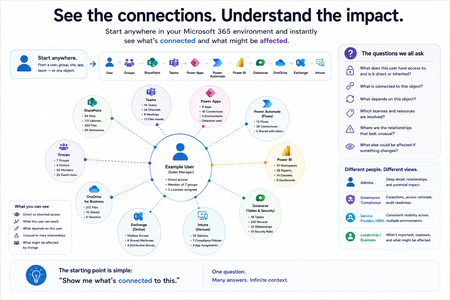
Not how many users you have. Not how many sites, teams, apps or flows you have. How much of it can you actually see connected together? I've been working across Microsoft 365 environments for a while, and I kept running into the same thing. There is no shortage of information. If anything, there is probably too much of it. Users, groups, permissions, SharePoint, Teams, Power Apps, Power Automate, Power BI, Dataverse, OneDrive, Exchange, Intune, licensing, configuration... It's all there. But when you're actually trying to understand how everything fits together, it can be a different story. You open one blade. Find something. Open another. Cross-check it. Go back. Open something else. Before long, you're jumping between different parts of the tenant trying to build the bigger picture in your head. And if you're working with larger environments, that gets difficult pretty quickly. The information isn't necessarily missing. The relationships between the information are what can be difficult to see. That got me thinking about a slightly different question: Instead of "where do I find this information?" "Show me what's connected to this." That's where VisibleState started. Start anywhere. Follow the connections. Imagine starting with a single user. Instead of seeing that user simply as a record with a list of properties, imagine being able to explore the relationships around them: User → Groups → SharePoint → Teams → Power Apps → Power Automate → Power BI → Dataverse → OneDrive → Exchange → Intune Then the questions become different: What does this user have access to? Is that access direct or coming through a group? What resources are connected to them? What depends on something they're associated with? Which licenses are involved? Are there relationships that look unusual? If something changes, what else might be affected? Those questions aren't necessarily about finding another piece of information. They're about putting information that already exists into context. A report can tell you that something exists. A connected view helps you understand what it is connected to. Illustrative example below — not a real customer environment. I'm not suggesting Microsoft 365 doesn't already give us this information Quite the opposite. Microsoft 365 already gives administrators an incredible amount of information and tooling. The thing I've been thinking about is what happens when you want to look across those boundaries. Sometimes I don't want another export. I don't want another list. I don't necessarily want another dashboard. I want to start with something I'm looking at and ask: "What's connected to this?" And then keep following the trail. That's the idea I'm exploring with VisibleState. The interesting part is what happens when you change the viewpoint The same relationships can be useful for completely different reasons. For example: Administrators may want to understand access, permissions and dependencies. Security and governance teams may want to find unusual relationships or exceptions. Compliance teams may need to understand who can access something and why. People managing multiple environments may want a consistent way to understand what's there without rebuilding the picture manually every time. Leadership may not need to see the graph at all. They may simply want to know what's important, what's exposed and what could be affected. It's still the same underlying environment. You're just looking at it from a different angle. And that's where I think things get interesting. Where I'm at with it VisibleState started as something I was building to make my own work easier. I was spending a lot of time investigating environments, tracing access and putting information together for reports. The individual tasks weren't necessarily difficult. It was the jumping between different places and reconstructing the bigger picture that took the time. So I started building something that would let me approach the environment through the relationships instead. It's grown quite a bit from where it started, and I'm continuing to build it. I'm not posting this as a product launch, and I'm not looking for people to sign up. I'm genuinely interested in whether the problem I'm seeing is familiar to other people working with Microsoft 365. So I'm curious... If you could start with any object in your Microsoft 365 environment and immediately see what it's connected to, where would you start? Would it be: Users and access Groups and permissions SharePoint and Teams Power Apps, Power Automate, Power BI and Dataverse Licensing and resources Governance and unusual relationships Something completely different Maybe you've already got a good way of doing this. Maybe you still find yourself jumping between different services and piecing things together manually. Or maybe I'm looking at the problem from the wrong direction. What's the one relationship in your Microsoft 365 environment that you wish you could see instantly?222Views0likes0Comments
Office 365 Mailbox Export to PST - Third Party Tools: What’s Your Experience?
Exporting Office 365 mailboxes to PST is still a common requirement in many Microsoft 365 environments, especially for backup, compliance, and migration scenarios. While Microsoft offers native options like Purview eDiscovery and Outlook export, many administrators also consider third-party tools when dealing with large mailboxes or bulk export requirements. In real-world scenarios, factors like speed, ease of use, permission handling, and consistency of exported data often influence the choice of tool. Some teams prefer native methods for compliance control, while others explore third-party solutions to simplify large-scale or repeated export tasks. For those working with Microsoft 365, what has your experience been with third-party PST export tools? Have they helped in your environment, or do you still rely mainly on Microsoft’s native options?521Views1like3Comments
Compliance licenses at tenant level
Hi, We are a small organization of about 200 employees, and we have following requirements. DLP policies configuration at Exchange, OneDrive, SharePoint BYOD security Users should not be able to send files outside the org And so on as we evaluate We already have M365 Business Premium. However, after researching we figured out that M365 Business premium will alone not solve our requirements. May be compliance license will. We want to apply security policies at tenant level in our organization but definitely do not want every user to get licenses as this will be expensive for us and there is no requirement at all for our users. The question is, Is there a way to solve the above scenario?814Views1like3CommentsUsing Purview eDiscovery APIs in App-Only Mode
Most eDiscovery work is done interactively, but a use case exists for working with eDiscovery cases through apps, such as populating a large review set. It’s possible to configure an Entra ID app to work with the eDiscovery APIs in app-only rather than delegated mode, but only by using an Exchange service principal to add the app to the eDiscovery manager role group. This approach also works with Azure Automation runbooks that use Managed Identities. https://practical365.com/ediscovery-app-only-mode/49Views0likes0Comments
Compliance search is not returning any data (Powershell)
At our organization, we have an SOP for purging phishing emails from all mailboxes. Part of that is creating a search and then examining it for any legit emails before going on to the purge step. The commands below are no longer returning any data, and they used to work. What has changed? PS C:\Windows\system32> Connect-IPPSSession -UserPrincipalName email address removed for privacy reasons PS C:\Windows\system32> New-ComplianceSearch -Name "Broken" -ExchangeLocation All -ContentMatchQuery 'Subject:"invoice"' Name RunBy JobEndTime Status ---- ----- ---------- ------ Broken NotStarted PS C:\Windows\system32> Start-compliancesearch -identity "broken" PS C:\Windows\system32> Get-compliancesearch -identity "broken" Name RunBy JobEndTime Status ---- ----- ---------- ------ Broken admin 7/14/2025 8:17:09 PM Completed PS C:\Windows\system32> Get-ComplianceSearch -Identity "broken" | >> Select-Object Name, Status, ItemsFound, Size, CreatedBy, CreatedTime | >> Export-Csv -Path "C:\filename.csv" -NoTypeInformation The resultant .csv has only the headers, but no information about emails, so any purge commands have nothing to purge. Thank you471Views0likes1CommentPractical Graph: Using PowerShell to Create and Run eDiscovery Cases
The new Purview eDiscovery implementation supports a Graph API. Where there's a Graph API, there are PowerShell cmdlets based on the API. This article explains how to use PowerShell to automate different aspects of eDiscovery cases. PowerShell can't review the items found by searches, but it can handle most of the other processing. https://practical365.com/purview-ediscovery-powershell/238Views0likes0CommentsPractical Purview: Removing Old Items from User Calendars
A reader wants to remove all calendar items over a certain age. Compliance purge actions seem like a good way to do this, but there's a problem that needs to be fixed. eDiscovery purges can do the job, but only if you have eDiscovery Premium. And then there's Graph APIs to consider. All in all, many ways exist to purge calendar items. https://practical365.com/ediscovery-purges/137Views2likes0CommentsImportant Purview eDiscovery Changes Take Effect in May 2025
Microsoft is making some important changes to Purview eDiscovery from May 26, 2025. The changes affect how content searches work and are likely to affect many Microsoft 365 tenants. Administrators and eDiscovery investigators will both have to master new ways of working with eDiscovery cases, searching for information, reviewing search results, and exporting what’s found. Changes to PowerShell cmdlets might affect scripts, so there’s lots to consider. https://office365itpros.com/2025/04/17/purview-ediscovery-may2025/201Views1like0CommentsPurview eDiscovery’s Big Makeover
eDiscovery is a calling best left to skilled investigators. But Microsoft 365 administrators need to know how to search and how the new Purview eDiscovery works. The new implementation is due by the end of 2024 and is in preview now. It unifies the three existing solutions in the Microsoft 365 eDiscovery space and promises to deliver new functionality. But will it make its dates? Who knows! https://office365itpros.com/2024/09/09/new-purview-ediscovery/178Views0likes0Comments