diagnostic imaging
3 TopicsModernizing radiology reporting—without disrupting care: A practical path to PowerScribe One
With growing imaging volumes, increasing complexity, and the rapid emergence of AI, healthcare organizations are reevaluating how their reporting environments support clinicians and strengthen operational performance. They are faced with how to modernize without interrupting the work that matters most. We developed our PowerScribe One solution and implementation approach with that reality in mind. In active production across a wide range of healthcare environments (including large integrated delivery networks, academic medical centers, independent radiology practices, and community hospitals), PowerScribe One reflects a solution that is both proven in practice and designed for what comes next. Over 250 organizations and 10,000+ radiologists use PowerScribe One to generate millions of reports each month. This scale is significant; it’s validation of what we bring through our solution and support. It reflects a system and team tested across diverse environments, integration landscapes, and operational models, performing reliably in real-world conditions. Combining the strength of our solutions with an experienced Microsoft team, we deliver a seamless implementation that minimizes disruption. Redefining the migration experience As I’ve worked with customers modernizing their reporting environments, I’ve noticed a consistent pattern of concern: how to modernize without disrupting the workflows teams rely on or the care they deliver. In my experience, even when a solution offers meaningful capabilities, customers still worry about the potential downsides of a prolonged migration. I understand that perspective. Many have worked with vendors who promise a “lift-and-shift” implementation but fall short of that expectation. Migrations can introduce real challenges, including downtime, retraining, and workflow disruption. Over time, we’ve seen that successful transformation is driven not only by the strength of the technology, but also by how effectively the transition is managed. With years of experience supporting PowerScribe environments, we’ve taken those insights and applied them to our approach. We defined what a successful PowerScribe One implementation looks like and developed a migration model designed to reduce risk while supporting adoption. Rather than viewing migration as a single milestone, PowerScribe One transitions are designed as a structured journey with clearly defined phases and timing: Discovery: Align on goals, workflows, and integration requirements Build: Preparing the technical and operational foundation Testing: Validating workflows end to end and addressing issues proactively Production: Supporting go-live with a focus on stability and adoption Each phase includes checkpoints and shared accountability to increase transparency and reduce uncertainty. Our Microsoft team works closely with our customers to build a project timeline that fits their needs while existing PowerScribe 360 workflows and content are leveraged, eliminating the need to rebuild from scratch. I’d also like to highlight at the center of this migration model is a parallel transition strategy. We enable PowerScribe 360 and PowerScribe One to operate side-by-side during our customer’s migration period. This approach provides organizations with the flexibility to: Introduce PowerScribe One to early adopters Validate workflows and integrations in a live environment Phase adoption across teams Maintain continuity throughout the transition In this measured approach, our customers can move forward with confidence, ensuring that systems, workflows, and teams are ready for successful adoption. The result is a model that is both repeatable and adaptable, capable of supporting organizations with varying levels of complexity. Our efforts to center our implementation process on the customer experience shows how migration work is not simply a technical capability proposition. This focus reflects our broader philosophy: transformation should be deliberate, not disruptive. From implementation to enablement Minimizing disruption doesn’t end with implementation. It extends into how teams are supported, trained, and enabled in their day-to-day workflows. Our focus on enablement is especially important in radiology, where even small workflow disruptions can have outsized impacts on productivity and the radiologist experience. With PowerScribe One, organizations not only gain access to a modern reporting solution but also support from teams with deep experience in radiology workflows, integrations, and large-scale deployments. With that in mind, I’ve seen firsthand how the healthcare landscape has radically changed over the last six years. Our customers tell us how workforce shifts in radiology means they are adapting their staffing models and workflows to include telework. With these changes in the workforce, organizations benefit from training and support models that are flexible, digital, and accessible remotely. We made live expert access (known to our customers as “drop-in help”) easily accessible through a simple QR code. It can be an ad hoc or scheduled engagement which ensures the offering aligns with a radiologist’s schedule. The feedback on this level of access we’ve received has been extremely positive and is resonating strongly with customers. I know that for any healthcare solution deployment to be successful, it requires a learning and support model that aligns with clinical schedules and operational realities. Modernizing radiology reporting is both a technical and operational effort with its success depending on advancing capability without disrupting clinical continuity. The transition to PowerScribe One shows this balance is achievable through phased adoption, low-disruption deployment, and strong user readiness. Organizations can modernize without affecting day-to-day care delivery with our structured approach, proven expertise and a focus on provider experience and patient outcomes. If you want to learn more about our approach or PowerScribe One, I’ll be at SIIM26, June 10-12, please stop by the Microsoft booth at 630-632. You can also discover how we partner with our customers why they decided to move to PowerScribe One by reading our Industry Blog.Empowering multi-modal analytics with the medical imaging capability in Microsoft Fabric
This blog is part of a series that explores the recent announcement of the public preview of healthcare data solutions in Microsoft Fabric. The DICOM® (Digital Imaging and Communications in Medicine) data ingestion capability within the healthcare data solutions in Microsoft Fabric enables the storage, management, and analysis of imaging metadata from various modalities, including X-rays, CT scans, and MRIs, directly within Microsoft Fabric. It fosters collaboration, R&D and AI innovation for healthcare and life science use cases. Our customers and partners can now integrate DICOM® imaging datasets with clinical data stored in FHIR® (Fast Healthcare Interoperability Resources) format. By making imaging pixels and metadata accessible alongside clinical history and laboratory data, it enables clinicians and researchers to interpret imaging findings in the appropriate clinical context. This leads to enhanced diagnostic accuracy, informative clinical decision-making, and ultimately, improved patient outcomes.General Availability - Medical imaging DICOM® in healthcare data solutions in Microsoft Fabric
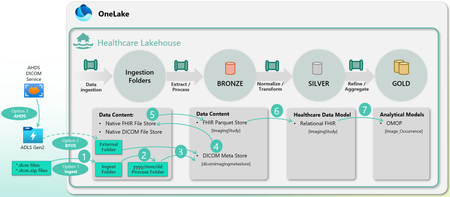
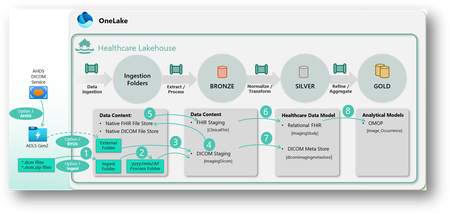
As part of the healthcare data solutions in Microsoft Fabric, the DICOM® (Digital Imaging and Communications in Medicine) data transformation is now generally available. Our Healthcare and Life Sciences customers and partners can now ingest, store, transform and analyze DICOM® imaging datasets from various modalities, such as X-rays, CT scans, and MRIs, directly within Microsoft Fabric. This was made possible by providing a purpose-built data pipeline built to top of the medallion Lakehouse architecture. The imaging data transformation capabilities enable seamless transformation of DICOM® (imaging) data into tabular formats that can persist in the lake in FHIR® (Fast Healthcare Interoperability Resources) (Silver) and OMOP (Observational Medical Outcomes Partnership) (Gold) formats, thus facilitating exploratory analysis and large-scale imaging analytics and radiomics. Establishing a true multi-modal biomedical Lakehouse in Microsoft Fabric Along with other capabilities in the healthcare data solutions in Microsoft Fabric, this DICOM® data transformation will empower clinicians and researchers to interpret imaging findings in the appropriate clinical context by making imaging pixel and metadata available alongside the clinical history and laboratory data. By integrating DICOM® pixels and metadata with clinical history and laboratory data, our customers and partners can achieve more with their multi-modal biomedical data estate, including: Unify your medical imaging and clinical data estate for analytics Establish a regulated hub to centralize and organize all your multi-model healthcare data, creating a foundation for predictive and clinical analytics. Built natively on well-established industry data models, including DICOM®, FHIR® and OMOP. Build fit-for-purpose analytics models Start constructing ML and AI models on a connected foundation of EHR and pixel-data. Enable researchers, data scientists and health informaticians to perform analysis on large volumes of multi-model datasets to achieve higher accuracy in diagnosis, prognosis and improved patient outcomes 1 . Advance research, collaboration and sharing of de-identified imaging Build longitudinal views of patients’ clinical history and related imaging studies with the ability to apply complex queries to identify patient cohorts for research and collaboration. Apply text and imaging de-identification to enable in-place sharing of research datasets with role-based access control. Reduce the cost of archival storage and recovery Take advantage of the cost-effective, HIPAA compliant and reliable cloud-based storage to back up your medical imaging data from the redundant storage of on-prem PACS and VNA systems. Improve your security posture with a 100% off-site cloud archival of your imaging datasets in case of unplanned data loss. Employ AI models to recognize pixel-level markers and patterns Deploy existing precision AI models such as Microsoft’s Project InnerEye and NVIDIA’s MONAI to enable automated segmentation of 3D radiology imaging that can help expedite the planning of radiotherapy treatments and reduce waiting times for oncology patients. Conceptual architecture The DICOM® data transformation capabilities in Microsoft Fabric continue to offer our customers and partners the flexibility to choose the ingestion pattern that best meets their existing data volume and storage needs. At a high level, there are three patterns for ingesting DICOM® data into the healthcare data solutions in Microsoft Fabric. Depending on the chosen ingestion pattern, there are up to eight end-to-end execution steps to consider from the ingestion of the raw DICOM® files to the transformation of the Gold Lakehouse into the OMOP CDM format, as depicted in the conceptual architecture diagram below. To review the eight end-to-end execution steps, please refer to the Public Preview of the DICOM® data ingestion in Microsoft Fabric. Conceptual architecture and ingestion patterns of the DICOM® data ingestion capability in Microsoft Fabric You can find more details about each of those three ingestion patterns in our public documentation: Use DICOM® data ingestion - Microsoft Cloud for Healthcare | Microsoft Learn Enhancements in the DICOM® data transformation in Microsoft Fabric. We received great feedback from our public preview customers and partners. This feedback provided an objective signal for our product group to improve and iterate on features and the product roadmap to make the DICOM® data transformation capabilities more conducive and sensible. As a result, several new features and improvements in DICOM® data transformation are now generally available, as described in the following sections: All DICOM® Metadata (Tags) are now accessible in the Silver Lakehouse We acknowledge the importance and practicality to avail all DICOM® metadata, i.e. tags, in the Silver Lakehouse closer to the clinical and ImagingStudy FHIR® resources. This makes it easier to explore any existing DICOM® tags from within the Silver Lakehouse. It also helps position the DICOM® staging table in the Bronze Lakehouse (ImagingDICOM) as a transient store, i.e., after the DICOM® metadata is processed and transformed from the bronze Lakehouse to the Silver Lakehouse, the data in the bronze staging table can now be considered as ready to be purged. This ensures cost and storage efficiency and reduces data redundancy between source files and staging tables in the bronze Lakehouse. Unified Folder Structure OneLake in Microsoft Fabric offers a logical data lake for your organization. Healthcare data solutions in Microsoft Fabric provide a unified folder structure that helps organize data across various modalities and formats. This structure streamlines data ingestion and processing while maintaining data lineage at the source file and source system levels in the bronze Lakehouse. A complete set of unified folders, including the Imaging modality and DICOM® format, is now deployed as part of the healthcare data foundation deployment experience in the healthcare data solutions in Microsoft Fabric. Purpose-built DICOM® data transformation pipeline Healthcare data foundations offer ready-to-run data pipelines that are designed to efficiently structure data for analytics and AI/machine learning modeling. We introduce an imaging data pipeline to streamline the end-to-end execution of all activities in the DICOM® data transformation capabilities. The DICOM® data transformation in the imaging data pipeline consists of the following stages: The pipeline ingests and persists the raw DICOM® imaging files, present in the native DCM format, in the bronze Lakehouse. Then, it extracts the DICOM® metadata (tags) from the imaging files and inserts them into the ImagingDICOM table in the bronze Lakehouse. The data in the ImagingDICOM will then be converted to FHIR® ImagingStudy NDJSON files, stored in OneLake. The data in the ImagingStudy NDJSON files will be transformed to relational FHIR® format and ingested in the ImagingStudy delta table in the Silver Lakehouse. Compression-by-design Healthcare data solutions in Microsoft Fabric support compression-by-design across the medallion Lakehouse design. Data ingested into the delta tables across the medallion Lakehouse are stored in a compressed, columnar format using parquet files. In the ingest pattern, when the files move from the Ingest folder to the Process folder, they will be compressed by default after successful processing. You can configure or disable the compression as needed. The imaging data transformation pipeline can also process the DICOM® files in a raw format, i.e. dcm files, and/or in a compressed format, i.e. ZIP format of dcm files/folders. Global configuration The admin Lakehouse was introduced in this release to manage cross-Lakehouse configuration, global configuration, status reporting, and tracking for healthcare data solutions in Microsoft Fabric. The admin Lakehouse system-configurations folder centralizes the global configuration parameters. The three configuration files contain preconfigured values for the default deployment of all healthcare data solutions capabilities. You can use the global configuration to repoint the data ingestion pipeline to any source folder other than the unified folder configured by default. You can also configure any of the input parameters for each activity in the imaging data transformation pipeline. Sample Data In this release, a more comprehensive sample data is provided to help you run the data pipelines in DICOM® data transformation end-to-end and explore the data processing in each step through the medallion Lakehouse, Bronze, Silver and Gold. The imaging sample data may not be clinically meaningful, but they are technically complete and comprehensive to demonstrate the full DICOM® data transformation capabilities 2 . In total, the sample data for DICOM® data transformation contains 340, 389 and 7739 DICOM® studies, series and instances respectively. One of those studies, i.e. dcm files, is an invalid DICOM® study, which was intentionally provided to showcase how the pipeline manages files that do not conform to the DICOM® format. Those sample DICOM® studies are related to 302 patients and those patients are also included in the sample data for the clinical ingestion pipeline. Thus, when you ingest the sample data for the DICOM® data transformation and clinical data ingestion, you will have a complete view that depicts how the clinical and imaging data would appear in a real-world scenario. Enhanced data lineage and traceability All delta tables in the Healthcare Data Model in the Silver Lakehouse now have the following columns to ensure lineage and traceability at the record and file level. msftCreatedDatetime: the datatime at which the record was first created in the respective delta table in the Silver Lakehouse msftModifiedDatetime: the datatime at which the record was last modified in the respective delta table in the Silver Lakehouse msftFilePath: the full path to the source file in the Bronze Lakehouse (including shortcut folders) msftSourceSystem: the source system of this record. It corresponds to the [Namespace] that was specified in the unified folder structure. As such, and to ensure lineage and traceability extend to the entire medallion Lakehouse, the following columns are added to the OMOP delta table in the Gold Lakehouse: msftSourceRecordId: the original record identifier from the respective source delta table in the Silver Lakehouse. This is important because OMOP records will have newly generated IDs. More details are provided here. msftSourceTableName: the name of the source delta table in the Silver Lakehouse. Due to the specifics of FHIR-to-OMOP mappings, there are cases where many OMOP tables in the Gold Lakehouse may be sourced from the same/single FHIR table in the Silver Lakehouse, such as the OBSERVATION and MEASUREMENT OMOP delta tables in the Gold Lakehouse that are both sources from the Observation FHIRL delta table in the Silver Lakehouse. There is also the case where a single delta table in the Gold Lakehouse may be sourced from many delta tables in the Silver Lakehouse, such as the LOCATION OMOP table that could be sourced from either the Patient or Organization FHIR table. msftModifiedDatetime: the datatime at which the record was last modified in the respective delta table in the Silver Lakehouse. In summary, this article provides comprehensive details on how the DICOM® data transformation capabilities in the healthcare data solutions in Microsoft Fabric offer a robust and all-encompassing solution for unifying and analyzing the medical imaging data in a harmonized pattern with the clinical dataset. We also listed major enhancements to these capabilities that are now generally available for all our healthcare and life sciences customers and partners. For more details, please refer to our public documentation: Overview of DICOM® data ingestion - Microsoft Cloud for Healthcare | Microsoft Learn 1 S. Kevin Zhou, Hayit Greenspan, Christos Davatzikos, James S. Duncan, Bram van Ginneken, Anant Madabhushi, Jerry L. Prince, Daniel Rueckert, Ronald M. Summers A review of deep learning in medical imaging: Imaging traits, technology trends, case studies with progress highlights, and future promises. arXiv:2008.09104 2 Microsoft provides the Sample Data in the Healthcare data solutions in Microsoft Fabric on an "as is" basis. This data is provided to test and demonstrate the end-to-end execution of data pipelines provided within the Healthcare data solutions in Microsoft Fabric. This data is not intended or designed to train real-world or production-level AI/ML models, or to develop any clinical decision support systems. Microsoft makes no warranties, express or implied, guarantees or conditions with respect to your use of the datasets. To the extent permitted under your local law, Microsoft disclaims all liability for any damages or losses, including direct, consequential, special, indirect, incidental, or punitive, resulting from your use of this data. The Sample Data in the Healthcare data solutions in Microsoft Fabric is provided under the Community Data License Agreement – Permissive – Version 2.0 DICOM® is the registered trademark of the National Electrical Manufacturers Association (NEMA) for its Standards publications relating to digital communications of medical information. FHIR® is a registered trademark of Health Level Seven International, registered in the U.S. Trademark Office, and is used with their permission.