developer productivity
10 TopicsMCP safety & evaluation with the Agent 365 CLI & Agent Governance Toolkit
Co Author: JiteshThakur AI agents are useful because they can act. They call tools, query databases, send messages, and hand work to other agents. That same freedom creates a problem: access control can tell you which service an agent may reach, but it does not always tell you whether a particular action is sensible, safe, or permitted. MCP is how most agents now act. Two Control Points: This post examines two control points that address different parts of the MCP lifecycle. Agent 365 CLI evaluates the MCP server before an agent uses it. Agent Governance Toolkit (AGT) governs sensitive tool calls while the agent runs. One improves what the agent sees. The other governs what the agent does. The Agent 365 CLI is a cross-platform command-line tool for Agent 365 applications on Azure. Its evaluation command examines MCP tool definitions and scores their quality. AGT evaluates actions against policy and records each decision. Together, these tools support a practical model: evaluate the server first, then provide proper scaffolding for the developer to test this in a dry run. Agent 365 CLI: Score an MCP server from the command line: The Agent 365 CLI can evaluate an MCP server against research-based practices for production readiness. The result is more useful than a simple pass or fail. The evaluation gives you: A score for each tool name, description, and parameter schema; A prioritized list of improvements; An overall maturity score for the server; and Local output that you can use early in development. This report turns a vague question, "Is this MCP server ready?", into a concrete list of work. The evaluate command a365 develop-mcp evaluate --server-url <server-url> [--auth-token <auth-token>] [options] The command reads the tool schemas from the server. It then produces guidance for names, descriptions, parameters, and schema structure. A local coding-agent CLI scores the semantic checks. You can use GitHub Copilot CLI or Claude Code under your account and AI subscription. The command does not send tool-schema data to Microsoft. Prerequisites: Install the following software: Agent 365 CLI; Node.js 18 or later for GitHub Copilot CLI; and A supported coding-agent CLI for semantic scoring. For example, install GitHub Copilot CLI with this command: powershell npm install -g @github/copilot This bring-your-own-LLM model keeps the scoring step in your local development environment. It is useful when model calls must remain inside an approved deployment. How the evaluation works The command runs a five-step pipeline and logs progress as it goes. Fig 1: MCP Evaluation using Agent 365 Cli Connect to the MCP server and collect its tool schemas. Generate an evaluation checklist in the output directory. Score the semantic checks with the selected coding agent. Calculate the maturity level and action priorities. Write the JSON and HTML reports. The evaluation contains two types of checks: Deterministic checks use exact rules in the CLI. For example, a tool name cannot be empty. Semantic checks use a coding agent to score clarity and meaning. Each result includes a reason for the score. Examples Set the authentication token in an environment variable. Then evaluate an authenticated server and write the artifacts to a subfolder. powershell $env:A365_MCP_AUTH_TOKEN = "<bearer-token>" a365 develop-mcp evaluate --server-url "https://my-mcp-server.contoso.com/mcp" --output-dir "./eval" Use a specific scoring engine with the `--eval-engine` option: powershell a365 develop-mcp evaluate --server-url "http://localhost:5000/mcp" --eval-engine claude-code Scenario: Evaluate a malicious MCP server For this demonstration, we hosted a deliberately malicious MCP server at `http://127.0.0.1:8124/`. It exposes tools that demonstrate tool poisoning, credential leakage, prompt injection, schema mismatch, sandbox escape, and other attacks. The server is intentionally unsafe and is for demonstration only. Fig 2: Setting up a test MCP server for evaluation We ran the evaluation in two steps. First, we generated the checklist without automatic semantic scoring: a365 develop-mcp evaluate --server-url "http://127.0.0.1:8124/" --eval-engine none Fig 3: Agent365CLI MCP Evaluation The command wrote the checklist and a semantic-evaluation prompt to the output directory. It also displayed the next steps. Second, we gave the prompt and checklist to a coding agent. The agent completed each unscored semantic check with a Boolean score and a short reason. After we saved the completed checklist, we ran the command again to generate the report: a365 develop-mcp evaluate --server-url "http://127.0.0.1:8124/" --output-dir "C:\temp\MaliciousMCP" Fig 4: Creating the report with Agent365 CLI MCP Evaluate command Understanding the evaluation report Open `<server-name>_eval_report.html` from the output directory. The report contains: The overall score from 0 to 100; The maturity level from 0 to 4; Scores for each tool and quality category; and A prioritized action list for the next maturity level. Fig 5: MCP Evaluation Report In our demonstration, the server scored 86.0 and reached Level 3: Optimized for AI. That strong overall score did not mean that every tool was safe or clear. The report found 58 action items, including one critical item and 33 high-priority items. That contrast matters. A server can have valid schemas and consistent names while still exposing misleading or dangerous tools. Fig 6: MCP Evaluation Report - Tool-By-Tool Detail What to look for Read the per-tool results before the overall score. A single weak tool can create more risk than the server average suggests. Focus on these report sections: Tool names: Can an agent select the correct tool from its name? Tool descriptions: Does each description explain the purpose and correct use? Parameter names: Do the names identify the data that the tool requires? Parameter descriptions: Do they explain the format, type, and constraints? Schema structure: Are the schemas valid and processable? Action items: Which changes have the highest effect on tool selection and use? The command processes static tool schemas from `tools/list`. It does not process runtime payloads, end-user data, or personal data. The command keeps the `--auth-token` value in memory. It sends the value only in the HTTP `Authorization` header. It does not write the token to disk or give it to the coding agent. AGT: Put governance in the execution path: Microsoft's open-source Agent Governance Toolkit (AGT) evaluates an action before execution. It adds identity and policy context, records the decision, and can send risky work for approval. This can be used by developers during the build time for dynamic evaluation of the MCP server. AGT lets developers put part of that intent into the execution path. Remote tools still need secure implementations, sandboxes need hard boundaries, and audit records need appropriate storage and access controls. You do not need to replace your agent framework to use it. What sits in the decision path? AGT wraps the tools that an agent already uses. You can start to govern a tool with two lines of Python: python from agentmesh.governance import govern safe_tool = govern(my_tool, policy="policy.yaml") On each call, `safe_tool` evaluates the configured policy. An allowed action reaches the original tool. A denied action raises `GovernanceDenied` and creates a decision record. This wrapper model reduces the cost of adoption. Teams can add governance to an existing agent stack without rebuilding it. AGT supports Python, TypeScript, .NET, Rust, and Go. Its documented integrations include popular agent frameworks, MCP, and A2A. Teams can also adopt AGT in stages. A team can begin with policy checks and audit records. It can add identity, approvals, sandboxing, and operational controls as risk increases. Each control answers a different question: Policy: Is this action allowed? Identity and trust: Which agent made the request? Runtime controls: What limits apply to execution? Audit evidence: Why did AGT allow or deny the action? A low-risk assistant can need only a deny rule and basic logging. An agent that moves money or changes production systems needs stronger controls. Fig 7: AGT Architecture Scenario: Govern the same malicious MCP server For this scenario demonstration, we used AGT Python packages as an MCP gateway. The gateway sat between an agent and the same malicious server from the earlier evaluation. This setup let us examine both control points against one target. The Agent 365 CLI examined the server's static tool definitions. The AGT gateway examined real requests and responses for the developer during its testing. Fig 8: AGT findings at runtime In the policy interface, a developer can edit runtime limits and detection rules. The developer can also validate the policy against sample tool metadata, save a revision, and activate it with a recorded reason. Fig 9: AGT control coverage The control-coverage view shows which AGT capabilities are active in the gateway. It also links each capability to package checks and end-to-end evidence. In our demonstration, we included the following controls: Tool metadata poisoning detection; Tool change and rug-pull detection; Dangerous argument blocking; Tool-response content scanning; Per-client tool-call budgets; and A redacted decision audit trail. You can build your detection & input security by reading more about it here. The gateway detected malicious content. For one blocked `tools/list` request, it recorded the findings. The important result was not only that AGT blocked the request. It also preserved the matched evidence, affected tool locations, policy modes, and request context. Fig 10: Example detection via AGT The dashboard then summarized block-mode findings, leading risk drivers, and tools that required review. This evidence can help a team prioritize policy changes and investigate repeated attacks. Fig 11: Sample AGT metrics AGT does not require this UI, gateway, or architecture. Its structured decisions can feed an admin console, SIEM, incident workflow, or approval queue. AGT also includes an Agent Compliance package with mappings for OWASP and other controls. These mappings give developers and governance teams a common record of applied controls. Teams do not need to reconstruct the agent's behavior after an incident. Check Compliance - Agent Governance Toolkit for more information. Conclusion: MCP safety needs controls before and during execution. The Agent 365 CLI improves the MCP interface before deployment. It exposes unclear tool definitions, scores server maturity, and turns quality gaps into prioritized work. While AGT is implemented at the build phase, it provides developers the ability to test policy, identity, execution context & preserve evidence for allowed or denied decisions. Neither tool replaces secure server code, strong sandbox boundaries, or protected audit storage. Instead, they make those controls easier to evaluate and explain. Start with one MCP server and one consequential tool call. Evaluate the server with the Agent 365 CLI. Then put an AGT policy around the action that carries the most risk. While these controls help secure the build phase of an agent, once agents move into production, runtime controls become essential. Agent365 provides those controls at runtime. With thanks to Ashik Kuppil for his inputs and collaboration on this post.Unlocking the next frontier of Local AI on Windows for Telecommunications
At Build 2026, we announced significant new capabilities across our on-device AI platform that expand what’s possible at the edge, in the field, and in the network operations center. This post covers two key areas and what they mean for telecom: new capabilities in Microsoft Foundry on Windows, and the introduction of secure agent execution and governance on Windows. Before we go further, let’s be clear about one thing: this is not a cloud-versus-device story. Cloud remains essential for training, orchestration, and shared intelligence across the network. What on-device AI does is expand the operating model. It adds a new execution tier that unlocks scenarios that were harder to deliver before because of latency, resiliency, privacy, or runtime constraints. The goal is to place AI where it creates the most value, and for many telecom workloads, that’s closer to the point of action. What Local AI unlocks for telecom When you bring AI inference to the device, it opens up scenarios that may have been limited in cloud-only architectures: Customer care at the point of interaction. Agents that can respond faster, with richer context, without round-tripping to a data center. Field and frontline continuity. Workflows that keep working when connectivity is weak, inconsistent, or unavailable: remote cell sites, underground facilities, rural deployments. Time-sensitive network operations. Decisions that need to happen quickly at the edge without cloud latency. Privacy and sovereignty by default. Inference on sensitive telemetry and customer data without it leaving the jurisdiction. Local agents that act, not just advise. A shift from generic copilots to agents that take action on the device, with better support for long-running execution, tool use, and reliable runtime behavior. Windows is where much of telecom’s enterprise and operational work already happens. NOC workstations, field technician laptops, back-office systems, retail point-of-sale. That installed base creates an opportunity: make the existing device a better surface for local AI execution without requiring new hardware or new deployment footprints. The differentiator isn’t just model runtime. It’s the complete environment: model execution, agent runtime, containment, and governance, integrated at the OS level. At Build 2026, we shipped the next wave of platform capabilities that make this concrete. Microsoft Foundry on Windows: new capabilities at Build 2026 Microsoft Foundry on Windows is our unified local AI platform, first introduced at Build 2025 and generally available since earlier this year. It gives developers and operations teams three complementary ways to run AI on-device, with hardware abstraction across NPU, GPU, and CPU. At Build 2026, we announced new capabilities across each layer of the stack that significantly expand what’s possible for telecom workloads. Windows AI APIs: expanding reach and capability Windows AI APIs provide the fastest path to integrating local AI into applications. These are ready-to-use, OS-managed capabilities powered by on-device models. These are the same capabilities that power Copilot+ local AI experiences today. Outlook Summarize, Alt Text Generation, and Teams video upscaling all run through these APIs locally on Copilot+ PCs. When you build with Windows AI APIs, you’re tapping into the same proven inference pipeline that millions of Windows users already rely on daily. New at Build 2026: We are expanding Windows AI APIs beyond NPUs to CPUs and GPUs, bringing local AI experiences to a much broader set of Windows 11 devices. We’re also introducing a new Speech Recognition API (aka.ms/speech-recognition-api) for real-time on-device speech-to-text. Unlocked potential for telecom: Field technicians use on-device OCR to read equipment serial numbers, fiber labels, and antenna configurations offline at remote cell sites. No connectivity, no cloud dependency, no delay. NOC analysts run local semantic search across alarm logs and trouble tickets for faster root-cause analysis, without sending sensitive network data off-premises. The new Speech Recognition API enables on-device transcription of field calls, dispatch audio, and customer interactions, even without network connectivity. This unlocks new workflows for dictation-enabled maintenance reports and real-time captioning in operations centers. With GPU and CPU expansion, these capabilities now reach the broader fleet of Windows devices already deployed across telecom operations, beyond Copilot+ PCs. Learn more at aka.ms/WinAI/APIs. Foundry Local: flexible local inference on standard enterprise hardware Foundry Local is Microsoft’s cross-platform local AI runtime that lets developers run AI directly into their applications without cloud dependency and cloud token costs. First previewed at Build 2025 and generally available since April 2026, Foundry Local is designed for scenarios where you need more flexibility than a pre-built API: running open-source language and vision models on-device with full control over inference and acceleration. Foundry Local supports five SDKs (C#, Python, JavaScript, Rust, and C++) and works on standard enterprise hardware. It is not limited to Copilot+ PCs. It handles model packaging, runtime fragmentation, hardware differences, and deployment complexity so teams can focus on shipping features rather than stitching infrastructure together. With access to the Foundry model catalog, developers can run models for chat completions, embeddings, live audio transcription, and vision-language tasks entirely on-device. New at Build 2026: The 1.2.0 release expands language support in the Live Transcription API, introduces inference cancellation for cleanly stopping in-flight requests, and upgrades to Windows ML (WinML) 2.0 for NPU and GPU acceleration without extra installation steps. Cross-region catalog routing now delivers faster model downloads for end users. Foundry Local also adds a Responses API for structured agentic interactions including tool calling and multimodal vision-language input. Foundry Local is already being used across privacy-sensitive, performance-sensitive, and hardware-diverse scenarios. From local assistants and document workflows to multimodal context collection and enterprise AI pipelines, developers are using it to reduce platform complexity and deliver production-ready AI experiences faster. Learn more at devblogs.microsoft.com/foundry. Unlocked potential for telecom: Data sovereignty. Run inference on network telemetry, customer records, and performance data without it leaving your data center or jurisdiction. Critical for regulated markets and government contracts. Autonomous network operations. Deploy local models that triage alarms, correlate events across network domains (transport, IP, radio), and recommend remediation actions, all on-prem with enterprise-grade privacy and offline operation. Disconnected scenarios. Field crews in rural tower deployments or underground facilities get full AI-assisted workflows without depending on backhaul connectivity. Custom model flexibility. Fine-tune models on your proprietary network data (topology, KPIs, fault patterns) and deploy them locally through Foundry without vendor lock-in. Windows ML: the foundation for local AI at scale Windows ML, generally available since September 2025, is the native ONNX Runtime-based engine for deploying custom AI models across Windows devices. It acts as a hardware abstraction layer to easily distribute models across CPUs, GPUs, and NPUs while ensuring the best on-device performance. Windows ML is also the foundational layer that powers Foundry Local, providing broad silicon support and a consistent deployment experience. At Build 2026, Windows ML continues to expand its silicon support and serves as the engine delivering unmetered intelligence on Windows, enabling the new Aion models and expanded API reach described above. Unlocked potential for telecom: Predictive maintenance. Deploy custom ONNX models trained on your specific equipment failure data to field devices or edge nodes. Predict faults before they become outages. RF optimization. Run propagation models or beamforming optimization algorithms on-device at cell sites for real-time RAN tuning without cloud latency. Anomaly detection. Deploy bespoke network anomaly detection models, trained on your traffic baselines, to edge servers for instant threat and fraud identification. Bring-your-own-model. CSPs with mature data science teams deploy proprietary models across their Windows fleet without being constrained by a single vendor ecosystem. Local AI Telecommunications App demo We’ve built a sample field technician application that combines Windows AI APIs (on-device OCR for reading equipment labels) with Foundry Local (a workflow that diagnoses the fault, recommends a fix, and generates a work order), all running locally with zero cloud dependency. (Note: This is NOT a Microsoft licensed product or application. This is NOT an officially supported Microsoft offering. Microsoft assumes no responsibility or liability for any use of this code.) GitHub: https://github.com/opesam/LocalAIDevelopment/tree/telecom-field-ai Introducing Aion: a new family of models for local AI At Build 2026, we introduced Aion, a new family of on-device models purpose-built for local execution on Windows. Aion represents a new generation of small language models that are smaller, faster, and more efficient than our previous Windows OS SLMs. Over time, Aion models across multiple parts of the on-device AI stack, though they have not yet been fully productized into specific APIs or features. Try Aion at aka.ms/tryaion The Aion family includes two models at launch: Aion 1.0 Instruct is optimized for instruction-following tasks: summarization, text generation, classification, and general-purpose language understanding. It is smaller and more efficient than our previous Windows OS SLM, delivering improved quality at lower compute cost. Aion 1.0 Plan is a 14-billion parameter reasoning and tool-calling model with 32K context, designed for agentic workflows. It can reason over user intent, invoke tools, manage files, and orchestrate sub-agents, enabling fully agentic execution on-device without cloud dependency. These models point toward a future where the full local AI stack benefits from purpose-built, efficient on-device intelligence. As they are integrated across APIs and features, they will unlock new classes of experiences for developers building on Windows Unlocked potential for telecom: A path to agentic network operations. As Aion models mature and integrate across the platform, they open the door to local agents that can triage alarms, correlate events across network domains, and recommend remediation actions entirely on-prem. On-device planning and orchestration. Aion’s reasoning and tool-calling direction enables multi-step workflows: a field technician’s device diagnosing a fault, looking up parts inventory, generating a work order, and scheduling a follow-up, all locally without waiting for a cloud round-trip. Efficient local intelligence. Aion’s smaller footprint and improved efficiency mean these capabilities will run well on the existing Windows hardware already deployed across telecom operations, without requiring top-tier GPU resources. Secure agent execution and governance on Windows Running models on-device is one thing. Running agents on-device, agents that take actions, access systems, and operate continuously, is a different challenge entirely. The question every CSP asks is the same: how do we let agents operate with enough autonomy to be useful, while maintaining the governance and security posture our business demands? At Build 2026, we introduced new capabilities that address this directly. Introducing Microsoft Execution Containers (MXC) Microsoft Execution Containers (MXC), introduced at Build 2026, is a policy-driven execution layer integrated into Windows and WSL. Developers declare what an agent can access (files, network, system resources) and MXC enforces those boundaries at runtime. It is not a single isolation technology. It is a composable spectrum: from lightweight process isolation to session isolation to full micro-VMs, dynamically matched to the risk profile of the workload. Get started at github.com/microsoft/mxc. Every agent running inside MXC is bound to an identity, either local or cloud-provisioned through Entra, so every action is attributable, auditable, and governed at the kernel level. MXC is delivered as an SDK, now available in early preview. OpenAI and NVIDIA are already building on it. Unlocked potential for telecom: OSS/BSS protection. Constrain agents that interact with production network management systems to read-only access. Prevent accidental or malicious configuration changes to live network elements. Multi-vendor agent isolation. When you deploy AI agents from multiple vendors (RAN analytics, transport optimization, independent fault correlation), each operates within strict boundaries. No cross-contamination of data or access between vendor agents. Regulatory auditability. Every agent action is attributable to a governed identity. Essential for telecom regulatory compliance: data retention, lawful intercept boundaries, GDPR, local privacy regulations. Zero-trust agent architecture. MXC enables a zero-trust posture for AI agents: assume breach, verify continuously, limit blast radius. This maps directly to the security frameworks telecom already operates within (3GPP, NIST CSF). Edge deployment security. Agents running at cell sites or multi-access edge compute nodes operate within kernel-enforced boundaries, even in physically less secure environments. Learn more at: Windows Platform Security for AI Agents and aka.ms/BUILD_SecurityBlog Windows 365 for Agents: enterprise governance for agent fleets Windows 365 for Agents, generally available since May 2026, provides computer-using agents with secure, managed Cloud PCs to execute enterprise workflows. It is the enterprise-grade platform for discovering, governing, and securing AI agents at scale, whether those agents are built by Microsoft, third parties, or your own teams. New at Build 2026: Windows 365 for Agents now integrates natively with MXC on Windows, delivering Defender, Entra, Intune, and Purview protections so that security and IT teams can constrain and secure local agents to prevent enterprise risk. This integration is available in preview starting July 2026. Windows 365 for Agents provides end-to-end observability across your entire agent estate. It surfaces “shadow AI”: agents that have been deployed across the organization without IT visibility or approval. Agents run in secure, managed Cloud PC environments (learn more), fully separate from user machines, for executing enterprise workflows that require a full desktop context. Unlocked potential for telecom: Agent fleet management at scale. CSPs may operate hundreds or thousands of AI agents across network domains: core, transport, access, customer operations. Windows 365 for Agents provides a single pane of glass for visibility and governance. Think of it as a network management system, but for AI agents. Shadow AI discovery. Identify agents that business units or vendors have deployed without IT approval, a growing risk in large telecom organizations where multiple vendor ecosystems operate simultaneously. Policy-driven autonomy. Define precisely what each class of agent can do. A network healing agent can restart services but cannot modify routing tables. A customer service agent can access CRM but cannot process billing adjustments above a threshold. Compliance and data governance. Purview integration ensures that agents handling customer PII (call detail records, location data, subscriber information) comply with GDPR, local telecom regulations, and data residency requirements. Operational continuity. If an autonomous agent misbehaves in a live network, operators can detect, halt, and remediate before customer impact. Mission-critical for the five-nines availability telecom demands. Why Local AI matters now for Telecommunications Local AI is not a retreat from cloud. It is an expansion of what AI can do across the telecom operating model. Build 2026 delivered the next wave of capabilities CSPs need to move from experimentation to execution: expanded local inference that reaches more devices and more scenarios, a new generation of on-device models purpose-built for agentic reasoning, and for the first time, OS-level containment and governance for autonomous agents. Microsoft Foundry on Windows gives you the inference engine: pre-built APIs for quick wins, an open-source runtime for agentic workflows, and a custom model deployment layer for your proprietary workloads. MXC and Windows 365 for Agents give you the guardrails: containment, identity, policy, and observability for every agent in your fleet. Telecom has always operated at the intersection of scale, reliability, and trust. The scenarios where on-device AI creates the most value (customer operations, field workflows, network operations, autonomous remediation) are exactly the scenarios where latency, resiliency, privacy, and governance matter most. The question for CSPs is no longer whether to run AI locally. It’s which workloads benefit most from this new execution tier, and how quickly you can get started. Get started Visit the Microsoft booth at DTW Ignite 2026 in Copenhagen (June 23–25) Reach out for a Local AI pitch and envisioning conversation: aka.ms/opesamolowu Explore Microsoft Foundry on Windows: learn.microsoft.com/windows/ai Get started with MXC: github.com/microsoft/mxc Learn more about Windows 365 for Agents: Windows 365 for Agents documentation Read the full Build 2026 Windows platform blog: Build 2026: Furthering Windows as the trusted platform for development
Microsoft Leads a New Era of Software Supply Chain Transparency
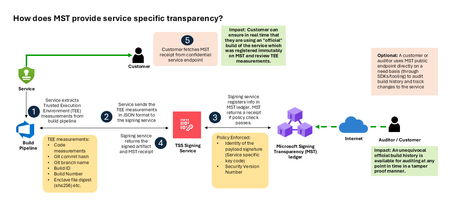
Today, Microsoft announces the general availability of Microsoft’s Signing Transparency (MST) – a first-of-its-kind capability that brings unprecedented visibility and trust to our software supply chain. With this release, Microsoft is leading the industry by recording the build of critical cloud services into a publicly readable and verifiable SCITT standard (Supply Chain Integrity, Transparency, and Trust) compliant blockchain ledger. This means every production software build for in scope services like Azure Attestation and Azure Managed HSM (Hardware Security Module), Azure confidential ledger, Microsoft Signing Transparency itself (and others over time) – is now logged in an immutable, tamper-evident record. Only builds that are in the MST ledger are deployed to production; this gives customers confidence that the supply chain for these critical services can be audited at anytime. Notably, the MST ledger is fully open source and built to align with the emerging IETF SCITT standard. By embracing SCITT’s principles and open protocols, Microsoft ensures that MST not only secures our own ecosystem but also contributes to a broader industry movement toward standardized supply chain transparency. The open-source MST ledger serves as a verifiable trust anchor that any organization or researcher can inspect, audit, or even integrate with their own tooling. MST itself meets the highest levels of transparency, backed by a tamper-proof confidential ledger, open-source, and independently verified. Specifically, we are making the foundation of our trust model transparent and accessible to everyone – reinforcing that trust must be earned through proof, not just promises. This launch marks a major milestone in our commitment to Zero Trust principles, extending “never trust, always verify” all the way into the build itself. Building on a public preview introduced late last year, MST’s general availability delivers verifiable transparency at the software level. It transforms traditional code signing with an additive trust layer that is accessible via an open verification model. Every new software update is accompanied by a publicly auditable proof of integrity, enabling security teams to proactively confirm that each update is authentic and unaltered. To help organizations get the most out of this capability, we are also introducing a free tool to explore the contents – Ledger Explorer – an offline tool that allows security teams to examine MST ledger entries, verify cryptographic proofs, and even validate the ledger’s integrity independently. This tool, combined with MST’s open design, ensures that every Microsoft customer – and the broader community – can hold us accountable in real time for the software we run on their behalf. Key Benefits of Microsoft’s Signing Transparency (MST) Verified Code Integrity – Every software release is cryptographically logged in MST’s ledgers. This makes each build tamper-evident and traceable. If an attacker attempts to inject malicious code or sign an unauthorized update, it will be evident through the well-defined validation step built into the SCITT standard. Organizations gain the assurance that code integrity can be independently confirmed at any time. Independent Verification & Zero Trust – MST enables customers and auditors to verify software authenticity on their own, without having to solely rely on vendor attestations. For each update, Microsoft provides a transparency “receipt” (proof of logging) that you can use to prove the update was officially published and unaltered. This fosters a “don’t just trust, verify” approach, empowering security teams to double-check everything running in their environment aligns with what Microsoft intended. Audit-Trail & Compliance – The transparency ledger creates a permanent, auditable timeline of code deployments. Every entry is a record of what was released and when, backed by cryptographic proofs. This simplifies compliance reporting and accelerates forensic analysis. In the event of an incident, you can quickly audit the ledger to see if any unexpected code was introduced. For highly regulated industries, MST offers concrete evidence of software integrity and policy compliance over time. Leadership & Open Standards – We are delivering real transparency now, encouraging a future where all critical software is released with verifiable integrity. MST’s open source implementation and SCITT-compliant design exemplify our commitment to openness and collaboration. We believe widespread adoption of these standards will strengthen supply chain security for everyone, making trust verification a universal practice. Next Steps Microsoft’s Signing Transparency is more than a new security feature and shapes the advances in trust technology. As threats grow more sophisticated, we must evolve the way we assure our customers about the software they depend on. With MST now generally available, we are leading by example: proving that it is possible to open up the traditionally opaque process of software deployment and turn it into a source of strength and trust, i.e., empowering each person with verifiable transparency. We invite the industry to join us on this journey and get started by reading the documentation and exploring Ledger Explorer today! Together, by embracing transparency and open standards, we can turn “trust but verify” from a slogan into an everyday reality for digital infrastructure.2.8KViews2likes3Comments
From Idea to Production — Building Microsoft Security Store Advisor with an Agentic SDLC
From AI-assisted coding to Agentic SDLC: Lessons from Microsoft Security Store If every developer on your team is using AI, why does the team still feel like it's starting from scratch on every feature? In this post, the Microsoft Security Store engineering team shares how we moved beyond one-off AI assists to an Agentic SDLC — a repeatable system where prompts, patterns, and reviews compound into team-wide velocity, quality, and security.Reimagining Telco with Microsoft: AI, TM Forum ODA, and Developer Innovation
The telecom industry is undergoing a seismic shift—driven by AI, open digital architectures, and the urgent need for scalable, customer-centric innovation. At the heart of this transformation is TM Forum Innovate Americas 2025, a flagship event bringing together global leaders to reimagine the future of connectivity. Microsoft’s presence at this year’s event is both strategic and visionary. As a key partner in the telecom ecosystem, Microsoft is showcasing how its technologies—spanning AI, cloud, and developer tools—are enabling Communication Service Providers (CSPs) to modernize operations, accelerate innovation, and deliver exceptional customer experiences. 🔑 Key Themes Shaping the Conversation Connected Intelligence: Microsoft is championing a new model of collaboration—one where AI systems, teams, and technologies work together seamlessly to solve real-world problems. This approach breaks down silos and enables intelligent decision-making across the enterprise. AI-First Mindset: From network optimization to customer service, Microsoft is helping telcos embed AI into the fabric of their operations. The focus is on building shared data platforms, connected models, and orchestration frameworks that scale. Customer Experience & Efficiency: With rising expectations and increasing complexity, CSPs must deliver faster, smarter, and more personalized services. Microsoft’s solutions are designed to enhance agility, reduce friction, and elevate the end-user experience. As the event unfolds, Microsoft’s sessions and showcases will highlight how these themes come to life—through real-world implementations, collaborative frameworks, and developer-first tools. Thought Leadership & Sessions At TM Forum Innovate Americas 2025, Microsoft is not just showcasing technology—it’s sharing a bold vision for the future of telecom. Through a series of thought-provoking sessions led by industry experts, Microsoft is demonstrating how AI, open standards, and developer tools can converge to drive meaningful transformation across the telco ecosystem. From enabling intelligent collaboration through the Azure AI Foundry, to operationalizing AI and Open Digital Architecture (ODA) for autonomous networks, and empowering developers with GitHub Copilot, Microsoft’s contributions reflect a deep commitment to innovation, scalability, and interoperability. Each session offers a unique lens into how Microsoft is helping Communication Service Providers (CSPs) modernize their IT stacks, accelerate development, and deliver exceptional customer experiences. Microsoft Thought Leadership Sessions CASE STUDY: Connected Intelligence: multiplying AI value across the enterprise 📅Sep 10 1:30pm CDT Peter Huang, Senior Director, Technology, Network Data and AI T-Mobile Andres Gil, Industry Advisor/Business Developer, Telco, Media and Gaming Industry Microsoft CASE STUDY: From hype to impact: operationalizing AI in telco with TM Forum’s ODA and Open APIs 📅Sep 11 1:30pm CDT Puja Athale, Director - Telco Global Azure AI Lead Microsoft Connected Intelligence & Azure AI Foundry: Scaling AI Across the Telco Enterprise T-Mobile and Microsoft are spotlighting a transformative approach to enterprise AI: Connected Intelligence. The joint session explores how telcos can break down silos and unlock the full potential of AI by enabling strategic collaboration across systems, teams, and technologies. The core challenge they address is clear: AI in isolation cannot answer even the simplest customer questions. Whether it's billing, device performance, or network coverage, fragmented systems lead to blind spots, duplication, and poor customer outcomes. To overcome this, they propose a unified framework that blends technology and culture—because tech alone doesn’t scale, and culture alone doesn’t transform. Azure AI Foundry: The Engine Behind Connected Intelligence At the heart of this vision is Microsoft’s Azure AI Foundry, a shared AI platform designed to scale intelligence across the enterprise and a core component of Microsoft’s recently announced Network Operations Agent Framework. Connected Intelligence integrates: Agent Frameworks and Agent Catalogs for modular AI deployment Hundreds of TBs of daily data from network switches, device logs, and location records Enterprise-grade orchestration and data governance AI/ML models aligned with customer-level time series events This architecture enables reuse, speed, and alignment across people, organizations, and systems—turning data into actionable intelligence. Model Context Protocol (MCP): AI-to-AI Collaboration A standout innovation is the Model Context Protocol (MCP), which goes beyond traditional APIs. While APIs connect systems through data, MCP connects intelligence through context. It allows AI agents to dynamically discover and chain APIs without custom coding, enabling real-time collaboration across network operations, device management, and deployment workflows. By integrating MCP into the API fabric, Microsoft is laying the groundwork for agentic AI—where intelligent systems can autonomously interact, adapt, and scale across the telco ecosystem. From Hype to Impact: Operationalizing AI in Telco with TM Forum’s ODA and Open APIs The telecom industry is moving from hype to impact by operationalizing AI through TM Forum’s Open Digital Architecture (ODA) and Open APIs. The session, From hype to impact: operationalizing AI in telco with TM Forum’s ODA and Open APIs, explores how telcos can build AI-ready architectures, unlock data value for automation and AI agents, and scale responsibly with governance and ethics at the core. Microsoft’s collaboration with TM Forum is enabling telcos to modernize OSS/BSS systems using the ODA Canvas—a modular, cloud-native execution environment orchestrated with AI and powered by Microsoft Azure. This architecture supports plug-and-play integration of differentiated services, reduces integration costs by over 30%, and boosts developer productivity by more than 40% with GitHub Copilot. Learn how leading telcos like Telstra are scaling AI solutions such as “One Sentence Summary” and “Ask Telstra” across their contact centers and retail teams. These solutions, built on Azure AI Foundry, have delivered measurable impact: 90% of employees reported time savings and increased effectiveness, with a 20% reduction in follow-up contacts. Telstra’s success is underpinned by a modernized data ecosystem and strong governance frameworks that ensure ethical and secure AI deployment. From Chaos to Clarity with Observability Despite advances in operational tooling, fragmented observability remains a persistent challenge. Vendors often capture telemetry in incompatible formats, forcing operations teams to rely on improvised log aggregators and custom parsers that drive up costs and hinder rapid incident resolution. Microsoft’s latest contribution to the Open Digital Architecture (ODA) initiative directly tackles this issue with the ODA Observability Operator, now available as open source on GitHub. By enforcing a standardized logging contract, integrating seamlessly with Azure Monitor, and surfacing health metrics through TM Forum nonfunctional APIs, the operator streamlines telemetry across systems. Early trials have shown promising results—carriers significantly reduced the time needed to detect billing anomalies, enabling teams to shift from reactive troubleshooting to proactive optimization. Accelerating TM Forum Open API Development with GitHub Copilot As the telecom industry embraces open standards and modular architectures, Microsoft is empowering developers to move faster and smarter with GitHub Copilot—an AI-powered coding assistant that’s transforming how TM Forum (TMF) Open APIs are built and deployed. Why GitHub Copilot for TM Forum Open APIs? TMF Open APIs are a cornerstone of interoperability in telecom, offering over 100 standardized RESTful interfaces across domains like customer management, product catalog, and billing. But implementing these APIs can be time-consuming and repetitive. GitHub Copilot streamlines this process by: Autocompleting boilerplate code for TMF endpoints Suggesting API handlers and data models aligned with TMF specs Generating test plans and documentation Acting as an AI pair programmer that understands your code context This means developers can focus on business logic while Copilot handles the heavy lifting. Real-World Uses Telco developers benefit from powerful features in GitHub Copilot that streamline the development of TMF Open API services. One such feature is Agent Mode, which automates complex, multi-step tasks such as implementing TMF API flows, running tests, and correcting errors—saving developers significant time and effort. Another key capability is Copilot Chat, which provides conversational support directly within the IDE, helping developers debug code, validate against TMF specifications, and follow best practices with ease. Together, these tools enhance productivity and reduce friction in building compliant, scalable telecom solutions. For example, when building a Customer Management microservice using the TMF629 API, Copilot can suggest endpoint handlers, validate field names against the spec, and even help write README documentation or unit tests. 📈 Proven Productivity Gains CSPs like Proximus have reported significant productivity improvements using GitHub Copilot in their Network IT functions: 20–30% faster code writing 25–35% faster refactoring 80–90% improvement in documentation 40–50% gains in code compliance Other telcos like Vodafone, NOS, Orange, TELUS, and Lumen Technologies are also leveraging Copilot to accelerate innovation and reduce development friction. Best Practices for TMF API Projects To get the most out of Copilot: Use it for repetitive tasks and pattern recognition Always validate generated code against TMF specs Keep relevant spec files open to improve suggestion accuracy Use Copilot Chat for guidance on security, error handling, and optimization GitHub Copilot is more than a coding assistant—it’s a catalyst for telco transformation. By combining AI with TMF’s open standards, Microsoft is helping developers build faster, smarter, and more consistently across the telecom ecosystem. Learn more about how to configure and use GitHub Copilot in your own TMF Open API projects in our latest tech community blog. Microsoft’s Broader Vision for Telco Transformation Microsoft’s contributions reflect a comprehensive strategy to reshape the telecom landscape through scalable intelligence, open collaboration, and developer empowerment. At the core of Microsoft’s vision is the idea that AI must be connected, contextual, and reusable. The Azure AI Foundry and Model Context Protocol (MCP) exemplify this approach by enabling telcos to: Harness massive volumes of time-series data from networks, devices, and customer interactions Deploy modular AI agents that can collaborate across systems Orchestrate workflows that adapt in real time to changing conditions This architecture transforms fragmented data into actionable insights, allowing CSPs to move from reactive operations to proactive intelligence. Conclusion: Microsoft’s Strategic Alignment with TM Forum Microsoft’s participation at TM Forum Innovate Americas 2025 reflects a deep commitment to transforming the telecom industry through AI-first innovation, open collaboration, and developer empowerment. From T-Mobile’s vision for Connected Intelligence, to Microsoft’s roadmap for operationalizing AI and ODA, and the developer-centric acceleration enabled by GitHub Copilot, Microsoft is helping Communication Service Providers (CSPs) move faster, scale smarter, and deliver better customer experiences. By aligning with TM Forum’s goals—standardization, interoperability, and autonomous operations—Microsoft is not just participating in the conversation; it’s helping lead it. 📣 Call to Action Join Microsoft and other industry leaders at TM Forum Innovate Americas 2025 to explore the future of telco transformation. Whether you're a strategist, technologist, or developer, this is your opportunity to connect, learn, and shape what’s next.
Accelerating revenue in telecommunications through Agentic Sales Processes
Executive Summary Telecommunications providers are under unprecedented pressure to reignite revenue growth amid market saturation, commoditization of core services, rising infrastructure costs, and intensifying competition from digital‑native players. At the same time, customers demand seamless, personalized, digital‑first experiences—while regulatory constraints, legacy systems, and talent gaps limit agility and innovation. These forces require a fundamental shift in how telecoms generate, manage, and scale revenue. Whitepaper This whitepaper presents a practical framework for accelerating revenue generation through agentic AI—intelligent, autonomous agents embedded across sales, marketing, and post‑sale processes. These agents augment human teams by analyzing data, orchestrating workflows, recommending next‑best actions, and automating routine tasks across the lead‑to‑cash lifecycle. By integrating agentic capabilities into existing CRM and business systems and aligning with TM Forum ODA and eTOM standards, service providers can modernize commercial operations without disrupting core platforms. The result is faster deal velocity, more personalized customer engagement, improved conversion and retention, and a scalable foundation for monetizing 5G, IoT, and emerging services. Agentic AI enables telecom leaders to move from reactive, cost‑driven models to intelligent, outcome‑driven revenue engines built for long‑term growth. eBook The eBook explores how agentic AI, based on Copilot Studio, can fundamentally reinvent telecom sales, marketing, and customer engagement by shifting organizations from reactive, manual processes to autonomous, intelligent, and continuously learning sales systems. Specifically, this eBook examines: Why traditional telecom sales models are failing. What “agentic sales systems” are. How agentic AI transforms the sales lifecycle. The business impact for telecom operators. Agentic AI is redefining how telecom providers grow, engage, and compete in an increasingly digital market. By moving beyond reactive, manual sales models and embracing intelligent, autonomous and adaptive agents, operators can unlock faster revenue growth, deeper customer relationships, and more agile go‑to‑market execution. The journey does not require a wholesale transformation—success starts with focused, modular deployments that deliver measurable impact and scale over time. Those who act now will position themselves as future‑ready, customer‑centric organizations, equipped to lead in the next era of telecom sales and engagement. Start small, scale fast, and lead the next wave of telecom innovation.