data governance
8 TopicsGoverning Entra‑Registered AI Apps with Microsoft Purview
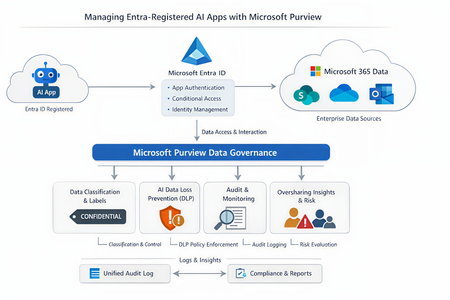
As the enterprise adoption of AI agents and intelligent applications continues to accelerate, organizations are rapidly moving beyond simple productivity tools toward autonomous, Entra‑registered AI workloads that can access, reason over, and act on enterprise data. While these capabilities unlock significant business value, they also introduce new governance, security, and compliance risks—particularly around data oversharing, identity trust boundaries, and auditability. In this context, it becomes imperative to govern AI interactions at the data layer, not just the identity layer. This is where Microsoft Purview, working alongside Microsoft Entra ID, provides a critical foundation for securing AI adoption—ensuring that AI agents can operate safely, compliantly, and transparently without undermining existing data protection controls. Lets look at the role of each solution Entra ID vs Microsoft Purview A very common misconception is that Purview “manages AI apps.” In reality, Purview and Entra serve distinct but complementary roles: Microsoft Entra ID Registers the AI app Controls authentication and authorization Enforces Conditional Access and identity governance Microsoft Purview Governs data interactions once access is granted Applies classification, sensitivity labels, DLP, auditing, and compliance controls Monitors and mitigates oversharing risks in AI prompts and responses Microsoft formally documents this split in its guidance for Entra‑registered AI apps, where Purview operates as the data governance and compliance layer on top of Entra‑secured identities. Lets look at how purview governs the Entra registered AI apps. Below is the high level reference architecture which can be extended to low level details 1. Visibility and inventory of AI usage Once an AI app is registered in Entra ID and integrated with Microsoft Purview APIs or SDK, Purview can surface AI interaction telemetry through Data Security Posture Management (DSPM). DSPM for AI provides: Visibility into which AI apps are being used Which users are invoking them What data locations and labels are touched during interactions Early indicators of oversharing risk This observability layer becomes increasingly important as organizations adopt Copilot extensions, custom agents and third‑party AI apps. 2. Classification and sensitivity awareness Purview does not rely on the AI app to “understand” sensitivity. Instead the Data remains classified and labeled at rest. AI interactions inherit that metadata at runtime Prompts and responses are evaluated against existing sensitivity labels If an AI app accesses content labeled Confidential or Highly Confidential, that classification travels with the interaction and becomes enforceable through policy. This ensures AI does not silently bypass years of data classification work already in place. 3. DLP for AI prompts and responses One of the most powerful but yet misunderstood purview capabilities is the AI‑aware DLP. Using DSPM for AI and standard Purview DLP: Prompts sent to AI apps are inspected Responses generated by AI can be validated Sensitive data types (PII, PCI, credentials, etc.) can be blocked, warned, or audited Policies are enforced consistently across M365 and AI workloads Microsoft specifically highlights this capability to prevent sensitive data from leaving trust boundaries via AI interactions. 4. Auditing and investigation Every AI interaction governed by Purview can be recorded in the Unified Audit Log, enabling: Forensic investigation Compliance validation Insider risk analysis eDiscovery for legal or regulatory needs This becomes critical when AI output influences business decisions and regulatory scrutiny increases. Audit records treat AI interactions as first‑class compliance events, not opaque system actions 5. Oversharing risk management Rather than waiting for a breach, Purview proactively highlights oversharing patterns using DSPM: AI repeatedly accessing broadly shared SharePoint sites High volumes of sensitive data referenced in prompts Excessive AI access to business‑critical repositories These insights feed remediation workflows, enabling administrators to tighten permissions, re‑scope access, or restrict AI visibility into specific datasets. In a nutshell, With agentic AI accelerating rapidly, Microsoft has made it clear that organizations must move governance closer to data, not embed it into individual AI apps. Purview provides a scalable way to enforce governance without rewriting every AI workload, while Entra continues to enforce who is allowed to act in the first place. This journey makes every organizations adopt Zero Trust at scale as its no longer limited to users, devices, and applications; It must now extend to AI apps and autonomous agents that act on behalf of the business. If you find the article insightful and you appreciate my time, please do not forget to like it 🙂609Views3likes2Comments
How to Unassign Assets from Data Products in Microsoft Purview at Once
Hello, I’ve assigned around 100 assets to a specific data product and would now like to unassign all of them at once, rather than removing them individually. Using the Purview REST API with Python, I was able to retrieve the list of my data products and successfully identify the target data product. However, I haven’t been able to fetch the list of assets currently assigned to it, which prevents me from performing a bulk unassignment. Could anyone please advise how to retrieve and unassign all assets from a data product programmatically?364Views1like3Comments
Scaling Data Governance- Does a Purview in a Day Framework Exist?
Hello Purview Community, I’ve been exploring the available acceleration resources for Microsoft Purview, and one thing I noticed is a potential gap in the "In a Day" workshop series. While we have excellent programs like Power BI in a Day or Fabric in a Day, I haven't yet seen a formalized Purview in a Day framework designed to help organizations jumpstart their governance journey in a single, cohesive session. I am reaching out because my team is currently preparing something in this area that we believe will be very useful to the community and Microsoft in the future. Rather than working in isolation, we want to ensure we are aligned with the official roadmap. I wanted to reach out to the community and the Microsoft product team to ask: Is there an official "In a Day" initiative for Purview currently in the works? If not, who would be the best point of contact to discuss alignment? Looking forward to hearing your thoughts and seeing if we can build something impactful together!297Views2likes3Comments
Cannot see Data Map and Unified Catalog in the free version of Microsoft Purview
Hey, I am trying to setup a data connection in the free version of Microsoft Purview. However, I cannot see the Data Map and Unified Catalog features. Is this the intended limitation of the free version? Or do I miss something?346Views0likes2Comments
Moving Data Products Between Governance Domains
I have a number of data products whose location in the governance domain hierarchy is no longer a good fit. I'm struggling to find a route to move them, unpublishing and select edit gets me to the same options as during creation but the governance domain can't be selected and change. https://learn.microsoft.com/en-us/purview/how-to-create-manage-data-products#edit-data-product is ambiguous on what can be edited but there's no exclusions given. Copilot makes a number of suggestions (dragging and dropping and using the "move" option from the list of data products), unfortunately none of of these appear to be based in reality. Is there a route to make a move? Am I missing permissions? Or is the expectation that I delete and re-create data products any time they need to move.Solved655Views8likes3Comments
Automating Power BI Viewer Role Assignment After Azure Purview Approval
Hello everyone! In my organization we use Azure Purview to manage access requests for our Power BI reports. Our current flow is: A user requests access to a data product (Power BI report) from Purview. I approve the request in the Purview portal. Although the user now has metadata-level access in Purview, to actually view the report they must click “Open in Power BI (Fabric)”—and that only works if I manually add them as Viewer to the workspace or app. This manual step is very tedious when there are dozens of requests per day. I’m looking for ideas to automate it so that, upon approval in Purview, the user is granted the Viewer role on the Power BI workspace/app for that report without any manual intervention. Has anyone implemented something similar or knows of an out-of-the-box approach? Perhaps a Purview extension (even in preview), third-party tool, or community solution that automates this provisioning? Thanks in advance for any pointers or examples!Solved398Views0likes5Comments
Retrieve a Schema of a Data Asset using the Atlas API
Hi, Is there a possibility to retrieve the schema of a data asset using the Atlas API? We have a need using the schema to control sensitive elements in Fabric. I know that one workaround is to add the data asset as a Governed Asset and then use the Self-service model to retrieve the schema, but is there a faster and more efficient way to do it?Solved192Views0likes2CommentsAccess to Premium Assessment Template
Can we activate E5 Compliance in our tenant to get access to this premium assessment template? But, as per the license requirement we should be in M365 E3 or to upgrade to m365 E5 straight away, but that is double our Op-Ex, because Team license and defender for office 365 plan 1 need to add additionally for M365 E3. In Small Business Licensing pdf Microsoft says E5 Info protection and gov & Insider threat add-on license can be added (AIP Plan1 is already part of Premium License) which is almost equal to E5 Compliance license (that include endpoint DLP). Is it mandatory to upgrade to M365 E5 or M365 E3 with E5 compliance to get the premium templates and entire compliance requirements to fulfilled? Or can we add the E5 add-ons supported for SMB licensing (E5 Information Protection & Governance and Microsoft 365 E5 Insider Risk Management) to access and achieve this assessment requirement? Look forward to hearing from you a valid comments or feedback how do we go ahead with the licensing. Appreciate your response.253Views0likes1Comment