customer experience
2 TopicsFrom fragmented data to trusted intelligence: Microsoft at TM Forum Innovate Americas 2026
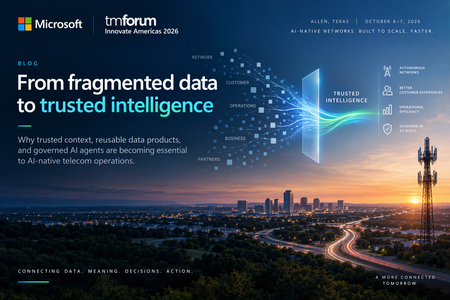
AI is reshaping telecom, but moving from isolated pilots to AI-native operations requires more than capable models and agents. It requires trusted data, shared operational context, and governance that enables AI to act safely across network, customer, and business workflows. At TM Forum Innovate Americas 2026, Microsoft will join industry leaders to explore how operators can build that foundation and turn intelligence into measurable outcomes at scale The next phase of telecom AI begins with the foundation The telecommunications industry is entering a new phase of AI adoption. The question is no longer whether AI can improve a particular task, workflow, or customer interaction. Operators are now asking how to move beyond isolated pilots and embed intelligence across network operations, customer experiences, business processes, and partner ecosystems—while maintaining the security, governance, reliability, and control that carrier-grade environments demand. That transition will require more than capable models or a growing collection of AI agents. Agents need timely access to operational information, but they must also understand what that information means: how customers, services, network resources, incidents, and business commitments relate; which sources are authoritative; what policies apply; and what actions they are permitted to take. As AI moves from observing and recommending toward acting inside operational workflows, trusted context becomes as important as the underlying data. These challenges will be at the center of TM Forum Innovate Americas 2026, taking place October 6–7 in Allen, Texas. Under the theme AI-native networks. Built to scale, faster, the event will bring together operators and industry partners to explore practical approaches to network autonomy, trusted AI and data, business and IT modernization, and the production-ready foundations needed to scale innovation. TM Forum expects more than 1,000 attendees, including over 350 CSP participants, alongside more than 130 speakers and 50 exhibitors and partners. Microsoft will contribute to this discussion through two complementary sessions. As part of the broader The data product challenge — Feeding AI with trusted, industrial-scale data session, Microsoft will participate in the panel Fix the data layer or fail at AI: What needs to change now? The panel will examine what makes data trustworthy enough for AI to act on, where fragmentation prevents cross-domain orchestration, who should be accountable for data quality and meaning, and what changes when operators begin managing data as reusable products rather than static enterprise assets. Microsoft will also contribute to the masterclass Reinvent Business & IT for autonomy: Building AI-Native Customer, Business and Ecosystem Growth Platforms. This discussion will expand the conversation from the data foundation to the broader business, technology, operating-model, and ecosystem changes required to turn AI capabilities into repeatable customer and operational outcomes. Together, the two sessions reflect a common premise: the next phase of telecom AI will not be defined by how many agents an operator deploys. It will be defined by whether those agents can reason from trusted business and operational context, act within clearly governed boundaries, and deliver outcomes that can be measured, proven, and scaled. The foundation matters because the path to AI-native operations begins not with more isolated automation, but with a shared intelligence layer that can connect data, meaning, decisions, and action. Fix the data layer or fail at AI: What needs to change now? 📅October 6, 2026 🕛14:00-15:40 📍Impact Stage The panel Fix the data layer or fail at AI: What needs to change now? features leaders from Microsoft, Verizon, AT&T, and NumoData to examine whether operators’ data foundations are ready not only to inform people, but also to support AI agents making and executing operational decisions. Operators have invested significantly in lakes, warehouses, analytics, APIs, telemetry systems, and operational platforms. Yet data remains distributed across network domains, OSS/BSS, customer care, billing, and field operations—with inconsistent definitions, unclear ownership, and limited shared context. The problem is therefore not simply fragmented data. It is fragmented context. From data access to shared context Consider a broadband failure. It may appear internally as a network alarm, customer complaint, field-service work order, and billing adjustment. The customer experiences one problem, but the operator’s systems may see several unrelated events. An AI agent needs more than access to those records. It must understand that they relate to the same customer, service, resource, and operational condition. It must also know which information is authoritative, what commitments and policies apply, and which actions it may take. For an agent to act reliably, the data’s meaning, provenance, freshness, ownership, permissions, and quality must be understood. Put simply: If the data is good enough to observe but not trustworthy enough to act on, it is not agent-ready. The foundation must answer three questions: Can the agent access the information? Does it understand what the information means? And is it authorized to act on that understanding? An upcoming operator whitepaper developed by Omdia in collaboration with Microsoft reinforces this challenge. 48% of respondents reported using a combined real-time intelligence layer for network telemetry, while 26% still use separate domain telemetry and 21% rely on centralized but non-real-time data lakes. Connecting real-time signals is important, but agents also need the business and operational context required to interpret them. Making data products genuinely reusable A curated dataset does not become a data product simply because it is relabeled. A meaningful data product needs a defined consumer and purpose, stable semantics and interfaces, an accountable owner, measurable quality and freshness expectations, governance policies, discoverability, and lifecycle management. Its strategic value comes from reuse. Operators should not rebuild integration, definitions, security, and governance for every AI project. This becomes increasingly urgent as operators deploy agents across multiple functions. Omdia’s research found respondents evaluating or deploying agents across an average of 4.2 domains, led by IT operations and network operations, followed by software development, BSS/OSS, and customer care. Establishing ownership and governed authority The technology platform can be centralized, while accountability for data meaning and fitness for purpose remains with the operational domains that create and use it. Central teams can provide governance, security, access, and interoperability; domain teams determine whether a network alarm, service relationship, or customer record is suitable for a specific decision. For agentic AI, accountability must extend through the full chain: Data → Context → Decision → Action → Outcome Operators must define authoritative sources, agent permissions, priority rules, approval requirements, and escalation paths. In Omdia’s research, 49% of respondents expected to resolve competing agent actions through a central AI supervisor with priority rules, while 35% anticipated human intervention for policy conflicts. Data governance and agent governance must therefore evolve together. Giving agents shared meaning Semantic models and ontologies help close the gap between data access and operational understanding. They can define how customers, accounts, services, network resources, incidents, policies, and actions relate, giving people and agents a more consistent understanding across network and business domains. Operator sentiment is strong: 58% of respondents described a standardized telecom ontology as important to their AI strategy and 34% described it as critical. In a related question, 86% agreed that a standardized telco ontology is vital for scaling automation and AI. These findings suggest that semantics are no longer merely a data-hygiene concern. They are becoming an operational requirement for agents expected to interpret information and coordinate decisions across domains. Building autonomy on evidence The Omdia research also shows that operators are prioritizing measurable outcomes. Cost reduction was the leading AI-agent success metric at 39%, followed by risk reduction at 36%, service-delivery speed at 35%, customer satisfaction or NPS at 34%, and revenue growth at 32%. Leading use cases include fraud prevention, network diagnostics and remediation, cross-domain analytics, and customer-care assistance. The message is clear: the next stage of telecom autonomy will not come from adding more isolated agents. It will come from giving agents trusted real-time context, shared semantic meaning, and clearly governed authority to act. Operators do not need to repair their entire data estate before beginning. They can select one valuable cross-domain journey, define its outcome and control boundaries, establish the minimum trusted context it requires, and measure the complete result. Agents can progress from observing and recommending to approval-gated actions and, once reliability has been demonstrated, bounded autonomy. The objective is not a perfect data estate or the largest collection of agents. It is a repeatable foundation that allows intelligence to move safely from observation to understanding, decision, and measurable action. Join the Microsoft in Telecom LinkedIn Group to connect with industry peers, follow the latest telecom AI insights, and be among the first to access the upcoming Omdia whitepaper on AI and Agent Driven Unified Data and Semantic Layer when it is published. Source: AI and Agent Driven Unified Data and Semantic Layer White Paper – Omdia GTM Telecom – October 2026 Reinventing business and IT for AI-native growth 📅October 6, 2026 🕛16:00-17:30 📍Twilight Microsoft’s second contribution at Innovate Americas will be part of the masterclass Reinvent Business & IT for autonomy: Building AI-Native Customer, Business and Ecosystem Growth Platforms. Microsoft will bring the perspective of AI4CX—AI for Customer Experience, a TM Forum workstream focused on translating AI-enabled business and IT modernization into measurable improvements across end-to-end customer journeys. AI4CX recognizes that transforming customer experience requires more than adding a chatbot or copilot to an existing process. Operators need to connect customer interactions with trusted knowledge, service information, network conditions, billing data, and operational workflows. The contact center can then evolve from an isolated support function into an intelligent experience hub where people and agents work together across self-service, employee assistance, service operations, and journey orchestration. A key element is the AI4CC—or AI for Contact Center—workstream, which applies an AI-native, decoupled architecture across applications, platform capabilities, and carrier-grade infrastructure. Agentic interfaces and TM Forum Open APIs can connect customer-facing virtual agents, employee copilots, knowledge-management capabilities, and operational systems while preserving modularity and interoperability. This creates a path from today’s assisted experiences toward increasingly proactive and autonomous customer-care journeys. The broader lesson extends beyond customer care. Operators need common platforms through which customer, network, and business agents can share trusted data, business context, identity, governance, and integration patterns. Microsoft’s AI4CX contribution will explore how these foundations can help operators move from disconnected AI use cases to reusable growth platforms—improving customer outcomes while creating capabilities that can be extended across business functions and ecosystem partners. Turning operator data into reusable intelligence with Microsoft Fabric The latest Microsoft Fabric announcements reinforce the central theme of Innovate Americas: scaling AI requires more than connecting models to data. Organizations need governed data, shared business definitions, real-time operational knowledge, and the guardrails that allow agents to act reliably. Microsoft Fabric provides an open foundation for connecting data across sources, while Fabric IQ adds a shared intelligence layer that brings together unified data from OneLake, trusted metrics from Power BI semantic models, and operational context from ontologies and real-time intelligence. This gives people, applications, and agents a more consistent understanding of the business. For telecom operators, Fabric IQ can help establish shared meaning across customers, services, network resources, incidents, and operational events. Microsoft announced a new agentic experience for creating and governing ontologies from semantic models, OneLake data, and other context documents. Organizations can define rules in natural language, connect them to ontology entities and relationships, and reuse established Power BI measures. This directly addresses the need to make telecom domain knowledge machine-readable and reusable across customer, network, and business workflows. OneLake also helps operators connect distributed data without requiring every source to be moved into a single physical repository. Mirroring and shortcuts can connect data across applications, platforms, and clouds, while IQ sharing, now in preview, is designed to share governed data and business context—including tables, files, agent instructions, and RDF ontologies—across teams and ecosystem partners. For multi-vendor telecom environments, this creates a path to reusable data products and shared intelligence without imposing a closed or monolithic architecture. Operational use cases also depend on understanding events as they happen. New Copilot capabilities in Fabric Real-Time Intelligence help teams create dashboards and manage live operational data using natural language, while operations agents support root-cause investigation and actionable recommendations. Fabric data agents can use ontologies, semantic models, glossaries, documentation, and data dictionaries to produce richer, more explainable answers grounded in established business concepts and relationships. Together, these capabilities help move the conversation from data access to reusable intelligence. Operators can connect existing data estates, establish shared context, ground agents in consistent definitions, and carry that intelligence into analytics, applications, copilots, and operational workflows. Fabric does not require operators to replace every existing data platform; its strategic role is to help turn distributed, governed data into an intelligence foundation that can be reused as AI expands across the telecom business and network. Start with one outcome—and build a foundation that can be reused Operators do not need to resolve every data challenge or transform their entire technology estate before generating value from AI. A more practical path is to begin with one high-value journey where better intelligence and automation can produce a measurable customer or operational outcome. This could include reducing service-restoration time, improving first-contact resolution, preventing repeat incidents, or accelerating network diagnosis. For that journey, operators should identify the minimum trusted context required for a reliable decision: the relevant customers, services, network resources, events, telemetry, policies, and relationships. That context should be managed as a reusable product, with clear ownership, stable meaning, quality and freshness expectations, governed access, and interfaces that allow other applications and agents to consume it. An agent’s authority should then expand progressively. It may begin by observing and recommending, move to actions performed with human approval, and ultimately receive bounded authority for defined actions once its performance, safety, and controls have been demonstrated. Success should be measured across the complete workflow—from detection and diagnosis through decision, execution, and verification—not simply by counting agent interactions or automated tasks. As additional journeys are introduced, operators can reuse the data products, ontologies, governance controls, evaluation practices, and workflow patterns established through the first deployment. The objective is not to create the largest agent estate or pursue autonomy as an abstract target. It is to build a repeatable operating capability that turns trusted intelligence into safe, measurable action—and compounds in value with every new use case. Join Microsoft at Innovate Americas TM Forum Innovate Americas 2026 will bring together the region’s telecom leaders on October 6–7 in Allen, Texas, to explore how the industry can move from AI experimentation to scalable, production-ready capabilities. Microsoft looks forward to contributing to this conversation and collaborating with operators and partners working to turn trusted data, operational knowledge, and AI into measurable outcomes. The path to AI-native telecom will not be defined by who deploys the most agents. It will be defined by who can turn unique data and operational knowledge into trusted intelligence—and move that intelligence safely from insight to action. Reach out to your account executive if you’d like to meet with Microsoft while at the event. We look forward to seeing you and continuing the conversation with customers, partners, and industry leaders at Innovate Americas!