cowork
10 TopicsMeasuring the value of Cowork: From AI interactions to completed work
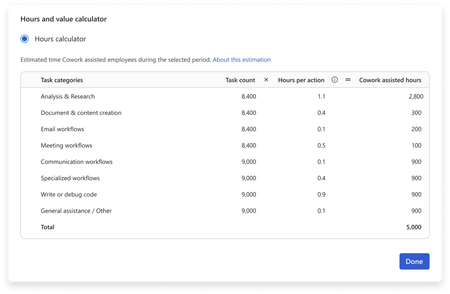
You have invested in Copilot. Adoption is climbing, prompt volume is up, and your dashboards are full of engagement charts. Yet the question leadership keeps asking is: How do we quantify the value of AI when it helps us across so many kinds of work? Value has always been incredibly hard to define for software, and as a result organizations looked to signals like usage trends as a proxy. These metrics were good approximations of value and made sense in a world where products and product costs were simple. The only assumption you need to make is that monthly usage of a product is at least equal to the monthly cost of that product, and you're confident that your active usage numbers are correlated with positive ROI (i.e. value). With AI, usage is incredibly dispersed and produces a massive variety of outputs and outcomes, from simple to complex. Additionally, costs vary with usage, so the old proxy measures are likely insufficient for more complex tasks. Most AI assistance today is transactional. A person prompts, reads the response, and takes the next step themselves. Copilot Cowork works differently. People describe an outcome, and Cowork helps plan, execute, and deliver work across Microsoft 365, with checkpoints that keep users in control. It can work across emails, meetings, files, documents, calendars, and Teams, turning intent into completed actions rather than a single answer. A practical starting point for measuring Cowork value When AI moves from answering questions to completing work, value can no longer be measured by prompts alone. The Consumption Dashboard in Insights now uses Cowork assisted hours and value: a directional estimate of the time Cowork returns to people by helping complete a wide range of tasks, including long-running work. The metric builds on assisted hours with research-based methods tailored to Cowork’s varied outputs. These metrics remain a proxy, not a precise measure, and estimates are intentionally conservative. It does not account for things like quality improvements, faster decision making, quantity of sources reviewed, ability to take on additional work, run simultaneous tasks across projects, and more. The value your teams realize may be greater depending on the outcomes Cowork delivers. The rest of this post explains how we calculate the metric and why it offers a more useful and practical view of value than prompt counts. This evolution of measuring Cowork value should be viewed as a starting point to your value conversations, and just as important, we will continue to evolve this approach as new research, customer feedback, telemetry, and capabilities come forward. From counting prompts to understanding work With a typical AI assistant, a person prompts, reviews the response, and orchestrates what happens next. They move information between apps, refine the output, and turn it into something usable. In that model, prompts are a useful proxy for discrete assists. Cowork is different. A person sets the intent, and Cowork orchestrates the work: planning, gathering inputs, running tools, and producing deliverables. The unit of value is therefore the workload required to fulfill the goal—not a single prompt. That is why our measurement approach is evolving: from counting interactions to understanding the work AI helps complete. Start with intent We first organize activity around what a person intends to accomplish, grouping work into discrete tasks defined by their goal rather than by the number of turns or prompts. A task might be building a customer proposal, analyzing documents, preparing for a meeting, drafting a stakeholder update, or creating a briefing. This maps measurement more closely to business outcomes. For consistency, we use a classifier model to categorize tasks into eight common types of work: Analysis and research Document and content creation Email workflows Meeting workflows Communication workflows Specialized workflows Writing or debugging code General assistance This helps organizations understand not just that Cowork was used, but what kind of work it helped with. Break the task into real activities Next, we identify the typical activities required to complete each task. For example, document and content creation can involve gathering source material, understanding context, structuring the narrative, drafting, editing, formatting, and finalizing the deliverable. That is the work Cowork is completing, and it is why a task-based model tells you more than a prompt-based one based on counts. By breaking work into typical activities, we can create a clearer and more explainable view of where AI assistance is showing up. The goal is not to claim that every task is identical. The goal is to ground the estimate in the kind of work a person would normally need to do. The same logic is applied consistently across all eight task types, which is what lets leaders compare value across very different kinds of work. The image below is an example of the task categorization process. Informed by research, and built to be conservative An estimate is only useful if you trust it, so the methodology is built to be conservative and used as a starting point for value discussions. Without assistance, a person completes every step: switching tools, finding inputs, drafting, editing, formatting, and preparing the final output. With Cowork, the person sets the intent and remains in control while Cowork orchestrates parts of the workflow, including gathering inputs, generating artifacts, taking actions, and carrying context across tools. To value that work fairly, the methodology anchors task categories in published productivity research from Stanford, Microsoft Research, NBER, and Forrester[1]. It expresses time savings as conservative, typical, and optimistic ranges, allowing customers to interpret results using their own environment and assumptions. Every per-category band traces back to the supporting research, so you can see where a figure comes from and pressure-test it against your own experience. Categories are valued differently because the work differs. Document creation may include drafting, rewriting, formatting, and polishing, while analysis and research may require learning new material, weighing evidence, solving problems, and making recommendations. Read the full methodology here Cowork_Methodology.pdf Why this matters for leaders For leaders, the key question is not simply how much AI was used, but what work it helped accomplish and what value that might represent. A task-based approach helps answer more practical business questions: Where is Cowork helping with higher-complexity, multi-step work? How much capacity might be returned to teams? How does usage compare with cost and consumption? Where should we expand, govern, or optimize adoption? The dashboard image below shows a helpful visual representation of the different tasks Cowork is used for by assisted hours and credits used. From this view you can start to answer some of those key business questions like where to accelerate usage to potentially capture more value. This matters as AI becomes more agentic and usage-based. Customers need to understand usage, cost, and value together to guide rollout, governance, and investment. It is also important to be clear about what the metric represents. Assisted hours provide a directional estimate of capacity returned to people, helping organizations identify opportunities to create value and complement their own business outcome measurement. This is the next step, not the final answer AI value measurement must evolve with the technology. We will refine this approach as task-level signals improve and customers share feedback. But the direction is clear: as AI moves from assistance to orchestration, value will be defined less by interactions and more by the work AI helps people accomplish. Take a look at the Consumption Dashboard in Insights and view Cowork details to see your top Cowork tasks and assisted hours. You can learn more about this new Cowork report on MS Learn here. These views will also come to the Cowork report in the M365 admin center soon.4.4KViews4likes0CommentsJoin Us Live: Understanding Copilot Cowork and Managing Copilot Credits
The way we work with AI is evolving rapidly, and so is the way organizations manage and scale those experiences. If you're exploring Copilot Cowork, navigating Copilot Credits, or looking for guidance on consumption-based AI experiences, you won't want to miss our upcoming live event. 🎙️ Live AMA: Understanding Copilot Cowork and Managing Copilot Credits Tuesday, July 21, 2026 9:00–10:00 AM Pacific Time Join us for a live webinar and Ask Microsoft Anything (AMA) featuring experts from the Microsoft 365 Copilot team as they dive into the latest capabilities of Copilot Cowork and share practical guidance for managing Copilot Credits across your organization. During this session, we'll explore: Who should be using Copilot Cowork How to allocate and manage Copilot Credits effectively Best practices for adoption and governance Strategies for scaling Copilot Cowork while maintaining visibility and control over costs This is your opportunity to hear directly from the experts, learn from real-world scenarios, and get answers to your most pressing questions. Whether you're an IT administrator, adoption lead, business decision-maker, or Microsoft 365 enthusiast, you'll leave with actionable insights to help your organization maximize the value of AI-powered collaboration. Bring Your Questions The session will include a live Q&A where attendees can submit questions and receive answers directly from Microsoft subject matter experts. The team is specifically focused on helping customers better understand Copilot Cowork, credit management, and the evolving landscape of AI consumption and governance. 👉 Register and join the conversation: aka.ms/CopilotCoworkAMA We look forward to seeing you on July 21!2.3KViews4likes0Comments