azure sre agent
64 TopicsAn AI led SDLC: Building an End-to-End Agentic Software Development Lifecycle with Azure and GitHub.
This is due to the inevitable move towards fully agentic, end-to-end SDLCs. We may not yet be at a point where software engineers are managing fleets of agents creating the billion-dollar AI abstraction layer, but (as I will evidence in this article) we are certainly on the precipice of such a world. Before we dive into the reality of agentic development today, let me examine two very different modules from university and their relevance in an AI-first development environment. Manual Requirements Translation. At university I dedicated two whole years to a unit called “Systems Design”. This was one of my favourite units, primarily focused on requirements translation. Often, I would receive a scenario between “The Proprietor” and “The Proprietor’s wife”, who seemed to be in a never-ending cycle of new product ideas. These tasks would be analysed, broken down, manually refined, and then mapped to some kind of early-stage application architecture (potentially some pseudo-code and a UML diagram or two). The big intellectual effort in this exercise was taking human intention and turning it into something tangible to build from (BA’s). Today, by the time I have opened Notepad and started to decipher requirements, an agent can already have created a comprehensive list, a service blueprint, and a code scaffold to start the process (*cough* spec-kit *cough*). Manual debugging. Need I say any more? Old-school debugging with print()’s and breakpoints is dead. I spent countless hours learning to debug in a classroom and then later with my own software, stepping through execution line by line, reading through logs, and understanding what to look for; where correlation did and didn’t mean causation. I think back to my year at IBM as a fresh-faced intern in a cloud engineering team, where around 50% of my time was debugging different issues until it was sufficiently “narrowed down”, and then reading countless Stack Overflow posts figuring out the actual change I would need to make to a PowerShell script or Jenkins pipeline. Already in Azure, with the emergence of SRE agents, that debug process looks entirely different. The debug process for software even more so… #terminallastcommand WHY IS THIS NOT RUNNING? #terminallastcommand Review these logs and surface errors relating to XYZ. As I said: breakpoints are dead, for now at least. Caveat – Is this a good thing? One more deviation from the main core of the article if you would be so kind (if you are not as kind skip to the implementation walkthrough below). Is this actually a good thing? Is a software engineering degree now worthless? What if I love printf()? I don’t know is my answer today, at the start of 2026. Two things worry me: one theoretical and one very real. To start with the theoretical: today AI takes a significant amount of the “donkey work” away from developers. How does this impact cognitive load at both ends of the spectrum? The list that “donkey work” encapsulates is certainly growing. As a result, on one end of the spectrum humans are left with the complicated parts yet to be within an agent’s remit. This could have quite an impact on our ability to perform tasks. If we are constantly dealing with the complex and advanced, when do we have time to re-root ourselves in the foundations? Will we see an increase in developer burnout? How do technical people perform without the mundane or routine tasks? I often hear people who have been in the industry for years discuss how simple infrastructure, computing, development, etc. were 20 years ago, almost with a longing to return to a world where today’s zero trust, globally replicated architectures are a twinkle in an architect’s eye. Is constantly working on only the most complex problems a good thing? At the other end of the spectrum, what if the performance of AI tooling and agents outperforms our wildest expectations? Suddenly, AI tools and agents are picking up more and more of today’s complicated and advanced tasks. Will developers, architects, and organisations lose some ability to innovate? Fundamentally, we are not talking about artificial general intelligence when we say AI; we are talking about incredibly complex predictive models that can augment the existing ideas they are built upon but are not, in themselves, innovators. Put simply, in the words of Scott Hanselman: “Spicy auto-complete”. Does increased reliance on these agents in more and more of our business processes remove the opportunity for innovative ideas? For example, if agents were football managers, would we ever have graduated from Neil Warnock and Mick McCarthy football to Pep? Would every agent just augment a ‘lump it long and hope’ approach? We hear about learning loops, but can these learning loops evolve into “innovation loops?” Past the theoretical and the game of 20 questions, the very real concern I have is off the back of some data shared recently on Stack Overflow traffic. We can see in the diagram below that Stack Overflow traffic has dipped significantly since the release of GitHub Copilot in October 2021, and as the product has matured that trend has only accelerated. Data from 12 months ago suggests that Stack Overflow has lost 77% of new questions compared to 2022… Stack Overflow democratises access to problem-solving (I have to be careful not to talk in past tense here), but I will admit I cannot remember the last time I was reviewing Stack Overflow or furiously searching through solutions that are vaguely similar to my own issue. This causes some concern over the data available in the future to train models. Today, models can be grounded in real, tested scenarios built by developers in anger. What happens with this question drop when API schemas change, when the technology built for today is old and deprecated, and the dataset is stale and never returning to its peak? How do we mitigate this impact? There is potential for some closed-loop type continuous improvement in the future, but do we think this is a scalable solution? I am unsure. So, back to the question: “Is this a good thing?”. It’s great today; the long-term impacts are yet to be seen. If we think that AGI may never be achieved, or is at least a very distant horizon, then understanding the foundations of your technical discipline is still incredibly important. Developers will not only be the managers of their fleet of agents, but also the janitors mopping up the mess when there is an accident (albeit likely mopping with AI-augmented tooling). An AI First SDLC Today – The Reality Enough reflection and nostalgia (I don’t think that’s why you clicked the article), let’s start building something. For the rest of this article I will be building an AI-led, agent-powered software development lifecycle. The example I will be building is an AI-generated weather dashboard. It’s a simple example, but if agents can generate, test, deploy, observe, and evolve this application, it proves that today, and into the future, the process can likely scale to more complex domains. Let’s start with the entry point. The problem statement that we will build from. “As a user I want to view real time weather data for my city so that I can plan my day.” We will use this as the single input for our AI led SDLC. This is what we will pass to promptkit and watch our app and subsequent features built in front of our eyes. The goal is that we will: - Spec-kit to get going and move from textual idea to requirements and scaffold. - Use a coding agent to implement our plan. - A Quality agent to assess the output and quality of the code. - GitHub Actions that not only host the agents (Abstracted) but also handle the build and deployment. - An SRE agent proactively monitoring and opening issues automatically. The end to end flow that we will review through this article is the following: Step 1: Spec-driven development - Spec First, Code Second A big piece of realising an AI-led SDLC today relies on spec-driven development (SDD). One of the best summaries for SDD that I have seen is: “Version control for your thinking”. Instead of huge specs that are stale and buried in a knowledge repository somewhere, SDD looks to make them a first-class citizen within the SDLC. Architectural decisions, business logic, and intent can be captured and versioned as a product evolves; an executable artefact that evolves with the project. In 2025, GitHub released the open-source Spec Kit: a tool that enables the goal of placing a specification at the centre of the engineering process. Specs drive the implementation, checklists, and task breakdowns, steering an agent towards the end goal. This article from GitHub does a great job explaining the basics, so if you’d like to learn more it’s a great place to start (https://github.blog/ai-and-ml/generative-ai/spec-driven-development-with-ai-get-started-with-a-new-open-source-toolkit/). In short, Spec Kit generates requirements, a plan, and tasks to guide a coding agent through an iterative, structured development process. Through the Spec Kit constitution, organisational standards and tech-stack preferences are adhered to throughout each change. I did notice one (likely intentional) gap in functionality that would cement Spec Kit’s role in an autonomous SDLC. That gap is that the implement stage is designed to run within an IDE or client coding agent. You can now, in the IDE, toggle between task implementation locally or with an agent in the cloud. That is great but again it still requires you to drive through the IDE. Thinking about this in the context of an AI-led SDLC (where we are pushing tasks from Spec Kit to a coding agent outside of my own desktop), it was clear that a bridge was needed. As a result, I used Spec Kit to create the Spec-to-issue tool. This allows us to take the tasks and plan generated by Spec Kit, parse the important parts, and automatically create a GitHub issue, with the option to auto-assign the coding agent. From the perspective of an autonomous AI-led SDLC, Speckit really is the entry point that triggers the flow. How Speckit is surfaced to users will vary depending on the organisation and the context of the users. For the rest of this demo I use Spec Kit to create a weather app calling out to the OpenWeather API, and then add additional features with new specs. With one simple prompt of “/promptkit.specify “Application feature/idea/change” I suddenly had a really clear breakdown of the tasks and plan required to get to my desired end state while respecting the context and preferences I had previously set in my Spec Kit constitution. I had mentioned a desire for test driven development, that I required certain coverage and that all solutions were to be Azure Native. The real benefit here compared to prompting directly into the coding agent is that the breakdown of one large task into individual measurable small components that are clear and methodical improves the coding agents ability to perform them by a considerable degree. We can see an example below of not just creating a whole application but another spec to iterate on an existing application and add a feature. We can see the result of the spec creation, the issue in our github repo and most importantly for the next step, our coding agent, GitHub CoPilot has been assigned automatically. Step 2: GitHub Coding Agent - Iterative, autonomous software creation Talking of coding agents, GitHub Copilot’s coding agent is an autonom ous agent in GitHub that can take a scoped development task and work on it in the background using the repository’s context. It can make code changes and produce concrete outputs like commits and pull requests for a developer to review. The developer stays in control by reviewing, requesting changes, or taking over at any point. This does the heavy lifting in our AI-led SDLC. We have already seen great success with customers who have adopted the coding agent when it comes to carrying out menial tasks to save developers time. These coding agents can work in parallel to human developers and with each other. In our example we see that the coding agent creates a new branch for its changes, and creates a PR which it starts working on as it ticks off the various tasks generated in our spec. One huge positive of the coding agent that sets it apart from other similar solutions is the transparency in decision-making and actions taken. The monitoring and observability built directly into the feature means that the agent’s “thinking” is easily visible: the iterations and steps being taken can be viewed in full sequence in the Agents tab. Furthermore, the action that the agent is running is also transparently available to view in the Actions tab, meaning problems can be assessed very quickly. Once the coding agent is finished, it has run the required tests and, even in the case of a UI change, goes as far as calling the Playwright MCP server and screenshotting the change to showcase in the PR. We are then asked to review the change. In this demo, I also created a GitHub Action that is triggered when a PR review is requested: it creates the required resources in Azure and surfaces the (in this case) Azure Container Apps revision URL, making it even smoother for the human in the loop to evaluate the changes. Just like any normal PR, if changes are required comments can be left; when they are, the coding agent can pick them up and action what is needed. It’s also worth noting that for any manual intervention here, use of GitHub Codespaces would work very well to make minor changes or perform testing on an agent’s branch. We can even see the unit tests that have been specified in our spec how been executed by our coding agent. The pattern used here (Spec Kit -> coding agent) overcomes one of the biggest challenges we see with the coding agent. Unlike an IDE-based coding agent, the GitHub.com coding agent is left to its own iterations and implementation without input until the PR review. This can lead to subpar performance, especially compared to IDE agents which have constant input and interruption. The concise and considered breakdown generated from Spec Kit provides the structure and foundation for the agent to execute on; very little is left to interpretation for the coding agent. Step 3: GitHub Code Quality Review (Human in the loop with agent assistance.) GitHub Code Quality is a feature (currently in preview) that proactively identifies code quality risks and opportunities for enhancement both in PRs and through repository scans. These are surfaced within a PR and also in repo-level scoreboards. This means that PRs can now extend existing static code analysis: Copilot can action CodeQL, PMD, and ESLint scanning on top of the new, in-context code quality findings and autofixes. Furthermore, we receive a summary of the actual changes made. This can be used to assist the human in the loop in understanding what changes have been made and whether enhancements or improvements are required. Thinking about this in the context of review coverage, one of the challenges sometimes in already-lean development teams is the time to give proper credence to PRs. Now, with AI-assisted quality scanning, we can be more confident in our overall evaluation and test coverage. I would expect that use of these tools alongside existing human review processes would increase repository code quality and reduce uncaught errors. The data points support this too. The Qodo 2025 AI Code Quality report showed that usage of AI code reviews increased quality improvements to 81% (from 55%). A similar study from Atlassian RovoDev 2026 study showed that 38.7% of comments left by AI agents in code reviews lead to additional code fixes. LLM’s in their current form are never going to achieve 100% accuracy however these are still considerable, significant gains in one of the most important (and often neglected) parts of the SDLC. With a significant number of software supply chain attacks recently it is also not a stretch to imagine that that many projects could benefit from "independently" (use this term loosely) reviewed and summarised PR's and commits. This in the future could potentially by a specialist/sub agent during a PR or merge to focus on identifying malicious code that may be hidden within otherwise normal contributions, case in point being the "near-miss" XZ Utils attack. Step 4: GitHub Actions for build and deploy - No agents here, just deterministic automation. This step will be our briefest, as the idea of CI/CD and automation needs no introduction. It is worth noting that while I am sure there are additional opportunities for using agents within a build and deploy pipeline, I have not investigated them. I often speak with customers about deterministic and non-deterministic business process automation, and the importance of distinguishing between the two. Some processes were created to be deterministic because that is all that was available at the time; the number of conditions required to deal with N possible flows just did not scale. However, now those processes can be non-deterministic. Good examples include IVR decision trees in customer service or hard-coded sales routines to retain a customer regardless of context; these would benefit from less determinism in their execution. However, some processes remain best as deterministic flows: financial transactions, policy engines, document ingestion. While all these flows may be part of an AI solution in the future (possibly as a tool an agent calls, or as part of a larger agent-based orchestration), the processes themselves are deterministic for a reason. Just because we could have dynamic decision-making doesn’t mean we should. Infrastructure deployment and CI/CD pipelines are one good example of this, in my opinion. We could have an agent decide what service best fits our codebase and which region we should deploy to, but do we really want to, and do the benefits outweigh the potential negatives? In this process flow we use a deterministic GitHub action to deploy our weather application into our “development” environment and then promote through the environments until we reach production and we want to now ensure that the application is running smoothly. We also use an action as mentioned above to deploy and surface our agents changes. In Azure Container Apps we can do this in a secure sandbox environment called a “Dynamic Session” to ensure strong isolation of what is essentially “untrusted code”. Often enterprises can view the building and development of AI applications as something that requires a completely new process to take to production, while certain additional processes are new, evaluation, model deployment etc many of our traditional SDLC principles are just as relevant as ever before, CI/CD pipelines being a great example of that. Checked in code that is predictably deployed alongside required services to run tests or promote through environments. Whether you are deploying a java calculator app or a multi agent customer service bot, CI/CD even in this new world is a non-negotiable. We can see that our geolocation feature is running on our Azure Container Apps revision and we can begin to evaluate if we agree with CoPilot that all the feature requirements have been met. In this case they have. If they hadn't we'd just jump into the PR and add a new comment with "@copilot" requesting our changes. Step 5: SRE Agent - Proactive agentic day two operations. The SRE agent service on Azure is an operations-focused agent that continuously watches a running service using telemetry such as logs, metrics, and traces. When it detects incidents or reliability risks, it can investigate signals, correlate likely causes, and propose or initiate response actions such as opening issues, creating runbook-guided fixes, or escalating to an on-call engineer. It effectively automates parts of day two operations while keeping humans in control of approval and remediation. It can be run in two different permission models: one with a reader role that can temporarily take user permissions for approved actions when identified. The other model is a privileged level that allows it to autonomously take approved actions on resources and resource types within the resource groups it is monitoring. In our example, our SRE agent could take actions to ensure our container app runs as intended: restarting pods, changing traffic allocations, and alerting for secret expiry. The SRE agent can also perform detailed debugging to save human SREs time, summarising the issue, fixes tried so far, and narrowing down potential root causes to reduce time to resolution, even across the most complex issues. My initial concern with these types of autonomous fixes (be it VPA on Kubernetes or an SRE agent across your infrastructure) is always that they can very quickly mask problems, or become an anti-pattern where you have drift between your IaC and what is actually running in Azure. One of my favourite features of SRE agents is sub-agents. Sub-agents can be created to handle very specific tasks that the primary SRE agent can leverage. Examples include alerting, report generation, and potentially other third-party integrations or tooling that require a more concise context. In my example, I created a GitHub sub-agent to be called by the primary agent after every issue that is resolved. When called, the GitHub sub-agent creates an issue summarising the origin, context, and resolution. This really brings us full circle. We can then potentially assign this to our coding agent to implement the fix before we proceed with the rest of the cycle; for example, a change where a port is incorrect in some Bicep, or min scale has been adjusted because of latency observed by the SRE agent. These are quick fixes that can be easily implemented by a coding agent, subsequently creating an autonomous feedback loop with human review. Conclusion: The journey through this AI-led SDLC demonstrates that it is possible, with today’s tooling, to improve any existing SDLC with AI assistance, evolving from simply using a chat interface in an IDE. By combining Speckit, spec-driven development, autonomous coding agents, AI-augmented quality checks, deterministic CI/CD pipelines, and proactive SRE agents, we see an emerging ecosystem where human creativity and oversight guide an increasingly capable fleet of collaborative agents. As with all AI solutions we design today, I remind myself that “this is as bad as it gets”. If the last two years are anything to go by, the rate of change in this space means this article may look very different in 12 months. I imagine Spec-to-issue will no longer be required as a bridge, as native solutions evolve to make this process even smoother. There are also some areas of an AI-led SDLC that are not included in this post, things like reviewing the inner-loop process or the use of existing enterprise patterns and blueprints. I also did not review use of third-party plugins or tools available through GitHub. These would make for an interesting expansion of the demo. We also did not look at the creation of custom coding agents, which could be hosted in Microsoft Foundry; this is especially pertinent with the recent announcement of Anthropic models now being available to deploy in Foundry. Does today’s tooling mean that developers, QAs, and engineers are no longer required? Absolutely not (and if I am honest, I can’t see that changing any time soon). However, it is evidently clear that in the next 12 months, enterprises who reshape their SDLC (and any other business process) to become one augmented by agents will innovate faster, learn faster, and deliver faster, leaving organisations who resist this shift struggling to keep up.58KViews9likes2CommentsAnnouncing general availability for the Azure SRE Agent
Today, we’re excited to announce the General Availability (GA) of Azure SRE Agent— your AI‑powered operations teammate that helps organizations improve uptime, reduce incident impact, and cut operational toil by accelerating diagnosis and automating response workflows.16KViews1like2CommentsContext Engineering Lessons from Building Azure SRE Agent
We started with 100+ tools and 50+ specialized agents. We ended with 5 core tools and a handful of generalists. The agent got more reliable, not less. Every context decision is a tradeoff: latency vs autonomy, evidence-building vs speed, oversight - and the cost of being wrong. This post is a practical map of those knobs and how we adjusted them for SRE Agent.15KViews22likes2CommentsThe Agent that investigates itself
Azure SRE Agent handles tens of thousands of incident investigations each week for internal Microsoft services and external teams running it for their own systems. Last month, one of those incidents was about the agent itself. Our KV cache hit rate alert started firing. Cached token percentage was dropping across the fleet. We didn't open dashboards. We simply asked the agent. It spawned parallel subagents, searched logs, read through its own source code, and produced the analysis. First finding: Claude Haiku at 0% cache hits. The agent checked the input distribution and found that the average call was ~180 tokens, well below Anthropic’s 4,096-token minimum for Haiku prompt caching. Structurally, these requests could never be cached. They were false positives. The real regression was in Claude Opus: cache hit rate fell from ~70% to ~48% over a week. The agent correlated the drop against the deployment history and traced it to a single PR that restructured prompt ordering, breaking the common prefix that caching relies on. It submitted two fixes: one to exclude all uncacheable requests from the alert, and the other to restore prefix stability in the prompt pipeline. That investigation is how we develop now. We rarely start with dashboards or manual log queries. We start by asking the agent. Three months earlier, it could not have done any of this. The breakthrough was not building better playbooks. It was harness engineering: enabling the agent to discover context as the investigation unfolded. This post is about the architecture decisions that made it possible. Where we started In our last post, Context Engineering for Reliable AI Agents: Lessons from Building Azure SRE Agent, we described how moving to a single generalist agent unlocked more complex investigations. The resolution rates were climbing, and for many internal teams, the agent could now autonomously investigate and mitigate roughly 50% of incidents. We were moving in the right direction. But the scores weren't uniform, and when we dug into why, the pattern was uncomfortable. The high-performing scenarios shared a trait: they'd been built with heavy human scaffolding. They relied on custom response plans for specific incident types, hand-built subagents for known failure modes, and pre-written log queries exposed as opaque tools. We weren’t measuring the agent’s reasoning – we were measuring how much engineering had gone into the scenario beforehand. On anything new, the agent had nowhere to start. We found these gaps through manual review. Every week, engineers read through lower-scored investigation threads and pushed fixes: tighten a prompt, fix a tool schema, add a guardrail. Each fix was real. But we could only review fifty threads a week. The agent was handling ten thousand. We were debugging at human speed. The gap between those two numbers was where our blind spots lived. We needed an agent powerful enough to take this toil off us. An agent which could investigate itself. Dogfooding wasn't a philosophy - it was the only way to scale. The Inversion: Three bets The problem we faced was structural - and the KV cache investigation shows it clearly. The cache rate drop was visible in telemetry, but the cause was not. The agent had to correlate telemetry with deployment history, inspect the relevant code, and reason over the diff that broke prefix stability. We kept hitting the same gap in different forms: logs pointing in multiple directions, failure modes in uninstrumented paths, regressions that only made sense at the commit level. Telemetry showed symptoms, but not what actually changed. We'd been building the agent to reason over telemetry. We needed it to reason over the system itself. The instinct when agents fail is to restrict them: pre-write the queries, pre-fetch the context, pre-curate the tools. It feels like control. In practice, it creates a ceiling. The agent can only handle what engineers anticipated in advance. The answer is an agent that can discover what it needs as the investigation unfolds. In the KV cache incident, each step, from metric anomaly to deployment history to a specific diff, followed from what the previous step revealed. It was not a pre-scripted path. Navigating towards the right context with progressive discovery is key to creating deep agents which can handle novel scenarios. Three architectural decisions made this possible – and each one compounded on the last. Bet 1: The Filesystem as the Agent's World Our first bet was to give the agent a filesystem as its workspace instead of a custom API layer. Everything it reasons over – source code, runbooks, query schemas, past investigation notes – is exposed as files. It interacts with that world using read_file, grep, find, and shell. No SearchCodebase API. No RetrieveMemory endpoint. This is an old Unix idea: reduce heterogeneous resources to a single interface. Coding agents already work this way. It turns out the same pattern works for an SRE agent. Frontier models are trained on developer workflows: navigating repositories, grepping logs, patching files, running commands. The filesystem is not an abstraction layered on top of that prior. It matches it. When we materialized the agent’s world as a repo-like workspace, our human "Intent Met" score - whether the agent's investigation addressed the actual root cause as judged by the on-call engineer - rose from 45% to 75% on novel incidents. But interface design is only half the story. The other half is what you put inside it. Code Repositories: the highest-leverage context Teams had prewritten log queries because they did not trust the agent to generate correct ones. That distrust was justified. Models hallucinate table names, guess column schemas, and write queries against the wrong cluster. But the answer was not tighter restriction. It was better grounding. The repo is the schema. Everything else is derived from it. When the agent reads the code that produces the logs, query construction stops being guesswork. It knows the exact exceptions thrown, and the conditions under which each path executes. Stack traces start making sense, and logs become legible. But beyond query grounding, code access unlocked three new capabilities that telemetry alone could not provide: Ground truth over documentation. Docs drift and dashboards show symptoms. The code is what the service actually does. In practice, most investigations only made sense when logs were read alongside implementation. Point-in-time investigation. The agent checks out the exact commit at incident time, not current HEAD, so it can correlate the failure against the actual diffs. That's what cracked the KV cache investigation: a PR broke prefix stability, and the diff was the only place this was visible. Without commit history, you can't distinguish a code regression from external factors. Reasoning even where telemetry is absent. Some code paths are not well instrumented. The agent can still trace logic through source and explain behavior even when logs do not exist. This is especially valuable in novel failure modes – the ones most likely to be missed precisely because no one thought to instrument them. Memory as a filesystem, not a vector store Our first memory system used RAG over past session learnings. It had a circular dependency: a limited agent learned from limited sessions and produced limited knowledge. Garbage in, garbage out. But the deeper problem was retrieval. In SRE Context, embedding similarity is a weak proxy for relevance. “KV cache regression” and “prompt prefix instability” may be distant in embedding space yet still describe the same causal chain. We tried re-ranking, query expansion, and hybrid search. None fixed the core mismatch between semantic similarity and diagnostic relevance. We replaced RAG with structured Markdown files that the agent reads and writes through its standard tool interface. The model names each file semantically: overview.md for a service summary, team.md for ownership and escalation paths, logs.md for cluster access and query patterns, debugging.md for failure modes and prior learnings. Each carry just enough context to orient the agent, with links to deeper files when needed. The key design choice was to let the model navigate memory, not retrieve it through query matching. The agent starts from a structured entry point and follows the evidence toward what matters. RAG assumes you know the right query before you know what you need. File traversal lets relevance emerge as context accumulates. This removed chunking, overlap tuning, and re-ranking entirely. It also proved more accurate, because frontier models are better at following context than embeddings are at guessing relevance. As a side benefit, memory state can be snapshotted periodically. One problem remains unsolved: staleness. When two sessions write conflicting patterns to debugging.md, the model must reconcile them. When a service changes behavior, old entries can become misleading. We rely on timestamps and explicit deprecation notes, but we do not have a systemic solution yet. This is an active area of work, and anyone building memory at scale will run into it. The sandbox as epistemic boundary The filesystem also defines what the agent can see. If something is not in the sandbox, the agent cannot reason about it. We treat that as a feature, not a limitation. Security boundaries and epistemic boundaries are enforced by the same mechanism. Inside that boundary, the agent has full execution: arbitrary bash, python, jq, and package installs through pip or apt. That scope unlocks capabilities we never would have built as custom tools. It opens PRs with gh cli, like the prompt-ordering fix from KV cache incident. It pushes Grafana dashboards, like a cache-hit-rate dashboard we now track by model. It installs domain-specific CLI tools mid-investigation when needed. No bespoke integration required, just a shell. The recurring lesson was simple: a generally capable agent in the right execution environment outperforms a specialized agent with bespoke tooling. Custom tools accumulate maintenance costs. Shell commands compose for free. Bet 2: Context Layering Code access tells the agent what a service does. It does not tell the agent what it can access, which resources its tools are scoped to, or where an investigation should begin. This gap surfaced immediately. Users would ask "which team do you handle incidents for?" and the agent had no answer. Tools alone are not enough. An integration also needs ambient context so the model knows what exists, how it is configured, and when to use it. We fixed this with context hooks: structured context injected at prompt construction time to orient the agent before it takes action. Connectors - what can I access? A manifest of wired systems such as Log Analytics, Outlook, and Grafana, along with their configuration. Repositories - what does this system do? Serialized repo trees, plus files like AGENTS.md, Copilot.md, and CLAUDE.md with team-specific instructions. Knowledge map - what have I learned before? A two-tier memory index with a top-level file linking to deeper scenario-specific files, so the model can drill down only when needed. Azure resource topology - where do things live? A serialized map of relationships across subscriptions, resource groups, and regions, so investigations start in the right scope. Together, these context hooks turn a cold start into an informed one. That matters because a bad early choice does not just waste tokens. It sends the investigation down the wrong trajectory. A capable agent still needs to know what exists, what matters, and where to start. Bet 3: Frugal Context Management Layered context creates a new problem: budget. Serialized repo trees, resource topology, connector manifests, and a memory index fill context fast. Once the agent starts reading source files and logs, complex incidents hit context limits. We needed our context usage to be deliberately frugal. Tool result compression via the filesystem Large tool outputs are expensive because they consume context before the agent has extracted any value from them. In many cases, only a small slice or a derived summary of that output is actually useful. Our framework exposes these results as files to the agent. The agent can then use tools like grep, jq, or python to process them outside the model interface, so that only the final result enters context. The filesystem isn't just a capability abstraction - it's also a budget management primitive. Context Pruning and Auto Compact Long investigations accumulate dead weight. As hypotheses narrow, earlier context becomes noise. We handle this with two compaction strategies. Context Pruning runs mid-session. When context usage crosses a threshold, we trim or drop stale tool calls and outputs - keeping the window focused on what still matters. Auto-Compact kicks in when a session approaches its context limit. The framework summarizes findings and working hypotheses, then resumes from that summary. From the user's perspective, there's no visible limit. Long investigations just work. Parallel subagents The KV cache investigation required reasoning along two independent hypotheses: whether the alert definition was sound, and whether cache behavior had actually regressed. The agent spawned parallel subagents for each task, each operating in its own context window. Once both finished, it merged their conclusions. This pattern generalizes to any task with independent components. It speeds up the search, keeps intermediate work from consuming the main context window, and prevents one hypothesis from biasing another. The Feedback loop These architectural bets have enabled us to close the original scaling gap. Instead of debugging the agent at human speed, we could finally start using it to fix itself. As an example, we were hitting various LLM errors: timeouts, 429s (too many requests), failures in the middle of response streaming, 400s from code bugs that produced malformed payloads. These paper cuts would cause investigations to stall midway and some conversations broke entirely. So, we set up a daily monitoring task for these failures. The agent searches for the last 24 hours of errors, clusters the top hitters, traces each to its root cause in the codebase, and submits a PR. We review it manually before merging. Over two weeks, the errors were reduced by more than 80%. Over the last month, we have successfully used our agent across a wide range of scenarios: Analyzed our user churn rate and built dashboards we now review weekly. Correlated which builds needed the most hotfixes, surfacing flaky areas of the codebase. Ran security analysis and found vulnerabilities in the read path. Helped fill out parts of its own Responsible AI review, with strict human review. Handles customer-reported issues and LiveSite alerts end to end. Whenever it gets stuck, we talk to it and teach it, ask it to update its memory, and it doesn't fail that class of problem again. The title of this post is literal. The agent investigating itself is not a metaphor. It is a real workflow, driven by scheduled tasks, incident triggers, and direct conversations with users. What We Learned We spent months building scaffolding to compensate for what the agent could not do. The breakthrough was removing it. Every prewritten query was a place we told the model not to think. Every curated tool was a decision made on its behalf. Every pre-fetched context was a guess about what would matter before we understood the problem. The inversion was simple but hard to accept: stop pre-computing the answer space. Give the model a structured starting point, a filesystem it knows how to navigate, context hooks that tell it what it can access, and budget management that keeps it sharp through long investigations. The agent that investigates itself is both the proof and the product of this approach. It finds its own bugs, traces them to root causes in its own code, and submits its own fixes. Not because we designed it to. Because we designed it to reason over systems, and it happens to be one. We are still learning. Staleness is unsolved, budget tuning remains largely empirical, and we regularly discover assumptions baked into context that quietly constrain the agent. But we have crossed a new threshold: from an agent that follows your playbook to one that writes the next one. Thanks to visagarwal for co-authoring this post.14KViews7likes0CommentsHow we build and use Azure SRE Agent with agentic workflows
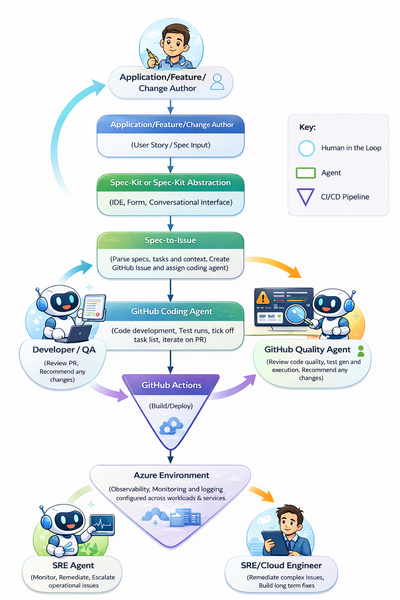
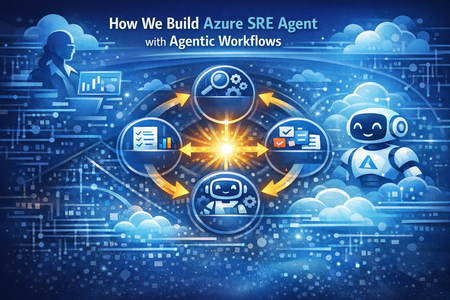
The Challenge: Ops is critical but takes time from innovation Microsoft operates always-on, mission-critical production systems at extraordinary scale. Thousands of services, millions of deployments, and constant change are the reality of modern cloud engineering. These are titan systems that power organizations around the globe—including our own—with extremely low risk tolerance for downtime. While operations work like incident investigation, response and recovery, and remediation is essential, it’s also disruptive to innovation. For engineers, operational toil often means being pulled away from feature work to diagnose alerts, sift through logs, correlate metrics across systems, or respond to incidents at any hour. On-call rotations and manual investigations slow teams down and introduce burnout. What's more, in the era of AI, demand for operational excellence has spiked to new heights. It became clear that traditional human-only processes couldn't meet the scale and complexity needs for system maintenance especially in the AI world where code shipping velocity has increased exponentially. At the same time, we needed to integrate with the AI landscape which continues to evolve at a breakneck pace. New models, new tooling, and new best practices released constantly, fragmenting ecosystems between different platforms for observability, DevOps, incident management, and security. Beyond simply automating tasks, we needed to build an adaptable approach that could integrate with existing systems and improve over time. Microsoft needed a fundamentally different way to perform operations—one that reduced toil, accelerated response, and gave engineers the time to focus on building great products. The Solution: How we build Azure SRE Agent using agentic workflows To address these challenges, Microsoft built Azure SRE Agent, an AI-powered operations agent that serves as an always-on SRE partner for engineers. In practice, Azure SRE Agent continuously observes production environments to detect and investigate incidents. It reasons across signals like logs, metrics, code changes, and other deployment records to perform root cause analysis. It supports engineers from triage to resolution and it’s used in a variety of autonomy levels from assistive investigation to automating remediation proposals. Everything occurs within governance guardrails and human approval checks grounded in role‑based access controls and clear escalation paths. What’s more, Azure SRE Agent learns from past incidents, outcomes, and human feedback to improve over time. But just as important as what was built is how it was built. Azure SRE Agent was created using the agentic workflow approach—building agents with agents. Rather than treating AI as a bolt-on tool, Microsoft embedded specialized agents across the entire software development lifecycle (SDLC) to collaborate with developers, from planning through operations. The diagram above outlines the agents used at each stage of development. They come together to form a full lifecycle: Plan & Code: Agents support spec‑driven development to unlock faster inner loop cycles for developers and even product managers. With AI, we can not only draft spec documentation that defines feature requirements for UX and software development agents but also create prototypes and check in code to staging which now enables PMs/UX/Engineering to rapidly iterate, generate and improve code even for early-stage merges. Verify, Test & Deploy: Agents for code quality review, security, evaluation, and deployment agents work together to shift left on quality and security issues. They also continuously assess reliability, ensure performance, and enforce consistent release best practices. Operate & Optimize: Azure SRE Agent handles ongoing operational work from investigating alerts, to assisting with remediation, and even resolving some issues autonomously. Moreover, it learns continuously over time and we provide Azure SRE Agent with its own specialized instance of Azure SRE Agent to maintain itself and catalyze feedback loops. While agents surface insights, propose actions, mitigate issues and suggest long term code or IaC fixes autonomously, humans remain in the loop for oversight, approval, and decision-making when required. This combination of autonomy and governance proved critical for safe operations at scale. We also designed Azure SRE agent to integrate across existing systems. Our team uses custom agents, Model Context Protocol (MCP) and Python tools, telemetry connections, incident management platforms, code repositories, knowledge sources, business process and operational tools to add intelligence on top of established workflows rather than replacing them. Built this way, Azure SRE Agent was not just a new tool but a new operational system. And at Microsoft’s scale, transformative systems lead to transformative outcomes. The Impact: Reducing toil at enterprise scale The impact of Azure SRE Agent is felt most clearly in day-to-day operations. By automating investigations and assisting with remediation, the agent reduces burden for on-call engineers and accelerates time to resolution. Internally at Microsoft in the last nine months, we've seen: 35,000+ incidents have been handled autonomously by Azure SRE Agent. 50,000+ developer hours have been saved by reducing manual investigation and response work. Teams experienced a reduced on-call burden and faster time-to-mitigation during incidents. To share a couple of specific cases, the Azure Container Apps and Azure App Service product group teams have had tremendous success with Azure SRE Agent. Engineers for Azure Container Apps had overwhelmingly positive (89%) responses to the root cause analysis (RCA) results from Azure SRE agent, covering over 90% of incidents. Meanwhile, Azure App Service has brought their time-to-mitigation for live-site incidents (LSIs) down to 3 minutes, a drastic improvement from the 40.5-hour average with human-only activity. And this impact is felt within the developer experience. When asked developers about how the agent has changed ops work, one of our engineers had this to say: “[It’s] been a massive help in dealing with quota requests which were being done manually at first. I can also say with high confidence that there have been quite a few CRIs that the agent was spot on/ gave the right RCA / provided useful clues that helped navigate my initial investigation in the right direction RATHER than me having to spend time exploring all different possibilities before arriving at the correct one. Since the Agent/AI has already explored all different combinations and narrowed it down to the right one, I can pick the investigation up from there and save me countless hours of logs checking.” - Software Engineer II, Microsoft Engineering Beyond the impact of the agent itself, the agentic workflow process has also completely redefined how we build. Key learnings: Agentic workflow process and impact It's very easy to think of agents as another form of advanced automation, but it's important to understand that Azure SRE agent is also a collaborative tool. Engineers can prompt the agent in their investigations to surface relevant context (logs, metrics, and related code changes) to propose actions far faster and easier than traditional troubleshooting. What’s more, they can also extend it for data analysis and dashboarding. Now engineers can focus on the agent’s findings to approve actions or intervene when necessary. The result is a human-AI partnership that scales operations expertise without sacrificing control. While the process took time and experimentation to refine, the payoff has been extraordinary; our team is building high-quality features faster than ever since we introduced specialized agents for each stage of the SDLC. While these results were achieved inside Microsoft, the underlying patterns are broadly applicable. First, building agents with agents is essential to scaling, as manual development quickly became a bottleneck; agents dramatically accelerated inner loop iteration through code generation, review, debugging, security fixes, etc. In practice, we found that a generic agent—guided by rich context and powered by memory and learning—can continuously adapt, becoming faster and more effective over time as it builds experience. This allows the agent to apply prior knowledge, avoid relearning, and reduce the effort required to resolve similar problems repeatedly. In parallel, specialized agents help bring consistency and repeatability to well‑defined categories of incidents, encoding proven patterns, workflows, and safeguards. Together, these approaches enable systems that both adapt to new situations and respond reliably at scale. Microsoft also learned to integrate deeply with existing systems, embedding agents into established telemetry, workflows, and platforms rather than attempting to replace them. Throughout this process, maintaining tight human‑in‑the‑loop governance proved critical. Autonomy had to be balanced with clear approval boundaries, role‑based access, and safety checks to build trust. Finally, teams learned to invest in continuous feedback and evaluation, using ongoing measurement to improve agents over time and understand where automation added value versus where human judgment should remain central. Want to learn more? Azure SRE Agent is one example of how agentic workflows can transform both product development and operations at scale. Teams at Microsoft are on a mission of leading the industry by example, not just sharing results. We invite you to take the practical learnings from this blog and apply the same principles in your own environments. Discover more about Azure SRE Agent Learn about agents in DevOps tools and processes Read best practices on agent management with Azure10KViews4likes1CommentAnnouncing AWS with Azure SRE Agent: Cross-Cloud Investigation using the brand new AWS DevOps Agent
Overview Connect Azure SRE Agent to AWS services using the official AWS MCP server. Query AWS documentation, execute any of the 15,000+ AWS APIs, run operational workflows, and kick off incident investigations through AWS DevOps Agent, which is now generally available. The AWS MCP server connects Azure SRE Agent to AWS documentation, APIs, regional availability data, pre-built operational workflows (Agent SOPs), and AWS DevOps Agent for incident investigation. When connected, the proxy exposes 23 MCP tools organized into four categories: documentation and knowledge, API execution, guided workflows, and DevOps Agent operations. How it works The MCP Proxy for AWS runs as a local stdio process that SRE Agent spawns via uvx . The proxy handles AWS authentication using credentials you provide as environment variables. No separate infrastructure or container deployment is needed. In the portal, you use the generic MCP server (User provided connector) option with stdio transport. Key capabilities Area Capabilities Documentation Search all AWS docs, API references, and best practices; retrieve pages as markdown API execution Execute authenticated calls across 15,000+ AWS APIs with syntax validation and error handling Agent SOPs Pre-built multi-step workflows following AWS Well-Architected principles Regional info List all AWS regions, check service and feature availability by region Infrastructure Provision VPCs, databases, compute instances, storage, and networking resources Troubleshooting Analyze CloudWatch logs, CloudTrail events, permission issues, and application failures Cost management Set up billing alerts, analyze resource usage, and review cost data DevOps Agent Start AWS incident investigations, read root cause analyses, get remediation recommendations, and chat with AWS DevOps Agent Note: The AWS MCP Server is free to use. You pay only for the AWS resources consumed by API calls made through the server. All actions respect your existing IAM policies. Prerequisites Azure SRE Agent resource deployed in Azure AWS account with IAM credentials configured uv package manager installed on the SRE Agent host (used to run the MCP proxy via uvx ) IAM permissions: aws-mcp:InvokeMcp , aws-mcp:CallReadOnlyTool , and optionally aws-mcp:CallReadWriteTool Step 1: Create AWS access keys The AWS MCP server authenticates using AWS access keys (an Access Key ID and a Secret Access Key). These keys are tied to an IAM user in your AWS account. You create them in the AWS Management Console. Navigate to IAM in the AWS Console Sign in to the AWS Management Console In the top search bar, type IAM and select IAM from the results (Direct URL: https://console.aws.amazon.com/iam/ ) In the left sidebar, select Users (Direct URL: https://console.aws.amazon.com/iam/home#/users ) Create a dedicated IAM user Create a dedicated user for SRE Agent rather than reusing a personal account. This makes it easy to scope permissions and rotate keys independently. Select Create user Enter a descriptive user name (e.g., sre-agent-mcp ) Do not check "Provide user access to the AWS Management Console" (this user only needs programmatic access) Select Next Select Attach policies directly Select Create policy (opens in a new tab) and paste the following JSON in the JSON editor: { "Version": "2012-10-17", "Statement": [ { "Effect": "Allow", "Action": [ "aws-mcp:InvokeMcp", "aws-mcp:CallReadOnlyTool", "aws-mcp:CallReadWriteTool" ], "Resource": "*" } ] } Select Next, give the policy a name (e.g., SREAgentMCPAccess ), and select Create policy Back on the Create user tab, select the refresh button in the policy list, search for SREAgentMCPAccess , and check it Select Next > Create user Generate access keys After the user is created, generate the access keys that SRE Agent will use: From the Users list, select the user you just created (e.g., sre-agent-mcp ) Select the Security credentials tab Scroll down to the Access keys section Select Create access key For the use case, select Third-party service Check the confirmation checkbox and select Next Optionally add a description tag (e.g., Azure SRE Agent ) and select Create access key Copy both values immediately: Value Example format Where you'll use it Access Key ID <your-access-key-id> Connector environment variable AWS_ACCESS_KEY_ID Secret Access Key <your-secret-access-key> Connector environment variable AWS_SECRET_ACCESS_KEY Important: The Secret Access Key is shown only once on this screen. If you close the page without copying it, you must delete the key and create a new one. Select Download .csv file as a backup, then store the file securely and delete it after configuring the connector. Tip: For production use, also add service-specific IAM permissions for the AWS APIs you want SRE Agent to call. The MCP permissions above grant access to the MCP server itself, but individual API calls (e.g., ec2:DescribeInstances , logs:GetQueryResults ) require their own IAM actions. Start broad for testing, then scope down using the principle of least privilege. Required permissions summary Permission Description Required? aws-mcp:InvokeMcp Base access to the AWS MCP server Yes aws-mcp:CallReadOnlyTool Read operations (describe, list, get, search) Yes aws-mcp:CallReadWriteTool Write operations (create, update, delete resources) Optional Step 2: Add the MCP connector Connect the AWS MCP server to your SRE Agent using the portal. The proxy runs as a local stdio process that SRE Agent spawns via uvx . It handles SigV4 signing using the AWS credentials you provide as environment variables. Determine the AWS MCP endpoint for your region The AWS MCP server has regional endpoints. Choose the one matching your AWS resources: AWS Region MCP Endpoint URL us-east-1 (default) https://aws-mcp.us-east-1.api.aws/mcp us-west-2 https://aws-mcp.us-west-2.api.aws/mcp eu-west-1 https://aws-mcp.eu-west-1.api.aws/mcp Note: Without the --metadata AWS_REGION=<region> argument, operations default to us-east-1 . You can always override the region in your query. Using the Azure portal In Azure portal, navigate to your SRE Agent resource Select Builder > Connectors Select Add connector Select MCP server (User provided connector) and select Next Configure the connector with these values: Field Value Name aws-mcp Connection type stdio Command python3 Arguments -c , __import__('subprocess').check_call(['pip','install','-q','mcp-proxy-for-aws']);__import__('os').execlp('mcp-proxy-for-aws','mcp-proxy-for-aws','https://aws-mcp.us-east-1.api.aws/mcp','--metadata','AWS_REGION=us-west-2') Environment variables AWS_ACCESS_KEY_ID=<your-access-key-id> , AWS_SECRET_ACCESS_KEY=<your-secret-access-key> Select Next to review Select Add connector This is equivalent to the following MCP client configuration used by tools like Claude Desktop or Amazon Kiro CLI: { "mcpServers": { "aws-mcp": { "command": "uvx", "args": [ "mcp-proxy-for-aws@latest", "https://aws-mcp.us-east-1.api.aws/mcp", "--metadata", "AWS_REGION=us-west-2" ] } } } Important: Store the AWS_ACCESS_KEY_ID and AWS_SECRET_ACCESS_KEY securely. In the portal, environment variables for connectors are stored encrypted. For production deployments, consider using a dedicated IAM user with scoped-down permissions (see Step 1). Never commit credentials to source control. Tip: If your SRE Agent host already has AWS credentials configured (e.g., via aws configure or an instance profile), the proxy will pick them up automatically from the environment. In that case, you can omit the explicit AWS_ACCESS_KEY_ID and AWS_SECRET_ACCESS_KEY environment variables. Note: After adding the connector, the agent service initializes the MCP connection. This may take up to 30 seconds as uvx downloads the proxy package on first run (~89 dependencies). If the connector does not show Connected status after a minute, see the Troubleshooting section below. Step 3: Add an AWS skill Skills give agents domain knowledge and best practices for specific tool sets. Create an AWS skill so your agent knows how to troubleshoot AWS services, provision infrastructure, and follow operational workflows. Tip: Why skills over subagents? Skills inject domain knowledge into the main agent's context, so it can use AWS expertise without handing off to a separate agent. Conversation context stays intact and there's no handoff latency. Use a subagent when you need full isolation with its own system prompt and tool restrictions. Navigate to Builder > Skills Select Add skill Paste the following skill configuration: api_version: azuresre.ai/v1 kind: SkillConfiguration metadata: owner: your-team@contoso.com version: "1.0.0" spec: name: aws_infrastructure_operations display_name: AWS Infrastructure & Operations description: | AWS infrastructure and operations: EC2, EKS, Lambda, S3, RDS, CloudWatch, CloudTrail, IAM, VPC, and others. Also covers AWS DevOps Agent for incident investigation, root cause analysis, and remediation. Use for querying AWS resources, investigating issues, provisioning infrastructure, searching documentation, running AWS API calls via the AWS MCP server, and coordinating investigations between Azure SRE Agent and AWS DevOps Agent. instructions: | ## Overview The AWS MCP Server is a managed remote MCP server that gives AI assistants authenticated access to AWS services. It combines documentation access, authenticated API execution, and pre-built Agent SOPs in a single interface. **Authentication:** Handled automatically by the MCP Proxy for AWS, running as a local stdio process. All actions respect existing IAM policies configured in the connector environment variables. **Regional endpoints:** The MCP server has regional endpoints. The proxy is configured with a default region; you can override by specifying a region in your queries (e.g., "list my EC2 instances in eu-west-1"). ## Searching Documentation Use aws___search_documentation to find information across all AWS docs. ## Executing AWS API Calls Use aws___call_aws to execute authenticated AWS API calls. The tool handles SigV4 signing and provides syntax validation. ## Using Agent SOPs Use aws___retrieve_agent_sop to find and follow pre-built workflows. SOPs provide step-by-step guidance following AWS Well-Architected principles. ## Regional Operations Use aws___list_regions to see all available AWS regions and aws___get_regional_availability to check service support in specific regions. ## AWS DevOps Agent Integration The AWS MCP server includes tools for AWS DevOps Agent: - aws___list_agent_spaces / aws___create_agent_space: Manage AgentSpaces - aws___create_investigation: Start incident investigations (5-8 min async) - aws___get_task: Poll investigation status - aws___list_journal_records: Read root cause analysis - aws___list_recommendations / aws___get_recommendation: Get remediation steps - aws___start_evaluation: Run proactive infrastructure evaluations - aws___create_chat / aws___send_message: Chat with AWS DevOps Agent ## Troubleshooting | Issue | Solution | |-------|----------| | Access denied errors | Verify IAM policy includes aws-mcp:InvokeMcp and aws-mcp:CallReadOnlyTool | | API call fails | Check IAM policy includes the specific service action | | Wrong region results | Specify the region explicitly in your query | | Proxy connection error | Verify uvx is installed and the proxy can reach aws-mcp.region.api.aws | mcp_connectors: - aws-mcp Select Save Note: The mcp_connectors: - aws-mcp at the bottom links this skill to the connector you created in Step 2. The skill's instructions teach the agent how to use the 23 AWS MCP tools effectively. Step 4: Test the integration Open a new chat session with your SRE Agent and try these example prompts to verify the connection is working. Quick verification Start with this simple test to confirm the AWS MCP proxy is connected and authenticating correctly: What AWS regions are available? If the agent returns a list of regions, the connection is working. If you see authentication errors, go back and verify the IAM credentials and permissions from Step 1. Documentation and knowledge Search AWS documentation for EKS best practices for production clusters What AWS regions support Amazon Bedrock? Read the AWS documentation page about S3 bucket policies Infrastructure queries List all my running EC2 instances in us-east-1 Show me the details of my EKS cluster named "production-cluster" What Lambda functions are deployed in my account? CloudWatch and monitoring What CloudWatch alarms are currently in ALARM state? Show me the CPU utilization metrics for my RDS instance over the last 24 hours Search CloudWatch Logs for errors in the /aws/lambda/my-function log group Troubleshooting workflows My EC2 instance i-0abc123 is not reachable. Help me troubleshoot. My Lambda function is timing out. Walk me through the investigation. Find an Agent SOP for troubleshooting EKS pod scheduling failures Cross-cloud scenarios My Azure Function is failing when calling AWS S3. Check if there are any S3 service issues and review the bucket policy for "my-data-bucket". Compare the health of my AWS EKS cluster with my Azure AKS cluster. AWS DevOps Agent investigations List all available AWS DevOps Agent spaces in my account Create an AWS DevOps Agent investigation for the high error rate on my Lambda function "order-processor" in us-west-2 Start a chat with AWS DevOps Agent about my EKS cluster performance Cross-agent investigation (Azure SRE Agent + AWS DevOps Agent) My application is failing across both Azure and AWS. Start an AWS DevOps Agent investigation for the AWS side while you check Azure Monitor for errors on the Azure side. Then combine the findings into a unified root cause analysis. What's New: AWS DevOps Agent Integration The AWS MCP server now includes full integration with AWS DevOps Agent, which recently became generally available. This means Azure SRE Agent can start autonomous incident investigations on AWS infrastructure and get back root cause analyses and remediation recommendations — all within the same chat session. Available tools by category AgentSpace management Tool Description aws___list_agent_spaces Discover available AgentSpaces aws___get_agent_space Get AgentSpace details including ARN and configuration aws___create_agent_space Create a new AgentSpace for investigations Investigation lifecycle Tool Description aws___create_investigation Start an incident investigation (async, 5-8 min) aws___get_task Poll investigation task status aws___list_tasks List investigation tasks with filters aws___list_journal_records Read root cause analysis journal aws___list_executions List execution runs for a task aws___list_recommendations Get prioritized mitigation recommendations aws___get_recommendation Get full remediation specification Proactive evaluations Tool Description aws___start_evaluation Start an evaluation to find preventive recommendations aws___list_goals List evaluation goals and criteria Real-time chat Tool Description aws___create_chat Start a real-time chat session with AWS DevOps Agent aws___list_chats List recent chat sessions aws___send_message Send a message and get a streamed response Cross-Agent Investigation Workflow With the AWS MCP server connected, SRE Agent can run parallel investigations across both clouds. Here's how the cross-agent workflow works: Start an AWS investigation: Ask SRE Agent to create an AWS DevOps Agent investigation for the AWS-side symptoms Investigate Azure in parallel: While the AWS investigation runs (5-8 minutes), SRE Agent uses its native tools to check Azure Monitor, Log Analytics, and resource health Read AWS results: When the investigation completes, SRE Agent reads the journal records and recommendations Correlate findings: SRE Agent combines both sets of findings into a single root cause analysis with remediation steps for both clouds Common cross-cloud scenarios: Azure app calling AWS services: Investigate Azure Function errors that correlate with AWS API failures Hybrid deployments: Check AWS EKS clusters alongside Azure AKS clusters during multi-cloud outages Data pipeline issues: Trace data flow across Azure Event Hubs and AWS Kinesis or SQS Agent-to-agent investigation: Start an AWS DevOps Agent investigation for the AWS side while Azure SRE Agent checks Azure resources in parallel Architecture The integration uses a stdio proxy architecture. SRE Agent spawns the proxy as a child process, and the proxy forwards requests to the AWS MCP endpoint: Azure SRE Agent | | stdio (local process) v mcp-proxy-for-aws (spawned via uvx) | | Authenticated HTTPS requests v AWS MCP Server (aws-mcp.<region>.api.aws) | |--- Authenticated AWS API calls --> AWS Services | (EC2, S3, CloudWatch, EKS, Lambda, etc.) | '--- DevOps Agent API calls ------> AWS DevOps Agent |-- AgentSpaces (workspaces) |-- Investigations (async root cause analysis) |-- Recommendations (remediation specs) '-- Chat sessions (real-time interaction) Troubleshooting Authentication and connectivity issues Error Cause Solution 403 Forbidden IAM user lacks MCP permissions Add aws-mcp:InvokeMcp , aws-mcp:CallReadOnlyTool to the IAM policy 401 Unauthorized Invalid or expired AWS credentials Rotate access keys and update the connector environment variables Proxy fails to start uvx not installed or not on PATH Install uv on the SRE Agent host Connection timeout Proxy cannot reach the AWS MCP endpoint Verify outbound HTTPS (port 443) is allowed to aws-mcp.<region>.api.aws Connector added but tools not available MCP connections are initialized at agent startup Redeploy or restart the agent service from the Azure portal Slow first connection uvx downloads ~89 dependencies on first run Wait up to 30 seconds for the initial connection API and permission issues Error Cause Solution AccessDenied on API call IAM user lacks the service-specific permission Add the required IAM action (e.g., ec2:DescribeInstances ) to the user's policy CallReadWriteTool denied Write permission not granted Add aws-mcp:CallReadWriteTool to the IAM policy Wrong region data Proxy configured for a different region Update the AWS_REGION metadata in the connector arguments, or specify the region in your query API not found Newly released or unsupported API Use aws___suggest_aws_commands to find the correct API name Verify the connection Test that the proxy can authenticate by opening a new chat session and asking: What AWS regions are available? If the agent returns a list of regions, the connection is working. If you see authentication errors, verify the IAM credentials and permissions from Step 1. Re-authorize the integration If you encounter persistent authentication issues: Navigate to the IAM console Select the user created in Step 1 Navigate to Security credentials > Access keys Deactivate or delete the old access key Create a new access key Update the connector environment variables in the SRE Agent portal with the new credentials Related content AWS MCP Server documentation MCP Proxy for AWS on GitHub AWS MCP Server tools reference AWS DevOps Agent documentation AWS DevOps Agent GA announcement AWS IAM documentation9.5KViews0likes1CommentExpanding the Public Preview of the Azure SRE Agent
We are excited to share that the Azure SRE Agent is now available in public preview for everyone instantly – no sign up required. A big thank you to all our preview customers who provided feedback and helped shape this release! Watching teams put the SRE Agent to work taught us a ton, and we’ve baked those lessons into a smarter, more resilient, and enterprise-ready experience. You can now find Azure SRE Agent directly in the Azure Portal and get started, or use the link below. 📖 Learn more about SRE Agent. 👉 Create your first SRE Agent (Azure login required) What’s New in Azure SRE Agent - October Update The Azure SRE Agent now delivers secure-by-default governance, deeper diagnostics, and extensible automation—built for scale. It can even resolve incidents autonomously by following your team’s runbooks. With native integrations across Azure Monitor, GitHub, ServiceNow, and PagerDuty, it supports root cause analysis using both source code and historical patterns. And since September 1, billing and reporting are available via Azure Agent Units (AAUs). Please visit product documentation for the latest updates. Here are a few highlights for this month: Prioritizing enterprise governance and security: By default, the Azure SRE Agent operates with least-privilege access and never executes write actions on Azure resources without explicit human approval. Additionally, it uses role-based access control (RBAC) so organizations can assign read-only or approver roles, providing clear oversight and traceability from day one. This allows teams to choose their desired level of autonomy from read-only insights to approval-gated actions to full automation without compromising control. Covering the breadth and depth of Azure: The Azure SRE Agent helps teams manage and understand their entire Azure footprint. With built-in support for AZ CLI and kubectl, it works across all Azure services. But it doesn’t stop there—diagnostics are enhanced for platforms like PostgreSQL, API Management, Azure Functions, AKS, Azure Container Apps, and Azure App Service. Whether you're running microservices or managing monoliths, the agent delivers consistent automation and deep insights across your cloud environment. Automating Incident Management: The Azure SRE Agent now plugs directly into Azure Monitor, PagerDuty, and ServiceNow to streamline incident detection and resolution. These integrations let the Agent ingest alerts and trigger workflows that match your team’s existing tools—so you can respond faster, with less manual effort. Engineered for extensibility: The Azure SRE Agent incident management approach lets teams reuse existing runbooks and customize response plans to fit their unique workflows. Whether you want to keep a human in the loop or empower the Agent to autonomously mitigate and resolve issues, the choice is yours. This flexibility gives teams the freedom to evolve—from guided actions to trusted autonomy—without ever giving up control. Root cause, meet source code: The Azure SRE Agent now supports code-aware root cause analysis (RCA) by linking diagnostics directly to source context in GitHub and Azure DevOps. This tight integration helps teams trace incidents back to the exact code changes that triggered them—accelerating resolution and boosting confidence in automated responses. By bridging operational signals with engineering workflows, the agent makes RCA faster, clearer, and more actionable. Close the loop with DevOps: The Azure SRE Agent now generates incident summary reports directly in GitHub and Azure DevOps—complete with diagnostic context. These reports can be assigned to a GitHub Copilot coding agent, which automatically creates pull requests and merges validated fixes. Every incident becomes an actionable code change, driving permanent resolution instead of temporary mitigation. Getting Started Start here: Create a new SRE Agent in the Azure portal (Azure login required) Blog: Announcing a flexible, predictable billing model for Azure SRE Agent Blog: Enterprise-ready and extensible – Update on the Azure SRE Agent preview Product documentation Product home page Community & Support We’d love to hear from you! Please use our GitHub repo to file issues, request features, or share feedback with the team6.2KViews2likes3CommentsReimagining AI Ops with Azure SRE Agent: New Automation, Integration, and Extensibility features
Azure SRE Agent offers intelligent and context aware automation for IT operations. Enhanced by customer feedback from our preview, the SRE Agent has evolved into an extensible platform to automate and manage tasks across Azure and other environments. Built on an Agentic DevOps approach - drawing from proven practices in internal Azure operations - the Azure SRE Agent has already saved over 20,000 engineering hours across Microsoft product teams operations, delivering strong ROI for teams seeking sustainable AIOps. An Operations Agent that adapts to your playbooks Azure SRE Agent is an AI powered operations automation platform that empowers SREs, DevOps, IT operations, and support teams to automate tasks such as incident response, customer support, and developer operations from a single, extensible agent. Its value proposition and capabilities have evolved beyond diagnosis and mitigation of Azure issues, to automating operational workflows and seamless integration with the standards and processes used in your organization. SRE Agent is designed to automate operational work and reduce toil, enabling developers and operators to focus on high-value tasks. By streamlining repetitive and complex processes, SRE Agent accelerates innovation and improves reliability across cloud and hybrid environments. In this article, we will look at what’s new and what has changed since the last update. What’s New: Automation, Integration, and Extensibility Azure SRE Agent just got a major upgrade. From no-code automation to seamless integrations and expanded data connectivity, here’s what’s new in this release: No-code Sub-Agent Builder: Rapidly create custom automations without writing code. Flexible, event-driven triggers: Instantly respond to incidents and operational changes. Expanded data connectivity: Unify diagnostics and troubleshooting across more data sources. Custom actions: Integrate with your existing tools and orchestrate end-to-end workflows via MCP. Prebuilt operational scenarios: Accelerate deployment and improve reliability out of the box. Unlike generic agent platforms, Azure SRE Agent comes with deep integrations, prebuilt tools, and frameworks specifically for IT, DevOps, and SRE workflows. This means you can automate complex operational tasks faster and more reliably, tailored to your organization’s needs. Sub-Agent Builder: Custom Automation, No Code Required Empower teams to automate repetitive operational tasks without coding expertise, dramatically reducing manual workload and development cycles. This feature helps address the need for targeted automation, letting teams solve specific operational pain points without relying on one-size-fits-all solutions. Modular Sub-Agents: Easily create custom sub-agents tailored to your team’s needs. Each sub-agent can have its own instructions, triggers, and toolsets, letting you automate everything from outage response to customer email triage. Prebuilt System Tools: Eliminate the inefficiency of creating basic automation from scratch, and choose from a rich library of hundreds of built-in tools for Azure operations, code analysis, deployment management, diagnostics, and more. Custom Logic: Align automation to your unique business processes by defining your automation logic and prompts, teaching the agent to act exactly as your workflow requires. Flexible Triggers: Automate on Your Terms Invoke the agent to respond automatically to mission-critical events, not wait for manual commands. This feature helps speed up incident response and eliminate missed opportunities for efficiency. Multi-Source Triggers: Go beyond chat-based interactions, and trigger the agent to automatically respond to Incident Management and Ticketing systems like PagerDuty and ServiceNow, Observability Alerting systems like Azure Monitor Alerts, or even on a cron-based schedule for proactive monitoring and best-practices checks. Additional trigger sources such as GitHub issues, Azure DevOps pipelines, email, etc. will be added over time. This means automation can start exactly when and where you need it. Event-Driven Operations: Integrate with your CI/CD, monitoring, or support systems to launch automations in response to real-world events - like deployments, incidents, or customer requests. Vital for reducing downtime, it ensures that business-critical actions happen automatically and promptly. Expanded Data Connectivity: Unified Observability and Troubleshooting Integrate data, enabling comprehensive diagnostics and troubleshooting and faster, more informed decision-making by eliminating silos and speeding up issue resolution. Multiple Data Sources: The agent can now read data from Azure Monitor, Log Analytics, and Application Insights based on its Azure role-based access control (RBAC). Additional observability data sources such as Dynatrace, New Relic, Datadog, and more can be added via the Remote Model Context Protocol (MCP) servers for these tools. This gives you a unified view for diagnostics and automation. Knowledge Integration: Rather than manually detailing every instruction in your prompt, you can upload your Troubleshooting Guide (TSG) or Runbook directly, allowing the agent to automatically create an execution plan from the file. You may also connect the agent to resources like SharePoint, Jira, or documentation repositories through Remote MCP servers, enabling it to retrieve needed files on its own. This approach utilizes your organization’s existing knowledge base, streamlining onboarding and enhancing consistency in managing incidents. Azure SRE Agent is also building multi-agent collaboration by integrating with PagerDuty and Neubird, enabling advanced, cross-platform incident management and reliability across diverse environments. Custom Actions: Automate Anything, Anywhere Extend automation beyond Azure and integrate with any tool or workflow, solving the problem of limited automation scope and enabling end-to-end process orchestration. Out-of-the-Box Actions: Instantly automate common tasks like running azcli, kubectl, creating GitHub issues, or updating Azure resources, reducing setup time and operational overhead. Communication Notifications: The SRE Agent now features built-in connectors for Outlook, enabling automated email notifications, and for Microsoft Teams, allowing it to post messages directly to Teams channels for streamlined communication. Bring Your Own Actions: Drop in your own Remote MCP servers to extend the agent’s capabilities to any custom tool or workflow. Future-proof your agentic DevOps by automating proprietary or emerging processes with confidence. Prebuilt Operations Scenarios Address common operational challenges out of the box, saving teams time and effort while improving reliability and customer satisfaction. Incident Response: Minimize business impact and reduce operational risk by automating detection, diagnosis, and mitigation of your workload stack. The agent has built-in runbooks for common issues related to many Azure resource types including Azure Kubernetes Service (AKS), Azure Container Apps (ACA), Azure App Service, Azure Logic Apps, Azure Database for PostgreSQL, Azure CosmosDB, Azure VMs, etc. Support for additional resource types is being added continually, please see product documentation for the latest information. Root Cause Analysis & IaC Drift Detection: Instantly pinpoint incident causes with AI-driven root cause analysis including automated source code scanning via GitHub and Azure DevOps integration. Proactively detect and resolve infrastructure drift by comparing live cloud environments against source-controlled IaC, ensuring configuration consistency and compliance. Handle Complex Investigations: Enable the deep investigation mode that uses a hypothesis-driven method to analyze possible root causes. It collects logs and metrics, tests hypotheses with iterative checks, and documents findings. The process delivers a clear summary and actionable steps to help teams accurately resolve critical issues. Incident Analysis: The integrated dashboard offers a comprehensive overview of all incidents managed by the SRE Agent. It presents essential metrics, including the number of incidents reviewed, assisted, and mitigated by the agent, as well as those awaiting human intervention. Users can leverage aggregated visualizations and AI-generated root cause analyses to gain insights into incident processing, identify trends, enhance response strategies, and detect areas for improvement in incident management. Inbuilt Agent Memory: The new SRE Agent Memory System transforms incident response by institutionalizing the expertise of top SREs - capturing, indexing, and reusing critical knowledge from past incidents, investigations, and user guidance. Benefit from faster, more accurate troubleshooting, as the agent learns from both successes and mistakes, surfacing relevant insights, runbooks, and mitigation strategies exactly when needed. This system leverages advanced retrieval techniques and a domain-aware schema to ensure every on-call engagement is smarter than the last, reducing mean time to resolution (MTTR) and minimizing repeated toil. Automatically gain a continuously improving agent that remembers what works, avoids past pitfalls, and delivers actionable guidance tailored to the environment. GitHub Copilot and Azure DevOps Integration: Automatically triage, respond to, and resolve issues raised in GitHub or Azure DevOps. Integration with modern development platforms such as GitHub Copilot coding agent increases efficiency and ensures that issues are resolved faster, reducing bottlenecks in the development lifecycle. Ready to get started? Azure SRE Agent home page Product overview Pricing Page Pricing Calculator Pricing Blog Demo recordings Deployment samples What’s Next? Give us feedback: Your feedback is critical - You can Thumbs Up / Thumbs Down each interaction or thread, or go to the “Give Feedback” button in the agent to give us in-product feedback - or you can create issues or just share your thoughts in our GitHub repo at https://github.com/microsoft/sre-agent. We’re just getting started. In the coming months, expect even more prebuilt integrations, expanded data sources, and new automation scenarios. We anticipate continuous growth and improvement throughout our agentic AI platforms and services to effectively address customer needs and preferences. Let us know what Ops toil you want to automate next!5.1KViews1like0CommentsAccess Your SRE Agent from Any IDE, Terminal, or AI Assistant
Your team already uses an SRE Agent — it monitors your services, learns your architecture, and handles operational tasks. Now developers can talk to that agent in natural language from the interfaces they already use every day: their editor, their terminal, their AI assistant. Check what the agent knows, ask it a question, search its memories, wire it into a workflow — all without leaving the tool where they're already writing code. What we're announcing Azure SRE Agent tools are now shipping in the Azure MCP Server. The azure/mcp package includes a full set of SRE Agent tools that let you manage and operate your SRE Agents from any MCP-compatible client — GitHub Copilot CLI, VS Code Copilot, Cursor, Claude Desktop, or any agent framework that speaks MCP. No separate CLI. No portal tab. No custom integration code. Your SRE Agent becomes accessible wherever you already think and work. This is about meeting developers where they are. Your SRE Agent has deep context about your systems — incident history, architecture knowledge, operational patterns. Now that expertise is accessible from VS Code, from your terminal, from any MCP-compatible AI assistant. Just type a question in natural language and your agent responds, right inside the workflow you're already in. Your SRE Agent stops being a destination you visit and becomes part of how your team works every day. This post walks through what you can do and how to get it running, using GitHub Copilot CLI as the example. The same setup works in VS Code Copilot, Claude Desktop, Cursor, and any other MCP-compatible client. What this unlocks Once the Azure MCP Server is connected to Copilot CLI, you can talk to your SRE Agent infrastructure the same way you'd ask a colleague: "List my SRE agents in subscription <sub-id> " "Create a Kusto connector named prod-logs on agent myagent pointing at cluster https://help.kusto.windows.net , database Samples " "Search memories on agent myagent for 'deployment failures'" "Pause the nightly scheduled task on agent myagent " "Generate an architecture plan for a multi-region web app" The full capability set breaks down into seven areas: Manage SRE Agents. List, get, and create Microsoft.App/agents resources in your subscription. Discover which tools a given agent has access to. Resource groups are resolved automatically via Resource Graph. Configure connectors. Create and manage Kusto connectors, MCP connectors (both http and stdio transports), Azure Monitor connectors, and more. Connectors go through ARM and show up in the Azure portal alongside anything you created there. MCP connectors default to system-assigned managed identity. Run and inspect threads. Create and list conversation threads, get thread details, send messages, and manage hooks on a thread. This is how you talk to the agent programmatically or inspect what it's doing mid-run. Schedule recurring work. Create, list, pause, resume, and delete scheduled tasks. Manage incidents. List active incidents and run incident setup commands for PagerDuty and ServiceNow. Knowledge and prompts. Manage common prompts like safety rules and standing instructions. Search, upload, and delete memories. List and delete skills. Fetch agent docs by topic. Author workflows. Generate architecture plans from requirements. Generate, validate, and apply YAML workflows. Safety Giving an AI assistant broad management access to your SRE Agents means it's worth knowing what guardrails are in place: Destructive operations require --confirm true . Any delete (connectors, hooks, memories, skills, scheduled tasks, sub-agents) refuses to run without the explicit flag. There's no way to accidentally tear something down through an autocompleted command. Secrets are stripped before they reach your client. Bearer tokens, API keys, passwords, connection strings, and Authorization headers are redacted from connector and tool responses. Error messages are sanitized. Upstream error bodies are scrubbed for secrets and truncated before surfacing, so credentials don't leak through error text. Data-plane calls are pinned to *.azuresre.ai . HTTPS is required; the host suffix is enforced to prevent SSRF. http:// is only allowed for localhost . Third-party hosts are pinned. ServiceNow connectors are restricted to .service-now.com and .servicenowservices.com . PagerDuty subdomains must be valid DNS labels. MCP connector secrets must be env-referenced. Header and environment values for MCP connectors must use ${env:NAME} syntax — literal secrets are rejected so they never enter LLM context. Prerequisites Before connecting anything, make sure you have the following installed and authenticated. Node.js LTS node --version If you're not on a current LTS, update via nodejs.org or your package manager. The Azure MCP Server is tested against the active Node.js LTS releases. Azure CLI The MCP server uses DefaultAzureCredential , which picks up credentials from az login . You need the Azure CLI installed and signed in. Install: https://learn.microsoft.com/cli/azure/install-azure-cli az --version az login If you work across multiple tenants: az login --tenant <tenant-id> If you have multiple subscriptions, set a default: az account set --subscription <subscription-id> GitHub Copilot CLI Install Copilot CLI following the official instructions: https://docs.github.com/en/copilot/how-tos/use-copilot-agents/use-copilot-cli Once installed, launch it and authenticate with your GitHub account. Connect the Azure MCP Server to Copilot CLI The Azure MCP Server runs as an npm package ( azure/mcp ) and launches via npx . The easiest way to add it is interactively from within Copilot CLI: /mcp add Follow the prompts: name it azure , set the command to npx , and args to -y azure/mcp@latest server start . Or add it manually to your MCP config file ( ~/.copilot/mcp.json or .copilot/mcp.json in your repo): { "mcpServers": { "azure": { "type": "stdio", "command": "npx", "args": ["-y", "@azure/mcp@latest", "server", "start"] } } } Restart Copilot CLI after saving. On the next launch, npx fetches azure/mcp and starts the server automatically. If you'd rather install globally: npm install -g @azure/mcp azmcp server start Keeping it up to date @latest means npx pulls the newest version on each launch, but npx caches aggressively. If you upgrade and the old version is still running: npx clear-npx-cache # or: rm -rf ~/.npm/_npx Then restart Copilot CLI. For environments where you want version stability, pin an exact version instead: "args": ["-y", "@azure/mcp@0.x.y", "server", "start"] Bump the version string when you're ready to upgrade. Set up access to your SRE Agents The MCP server doesn't pin to a specific agent. It discovers agents dynamically from your subscription and you target one per command. Two steps to get access working. Assign RBAC You need two roles on the Microsoft.App/agents resource (or at the resource group or subscription level): Role What it covers Reader Control-plane: list and get agents and connectors via ARM SRE Agent Administrator Data-plane: threads, memories, scheduled tasks, prompts, and everything on the agent's own endpoint az role assignment create \ --assignee <your-upn-or-objectid> \ --role "Reader" \ --scope /subscriptions/<sub>/resourceGroups/<rg>/providers/Microsoft.App/agents/<agentName> az role assignment create \ --assignee <your-upn-or-objectid> \ --role "SRE Agent Administrator" \ --scope /subscriptions/<sub>/resourceGroups/<rg>/providers/Microsoft.App/agents/<agentName> On Windows PowerShell, use a single line or backtick continuations instead of \ . Find your agents From Copilot CLI, ask: "List my SRE agents in subscription <sub-id> " This returns each agent's name, resource group, and endpoint. Once you have that, you're ready to work. How the calls work under the hood Two distinct layers, worth knowing which is which. Control-plane (agents, connectors): goes through Azure Resource Manager at Microsoft.App/agents , API version 2025-05-01-preview . Anything you create or modify shows up in the Azure portal. Data-plane (threads, memories, scheduled tasks, incidents, prompts, skills, hooks, docs, workflows): goes through the agent's own endpoint at https://<name>--<hash>.<region>.azuresre.ai . The server handles the SRE Agent token audience automatically. You don't need to manage separate credentials for the data plane. Your az login session covers both. When things go wrong Symptom What's happening Fix 401/403 on data-plane calls Missing SRE Agent Administrator role Assign the role at the agent scope 403 on ARM calls Missing Reader role Assign Reader at subscription, RG, or agent scope "No agent endpoint" Agent not fully provisioned Check provisioningState in the portal sreagent_* tools not showing up npx cache is stale npx clear-npx-cache , restart Copilot CLI Wrong tenant errors Credentials from a different tenant az login --tenant <id> , restart Copilot CLI Verify it's working Ask Copilot CLI: "List my Azure subscriptions" or "List my SRE agents." If sreagent_* tools appear in the tool list and return results, you're connected and on a version that includes this release. Get started with Azure SRE Agent If you don't have an SRE Agent yet, you can create one in minutes from the Azure portal or through the CLI. Connect it to your code, your logs, and your incident sources — and it starts building expertise from day one. Once you've added the Azure MCP Server to your editor, your agent is one sentence away in every session. Resources SRE Agent documentation — https://aka.ms/sreagent/newdocs SRE Agent overview — https://aka.ms/sreagent/newdocsoverview Azure MCP Server — https://aka.ms/azmcp Azure MCP Server get-started — https://learn.microsoft.com/azure/developer/azure-mcp-server/get-started Deep Context blog — https://aka.ms/sreagent/blogs/deepcontextblog4.9KViews0likes0CommentsAnnouncing a flexible, predictable billing model for Azure SRE Agent
Billing for Azure SRE Agent will start on September 1, 2025. Announced at Microsoft Build 2025, Azure SRE Agent is a pre-built AI agent for root cause analysis, uptime improvement, and operational cost reduction. Learn more about the billing model and example scenarios.4.4KViews1like1Comment