azure sql managed instance
10 Topics
Alternatives After the Deprecation of the Azure SQL Migration Extension in Azure Data Studio
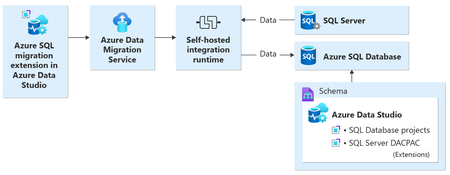
The Azure SQL Migration extension for Azure Data Studio is being deprecated and will be retired by February 28, 2026. As part of our unified and streamlined migration strategy for Azure SQL, we are consolidating all migration experiences into a consistent, scalable platform. If you are currently using the Azure SQL Migration extension, this blog will guide you through recommended replacement options for every phase of migration, whether you are moving to Azure SQL Managed Instance, SQL Server on Azure Virtual Machines, or Azure SQL Database. What is happening to the Azure SQL Migration extension in ADS? As you already know, Azure data studio will officially retire on February 28, 2026. The Azure SQL Migration extension in Azure Data Studio will also retire along with Azure Data Studio on February 28, 2026. The Azure SQL Migration extension will no longer be available in the marketplace of Azure Data Studio. What should you use instead? Below is the updated guidance for the migration tool categorized by migration phase and target. 1) Pre‑Migration: Discovery & Assessments Prior to migration, it is advisable to evaluate the SQL Server environment for readiness and to determine the right-sized Azure SQL SKU. Below are the recommended options: A) SQL Server enabled by Azure Arc Use the SQL Server migration experience in the Azure Arc portal for: Instance discovery at scale Migration assessments at scale, including: Readiness assessment for all Azure SQL targets. Performance-based, right-sized target recommendations. Projected Azure costs with the recommended target configuration. Reference: Steps to get started with the Azure Arc assessments- Deploy Azure Arc on your servers. SQL Server instances on Arc-enabled servers are automatically connected to Azure Arc. See options to optimize this. B) Automated assessments at scale using Azure DMS PowerShell and Azure CLI The Azure DataMigration modules in Azure PowerShell and Azure CLI can be used to automate assessments at scale. Learn more about how to do this. Here are the sample templates to automate the assessment workflow: Azure PowerShell DataMigration cmdlets DMS Azure CLI commands C) Azure Migrate For scenarios where assessments are required at data center level including different types of workloads like Applications, VM Servers and databases, use Azure Migrate to perform discovery and assessments at scale. Learn more about Azure Migrate. References: Review inventory Create SQL Assessment Review SQL Assessment 2) Migrations Based on the migration targets, here are the recommended tools you can use to carry out the migration: A. To Azure SQL Managed Instance The following options are available for migrating data to Azure SQL Managed Instance: 1. SQL Migration experience in Azure Arc For migrations to Azure SQL MI, leverage the streamlined SQL Migration experience in Azure Arc which lets you complete the end-to-end migration journey in a single experience. This experience provides: Evergreen assessments and right-fit Azure SQL target recommendation. Inline Azure SQL Target creation. Free Azure SQL MI Next generation General Purpose service that lets you experience the power of Azure SQL MI for free for 12 months. Near zero downtime migration using Managed Instance link powered by Distributed Availability Group technology. Secure connectivity. Reference blog: SQL Server migration in Azure Arc 2. Automated migration at scale using Azure DMS PowerShell and Azure CLI To Orchestrate migrations to Azure SQL MI at scale programmatically, use: DMS PowerShell cmdlets DMS Azure CLI commands Learn more about how to do this. B. To SQL Server on Azure Virtual Machines To migrate to SQL Server on Azure Virtual Machines, use: 1. Azure Database Migration Service (DMS) DMS supports migrating to SQL Server on Azure Virtual Machines using both online and offline methods. Your SQL Server backups can be in Azure Blob Storage or on a network SMB file share. For details on each option, see: Backups stored in Azure Blob Storage Backups maintained on network SMB file shares Note: The migration experience from SQL Server on-premises to SQL Server on Azure VM will soon be available in SQL Server enabled by Azure Arc. 2. Automated migration at scale using Azure DMS PowerShell and Azure CLI For programmatic migrations to Azure SQL Virtual Machines: DMS PowerShell cmdlets DMS Azure CLI commands Learn more about how to do this. 3. SSMS option: SQL Server Management Studio (SSMS) migration component If you can connect to both SQL Server on-premises and SQL Server running on Azure VM using SQL Server Management Studio, the migration component in SSMS can help you to migrate to SQL Server on Azure VM. For details, see SSMS Migration component. C. To Azure SQL Database Migrating a SQL Server database to Azure SQL Database typically involves migrating schema and data separately. Here are the options to perform offline and online migration to Azure SQL Database: 1. Offline migration to Azure SQL Database a. Azure Database Migration Service (DMS) portal experience Use Azure DMS portal to migrate both schema and data. Azure DMS uses Azure Data Factory and leverages the Self-hosted Integration Runtime (SHIR). Installation steps are here. b. Automated migration at scale using Azure DMS PowerShell and Azure CLI Use Azure DMS PowerShell and Azure CLI command line to orchestrate the schema and data migration to Azure SQL Database at scale: DMS PowerShell cmdlets DMS Azure CLI commands Learn more about how to do this. 2. Online migration to Azure SQL Database Using Striim To enable online migration of your mission critical databases to Azure SQL Database leverage Striim. Microsoft and Striim have entered a strategic partnership to enable continuous data replication from off-Azure SQL Servers to Azure SQL Database with near-zero downtime. For more details, refer to: Zero downtime migration from SQL Server to Azure SQL Database | Microsoft Community Hub Removing barriers to migrating databases to Azure with Striim’s Unlimited Database Migration program... To leverage the Striim program for migrations, please reach out to your Microsoft contact or submit the below feedback to get started. Summary The table below provides a summary of the available alternatives for each migration scenario. Migration Scenario Guided experience Automation experience Pre-Migration (Discovery + Assessment) SQL Migration experience in Azure Arc / Azure Migrate DMS PowerShell / Azure CLI To Azure SQL Managed Instance SQL Migration experience in Azure Arc DMS PowerShell / Azure CLI To SQL Server on Azure Virtual Machine DMS Azure Portal / SSMS migration component DMS PowerShell / Azure CLI To Azure SQL Database DMS Azure portal (offline & schema migration) / Striim (online migration) DMS PowerShell / Azure CLI (offline & schema migration) Final Thoughts Simplify your SQL migration journey and improve migration velocity to all Azure SQL targets, leverage the connected migration experiences in SQL Server enabled by Azure Arc, DMS, and SSMS. For SSMS, as a first step we brought the capabilities to perform assessment and migration to higher versions of SQL Server including to SQL Server on Azure Virtual Machines. As a next step, we are bringing cloud migration capabilities as well into SSMS. Feedback We love hearing from our customers. If you have feedback or suggestions for the product group, please use the following form: Feedback form As you begin your migration to Azure, we welcome your feedback. If you do not see suitable alternatives for any migration phases, use the feedback form to let us know so we can update the options accordingly.2.5KViews1like0Comments
Removing barriers to migrating databases to Azure with Striim’s Unlimited Database Migration program
Alok Pareek, co-founder and Executive Vice President of Product and Engineering at Striim Shireesh Thota, Corporate Vice President of Databases at Microsoft Every modernization strategy starts with data. It’s what enables advanced analytics and AI agents today, and prepares enterprises for what’s to come in the future. But before services like Microsoft Fabric, Azure AI Foundry, or Copilot can create that value, the underlying data needs to move into Microsoft’s cloud platforms. It’s within that first step, database migration, where the real complexity often lies. To simplify the process, Microsoft has expanded its investment in the Striim partnership. Striim continuously replicates data from existing databases into Azure in real time, enabling online migrations with zero downtime. Through this partnership, we have collaborated to enable modernization and migration into Azure at no additional cost to our customers. We’ve designed this Unlimited Database Migration program to accelerate adoption by making migrations easier to start, easier to scale, and easier to complete, all without disrupting business operations. Since launch, this joint program has already driven significant growth in customer adoption, indicating the demand for faster, more seamless modernization. And with Microsoft’s continued investment in this partnership, enterprises now have a proven, repeatable path to modernize their databases and prepare their data for the AI era. Watch or listen to our recent podcast episode (Apple Podcasts, Spotify, YouTube) to learn more. Striim’s Unlimited Migration Program Striim’s Unlimited Database Migration Program was designed to make modernization as straightforward as possible for Microsoft customers. Through this initiative, enterprises gain unlimited Striim licenses to migrate as many databases as they need at no additional cost. Highlights and benefits of the program include: Zero-downtime, zero-data-loss migrations. Supported sources include SQL Server, MongoDB, Oracle, MySQL, PostgreSQL, and Sybase. Supported targets include Azure Database for MySQL, Azure Database for PostgreSQL, Azure Cosmos DB, and Azure SQL. Mission-critical, heterogeneous workloads supported. Applies for SQL, Oracle, NoSQL, OSS. Drives faster AI adoption. Once migrated, data is ready for analytics & AI. Access is streamlined through Microsoft’s Cloud Factory Accelerator team, which manages program enrollment and coordinates the distribution of licenses. Once onboarded, customers receive installation walkthroughs, an enablement kit, and direct support from Striim architects. Cutover support, hands-on labs, and escalation paths are all built in to help migrations run smoothly from start to finish. Enterprises can start migrations quickly, scale across business units, and keep projects moving without slowing down for procurement hurdles. Now, migrations can begin when the business is ready, not when budgets or contracts catch up. How Striim Powers Online Migrations Within Striim’s database migrations, schema changes and metadata evolution are automatically detected and applied, preserving data accuracy and referential integrity. As the migration progresses, Striim automatically coordinates both the initial bulk load of historical data and the ongoing synchronization of live transactions. This ongoing synchronization keeps source and target systems in sync for as long as needed to actively test the target applications with real data before doing the cutoff, thereby minimizing risk. However, the foundation of Striim’s approach is log-based Change Data Capture (CDC), which streams database changes in real time from source to target with sub-second latency. This helps migrations avoid just moving the static snapshot of a database. Rather, they continuously replicate every update as it happens, so both environments remain aligned with minimal impact on operational systems throughout the process. While the snapshot (initial load) is being applied to the target system, Striim captures all the changes that occur. Once the initial load process is complete, Striim applies the changes using CDC, and from this point on, the source and target systems are in sync. This eliminates the need for shutting down the source system during the initial load process and enables customers to complete their migrations without any downtime of the source database. Striim is also designed to work across hybrid and multi-cloud architectures. It can seamlessly move workloads from on-premises databases, SaaS applications, or other clouds into Microsoft databases. By maintaining exactly-once delivery and ensuring downstream systems stay in sync, Striim can reduce risk and accelerates the path to modernization. Striim is available in the Azure Marketplace, giving customers a native, supported way to integrate it directly into their Azure environment. This means migrations can be deployed quickly, governed centrally, and scaled as business needs evolve, all while still aligning with Azure’s security and compliance standards. From Migration to Value With workloads fully landed in Azure, enterprises can immediately take advantage of the broader Microsoft data ecosystem. Fabric, Azure AI Foundry, and Copilot become available as extensions of the database foundation, allowing teams to analyze, visualize, and enrich data without delay. Enterprises can begin adopting Microsoft AI services with data that is current, trusted, and governed. Instead of treating migration as an isolated project, customers gain an integrated pathway to analytics and AI, creating value as soon as databases go live in Azure. How Enterprises Are Using the Program Today Across industries, we’re already seeing how this program changes the way enterprises approach modernization. Financial Services Moving from Oracle to Azure SQL, one global bank used Striim to keep systems in sync throughout the migration. With transactions flowing in real time, they stood up a modern fraud detection pipeline on Azure that identifies risks as they happen. Logistics For a logistics provider, shifting package-tracking data from MongoDB to Azure Cosmos DB meant customers could monitor shipments in real time. Striim’s continuous replication kept data consistent throughout the cutover, so the company didn’t have to trade accuracy for speed. Healthcare A provider modernizing electronic medical records from Sybase to Azure SQL relied on Striim to ensure clinicians never lost access. With data now in Azure, they can meet compliance requirements while building analytics that improve patient care. Technology InfoCert, a leading provider of digital trust services specializing in secure digital identity solutions, opted to migrate its critical Legalmail Enterprise application from Oracle to Azure Database for PostgreSQL. Using Striim and Microsoft, they successfully migrated 2 TB of data across 12 databases and completed the project within a six-month timeframe, lowering licensing costs, enhancing scalability, and improving security. What unites these stories is a common thread: once data is in Azure, it becomes part of a foundation that’s ready for analytics and AI. Accelerate Your Path to Azure Now, instead of database migration being the bottleneck for modernization, it’s the starting point for what comes next. With the Unlimited Database Migration Program, Microsoft and Striim have created a path that removes friction and clears the way for innovation. Most customers can simply reach out to their Microsoft account team or seller to begin the process. Your Microsoft representative will validate that your migration scenario is supported by Striim, and Striim will allocate the licenses, provide installation guidance, and deliver ongoing support. If you’re unsure who your Microsoft contact is, you can connect directly with Striim, and we’ll coordinate with Microsoft on your behalf. There’s no lengthy procurement cycle or complex setup to navigate. With Microsoft and Striim jointly coordinating the program, enterprises can begin migrations as soon as they’re ready, with confidence that support is in place from start to finish. Simplify your migration and move forward with confidence. Talk to your Microsoft representative or book a call with Striim team today to take advantage of the Unlimited Database Migration Program and start realizing the value of Azure sooner. Or if you’re attending Microsoft Ignite, visit Striim at booth 6244 to learn more, ask questions, and see how Striim and Microsoft can help accelerate your modernization journey together. 1.2KViews2likes0Comments
SQL Server migration in Azure Arc – Generally Available
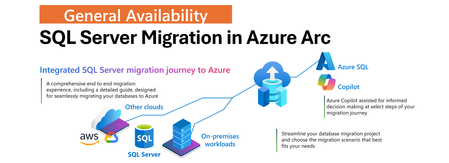
We’re excited to announce General Availability of the SQL Server migration in Azure Arc. This experience is designed to simplify and accelerate SQL Server migration journey to Azure SQL Managed Instance offering a unified, end-to-end workflow directly within the Azure portal. About the solution SQL Server migration in Azur Arc integrates existing Azure Database Migration Service capabilities into Azure Arc by enabling the entire end to end migration journey with the following capabilities: Continuous database migration assessments with Azure SQL target recommendations and cost estimates. Seamless provisioning of Azure SQL Managed Instance as destination target, also with an option of free instance evaluation. Option to choose between two built-in migration methods: real-time database replication using Distributed Availability Groups (powered by MI link feature), or log shipping via backup and restore (powered by Log Replay Service feature). Unified interface that eliminates the need to use multiple tools or to jump between various places in Azure portal. Microsoft Copilot is integrated to assist you at select points during the migration journey. Learn more about SQL Server Migration in Azure Arc. Benefits of the solution Traditionally, migrating SQL Server workloads to Azure required juggling between multiple tools, various places in portal, and some manual steps. This new experience changes that by: Providing a single pane of glass in the Azure portal for the entire migration journey. Reducing migration timelines from months to days. Offering a choice of two migration methods – real-time replication or log-shipping Enabling validation of target environments using read-only replicas before cutover for real-time replication. Automatically capturing application client connection data to simplify mapping between applications and databases. Optional failback from Azure SQL Managed Instancy with configured upgrade policy for SQL Server 2022 and SQL Server 2025 with external tooling. Providing intelligent step-by-step guidance with Microsoft Copilot at select points of the migration journey, helping you make informed decisions. Start Your Migration Journey Today In case your SQL Server is Arc enabled, you could proceed right away to Azure portal. If you need to enable it, then onboard your SQL Server to Azure Arc today. In the portal, navigate to Arc enabled SQL Server resource, and on the left-hand side select Migration, then Database Migration. This is where you will navigate to the new database migration experience. Shown below is illustrated experience of the database migration experience you are expected to see. From the main screen, you can navigate through each stage of the migration journey - starting with the database migration readiness assessment, followed by selecting or provisioning an Azure SQL Managed Instance as the target destination, choosing the appropriate migration method, monitoring progress, and performing the final cutover. By selecting the Azure SQL Benefits tab, you’ll gain insights into the advantages of Azure SQL - helping you make well-informed decisions about your migration. By selecting the Tutorials tab, you will access information helping you getting started with the solution. We've also integrated Microsoft Copilot at select points in the journey for any guidance and support you might need to ensure confident and informed decision-making. For next steps, click on the button below: Get started with SQL Server Migration in Azure Arc today. Feedback We love hearing from our customers! Any feedback or suggestions for the product group, use the following online form to let us know: Provide feedback to the product group We hope that you will enjoy our solution, and we look forward to your feedback as you embark on your migration journey to Azure.1.3KViews1like0CommentsGeneral Availability - DMS's PowerShell, Azure CLI, and Python SDK
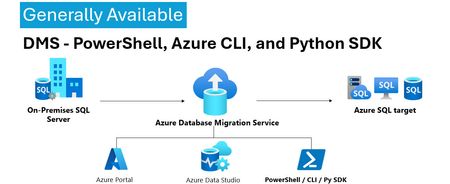
We’re excited to announce the General Availability (GA) of DMS client tools - PowerShell, Azure CLI, Python SDK and more. This milestone unlocks efficient, stable, and scalable automation options for database migration workflows—making it easier than ever to integrate DMS into your DevOps pipelines and enterprise migration strategies. 💡Introduction: With the general availability of DMS client tools - PowerShell, Azure CLI, Python SDK, users can now use stable release of: PowerShell module 1.0.0 (https://www.powershellgallery.com/packages/Az.DataMigration/1.0.0) Azure CLI extension 1.0.0 (https://learn.microsoft.com/en-us/cli/azure/datamigration?view=azure-cli-latest) DMS V2 APIs (version 2025-06-30) SDKs for multiple languages (listed below) SDKs Releases: Language GA Package / Link .Net https://www.nuget.org/packages/Azure.ResourceManager.DataMigration/1.0.0 Java https://central.sonatype.com/artifact/com.azure.resourcemanager/azure-resourcemanager-datamigration/1.1.0 Go https://pkg.go.dev/github.com/Azure/azure-sdk-for-go/sdk/resourcemanager/datamigration/armdatamigration/v2 Python azure-mgmt-datamigration · PyPI JavaScript https://www.npmjs.com/package/@azure/arm-datamigration/v/3.0.0 🔧 What’s New? Three new commands have been introduced in the latest releases of the SDK, PowerShell module, and CLI extension, as outlined below: New CLI Commands: az datamigration sql-db retry - Retry the failed SQL DB migrations. az datamigration sql-managed-instance delete - Delete Azure SQL MI’s Database Migration resource. az datamigration sql-vm delete - Delete Azure SQL VM’s Database Migration resource. New PowerShell Commands: Invoke-AzDataMigrationRetryToSqlDb - Retry the failed SQL DB migrations. Remove-AzDataMigrationToSqlManagedInstance - Delete Azure SQL MI’s Database Migration resource. Remove-AzDataMigrationToSqlVM - Delete Azure SQL VM’s Database Migration resource. 🚀Conclusion: With this GA / stable release, users can now: Use them to configure and execute migrations with full control. Automate migrations: DevOps teams can embed migration steps into CI/CD pipelines. Integrate into custom applications and orchestration tools. These support all the DMS migration scenarios—from simple lift-and-shift operations to complex logical migrations—while ensuring stability, and repeatability. For more details, refer: Documentation: Migrate databases at scale using Azure PowerShell / CLI PowerShell: Az.DataMigration Module Azure CLI: az datamigration Python SDK: azure-mgmt-datamigration · PyPI417Views2likes0CommentsMaking Azure DMS More Secure: Azure Portal Permission Enhancements
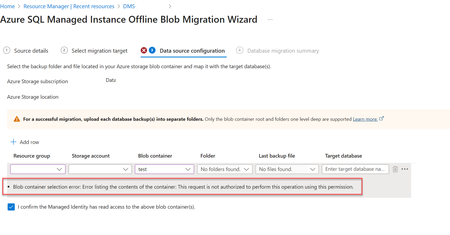
Migrating databases to Azure SQL Managed Instance or Azure SQL Virtual Machine is a critical step in modernizing enterprise infrastructure. With security and compliance top of mind, Azure Database Migration Service (DMS) has introduced key changes to its Azure portal experience—especially around permission for blob container access. Why the Change? Previously, in case of Azure Portal, DMS relied on account key-based access to Azure Blob Storage for listing and accessing backup files on the migration configuration page. While functional, this approach is not best in terms of security, especially for industries which prohibit the use of shared keys. Now, DMS's Azure portal uses security context of the current signed in user on the Azure portal to list and access backup files in the blob container, making it better security approach. Impact of the Change When migrating to Azure SQL Managed Instance or Azure SQL Virtual Machine via Azure portal make sure the current signed in user has Storage Blob Data Reader role on the Blob container that contains the backup files. This permission is needed to list folders and files in the blob container during migration setup via Azure portal only. If the current signed in user lacks the Storage Blob Data Reader role on the Blob container, users will encounter the following error: Error: "Blob container selection error: Error listing the contents of the container: This request is not authorized to perform this operation using this permission." Solution: Make sure the current signed in user has "Storage Blob Data Reader" role on the Blob container that contains the backup files. For more information, refer : Tutorial: Migrate SQL Server to Azure SQL Managed Instance - Azure Database Migration Service | Microsoft Learn Tutorial: Migrate SQL Server to SQL Server on Azure Virtual Machine Using Azure Data Studio - Azure Database Migration Service | Microsoft Learn341Views0likes0CommentsNew database migration experience for SQL Server enabled by Azure Arc – Public Preview
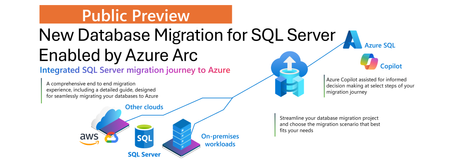
We’re excited to announce a new database migration experience for SQL Server enabled by Azure Arc - now in public preview. This experience is designed to simplify and accelerate SQL Server migration journey to Azure SQL Managed Instance offering a unified, end-to-end workflow directly within the Azure portal. 🚀 What Is It? This new migration experience integrates existing Azure Database Migration Service capabilities into Azure Arc by enabling the entire end to end migration journey with the following capabilities: Continuous database migration assessments with Azure SQL target recommendations and cost estimates. Seamless provisioning of Azure SQL Managed Instance as destination target, also with an option of free instance evaluation. Option to choose between two built-in migration methods: real-time database replication using Distributed Availability Groups (powered by the MI link feature), or log shipping via backup and restore (powered by the Log Replay Service feature). Unified interface that eliminates the need to use multiple tools or to jump between various places in Azure portal. Microsoft Copilot is integrated to assist you at select points during the migration journey. 💡 Why It Matters Traditionally, migrating SQL Server workloads to Azure required juggling between multiple tools, various places in portal, and some manual steps. This new experience changes that by: Providing a single pane of glass in the Azure portal for the entire migration journey. Reducing migration timelines from months to days. Offering real-time replication and minimal downtime migration Enabling validation of target environments using read-only replicas before cutover. Automatically capturing application client connection data to simplify mapping between applications and databases. With built-in support for both MI link and Log Replay Service (LRS), customers can choose the migration method that best fits their SQL Server version and business needs. Optional failback for SQL Server 2022 and above with external tooling. Providing intelligent step-by-step guidance with Microsoft Copilot at select points of the migration journey, helping users make informed decisions. 🧭 Start Your Migration Journey Today In case your SQL Server is Arc enabled, you could proceed right away to Azure portal. If you need to enable it, then onboard your SQL Server to Azure Arc today. In the portal, navigate to Arc enabled SQL Server resource, and on the left-hand side select Migration, then Database Migration (preview). This is where you will navigate to the new database migration experience. ▶️ Demo Video Included below is a short YouTube video demonstrating the database migration experience you can expect. From the main screen, you can navigate through each stage of the migration journey - starting with the database migration readiness assessment, followed by selecting or provisioning an Azure SQL Managed Instance as the target destination, choosing the appropriate migration method, monitoring progress, and performing the final cutover. By selecting the Azure SQL Benefits tab, you’ll gain insights into the advantages of Azure SQL - helping you make well-informed decisions about your migration. You can consult the integrated Microsoft Copilot at select points in the journey for guidance and support to ensure confident and informed decision-making. ➡️ Next steps To get started with the new database migration experience for SQL Server enabled by Azure Arc, visit Microsoft Learn: Learn more about new migration experience in Azure Arc on Microsoft Learn We love hearing from our customers! Any feedback or suggestions for the product group, use the following online form to let us know: Provide feedback on database migrations for SQL Server enabled by Azure Arc to the product group We hope that you will enjoy our solution, and we look forward to your feedback as you embark on your migration journey!2.1KViews2likes0CommentsSQL Migration assessments now include Next-gen General Purpose Azure SQL MI
Announcing the inclusion of the Next-gen General Purpose service tier in migration assessments for SQL Server migration to Azure SQL Managed Instance. All database migration tooling includes this capability now. This service tier is more customizable, allowing the configuration to be tailored more closely to the resource requirements.761Views1like0CommentsIntroducing Azure SQL Database offline migrations for the Azure SQL migration extension
The new migration capability in the Azure SQL Migration extension provides an end-to-end experience to modernize SQL Server to Azure SQL Database. The extension allows you to perform a migration readiness check with actions to remediate possible migration blockers, export the assessment results, and get right-sized Azure recommendations.18KViews3likes1Comment