azure sql managed instance
310 TopicsDatabase Hub in Fabric: Now in Public Preview -Turn Database Signals into Guided Action
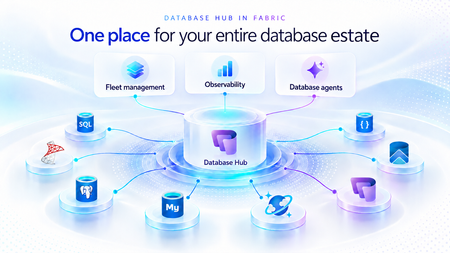
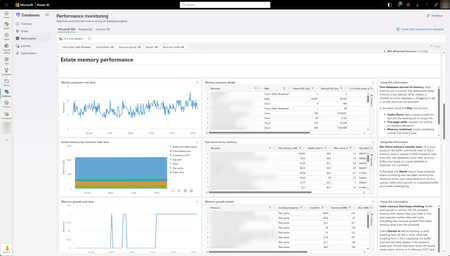
As applications grow, so does the database estate behind them. What starts with a handful of databases can become hundreds or thousands of resources spread across services, subscriptions, and environments. For the teams responsible for keeping them healthy, the challenge is no longer just collecting signals. It is knowing what needs attention, why it matters, and what to do next. Now in public preview, Database Hub in Microsoft Fabric brings inventory, health, performance, security, and optimization insights into one connected experience. It helps administrators and developers see the bigger picture, identify affected resources, and move from estate-wide visibility to focused investigation, without losing the context that brought them there. The preview brings together supported resources across Azure SQL Database, SQL Server enabled by Azure Arc, Azure Database for PostgreSQL, Azure Cosmos DB, and SQL database in Fabric. Available capabilities and signals vary by service and preview configuration. Database Hub Overview brings together estate-wide findings and cross-engine performance trends to help you prioritize what needs attention. Start with what needs your attention When you manage a large database estate, another dashboard is only useful if it helps you decide where to spend your time. The Overview page provides that starting point, bringing together findings across security, performance, and optimization. It distinguishes Issues, which require timely attention, from Suggestions, which highlight opportunities to improve your estate over time. You might begin with a security configuration that needs review or a performance signal that warrants investigation. Selecting a finding opens Estate with the relevant filters already applied, so you can see the affected resources rather than search for them again. The result is a more direct path from “something needs attention” to “these are the resources I should investigate.” Overview highlights issues across Security, Performance, and Optimization, with affected-resource counts and direct links to investigate further. Bring your estate into one view, and make it relevant to you The Estate experience brings supported resources into a unified inventory, scoped to your existing permissions. Search and filters help you narrow that inventory to the service, subscription, or resource group you manage. This is especially useful when your responsibilities span database engines. You can begin with a broader view, then focus on Azure SQL databases, Arc-enabled SQL Server resources, or Azure Database for PostgreSQL flexible servers without rebuilding the resource list in separate portals. Each resource brings its associated Issues and Suggestions into context. Open a finding to review the affected resource, supporting information, and recommended next step. The inventory also respects the resource model of each service. For example, the PostgreSQL view represents flexible server instances, rather than every database hosted within them. A unified view does not mean moving your databases. Your Azure resources remain in their existing subscriptions, and on-premises SQL Server instances remain on-premises, connected through Azure Arc. Database Hub brings operational context together; it does not require relocating or mirroring your application data into Fabric. Estate brings resource inventory, Issues, and Suggestions into one view, with quick actions to continue investigation in the Azure portal, VS Code, or SSMS. Understand security posture and performance in context Database Hub helps you identify configurations worth reviewing and resources that need a closer look. For security, supported signals can include Microsoft Entra authentication, customer-managed keys, and auditing coverage, depending on the database service. These findings provide a starting point for investigation, not a blanket judgment that every flagged resource is insecure or noncompliant. For example, a suggestion to review customer-managed keys should be evaluated against your organization’s requirements. A resource using service-managed keys is still encrypted at rest. For performance, built-in dashboards bring supported utilization and activity signals into view, including CPU, memory, storage, I/O, and connections. Review trends across your estate, then narrow the scope and time range to investigate individual resources. Metric availability varies by engine and monitoring configuration; missing data should not be interpreted as good health. For supported SQL monitoring scenarios, you can also create a custom monitoring dashboard from a template and tailor its charts and layout to the resources your team follows regularly. Together, these experiences help answer two practical questions: Where is pressure building, and where is there an opportunity to improve? Performance summaries highlight recent capacity signals and trends across Microsoft SQL, PostgreSQL, and Cosmos DB. The Security dashboard summarizes Microsoft Entra authentication, audit logging, and customer-managed key coverage, helping you identify configurations that warrant review across your estate. The Performance monitoring dashboard combines memory-pressure trends, resource-level details, and interpretation guidance to help focus your investigation. Move from a finding to an informed next step Estate-wide visibility is the beginning of an investigation, not a replacement for database expertise. When a finding needs deeper analysis, Database Hub helps you review the evidence and continue in the appropriate native experience, such as the Azure portal or SQL Server Management Studio (SSMS). Engine-specific diagnostics and configuration changes remain in the tools designed for that work. Consider a performance issue that occurred before an administrator could inspect it. In supported agent-assisted scenarios, captured incident evidence can help establish what happened, when it happened, and which queries or sessions were involved. That context gives the administrator a more informed starting point for investigation. The operator remains in control: review the evidence, evaluate the recommendation, and apply authorized changes through the appropriate service tools. The preview investigation workflow does not automatically remediate issues, and existing permissions and approval requirements continue to apply. Bring database expertise into agent-assisted workflows We are also making database operational intelligence available through agent skills: reusable capabilities that agents can call to support observability, monitoring, diagnostics, optimization, and other database operations. Database Hub provides estate context; skills provide a way to bring database expertise into an agent-assisted investigation. This creates a foundation for helping teams move from identifying an affected resource to understanding its signals and evaluating the next step. We’re building toward making this expertise available in the AI companions and development tools teams already use, with recommendations grounded in evidence, the specific database, and your organization’s operational controls. If we take a step back, our broader vision brings together a free, extensible Database Hub experience, agentic observability, and OneLake integration, all within Microsoft Fabric. It’s a foundation for connecting database operations with analytics and AI and helping teams turn signals into informed action. Get started with Database Hub Start with the Database Hub documentation to review preview availability, supported services, and setup requirements. Ask your Fabric administrator to enable the preview where required, confirm that you have the appropriate resource permissions, and complete any service-specific monitoring prerequisites. Then open Microsoft Fabric, select Databases in the left navigation, and begin with Overview. Choose a finding, explore the affected resources in Estate, and follow the evidence into your next investigation. For more details on supported services and getting set up, the Database Hub documentation is also available on Microsoft Learn.303Views4likes1CommentMI link support for multiple databases in an Always On availability group for SQL Server (Preview)
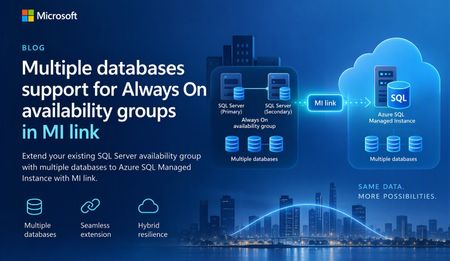
A simpler way to extend availability groups to Azure We are pleased to announce the preview of multi-database mode for Managed Instance link. The new mode lets you replicate multiple databases from an existing Always On availability group through a single link between SQL Server and Azure SQL Managed Instance. Managed Instance link uses distributed availability group technology to provide near-real-time replication between SQL Server and Azure SQL Managed Instance. It supports hybrid architectures, online migration, disaster recovery, and read-only workload offload. The link can be configured and managed through SQL Server Management Studio (SSMS), PowerShell, Azure CLI, and Azure APIs. Previously, each link supported one database. Customers with multi-database availability groups therefore had to split databases into separate availability groups and create a link for each database. Multi-database mode removes that limitation for supported SQL Server versions and editions, while the existing single-database mode remains available for earlier versions and other supported configurations. What you can do with multi-database link mode Migrate multiple databases to Azure SQL Managed Instance with minimal cutover downtime. Offload read-only workloads, including reporting and analytics, to the secondary replica. Use Azure SQL Managed Instance as a disaster recovery target for supported SQL Server versions. Start replication in either direction when the SQL Server version and Azure SQL Managed Instance update policy support that direction. Reverse primary and secondary roles through a planned failover. Build hybrid and multicloud topologies that place database groups where they are most useful. One link for an existing multi-database availability group If you already use an Always On availability group, multi-database link mode lets you extend the complete database group to Azure SQL Managed Instance without creating a separate availability group for every database. All databases in the link move together as one managed group. Databases on the primary are read-write, while their copies on the secondary are read-only. Use of your existing Always On AG listener endpoint is supported with multi-database mode MI link, allowing the link to remain operational after a local AG failover. Image 1: A multi-database Always On availability group replicated to Azure SQL Managed Instance through one Managed Instance link. The diagram illustrates the availability group relationship rather than a specific Azure SQL Managed Instance service-tier replica count. Managed Instance link is supported across all Azure SQL Managed Instance service tiers. Run multiple links in different directions A single SQL Server instance can participate in multiple links. Each link can carry a different availability group, and supported links can replicate in different directions at the same time. In the following example, AG1 (containing DB1, DB2, and DB3) replicates from SQL Server to Azure SQL Managed Instance through MI link 1. AG2 (containing DB4, DB5, and DB6) replicates from Azure SQL Managed Instance to SQL Server through MI link 2. Both links can operate at the same time between the two instances. Image 2: Two multi-database availability groups using separate links with opposite replication directions. Important: Database names must be unique in this configuration. A database cannot be renamed on the secondary while it is participating in replication to resolve a naming conflict. Replicate one availability group to multiple managed instances Multi-database mode also supports fan-out topologies. You can replicate multiple availability groups to one managed instance, or replicate the same availability group to different managed instances. For example, separate links can target managed instances in different Azure regions. Image 3: One multi-database availability group replicated through separate links to two Azure SQL managed instances. Preview requirements Requirement Details SQL Server SQL Server 2022 with CU27 or SQL Server 2025 with CU9 and above. Edition Enterprise or Developer edition. Standard edition supports basic availability groups with one database and is not supported for multi-database mode. Azure SQL Managed Instance Use a compatible update policy (2022 or 2025) matching your SQL Server version. SSMS SSMS 22.10.2 or later for the multi-database link capability. Automation Az module 16.3.0 or later and Az.Sql 7.1.0 or later, or the corresponding Azure APIs. Get started To evaluate multi-database mode during preview: Confirm that the SQL Server version, edition, servicing level, and Azure SQL Managed Instance update policy meet the preview requirements. Upgrade to SSMS 22.10.2 or later, or use a supported automation interface. Enable multi-database mode before creating a multi-database link. Create the link from the existing Always On availability group and validate synchronization for every database. Review the Azure documentation for multi-database Managed Instance link configuration, limitations, monitoring, failover, and cleanup guidance. Share your feedback We would love to hear about your experience with multi-database mode. Please share questions, feedback, and feature suggestions through the Managed Instance link feedback form.178Views0likes0Comments
Public Preview: Performance monitoring for Azure SQL in Database Hub
We're excited to announce the public preview of performance monitoring for Azure SQL in Database Hub in Fabric. Performance monitoring brings the health and performance of your SQL estate into Database Hub. You see every supported database in one place and quickly spot the ones that need attention. It works across: Azure SQL Database Azure SQL Managed Instance (coming soon) SQL Server on Azure Virtual Machines SQL Server enabled by Azure Arc Microsoft collects performance-related telemetry, runs the pipeline, and stores the data for you. There's nothing you need to deploy and nothing to operate. Turn it on, and your SQL resources show up on the Performance page in Database Hub, which is free. This post is a deep dive on the performance part of Database Hub. For the full tour, including the Overview, Estate, and Security pages, read Database Hub in Fabric: Now in Public Preview. Get started in three steps Open Database Hub in Fabric. During the preview, a Fabric administrator needs to turn on the Database Hub tenant setting. See the prerequisites. Turn on performance monitoring for your SQL resources. See Enable performance monitoring for Microsoft SQL. Go to the Performance page to see which databases need your attention. See your entire database estate in Database Hub Performance monitoring powers the Performance page in Database Hub. Database Hub is built for when you need to look across all your databases, not just one at a time. It brings your database estate across Azure, on-premises, and other clouds into one place, including: Azure SQL and SQL Server enabled by Azure Arc Azure Database for PostgreSQL Azure Cosmos DB The Performance page comes with prebuilt dashboards, so you can see performance at a glance without building anything yourself. The dashboards are designed to quickly answer two questions: Are my databases healthy? Which ones need my attention? From there, you can drill into resource usage, waits, and session activity to understand what's driving a change in performance. With Database Hub, you can: Get estate-wide visibility into health and performance across database types Investigate the root cause of performance issues across many databases Use AI-assisted analysis to find and explain issues faster To learn more, see What is Database Hub in Fabric? Why we built this Monitoring SQL performance at scale often meant building and running your own monitoring stack. Before you could effectively answer, "Which of my databases need attention right now?" you typically had to: Deploy and configure a collection resource, such as a watcher or an agent Build a telemetry pipeline to move the data Provision a data store, and then pay for it, secure it, and keep it running Build dashboards on top of all of it Repeat for every new server, database, or region That's a lot of work before you see your first chart. And every step is another thing that can break, drift, or quietly stop collecting data. Customers are also turning to AI to make sense of their database estate. They want an AI agent that can spot a performance problem, explain what's causing it, and recommend a fix. But an AI agent is only as good as the data it can reach. It operates best with one consistent source of performance data across every database, not a patchwork of tools and data stores. We heard this feedback loud and clear from customers. You told us you love having at-scale dashboards and ownership of your performance data. You also told us that setting up a telemetry stack was time-consuming, scale limits got in the way, and running the data store added operational burden and cost overhead. One customer put it simply: they wanted to spend less time managing their telemetry infrastructure and more time managing and improving their databases. Performance monitoring keeps the parts you valued and removes the infrastructure you had to manage. That's why it feeds Database Hub directly. You get one place to see your whole estate, and your AI agents get one consistent source of performance data. No infrastructure to manage (or pay for) With performance monitoring, there's no monitoring infrastructure for you to deploy, size, or run. It's all managed by Microsoft, with no scale limits on how many targets you can monitor. Telemetry is collected close to the database engine and sent to a Microsoft-managed telemetry pipeline and data store. Access to that data is governed by Azure role-based access control (RBAC), so people only see telemetry for the resources they already have access to. Consistent telemetry across your SQL estate Performance monitoring collects the same core set of performance data across every supported SQL deployment, whether it runs in Azure, on-premises, or in another cloud. That means one mental model and one set of dashboards in Database Hub, instead of a different tool for every flavor of SQL. The preview collects performance-related telemetry, including: CPU and memory utilization Wait statistics Active sessions Storage I/O and database storage utilization Performance counters Client connections Database properties Availability group, replica, and database replica health Go beyond Database Hub with KQL Database Hub covers the most common performance questions. When you need a view that Database Hub doesn't show, you can query the same telemetry directly with Kusto Query Language (KQL). The telemetry is available through a Microsoft-managed, RBAC-governed endpoint, so you don't need to create or pay for your own Azure Data Explorer cluster. Use it to: Build your own Real-Time Dashboards and reports Connect tools you already use, such as Grafana or Power BI Give an AI agent access to investigate performance across your estate To get started, see Query performance monitoring telemetry. It includes the schema, connection steps, and ready-to-run starter queries. Turn on performance monitoring How you turn on performance monitoring depends on the resource type. For all of the steps in one place, see Enable performance monitoring for Microsoft SQL. Resource type How monitoring is enabled in preview Step-by-step guidance Azure SQL Database Add an extended property to each database you want to monitor. You can also select Enable Performance Monitoring in Database Hub. Azure SQL Database Azure SQL Managed Instance (coming soon) Coming soon Coming soon SQL Server on Azure VMs Turn on a feature flag in the SQL IaaS Agent extension. SQL Server on Azure VMs SQL Server enabled by Azure Arc On by default once the server is connected to Azure Arc. SQL Server enabled by Azure Arc To view performance monitoring data, you need: The Reader role, or a role with higher privileges, on each subscription that contains the resources you want to view. The Microsoft.AzureArcData resource provider registered on each subscription. For steps, see Register the Azure resource provider. Availability Performance monitoring is available in public preview in select Azure regions. For the current list of supported regions, see Regional availability and data handling. Learn more Database Hub in Fabric: Now in Public Preview What is Database Hub in Fabric? Enable performance monitoring for Microsoft SQL Query performance monitoring telemetry Supplemental Terms of Use for Microsoft Azure Previews634Views1like5CommentsMore performance and flexibility for Azure SQL Managed Instance Business Critical
Higher transaction log throughput and flexible memory address two different resource dimensions, but they follow the same principle: giving customers more control over the resources they need for their workloads.186Views1like0CommentsPublic Preview: Zone-Redundant Next-Gen General Purpose for Azure SQL Managed Instance
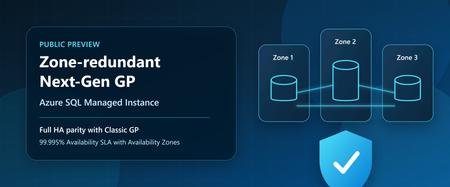
Customers no longer need to choose between the latest General Purpose architecture and zone-level resiliency. With the public preview of zone redundancy for Next-Generation General Purpose Azure SQL Managed Instance, organizations can now take advantage of all the benefits of Next-Generation General Purpose while meeting strict high availability and compliance requirements through Availability Zone protection. When Next-Generation General Purpose became generally available, it introduced a modernized General Purpose architecture delivering improved performance, greater scalability, enhanced flexibility, and better price-performance for Azure SQL Managed Instance workloads. Since then, customers have increasingly adopted the architecture to modernize SQL workloads, consolidate databases, and optimize total cost of ownership. Today, we're extending those benefits to customers who require zone-level resiliency. With zone redundancy now available in public preview, customers can realize all the advantages of Next-Generation General Purpose while meeting the same zone-level availability requirements previously available only with Classic General Purpose. This milestone brings full high-availability parity between Classic General Purpose and Next-Generation General Purpose, removing one of the last major reasons for customers to remain on the previous architecture. Closing the last major gap Zone redundancy has consistently been one of the most requested capabilities for Next-Generation General Purpose. Since its introduction, Next-Generation General Purpose has provided substantial improvements in scalability and flexibility, including support for up to 128 vCores, up to 32 TB of storage, up to 500 databases per instance, configurable IOPS, and flexible memory sizing. Customers can optimize resources for their workload requirements while continuing to benefit from the simplicity and compatibility of Azure SQL Managed Instance. With today's announcement, these capabilities can now be combined with zone-level resiliency, enabling customers to deploy highly available business-critical workloads on the latest General Purpose architecture without compromise. In addition, the flexible memory option for zone-redundant Next-Generation General Purpose instances is also available in public preview, providing even greater flexibility to balance performance requirements and infrastructure costs. Built-in high availability, now with Zone-level protection Azure SQL Managed Instance has always been designed for high availability. Next-Generation General Purpose delivers built-in high availability through its distributed architecture, leveraging Service Fabric together with fault domains and update domains to minimize the impact of hardware failures, software updates, and planned maintenance events. This architecture enables applications to remain available even during infrastructure events and maintenance operations. As a result, single-zone deployments provide a 99.99% availability SLA. For organizations with more demanding availability requirements, zone redundancy distributes service components across multiple Availability Zones within a region. This provides protection against zone-level failures and increases the availability SLA to 99.995%. While many workloads are well served by single-zone deployments, organizations in regulated industries and mission-critical environments often require zone-redundant architectures as part of compliance, operational resilience, or business continuity requirements. With today's preview, these customers can now adopt Next-Generation General Purpose without sacrificing those requirements. Regional availability Zone redundancy for Next-Generation General Purpose is available in public preview in all regions where the underlying ESAN infrastructure supports zone-redundant deployments. For the latest list of supported regions, check out the documentation page containing the regions where Elastic SAN is currently available and the supported redundancy options. Regions that do not yet support ESAN-based zone redundancy are not included in the preview at this time. Additional regions will become available as platform support expands. Upgrading existing deployments Whether you are already running Next-Generation General Purpose or remain on Classic General Purpose, adopting zone-redundant Next-Generation General Purpose is designed to be straightforward and transparent. Enable zone redundancy on existing Next-gen General Purpose instances Customers already running Next-Generation General Purpose can enable zone redundancy directly on existing instances and immediately benefit from enhanced resiliency and a higher availability SLA. Move from classic General Purpose zone-redundant to Next-generation General Purpose zone-redundant Customers currently running Classic General Purpose with zone redundancy can migrate to Next-Generation General Purpose while preserving zone-level resiliency and gaining access to the latest platform architecture, resource flexibility, and scalability improvements. This provides a natural modernization path for existing deployments and allows customers to standardize on the future architecture of the General Purpose tier. Online operation with a short failover Enabling zone redundancy or migrating between architectures is performed as an online management operation. During most of the operation, Azure SQL Managed Instance provisions and synchronizes the new infrastructure while the existing deployment continues serving application traffic. Near the end of the operation, a brief failover occurs as client connections are switched from the existing infrastructure to the newly provisioned environment. For more information about management operations, expected behavior, and application connectivity considerations, see management operations overview article. Protecting workloads beyond a single region For customers running in regions where zone redundancy is not currently available, or for customers seeking protection from broader regional outages, Failover Groups remain the recommended solution. Failover Groups enable disaster recovery across Azure regions by maintaining a secondary managed instance and providing automatic or manual failover capabilities when needed. This approach helps organizations meet business continuity objectives even when Availability Zone protection is unavailable or when protection from regional outages is required. Optimize disaster recovery costs with License Free failover rights Customers implementing disaster recovery through Failover Groups can further optimize costs through Azure SQL License Free failover rights. When the secondary managed instance is maintained exclusively for standby disaster recovery purposes and is not used for read-only workloads, SQL Server licensing costs do not apply to the secondary environment. Customers pay only for the compute resources required to maintain disaster recovery readiness, helping reduce overall total cost of ownership. Planning costs The Azure SQL Managed Instance pricing page and Azure Pricing Calculator have been updated to include the latest zone-redundant Next-Generation General Purpose offerings. These tools can help customers evaluate deployment options, compare availability architectures, and estimate costs associated with zone redundancy and disaster recovery configurations. Get started Zone redundancy for Next-Generation General Purpose marks the completion of an important milestone in the evolution of Azure SQL Managed Instance. Customers can now combine the performance, scalability, flexibility, and operational advantages of Next-Generation General Purpose with zone-level resiliency and a 99.995% availability SLA. Whether deploying new workloads, enabling zone redundancy on existing Next-Generation General Purpose instances, or modernizing Classic General Purpose deployments, organizations now have a clear path to adopting the latest General Purpose architecture without compromise. Learn more What is Azure SQL Managed Instance Availability through local and zone redundancy - Azure SQL Managed Instance Flexible memory - Azure SQL Managed Instance Next-gen General Purpose – official documentation Try Azure SQL Managed Instance for free Accelerate SQL Server Migration to Azure with Azure Arc Analyzing the Economic Benefits of Microsoft Azure SQL Managed Instance How 3 customers are driving change with migration to Azure SQL717Views1like0CommentsHostNameInCertificate changes in Azure SQL Managed Instance affecting client connectivity
Azure SQL Managed Instance is changing how TLS certificates are stored and handled in managed instances. One of those certificates was specifically tailored to support migration scenarios where SQL clients retain the server name, while updating its record in DNS so that it resolves to the managed instance instead. This was supported with an instance certificate that we are now replacing in favor of a more complete solution. When does this change take effect? New managed instances already contain certificates with a reduced list of SANs. Existing managed instances will have their certificates revoked and replaced with reduced certificates during the first week of August 2026. Am I affected? Your SQL clients and applications might be unable to connect if all of the below is true: The client is connecting over the VNet-local endpoint, and The client attempts to establish a Redirect connection, and Client settings contain the HostNameInCertificate connection parameter. The exact error message depends on your application, client, and driver. For example: The target principal name is incorrect. The certificate chain was issued by an authority that is not trusted. The certificate's CN name does not match the passed value. The remote certificate is invalid according to the validation procedure. Failed to validate the server name in a certificate hostname verification failed certificate verify failed: Hostname mismatch My clients are affected. What should I do? If your clients are affected, find an appropriate solution in the table below. If the client is... Solution Connecting to the managed instance's VNet-local endpoint with Redirect using the instance's original VNet-local domain name Remove HostNameInCertificate from client's connection string; or Deploy a private endpoint and ensure your client is connecting to it. Connecting to the managed instance’s VNet-local endpoint with Redirect using a different domain name (for example, via DNS CNAME) Set the instance’s connection type to Proxy; or Deploy a private endpoint and ensure your client is connecting to it. Connecting via private endpoint No action is needed. Connecting via public endpoint No action is needed. Connecting with Proxy connection type No action is needed. What else should I know? Microsoft recommends you adhere to the security best practices for data in flight: Only allow network access to known networks and hosts; see Connecting to a managed instance. Authorize using safe credentials, ideally by using Microsoft Entra where possible. Always use TLS encryption (Encrypt=Strict or Encrypt=Mandatory). Monitor suspicious network activity throughout your network topology. Follow the principle of least privilege. Ensure that your SQL clients and applications have a network path to fetch the latest CRL and/or connect to OCSP for certificate validation.530Views0likes0CommentsAnnouncing Automatic Backup Immutability for Azure SQL Database and Azure SQL Managed Instance
Built-in protection for your most recent backups - enabled automatically Today, we're excited to announce General Availability of automatic backup immutability up to the most recent 7 days of point-in-time restore (PITR) backups in Azure SQL Database and Azure SQL Managed Instance, at no additional cost. With this release, up to most recent 7 days of backups are automatically protected with immutability by default, regardless of your configured PITR retention period. No configuration changes, policy creation, or administrative action are required. This enhancement provides an additional layer of protection for one of your most critical recovery assets - your backups. Why backup immutability matters Cyberattacks continue to evolve, with ransomware increasingly targeting not only production data, but also backup systems. Attackers understand that if backups can be deleted, modified, or corrupted, recovery becomes significantly more difficult and costly. Traditional backup strategies focus on creating recoverable copies of data. Modern cyber-resilience strategies go further by ensuring those backups themselves cannot be altered or removed during a protected period. Immutable backups help ensure that recovery points remain available when you need them most - even in the face of malicious actions, accidental deletion, or compromised administrative credentials. What is changing? Starting with this release: Up to the most recent 7 days of Azure SQL Database and Azure SQL Managed Instance PITR backups are automatically protected by immutability Protection is enabled by default for all databases, with no additional cost No configuration or onboarding is required Protection applies regardless of the database's configured PITR retention setting Because this capability is built directly into the Azure SQL backup service, customers automatically benefit from stronger protection without changing existing backup, restore, or operational workflows. Designed for modern cyber resilience Organizations across industries increasingly require stronger safeguards around backup data as part of broader cyber-resilience programs. Automatic backup immutability helps customers: Improve protection against ransomware attacks Reduce the risk of accidental backup deletion Strengthen recovery readiness Increase confidence that recent recovery points remain available during an incident Simplify adoption of immutable backup practices without additional deployment effort This capability is particularly valuable because the backups most often used during recovery operations are typically the most recent ones. Supporting compliance and governance requirements Many industries must maintain records in a protected, tamper-resistant manner to satisfy regulatory and governance requirements. Azure Storage immutable storage capabilities have been validated for compliance scenarios involving requirements such as: SEC Rule 17a-4(f) CFTC Rule 1.31(d) FINRA record-retention requirements These regulations commonly require records to be retained in a nonerasable, non-rewritable format for a defined period of time. Azure immutable storage uses a Write Once, Read Many (WORM) model that helps organizations meet these requirements. Azure SQL database backups leverage this WORM capability from Azure storage to achieve immutability for the backups. While compliance requirements vary by organization and jurisdiction, automatic backup immutability provides an additional foundational control that can support broader security, governance, and resilience objectives. No additional complexity One of our goals with this release is to deliver stronger security without increasing operational burden. You don't need to: Create immutability policies Configure storage accounts Manage retention locks Extract data The protection is integrated directly into the Azure SQL managed backup service and works automatically for all Azure SQL Database and Azure SQL Managed Instance databases. Pricing and Availability Automatic backup immutability up to the most recent 7 days of point-in-time restore (PITR) backups is available for all Azure SQL Database and Azure SQL Managed Instance databases. There is no additional cost to use this capability. The protection is built into the Azure SQL managed backup service and is automatically applied to the most recent 7 days of backups. No configuration, policy management, or separate licensing is required. By enabling immutable protection by default and at no additional charge, Azure SQL helps customers strengthen their cyber-resilience posture, improve protection against ransomware and accidental deletion, and gain the benefits of immutable backups without added operational complexity. Building on Azure SQL's data protection foundation Automatic backup immutability is the latest enhancement in Azure SQL's ongoing investment in data protection, security, and business continuity. By combining automated backups, point-in-time restore capabilities, geo-redundant backup options, soft delete protection for your Azure SQL logical server and now automatic backup immutability for recent backups, Azure SQL continues to help organizations strengthen their resilience against both operational accidents and modern cyber threats. This is just the beginning. Azure SQL hyperscale backup immutability and a host of other additional capabilities are coming soon. FAQs Q: What is changing? A: Microsoft Azure SQL will start protecting the short-term retention backups for all Azure SQL DB and Azure SQL managed instance databases with immutability to protect against ransomware attacks. Q: Are all my backups protected? A: In this release, up to most recent 7 days of short-term retention backups are immutable, regardless of the configured retention period. For example, if the configured retention period is 7 or less, then all the backups are immutable. If the configured retention period is 35 days, then the most recent 7 days of backups are immutable. Q: Is there any additional cost for this feature? A: No. Immutability for the backups is being provided as a security feature natively. Q: When will this be available? A: The code to enable immutable policy is already in progress in all Azure regions worldwide. In the next few weeks all backups will be on immutable storage. Q: Do I need to do anything to enable/configure immutability? A: No. There is no action needed on your end. The backups will automatically be immutable once the enablement is complete. Q: How can I verify if my backups are immutable? A: In a future release, immutability status will be exposed as a database property. Q: How can I get immutability for my backups beyond 7 days? A: In this release backups up to most recent 7 days are immutable. Immutability for additional retention period will be added in a future release. Limitations Immutability for Azure SQL hyperscale is not included in this release but will be available soon. Learn more To learn more about immutable storage concepts and WORM (Write Once, Read Many) protection in Azure, see: https://learn.microsoft.com/azure/storage/blobs/immutable-storage-overview We are excited to bring this protection to every Azure SQL Database and Azure SQL Managed Instance customer automatically, helping you improve backup security and recovery readiness with no additional effort. Documentation updates More details at https://aka.ms/auto-immutability Looking ahead We are just getting started on this journey of ransomware protection. Additional flexibility and configuration options coming in future releases.1.3KViews3likes2Comments3 Reasons Enterprise SQL Server Migrations Slow Down - and How to Avoid Them
Summary Many of Enterprises around the globe have relied on SQL Server for over 3 decades to run their mission critical business applications. Their SQL Server estates face pressure from downtime risk, cost volatility, end of support timelines and modernization demands. As these customers get ready to modernize their data to use the latest capabilities of A.I and cloud native application trends, they want to migrate and modernize their SQL Servers to use Azure SQL with a modernization strategy built on confidence of customer success. Enterprise migrations rarely fail because of migration tools. They slow down because organizations struggle to answer three questions: How much downtime can we tolerate? What will it cost after migration? Are we choosing the right target platform? The organizations that answer these questions early move faster and with less risk. For the DB Administrators, Data architects, application architect and cloud-cost decision makers there are important technical considerations before, during and after data modernization to avoid long term costs and operational concerns. The Microsoft SQL Team has helped many customers modernize their SQL. We discuss important guidelines that can help resolve the 3 major concerns that block or slow SQL Server migration and modernization in Enterprises. This is covered in the episode of DataExposed for which this companion blog goes into the details. What are important triggers that cause customers and partners to consider SQL modernization? There are many business triggers that force Enterprises to migrate their data to public cloud. As SQL Server 2012 to SQL Server 2016 are already in the end of support stage of their lifecycle, customers need to upgrade SQL Server in place or migrate to AzureSQL. Due to cyber security threats, customers are feeling more vulnerable to attackers. Moving their data into a secure environment is essential for protecting not just their data but their business. Customers are reporting the need to free up IT dollars to invest into other parts of the business that may need it more. These may be anything from datacenter contract expirations, need for Hardware refreshes to software license renewals. As the business grows or becomes cyclical, there is surge in demand. Capacity constraints become a barrier for such expansions. These are triggers that cause them to rethink their data modernization strategy. Data modernization and moving the data to a elastic, scalable, secure and resilient data platform such as Azure SQL, becomes essential. The Three Migration Blockers However, data modernization and migration is not without any risk. Based on our customers experience, here are three key reasons that we have commonly encountered that halt or slow down SQL modernization. 1. Downtime Risk Business stakeholders often require strict service level commitments before authorizing production cutovers. Even when migrations are technically feasible, organizations may delay projects if they believe downtime windows could impact revenue, customer experience, or regulatory obligations. Most customers are still offered offline migration paths which can take hours to days, even though zero-downtime migrations are possible which take seconds to minutes. 2. Cost uncertainty Many modernization projects are approved based on expected cost savings. However, if infrastructure sizing, licensing assumptions, storage consumption, or disaster recovery requirements are not evaluated properly, the actual operational cost can exceed initial expectations. Cost uncertainty often slows executive approval processes and extends migration timelines. 3. Compatibility and Feature Fit When migrating SQL Server, Azure SQL has several deployment offerings from IaaS to PaaS. These include SQL Server on Azure VM, Azure SQL Managed Instance, Azure SQL DB Hyperscale and Azure SQL in Microsoft Fabric. Many customers maybe using SQL Server features like Cross-database queries, CLR, SSIS, SQL Agent, and linked servers. They make a safe decision to lift and shift migrate to SQL Server on Azure VMs IaaS instead of modernizing to a PaaS service like Azure SQL Managed Instance. However, in the process, they lose the opportunity to use the PaaS capabilities, manageability and AI/Fabric capabilities in Azure by making this choice. Enterprise Architects, Application Architects, Database developers and DB Administrators have to make the right choice taking both development as well as operational costs and compatibility when they make their SQL modernization decisions. Here are best practices some of the biggest and successful SQL migrations have used to make the migration and modernization journey with confidence. While we cannot disclose specific customer names, these guidelines are based on helping many large to small Enterprise customers. Azure SQL Managed Instance as the Resiliency Anchor Azure SQL Managed Instance is often the platform that helps organizations overcome all three concerns simultaneously because it combines near-full SQL Server compatibility with platform-as-a-service benefits. Azure SQL Managed Instance (Azure SQL MI) Next-gen General Purpose is now generally available, bringing a built-in performance and scale upgrade for General Purpose workloads, including up to 500 databases per instance, up to 32 TB storage, lower latency, and higher IOPS. The release also adds more flexible cost-performance tuning with independent vCore, IOPS, and memory scaling, plus faster management operations to adapt to changing workload demand. For enterprise SQL Server modernization, this positions Azure SQL MI as a stronger path for high-compatibility migrations that need better price-performance without moving to a full replatform. Let us dive deeper into how this helps address the downtime risk concerns by enables three levels of resiliency and high availability features. Local Redundancy Azure SQL Managed Instance provides first layer of Local Redundancy — built into every Azure SQL MI instance at no extra cost. Azure SQL Managed Instance uses local redundancy by default to keep workloads available during node, VM, rack, maintenance, and other local failures within a single datacenter, with Service Fabric orchestrating failover. In General Purpose (including Next-gen GP), this is implemented as stateless compute plus remote stateful storage; during failover, the engine process moves to another compute node and reattaches data, which can cause temporary performance impact due to cold cache. In Business Critical, local redundancy uses multiple synchronized replicas with local SSD storage (Always On-like architecture), enabling fast failover and read scale-out on secondaries.Next-gen General Purpose is an architectural upgrade to the existing General Purpose service tier that uses an upgraded remote storage layer that stores instance data and log files on Elastic SAN instead of page blobs and maintains it locally. Local redundancy protects against local infrastructure issues. This gives you a 99.99% SLA but not full datacenter/zone disasters, so zone redundancy (where supported) or disaster recovery (DR) options like failover groups/geo-restore are needed for broader resilience. Zone Redundancy The second layer is Zone Redundancy, which is accomplished placing data replicas across availability zones. Your Azure SQL MI resources are distributed across multiple availability zones within a region. This protects against the failure of an entire datacenter because each Azure availability zone is a separate physical location with independent power, cooling and networking. It relies on synchronous replication using zone-redundant storage for General Purpose. For Business critical, it uses Always On Availability group replicas across zones for Business Critical. Always On availability group technology replicates data changes from the primary instance to standby replicas in other availability zones. In the event of an outage, there's an automatic failover that seamlessly transitions one of the standby replicas to be prima. These replicas are always in sync — which means zero data loss. Failover typically happens in under 30 seconds, and your SLA jumps to 99.995%. Failover Groups The third layer is Failover Groups. This is your cross-region disaster recovery solution. It asynchronously replicates all user databases to a secondary Azure SQL MI instance in a different Azure region. Because it is asynchronous replication, there is potential for momentary data loss in the case of a datacenter outage. But it still protects the data against the worst case failure — a full regional outage. If the replica is a standby replica, there is no license required and it is used only for disaster recovery. Using these options, business stakeholders can get their assurance that they have Enterprise grade availability and resiliency platform of AzureSQL for running their mission critical workloads. You can read more about these HA and Resiliency options in Microsoft Learn. Cost Governance for Enterprise Buyers The total cost of data modernization and migration is not a one-time estimate but an ongoing one. In this case, Azure SQL MI provides Enterprise DB Administrators many levers through pricing model choice, right-sizing, elasticity, serverless options and dev/test free tiers. Let us explore how these can be combined for smart cost estimations. Lets also look at the best offering for the cost-conscious Enterprises - Azure SQL DB Hyperscale. With Azure SQL DB Hyperscale, you get the SQL Server engine, T-SQL compatibility, High Availability, Disaster recovery, security, backups, and management all bundled into the service price. No separate cost for SQL Server license. Hyperscale separates compute and storage that can scale independently and does not force you to overprovision. You have to only pay what you use which is ideal for seasonal workloads, Dev/Test, SaaS applications, predictable daytime trends, and up to 60% savings when you use Elastic pools. Azure Hybrid benefit (AHB)- Azure Hybrid Benefit lets you bring your existing SQL Server investments to Azure and reduce compute costs, accelerating your ROI from cloud migration while preserving all the benefits of Azure SQL Azure SQL DB Free offer – is the strongest product offering. Enterprises can use all features of Azure SQL at no cost for up to 10 Azure SQL DB free-tier. 100,000 vCore-seconds of serverless compute per month, 32GB data storage, 32 GB backup storage, serverless auto-scaling and auto-pause if you hit the limit per month. Run your POCs at no cost and evaluate before you move to Azure SQLDB, especially SMB& some enterprise Azure SQL Managed Instance also offers 1 free Azure SQL MI instance per Azure subscription giving you 720vCore hours per month, 64GB storage, up to 500 databases, automated backups and 12 months free. And if data migration is not possible due to data compliance or data proximity purposes, Azure Arc Pay-As-You-Go (PAYG) gives you cloud-style SQL licensing for servers running anywhere—on-premises, at the edge, or in other clouds. Instead of making large up-front licensing investments, you only pay for SQL Server while it's running, while still gaining access to Azure Arc management, security, monitoring, and modernization capabilities. For seasonal, variable, or growth-oriented workloads, PAYG can improve cash flow and reduce licensing complexity. Reserved instances allow Enterprise customers to commit to using Azure SQL resource for a period of one or three years to receive a significant discount. This option combined with AHB can save you even more up to 80%. We have a comprehensive licensing guide for on-premises SQL Server for your reference. Azure SQL enables a variety of cloud cost-models for a wide range of enterprise workload needs to help Enterprise cloud cost decision makers and DB Administrators make the right choice for their workloads. Target selection guidance While Azure SQL has multiple deployment options to migrate your on-premises work loads, it is critical to make the right choice long term. Customers can install SQL Server on-premises, they can use Azure SQL deployment options, and also run SQL Server in other clouds like Amazon Web Services and Google Cloud. If there is an Enterprise workload that is not ready to modernize, you have the ability to lift and shift into SQL Server in Azure VM. It is a low cost migration option, because the application does not need any modification and it gives DB Administrators full control over the SQL server and underlying Windows or Linux OS. This can be a first step to modernization for some customers who are risk-averse. For those Enterprise customers who are willing to modernize their workloads and SQL Server instances, Azure SQL DB Hyperscale is the best option. Azure SQL Database Hyperscale helps organizations modernize their most demanding database workloads with virtually unlimited growth, high performance, and cloud-scale economics. Customers can scale storage and compute independently, support large multi-terabyte databases, accelerate application performance with read-scale replicas, and eliminate the operational complexity of managing infrastructure, backups, patching, and high availability. They can build cloud-native applications or cloud-enable existing applications. However, if Enterprise customers want good compatibility with their on-premises SQL Server but continue down the modernization path - their best option is Azure SQL Managed Instance. They can modernize the instance and not impact the application as there is no application change required. Applications will continue to work and the DB Administrators do not need to worry about managing infrastructure and all the overhead that comes with managing, self-managing your SQL Server virtual machines. For SQL Server customers, PostgreSQL may look like an attractive low cost option. However, it requires re-platforming that could add significant hidden cost due to retraining all their DBAs and their developers to do performance optimization, performance best practices and operational maintenance. Lastly, our same SQL engine is also available to customers as a SaaS-ified version, Fabric SQL database as well. All these options use the exact same SQL engine which makes it easier for Database developers and DB Administrators continue to use the same expertise, tools and process. Making the right choice of Azure SQL deployment is not just on the fastest way to modernize but the right long term approach. Conclusion and Next steps Enterprise SQL Server migrations rarely stall because of migration technology. More often, they are delayed by concerns around downtime, cost predictability, and platform selection. Organizations that address these questions early can accelerate modernization while reducing operational risk. Azure SQL provides multiple modernization paths—from SQL Server on Azure Virtual Machines to Azure SQL Managed Instance and Azure SQL Database—allowing organizations to balance compatibility, operational simplicity, resiliency, and cost efficiency based on their business requirements. As modernization initiatives accelerate, the most successful projects are those that treat migration not as a one-time infrastructure event, but as a long-term platform strategy. Whether its the newest and the fastest way for us to migrate customers, we have all the comprehensive Copilot enabled AI-assisted migration tooling, technical training and support you need. Look for more blogs, whitepapers, guides and training based on best practices used real-world data modernization projects.428Views0likes0CommentsRegex support for LOB types in T-SQL—available in Azure SQL & SQL Server 2025
At a glance — Native regular expression (regex) functions in T-SQL now accept varchar(max) and nvarchar(max) inputs of up to 2 MB across all seven regex functions, including the two table-valued functions (REGEXP_MATCHES and REGEXP_SPLIT_TO_TABLE). This capability ships in SQL Server 2025 CU5 and is already available in Azure SQL Database, SQL Database in Fabric and Azure SQL Managed Instance configured with the Always-up-to-date update policy. It will reach Managed Instances on the SQL Server 2025 update policy as part of the CU5 rollout. You no longer need to split log files, HTML documents, or large JSON payloads into 8,000-byte chunks just to run a pattern match. 1. Introduction Regular expressions have long been a cornerstone of modern data processing — used for validation, parsing, transformation, and extracting structured insights from unstructured text. With SQL Server 2025 and Azure SQL, regex is now a first-class T-SQL capability, removing the historical need to rely on SQLCLR functions or application-tier processing. While the initial release made native regex broadly available, large-object (LOB) inputs were not yet supported on every function. CU5 closes that gap. Under the hood, T-SQL regex implements POSIX Extended Regular Expression (ERE) semantics, augmented by a curated set of Perl-style features, and is powered by the RE2 engine. RE2 is a linear-time, non-backtracking implementation, which means it is not susceptible to catastrophic backtracking (a class of denial-of-service issue commonly known as ReDoS). That guarantee becomes far more important when the input is a 1.8 MB log blob than when it is an 8,000-byte string. Release timeline Milestone What shipped Ignite 2025 — General Availability Regex went GA in SQL Server 2025 and Azure SQL. LOB inputs were initially supported only on REGEXP_LIKE, REGEXP_COUNT, and REGEXP_INSTR. LOB support on REGEXP_REPLACE and REGEXP_SUBSTR was deferred, and the two table-valued functions (TVFs) accepted only non-LOB string types. Azure SQL (post-GA service updates) LOB inputs enabled across all seven functions. SQL Server 2025 CU5 LOB inputs up to 2 MB enabled on all seven functions in the SQL Server. What’s new in CU5 varchar(max) and nvarchar(max) inputs are accepted on every regex function. The input string is capped at 2 MB per function call. The pattern is still capped at 8,000 bytes, which is far larger than any maintainable regular expression should ever need. Behavior is consistent between Azure SQL and SQL Server, so code you write today is fully portable. Note — The 2 MB limit applies to the input passed to a single function call, not to the column or row. A single value in a varchar(max) column can still store up to 2 GB; the constraint is that no single regex evaluation can consume more than 2 MB of that value. Prerequisites SQL Server 2025 CU5 or later, or Azure SQL Database, or SQL Database in Fabric or Azure SQL Managed Instance configured with the SQL Server 2025 / Always-up-to-date update policy. The two table-valued functions (REGEXP_MATCHES and REGEXP_SPLIT_TO_TABLE) require database compatibility level 170, unless the database-scoped configuration ALLOW_BUILTIN_TVF_IN_ALL_COMPAT_LEVELS (preview) is enabled. Note — On Azure SQL Managed Instance (Always-up-to-date), this capability is rolling out region by region. It is already live in regions where the rollout has completed and will light up in the remaining regions as the deployment finishes. Instances on the SQL Server 2025 update policy will receive it as part of the CU5 rollout — coming soon. Verify compatibility level (170 required for the TVFs) – SELECT name, compatibility_level FROM sys.databases WHERE name = DB_NAME(); -- If necessary: -- ALTER DATABASE [<your-database>] SET COMPATIBILITY_LEVEL = 170; 2. Working with LOB Data This section demonstrates the CU5 capabilities against a realistic LOB data. We build a LogEntries table whose RawPayload column holds multi-KB to multi-MB chunks of web server and application output, plus an HtmlPages table for HTML cleansing examples. 2.1 Create the sample schema and data IF OBJECT_ID('dbo.LogEntries', 'U') IS NOT NULL DROP TABLE dbo.LogEntries; IF OBJECT_ID('dbo.HtmlPages', 'U') IS NOT NULL DROP TABLE dbo.HtmlPages; CREATE TABLE dbo.LogEntries ( LogId BIGINT IDENTITY(1,1) PRIMARY KEY, Source SYSNAME NOT NULL, IngestedAt DATETIME2(3) NOT NULL DEFAULT SYSUTCDATETIME(), RawPayload VARCHAR(MAX) NOT NULL -- LOB column ); CREATE TABLE dbo.HtmlPages ( PageId INT IDENTITY(1,1) PRIMARY KEY, Url NVARCHAR(2048) NOT NULL, Body NVARCHAR(MAX) NOT NULL -- LOB column (Unicode) ); Now generate realistically large rows. The REPLICATE(CAST(... AS varchar(max)), n) pattern is required because REPLICATE returns NULL when the result would exceed 8,000 bytes unless its first argument is a max type. -- Synthetic web access-log payload (~252 KB in row 1, plus a separate ~586 KB row). DECLARE @logLine VARCHAR(500) = '127.0.0.1 - alice [21/May/2026:10:15:32 +0000] "GET /api/orders/42 HTTP/1.1" 200 1532 ' + 'user-agent="Mozilla/5.0" ip=10.0.0.7 email=alice@contoso.com card=4111-1111-1111-1234' + CHAR(10); DECLARE @bigLog VARCHAR(MAX) = REPLICATE(CAST(@logLine AS VARCHAR(MAX)), 1500) -- ~252 KB + '127.0.0.1 - mallory [21/May/2026:10:16:01 +0000] "POST /login HTTP/1.1" 500 0 ' + 'ip=203.0.113.99 ssn=123-45-6789' + CHAR(10); INSERT INTO dbo.LogEntries (Source, RawPayload) VALUES ('web-01', @bigLog), -- ~252 KB ('web-02', REPLICATE(CAST('OK ' AS VARCHAR(MAX)), 200000)); -- ~586 KB -- Synthetic HTML page (~775 KB / ~396,000 characters). DECLARE @htmlChunk NVARCHAR(MAX) = N'<div class="row"><p>Hello <b>world</b>! Contact <a href="mailto:bob@contoso.com">bob</a>.</p></div>'; INSERT INTO dbo.HtmlPages (Url, Body) VALUES (N'https://contoso.example/page-1', N'<html><head><title>Big Page</title></head><body>' + REPLICATE(@htmlChunk, 4000) + N'</body></html>'); -- Confirm payload sizes in bytes. SELECT LogId, Source, DATALENGTH(RawPayload) AS PayloadBytes FROM dbo.LogEntries; SELECT PageId, DATALENGTH(Body) AS BodyBytes, LEN(Body) AS BodyChars FROM dbo.HtmlPages; Results: LogId Source PayloadBytes 1 web-01 258,110 2 web-02 600,000 PageId BodyBytes BodyChars 1 792,124 396,062 Before CU5, feeding any of these payloads into REGEXP_REPLACE, REGEXP_SUBSTR, REGEXP_MATCHES, or REGEXP_SPLIT_TO_TABLE would have failed with a type-mismatch error or required a LEFT(RawPayload, 8000)-style truncation. The same queries now run end-to-end. 2.2 REGEXP_LIKE — Filter rows by LOB content -- Find logs that contain at least one HTTP 5xx response. SELECT LogId, Source, DATALENGTH(RawPayload) AS PayloadBytes FROM dbo.LogEntries WHERE REGEXP_LIKE(RawPayload, '"[A-Z]+\s[^"]+\sHTTP/1\.[01]"\s5[0-9]{2}\s'); REGEXP_LIKE is a Boolean predicate: it evaluates to true when the pattern matches anywhere in the input and false otherwise. Because it returns a Boolean rather than a bit, use it directly in WHERE, CASE WHEN, IIF, or CHECK constraint contexts — do not compare it with = 1 or = 0 (the parser rejects that syntax). Note — REGEXP_LIKE itself requires database compatibility level 170. The other scalar regex functions (REGEXP_COUNT, REGEXP_INSTR, REGEXP_REPLACE, REGEXP_SUBSTR) are available at all compatibility levels. Results: LogId Source PayloadBytes 1 web-01 258,110 2.3 REGEXP_COUNT — Counting at scale -- Per-row tally of GET requests, POST requests, and 5xx responses -- across the entire LOB payload. SELECT LogId, Source, REGEXP_COUNT(RawPayload, '"GET\s') AS Gets, REGEXP_COUNT(RawPayload, '"POST\s') AS Posts, REGEXP_COUNT(RawPayload, '\s5[0-9]{2}\s') AS ServerErrors FROM dbo.LogEntries; Results: LogId Source Gets Posts ServerErrors 1 web-01 1,500 1 1 2 web-02 0 0 0 2.4 REGEXP_INSTR — Locate the first error -- 1-based character position (or 0 if no match) of the FIRST 5xx response in each payload. SELECT LogId, Source, REGEXP_INSTR(RawPayload, '\s5[0-9]{2}\s', 1, 1, 0) AS FirstErrorPos FROM dbo.LogEntries; Parameter recap: REGEXP_INSTR(string, pattern, start, occurrence, return_option [, flags [, group ]]). A return_option of 0 returns the starting position of the match; 1 returns the position immediately after the last character of the match. Results: LogId Source FirstErrorPos 1 web-01 258,072 2 web-02 0 2.5 REGEXP_REPLACE — Redact sensitive data in place PII redaction over LOB payloads was one of the most-requested CU5 scenarios. Before CU5, it required a custom chunked-replace routine; it is now a single expression. -- Redact credit-card-shaped tokens, U.S. SSN-shaped tokens, and email addresses -- across the entire payload. SELECT LogId, REGEXP_REPLACE( REGEXP_REPLACE( REGEXP_REPLACE( RawPayload, '\b[0-9]{4}[- ]?[0-9]{4}[- ]?[0-9]{4}[- ]?[0-9]{4}\b', '****-****-****-****'), '\b[0-9]{3}-[0-9]{2}-[0-9]{4}\b', '***-**-****'), '\b[A-Za-z0-9._%+\-]+@[A-Za-z0-9.\-]+\.[A-Za-z]{2,}\b', '[redacted-email]' ) AS RedactedPayload FROM dbo.LogEntries; Or strip every HTML tag from an nvarchar(max) page in a single call: SELECT PageId, LEN(Body) AS OriginalLen, LEN(REGEXP_REPLACE(Body, N'<[^>]+>', N'')) AS TextOnlyLen FROM dbo.HtmlPages; Results — the ~775 KB HTML document collapses from 396,062 to 100,008 characters of plain text in a single call: PageId OriginalLen TextOnlyLen 1 396,062 100,008 2.6 REGEXP_SUBSTR — Extract a single value -- Pull the first IPv4 address out of each log payload. SELECT LogId, REGEXP_SUBSTR(RawPayload, '\b(?:[0-9]{1,3}\.){3}[0-9]{1,3}\b', 1, -- start position 1, -- occurrence 'c', -- flags: case-sensitive 0 -- group: 0 returns the whole match ) AS FirstIp FROM dbo.LogEntries; To return the contents of a specific capture group instead of the entire match, pass its 1-based group number as the final argument. Results: LogId FirstIp 1 127.0.0.1 2 NULL 2.7 REGEXP_MATCHES — Every match, set-based This is where the combination of TVF and LOB delivers the largest productivity gain: extract every structured value from a megabyte of unstructured text in a single set-based query, with no client round-trips. REGEXP_MATCHES returns one row per match with these columns: Column Type Description match_id bigint Sequence number of the match (1-based). start_position int 1-based start index of the match. end_position int 1-based end index of the match. match_value same type as string_expression The entire matched substring. substring_matches json JSON array describing each capture group, with the shape [{"value":"…","start":N,"length":N}, …]. -- Every email address in every log payload, alongside its row of origin. SELECT l.LogId, m.match_id, m.match_value AS EmailFound FROM dbo.LogEntries AS l CROSS APPLY REGEXP_MATCHES( l.RawPayload, '\b[A-Za-z0-9._%+\-]+@[A-Za-z0-9.\-]+\.[A-Za-z]{2,}\b' ) AS m ORDER BY l.LogId, m.match_id; Capture groups are even more useful — you can project the parts of every log line as columns by reading from the substring_matches JSON document: -- Parse Common-Log-Format-ish entries into ip, user, status, and bytes columns. -- The pattern has four capture groups, accessed below as $[0] through $[3]. SELECT l.LogId, m.match_id, JSON_VALUE(m.substring_matches, '$[0].value') AS Ip, JSON_VALUE(m.substring_matches, '$[1].value') AS UserName, JSON_VALUE(m.substring_matches, '$[2].value') AS Status, JSON_VALUE(m.substring_matches, '$[3].value') AS Bytes FROM dbo.LogEntries AS l CROSS APPLY REGEXP_MATCHES( l.RawPayload, '^([0-9.]+)\s-\s(\S+)\s\[[^\]]+\]\s"[^"]+"\s([0-9]{3})\s([0-9]+)', 'm' -- multi-line: ^ and $ anchor to each line, not just the whole input ) AS m ORDER BY l.LogId, m.match_id; Important — Without the 'm' flag, the ^ anchor matches only at the start of the entire 250 KB input, so you would receive exactly one match for the first line. The multi-line flag is what unlocks per-line extraction. Results (first two parsed rows): LogId match_id Ip UserName Status Bytes 1 1 127.0.0.1 alice 200 1532 1 2 127.0.0.1 alice 200 1532 2.8 REGEXP_SPLIT_TO_TABLE — Shred a LOB into rows -- Project the entire log payload as one row per non-empty line. SELECT l.LogId, s.ordinal AS [LineNo], s.value AS LineText FROM dbo.LogEntries AS l CROSS APPLY REGEXP_SPLIT_TO_TABLE(l.RawPayload, '\r?\n') AS s WHERE l.LogId = 1 AND s.value <> '' ORDER BY s.ordinal; You now have a tabular projection of a multi-megabyte text blob without leaving the engine. You can feed it into a CTE, aggregate it, join it to dimension tables, or materialize it into a staging table — all set-based. Results (first three rows): LogId ordinal LineText (first 80 chars) 1 1 127.0.0.1 - alice [21/May/2026:10:15:32 +0000] "GET /api/orders/42 HTTP/1.1" 200 1 2 127.0.0.1 - alice [21/May/2026:10:15:32 +0000] "GET /api/orders/42 HTTP/1.1" 200 1 3 127.0.0.1 - alice [21/May/2026:10:15:32 +0000] "GET /api/orders/42 HTTP/1.1" 200 Tip — composing LOB regex pipelines — CROSS APPLY (and OUTER APPLY when you need to preserve rows that produce no matches) is the primary composition primitive. You can stack REGEXP_SPLIT_TO_TABLE (lines) feeding REGEXP_MATCHES (fields per line) feeding ordinary aggregates, all within a single query plan. 2.9 The 2 MB ceiling — strategies for larger inputs The 2 MB limit applies to the input string of a single regex call. If the value passed to a regex function exceeds 2 MB, the call raises an error (error number 19311, severity 16) rather than silently truncating. That is the intended behavior — silent truncation would hide correctness bugs. In practice, 2 MB is a generous ceiling: a single log file or HTML document of that size is already unusual, and most real-world LOB data sit comfortably below it. When individual values do exceed the limit, the most reliable approach is to split them into smaller logical units before they land in the column you want to query — for example, by writing one log line, one document section, or one record per row at ingestion time. Because every regex function (including the two TVFs) shares the same 2 MB ceiling, sharding at query time is not generally feasible; doing it at the load path keeps every regex call well under the limit and avoids per-query workarounds. Bytes vs. characters — The 2 MB limit is measured in bytes, not characters, and the byte count is based on the UTF-8 encoding of the input regardless of the column’s declared type. ASCII characters take 1 byte each, so plain ASCII text can run to roughly two million characters; non-ASCII characters take 2–4 bytes in UTF-8, so fewer characters fit. Keep in mind that DATALENGTH() reports storage size in the column’s own encoding, which may differ from the UTF-8 byte count used by the limit, and LEN() (which counts characters) is best avoided as a sizing check here. To measure the UTF-8 byte length that the limit actually checks, cast the value to varchar(max) under a UTF-8 collation and take its DATALENGTH: SELECT DATALENGTH( CONVERT(varchar(max), Body COLLATE Latin1_General_100_CI_AS_SC_UTF8) ) AS Utf8Bytes FROM dbo.HtmlPages; Anything above 2 * 1024 * 1024 (2,097,152) bytes will be rejected by a regex call on that value. Have a scenario that genuinely needs more than 2 MB? If your workload requires regex evaluation on individual values larger than the current 2 MB ceiling, we would like to hear about it. Please share the details — data shape, payload size, pattern, and business need — on the Azure SQL feedback portal. Customer feedback directly informs how we prioritize future limit changes. 2.10 Cleanup DROP TABLE IF EXISTS dbo.LogEntries; DROP TABLE IF EXISTS dbo.HtmlPages; 3. Summary What changed in CU5 Before CU5 — LOB inputs were accepted on REGEXP_LIKE, REGEXP_COUNT, and REGEXP_INSTR. The remaining functions — REGEXP_REPLACE, REGEXP_SUBSTR, and the two TVFs (REGEXP_MATCHES, REGEXP_SPLIT_TO_TABLE) — required non-LOB string inputs, which often meant truncating with LEFT(..., 8000) or chunking in the application tier. After CU5 (and already in Azure SQL) — All seven functions accept varchar(max) and nvarchar(max) inputs of up to 2 MB. The pattern remains capped at 8,000 bytes. Quick reference Function Returns LOB input (CU5) Common use case REGEXP_LIKE Boolean (predicate) Yes Filter rows in WHERE / CASE / CHECK predicates REGEXP_COUNT int Yes Count occurrences of a pattern REGEXP_INSTR int Yes Position of the nth match REGEXP_REPLACE string Yes Redact, cleanse, or normalize text REGEXP_SUBSTR string Yes Extract a single value REGEXP_MATCHES (TVF) (match_id, start_position, end_position, match_value, substring_matches) Yes Extract every match plus capture groups (via JSON), set-based REGEXP_SPLIT_TO_TABLE (TVF) (value, ordinal) Yes Split a LOB into rows by a regex delimiter Further reading Official documentation: REGEXP_LIKE, REGEXP_COUNT, REGEXP_INSTR, REGEXP_REPLACE, REGEXP_SUBSTR, REGEXP_MATCHES, REGEXP_SPLIT_TO_TABLE. Regular expressions overview. SQL Server 2025 CU5 release notes. Closing thought. Native regex was already a significant quality-of-life improvement when it became generally available. CU5 completes the picture: every function, every input size up to 2 MB, every shape — scalar or table-valued. The next time you are tempted to export a column out of the database in order to grep it, try one of the seven regex functions first. Happy matching. 🧠441Views0likes0CommentsAutomatic Connectivity Tests for Azure SQL Managed Instance
To further enhance connectivity monitoring and improve service reliability, we’re introducing automatic internal connectivity tests for all Azure SQL Managed Instances. These tests are fully automated and require no action from you. Beginning May 2026, the tests will be continuously performed at regular intervals on all managed instances. By proactively monitoring internal network connections, we’re able to quickly identify potential issues and maintain stable end-to-end connectivity. These tests are performed from a pair of internal IP addresses from the subnet range that hosts the managed instance, so they do not require any external inbound or outbound connectivity. Please note that additional IP addresses will be reserved for these tests and that tests may leave traces in your observability logs. Automatic tests diagnose issues in internal service and network availability. This results in accelerated issue discovery and shorter time to mitigate incidents that involve degraded connectivity of managed instances’ internal networking components. This suite of connectivity tests examines internal network connections at several levels, boosting the supportability and visibility into the service’s internal state and offering you peace of mind regarding your managed instances. Do note that your audit and security systems, if configured to track certain types of events emitted by SQL Server, may record failed login attempts. Those are normal and expected byproducts of the end-to-end connectivity test suite. If you would prefer to not have those events register in your SQL Server audit logs, SQL error logs, or captured Extended Events, we provide you with their event signatures so you can set up event filters or configure your SIEM system to ignore them: Observing failed logins caused by end-to-end tests. You can read more about the automated connectivity tests at Automatic internal connectivity tests for Azure SQL Managed Instance.477Views0likes0Comments