azure logic apps
59 TopicsCalling APIs using private Certificate Authorities from Logic Apps
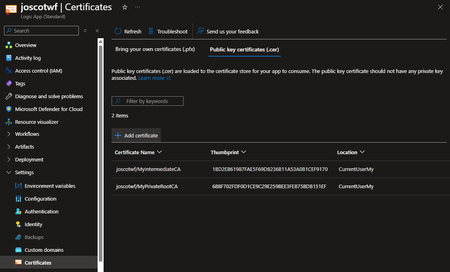
A colleague reached out to me to help with a customer's Logic App issue. They were trying to make what looked like a simple HTTP request to a Jira API but were getting back an SSL error. The root of the error was that the customer was securing the API endpoint with a certificate generated from a private Certificate Authority in their environment. Because this certificate was not signed by VeriSign, GoDaddy or other public certificate authority, and the Logic App HTTP Connector was failing as it did not trust the issuer. The fix for this is simple as it turns out but required a bit of reading the manual. First, go to Certificates and load the root CA and any intermediate CAs you might be using to the store. Then, to get the Logic App to load these certs, go to Environment Variables and add a new setting WEBSITE_LOAD_ROOT_CERTIFICATES and place the thumbprints of the added root and intermediate CAs as a comma delimited string (hat tip to Glen from our consulting team for figuring that one out). When you save the change, the service will restart and will now trust these private certificates. It should be noted that Logic Apps Standard is a flavor of Azure App Service, so this fix would also work for a regular App Service or a Function App as well. I hope this helps you out!Logic Apps, Windows auth, the On-Premises Data Gateway and you
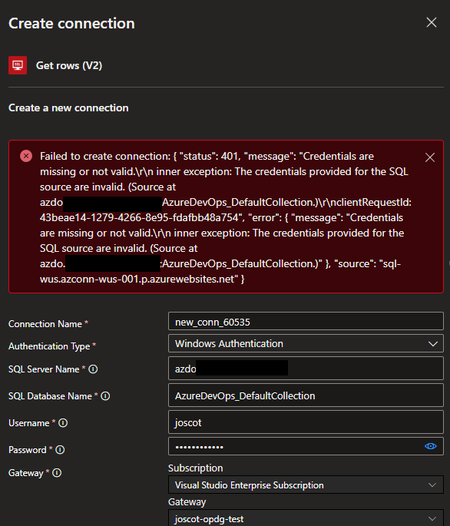
I was working with a customer recently who had a somewhat unusual situation, unusual in that I have become accustomed to most government customers having an Express Route or site-to-site VPN connection to connect their on-premises network to their Azure environment. However, this customer had a need to connect to an on-premises SQL instance via the on-premises data gateway (OPDG). The OPDG is installed as a Windows service on a machine inside the on-premises network and, when registered in Azure, allows Azure resources to connect to services on premises (more here). I did not have any direct experience with this tool but worked with the customer to get it installed on their network, which included getting it to work with their proxy (thanks to the larger Microsoft team for the assist and thanks to the customer for their patience figuring this out). We got the gateway registered in Azure and were ready to test it out. The customer is using Logic Apps and the SQL Connector to connect back to their on-premises SQL instance. The initial attempt to connect to SQL using SQL credentials was successful (Yay!!!) but the customer wanted to use Windows Authentication (which is a best practice). However, when trying to establish the connection with Windows Authentication, they were getting the error "status 401 - Credentials are missing or not valid...The credentials provided for the SQL source are invalid." Doing a little sleuthing in the Security logs on the SQL server, we could see that the authentication attempt being made, but with null credentials. Of course! We're passing our Windows credentials to the OPDG, but we haven't configured the gateway service account with delegation permissions to pass them on to SQL! To configure the on-premises data gateway account for delegation, do the following: Create a Service Principal Name (SPN) using the setspn command line tool for the OPDG service account: setspn -S gateway\gatewayMachineName domainname\gatewaySvcAcctName Open Active Directory Users and Computers (ADUC) and locate the OPDG service account Open the Delegation tab and select "Trust this user for delegation to specified services only" and "Use Kerberos Only" then add the services for which you want the OPDG to have delegation, e.g. SQL Server. Once this was done, we could create the Logic Apps SQL Connection successfully. A good check is to see if you can enumerate the list of tables in the database to which you are querying. As it turns out, there is fairly good documentation on this topic under the Power BI documentation, but searching for this under the context of Logic Apps didn't yield much success! In any case, I hope this helps someone else in the future!Building the agentic future together at JDConf 2026
JDConf 2026 is just weeks away, and I’m excited to welcome Java developers, architects, and engineering leaders from around the world for two days of learning and connection. Now in its sixth year, JDConf has become a place where the Java community compares notes on their real-world production experience: patterns, tooling, and hard-earned lessons you can take back to your team, while we keep moving the Java systems that run businesses and services forward in the AI era. This year’s program lines up with a shift many of us are seeing first-hand: delivery is getting more intelligent, more automated, and more tightly coupled to the systems and data we already own. Agentic approaches are moving from demos to backlog items, and that raises practical questions: what’s the right architecture, where do you draw trust boundaries, how do you keep secrets safe, and how do you ship without trading reliability for novelty? JDConf is for and by the people who build and manage the mission-critical apps powering organizations worldwide. Across three regional livestreams, you’ll hear from open source and enterprise practitioners who are making the same tradeoffs you are—velocity vs. safety, modernization vs. continuity, experimentation vs. operational excellence. Expect sessions that go beyond “what” and get into “how”: design choices, integration patterns, migration steps, and the guardrails that make AI features safe to run in production. You’ll find several practical themes for shipping Java in the AI era: connecting agents to enterprise systems with clear governance; frameworks and runtimes adapting to AI-native workloads; and how testing and delivery pipelines evolve as automation gets more capable. To make this more concrete, a sampling of sessions would include topics like Secrets of Agentic Memory Management (patterns for short- and long-term memory and safe retrieval), Modernizing a Java App with GitHub Copilot (end-to-end upgrade and migration with AI-powered technologies), and Docker Sandboxes for AI Agents (guardrails for running agent workflows without risking your filesystem or secrets). The goal is to help you adopt what’s new while hardening your long lived codebases. JDConf is built for community learning—free to attend, accessible worldwide, and designed for an interactive live experience in three time zones. You’ll not only get 23 practitioner-led sessions with production-ready guidance but also free on-demand access after the event to re-watch with your whole team. Pro tip: join live and get more value by discussing practical implications and ideas with your peers in the chat. This is where the “how” details and tradeoffs become clearer. JDConf 2026 Keynote Building the Agentic Future Together Rod Johnson, Embabel | Bruno Borges, Microsoft | Ayan Gupta, Microsoft The JDConf 2026 keynote features Rod Johnson, creator of the Spring Framework and founder of Embabel, joined by Bruno Borges and Ayan Gupta to explore where the Java ecosystem is headed in the agentic era. Expect a practitioner-level discussion on how frameworks like Spring continue to evolve, how MCP is changing the way agents interact with enterprise systems, and what Java developers should be paying attention to right now. Register. Attend. Earn. Register for JDConf 2026 to earn Microsoft Rewards points, which you can use for gift cards, sweepstakes entries, and more. Earn 1,000 points simply by signing up. When you register for any regional JDConf 2026 event with your Microsoft account, you'll automatically receive these points. Get 5,000 additional points for attending live (limited to the first 300 attendees per stream). On the day of your regional event, check in through the Reactor page or your email confirmation link to qualify. Disclaimer: Points are added to your Microsoft account within 60 days after the event. Must register with a Microsoft account email. Up to 10,000 developers eligible. Points will be applied upon registration and attendance and will not be counted multiple times for registering or attending at different events. Terms | Privacy JDConf 2026 Regional Live Streams Americas – April 8, 8:30 AM – 12:30 PM PDT (UTC -7) Bruno Borges hosts the Americas stream, discussing practical agentic Java topics like memory management, multi-agent system design, LLM integration, modernization with AI, and dependency security. Experts from Redis, IBM, Hammerspace, HeroDevs, AI Collective, Tekskills, and Microsoft share their insights. Register for Americas → Asia-Pacific – April 9, 10:00 AM – 2:00 PM SGT (UTC +8) Brian Benz and Ayan Gupta co-host the APAC stream, highlighting Java frameworks and practices for agentic delivery. Topics include Spring AI, multi-agent orchestration, spec-driven development, scalable DevOps, and legacy modernization, with speakers from Broadcom, Alibaba, CERN, MHP (A Porsche Company), and Microsoft. Register for Asia-Pacific → Europe, Middle East and Africa – April 9, 9:00 AM – 12:30 PM GMT (UTC +0) The EMEA stream, hosted by Sandra Ahlgrimm, will address the implementation of agentic Java in production environments. Topics include self-improving systems utilizing Spring AI, Docker sandboxes for agent workflow management, Retrieval-Augmented Generation (RAG) pipelines, modernization initiatives from a national tax authority, and AI-driven CI/CD enhancements. Presentations will feature experts from Broadcom, Docker, Elastic, Azul Systems, IBM, Team Rockstars IT, and Microsoft. Register for EMEA → Make It Interactive: Join Live Come prepared with an actual challenge you’re facing, whether you’re modernizing a legacy application, connecting agents to internal APIs, or refining CI/CD processes. Test your strategies by participating in live chats and Q&As with presenters and fellow professionals. If you’re attending with your team, schedule a debrief after the live stream to discuss how to quickly use key takeaways and insights in your pilots and projects. Learning Resources Java and AI for Beginners Video Series: Practical, episode-based walkthroughs on MCP, GenAI integration, and building AI-powered apps from scratch. Modernize Java Apps Guide: Step-by-step guide using GitHub Copilot agent mode for legacy Java project upgrades, automated fixes, and cloud-ready migrations. AI Agents for Java Webinar: Embedding AI Agent capabilities into Java applications using Microsoft Foundry, from project setup to production deployment. Java Practitioner’s Guide: Learning plan for deploying, managing, and optimizing Java applications on Azure using modern cloud-native approaches. Register Now JDConf 2026 is a free global event for Java teams. Join live to ask questions, connect, and gain practical patterns. All 23 sessions will be available on-demand. Register now to earn Microsoft Rewards points for attending. Register at JDConf.com270Views0likes0Comments
HTTP Triggers in Azure SRE Agent: From Jira Ticket to Automated Investigation
Introduction Many teams run their observability, incident management, ticketing, and deployment on platforms outside of Azure—Jira, Opsgenie, Grafana, Zendesk, GitLab, Jenkins, Harness, or homegrown internal tools. These are the systems where alerts fire, tickets get filed, deployments happen, and operational decisions are made every day. HTTP Triggers make it easy to connect any of them to Azure SRE Agent—turning events from any platform into automated agent actions with a simple HTTP POST. No manual copy-paste, no context-switching, no delay between detection and response. In this blog, we'll demonstrate by connecting Jira to SRE Agent—so that every new incident ticket automatically triggers an investigation, and the agent posts its findings back to the Jira ticket when it's done. The Scenario: Jira Incident → Automated Investigation Your team manages production applications backed by Azure PostgreSQL Flexible Server. You use Jira for incident tracking. Today, when a P1 or P2 incident is filed, your on-call engineer has to manually triage—reading through the ticket, checking dashboards, querying logs, correlating recent deployments—before they can even begin working on a fix. Some teams have Jira automations that route or label tickets, but the actual investigation still starts with a human. HTTP Triggers let you bring SRE Agent directly into that existing workflow. Instead of adding another tool for engineers to check, the agent meets them where they already work. Jira ticket created → SRE Agent automatically investigates → Agent writes findings back to Jira The on-call engineer opens the Jira ticket and the investigation is already there—root cause analysis, evidence from logs and metrics, and recommended next steps—posted as a comment by the agent. Here's how to set this up. Architecture Overview Here's the end-to-end flow we'll build: Jira — A new issue is created in your project Logic App — The Jira connector detects the new issue, and the Logic App calls the SRE Agent HTTP Trigger, using Managed Identity for authentication HTTP Trigger — The agent prompt is rendered with the Jira ticket details (key, summary, priority, etc.) via payload placeholders Agent Investigation — The agent uses Jira MCP tools to read the ticket and search related issues, queries Azure logs, metrics, and recent deployments, then posts its findings back to the Jira ticket as a comment How HTTP Triggers Work Every HTTP Trigger you create in Azure SRE Agent exposes a unique webhook URL: https://<your-agent>.<instance>.azuresre.ai/api/v1/httptriggers/trigger/<trigger-id> When an external system sends a POST request to this URL with a JSON payload, the SRE Agent: Validates the trigger exists and is enabled Renders your agent prompt by injecting payload values into {payload.X} placeholders Creates a new investigation thread (or reuses an existing one) Executes the agent with the rendered prompt—autonomously or in review mode Records the execution in the trigger's history for auditing Payload Placeholders The real power of HTTP Triggers is in payload placeholders. When you configure a trigger, you write an agent prompt with {payload.X} tokens that get replaced at runtime with values from the incoming JSON. For example, a prompt like: Investigate Jira incident {payload.key}: {payload.summary} (Priority: {payload.priority}) Gets rendered with actual incident data before the agent sees it, giving it immediate context to begin investigating. If your prompt doesn't use any placeholders, the raw JSON payload is automatically appended to the prompt, so the agent always has access to the full context regardless. Thread Modes HTTP Triggers support two thread modes: New Thread (recommended for incidents): Every trigger invocation creates a fresh investigation thread, giving each incident its own isolated workspace Same Thread: All invocations share a single thread, building up a continuous conversation—useful for accumulating alerts from a single source Authenticating External Platforms The HTTP Trigger endpoint is secured with Azure AD authentication, ensuring only authorized callers can create agent investigation threads. Every request requires a valid bearer token scoped to the SRE Agent's data plane. External platforms like Jira send standard HTTP webhooks and don't natively acquire Azure AD tokens. To bridge this, you can use any Azure service that supports Managed Identity as an intermediary—this approach means zero secrets to store or rotate in the external platform. Common options include: Approach Best For Azure Logic Apps Native connectors for many platforms, no code required, visual workflow designer Azure Functions Simple relay with ~15 lines of code, clean URL for any webhook source API Management (APIM) Enterprise environments needing rate limiting, IP filtering, or API key management All three support Managed Identity and can transparently acquire the Azure AD token before forwarding requests to the SRE Agent HTTP Trigger. In this walkthrough, we'll use Azure Logic Apps with the built-in Jira connector. Step-by-Step: Connecting Jira to SRE Agent Prerequisites An Azure SRE Agent resource deployed in your subscription A Jira Cloud project with API token access An Azure subscription for the Logic App Step 1: Set Up the Jira MCP Connector First, let's give the SRE Agent the ability to interact with Jira directly. In your agent's MCP Tool settings, add the Jira connector: Setting Value Package mcp-atlassian (npm, version 2.0.0) Transport STDIO Configure these environment variables: Variable Value ATLASSIAN_BASE_URL https://your-site.atlassian.net ATLASSIAN_EMAIL Your Jira account email ATLASSIAN_API_TOKEN Your Jira API token Once the connector is added, select the specific MCP tools you want the agent to use. The connector provides 18 Jira tools out of 80 available. For our incident investigation workflow, the key tools include: jira-mcp_read_jira_issue — Read details from a Jira issue by issue key jira-mcp_search_jira_issues — Search for Jira issues using JQL (Jira Query Language) jira-mcp_add_jira_comment — Add a comment to a Jira issue (post investigation findings back) jira-mcp_list_jira_projects — List available Jira projects jira-mcp_create_jira_issue — Create a new Jira issue This gives the SRE Agent bidirectional access to Jira—it can read ticket details, fetch comments, query related issues, and post investigation findings back as comments on the original ticket. This closes the loop so your on-call engineers see the agent's analysis directly in Jira without switching tools. Step 2: Create the HTTP Trigger Navigate to Builder → HTTP Triggers in the SRE Agent UI and click Create. Setting Value Name jira-incident-handler Agent Mode Autonomous Thread Mode New Thread (one investigation per incident) Sub-Agent (optional) Select a specialized incident response agent Agent Prompt: A new Jira incident has been filed that requires investigation: Jira Ticket: {payload.key} Summary: {payload.summary} Priority: {payload.priority} Reporter: {payload.reporter} Description: {payload.description} Jira URL: {payload.ticketUrl} Investigate this incident by: Identifying the affected Azure resources mentioned in the description Querying recent metrics and logs for anomalies Checking for recent deployments or configuration changes Providing a structured analysis with Root Cause, Evidence, and Recommended Actions Once your investigation is complete, use the Jira MCP tools to post a summary of your findings as a comment on the original ticket ({payload.key}). After saving, enable the trigger and open the trigger detail view. Copy the Trigger URL—you'll need it for the Logic App. Step 3: Create the Azure Logic App In the Azure Portal, create a new Logic App: Setting Value Type Consumption (Multi-tenant, Stateful) Name jira-sre-agent-bridge Region Same region as your SRE Agent (e.g., East US 2) Resource Group Same resource group as your SRE Agent (recommended for simplicity) Step 4: Enable Managed Identity In the Logic App → Identity → System assigned: Set Status to On Click Save Step 5: Assign the SRE Agent Admin Role Navigate to your SRE Agent resource → Access control (IAM) → Add role assignment: Setting Value Role SRE Agent Admin Assign to Managed Identity → select your Logic App This grants the Logic App's Managed Identity the data-plane permissions needed to invoke HTTP Triggers. Important: The Contributor role alone is not sufficient. Contributor covers the Azure control plane, but SRE Agent uses a separate data plane with its own RBAC. The SRE Agent Admin role provides the required data-plane permissions. Step 6: Create the Jira Connection Open the Logic App designer. When adding the Jira trigger, it will prompt you to create a connection: Setting Value Connection name jira-connection Jira instance https://your-site.atlassian.net Email Your Jira email API Token Your Jira API token Step 7: Configure the Logic App Workflow Switch to the Logic App Code view and paste this workflow definition: { "definition": { "$schema": "https://schema.management.azure.com/providers/Microsoft.Logic/schemas/2016-06-01/workflowdefinition.json#", "contentVersion": "1.0.0.0", "triggers": { "When_a_new_issue_is_created_(V2)": { "recurrence": { "interval": 3, "frequency": "Minute" }, "splitOn": "@triggerBody()", "type": "ApiConnection", "inputs": { "host": { "connection": { "name": "@parameters('$connections')['jira']['connectionId']" } }, "method": "get", "path": "/v2/new_issue_trigger/search", "queries": { "X-Request-Jirainstance": "https://YOUR-SITE.atlassian.net", "projectKey": "YOUR_PROJECT_ID" } } } }, "actions": { "Call_SRE_Agent_HTTP_Trigger": { "runAfter": {}, "type": "Http", "inputs": { "uri": "https://YOUR-AGENT.azuresre.ai/api/v1/httptriggers/trigger/YOUR-TRIGGER-ID", "method": "POST", "headers": { "Content-Type": "application/json" }, "body": { "key": "@{triggerBody()?['key']}", "summary": "@{triggerBody()?['fields']?['summary']}", "priority": "@{triggerBody()?['fields']?['priority']?['name']}", "reporter": "@{triggerBody()?['fields']?['reporter']?['displayName']}", "description": "@{triggerBody()?['fields']?['description']}", "ticketUrl": "@{concat('https://YOUR-SITE.atlassian.net/browse/', triggerBody()?['key'])}" }, "authentication": { "type": "ManagedServiceIdentity", "audience": "https://azuresre.dev" } } } }, "outputs": {}, "parameters": { "$connections": { "type": "Object", "defaultValue": {} } } }, "parameters": { "$connections": { "type": "Object", "value": { "jira": { "id": "/subscriptions/YOUR-SUB/providers/Microsoft.Web/locations/YOUR-REGION/managedApis/jira", "connectionId": "/subscriptions/YOUR-SUB/resourceGroups/YOUR-RG/providers/Microsoft.Web/connections/jira", "connectionName": "jira" } } } } } Replace the YOUR-* placeholders with your actual values. To find your Jira project ID, navigate to https://your-site.atlassian.net/rest/api/3/project/YOUR-PROJECT-KEY in your browser and find the "id" field in the JSON response. The critical piece is the authentication block: "authentication": { "type": "ManagedServiceIdentity", "audience": "https://azuresre.dev" } This tells the Logic App to automatically acquire an Azure AD token for the SRE Agent data plane and attach it as a Bearer token. No secrets, no expiration management, no manual token refresh. After pasting the JSON and clicking Save, switch back to the Designer view. The Logic App automatically generates the visual workflow from the code — you'll see the Jira trigger ("When a new issue is created (V2)") connected to the HTTP action ("Call SRE Agent HTTP Trigger") as a two-step flow, with all the field mappings and authentication settings already configured What Happens Inside the Agent When the HTTP Trigger fires, the SRE Agent receives a fully contextualized prompt with all the Jira incident data injected: A new Jira incident has been filed that requires investigation: Jira Ticket: KAN-16 Summary: Elevated API Response Times — PostgreSQL Table Lock Causing Request Blocking on Listings Service Priority: High Reporter: Vineela Suri Description: Severity: P2 — High. Affected Service: Production API (octopets-prod-postgres). Impact: End users experience slow or unresponsive listing pages. Jira URL: https://your-site.atlassian.net/browse/KAN-16 Investigate this incident by: Identifying the affected Azure resources mentioned in the description Querying recent metrics and logs for anomalies ... The agent then uses its configured tools to investigate—Azure CLI to query metrics, Kusto to analyze logs, and the Jira MCP connector to read the ticket for additional context. Once the investigation is complete, the agent posts its findings as a comment directly on the Jira ticket, closing the loop without any manual copy-paste. Each execution is recorded in the trigger's history with timestamp, thread ID, success status, duration, and an AI-generated summary—giving you full observability into your automated investigation pipeline. Extending to Other Platforms The pattern we built here works for any external platform that isn't natively supported by SRE Agent. The core architecture stays the same: External Platform → Auth Bridge (Managed Identity) → SRE Agent HTTP Trigger You only need to swap the inbound side of the bridge. For example: External Platform Auth Bridge Configuration Jira Logic App with Jira V2 connector (polling) OpsGenie Logic App with OpsGenie connector, or Azure Function relay receiving OpsGenie webhooks Datadog Azure Function relay or APIM policy receiving Datadog webhook notifications Grafana Azure Function relay or APIM policy receiving Grafana alert webhooks Splunk APIM with webhook endpoint and Managed Identity forwarding Custom / Internal tools Logic App HTTP trigger, Azure Function relay, or APIM — any service that supports Managed Identity The SRE Agent HTTP Trigger and the Managed Identity authentication remain the same regardless of the source platform. You configure the trigger once, set up the auth bridge, and connect as many external sources as needed. Each trigger can have its own tailored prompt, sub-agent, and thread mode optimized for the type of incoming event. Key Takeaways HTTP Triggers extend Azure SRE Agent's reach to any external platform: Connect What You Use: If your incident platform isn't natively supported, HTTP Triggers provide the integration point—no code changes to SRE Agent required Secure by Design: Azure AD authentication with Managed Identity keeps the data plane protected while making integration straightforward through standard Azure services Bidirectional with MCP: Combine HTTP Triggers (inbound) with MCP connectors (outbound) for full round-trip integration—receive incidents automatically and post findings back to the source platform Full Observability: Every trigger execution is recorded with timestamps, thread IDs, duration, and AI-generated summaries Flexible Context Injection: Payload placeholders let you craft precise investigation prompts from incident data, while raw payload passthrough ensures the agent always has full context Getting Started HTTP Triggers are available now in the Azure SRE Agent platform: Create a Trigger: Navigate to Builder → HTTP Triggers → Create. Define your agent prompt with {payload.X} placeholders Set Up an Auth Bridge: Use Logic Apps, Azure Functions, or APIM with Managed Identity to handle Azure AD authentication Connect Your Platform: Point your external platform at the bridge and create a test event Within minutes, you'll have an automated pipeline that turns every incident ticket into an AI-driven investigation. Learn More HTTP Triggers Documentation Agent Hooks Blog Post — Governance controls for automated investigations YAML Schema Reference SRE Agent Getting Started Guide Ready to extend your SRE Agent to platforms it doesn't support natively? Set up your first HTTP Trigger today at sre.azure.com.1KViews0likes0CommentsSecure Unique Default Hostnames Now GA for Functions and Logic Apps
We are pleased to announce that Secure Unique Default Hostnames are now generally available (GA) for Azure Functions and Logic Apps (Standard). This expands the security model previously available for Web Apps to the entire App Service ecosystem and provides customers with stronger, more secure, and standardized hostname behavior across all workloads. Why This Feature Matters Historically, App Service resources have used default hostname format such as: <SiteName>.azurewebsites.net While straightforward, this pattern introduced potential security risks, particularly in scenarios where DNS records were left behind after deleting a resource. In those situations, a different user could create a new resource with the same name and unintentionally receive traffic or bindings associated with the old DNS configuration, creating opportunities for issues such as subdomain takeover. Secure Unique Default Hostnames address this by assigning a unique, randomized, region‑scoped hostname to each resource, for example: <SiteName>-<Hash>.<Region>.azurewebsites.net This change ensures that: No other customer can recreate the same default hostname. Apps inherently avoid risks associated with dangling DNS entries. Customers gain a more secure, reliable baseline behavior across App Service. Adopting this model now helps organizations prepare for the long‑term direction of the platform while improving security posture today. What’s New: GA Support for Functions and Logic Apps With this release, both Azure Functions and Logic Apps (Standard) fully support the Secure Unique Default Hostname capability. This brings these services in line with Web Apps and ensures customers across all App Service workloads benefit from the same secure and consistent default hostname model. Azure CLI Support The Azure CLI for Web Apps and Function Apps now includes support for the “--domain-name-scope” parameter. This allows customers to explicitly specify the scope used when generating a unique default hostname during resource creation. Examples: az webapp create --domain-name-scope {NoReuse, ResourceGroupReuse, SubscriptionReuse, TenantReuse} az functionapp create --domain-name-scope {NoReuse, ResourceGroupReuse, SubscriptionReuse, TenantReuse} Including this parameter ensures that deployments consistently use the intended hostname scope and helps teams prepare their automation and provisioning workflows for the secure unique default hostname model. Why Customers Should Adopt This Now While existing resources will continue to function normally, customers are strongly encouraged to adopt Secure Unique Default Hostnames for all new deployments. Early adoption provides several important benefits: A significantly stronger security posture. Protection against dangling DNS and subdomain takeover scenarios. Consistent default hostname behavior as the platform evolves. Alignment with recommended deployment practices and modern DNS hygiene. This feature represents the current best practice for hostname management on App Service and adopting it now helps ensure that new deployments follow the most secure and consistent model available. Recommended Next Steps Enable Secure Unique Default Hostnames for all new Web Apps, Function Apps, and Logic Apps. Update automation and CLI scripts to include the --domain-name-scope parameter when creating new resources. Begin updating internal documentation and operational processes to reflect the new hostname pattern. Additional Resources For readers who want to explore the technical background and earlier announcements in more detail, the following articles offer deeper coverage of unique default hostnames: Public Preview: Creating Web App with a Unique Default Hostname This article introduces the foundational concepts behind unique default hostnames. It explains why the feature was created, how the hostname format works, and provides examples and guidance for enabling the feature when creating new resources. Secure Unique Default Hostnames: GA on App Service Web Apps and Public Preview on Functions This article provides the initial GA announcement for Web Apps and early preview details for Functions. It covers the security benefits, recommended usage patterns, and guidance on how to handle existing resources that were created without unique default hostnames. Conclusion Secure Unique Default Hostnames now provide a more secure and consistent default hostname model across Web Apps, Function Apps, and Logic Apps. This enhancement reduces DNS‑related risks and strengthens application security, and organizations are encouraged to adopt this feature as the standard for new deployments.2.8KViews0likes0Comments
Stop Running Runbooks at 3 am: Let Azure SRE Agent Do Your On-Call Grunt Work
Your pager goes off. It's 2:47am. Production is throwing 500 errors. You know the drill - SSH into this, query that, check these metrics, correlate those logs. Twenty minutes later, you're still piecing together what went wrong. Sound familiar? The On-Call Reality Nobody Talks About Every SRE, DevOps engineer, and developer who's carried a pager knows this pain. When incidents hit, you're not solving problems - you're executing runbooks. Copy-paste this query. Check that dashboard. Run these az commands. Connect the dots between five different tools. It's tedious. It's error-prone at 3am. And honestly? It's work that doesn't require human creativity but requires human time. What if an AI agent could do this for you? Enter Azure SRE Agent + Runbook Automation Here's what I built: I gave SRE Agent a simple markdown runbook containing the same diagnostic steps I'd run manually during an incident. The agent executes those steps, collects evidence, and sends me an email with everything I need to take action. No more bouncing between terminals. No more forgetting a step because it's 3am and your brain is foggy. What My Runbook Contains Just the basics any on-call would run: az monitor metrics – CPU, memory, request rates Log Analytics queries – Error patterns, exception details, dependency failures App Insights data – Failed requests, stack traces, correlation IDs az containerapp logs – Revision logs, app configuration That's it. Plain markdown with KQL queries and CLI commands. Nothing fancy. What the Agent Does Reads the runbook from its knowledge base Executes each diagnostic step Collects results and evidence Sends me an email with analysis and findings I wake up to an email that says: "CPU spiked to 92% at 2:45am, triggering connection pool exhaustion. Top exception: SqlException (1,832 occurrences). Errors correlate with traffic spike. Recommend scaling to 5 replicas." All the evidence. All the queries used. All the timestamps. Ready for me to act. How to Set This Up (6 Steps) Here's how you can build this yourself: Step 1: Create SRE Agent Create a new SRE Agent in the Azure portal. No Azure resource groups to configure. If your apps run on Azure, the agent pulls context from the incident itself. If your apps run elsewhere, you don't need Azure resource configuration at all. Step 2: Grant Reader Permission (Optional) If your runbooks execute against Azure resources, assign Reader role to the SRE Agent's managed identity on your subscription. This allows the agent to run az commands and query metrics. Skip this if your runbooks target non-Azure apps. Step 3: Add Your Runbook to SRE Agent's Knowledge base You already have runbooks, they're in your wiki, Confluence, or team docs. Just add them as .md files to the agent's knowledge base. To learn about other ways to link your runbooks to the agent, read this Step 4: Connect Outlook Connect the agent to your Outlook so it can send you the analysis email with findings. Step 5: Create a Subagent Create a subagent with simple instructions like: "You are an expert in triaging and diagnosing incidents. When triggered, search the knowledge base for the relevant runbook, execute the diagnostic steps, collect evidence, and send an email summary with your findings." Assign the tools the agent needs: RunAzCliReadCommands – for az monitor, az containerapp commands QueryLogAnalyticsByWorkspaceId – for KQL queries against Log Analytics QueryAppInsightsByResourceId – for App Insights data SearchMemory – to find the right runbook SendOutlookEmail – to deliver the analysis Step 6: Set Up Incident Trigger Connect your incident management tool - PagerDuty, ServiceNow, or Azure Monitor alerts and setup the incident trigger to the subagent. When an incident fires, the agent kicks off automatically. That's it. Your agentic workflow now looks like this: This Works for Any App, Not Just Azure Here's the thing: SRE Agent is platform agnostic. It's executing your runbooks, whatever they contain. On-prem databases? Add your diagnostic SQL. Custom monitoring stack? Add those API calls. The agent doesn't care where your app runs. It cares about following your runbook and getting you answers. Why This Matters Lower MTTR. By the time you're awake and coherent, the analysis is done. Consistent execution. No missed steps. No "I forgot to check the dependencies" at 4am. Evidence for postmortems. Every query, every result, timestamped and documented. Focus on what matters. Your brain should be deciding what to do not gathering data. The Bottom Line On-call runbook execution is the most common, most tedious, and most automatable part of incident response. It's grunt work that pulls engineers away from the creative problem-solving they were hired for. SRE Agent offloads that work from your plate. You write the runbook once, and the agent executes it every time, faster and more consistently than any human at 3am. Stop running runbooks. Start reviewing results. Try it yourself: Create a markdown runbook with your diagnostic queries and commands, add it to your SRE Agent's knowledge base, and let the agent handle your next incident. Your 3am self will thank you.1.4KViews1like0CommentsIndustry-Wide Certificate Changes Impacting Azure App Service Certificates
Executive Summary In early 2026, industry-wide changes mandated by browser applications and the CA/B Forum will affect both how TLS certificates are issued as well as their validity period. The CA/B Forum is a vendor body that establishes standards for securing websites and online communications through SSL/TLS certificates. Azure App Service is aligning with these standards for both App Service Managed Certificates (ASMC, free, DigiCert-issued) and App Service Certificates (ASC, paid, GoDaddy-issued). Most customers will experience no disruption. Action is required only if you pin certificates or use them for client authentication (mTLS). Update: February 17, 2026 We’ve published new Microsoft Learn documentation, Industry-wide certificate changes impacting Azure App Service , which provides more detailed guidance on these compliance-driven changes. The documentation also includes additional information not previously covered in this blog, such as updates to domain validation reuse, along with an expanding FAQ section. The Microsoft Learn documentation now represents the most complete and up-to-date overview of these changes. Going forward, any new details or clarifications will be published there, and we recommend bookmarking the documentation for the latest guidance. Who Should Read This? App Service administrators Security and compliance teams Anyone responsible for certificate management or application security Quick Reference: What’s Changing & What To Do Topic ASMC (Managed, free) ASC (GoDaddy, paid) Required Action New Cert Chain New chain (no action unless pinned) New chain (no action unless pinned) Remove certificate pinning Client Auth EKU Not supported (no action unless cert is used for mTLS) Not supported (no action unless cert is used for mTLS) Transition from mTLS Validity No change (already compliant) Two overlapping certs issued for the full year None (automated) If you do not pin certificates or use them for mTLS, no action is required. Timeline of Key Dates Date Change Action Required Mid-Jan 2026 and after ASMC migrates to new chain ASMC stops supporting client auth EKU Remove certificate pinning if used Transition to alternative authentication if the certificate is used for mTLS Mar 2026 and after ASC validity shortened ASC migrates to new chain ASC stops supporting client auth EKU Remove certificate pinning if used Transition to alternative authentication if the certificate is used for mTLS Actions Checklist For All Users Review your use of App Service certificates. If you do not pin these certificates and do not use them for mTLS, no action is required. If You Pin Certificates (ASMC or ASC) Remove all certificate or chain pinning before their respective key change dates to avoid service disruption. See Best Practices: Certificate Pinning. If You Use Certificates for Client Authentication (mTLS) Switch to an alternative authentication method before their respective key change dates to avoid service disruption, as client authentication EKU will no longer be supported for these certificates. See Sunsetting the client authentication EKU from DigiCert public TLS certificates. See Set Up TLS Mutual Authentication - Azure App Service Details & Rationale Why Are These Changes Happening? These updates are required by major browser programs (e.g., Chrome) and apply to all public CAs. They are designed to enhance security and compliance across the industry. Azure App Service is automating updates to minimize customer impact. What’s Changing? New Certificate Chain Certificates will be issued from a new chain to maintain browser trust. Impact: Remove any certificate pinning to avoid disruption. Removal of Client Authentication EKU Newly issued certificates will not support client authentication EKU. This change aligns with Google Chrome’s root program requirements to enhance security. Impact: If you use these certificates for mTLS, transition to an alternate authentication method. Shortening of Certificate Validity Certificate validity is now limited to a maximum of 200 days. Impact: ASMC is already compliant; ASC will automatically issue two overlapping certificates to cover one year. No billing impact. Frequently Asked Questions (FAQs) Will I lose coverage due to shorter validity? No. For App Service Certificate, App Service will issue two certificates to span the full year you purchased. Is this unique to DigiCert and GoDaddy? No. This is an industry-wide change. Do these changes impact certificates from other CAs? Yes. These changes are an industry-wide change. We recommend you reach out to your certificates’ CA for more information. Do I need to act today? If you do not pin or use these certs for mTLS, no action is required. Glossary ASMC: App Service Managed Certificate (free, DigiCert-issued) ASC: App Service Certificate (paid, GoDaddy-issued) EKU: Extended Key Usage mTLS: Mutual TLS (client certificate authentication) CA/B Forum: Certification Authority/Browser Forum Additional Resources Changes to the Managed TLS Feature Set Up TLS Mutual Authentication Azure App Service Best Practices – Certificate pinning DigiCert Root and Intermediate CA Certificate Updates 2023 Sunsetting the client authentication EKU from DigiCert public TLS certificates Feedback & Support If you have questions or need help, please visit our official support channels or the Microsoft Q&A, where our team and the community can assist you.9.7KViews1like0CommentsProactive Monitoring Made Simple with Azure SRE Agent
SRE teams strive for proactive operations, catching issues before they impact customers and reducing the chaos of incident response. While perfection may be elusive, the real goal is minimizing outages and gaining immediate line of sight into production environments. Today, that’s harder than ever. It requires correlating countless signals and alerts, understanding how they relate—or don’t relate—to each other, and assigning the right sense of urgency and impact. Anything that shortens this cycle, accelerates detection, and enables automated remediation is what modern SRE teams crave. What if you could skip the scripting and pipelines? What if you could simply describe what you want in plain language and let it run automatically on a schedule? Scheduled Tasks for Azure SRE Agent With Scheduled Tasks for Azure SRE Agent, that what-if scenario is now a reality. Scheduled tasks combine natural language prompts with Azure SRE Agent’s automation capabilities, so you can express intent, set a schedule, and let the agent do the rest—without writing a single line of code. This means: ⚡ Faster incident response through early detection ✅ Better compliance with automated checks 🎯 More time for high-value engineering work and innovation 💡 The shift from reactive to proactive: Instead of waiting for alerts to fire or customers to report issues, you’re continuously monitoring, validating, and catching problems before they escalate. How Scheduled Tasks Work Under the Hood When you create a Scheduled Task, the process is more than just running a prompt on a timer. Here’s what happens: 1. Prompt Interpretation and Plan Creation The SRE Agent takes your natural language prompt—such as “Scan all resources for security best practices”—and converts it into a structured execution plan. This plan defines the steps, tools, and data sources required to fulfill your request. 2. Built-In Tools and MCP Integration The agent uses its built-in capabilities (Azure CLI, Log Analytics workspace, Appinsights) and can also leverage 3 rd party data sources or tools via MCP server integration for extended functionality. 3. Results Analysis and Smart Summarization After execution, the agent analyzes results, identifies anomalies or issues, and provides actionable summaries not just raw data dumps. 4. Notification and Escalation Based on findings, the agent can: Post updates to Teams channels Create or update incidents Send email notifications Trigger follow-up actions Real-World Use Cases for Proactive Ops Here’s where scheduled tasks shine for SRE teams: Use Case Prompt Example Schedule Security Posture Check “Scan all subscriptions for resources with public endpoints and flag any that shouldn’t be exposed” Daily Cost Anomaly Detection “Compare this week’s spend against last week and alert if any service exceeds 20% growth” Weekly Compliance Drift Detection “Check all storage accounts for encryption settings and report any non-compliant resources” Daily Resource Health Summary “Summarize the health status of all production VMs and highlight any degraded instances” Every 4 hours Incident Trend Analysis “Analyze ICM incidents from the past week, identify patterns, and summarize top contributing services” Weekly Getting Started in 3 Steps Step 1: Define Your Intent Write a natural language prompt describing what you want to monitor or check. Be specific about: - What resources or scope - What conditions to look for - What action to take if issues are found Example: > “Every morning at 8 AM, check all production Kubernetes clusters for pods in CrashLoopBackOff state. If any are found, post a summary to the #sre-alerts Teams channel with cluster name, namespace, and pod details.” Step 2: Set Your Schedule Choose how often the task should run: - Cron expressions for precise control - Simple intervals (hourly, daily, weekly) Step 3: Define Where to Receive Updates Include in your prompt where you want results delivered when the task finishes execution. The agent can use its built-in tools and connectors to: - Post summaries to a Teams channel - Send email notifications - Create or update ICM incidents Example prompt with notification: > "Check all production databases for long-running queries over 30 seconds. If any are found, post a summary to the #database-alerts Teams channel." Why This Matters for Proactive Operations Traditional monitoring approaches have limitations: Traditional Approach With Scheduled Tasks Write scripts, maintain pipelines Describe in plain language Static thresholds and rules Contextual, AI-powered analysis Alert fatigue from noisy signals Smart summarization of what matters Separate tools for check vs. action Unified detection and response Requires dedicated DevOps effort Any SRE can create and modify The result? Your team spends less time building and maintaining monitoring infrastructure and more time on the work that truly requires human expertise. Best Practices for Scheduled Tasks Start simple, iterate — Begin with one or two high-value checks and expand as you gain confidence Be specific in prompts — The more context you provide, the better the results Set appropriate frequencies — Not everything needs to run hourly; match the schedule to the risk Review and refine — Check task results periodically and adjust prompts for better accuracy What’s Next? Scheduled tasks are just the beginning. We’re continuing to invest in capabilities that help SRE teams shift left—catching issues earlier, automating routine checks, and freeing up time for strategic work. Ready to Start? Use this sample that shows how to create a scheduled health check sub-agent: https://github.com/microsoft/sre-agent/blob/main/samples/automation/samples/02-scheduled-health-check-sample.md This example demonstrates: - Building a HealthCheckAgent using built-in tools like Azure CLI and Log Analytics Workspace - Scheduling daily health checks for a container app at 7 AM - Sending email alerts when anomalies are detected 🔗 Explore more samples here: https://github.com/microsoft/sre-agent/tree/main/samples More to Learn Ignite 2025 announcements: https://aka.ms/ignite25/blog/sreagent Documentation: https://aka.ms/sreagent/docs Support & Feature Requests: https://github.com/microsoft/sre-agent/issues1.5KViews1like0CommentsBuilding AI apps and agents for the new frontier
Every new wave of applications brings with it the promise of reshaping how we work, build and create. From digitization to web, from cloud to mobile, these shifts have made us all more connected, more engaged and more powerful. The incoming wave of agentic applications, estimated to number 1.3 billion over the next 2 years[1] is no different. But the expectations of these new services are unprecedented, in part for how they will uniquely operate with both intelligence and agency, how they will act on our behalf, integrated as a member of our teams and as a part of our everyday lives. The businesses already achieving the greatest impact from agents are what we call Frontier Organizations. This week at Microsoft Ignite we’re showcasing what the best frontier organizations are delivering, for their employees, for their customers and for their markets. And we’re introducing an incredible slate of innovative services and tools that will help every organization achieve this same frontier transformation. What excites me most is how frontier organizations are applying AI to achieve their greatest level of creativity and problem solving. Beyond incremental increases in efficiency or cost savings, frontier firms use AI to accelerate the pace of innovation, shortening the gap from prototype to production, and continuously refining services to drive market fit. Frontier organizations aren’t just moving faster, they are using AI and agents to operate in novel ways, redefining traditional business processes, evolving traditional roles and using agent fleets to augment and expand their workforce. To do this they build with intent, build for impact and ground services in deep, continuously evolving, context of you, your organization and your market that makes every service, every interaction, hyper personalized, relevant and engaging. Today we’re announcing new capabilities that help you build what was previously impossible. To launch and scale fleets of agents in an open system across models, tools, and knowledge. And to run and operate agents with the confidence that every service is secure, governed and trusted. The question is, how do you get there? How do you build the AI apps and agents fueling the future? Read further for just a few highlights of how Microsoft can help you become frontier: Build with agentic DevOps Perhaps the greatest area of agentic innovation today is in service of developers. Microsoft’s strategy for agentic DevOps is redefining the developer experience to be AI-native, extending the power of AI to every stage of the software lifecycle and integrating AI services into the tools embraced by millions of developers. At Ignite, we’re helping every developer build faster, build with greater quality and security and deliver increasingly innovative apps that will shape their businesses. Across our developer services, AI agents now operate like an active member of your development and operations teams – collaborating, automating, and accelerating every phase of the software development lifecycle. From planning and coding to deployment and production, agents are reshaping how we build. And developers can now orchestrate fleets of agents, assigning tasks to agents to execute code reviews, testing, defect resolution, and even modernization of legacy Java and .NET applications. We continue to take this strategy forward with a new generation of AI-powered tools, with GitHub Agent HQ making coding agents like Codex, Claude Code, and Jules available soon directly in GitHub and Visual Studio Code, to Custom Agents to encode domain expertise, and “bring your own models” to empower teams to adapt and innovate. It’s these advancements that make GitHub Copilot, the world’s the most popular AI pair programmer, serving over 26 million users and helping organizations like Pantone, Ahold Delhaize USA, and Commerzbank streamline processes and save time. Within Microsoft’s own developer teams, we’re seeing transformative results with agentic DevOps. GitHub Copilot coding agent is now a top contributor—not only to GitHub’s core application but also to our major open-source projects like the Microsoft Agent Framework and Aspire. Copilot is reducing task completion time from hours to minutes and eliminating up to two weeks of manual development effort for complex work. Across Microsoft, 90% of pull requests are now covered by GitHub Copilot code review, increasing the pace of PR completion. Our AI-powered assistant for Microsoft’s engineering ecosystem is deeply integrated into VS Code, Teams, and other tools, giving engineers and product managers real-time, context-aware answers where they work—saving 2.2k developer days in September alone. For app modernization, GitHub Copilot has reduced modernization project timelines by as much as 88%. In production environments, Azure SRE agent has handled over 7K incidents and collected diagnostics on over 18K incidents, saving over 10,000 hours for on-call engineers. These results underscore how agentic workflows are redefining speed, scale, and reliability across the software lifecycle at Microsoft. Launch at speed and scale with a full-stack AI app and agent platform We’re making it easier to build, run, and scale AI agents that deliver real business outcomes. To accelerate the path to production for advanced AI applications and agents is delivering a complete, and flexible foundation that helps every organization move with speed and intelligence without compromising security, governance or operations. Microsoft Foundry helps organizations move from experimentation to execution at scale, providing the organization-wide observability and control that production AI requires. More than 80,000 customers, including 80% of the Fortune 500, use Microsoft Foundry to build, optimize, and govern AI apps and agents today. Foundry supports open frameworks like the Microsoft Agent Framework for orchestration, standard protocols like Model Context Protocol (MCP) for tool calling, and expansive integrations that enable context-aware, action-oriented agents. Companies like Nasdaq, Softbank, Sierra AI, and Blue Yonder are shipping innovative solutions with speed and precision. New at Ignite this year: Foundry Models With more than 11,000 models like OpenAI’s GPT-5, Anthropic’s Claude, and Microsoft’s Phi at their fingertips, developers, Foundry delivers the broadest model selection on any cloud. Developers have the power to benchmark, compare, and dynamically route models to optimize performance for every task. Model router is now generally available in Microsoft Foundry and in public preview in Foundry Agent Service. Foundry IQ, Delivering the deep context needed to make every agent grounded, productive, and reliable. Foundry IQ, now available in public preview, reimagines retrieval-augmented generation (RAG) as a dynamic reasoning process rather than a one-time lookup. Powered by Azure AI Search, it centralizes RAG workflows into a single grounding API, simplifying orchestration and improving response quality while respecting user permissions and data classifications. Foundry Agent Service now offers Hosted Agents, multi-agent workflows, built-in memory, and the ability to deploy agents directly to Microsoft 365 and Agent 365 in public preview. Foundry Tools, empowers developers to create agents with secure, real-time access to business systems, business logic, and multimodal capabilities. Developers can quickly enrich agents with real-time business context, multimodal capabilities, and custom business logic through secure, governed integration with 1,400+ systems and APIs. Foundry Control Plane, now in public preview, centralizes identity, policy, observability, and security signals and capabilities for AI developers in one portal. Build on an AI-Ready foundation for all applications Managed Instance on Azure App Service lets organizations migrate existing .NET web applications to the cloud without the cost or effort of rewriting code, allowing them to migrate directly into a fully managed platform-as-a-service (PaaS) environment. With Managed Instance, organizations can keep operating applications with critical dependencies on local Windows services, third-party vendor libraries, and custom runtimes without requiring any code changes. The result is faster modernizations with lower overhead, and access to cloud-native scalability, built-in security and Azure’s AI capabilities. MCP Governance with Azure API Management now delivers a unified control plane for APIs and MCP servers, enabling enterprises to extend their existing API investments directly into the agentic ecosystem with trusted governance, secure access, and full observability. Agent Loop and native AI integrations in Azure Logic Apps enable customers to move beyond rigid workflows to intelligent, adaptive automation that saves time and reduces complexity. These capabilities make it easier to build AI-powered, context-aware applications using low-code tools, accelerating innovation without heavy development effort. Azure Functions now supports hosting production-ready, reliable AI agents with stateful sessions, durable tool calls, and deterministic multi-agent orchestrations through the durable extension for Microsoft Agent Framework. Developers gain automatic session management, built-in HTTP endpoints, and elastic scaling from zero to thousands of instances — all with pay-per-use pricing and automated infrastructure. Azure Container Apps agents and security supercharges agentic workloads with automated deployment of multi-container agents, on-demand dynamic execution environments, and built-in security for runtime protection, and data confidentiality. Run and operate agents with confidence New at Ignite, we’re also expanding the use of agents to keep every application secure, managed and operating without compromise. Expanded agentic capabilities protect applications from code to cloud and continuously monitor and remediate production issues, while minimizing the efforts on developers, operators and security teams. Microsoft Defender for Cloud and GitHub Advanced Security: With the rise of multi-agent systems, the security threat surface continues to expand. Increased alert volumes, unprioritized threat signals, unresolved threats and a growing backlog of vulnerabilities is increasing risk for businesses while security teams and developers often operate in disconnected tools, making collaboration and remediation even more challenging. The new Defender for Cloud and GitHub Advanced Security integration closes this gap, connecting runtime context to code for faster alert prioritization and AI-powered remediation. Runtime context prioritizes security risks with insights that allow teams to focus on what matters most and fix issues faster with AI-powered remediation. When Defender for Cloud finds a threat exposed in production, it can now link to the exact code in GitHub. Developers receive AI suggested fixes directly inside GitHub, while security teams track progress in Defender for Cloud in real time. This gives both sides a faster, more connected way to identify issues, drive remediation, and keep AI systems secure throughout the app lifecycle. Azure SRE Agent is an always-on, AI-powered partner for cloud reliability, enabling production environments to become self-healing, proactively resolve issues, and optimize performance. Seamlessly integrated with Azure Monitor, GitHub Copilot, and incident management tools, Azure SRE Agent reduces operational toil. The latest update introduces no-code automation, empowering teams to tailor processes to their unique environments with minimal engineering overhead. Event-driven triggers enable proactive checks and faster incident response, helping minimize downtime. Expanded observability across Azure and third-party sources is designed to help teams troubleshoot production issues more efficiently, while orchestration capabilities support integration with MCP-compatible tools for comprehensive process automation. Finally, its adaptive memory system is designed to learn from interactions, helping improve incident handling and reduce operational toil, so organizations can achieve greater reliability and cost efficiency. The future is yours to build We are living in an extraordinary time, and across Microsoft we’re focused on helping every organization shape their future with AI. Today’s announcements are a big step forward on this journey. Whether you’re a startup fostering the next great concept or a global enterprise shaping your future, we can help you deliver on this vision. The frontier is open. Let’s build beyond expectations and build the future! Check out all the learning at Microsoft Ignite on-demand and read more about the announcements making it happen at: Recommended sessions BRK113: Connected, managed, and complete BRK103: Modernize your apps in days, not months, with GitHub Copilot BRK110: Build AI Apps fast with GitHub and Microsoft Foundry in action BRK100: Best practices to modernize your apps and databases at scale BRK114: AI Agent architectures, pitfalls and real-world business impact BRK115: Inside Microsoft's AI transformation across the software lifecycle Announcements aka.ms/AgentFactory aka.ms/AppModernizationBlog aka.ms/SecureCodetoCloudBlog aka.ms/AppPlatformBlog [1] IDC Info Snapshot, sponsored by Microsoft, 1.3 Billion AI Agents by 2028, #US53361825 and May 2025.9.5KViews2likes0Comments