azure horizondb
18 TopicsPostgres Trip Report from Postgres Summit US 2026
Photo gallery: Microsoft team at Postgres Summit US 2026 Postgres Summit US 2026 was a conference of connections: between database internals and the infrastructure underneath them, between AI ideas and production engineering, and between the people building PostgreSQL today and those who will carry it forward. For anyone who could not be in New York, this report captures the talks, technical questions, hallway conversations, and community moments that defined the week. The event also opened a new chapter. After years as PGConf NYC, the conference returned as Postgres Summit US, bringing more than 240 developers, DBAs, architects, contributors, technology leaders, and partners to Convene on Broadway from September 30 through October 2. The Microsoft team contributed six sessions across performance, replication, infrastructure, benchmarking, AI, developer tools, and community sustainability. Around those talks was a much larger program shaped by speakers and attendees from across the PostgreSQL ecosystem. 01 - Microsoft speaker highlights 02 - What the wider program was talking about 03 - Workshops and the hallway track 04 - The conversations continued after the slides 05 - What we brought home from New York 06 - Explore the Postgres Summit US 2026 program Gratitude for the organizers, speakers, sponsors, and attendees 01 - Microsoft speaker highlights Abe Omorogbe and Jared Meade: "Tour of Postgres on Azure with HorizonDB, Agentic workflows, & VS Code." Their end-to-end tour moved from HorizonDB's shared-storage architecture, rapid failover, and elastic read scale to SQL-declared chunking and embedding pipelines, durable incremental processing, intelligent product search, Copilot CLI Postgres skills, and an interactive VS Code query-plan visualizer. Although the demos used Microsoft technology, the engineering message applied broadly: production AI needs a dependable data layer, observable workflows, and tools that help developers understand what the database is doing. Microsoft Azure HorizonDB Documentation Landing Page | Microsoft Learn Claire Giordano delivered two talks that connected PostgreSQL's technical foundations with its future. In "A Secret Decoder Ring for Postgres Replication: A Beginner's Guide," Claire turned the alphabet soup of logical, physical, streaming, synchronous, and asynchronous replication into approachable mental models tied to high availability, disaster recovery, read scaling, migrations, WAL, and Patroni. In "Building the next generation of Postgres contributors: what's working & what's getting in the way," she marked PostgreSQL's 30th anniversary by examining the project through three lenses: the soul of its people and culture, the machine of its workflows and governance, and the fuel of economics and funding. Together, the talks asked both how PostgreSQL keeps data moving and how the community keeps itself moving. Divya Bhargov: "Same Postgres, Moving Ground: How Infrastructure Changes Shape Database Behavior." Divya explored a production reality that applies to every environment: PostgreSQL can remain stable while VM families, storage layers, operating systems, kernels, and networking stacks change underneath it. Drawing from large-scale operational experience, she showed why teams should correlate database symptoms with infrastructure transitions before assuming every behavioral change originated inside PostgreSQL. Gayathri Paderla: "PostgreSQL Performance Mysteries: When Low IOPS Still Means High Latency." Gayathri unpacked real production cases where latency increased even though familiar signals such as IOPS, query duration, CPU pressure, and indexing did not point to the cause. The trail instead led through memory behavior, cache eviction, PostgreSQL shared buffers, the operating system page cache, and storage interactions. The session showed how to correlate pg_buffercache, pg_stat_statements, wait events, storage behavior, and cache-warming techniques such as pg_prewarm. The practical lesson was memorable: low IOPS does not mean storage is uninvolved, and a normal query metric does not mean the application is experiencing normal latency. Here are the slides from the talk. PostgreSQL Performance Mysteries When low IOPS still means high latency - Speaker Deck Richard Yen: "Pushing PostgreSQL to the Limit: How to Benchmark Hardware with Postgres." Richard challenged the numbers used to sell hardware and cloud storage. Massive advertised IOPS or throughput does not tell a DBA whether the real limit will be storage, CPU bandwidth, PostgreSQL locks, checkpoints, archive_mode overhead, or autovacuum interference. His session focused on building an impartial PostgreSQL benchmarking harness, instrumenting both system and database metrics, and avoiding synthetic-test traps that can produce confident but misleading conclusions. Pushing PostgreSQL to the Limit: How to Benchmark Hardware with Postgres 02 - What the wider program was talking about Beyond the Microsoft sessions, the schedule showed where PostgreSQL engineering is headed. The keynote "Lessons Learned from Developing Agentic AI Tooling for Postgres" set a practical tone for AI. Other sessions explored hybrid search, agent memory, AI-agent security, PostgreSQL 19, planner behavior, VACUUM, index prefetching, change data capture, driver maintenance, Kubernetes migrations, replication, and zero-downtime operations. The breadth of the program mattered. Healthcare, financial services, government, SaaS, analytics, and cloud-native teams have different workloads, but they share the same production requirements: reliability, security, predictable performance, recovery, regional availability, and a clear way to choose the right platform for each workload. The question is no longer simply whether PostgreSQL is enterprise ready. It is how each organization should use PostgreSQL without creating unnecessary operational complexity. 03 - Workshops and the hallway track The workshop track made the conference approachable for people at different stages of their PostgreSQL journey. Sessions such as "Getting Comfortable with Postgres," "Postgres DBA Basics Nobody Told You,"And "Locks, Monitoring & the Config That Matters" turned administration, configuration, troubleshooting, and performance concepts into hands-on practice. That mix of beginner-friendly learning and deep technical sessions is one of the best things about PostgreSQL conferences. Photo gallery: hands-on learning and community conversations 04 - The conversations continued after the slides The Day 1 reception gave everyone time to compare notes after the first full program, and many of the best exchanges continued at sponsor booths, over dinner, and between sessions. Engineers compared production lessons. Contributors heard directly from users. Teams discovered that problems they had considered unique were often shared by people at other companies. That hallway track is difficult to capture in an agenda, but it is a big reason people travel to PostgreSQL events. Postgres Summit US is organized by the United States PostgreSQL Association (PgUS) and supported by volunteer organizers, reviewers, speakers, and sponsors. The sponsor community included cloud providers, database companies, observability vendors, and open-source specialists. Microsoft was proud to participate, but the event's real strength came from the range of people willing to share what they had built, what had failed, and what they had learned. 05 - What we brought home from New York Microsoft brought home five key takeaways from Postgres Summit US 2026: Production AI is now a PostgreSQL architecture and operations discussion. The community is moving beyond AI prototypes toward dependable data foundations, secure agent access, observable pipelines, hybrid search, and production-ready developer tooling. Infrastructure changes can affect database behavior even when PostgreSQL itself has not changed. VM, storage, operating-system, kernel, and networking changes must be considered when diagnosing PostgreSQL performance and reliability. Observability and explainability are essential at scale. Effective diagnosis requires correlating PostgreSQL internals, query behavior, memory, caching, wait events, infrastructure metrics, and storage behavior rather than relying on one familiar metric. Organizations want to consolidate more workloads on PostgreSQL without increasing operational complexity. Customers expect simpler operations, predictable performance, stronger recovery, high availability, and clear guidance for selecting the right PostgreSQL platform. Community knowledge sharing remains one of PostgreSQL’s greatest strengths. Technical sessions, workshops, hallway conversations, and candid production lessons help practitioners, contributors, and new community members learn from one another. These takeaways reinforce Microsoft’s continued investment in PostgreSQL performance, developer experiences, AI integration, operational reliability, and open-source collaboration. The transition from PGConf NYC to Postgres Summit US felt appropriate. The event still had the technical depth, welcoming hallway conversations, and practical learning that people value, but the scope was broader. AI-enabled applications are moving into production, PostgreSQL 19 is opening new possibilities, and operators are asking sharper questions about reliability and performance. Microsoft will continue investing in PostgreSQL performance, developer experiences, AI integration, and open-source collaboration. We are already looking forward to the next gathering. Microsoft booth, reception, community dinner, and New York moments 06 - Explore the Postgres Summit US 2026 program Conference schedule :https://postgresql.us/events/postgressummitus2026/schedule/ Conference sessions and abstracts: https://postgresql.us/events/postgressummitus2026/sessions/ Gratitude for the organizers, speakers, sponsors, and attendees A conference like this only happens because many people contribute behind the scenes. Thank you to Postgres Summit US, the volunteer organizers, the program committee, the speakers who did the work behind every slide and demo, the sponsors who helped make the event possible, and the attendees who brought thoughtful questions and real production experience into every room. To everyone who shared a lesson, asked a difficult question, demonstrated a new idea, or welcomed someone new to the community: thank you. Hopefully these photos and highlights give you a feel for the energy in New York. See you at the next PostgreSQL gathering.
Rethinking Memory Management for Azure HorizonDB on Disaggregated Storage
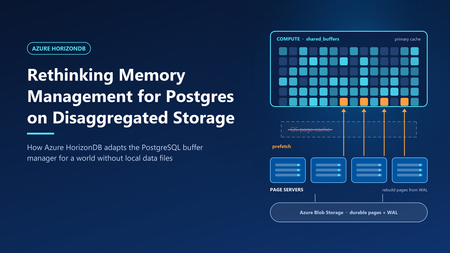
In Smarter Storage for Azure HorizonDB, we described how HorizonDB moves durability, replication, checkpointing, and recovery out of PostgreSQL and into a purpose-built storage layer. The compute node writes only the write-ahead log (WAL). Data pages are rebuilt and stored by remote page servers. That design raises an obvious question: if PostgreSQL no longer reads and writes its own data files, what happens to its memory management? PostgreSQL's buffer manager was built around a specific partner: the operating system's page cache. Many of its defaults and heuristics only make sense because the kernel is quietly doing a lot of work underneath. HorizonDB removes that partner. This post explains which assumptions broke, and the changes we made to the PostgreSQL engine, so memory works well on disaggregated storage. What PostgreSQL assumes about the kernel PostgreSQL stores each table and index as ordinary files and accesses them with buffered I/O. Every page therefore can live in two places in memory: in PostgreSQL's own buffer pool (shared_buffers) and in the operating system's page cache. This "double buffering" is a deliberate part of the design, and it shapes several behaviors. A modest buffer pool. The PostgreSQL documentation suggests starting shared_buffers at about 25% of system memory. Much of the rest is expected to act as kernel file cache. A page evicted from shared_buffers is often still in the kernel cache, so reading it back costs a memory copy rather than a disk read. Prefetching is a hint to the kernel. When PostgreSQL knows it will need a page soon—during a bitmap heap scan, for example—it calls posix_fadvise with POSIX_FADV_WILLNEED. The kernel starts reading the page into its cache. A later read finds it there. PostgreSQL itself never allocates a buffer for the prefetched page. Sequential scans rely on kernel readahead. For sequential access, the kernel detects the pattern and reads ahead automatically, so PostgreSQL can issue fewer explicit hints. Ring buffers protect the cache. Large sequential scans, VACUUM, and bulk writes such as COPY use a small private ring of buffers—from a few hundred kilobytes to a few megabytes—instead of the whole buffer pool. A scan of a table much larger than memory therefore cannot push the working set out of shared_buffers. This is safe because a page that cycles through the ring is usually still in the kernel cache if it is needed again. Writes are cheap and deferred. When a dirty buffer is evicted, PostgreSQL writes it to the kernel cache, which flushes it to disk later. The background writer cleans buffers ahead of eviction so that queries rarely wait for a write. Checkpoints write all dirty pages and call fsync to make them durable. Each of these behaviors assumes that a miss in shared_buffers is usually cheap, and that writing a page means writing it to a local file. What changes in HorizonDB Figure 1. Compute memory layout: Community PostgreSQL vs. Azure HorizonDB. In HorizonDB, permanent tables and indexes do not exist as local files on the compute node. There is no kernel page cache holding database pages. A miss in shared_buffers must be served by the remote storage layer: Tier Where it lives Typical role Shared buffers Compute memory Working set; all pages are read and modified here SSD cache Compute local disk Extends shared buffers; holds cached copies of pages Page servers Remote storage fleet Page cache of the current version of every page Azure Blob Storage Remote, zone-redundant Durable backing store for pages and WAL A page that falls out of memory no longer drops into a free kernel cache. It may require a network round trip to a page server, which is much more expensive than a memory read. Writes change too. Because page servers rebuild pages from WAL, "writing" a dirty page on the compute node does not mean copying it anywhere. PostgreSQL only has to make sure the WAL describing the change is durable - a rule it already enforces before any page write. Taken together, this inverts the trade-offs behind PostgreSQL's defaults. Memory is no longer one of two caches. It is the primary cache. Design principle: shared buffers are the primary cache We organized the engine changes around one principle. shared_buffers is the primary cache, eliminating the memory overhead of double buffering and improving memory efficiency. Every page that is about to be needed should arrive in memory before the query asks for it. The following sections describe the engine changes that implement it. 1. Size shared buffers for the machine Without a kernel cache to share memory with, leaving 75% of RAM to the operating system would waste most of it. HorizonDB sizes shared_buffers automatically at 60–70% of the compute node's memory, depending on the size of the instance. The remaining memory is left for connections, query execution memory such as sorts and hashes, and the operating system. 2. Retire ring buffers Ring buffers exist so that a large scan can use a few megabytes of memory and rely on the kernel cache for anything it needs again. In HorizonDB, there is no such safety net. Recycling a small ring means that every page the scan touches is read, used once, and discarded—and a second scan of the same table must fetch everything again from storage. Ring buffers also exist to limit write traffic: a bulk operation that dirties pages in a small ring must write them out quickly. HorizonDB doesn't need to write dirty data pages back to disk at all, so that motivation disappears as well. HorizonDB therefore disables buffer ring strategies. Sequential scans, VACUUM, and bulk loads use the shared buffer pool like any other query. This is a trade-off, not a free win. A very large scan can now displace pages from shared_buffers that other queries were using. Two factors limit the cost. First, clock-sweep replacement tracks how often each buffer is used, so frequently accessed pages outlive pages a scan touched only once—and buffer replacement is an area we continue to improve. Second, pages that leave shared_buffers are not simply lost: HorizonDB can keep them close by in the local SSD cache. How it decides and what goes there is a story for a separate post. 3. Prefetch directly into shared buffers On a local disk, a prefetch miss costs a disk seek. On disaggregated storage, it costs a network round trip. Hiding that latency matters even more, so HorizonDB makes prefetching explicit, aggressive, and memory aware. Prefetch requests go to the page servers. When PostgreSQL issues a prefetch, HorizonDB sends a read request for the page to the page server that owns it, and does not wait for the answer. Each backend keeps a set of outstanding requests by default, so dozens of page reads overlap instead of running one after another. Sequential scans prefetch explicitly. PostgreSQL's read stream mechanism, which drives sequential scans and other block-range reads, normally avoids prefetching sequential blocks because it expects kernel readahead to cover them. HorizonDB turns that assumption off, so sequential reads are prefetched like any other access pattern. Responses land in their final buffer. In stock PostgreSQL, a prefetch only warms the kernel cache, so the later read still has to copy the page into shared_buffers. In HorizonDB, the page server's response goes straight into a shared buffer. When the query asks for the page, it is already in memory, with no extra copy and no second request to storage. These are only some of the prefetch optimizations we have built into the engine. Others use custom prefetch implementations and logic that tunes how far ahead each query reads. All of them share one goal: hiding storage latency so queries spend less time waiting on I/O and more time doing useful work. What this means for you As a fully managed service, our goal is to delight customers with a best-in-class PostgreSQL experience. You shouldn't have to think about kernel caches, buffer rings, or prefetch windows—that is our job. HorizonDB retains full PostgreSQL compatibility, so applications keep the familiar Postgres programming interface while the engine is tuned to deliver predictable performance on the storage underneath626Views5likes1Comment
AI features in Azure databases
A support engineer hits a fault. Somebody solved the same fault two years ago, wrote down what fixed it, and closed the ticket. The engineer searches, finds nothing, and works it out from scratch. The answer was in the database the whole time. The search could not reach it. The cost of that is not abstract. It is the same diagnosis paid for twice, a vessel or a production line down for longer than it needed to be, and an organisation that cannot tell whether a fault is new or its fifth recurrence. The knowledge was captured. The organisation still could not use it. That is a retrieval problem, not a model problem, and it is where this experiment starts. It also explains why a model alone does not fix it: the limiting factor is what the system can find, not how well it writes. Azure Database for PostgreSQL and Azure Cosmos DB have both added vector search, full text search, hybrid ranking, and the ability to call a model directly. These arrived as feature announcements. What they do under a real question, what they cost, and where each one stops being the right tool are not in the announcements. So the same 1000 records were loaded into both engines and into a graph, and every query was run live against Azure. Nothing here is a screenshot or a recorded result. Each claim is a query that executed, with its wall clock time and its request unit cost recorded. Three questions were being answered: Where does keyword search beat vector search, and where does it collapse? What changes when the database calls the model itself, rather than an application doing it? Does a graph add anything that SQL over the same table cannot already do? The third one produced the most uncomfortable answer. Background Both engines now ship the same broad capability set, at different stages of maturity. Capability PostgreSQL flexible server Cosmos DB for NoSQL Vector index DiskANN, via pg_diskann DiskANN Full text search tsvector with GIN built in, BM25 scoring Hybrid ranking written by hand RRF() as a single clause Embeddings from inside the database azure_ai extension, generally available public preview Generation from inside the database azure_ai.generate() not available Graph Apache AGE extension no The asymmetry is the interesting part. PostgreSQL gives the database its own identity and lets it call a model, which moves work out of the application entirely. Cosmos DB gives hybrid ranking as one function call and keeps latency low. Neither is a superset of the other. Method Dataset. 1000 synthetic support tickets across maritime, energy, payments and retail, generated from a fixed seed so the results reproduce exactly. Each ticket has a title, a free text description written the way a person would write it, a resolution, a fault code, an asset, a team and a severity. Two design choices decide whether the experiment says anything: The same fault is described as shuddering, juddering, trembling and knocking by different people. Without that variation there is nothing for vector search to beat keyword search at. The fault code is excluded from the embedded text. Include it and vector search half answers code lookups, which destroys the contrast being measured. Stores. Store Configuration PostgreSQL flexible server pgvector at 1536 dimensions, DiskANN, azure_ai, Apache AGE AGE graph, same server 1000 tickets, 18 assets, 12 teams, 12 codes, 3209 edges Cosmos DB for NoSQL 3072 dimension vectors, DiskANN, full text index, autoscale to 5000 RU/s Models. One Microsoft Foundry account. text-embedding-3-large for both stores, gpt-5.5 for the application, gpt-4.1-mini for generation inside PostgreSQL. Authentication. Entra ID everywhere. Password authentication disabled on PostgreSQL, local authentication disabled on Cosmos DB and Foundry. No key or connection string exists anywhere in the build. Measurement. A four page web application executes each query and reports wall clock time. A script runs every endpoint against every input and then clicks every control in a real browser. Numbers below come from that run. The setup. Note the difference in the two lines on the right: for PostgreSQL the database calls the model itself, for Cosmos DB the application does it. Results: PostgreSQL Query Time Plain English search, embedding generated in the database 1.3 s Semantic search feeding a GROUP BY 540 ms Hybrid fusion written by hand 580 ms Retrieval and generation in one statement 2.7 s The query contains no vector. azure_openai.create_embeddings() runs inside the SQL, authenticated by the server’s own managed identity. Because a similarity search returns an ordinary relation, ordinary SQL aggregates over it: which teams, how many tickets, average hours to repair. This is the operation a separate vector store cannot perform, because the join does not exist across two systems. With azure_ai.generate(), one statement embeds the question, searches, builds the prompt and calls the model. There is no application tier in the loop, so anything that can run SQL can do it: a scheduled job, a report, a trigger. The cost of that convenience is latency. Every one of these timings includes the database going out to Foundry and back on the caller’s behalf, which is why the plain English search takes over a second. The next section shows what the same questions cost when the application does that work instead. Results: the graph Apache AGE runs inside the same PostgreSQL server used above. No second database and no sync job. Three of its four edge types restate columns that already exist: which asset a ticket is on, which team fixed it, which code it carried. The fourth does not. SIMILAR_TO links each ticket to its two nearest neighbours by embedding, restricted to neighbours with a different fault code and a cosine distance under 0.40. That produced 209 edges over 1000 tickets. Same code neighbours are skipped because the existing CODED edge already connects those. Measured against a retail point of sale fault: Reached by Assets Fault code walk 5 retail stores and distribution centres SIMILAR_TO walk 4 vessels and 2 substations, none carrying that fault code The first walk is reproducible in SQL. SELECT DISTINCT asset FROM tickets WHERE error_code = ... returns the identical rows, verified one by one. The second is not, because no column connects a checkout terminal to a ship’s bridge display. Expanding from a retail point of sale fault. Grey links are the fault code, which SQL could also follow. Magenta links are the embedding-derived edge, and they reach four vessels and two substations that carry no ERR-6205 ticket at all. Note also that the graph stores no text and no vectors, so it cannot be searched by meaning, only traversed. Vector search selects the entry node and the graph decides how far to walk from there. Results: Cosmos DB The same 1000 tickets, in a document database rather than a relational one, with the application rather than the database calling the model. Query Result Time RU Keyword ERR-5012 13 tickets 130 ms 3.6 Keyword shaking 0 tickets 130 ms 3.6 Vector, paraphrased symptom the same 13 tickets, none sharing a word with the query 190 ms 7.1 Vector, given a fault code unrelated tickets, confidently ranked 420 ms 7.1 Filtered vector meaning plus metadata in one query 180 ms 8.7 Hybrid, ORDER BY RANK RRF(...) both rankings fused in the engine 380 ms 70.5 Two results stand out. The shaking query returns zero. The tickets describe that exact fault, using other words. Vector search then returns those tickets from a sentence that shares no vocabulary with them. Handed a fault code instead, vector search fails, because a code carries no meaning to embed. The two methods fail at opposite things. Hybrid search costs roughly ten times a plain vector query, 70.5 RU against 7.1. It is one clause and it works well, but it is not free and should not be the default on every request. The fusion itself is reciprocal rank fusion, which combines the two result lists by position rather than by score: score = sum over lists of 1 / (k + rank) This matters in practice, because it means the BM25 relevance score and the cosine distance never have to be made comparable. Only the ordering is used. It is also why the demo shows rank rather than the fused score: the score is an artefact of the constant k. With both sets of numbers on the table, the latency gap is the clearest difference between the two engines. Cosmos DB answers a vector query in 190 ms where PostgreSQL takes 1.3 s, roughly seven times faster, because the application has already produced the vector before the query is sent. That is the trade: PostgreSQL removes the application and pays for it in latency. Results: retrieval versus model The final test holds the model constant and varies only the retrieval. Same deployment, same prompt, same question. Each side receives whatever its search returned. Retrieval Tickets passed Answer Keyword search 0 “We have no record of this happening before.” Vector search 8 Names the causes and fixes, cites 8 ticket IDs, all verified Same deployment, same prompt, same 1000 tickets. Only the retrieval differed. The first answer is not a hallucination and not a weak model. It is accurate about what it was given, and wrong about reality, because the retrieval beneath it failed. A system that returns no results produces a confident denial rather than an error, which is why this failure mode reaches production. It is also the expensive one. A wrong answer gets challenged. “We have no record of this” gets believed, and the engineer starts again from nothing. No alert fires, no error appears in a log, and the only visible symptom is work being repeated somewhere else in the organisation months later. Constraints encountered Findings that were not documented in anything read beforehand. Cosmos DB autoscale has an irreversible floor. The maximum cannot later be set below one tenth of the highest value ever provisioned on that container. Raising throughput to 20000 briefly during a load permanently floored the container at 2000 RU/s. Data plane and control plane RBAC are independent. A subscription Owner still receives 403 when reading documents without a Cosmos data plane role. Throughput changes are control plane only. With local authentication disabled the data plane SDK cannot alter RU/s at all, regardless of identity. azure_ai.generate() sends temperature = 0.2 with no override. Newer reasoning models accept only the default and reject the request, so in database generation required a separate gpt-4.1-mini deployment. An embedding call inside ORDER BY is evaluated once per row. Over a cross join that is 1000 model calls per query. Moving it into its own CTE fixes it. The symptom presents as an unreliable network. pg_diskann is limited to 2000 dimensions. text-embedding-3-large produces 3072, so PostgreSQL indexes a 1536 dimension prefix of the same model. Apache AGE is preloaded on Azure. LOAD 'age', which most tutorials instruct, fails with a privilege error. shared_preload_libraries replaces rather than appends and changing it restarts the server. The Gremlin API does not support Entra ID on the data plane. It requires an account key and a separate account, which is incompatible with a keyless deployment. AGE inside PostgreSQL provided a graph without a second database. Role assignments take two to four minutes to propagate. During that window the error reads “Principal does not have access to API/Operation”, which is indistinguishable from a genuine misconfiguration. The /models inference endpoint requires Azure AI Developer. Cognitive Services OpenAI User grants OpenAI/* but not MaaS/*. A pooled connection survives a network change as a black hole. After the client machine changed address, the shared PostgreSQL connection remained open but unresponsive, and queries blocked indefinitely. connect_timeout, TCP keepalives and statement_timeout convert this into a recoverable error; measured recovery is 1.3 seconds. Cost Per day, in NOK, for the deployment described above: Component Cost PostgreSQL flexible server, running 83.80 Cosmos DB about 13 Storage about 1.30 The database dominates. Stopping the PostgreSQL server between sessions is the entire cost strategy. Model usage is consumption priced and negligible at this volume. Two things follow from that. The search and retrieval capability itself is nearly free, because it is a feature of a database that is already being paid for rather than a separate product with its own licence and its own operations budget. And the meter that matters is compute hours on a server that can be stopped, not tokens, which is a more predictable line item than most AI spending. Takeaways Money spent on a better model does not buy a better answer if the retrieval is weak. Both sides of the final test held the same 1000 tickets. Only the search differed, and that alone separated a correct answer from a confident denial. The search layer is where the return on an AI investment is decided, and it is usually the cheapest part of the stack to improve. The two search methods are complements, not competitors. Keyword search is exact and literal, and it is what a serial number, a part code or an invoice number needs. Vector search is approximate and semantic, and it is what a symptom described in someone’s own words needs. Each fails at what the other does well. Real questions contain both, which is the argument for hybrid rather than for choosing. Hybrid search is not free. Ten times the request units of a vector query on this dataset. That is a per-query cost multiplier at production volume, so it belongs on the queries that mix a code with a description, not on every request by default. PostgreSQL and Cosmos DB answer different questions, and the choice has consequences beyond performance. PostgreSQL keeps the semantic result inside SQL, where it can be joined, aggregated, and handed to a model without an application in between, which means a scheduled job or a report can use AI without anyone building a service first. Cosmos DB is the low latency path and gives hybrid fusion as a single clause. The first changes who in an organisation is able to deliver something. The second changes what the user waits for. Keeping operational data and vectors in one engine removes a moving part. There is no second store to provision, secure, synchronise or reconcile, and no window in which the two disagree. The experiment never had to answer the question “which copy is right”, because there was only one. A graph earns its place only through edges that are not columns. Traversing relationships that already exist as foreign keys is a GROUP BY in different syntax, and calling that a graph capability will not survive a competent question. An edge derived from embeddings is different: it reaches records that no WHERE clause can, and in this dataset it connected failures across four separate parts of the business that shared no code, no component and no domain. Keyless is achievable end to end. Entra ID across both databases and the model account, with the database calling the model as its own managed identity, removed every key, password and connection string from the system. Nothing can leak from a repository or a configuration file, because nothing is there. The cost is understanding that data plane roles are assigned separately from control plane roles. Silent failures dominate, and they are the ones that reach production. Every significant defect in this build produced no error: counts inflated by a cartesian product, unresolved tickets averaged as zero hour repairs, near duplicate generated text, a stale process serving old code, and a connection that had stopped responding. Nothing alerted. Assertions over the data and a scripted pass over every endpoint caught all of them, and both took under a day to write. On a system that answers questions rather than returning rows, that kind of check is not optional, because a wrong answer looks exactly like a right one. Where this goes next: Azure HorizonDB Nothing in this experiment used Azure HorizonDB, but it changes the shape of the argument, so it belongs here. The pattern behind the scaling question is familiar: teams want to stay on PostgreSQL and eventually hit a ceiling. HorizonDB is Microsoft’s own PostgreSQL, built for workloads past that point, and it is in public preview. It carries the same AI surface used above, pgvector, DiskANN indexing, hybrid search with reciprocal rank fusion, and the azure_ai extension, so the code in this experiment transfers rather than being rewritten. What it adds is AI pipelines. Chunking, embedding, extraction, generation and ranking are declared in SQL as a pipeline that runs inside the database, on top of durable execution. The definition is a row in a system catalog. Execution survives a crash, retries failed steps, checkpoints partial work, and re-embeds only rows that are new or changed. That closes the remaining gap. This experiment showed a database answering a question. A pipeline is the same idea applied to keeping the data ready to be asked: no orchestrator, no separate worker, no job that quietly stops running. Both are preview features and should be read as direction rather than as something to put in front of customers this quarter. Not tested Scope was limited to what the two databases do on their own. Three things were left out deliberately and would change the conclusions if included. Agentic retrieval. Query planning, sub queries, iterative retrieval and reflection over multiple knowledge sources, as offered by Azure AI Search and Foundry IQ. That is a retrieval strategy built above the database, and it would have made the single query comparison meaningless. Reranking. A semantic reranking model over the candidate set. PostgreSQL exposes azure_ai.rank() for this and it was verified as working, but nothing in the experiment used it. Scale. 1000 rows is enough to show behaviour and not enough to show performance. The query planner in particular behaves differently: at this size it correctly ignores the vector index, because a sequential scan over a thousand rows is cheaper than the index startup cost. Try it yourself Everything described here is published, including the Terraform for the Azure resources and the generator for the dataset. https://github.com/Hanifff/ai-features-in-azure-databases git clone https://github.com/Hanifff/ai-features-in-azure-databases.git cd ai-features-in-azure-databases az login ./scripts/setup.sh That reads your current Azure context, provisions the resources, loads all three stores, and starts the application. The dataset is generated from a fixed seed, so the counts quoted in this post reproduce exactly. The PostgreSQL server is the only meaningful cost. Stop it when you are not using it, and run terraform -chdir=infra/terraform destroy to remove everything.348Views1like0CommentsPostGIS and AI Retrieval in Azure HorizonDB
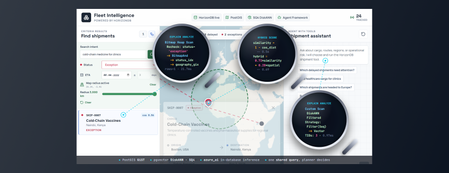
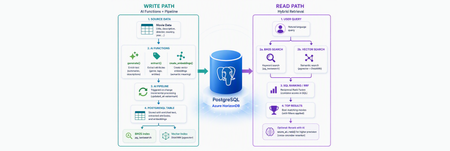
Fleet operators rarely search with a single kind of question. Sometimes they know exactly what they want: delayed shipments, within a certain radius of a location, arriving in a given window. Other times they only have intent, phrased in a sentence: "which delayed shipments need attention?" The first case is a deterministic filter. The second is a semantic search that a language model can shape into a query. Both need to run against the same operational data, return the same kind of exact rows, and stay inspectable enough that an operator can trust the result. The usual answer is to split that data: keep the transactional and, maybe, spatial rows in one system and copy embeddings into a separate vector store, with a search service in front. That works, but it duplicates the data, adds a synchronization problem, and hides the retrieval behind an API that no longer shows how a result was reached. The goal here is to keep both kinds of question against one database. I built a sample application, HorizonDB Fleet Intelligence, that answers them two ways: a criteria search form on the left, and a prompt-only assistant on the right. Its 24 global shipments are a deliberately small, hand-authored demo fixture, not a scale benchmark. Keeping the dataset small makes every returned row and planner choice easy to inspect. Both paths call the same repository, use PostGIS for location and pgvector for meaning, and expose the exact SQL and execution plan that produced their rows. This post walks through the goal, the two paths, and the queries and execution plans behind each. The interesting part is not that PostgreSQL can call an AI model. It is that the whole retrieval workflow, spatial filtering, vector ranking, and model reasoning, stays next to the data and remains readable. This sample demonstrates: One operational PostgreSQL database PostGIS for spatial filtering pgvector and DiskANN for semantic retrieval Agent Framework for prompt-driven search Full SQL and execution-plan visibility I ran this on Azure HorizonDB (preview), PostgreSQL 17.11, with postgis 3.6.1, vector 0.8.0, pg_diskann 0.7.3, and azure_ai 2.2.2 enabled. Both model aliases were registered with HorizonDB AI Model Management (AIMM). HorizonDB is a preview service, so region and subscription availability can change, and the plans and numbers below reflect what I ran rather than a support statement. The data model Each shipment is one row that carries relational fields, three PostGIS points, a JSON metadata blob, and a 1,536-dimensional embedding. The location columns are geometry(Point, 4326) , the standard WGS 84 longitude/latitude reference used by web maps. CREATE TABLE IF NOT EXISTS horizon_ship.shipments ( id uuid PRIMARY KEY DEFAULT pg_catalog.gen_random_uuid(), shipment_number text NOT NULL UNIQUE, title text NOT NULL, description text NOT NULL, origin_name text NOT NULL, origin_position public.geometry(Point, 4326) NOT NULL, destination_name text NOT NULL, destination_position public.geometry(Point, 4326) NOT NULL, current_location_name text NOT NULL, current_position public.geometry(Point, 4326) NOT NULL, status text NOT NULL CHECK ( status IN ('in_transit', 'delivered', 'delayed', 'exception', 'unknown') ), eta date, updated_at timestamptz NOT NULL DEFAULT now(), embedding vector(1536), metadata jsonb NOT NULL DEFAULT '{}'::jsonb ); The indexes give the planner several selective alternatives, which matters later because the two paths deliberately let the planner choose differently. There is a B-tree on status , a B-tree on eta , a GiST index on the geometry, and a second GiST index on the geography cast used by radius search: CREATE INDEX shipments_current_position_gix ON horizon_ship.shipments USING gist (current_position); CREATE INDEX shipments_current_position_geography_gix ON horizon_ship.shipments USING gist ((current_position::public.geography)); CREATE INDEX shipments_status_idx ON horizon_ship.shipments (status); CREATE INDEX shipments_eta_idx ON horizon_ship.shipments (eta); The vector index combines DiskANN with HorizonDB's spherical quantization (SQ) preview. DiskANN navigates a nearest-neighbor graph instead of scanning every vector. SQ compresses vector directions into low-bit representations, reducing the index footprint and memory traffic during graph traversal at the cost of an approximate comparison. Here each component uses four bits, shown as SQ4 in the interface, and sq_training_samples is configured at 25,000. Cosine distance matches the embedding model. CREATE INDEX shipments_embedding_diskann_idx ON horizon_ship.shipments USING diskann (embedding vector_cosine_ops) WITH ( spherical_quantized = true, sq_bits = 4, sq_training_samples = 25000 ); AI Model Management and azure_ai Both aliases are registered with HorizonDB AI Model Management (AIMM). The default-embedding alias resolves to text-embedding-3-small with 1,536 dimensions, and default-chat resolves to gpt-5.4 . Using aliases keeps the SQL and application code independent of the underlying model deployment details. The azure_ai extension provides the in-database model integration used by both paths: CREATE EXTENSION IF NOT EXISTS azure_ai CASCADE; Setup calls azure_openai.create_embeddings to create each row's embedding inside the database. The prompt-only agent later calls azure_ai.generate through its Agent Framework adapter. The embedding input uses format() with field labels, giving the model the business role of each value instead of an unlabeled sequence of words: UPDATE horizon_ship.shipments AS shipment SET embedding = azure_openai.create_embeddings( 'default-embedding', format( 'Title: %s. Description: %s. Origin: %s. Destination: %s. ' 'Current location: %s. Status: %s. Metadata: %s.', shipment.title, shipment.description, shipment.origin_name, shipment.destination_name, shipment.current_location_name, shipment.status, shipment.metadata::text ) )::vector(1536) WHERE ...; The application does not move embeddings between services, and no separate vector store is involved. Two paths, one repository The interface shown above has three panes: a criteria workbench on the left, a shared map in the center, and a prompt-only assistant on the right: Criteria workbench (left) Explicit status, ETA, and radius filters Calls POST /api/search This is a deterministic form, not a chat Agent assistant (right) Natural-language question only Calls POST /api/chat Agent Framework lets gpt-5.4 infer tool arguments The important design decision is that both paths call the same repository method, semantic_search . The criteria path fills in the filters from the form. The agent path fills them in from what the model inferred. Nothing from the left form leaks into the agent request, and the agent request contract enforces that: the /api/chat model forbids extra fields, so posting status or radius to it returns HTTP 422 before Agent Framework even runs. Here is the shared query, exactly as the repository builds it. The %s placeholders are bound with parameters. The criteria path supplies real values, while the agent path passes NULL for the filters it did not infer. -- 1. Embed the query text in the database, using the same model -- (default-embedding) that produced the row embeddings. WITH query_vector AS ( SELECT azure_openai.create_embeddings( %s, -- embedding model alias %s -- query text )::vector(1536) AS embedding ), -- 2. Retrieve candidates. MATERIALIZED forces this CTE to run once and -- be reused, so the vector distance is computed a single time. candidates AS MATERIALIZED ( SELECT s.shipment_number, s.title, -- ... projected columns, PostGIS points unpacked with ST_X / ST_Y ... -- 2a. Cosine distance between the row and the query embedding. s.embedding <=> query_vector.embedding AS vector_distance, -- 2b. Great-circle distance in km to the map center, only when a -- center was supplied (otherwise NULL). CASE WHEN %s::double precision IS NULL THEN NULL ELSE public.ST_Distance( s.current_position::public.geography, public.ST_SetSRID( public.ST_MakePoint(%s, %s), 4326 )::public.geography ) / 1000.0 END AS distance_km FROM horizon_ship.shipments AS s CROSS JOIN query_vector -- 2c. Optional filters. Each is "parameter IS NULL OR <condition>", -- so an unused filter drops out and the planner can ignore it -- (the application sets plan_cache_mode to force_custom_plan). WHERE (%s::text IS NULL OR s.status = %s) -- status AND ( -- ETA window %s::date IS NULL OR s.eta BETWEEN %s::date - (%s * INTERVAL '1 day') AND %s::date + (%s * INTERVAL '1 day') ) AND ( -- PostGIS radius %s::double precision IS NULL OR public.ST_DWithin( s.current_position::public.geography, public.ST_SetSRID( public.ST_MakePoint(%s, %s), 4326 )::public.geography, %s * 1000.0 ) ) -- 2d. Order by cosine distance and cap the list. This is the step -- DiskANN serves: nearest neighbors first, then LIMIT. ORDER BY s.embedding <=> query_vector.embedding LIMIT %s ) -- 3. Score and rank. Pure cosine similarity when there is no radius, -- otherwise a 72% semantic / 28% spatial blend. SELECT candidates.*, 1 - vector_distance AS similarity, CASE WHEN distance_km IS NULL THEN 1 - vector_distance ELSE 0.72 * (1 - vector_distance) + 0.28 * GREATEST(0, 1 - distance_km / %s) END AS hybrid_score FROM candidates ORDER BY hybrid_score DESC LIMIT %s; </condition> A few things are worth pointing out. The query embedding is created inside HorizonDB with azure_openai.create_embeddings , so the same model that embedded the rows also embeds the query, on the same connection. Each optional predicate is written as %s IS NULL OR , so an unused filter disappears from the effective query and the planner is free to ignore it. The inner ORDER BY ... <=> ... LIMIT keeps cosine distance as the candidate-retrieval step, which is what lets DiskANN serve it. The outer query then produces a hybrid score: pure cosine similarity when there is no radius, and a 72% semantic / 28% spatial blend when a radius is present. Why 72% semantic and 28% spatial The split is a tunable product choice, not a mathematical constant. Both terms are normalized from 0 to 1. Because ST_DWithin already removes rows outside the radius, semantic relevance leads among the eligible shipments and the 28% spatial term rewards proximity. Without a radius, the score is pure cosine similarity. Because the two paths share this query, the only thing that changes between them is which parameters are NULL . That is what makes the execution plans interesting: the same SQL shape produces two very different plans depending on how selective the filters are. Path one: criteria search For the first search I ask for cold-chain medicine for clinics, select the exception status, center the map near Dakar in West Africa, and choose a 3,000-kilometer radius. This is a highly selective request. In the sample data it returns exactly one row: SHIP-0007, Cold-Chain Vaccines. The cosine similarity is 0.56 and the hybrid score is 0.69. No model reasoning is needed to interpret those explicit filters. The application does not force an index. Every runtime SELECT is first run through EXPLAIN (ANALYZE, BUFFERS, WAL, FORMAT TEXT) , and the plan is retained alongside the literalized SQL. For this selective request, the planner does not touch the vector index at all. It combines the status B-tree and the PostGIS geography GiST index with a BitmapAnd , feeds one row into a Bitmap Heap Scan, and rechecks ST_DWithin there: -> Bitmap Heap Scan on shipments s (actual time=21.684..21.687 rows=1 loops=1) Recheck Cond: (status = 'exception'::text) Filter: st_dwithin((current_position)::geography, '...'::geography, '3000000'::double precision, true) Heap Blocks: exact=1 -> BitmapAnd (actual time=0.020..0.020 rows=0 loops=1) -> Bitmap Index Scan on shipments_status_idx (actual time=0.007..0.007 rows=2 loops=1) Index Cond: (status = 'exception'::text) -> Bitmap Index Scan on shipments_current_position_geography_gix (actual time=0.012..0.012 rows=3 loops=1) Index Cond: ((current_position)::geography && _st_expand('...'::geography, '3000000'::double precision)) This is the right call. The status B-tree returns two candidate rows, the geography GiST index returns three, and the BitmapAnd intersects them. The ST_DWithin recheck on the heap confirms the single match. Resolving that with relational and spatial selectivity is far cheaper than an approximate nearest-neighbor scan, and the whole query ran in about 22 ms. The vector distance is still computed in the outer query to produce the similarity and hybrid score, but it is not driving the access path. The SQL pane shows every literal, prompt, status, coordinates, and radius, so the operator can see exactly what was asked and how it was answered. Note that the GiST index scan uses the && bounding-box operator against _st_expand(...) , which is the index-friendly part of ST_DWithin . The exact distance test is then applied as the recheck, so the spatial predicate is both index-accelerated and exact. The application shows the same thing as a graph, with the literal SQL beside it. The BitmapAnd and its two bitmap index scans are visible as one flow, and the SQL pane highlights each user-supplied literal: Path two: the prompt-only agent For the second search I clear the left criteria and just ask the assistant: "Which delayed shipments need attention?" The request body contains only that question. Behind that, Microsoft Agent Framework runs a bounded two-turn loop while model inference stays inside HorizonDB. On the first turn, gpt-5.4 is asked, through azure_ai.generate , to return JSON arguments for a single registered tool, search_shipments . The model chooses delayed as the status and rewrites the intent to something like "shipments needing attention". Agent Framework validates those arguments and invokes the tool exactly once. That tool calls the same semantic_search method, with the model-chosen status and no spatial or ETA filter. On the second turn, the model receives only the serialized result rows and writes the grounded answer. The client caps the run at two model iterations and one function call, so the orchestration stays predictable. The tool is a plain typed function. The framework reads its schema from the annotations: @tool( name="search_shipments", description=( "Search live shipments by meaning and optional status. HorizonDB retrieves " "candidates with spherical-quantized DiskANN and returns ranked evidence." ), max_invocations=1, ) async def search_shipments(query_text: str, status_filter: StatusArgument = "all") -> str: ... This time the filter is not selective enough to win as a bitmap, so the planner takes the vector path. Before running a filtered vector query, the repository enables DiskANN's strict iterative search and filter hook in a transaction-local scope: SET LOCAL diskann.iterative_search TO 'strict_order'; SET LOCAL diskann.enable_filter_hook TO 'true'; SET LOCAL diskann.selectivity_min TO '0.0'; SET LOCAL diskann.selectivity_threshold TO '1.0'; SET LOCAL diskann.filtering_beta TO 0.85; SET LOCAL diskann.l_value_is TO 300; The plan is now a custom DiskANN scan. Strict iterative search applies the delayed filter and then vector ordering, collecting exactly the tuples that match: -> Custom Scan (DiskANNFilteredScan) (actual time=0.942..0.967 rows=3 loops=1) Strategy: Filter(SeqScan) -> Vector Rows Retrieved: 3 count TIDs Collected: 3 count The strategy line reads Filter(SeqScan) -> Vector : the delayed filter is applied first, then the vector index orders the survivors. It collected three tuple identifiers and retrieved three rows, and the whole statement ran in about 1.2 ms. Those three rows, Electric Vehicles, Apparel and Textiles, and Lithium Batteries, are the same rows that appear as cards in the answer, in the left-hand list, and on the map. The query pane exposes the model-selected semantic phrase and the cosine operator, so the vector path is as inspectable as the relational one. Filtered vector search is exactly what a separate vector store tends to hide. Here it stays in the plan. The plan graph makes the strategy explicit. The Query + plan button on the agent turn opens the exact SQL the model produced, "shipments needing attention" highlighted, next to the DiskANNFilteredScan node with its strategy and TID count: Both plans come from the identical query. The criteria request was selective, so the planner chose BitmapAnd over the status B-tree and geography GiST. The agent request was broad, so the planner chose DiskANNFilteredScan and let the vector index order the candidates. That is the payoff of keeping one query and one dataset: the planner adapts to the shape of each question instead of the application hard-coding an access path. The two plans do the same thing under the hood These two access paths look different in the plan, but they are solving the same problem the same way: reduce the table to the set of rows that satisfy the predicates, expressed as tuple identifiers (TIDs), the physical (block, offset) addresses of rows. In the criteria plan, each index produces a bitmap of TIDs. The status B-tree contributes the TIDs of exception rows, the geography GiST index contributes the TIDs whose bounding box intersects the radius, and BitmapAnd intersects the two bitmaps into the TIDs that satisfy both. The heap is then visited for exactly those TIDs and the exact ST_DWithin is rechecked. The predicates are resolved first, then the rows are fetched. The DiskANN filtered scan does the equivalent, but in the opposite order and against a graph. Rather than ordering by distance and hoping the top results happen to be delayed , strict iterative search evaluates the filter during graph navigation: as it walks the nearest-neighbor graph it keeps only the TIDs that pass the delayed predicate, and keeps walking until it has collected enough matches in nearest-first order. That is what Filter(SeqScan) -> Vector and TIDs Collected: 3 describe, the filter builds the set of eligible TIDs, and the vector index visits them in similarity order. So a bitmap index scan and a pre-filtered ANN search are two implementations of one idea: build the set of TIDs that match the predicates, then combine it, by bitmap intersection in one case, by filtering the candidates during navigation in the other. This is exactly the capability a separate vector store usually lacks. A pure HNSW index, for instance, orders by distance with no way to intersect a relational predicate into the walk, so it either over-fetches and filters afterward or misses matches. Keeping the vectors in the same table as the relational and spatial columns is what lets one predicate feed the other. A note on inspectability Every runtime SELECT in this sample is executed twice on purpose. The backend first runs it under EXPLAIN (ANALYZE, BUFFERS, WAL, FORMAT TEXT) to capture the real plan with buffer and WAL statistics, then runs the same statement to fetch rows. That is a demonstration choice, not something you would do in production, but it means every result carries the literal SQL and the plan that produced it. Each agent answer keeps its own plan snapshot too, so the Query + plan control still shows that turn's SQL and plan even after a later criteria search runs. Because EXPLAIN ANALYZE runs the statement, the model-backed statements run twice as well. Takeaways This started as a practical customer question: show PostGIS on HorizonDB, then combine location with AI in something that looks like a real development stack. The result is one operational database with two trustworthy ways to ask. When the operator knows the criteria, the left workflow keeps status, time, and geography deterministic, and the planner resolves it with B-tree and GiST bitmaps. When the intent is conversational, gpt-5.4 gets one controlled Agent Framework tool over the same repository, and the planner serves it from spherical-quantized DiskANN. In both cases the rows, scores, SQL literals, and planner decisions stay visible. Relational data, PostGIS geometry, pgvector embeddings, and AI model calls all live in the same HorizonDB instance, so there is no second store to synchronize and no retrieval hidden behind an opaque service. The pattern starts with shipment tracking but transfers directly to fleet, taxi, bus, and security dispatch, anywhere service intent and proximity matter together. If you want to try HorizonDB capabilities like these, the PostgreSQL Hub has sample applications and learning paths, and the PostgreSQL Developer Forum is the best place to share feedback and ask questions.244Views1like0Comments
Postgres Skills: Give Your AI Agent PostgreSQL Expertise
Modern application development increasingly relies on AI agents to generate code, configure services, and accelerate delivery. But generic agents often stop at plausible SQL or broad recommendations. They do not reliably inspect the live database, account for PostgreSQL versions and extensions, distinguish self-hosted from managed environments, apply production guardrails, or verify that a change actually works. That gap matters when database decisions affect security, performance, availability, and customer experience. A syntactically correct query can still create an isolation issue, use an incompatible feature, recommend an unsupported managed-service command, or leave an application with a design that does not scale. The solution: PostgreSQL Skills PostgreSQL Skills closes this gap by giving agents the PostgreSQL expertise, live context, execution tools, and validation workflow needed to turn a generic answer into a safe, production-ready outcome that solves the application’s business problem. Its 32 expert sub-skills support PostgreSQL running locally, self-hosted, or on any cloud; Azure Database for PostgreSQL and HorizonDB. The plugin includes postgres-mcp for live database access and Azure CLI integration for managed-service operations. One install works across GitHub Copilot CLI, VS Code, Claude Code, and Codex CLI. Domain What you can do PostgreSQL Anywhere Build vector search, partition tables, implement row-level security, index JSONB data, and analyze query regressions on local, self-hosted, or cloud deployments Azure Database for PostgreSQL & HorizonDB Provision and scale servers, configure HA/DR and PITR, use Entra ID authentication, plan major-version upgrades, and get HorizonDB (Preview) guidance You do not need to choose a sub-skill or tell the agent which rules apply. The plugin checks your environment and routes each request to the guidance that fits your deployment. Live database context and PostgreSQL expertise, together The included postgres-mcp server gives your agent structured access to the database you are using. It can inspect schemas, roles, extensions, and server capabilities, run queries, and apply changes you approve. This grounds the work in live database state instead of assumptions. The sub-skills guide how the agent uses that access. They define what to check, which rules apply to your deployment, when to ask for confirmation, and how to validate the outcome. Together, postgres-mcp and the sub-skills help the agent move from a generic answer to a change that fits your database and has been verified. Try it yourself Choose a host and follow the setup path for your operating system. Install your host Add the marketplace and install PostgreSQL Skills GitHub Copilot CLI copilot plugin marketplace add microsoft/postgres-skills copilot plugin install postgres-skills@postgres-skills copilot plugin list # confirm postgres-skills is active Claude Code /plugin marketplace add microsoft/postgres-skills /plugin install postgres-skills@postgres-skills /plugin # confirm the plugin appears as installed Codex CLI codex plugin marketplace add microsoft/postgres-skills codex plugin add postgres-skills codex plugin list # confirm postgres-skills is active See it work: three developer scenarios PostgreSQL anywhere: enforce tenant isolation Prompt: "Add row-level security so each tenant can only access its own data." A generic agent with SQL access can write a CREATE POLICY statement. But it may not inspect table ownership, BYPASSRLS roles, existing policies, or how your application establishes tenant context. The policy can look correct while still leaving an isolation gap. With PostgreSQL Skills, the agent inspects the live schema and role model, identifies the tenant key, accounts for owner bypass behavior, and proposes the policy against your actual tables. It asks before enabling RLS, then tests allowed and denied access with representative roles. You get a verified security boundary, not just policy syntax. PostgreSQL application development: build hybrid search Prompt: "Add semantic and keyword search to my product catalog." A generic agent can generate a pgvector query and a full-text search query. It still leaves you to reconcile two result sets, choose compatible indexes, and adapt the example to your schema and PostgreSQL version. With PostgreSQL Skills, the agent inspects your catalog schema and extension availability, designs the embedding and text-search columns, creates the appropriate indexes, and combines both signals with reciprocal rank fusion. It runs the search against your data and verifies the result before calling the implementation complete. Azure PostgreSQL: connect an application without passwords or public access Prompt: "Connect my application to Azure Database for PostgreSQL without passwords or public internet access." A generic agent with Azure CLI access may provide the right ingredients: Entra authentication, a managed identity, and a private endpoint. It may not check which server is targeted, whether private networking is already configured, how the application identity maps to PostgreSQL, or whether disabling an existing authentication path will break deployed applications. With PostgreSQL Skills, the agent confirms the Azure connection and discovers the server, subscription, resource group, networking mode, and current authentication configuration. It identifies the application identity, proposes a private and passwordless connection plan, and explains every Azure and PostgreSQL object that will change. It asks before modifying identity, authentication, or network access, validates token-based connectivity, and leaves existing access in place until you confirm it can be removed. Guardrails for safe execution Acting on a database is only useful if it is safe on any host. One rule is universal: Every destructive or non-reversible action is confirmed with you first. This applies without exception on self-hosted and Azure deployments. If you're connected to Azure, three more rules kick in automatically: Azure guidance uses `azure_pg_admin`, never `SUPERUSER`. It never assumes access that the managed service does not grant. No `ALTER SYSTEM` and no OS-level access on Flexible Server. Azure changes go through az ... parameter set, matching how the service actually works. Connection-aware gating. Azure-only guidance loads only after the live connection confirms isAzure: true. It never guesses your environment or applies Azure rules to a database that is not one. Get started Repo: github.com/microsoft/postgres-skills. Visit the PostgreSQL Skills repository for installation commands, usage examples, and contribution guidance. Explore the open-source collection of PostgreSQL skills for AI coding agents, including installation commands, usage examples, and contribution guidance. Contribute: Follow CONTRIBUTING.md to add a reference file, register its triggers in the routing table, run the validation checks, and submit a pull request. Feedback: open an issue on the repo with what you tried and what broke The takeaway: generic agents can produce plausible database code, but solving real application problems requires PostgreSQL expertise, live environment context, production guardrails, and validation. PostgreSQL Skills brings those capabilities together so your agent can move beyond suggesting an answer to delivering a safe, deployment-aware, and verified outcome.851Views2likes0CommentsSmarter Storage for Azure HorizonDB
A key benefit of Azure HorizonDB comes from its smart storage layer, which works seamlessly with Postgres and takes over durability and high availability work typically done by Postgres itself. This frees Postgres to operate as a stateless compute engine focused on running queries and transactions leaving more CPU, disk, and network bandwidth available for your application’s business logic. For example, HorizonDB’s storage layer handles work such as replicating WAL to read replicas and archiving WAL to blob storage for point-in-time restore. PostgreSQL also no longer needs full-page writes or background dirty-page flushing, that work is handled by the storage layer. The rest of this post explains the storage architecture that enables this division of responsibility. HorizonDB Storage Overview HorizonDB’s storage design is similar to that of Socrates. The write‑ahead log (WAL) is the sole mechanism used to persist writes to storage (Orange in Figure 1). PostgreSQL compute nodes never write data pages to storage directly in HorizonDB (blue in Figure 1). Instead, pages and other on‑disk structures are treated as derived state and are reconstructed by the storage layer from WAL records. Each Postgres instance in a cluster shares the same copy of the data pages in storage (blue “Page Reads” arrow in Figure 1). A Postgres read replica doesn’t need to maintain its own copy of WAL and data pages as in a typical Postgres setup with a hot standby or readable secondary. Figure 1 - HorizonDB WAL and Page Storage HorizonDB uses separate storage services for WAL and data pages. This separation allows each to be specialized for the very different patterns of reads and writes for WAL versus pages. The WAL server is optimized for low latency writes to the tail of the log stream and reads often at or near the tail. The page server is optimized for elastic storage of potentially many terabytes of pages and it must support random reads and writes of pages. This specialization improves query performance as we have demonstrated in the past. Moving Work into Storage Figure 2) shows the work Postgres does in a typical configuration with high availability, backups and WAL archiving configured. The Postgres primary is doing the work to send WAL to the secondary, and archive WAL to blob storage. The primary and secondary nodes both maintain their own complete copies of the data. Figure 2 - Postgres without Smart Storage Figure 3) shows where the equivalent work is done by HorizonDB storage. The primary and secondaries share one copy of the data in storage in this design. Figure 3 – HorizonDB storage offloading work from Postgres Some example work HorizonDB storage is now doing in Figure 3. The work usually done by the Postgres walsender and archiver processes to send WAL to standbys\secondaries or to WAL archive (blob storage) is now done by HorizonDB’s WAL servers in Figure 3) instead of by Postgres as in Figure 2). In HorizonDB, Postgres secondaries don’t ever communicate directly the with primary. When Postgres starts up, it no longer needs to redo WAL to bring stale page content up to date speeding up startup times. HorizonDB’s page servers in Figure 3) take care of page recovery for Postgres and can send it any pages it needs on demand. The Postgres checkpointer and background writer no longer need to write dirty pages to disk. The page server handles this work. Both Postgres primary and any secondaries can retrieve the page versions they need from the page servers. HorizonDB page servers protect against torn pages making Postgres Full page writes unnecessary reducing the amount of WAL generated and improving write throughput. On read replicas, HorizonDB only requires redo of WAL onto pages that the read replica has stored in memory already saving the work to persist the WAL and redo it. HorizonDB read replicas don’t maintain their own private copy of the data, so redo is only used as a mechanism to keep their in-memory copy in sync with the primary. Tables 1) and 2) below summarize the Postgres processes whose work moved into HorizonDBs storage layer. Task Resource Savings Postgres Process Moved WAL sending to Postgres replicas Disk IO, Network IO walsender WAL archiving to blob storage Disk IO, Network IO archiver WAL filtering CPU, Network IO Shared Storage Specific (*) Dirty Page Writing Disk IO background writer Checkpointing Disk IO checkpointer PostgreSQL WAL recovery Disk IO, CPU startup recovering PostgreSQL read replica redo Disk IO, CPU startup recovering PostgreSQL read replica shared storage (read replicas share storage with primary Disk IO Background writer, checkpointer Backups Disk IO pg_dump, pg_basebackup, pg_backup_start, pg_backup_stop Full page writes Disk IO Backends doing WAL writing Hot standby feedback Vacuum accuracy walreceiver Task HorizonDB Storage Component Responsible WAL sending to Postgres replicas WAL Service WAL archiving to blob storage WAL Service WAL filtering WAL Filtering Service Dirty Page Writing Page Server Checkpointing Page Server PostgreSQL WAL recovery Page Server PostgreSQL read replica redo Page Server PostgreSQL read replica shared storage Page Server Backups WAL Service and Page Server Full page writes Page Server Hot standby feedback WAL Filtering Service (*) Table 1) and 2) refer to HorizonDB’s WAL filtering service. We haven’t talked about this service yet. It’s responsible for sharding the WAL stream across many page servers. To store 10s of TBs of data the page servers shard that data out across many machines. The WAL filtering service takes as input the full WAL stream and shards it into the parts that apply to each page server shard, sending only the WAL that applies to a given shard to that shard (reducing network amplification). Some other shared storage OLTP databases do this WAL filtering on the compute VM, within or alongside Postgres, incurring non-trivial CPU use and higher tail latencies on WAL writes. In summary, by moving durability, recovery, and replication into a purpose-built storage layer, HorizonDB simplifies Postgres while freeing up compute resources for query execution. The result is higher throughput, faster recovery, and lower cost, without compromising the familiar Postgres programming interface.803Views2likes0CommentsWhy PostgreSQL Still Inspires Builders
The PostgreSQL project turned 30 years old in July. As it enters middle-age, developers and builders rely on it more today than ever. In the crowded and competitive SQL database market, what is driving this popularity? PostgreSQL is a great fully featured database, but it’s not clearly better than the alternatives (SQL Server, MySQL, Oracle) on performance benchmarks or in feature-by-feature comparisons. Its popularity stems from other factors: the community’s focus on reliability and stability, and its open governance and lenient licensing. Together these qualities of PostgreSQL have spawned an ecosystem of extensions and forks built around its stable core. A stable open core My claim that PostgreSQL is more reliable than other databases is based on my experience and not on any hard data. I don’t know of any rigorous study on the count and severity of regressions in new releases of different database engines. Companies love to show off their TPC-C benchmark performance numbers, but we don’t have such an easily measurable metric for reliability. I’ve written code for a few different database engines in my engineering career (SQL Server, MemSQL/Singlestore in the MySQL ecosystem, and Azure HorizonDB in the PostgreSQL ecosystem). Of those, PostgreSQL is on the more conservative, careful and rigorous end of the engineering spectrum. The PostgreSQL committers may move a little more slowly when adding new features, but they move with great care. PostgreSQL’s open and independent governance model prevents a single company from dominating its evolution. That said, large companies such as Microsoft and Amazon employ teams of engineers whose job is writing open-source PostgreSQL engine code (not working on proprietary closed source forks for their respective companies). Application developers have learned to expect a steady stream of new features year after year as a result. PostgreSQL can run on a laptop, your own server running a variety of different operating systems, or on any of a dozen different PostgreSQL cloud services (see Table 1 below). It’s the database that gives builders the most choice and least single vendor lock-in. Built to extend and fork The PostgreSQL source code is also an important building block in many PostgreSQL derived databases and services. Folks building applications in the PostgreSQL ecosystem have a broad choice of vendors and systems. PostgreSQL’s permissive license makes it the most forked open-source database engine. There are forks that specialize in data warehousing, distributed SQL and cloud native OLTP. Its code base is a building block generating billions in revenues across the global economy for various companies. The table below shows some of the PostgreSQL compatible databases or services in production today. They include more specialized forks built to handle use cases that community Postgres is not as good at (i.e., data warehousing) as well as services that run mostly unmodified Postgres as a cloud service. The databases in bold are available on Azure. Category Product/Service Name Compatibility Cloud Native OLTP Azure HorizonDB, AWS Aurora PostgreSQL, Google AlloyDB, Neon, PolarDB PostgreSQL forks designed to run on top of specialized WAL and page storage services enabling lower latency writes, faster failovers, storage auto grow/shrink, efficient read scale out etc. Managed OLTP Services Azure Database for PostgreSQL AWS RDS PostgreSQL, Google CloudSQL PostgreSQL, Supabase, Crunchy Data Run mostly unmodified PostgreSQL as a service attached to off-the-shelf cloud storage (managed disks) and virtual machines Distributed SQL extensions or forks CitusDB (Azure PostgreSQL Elastic Clusters), YugabyteDB, Aurora DSQL, Aurora Limitless Shard data across a cluster of machines with a PostgreSQL compatible distributed query layer on top enabling read and write scale out. Distributed SQL with Postgres compatibility Google Spanner, CockroachDB These are not Postgres forks, but are sharded databases that aim for PostgreSQL query and wire compatibility Data warehousing extensions or forks Greenplum, ParAccel (powers AWS Redshift), Aster Data, TimescaleDB Postgres forks that add parallel query processing and column stores for data warehousing Document database forks or extensions Azure DocumentDB, FerretDB MongoDB compatibility layer on top of Postgres storage Table 1 – Postgres based databases or services; Not an exhaustive list. For more see PostgreSQL derived databases - PostgreSQL wiki No other open-source database has as many successful product offerings based on its source code or its query and wire protocols. MySQL would be a distant second place as far as number of derived databases or services. The databases listed above aren’t all fully compatible with community PostgreSQL, but many are highly compatible. Postgres on Azure At Azure, we’ve built three services around PostgreSQL shown in bold in Table 1 Azure Database for PostgreSQL runs Postgres on Azure virtual machines and Azure managed disks managing backups, high availability, and geo-replica’s as needed. It offers the Citus extension (via the Elastic Clusters configuration) to shard data across a cluster of Postgres worker machines to scale out writes and reads as needed. Azure HorizonDB extends the core PostgreSQL engine with a custom storage layer that has specialized WAL and page services improving performance, reliability and scalability. It frees up Postgres to run queries and transactions by pushing the work to make data durable and highly available into the storage layer (replication, checkpointing, WAL archival, etc.). Azure DocumentDB gives customers the option to build apps against a MongoDB compatible service on top of PostgreSQL’s solid foundation. So, thank you to the PostgreSQL developers (and community) for the hard work they’ve put in over three decades. The family of Postgres derivative or compatible databases wouldn’t exist with their foundational work. Choosing Postgres gives builders the confidence they’re building on a mature, reliable and flexible foundation. Who knows where a new fork or extension may take Postgres in the future. About PostgreSQL Perspectives PostgreSQL Perspectives is a monthly blog series featuring insights from Microsoft engineers, contributors, and builders working with PostgreSQL. Explore more articles on the Microsoft for PostgreSQL blog.533Views4likes0CommentsAI-assisted Oracle-to-PostgreSQL schema conversion in Visual Studio Code
By AI Omar Rajawat, Pranay Lohia, Gautam Juneja, Vikas Nimmagadda, Anil Dogra, Aditya Duvuri We’re seeing significant interest in migrating database workloads from Oracle to Azure Database for PostgreSQL. Historically, schema conversion has been one of the most technically challenging and expensive steps in that journey, demanding specialist knowledge of both engines and stretching migration timelines before a single row of data moves. Recent advances in AI-assisted schema conversion are changing that, turning what used to be a long, manual effort into a faster, more accessible, and lower-cost proposition. This post looks at what that shift means in practice for teams moving to Azure Database for PostgreSQL flexible server. Oracle schema conversion is where the complexity of translating schema and code objects to PostgreSQL becomes visible. Packages, procedures, triggers, custom types, and dependencies built up over years must be mapped to PostgreSQL-compatible definitions while preserving the relationships that make the schema work. Generally available since May 2026, the feature is built into the PostgreSQL extension for Visual Studio Code, published by Microsoft. It helps teams convert Oracle schema and code objects — tables, views, constraints, packages, procedures, functions, and triggers — into PostgreSQL-compatible definitions for Azure Database for PostgreSQL flexible server, with no separate conversion utility to install and no disconnected workflow to manage. It brings schema discovery, conversion, compile validation, and review into one project-based experience. Teams can connect to Oracle, select schemas, and configure a Microsoft Foundry connection in the same project. The extension then translates Oracle-specific constructs, compiles and syntax-checks converted DDL into scratch schemas on Azure Database for PostgreSQL flexible server and surfaces unresolved items as review tasks that teams can work through with GitHub Copilot agent mode. Why schema conversion deserves a better workflow Traditional conversion tools can produce a useful first pass, but the long tail of the process is rarely solved by generating replacement DDL alone. Teams still need clear answers to practical questions: What converted successfully? What needs attention? Which Oracle constructs require a PostgreSQL design decision? Which items should be reviewed first? We designed the schema conversion experience around those questions. The goal is not to hide complexity behind a single score. It is to help teams make steady progress while keeping the work visible and reviewable. What the schema conversion experience provides The experience guides teams through a schema conversion project rather than a collection of separate scripts. It discovers the selected Oracle schemas and converts both the relational model and the code that runs on it: tables, indexes, sequences, primary key, unique, check and foreign key constraints, views and materialized views, synonyms, and Oracle object types — along with the PL/SQL that is usually the hardest part of the migration. Packages and package bodies, package-level state, standalone procedures and functions, and triggers are translated into PostgreSQL functions, procedures, and trigger functions. Oracle-specific constructs are mapped to PostgreSQL equivalents rather than dropped or stubbed out. REF CURSOR and SYS_REFCURSOR become PostgreSQL refcursor; CLOB and BLOB columns become text and bytea ; and NUMBER and VARCHAR2 are mapped by precision and length to their closest PostgreSQL types. Oracle date functions such as ADD_MONTHS, LAST_DAY, MONTHS_BETWEEN, and TRUNC are resolved through the orafce extension, which the project detects and flags for you before deployment. Every converted definition is compiled against scratch schemas on Azure Database for PostgreSQL flexible server, so the deployment script you end up with is an organized, dependency-ordered set of PostgreSQL SQL artifacts that has already been proven to build. Objects that still require human judgment are surfaced as review tasks. Teams can inspect the source and converted definitions side by side, work through the remaining items, and use GitHub Copilot agent mode for guided assistance — keeping automation and human review in the same workflow. How it works: the system architecture Under the hood, the conversion engine follows one principle — the language model is a single, bounded stage; it never has the first or the last word. Deterministic steps decide what the model sees and what it is allowed to produce. Deterministic in. Rule-based extraction reads the Oracle DDL and metadata, then a dependency-graph decomposition splits the estate into bounded, dependency-ordered chunks — so every object is converted in the context that keeps it correct. Bounded conversion. A tiered model strategy through the Microsoft Foundry connection translates each chunk with structured, contract-wrapped input and output. Even very large PL/SQL packages are split and converted member by member, so nothing is trusted as a monolith. Deterministic out. Converted objects pass through review, then compile-and-verify against scratch schemas on Azure Database for PostgreSQL flexible server, and finally dependency-ordered deploy assembly. Unresolved items become review tasks, and every object carries a per-object audit trail. A continuous-improvement loop closes the system: the engineering team maintains a versioned regression suite of supported conversion patterns, and an executable benchmark tracks regressions as the pipeline evolves. Proven in production The approach has been exercised on real enterprise estate. Across representative production runs totaling more than 60,000 schema objects; conversion reached roughly 98% overall — with several schemas converting at a full 100%. The hardest tail, PL/SQL package members, now compiles at 96% across more than 20,000 members thanks to targeted coverage and a resilient compile stage. Conversion outcome and review status are separate measures. Objects that convert and compile cleanly are safe to deploy as they are; the rest are deliberately routed into a prioritized review queue rather than silently accepted. In a representative single-schema run, no object ended in a hard conversion failure, and a cleanly generated object can still involve a PostgreSQL design decision. That is the workflow operating as intended: automation absorbs the volume, and review tasks to keep the remaining judgment calls visible, ordered, and auditable. Measured, not asserted: the SchemaBench eval Quality is verified by running it. SchemaBench, the evaluation framework, deploys each converted schema to a live PostgreSQL database and probes real behavior — whether constraints still fire and whether objects still resolve — rather than comparing DDL text. It scores seven weighted dimensions: semantic fidelity, structure, constraints, completeness, performance, target idioms, and maintainability, behind hard gates. On the e-commerce benchmark, the strongest model scored 96.1 overall with 100% semantic fidelity and a ~98% behavioral-probe pass rate. Every failure a migration hits becomes a permanent regression test the next run has to pass. Learn more: Oracle to Azure Database for PostgreSQL schema conversion overview508Views5likes0CommentsAI-Powered Retrieval in PostgreSQL with Azure HorizonDB
Developers need flexible, efficient item searches by description. Using a Wikipedia movie dataset, I started with full-text search, then created embeddings for descriptions, and performed semantic searches. Queries combined text or similarity searches with filters. Common questions arose: How to update embeddings as data changes? How to avoid reprocessing all data? How to make AI calls more efficient? I prefer to keep business logic in the app and data manipulation in SQL, but triggers and stored procedures complicate this. This post explores keeping retrieval workflows inside the database, using data, indexes, filters, and rules already in place. Instead of external workers, I want SQL abstractions to handle operations like generating and maintaining embeddings as part of the data model. I begin with relational data, using BM25 text search, generating embeddings with AI Model Management (AIMM) and AI Functions, storing them with pgvector, indexing them with DiskANN, and integrating AI into PostgreSQL. Then I define an AI pipeline to maintain consistency without extra procedural code. The goal is to keep AI processing close to data with declarative SQL. I used a Kaggle movies dataset with 30,000 entries over 11 years, importing a subset for simplicity. Each file has title, description, director, country, year, and ID. HorizonDB and AI extensions I've run this on HorizonDB preview, where I enabled pg_textsearch, pg_vector, DiskANN, and azure_ai extensions: postgres=> select name, current_setting(name) from pg_settings where name in ('server_version', 'azure.extensions') ; name | current_setting ------------------+----------------------------------------------- azure.extensions | pg_diskann,vector,pg_textsearch,azure_ai server_version | 17.9 (Azure HorizonDB (81895d42565)(release)) (2 rows) I downloaded and unzipped the dataset files in the current directory: \! curl -L -o movies-dataset-2016-2026.zip https://www.kaggle.com/api/v1/datasets/download/lakshyaupadhyaya/wikipedia-movies-dataset-2016-2026 \! unzip -o movies-dataset-2016-2026.zip \! rm movies-dataset-2016-2026.zip I created a table where I can load this data and add embeddings later: postgres=> drop table if exists wikipedia_movies ; DROP TABLE postgres=> create table wikipedia_movies ( year int, id bigint, title text, description text, directed_by text, written_by text, produced_by text, starring text, cinematography text, edited_by text, release_date text, country text, language text, primary key (year, id) ); CREATE TABLE postgres=> create index on wikipedia_movies (country) ; CREATE INDEX I loaded data from 2026 using a one-liner that prepends the year from the filename. postgres=> \copy wikipedia_movies from program 'awk ''FNR>1{print substr(FILENAME,1,4)","$0}'' {2026..2026}.csv' with (format csv) COPY 852 Some rows have a NULL description. I updated them with the title so every row has something meaningful to embed or search, and make sure the description cannot be null: postgres=> update wikipedia_movies set description = format('Title: %s', title) where description is null ; UPDATE 22 postgres=> alter table wikipedia_movies alter column description set not null ; ALTER TABLE So far, there's nothing AI-specific here. It's simply PostgreSQL functioning as it always does: storing structured data, enforcing keys, and allowing me to load, clean, and query using SQL. Try full-text search first Before generating embeddings for similarity search, I started with lexical search. Azure Database for PostgreSQL supports pg_textsearch , which provides BM25-based full-text search and scoring. postgres=> create extension if not exists pg_textsearch; CREATE EXTENSION postgres=> create index wikipedia_movies_description_idx on wikipedia_movies using bm25 (description) with (text_config = 'english') ; NOTICE: BM25 index build started for relation wikipedia_movies_description_idx NOTICE: Using text search configuration: english NOTICE: Using index options: k1=1.20, b=0.75 NOTICE: BM25 index build completed: 852 documents, avg_length=35.95 CREATE INDEX Then I can search the descriptions: postgres=> select description <@> 'Spanish tragicomedy autofiction from 2026' as score, title, description from wikipedia_movies where country = 'Spain' and year = '2026' order by score limit 2 ; score | title | description --------------------+------------------+------------------------------------------------------------------------------------------------------------------------------------------------------------------------------------------------------------------------------------------------------------------------------------------------------------------ -17.06686845421791 | Bitter Christmas | Bitter Christmas (Spanish: Amarga Navidad) is a 2026 Spanish tragicomedy film written and directed by Pedro Almodóvar. It stars Bárbara Lennie and Leonardo Sbaraglia alongside Aitana Sánchez-Gijón, Victoria Luengo, Patrick Criado, Milena Smit, and Quim Gutiérrez. It incorporates elements of autofiction. -5.273793399333954 | Aida, the Movie | Aida, the Movie (Spanish: Aída y vuelta) is a 2026 Spanish comedy film directed by Paco León serving as a meta-sequel to the sitcom Aída. (2 rows) Time: 31.024 ms This is the appropriate initial step. When the query includes terms found in the text, BM25 provides search and scoring capabilities. It is transparent, efficient, and easy to combine with relational filters. Nevertheless, lexical search has its limitations. It works best when the query vocabulary matches the data. But what if the user searches by concept rather than exact words? Or if the query is in French while the descriptions are in English? In such situations, embeddings help capture the semantic meaning of the description rather than its words. They do not replace BM25 but serve as an additional signal for retrieval. AI Model Management AI Model Management (AIMM) includes pre-provisioned models, so manual registration is not required, and I've just enabled the managed model: Once successfully enabled, I can see three registered models, which are used by default by the AI functions: postgres=> select alias, model_name, status from model_registry.model_list_all(); alias | model_name | status -------------------+-------------------------+------------ default-chat | gpt-5.4 | registered default-embedding | text-embedding-3-small | registered default-reranker | Cohere-rerank-v4.0-fast | registered (3 rows) postgres=> Without AIMM, you would need to bring your own model, or deploy an OpenAI model in Azure AI Foundry, and register it: postgres=> create extension if not exists azure_ai ; CREATE EXTENSION postgres=> select model_registry.model_add('default-embedding',...) ; model_add ------------------------------------------------------------------------ Model 'default-embedding' (text-embedding-3-small) added successfully. (1 row) Time: 40.762 ms Generate embeddings manually I created a vector column and generated embeddings directly from the movie descriptions. postgres=> create extension if not exists azure_ai ; CREATE EXTENSION postgres=> create extension if not exists vector; CREATE EXTENSION postgres=> alter table wikipedia_movies add column embedding vector(1536), alter column embedding set storage external -- (it's the default) ; ALTER TABLE postgres=> update wikipedia_movies set embedding = azure_openai.create_embeddings( input => description, dimensions => 1536 )::vector(1536) ; INFO: Using user-assigned managed identity authentication method. UPDATE 852 Time: 200905.958 ms (03:20.906) This approach invokes the embedding service separately for each row. These calls are visible if you set client_min_messages to 'log' . Making external service calls asynchronously for each row is not optimal. Performance could be improved by batching the requests into a more complex query: postgres=> with numbered as ( select year, id, description, (row_number() over() - 1) / 100 as batch_num from wikipedia_movies ), batched AS ( select array_agg(year) as years, array_agg(id) as ids, array_agg(description) as texts, batch_num from numbered group by batch_num ), embedded AS ( select unnest(years) as year, unnest(ids) as id, azure_openai.create_embeddings( input => texts, dimensions => 1536 ) as emb from batched ) update wikipedia_movies t set embedding = e.emb::vector(1536) from embedded e where t.year = e.year and t.id = e.id ; UPDATE 852 Time: 10892.871 ms (00:10.893) This is precisely where an abstraction is needed to simplify and optimize embedding generation. I will add that later. After setting the vectors in the table, I can proceed to add a DiskANN index. postgres=> CREATE EXTENSION IF NOT EXISTS pg_diskann ; CREATE EXTENSION postgres=> CREATE INDEX wikipedia_movies_embedding_idx ON wikipedia_movies USING diskann (embedding vector_cosine_ops) ; CREATE INDEX Time: 5369.375 ms (00:05.369) This allows me to perform a semantic query in French on English descriptions while continuing to filter using standard SQL: postgres=> select azure_openai.create_embeddings( input => 'une comédie amère sur le thème de l''auto-fiction' )::vector(1536) <=> embedding as score, title, description from wikipedia_movies where country = 'Spain' and year = '2026' order by score limit 2 ; score | title | description -------------------+------------------+-------------------------------------------------------------------------------------------------------------------------------------------------------------------------------------------------------------------------------------------------------------------------------------------------------------------- 0.692949073279717 | Bitter Christmas | Bitter Christmas (Spanish: Amarga Navidad) is a 2026 Spanish tragicomedy film written and directed by Pedro Almodóvar. It stars Bárbara Lennie and Leonardo Sbaraglia alongside Aitana Sánchez-Gijón, Victoria Luengo, Patrick Criado, Milena Smit, and Quim Gutiérrez. It incorporates elements of autofiction. 0.757078099513101 | Cool Books | Cool Books (Spanish: Casi todo bien)[1] is a 2026 Spanish comedy-drama film directed by Andrés Salmoyraghi and Rafael López Saubidet and written by López Saubidet and Ricardo Uhagón Vivas. It stars Marcel Borràs and Silma López alongside Lorenzo Ferro, Julián Villagrán, Secun de la Rosa, and Adelfa Calvo. (2 rows) Time: 269.598 ms The query goes beyond simple token matching: it searches based on the description's meaning across different languages, while PostgreSQL continues to enforce relational filters on the year and country. The execution plan shows a filtered scan through the DiskANN index: QUERY PLAN ----------------------------------------------------------------------------------- Limit (actual time=1.622..1.642 rows=2 loops=1) -> Custom Scan (DiskANNFilteredScan) (actual time=1.620..1.639 rows=2 loops=1) Strategy: Filter(BitmapHeapScan) -> Vector Rows Retrieved: 2 count TIDs Collected: 31 count Planning Time: 250.003 ms Execution Time: 1.789 ms (7 rows) Time: 283.231 ms This approach is efficient: the "country" predicate leverages the b-tree index for pre-filtering, narrowing the search to 31 rows identified by their TID—tuple identifiers stored in the b-tree leaf nodes. The Approximate Nearest Neighbors search then considers only this pre-filtered list when navigating the vector index, finding the best candidates, and subsequently retrieving the top two. Although I could have used pgvector's HNSW index instead of DiskANN, it lacks pre-filtering capabilities. I now face a maintenance issue: the embeddings remain correct only until the next insert or update of the description. In SQL, I expect indexes to be maintained synchronously by the database rather than by the application, but embedding generation is a step in between. Embedding becomes a pipeline For a one-time load, manually running the UPDATE is sufficient. However, for regular applications, this approach isn't practical. I don't want to remember to run an embedding update whenever new movies arrive, nor do I want an extra worker polling the table, additional queues, retry loops, or extra status tables that can cause data to get out of sync. Instead, I prefer the embedding workflow to be directly linked to the data, with AI pipelines in the AI Functions. A pipeline consists of a source, steps, a trigger, and a sink. In this case, the source is the movie table, the step is embedding generation, the trigger is an on_change event, and the sink is the same table with the embeddings stored as a column within each row’s description. postgres=> SELECT ai.create_pipeline( name => 'movie_embeddings', source => ai.table_source('wikipedia_movies'), steps => ARRAY[ ai.embed( model => 'default-embedding', input => 'description', dimensions => 1536 ) ], trigger => 'on_change', sink => ai.table_sink( 'wikipedia_movies', on_conflict => ARRAY['year', 'id'], on_conflict_action => 'DO UPDATE SET embedding = EXCLUDED.embedding' ) ); NOTICE: trigger "_ai_pipeline_movie_embeddings_trigger" for relation "public.wikipedia_movies" does not exist, skipping create_pipeline -------------------------------------------------- Pipeline 'movie_embeddings' created successfully (1 row) The AI pipeline is configured to insert embeddings into a sink table, with an on-conflict clause that updates the existing row rather than inserts a new one when the key already exists. When the sink table is the source table, this always leads to an insert conflict because the row already exists when the pipeline runs, making it an update. The pipeline creates an internal batch from the source, generates embeddings, and writes them back with ON CONFLICT DO UPDATE. The trigger verifies whether the pipeline is already running in the same transaction to prevent an infinite recursion when it writes back to the same table. I can validate my pipeline by updating all embeddings for each description using the AI model and requesting a backfill: postgres=> select ai.backfill('movie_embeddings') ; NOTICE: table "_ai_batch_d03946bdb634_chunks" does not exist, skipping backfill ----------------------------------------------------------- Pipeline 'movie_embeddings' completed: 852 rows processed (1 row) Time: 10653.393 ms (00:10.65) This was as quick as my batching query because the default batch size is 100. Under the hood: triggers and batches I like to understand what is executed behind the abstraction. The call to ai.create_pipeline() has created an internal trigger on my table: postgres=> \d wikipedia_movies Table "public.wikipedia_movies" Column | Type | Collation | Nullable | Default ------------------+--------------+-----------+----------+--------- year | integer | | not null | id | bigint | | not null | title | text | | | description | text | | | directed_by | text | | | written_by | text | | | produced_by | text | | | starring | text | | | cinematography | text | | | edited_by | text | | | release_date | text | | | country | text | | | language | text | | | embedding | vector(1536) | | | Indexes: "wikipedia_movies_pkey" PRIMARY KEY, btree (year, id) "wikipedia_movies_country_idx" btree (country) "wikipedia_movies_description_idx" bm25 (description) WITH (text_config=english) "wikipedia_movies_embedding_idx" diskann (embedding vector_cosine_ops) Triggers: _ai_pipeline_movie_embeddings_trigger AFTER INSERT OR UPDATE ON wikipedia_movies FOR EACH STATEMENT EXECUTE FUNCTION ai._pipeline_trigger_movie_embeddings() postgres=> \sf ai._pipeline_trigger_movie_embeddings CREATE OR REPLACE FUNCTION ai._pipeline_trigger_movie_embeddings() RETURNS trigger LANGUAGE plpgsql AS $function$ DECLARE running BOOLEAN; BEGIN SELECT EXISTS(SELECT 1 FROM ai.pipeline_runs WHERE pipeline_name = 'movie_embeddings' AND status = 'running') INTO running; IF NOT running THEN PERFORM ai.run('movie_embeddings'); END IF; RETURN NULL; END; $function$ This trigger function is called after each INSERT or UPDATE statement, not after individual rows, and runs the pipeline if it's not already active. The FOR EACH STATEMENT option ensures it triggers once per DML statement rather than per row, enabling batching. By default, it behaves like my previous ai.backfill() , updating all embeddings regardless of description changes. Interestingly, it calls ai.run() instead of ai.backfill() , which can operate incrementally if a tracking column exists in the source table. Only process what changed: incremental pipelines Without an incremental_column specified in the pipeline, it replicates the source table as its batch table and re-embeds all data each time. Generating embeddings again for the unchanged description is inefficient. To prevent this, I should add a timestamp column to indicate each row's last modification time and configure the pipeline to use it as a watermark: postgres=> -- add the tracking column alter table wikipedia_movies add column updated_at timestamptz not null default clock_timestamp() ; postgres=> -- function to set the update_at to now() create or replace function update_timestamp() returns trigger as $$ begin new.updated_at = clock_timestamp(); return new; end; $$ language plpgsql ; postgres=> -- trigger to call the function on insert or update create trigger wikipedia_movies_updated before insert or update on wikipedia_movies for each row execute function update_timestamp() ; Lots of PostgreSQL examples use now() to set the update time, but now() returns the time when the transaction began, not the time when the update occurred, so using it for an incremental approach could miss the changes if a concurrent session ran the pipeline between those two in Read Committed isolation. I use clock_timestamp() which gets the time after the verification that no concurrent pipeline is running. Now I can re-create the pipeline with the incremental column defined: postgres=> select ai.drop_pipeline( 'movie_embeddings' ); drop_pipeline ------------------------------------- Pipeline 'movie_embeddings' dropped (1 row) postgres=> select ai.create_pipeline( name => 'movie_embeddings', source => ai.table_source( 'wikipedia_movies', incremental_column => 'updated_at' ), steps => ARRAY[ ai.embed( model => 'default-embedding', input => 'description', dimensions => 1536 ) ], trigger => 'on_change', sink => ai.table_sink( 'wikipedia_movies', on_conflict => ARRAY['year', 'id'], on_conflict_action => 'DO UPDATE SET embedding = EXCLUDED.embedding' ) ); NOTICE: trigger "_ai_pipeline_movie_embeddings_trigger" for relation "public.wikipedia_movies" does not exist, skipping create_pipeline -------------------------------------------------- Pipeline 'movie_embeddings' created successfully (1 row) When using incremental_column => 'updated_at' , the batch records the last execution time as a checkpoint, so the next run only processes rows with an updated_at value higher than that checkpoint. The next run will then process all rows again: postgres=> select ai.run('movie_embeddings'); NOTICE: table "_ai_batch_ef762cbb918f_chunks" does not exist, skipping run ----------------------------------------------------------- Pipeline 'movie_embeddings' completed: 852 rows processed (1 row) Time: 12231.656 ms (00:12.232) However, a new execution will process only incrementally: postgres=> select ai.run('movie_embeddings'); run ----------------------------------------------------- Pipeline 'movie_embeddings': no new rows to process (1 row) postgres=> update wikipedia_movies set description = description || ' (film Français)' where country = 'France' ; NOTICE: table "_ai_batch_9769bddf6224_chunks" does not exist, skipping UPDATE 7 Time: 477.686 ms postgres=> select ai.run('movie_embeddings'); run ----------------------------------------------------- Pipeline 'movie_embeddings': no new rows to process (1 row) Time: 33.692 ms The 7 updated rows have been handled by the trigger, which set the checkpoint timestamp, ensuring that the next run has no further processing to perform. I loaded only 2026 movies to save AI model tokens. I insert more movies from previous years and specific countries: \copy wikipedia_movies from program 'awk ''FNR>1{print substr(FILENAME,1,4)","$0",,"}'' {2016..2025}.csv' with (format csv) where description is not null and country like '%France%' COPY 1730 Time: 24935.910 ms (00:24.936) The insert has automatically generated 1730 embeddings from the model. The new rows are immediately accessible and can be retrieved using a new query. postgres=> select azure_openai.create_embeddings( input => 'a movie based on a novel from A. Camus' )::vector(1536) <=> embedding as score, year, title, country from wikipedia_movies order by score limit 2 ; score | year | title | country --------------------+------+------------------+----------------- 0.4765376989279472 | 2025 | The Stranger | France, Belgium 0.5485678715584099 | 2024 | An Ordinary Case | France (2 rows) Time: 448.648 ms The result includes the newly inserted movies from previous years. The index remains strongly consistent when the “embedding” column is modified, and the AI pipeline ensures this consistency also applies to changes in the “description” column. It behaves exactly like indexes in SQL: transparent to the application, consistent in the database. More AI functions Generating the embeddings is not the only feature of AI functions. Previously I've updated the description for the movies that didn't have one, simply putting the title in it. However, I can use generate() to get a real description: postgres=> \x Expanded display is on. postgres=> select azure_ai.generate(format( 'Write a short description for the movie %s, directed by %s', title, directed_by )), title from wikipedia_movies where description like 'Title: %' limit 3 ; -[ RECORD 1 ]--------------------------------------------------------------------------------------------------------------------------------------------------------------------------------------------------------------------------------------------------------------------------------------------------------------------------------------------------------------------------- generate | Billie Eilish – Hit Me Hard and Soft: The Tour (Live in 3D) is a concert film directed by James Cameron and Billie Eilish, capturing the energy and emotion of Eilish’s live tour in immersive 3D. Blending striking visuals with powerful performances, the film brings audiences into the heart of the show and offers a vivid celebration of her music and stage presence. title | Billie Eilish – Hit Me Hard and Soft: The Tour (Live in 3D) -[ RECORD 2 ]--------------------------------------------------------------------------------------------------------------------------------------------------------------------------------------------------------------------------------------------------------------------------------------------------------------------------------------------------------------------------- generate | Border 2 is an upcoming Indian war drama directed by Anurag Singh. Serving as a sequel to the iconic film Border, it is expected to bring a powerful story of patriotism, courage, and sacrifice, set against the backdrop of military conflict. title | Border 2 -[ RECORD 3 ]--------------------------------------------------------------------------------------------------------------------------------------------------------------------------------------------------------------------------------------------------------------------------------------------------------------------------------------------------------------------------- generate | *February* (2022) is a drama film directed by Kamen Kalev. The story follows a quiet man through different stages of his life, using minimal dialogue and striking imagery to reflect on solitude, routine, and the passage of time. title | (February 2022) The generate() function doesn't simply repeat the title. Using the title and director as context, it generates a richer description that can be stored in the table, indexed with BM25, embedded for semantic search. Instead of generating text from structured column, with the generate() function, I can do the opposite: create new columns from the description with the extract() function: postgres=> select azure_ai.extract( description, array['genre'] ), title from wikipedia_movies limit 3 ; -[ RECORD 1 ]-------------------------------------- extract | {"genre": "coming-of-age romantic drama"} title | 18th Rose -[ RECORD 2 ]-------------------------------------- extract | {"genre": "drama"} title | Animol -[ RECORD 3 ]-------------------------------------- extract | {"genre": "documentary film"} title | The Best Summer Like embeddings, extracted attributes or additional columns could be maintained automatically through an AI Pipeline when descriptions change. Another function, azure_ai.rank() , can use the re-ranker model on the set of candidates (AIMM installed the Cohere Rerank model). Hybrid search in one query Once the table has both a BM25 index and embeddings, there is no need to choose between lexical and semantic retrieval. For many real applications, the best answer is to get candidates from both approaches and combine them to retrieve the best overall score. A classic way to combine them is Reciprocal Rank Fusion: postgres=> with semantic as ( select year, id, rank() over ( order by embedding <=> azure_openai.create_embeddings( input => 'space opera produced or directed by luc besson', dimensions => 1536 )::vector(1536) ) as r from wikipedia_movies where year between 2016 and 2026 ), lexical as ( select year, id, rank() over ( order by description <@> 'space opera produced or directed by luc besson' ) as r from wikipedia_movies where year between 2016 and 2026 ) select m.year, m.title from wikipedia_movies m join semantic s using (year, id) -- Join both result sets (full join to keep all) full join lexical l using (year, id) -- Reciprocal Rank Fusion (RRF): order by coalesce(1.0 / (60 + s.r), 0) + coalesce(1.0 / (60 + l.r), 0) desc limit 5 ; NOTICE: pg_diskann: Filter selectivity too high (1.0000), skipping filtered vector scan year | title ------+--------------------------------------------- 2017 | Valerian and the City of a Thousand Planets 2025 | Dracula 2016 | Ballerina 2024 | Meanwhile on Earth 2016 | The Warriors Gate (5 rows) Time: 410.727 ms The data and filters remain relational, with both BM25 and vector search options available. Ranking is handled through SQL, embeddings are synchronized through a pipeline, and reranking can be delegated to an AI model when additional precision is required. The notable aspect isn't just PostgreSQL's ability to invoke AI models, but that the entire retrieval workflow, from indexing and filtering to ranking and reranking, remains close to the data and can be expressed declaratively in SQL. Conclusion This example started with a simple retrieval problem: searching movie descriptions, combining lexical and semantic relevance, and keeping embeddings synchronized as data changes. Along the way, it used AI Functions, BM25 full-text search, vector embeddings, DiskANN indexes, and AI Pipelines, all from within PostgreSQL. Those capabilities are part of a broader set of multi-model features in HorizonDB, including built-in AI models and functions, graph queries with Apache AGE, and durable workflow execution. What interested me here was not any individual feature, but how they fit together around the data. Search, embeddings, indexing, and synchronization can be expressed in SQL and managed alongside the application data they depend on. AI applications still need models, prompts, and business logic in the application layer. But retrieval remains a critical foundation. By combining relational data, keyword search, vector search, and automated embedding pipelines within a single PostgreSQL database, HorizonDB reduces the infrastructure required to keep that foundation accurate, consistent, and up to date. If you'd like to try these capabilities yourself, visit the PostgreSQL Hub for sample applications, learning paths, and solution accelerators. The PostgreSQL Developer Forum is also the best place to share feedback, ask questions, and participate in the community.653Views2likes0Comments