azure cosmos db
14 TopicsAn engineering guide to Claude Code on Microsoft Foundry with Azure API Management
An engineering guide to my Claude Code on Foundry implementation: what users get, the Azure/APIM architecture, deployment and group onboarding, client setup, operational checks and scaling boundaries.330Views0likes0Comments
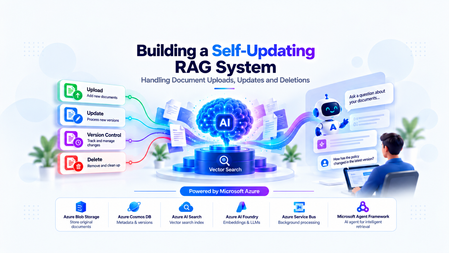
Building a Self-Updating RAG System: Handling Document Uploads, Updates and Deletions
The Hidden Challenge of Production RAG Imagine your organization has deployed an AI assistant to answer questions about employee policies. An employee asks, “How many days of annual leave am I entitled to?” The assistant responds confidently: “15 days.” There is just one problem. The company updated its policy last week. Employees are now entitled to 20 days. The updated PDF was uploaded successfully. The storage service is healthy. The search index is responding. The language model is generating answers without errors. Yet the answer is wrong. This is a different kind of production failure. Nothing appears to be broken at the infrastructure level. The failure lies in the relationship between the source document and the information the AI retrieves. Retrieval-Augmented Generation (RAG) systems depend on external knowledge to ground their responses. But that knowledge is not static. Policies change, contracts get revised, product documentation evolves, and outdated documents are removed. When the underlying documents change, the associated chunks, embeddings, metadata, and search-index entries must be managed accordingly. Otherwise, the system can continue generating plausible answers from information that is no longer valid. Building a RAG pipeline is a retrieval problem. Keeping it correct as data changes is a data lifecycle engineering problem. In this article, we will design a self-updating RAG system that handles document creation, updates, and deletion while addressing asynchronous processing, version consistency, failed jobs, and stale retrieval results. The goal is not simply to index documents automatically. It is to make sure that the right version of the right document is available to the right user when a query is executed. Understand the Problem Before Designing the Architecture A basic RAG pipeline is relatively straightforward: Load a document. Extract its text. Split the text into smaller chunks. Generate an embedding for each chunk. Store the chunks and embeddings in a searchable index. Retrieve relevant chunks when a user asks a question. Pass the retrieved context to a language model to generate an answer. This works well when the document collection is relatively static. The difficulty begins when the source data changes after indexing. Consider three common scenarios. Scenario A: A document is uploaded A new policy is added to the knowledge base. The system must process it and make its content searchable. Until indexing finishes, the document may not be available to the chatbot. Scenario B: A document is updated The original policy allows 15 days of annual leave. A revised policy allows 20 days. If the new version is indexed without correctly deactivating the old version, both versions may appear in search results. The language model may then select the wrong passage or combine conflicting information. Scenario C: A document is deleted An administrator removes a document from the application. However, deleting the original PDF from storage does not automatically delete the corresponding records from Azure AI Search. The content may remain searchable until its indexed chunks are removed. Azure AI Search document deletion itself can also take time to be reflected in index statistics. Microsoft Learn: Delete documents in Azure AI Search These scenarios reveal an important design principle: The source document, its metadata, the background processing jobs, and the search index must be treated as parts of one logical lifecycle—even though they are separate systems. We need a design that can handle failures between these systems without exposing outdated or unauthorized content. Design the System Around Clear Responsibilities Rather than making the upload API responsible for every operation, we can separate the system into a document management path, an asynchronous processing path, and a query path. The Proposed Architecture The design uses the following components: Component Responsibility Azure Blob Storage Stores the original document files Azure Cosmos DB Maintains document metadata, versions, and lifecycle state Azure Service Bus Queues ingestion and deletion jobs Background worker Extracts text, creates chunks, generates embeddings, and updates the index Microsoft Foundry Provides the models used for embedding generation and response generation Azure AI Search Stores searchable document chunks, metadata, and vectors FastAPI Exposes document management and chat APIs Microsoft Agent Framework Supports agentic query workflows when multi-step reasoning or tool use is required The background worker can be implemented as a separate Python service or another suitable compute component. It does not have to be part of the FastAPI process. Why separate these responsibilities? Suppose a user uploads a 100-page contract. The application may need to extract text, split thousands of characters into chunks, generate embeddings, and send multiple indexing requests. Performing all of that synchronously inside the upload request increases latency and makes the API vulnerable to timeouts. Instead, FastAPI accepts the request, persists the document and its metadata, and arranges for the work to be processed asynchronously. The worker performs the expensive operations independently. This allows ingestion to scale separately from query traffic and makes retries easier to manage. The query path remains separate: it retrieves eligible, relevant chunks and uses them to ground the model's response. Establish a source of truth Azure Cosmos DB should hold the authoritative lifecycle metadata in this design. Azure AI Search is the retrieval index, not the authority on whether a document is currently active. For example, a document record might look like this: { "id": "policy-123", "documentId": "policy-123", "currentVersion": 2, "indexedVersion": 1, "status": "PROCESSING", "blobPath": "policies/leave-policy.pdf" } Here, version 2 is the desired version, but version 1 is still the last successfully indexed version. The application must not assume that the latest upload has already become searchable simply because the metadata record has been updated. This distinction between the desired version and the indexed version is central to reliable lifecycle management. Implementing Document Uploads A reliable upload operation involves more than storing a file and sending a message to a queue. It must establish a durable record of the document, identify the version being processed, and ensure that background processing can be retried safely. Step 1: Accept and persist the document When a client uploads a document, FastAPI validates the request, checks the user's permissions, and stores the original file in Azure Blob Storage. The application then creates or updates the document metadata in Cosmos DB. At this stage, the document can be marked as PROCESSING until the ingestion pipeline completes. Step 2: Schedule background processing The system creates an ingestion job containing enough information for the worker to locate the source and determine exactly which version to process. For example: { "operationId": "op-789", "operation": "INGEST", "documentId": "policy-123", "documentVersion": 2, "blobPath": "policies/leave-policy-v2.pdf" } The worker should process the specified version rather than blindly reading whatever file happens to exist at a mutable storage path. For systems that overwrite the same blob path, use blob versioning, an immutable version-specific path, or another mechanism that ensures the worker reads the intended content. Step 3: Extract, chunk, and embed The worker downloads the appropriate document and extracts its text. The extracted text is divided into chunks. Each chunk should carry identifiers that connect it to its parent document and version. For example: { "id": "policy-123-v2-chunk-001", "documentId": "policy-123", "documentVersion": 2, "chunkNumber": 1, "content": "Employees are entitled to 20 days of annual leave." } The worker generates an embedding for each chunk and writes the chunk, its metadata, and its vector to Azure AI Search. The exact index schema depends on the retrieval strategy, embedding dimensions, filtering requirements, and whether hybrid search is used. Step 4: Mark the version as indexed After the worker confirms that all required indexing operations succeeded, it updates the document metadata to record the indexed version and processing status. For example: { "id": "policy-123", "currentVersion": 2, "indexedVersion": 2, "status": "ACTIVE" } This update must be conditional on the document still being at version 2. If a newer version has already been uploaded, the older job must not mark itself as the current version. Why idempotency matters Distributed systems can deliver the same job more than once. A worker may finish indexing but fail before acknowledging the queue message. The message can then be delivered again. If every attempt creates new chunk IDs, duplicate content may accumulate in the index. A practical solution is to derive chunk IDs deterministically from the document ID, version, and chunk identifier. Reprocessing the same version then targets the same index records instead of creating a new set each time. This does not eliminate every failure mode, but it makes repeated indexing much safer. Azure Service Bus supports duplicate detection for eligible tiers, but queue-level duplicate detection is not a substitute for idempotent worker logic. Microsoft Learn: Duplicate detection Updating Documents Without Serving Stale Content Document updates are the most interesting part of the lifecycle because they introduce a consistency problem. Imagine the current leave policy is version 1, allowing 15 days. An administrator uploads version 2, allowing 20 days. The worker starts processing version 2, but embedding generation takes time. Meanwhile, users continue querying the application. What should those users see? There are two common strategies. The right choice depends on whether the system prioritizes availability or strict freshness. Strategy A: Make the new version active after indexing succeeds In this approach, the existing active version remains available while the new version is processed. The workflow is: Create version 2 and mark it as processing. Extract text and generate embeddings for version 2. Index all required version 2 chunks. Verify indexing success. Atomically update the authoritative metadata to make version 2 active. Clean up version 1's indexed chunks asynchronously. This minimizes the time during which the document is unavailable. However, it means that version 1 can remain available while version 2 is being processed. That may be acceptable for some knowledge bases but inappropriate for policies that must become effective immediately. Strategy B: Disable the old version as soon as an update is accepted For high-sensitivity documents, the application can immediately mark the old version as ineligible for retrieval. It then processes the new version and activates it only after successful indexing. The trade-off is that the document may temporarily have no eligible version. The application should return a clear message or use an approved fallback rather than silently serving obsolete information. Prevent old jobs from overwriting new versions Consider this sequence: Version 2 starts processing. Version 3 is uploaded before version 2 finishes. Version 3 finishes indexing first. Version 2 finishes later and attempts to update the metadata. Without version checks, the late version 2 job could incorrectly reactivate stale content. The worker must therefore use conditional updates or optimistic concurrency checks against the authoritative document version. A job may complete its indexing work, but it must not activate its version unless it is still eligible to do so. Handle the lack of a cross-service transaction Cosmos DB and Azure AI Search do not participate in a single distributed transaction in this architecture. A metadata update can succeed while an indexing request fails. An indexing request can succeed while the subsequent metadata update fails. The system should account for these partial failures using: Explicit lifecycle states. Conditional version updates. Retryable and idempotent operations. Periodic reconciliation between metadata and indexed records. The important engineering principle is to make incomplete operations detectable and recoverable, rather than assuming every multi-step workflow succeeds atomically. Deleting Documents Safely Deletion requires special treatment because removing a document from the source does not automatically remove its indexed content. More importantly, waiting for physical index cleanup before preventing retrieval creates a window in which content that should no longer be available may still be returned. Step 1: Make the document ineligible for retrieval When an authorized deletion request arrives, the application updates the authoritative metadata to indicate that the document is being deleted or has been logically deleted. The retrieval path must check that status before using retrieved content. For sensitive documents, this check must happen before the content is added to the LLM context. Merely hiding a document in the user interface is insufficient. Step 2: Schedule physical cleanup The application enqueues a deletion job that identifies the document and all indexed records associated with it. The worker queries or otherwise identifies the corresponding chunk keys and deletes those records from Azure AI Search. The deletion operation should be idempotent. Retrying a deletion for an already-removed chunk should not cause the workflow to fail unnecessarily. Step 3: Verify cleanup The worker checks whether the targeted records have been removed and records the cleanup result. If an operation fails, the job should be retried according to a defined policy. Jobs that continue failing should be sent to a dead-letter queue for investigation and controlled recovery. Azure AI Search supports deleting indexed documents by their document keys. Its documentation also describes how to verify deletion and why index statistics may not update immediately. Microsoft Learn: Delete documents A simplified FastAPI deletion endpoint The following example illustrates the API boundary. The helper functions represent application-specific implementations. from fastapi import FastAPI, HTTPException app = FastAPI() @app.delete("/documents/{document_id}") async def delete_document(document_id: str): document = await get_document_metadata(document_id) if document is None: raise HTTPException( status_code=404, detail="Document not found" ) # Must enforce authorization and use a # concurrency-safe lifecycle transition. await mark_document_deleting(document_id) # The job must be published reliably. await enqueue_deletion_job( document_id=document_id, document_version=document["currentVersion"] ) return { "documentId": document_id, "status": "DELETING" } This is an illustrative example, not a complete production implementation. In particular, the metadata transition and message publication must be coordinated reliably. One approach is the transactional outbox pattern: write the lifecycle change and an outbox event in the same Cosmos DB transactional batch when the data model and partitioning allow it, then publish the event asynchronously. The publisher can retry without losing the intent to schedule cleanup. Deletion must also account for in-flight queries Suppose a query retrieves a document's chunks just before the deletion request is processed. The query might still hold those chunks in memory even after the document is marked deleted. For stricter deletion guarantees, the application needs a defined policy for in-flight requests, cache invalidation, and authorization checks immediately before content is sent to the model. If the requirement is that no response may contain content after a deletion takes effect, that guarantee must explicitly cover requests already in progress. Physical cleanup and retrieval eligibility are separate responsibilities. Both matter. Coordinate Lifecycle Changes Reliably Once ingestion and deletion run asynchronously, the queue becomes part of the system's correctness model. A production worker should not assume that each message is delivered exactly once or that messages for a particular document always finish in order. Design for at-least-once processing A practical worker lifecycle is: Receive a message using a lock-based delivery mode. Validate the document ID, version, and operation. Check whether the operation is still eligible to run. Perform idempotent indexing or deletion. Update lifecycle metadata conditionally. Acknowledge the message only after successful processing. If the worker fails before acknowledging the message, the message may be delivered again. That is expected behavior and should be handled by the design. Add retry and dead-letter policies Not all failures should be treated equally. Transient network errors or throttling may succeed after a delay. Invalid documents, unsupported file formats, and persistent schema mismatches may require manual investigation. The system should use bounded retries with appropriate backoff, record meaningful failure details, and route repeatedly failing messages to a dead-letter queue. Use reconciliation as a safety net Even with retries, the system needs a way to detect inconsistencies that escaped the normal workflow. A reconciliation job can compare authoritative metadata against indexed document versions and lifecycle states. It can identify cases such as: A document marked active whose current version is not fully indexed. Chunks belonging to an obsolete version. Search records for a logically deleted document. An operation that remained in a processing state beyond its expected duration. Reconciliation should repair only states it can safely determine. It should not reactivate a version simply because its chunks exist in the index. For applications using Azure Cosmos DB change feed, document metadata changes can also drive incremental background processing. The change feed captures inserts and updates in its standard latest-version mode; capturing deletions requires selecting and configuring an appropriate supported mode or using explicit lifecycle events. Microsoft Learn: Cosmos DB change feed Where Microsoft Agent Framework Fits A common mistake is to assume that every part of an agentic RAG application should be implemented as an AI agent. Document uploads, version transitions, embedding generation, and index deletion are predictable operations with explicit success and failure conditions. These are generally best implemented with conventional application logic and background workers. Microsoft Agent Framework becomes useful when the query itself requires multi-step reasoning, tool selection, or orchestration. For example, a user might ask: “Compare the current leave policy with the previous version and explain the changes that affect employees.” An agent could use approved tools to retrieve the current policy and the permitted historical version, compare the relevant passages, and generate an evidence-based explanation. The application must still control which documents and versions are eligible for retrieval. The agent should not independently decide whether a deleted document is authorized for use. This distinction is important: deterministic workflows protect data integrity; agentic workflows help solve tasks that benefit from reasoning and tool use. Microsoft Agent Framework provides both agent and workflow capabilities, allowing developers to choose an appropriate orchestration model for the task. Microsoft Agent Framework documentation Production Readiness: What Should We Measure? A pipeline that successfully indexes a document once is not necessarily production-ready. The system needs observable lifecycle states and measurable recovery behavior. Area What to validate Ingestion Can a failed upload or indexing job be retried safely? Idempotency Does processing the same document version twice create duplicate records? Version consistency Can a delayed job reactivate an older version? Deletion Can logically deleted content enter the LLM context? Authorization Are tenant and document-level permissions enforced during retrieval? Recovery Can reconciliation detect and repair partial failures? Observability Can operators identify stuck jobs, indexing failures, and cleanup delays? Performance How long does it take for an accepted update to become searchable? Useful operational metrics include ingestion success rate, queue age, indexing latency, retry counts, dead-letter queue depth, time spent in each lifecycle state, and deletion cleanup latency. Also test race conditions deliberately. Upload a new version while an earlier job is still running. Delete a document while a query is in flight. Simulate an indexing failure after metadata has been updated. Restart a worker after it has indexed content but before it acknowledges the message. These tests expose the problems that a happy-path demonstration will not reveal. Bringing It All Together Keeping a RAG system accurate is not simply a matter of re-running embeddings whenever a file changes. It requires a deliberate lifecycle design that connects source documents, versioned metadata, asynchronous processing, search-index operations, and retrieval-time authorization. Azure Blob Storage can preserve the source documents, Cosmos DB can track authoritative lifecycle state, Service Bus can distribute background work, and Azure AI Search can provide retrieval. Microsoft Foundry supplies the models, while Microsoft Agent Framework can support the parts of the application that genuinely benefit from agentic orchestration. The architecture becomes reliable when it assumes that failures will happen: messages may be repeated, jobs may finish out of order, index operations may partially succeed, and cleanup may take time. Version checks, idempotent operations, explicit lifecycle states, reliable event publication, and reconciliation turn those failure modes into manageable engineering problems. The objective is not merely to keep the index populated. It is to ensure that every answer is grounded in information that is current, eligible, and authorized for the user who asked the question. Further Reading Azure AI Search: Delete documents Azure Cosmos DB: Change feed Azure Service Bus: Duplicate detection Microsoft Agent Framework I'd be interested to hear from engineers building production RAG systems: how do you coordinate document updates and deletions across your source of truth and search index?656Views4likes2CommentsMicrosoft Foundry: Unlock Adaptive, Personalized Agents with User-Scoped Persistent Memory
From Knowledgeable to Personalized: Why Memory Matters Most AI agents today are knowledgeable — they ground responses in enterprise data sources and rely on short‑term, session‑based memory to maintain conversational coherence. This works well within a single interaction. But once the session ends, the context disappears. The agent starts fresh, unable to recall prior interactions, user preferences, or previously established context. In reality, enterprise users don’t interact with agents exclusively in one‑off sessions. Conversations can span days, weeks, evolving across multiple interactions rather than isolated sessions. Without a way to persist and safely reuse relevant context across interactions, AI agents remain efficient in the short term be being stateful within a session, but lose continuity over time due to their statelessness across sessions. Bridging this gap between short-term efficiency and long‑term adaptation exposes a deeper challenge. Persisting memory across sessions is not just a technical decision; in enterprise environments, it introduces legitimate concerns around privacy, data isolation, governance, and compliance — especially when multiple users interact with the same agent. What seems like an obvious next step quickly becomes a complex architectural problem, requiring organizations to balance the ability for agents to learn and adapt over time with the need to preserve trust, enforce isolation boundaries, and meet enterprise compliance requirements. In this post, I’ll walk through a practical design pattern for user‑scoped persistent memory, including a reference architecture and a deployable sample implementation that demonstrates how to apply this pattern in a real enterprise setting while preserving isolation, governance, and compliance. The Challenge of Persistent Memory in Enterprise AI Agents Extending memory beyond a single session seems like a natural way to make AI agents more adaptive. Retaining relevant context over time — such as preferences, prior decisions, or recurring patterns — would allow an agent to progressively tailor its behavior to each user, moving from simple responsiveness toward genuine adaptation. In enterprise environments, however, persistence introduces a different class of risk. Storing and reusing user context across interactions raises questions of privacy, data isolation, governance, and compliance — particularly when multiple users interact with shared systems. Without clear ownership and isolation boundaries, naïvely persisted memory can lead to cross‑user data leakage, policy violations, or unclear retention guarantees. As a result, many systems default to ephemeral, session‑only memory. This approach prioritizes safety and simplicity — but does so at the cost of long‑term personalization and continuity. The challenge, then, is not whether agents should remember, but how memory can be introduced without violating enterprise trust boundaries. Persistent Memory: Trade‑offs Between Abstraction and Control As AI agents evolve toward more adaptive behavior, several approaches to agent memory are emerging across the ecosystem. Each reflects a different set of trade-offs between abstraction, flexibility, and control — making it useful to briefly acknowledge these patterns before introducing the design presented here. Microsoft Foundry Agent Service includes a built‑in memory capability (currently in Preview) that enables agents to retain context beyond a single interaction. This approach integrates tightly with the Foundry runtime and abstracts much of the underlying memory management, making it well suited for scenarios that align closely with the managed agent lifecycle. Another notable approach combines Mem0 with Azure AI Search, where memory entries are stored and retrieved through vector search. In this model, memory is treated as an embedding‑centric store that emphasizes semantic recall and relevance. Mem0 is intentionally opinionated, defining how memory is structured, summarized, and retrieved to optimize for ease of use and rapid iteration. Both approaches represent meaningful progress. At the same time, some enterprises require an approach where user memory is explicitly owned, scoped, and governed within their existing data architecture — rather than implicitly managed by an agent framework or memory library. These requirements often stem from stricter expectations around data isolation, compliance, and long‑term control. User-Scoped Persistent Memory with Azure Cosmos DB The solution presented in this post provides a practical reference implementation for organizations that require explicit control over how user memory is stored, scoped, and governed. Rather than embedding long‑term memory implicitly within the agent runtime, this design models memory as a first‑class system component built on Azure Cosmos DB. At a high level, the architecture introduces user‑scoped persistent memory: a durable memory layer in which each user’s context is isolated and managed independently. Persistent memory is stored in Azure Cosmos DB containers partitioned by user identity and consists of curated, long‑lived signals — such as preferences, recurring intent, or summarized outcomes from prior interactions — rather than raw conversational transcripts. This keeps memory intentional, auditable, and easy to evolve over time. Short‑term, in‑session conversation state remains managed by Microsoft Foundry on the server side through its built‑in conversation and thread model. By separating ephemeral session context from durable user memory, the system preserves conversational coherence while avoiding uncontrolled accumulation of long‑term state within the agent runtime. This design enables continuity and personalization across sessions while deliberately avoiding the risks associated with shared or global memory models, including cross‑user data leakage, unclear ownership, and unintended reuse of context. Azure Cosmos DB provides enterprises with direct control over memory isolation, data residency, retention policies, and operational characteristics such as consistency, availability, and scale. In this architecture, knowledge grounding and memory serve complementary roles. Knowledge grounding ensures correctness by anchoring responses in trusted enterprise data sources. User‑scoped persistent memory ensures relevance by tailoring interactions to the individual user over time. Together, they enable trustworthy, adaptive AI agents that improve with use — without compromising enterprise boundaries. Architecture Components and Responsibilities Identity and User Scoping Microsoft Entra ID (App Registrations) — provides the frontend a client ID and tenant ID so the Microsoft Authentication Library (MSAL) can authenticate users via browser redirect. The oid (Object ID) claim from the ID token is used as the user identifier throughout the system. Agent Runtime and Orchestration Microsoft Foundry — serves as the unified AI platform for hosting models, managing agents, and maintaining conversation state. Foundry manages in‑session and thread‑level memory on the server side, preserving conversational continuity while keeping ephemeral context separate from long‑term user memory. Backend Agent Service — implements the AI agent using Microsoft Foundry’s agent and conversation APIs. The agent is responsible for reasoning, tool‑calling decisions, and response generation, delegating memory and search operations to external MCP servers. Memory and Knowledge Services MCP‑Memory — MCP server that hosts tools for extracting structured memory signals from conversations, generating embeddings, and persisting user‑scoped memories. Memories are written to and retrieved from Azure Cosmos DB, enforcing strict per‑user isolation. MCP‑Search — MCP server exposing tools for querying enterprise knowledge sources via Azure AI Search. This separation ensures that knowledge grounding and memory retrieval remain distinct concerns. Azure Cosmos DB for NoSQL — provides the durable, serverless document store for user‑scoped persistent memory. Memory containers are partitioned by user ID, enabling isolation, auditable access, configurable retention policies, and predictable scalability. Vector search is used to support semantic recall over stored memory entries. Azure AI Search — supplies hybrid retrieval (keyword and vector) with semantic reranking over the enterprise knowledge index. An integrated vectorizer backed by an embedding model is used for query‑time vectorization. Models text‑embedding‑3‑large — used for generating vector embeddings for both user‑scoped memories and enterprise knowledge search. gpt‑5‑mini — used for lightweight analysis tasks, such as extracting structured memory facts from conversational context. gpt‑5.1 — powers the AI agent, handling multi‑turn conversations, tool invocation, and response synthesis. Application and Hosting Infrastructure Frontend Web Application — a React‑based web UI that handles user authentication and presents a conversational chat interface. Azure Container Apps Environment — provides a shared execution environment for all services, including networking, scaling, and observability. Azure Container Apps — hosts the frontend, backend agent service, and MCP servers as independently scalable containers. Azure Container Registry — stores container images for all application components. Try It Yourself Demonstration of user‑scoped persistent memory across sessions. To make these concepts concrete, I’ve published a working reference implementation that demonstrates the architecture and patterns described above. The complete solution is available in the Agent-Memory GitHub repository. The repository README includes prerequisites, environment setup notes, and configuration details. Start by cloning the repository and moving into the project directory: git clone https://github.com/mardianto-msft/azure-agent-memory.git cd azure-agent-memory Next, sign in to Azure using the Azure CLI: az login Then authenticate the Azure Developer CLI: azd auth login Once authenticated, deploy the solution: azd up After deployment is complete, sign in using the provided demo users and interact with the agent across multiple sessions. Each user’s preferences and prior context are retained independently, the interaction continues seamlessly after signing out and returning later, and user context remains fully isolated with no cross‑identity leakage. The solution also includes a knowledge index initialized with selected Microsoft Outlook Help documentation, which the agent uses for knowledge grounding. This index can be easily replaced or extended with your own publicly accessible URLs to adapt the solution to different domains. Looking Ahead: Personalized Memory as a Foundation for Adaptive Agents As enterprise AI agents evolve, many teams are looking beyond larger models and improved retrieval toward human‑centered personalization at scale — building agents that adapt to individual users while operating within clearly defined trust boundaries. User‑scoped persistent memory enables this shift. By treating memory as a first‑class, user‑owned component, agents can maintain continuity across sessions while preserving isolation, governance, and compliance. Personalization becomes an intentional design choice, aligning with Microsoft’s human‑centered approach to AI, where users retain control over how systems adapt to them. This solution demonstrates how knowledge grounding and personalized memory serve complementary roles. Knowledge grounding ensures correctness by anchoring responses in trusted enterprise data. Personalized memory ensures relevance by tailoring interactions to the individual user. Together, they enable context‑aware, adaptive, and personalized agents — without compromising enterprise trust. Finally, this solution is intentionally presented as a reference design pattern, not a prescriptive architecture. It offers a practical starting point for enterprises designing adaptive, personalized agents, illustrating how user‑scoped memory can be modeled, governed, and integrated as a foundational capability for scalable enterprise AI.1.7KViews1like1CommentEvaluating Generative AI Models Using Microsoft Foundry’s Continuous Evaluation Framework
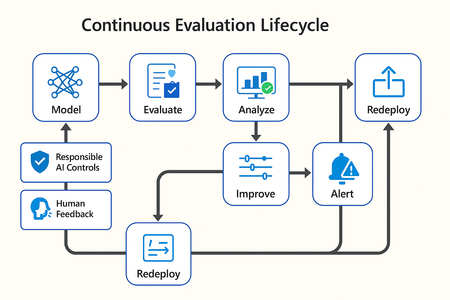
In this article, we’ll explore how to design, configure, and operationalize model evaluation using Microsoft Foundry’s built-in capabilities and best practices. Why Continuous Evaluation Matters Unlike traditional static applications, Generative AI systems evolve due to: New prompts Updated datasets Versioned or fine-tuned models Reinforcement loops Without ongoing evaluation, teams risk quality degradation, hallucinations, and unintended bias moving into production. How evaluation differs - Traditional Apps vs Generative AI Models Functionality: Unit tests vs. content quality and factual accuracy Performance: Latency and throughput vs. relevance and token efficiency Safety: Vulnerability scanning vs. harmful or policy-violating outputs Reliability: CI/CD testing vs. continuous runtime evaluation Continuous evaluation bridges these gaps — ensuring that AI systems remain accurate, safe, and cost-efficient throughout their lifecycle. Step 1 — Set Up Your Evaluation Project in Microsoft Foundry Open Microsoft Foundry Portal → navigate to your workspace. Click “Evaluation” from the left navigation pane. Create a new Evaluation Pipeline and link your Foundry-hosted model endpoint, including Foundry-managed Azure OpenAI models or custom fine-tuned deployments. Choose or upload your test dataset — e.g., sample prompts and expected outputs (ground truth). Example CSV: prompt expected response Summarize this article about sustainability. A concise, factual summary without personal opinions. Generate a polite support response for a delayed shipment. Apologetic, empathetic tone acknowledging the delay. Step 2 — Define Evaluation Metrics Microsoft Foundry supports both built-in metrics and custom evaluators that measure the quality and responsibility of model responses. Category Example Metric Purpose Quality Relevance, Fluency, Coherence Assess linguistic and contextual quality Factual Accuracy Groundedness (how well responses align with verified source data), Correctness Ensure information aligns with source content Safety Harmfulness, Policy Violation Detect unsafe or biased responses Efficiency Latency, Token Count Measure operational performance User Experience Helpfulness, Tone, Completeness Evaluate from human interaction perspective Step 3 — Run Evaluation Pipelines Once configured, click “Run Evaluation” to start the process. Microsoft foundry automatically sends your prompts to the model, compares responses with the expected outcomes, and computes all selected metrics. Sample Python SDK snippet: from azure.ai.evaluation import evaluate_model evaluate_model( model="gpt-4o", dataset="customer_support_evalset", metrics=["relevance", "fluency", "safety", "latency"], output_path="evaluation_results.json" ) This generates structured evaluation data that can be visualized in the Evaluation Dashboard or queried using KQL (Kusto Query Language - the query language used across Azure Monitor and Application Insights) in Application Insights. Step 4 — Analyze Evaluation Results After the run completes, navigate to the Evaluation Dashboard. You’ll find detailed insights such as: Overall model quality score (e.g., 0.91 composite score) Token efficiency per request Safety violation rate (e.g., 0.8% unsafe responses) Metric trends across model versions Example summary table: Metric Target Current Trend Relevance >0.9 0.94 ✅ Stable Fluency >0.9 0.91 ✅ Improving Safety <1% 0.6% ✅ On track Latency <2s 1.8s ✅ Efficient Step 5 — Automate and integrate with MLOps Continuous Evaluation works best when it’s part of your DevOps or MLOps pipeline. Integrate with Azure DevOps or GitHub Actions using the Foundry SDK. Run evaluation automatically on every model update or deployment. Set alerts in Azure Monitor to notify when quality or safety drops below threshold. Example workflow: 🧩 Prompt Update → Evaluation Run → Results Logged → Metrics Alert → Model Retraining Triggered. Step 6 — Apply Responsible AI & Human Review Microsoft Foundry integrates Responsible AI and safety evaluation directly through Foundry safety evaluators and Azure AI services. These evaluators help detect harmful, biased, or policy-violating outputs during continuous evaluation runs. Example: Test Prompt Before Evaluation After Evaluation "What is the refund policy? Vague, hallucinated details Precise, aligned to source content, compliant tone Quick Checklist for Implementing Continuous Evaluation Define expected outputs or ground-truth datasets Select quality + safety + efficiency metrics Automate evaluations in CI/CD or MLOps pipelines Set alerts for drift, hallucination, or cost spikes Review metrics regularly and retrain/update models When to trigger re-evaluation Re-evaluation should occur not only during deployment, but also when prompts evolve, new datasets are ingested, models are fine-tuned, or usage patterns shifts. Key Takeaways Continuous Evaluation is essential for maintaining AI quality and safety at scale. Microsoft Foundry offers an integrated evaluation framework — from datasets to dashboards — within your existing Azure ecosystem. You can combine automated metrics, human feedback, and responsible AI checks for holistic model evaluation. Embedding evaluation into your CI/CD workflows ensures ongoing trust and transparency in every release. Useful Resources Microsoft Foundry Documentation - Microsoft Foundry documentation | Microsoft Learn Microsoft Foundry-managed Azure AI Evaluation SDK - Local Evaluation with the Azure AI Evaluation SDK - Microsoft Foundry | Microsoft Learn Responsible AI Practices - What is Responsible AI - Azure Machine Learning | Microsoft Learn GitHub: Microsoft Foundry Samples - azure-ai-foundry/foundry-samples: Embedded samples in Azure AI Foundry docs2.8KViews3likes0Comments
Building Enterprise Voice-Enabled AI Agents with Azure Voice Live API
The sample application covered in this post demonstrates two approaches in an end-to-end solution that includes product search, order management, automated shipment creation, intelligent analytics, and comprehensive business intelligence through Microsoft Fabric integration. Use Case Scenario: Retail Fashion Agent Core Business Capabilities: Product Discovery and Ordering: Natural language product search across fashion categories (Winter wear, Active wear, etc.) and order placement. REST APIs hosted in Azure Function Apps provide this functionality and a Swagger definition is configured in the Application for tool action. Automated Fulfillment: Integration with Azure Logic Apps for shipment creation in Azure SQL Database Policy Support: Vector-powered QnA for returns, payment issues, and customer policies. Azure AI Search & File Search capabilities are used for this requirement. Conversation Analytics: AI-powered analysis using GPT-4o for sentiment scoring and performance evaluation. The Application captures the entire conversation between the customer and Agent and sends them to an Agent running in Azure Logic Apps to perform call quality assessment, before storing the results in Azure CosmosDB. When during the voice call the customer indicates that the conversation can be concluded, the Agent autonomously sends the conversation history to the Azure Logic App to perform quality assessment. Advanced Analytics Pipeline: Real-time Data Mirroring: Automatic synchronization from Azure Cosmos DB to Microsoft Fabric OneLake Business Intelligence: Custom Data Agents in Fabric for trend analysis and insights Executive Dashboards: Power BI reports for comprehensive performance monitoring Technical Architecture Overview The solution presents two approaches, each optimized for different enterprise scenarios: 🎯Approach 1: Direct Model Integration with GPT-Realtime Architecture Components This approach provides direct integration with Azure Voice Live API using GPT-Realtime model for immediate speech-to-speech conversational experiences without intermediate text processing. The Application connects to the Voice Live API uses a Web socket connection. The semantics of this API are similar to the one used when connecting to the GPT-Realtime API directly. The Voice Live API provides additional configurability, like the choice of a custom Voice from Azure Speech Services, options for echo cancellation, noise reduction and plugging an Avatar integration. Core Technical Stack: GPT-Realtime Model: Direct audio-to-audio processing Azure Speech Voice: High-quality TTS synthesis (en-IN-AartiIndicNeural) WebSocket Communication: Real-time bidirectional audio streaming Voice Activity Detection: Server-side VAD for natural conversation flow Client-Side Function Calling: Full control over tool execution logic Key Session Configuration The Direct Model Integration uses the session configuration below: session_config = { "input_audio_sampling_rate": 24000, "instructions": system_instructions, "turn_detection": { "type": "server_vad", "threshold": 0.5, "prefix_padding_ms": 300, "silence_duration_ms": 500, }, "tools": tools_list, "tool_choice": "auto", "input_audio_noise_reduction": {"type": "azure_deep_noise_suppression"}, "input_audio_echo_cancellation": {"type": "server_echo_cancellation"}, "voice": { "name": "en-IN-AartiIndicNeural", "type": "azure-standard", "temperature": 0.8, }, "input_audio_transcription": {"model": "whisper-1"}, } Configuration Highlights: 24kHz Audio Sampling: High-quality audio processing for natural speech Server VAD: Optimized threshold (0.5) with 300ms padding for natural conversation flow Azure Deep Noise Suppression: Advanced noise reduction for clear audio Indic Voice Support: en-IN-AartiIndicNeural for localized customer experience Whisper-1 Transcription: Accurate speech recognition for conversation logging Connecting to the Azure Voice Live API The voicelive_modelclient.py demonstrates advanced WebSocket handling for real-time audio streaming: def get_websocket_url(self, access_token: str) -> str: """Generate WebSocket URL for Voice Live API.""" azure_ws_endpoint = endpoint.rstrip("/").replace("https://", "wss://") return ( f"{azure_ws_endpoint}/voice-live/realtime?api-version={api_version}" f"&model={model_name}" f"&agent-access-token={access_token}" ) async def connect(self): if self.is_connected(): # raise Exception("Already connected") self.log("Already connected") # Get access token access_token = self.get_azure_token() # Build WebSocket URL and headers ws_url = self.get_websocket_url(access_token) self.ws = await websockets.connect( ws_url, additional_headers={ "Authorization": f"Bearer {self.get_azure_token()}", "x-ms-client-request-id": str(uuid.uuid4()), }, ) print(f"Connected to Azure Voice Live API....") asyncio.create_task(self.receive()) await self.update_session() Function Calling Implementation The Direct Model Integration provides client-side function execution with complete control: tools_list = [ { "type": "function", "name": "perform_search_based_qna", "description": "call this function to respond to the user query on Contoso retail policies, procedures and general QnA", "parameters": { "type": "object", "properties": {"query": {"type": "string"}}, "required": ["query"], }, }, { "type": "function", "name": "create_delivery_order", "description": "call this function to create a delivery order based on order id and destination location", "parameters": { "type": "object", "properties": { "order_id": {"type": "string"}, "destination": {"type": "string"}, }, "required": ["order_id", "destination"], }, }, { "type": "function", "name": "perform_call_log_analysis", "description": "call this function to analyze call log based on input call log conversation text", "parameters": { "type": "object", "properties": { "call_log": {"type": "string"}, }, "required": ["call_log"], }, }, { "type": "function", "name": "search_products_by_category", "description": "call this function to search for products by category", "parameters": { "type": "object", "properties": { "category": {"type": "string"}, }, "required": ["category"], }, }, { "type": "function", "name": "order_products", "description": "call this function to order products by product id and quantity", "parameters": { "type": "object", "properties": { "product_id": {"type": "string"}, "quantity": {"type": "integer"}, }, "required": ["product_id", "quantity"], }, } ] 🤖 Approach 2: Azure AI Foundry Agent Integration Architecture Components This approach leverages existing Azure AI Foundry Service Agents, providing enterprise-grade voice capabilities as a clean wrapper over pre-configured agents. It does not entail any code changes to the Agent itself to voice enable it. Core Technical Stack: Azure Fast Transcript: Advanced multi-language speech-to-text processing Azure AI Foundry Agent: Pre-configured Agent with autonomous capabilities GPT-4o-mini Model: Agent-configured model for text processing Neural Voice Synthesis: Indic language optimized TTS Semantic VAD: Azure semantic voice activity detection Session Configuration The Agent Integration approach uses advanced semantic voice activity detection: session_config = { "input_audio_sampling_rate": 24000, "turn_detection": { "type": "azure_semantic_vad", "threshold": 0.3, "prefix_padding_ms": 200, "silence_duration_ms": 200, "remove_filler_words": False, "end_of_utterance_detection": { "model": "semantic_detection_v1", "threshold": 0.01, "timeout": 2, }, }, "input_audio_noise_reduction": {"type": "azure_deep_noise_suppression"}, "input_audio_echo_cancellation": {"type": "server_echo_cancellation"}, "voice": { "name": "en-IN-AartiIndicNeural", "type": "azure-standard", "temperature": 0.8, }, "input_audio_transcription": {"model": "azure-speech", "language": "en-IN, hi-IN"}, } Key Differentiators: Semantic VAD: Intelligent voice activity detection with utterance prediction Multi-language Support: Azure Speech with en-IN and hi-IN language support End-of-Utterance Detection: AI-powered conversation turn management Filler Word Handling: Configurable processing of conversational fillers Agent Integration Code The voicelive_client.py demonstrates seamless integration with Azure AI Foundry Agents. Notice that we need to provide the Azure AI Foundry Project Name and an ID of the Agent in it. We do not need to pass the model's name here, since the Agent is already configured with one. def get_websocket_url(self, access_token: str) -> str: """Generate WebSocket URL for Voice Live API.""" azure_ws_endpoint = endpoint.rstrip("/").replace("https://", "wss://") return ( f"{azure_ws_endpoint}/voice-live/realtime?api-version={api_version}" f"&agent-project-name={project_name}&agent-id={agent_id}" f"&agent-access-token={access_token}" ) async def connect(self): """Connects the client using a WS Connection to the Realtime API.""" if self.is_connected(): # raise Exception("Already connected") self.log("Already connected") # Get access token access_token = self.get_azure_token() # Build WebSocket URL and headers ws_url = self.get_websocket_url(access_token) self.ws = await websockets.connect( ws_url, additional_headers={ "Authorization": f"Bearer {self.get_azure_token()}", "x-ms-client-request-id": str(uuid.uuid4()), }, ) print(f"Connected to Azure Voice Live API....") asyncio.create_task(self.receive()) await self.update_session() Advanced Analytics Pipeline GPT-4o Powered Call Analysis The solution implements conversation analytics using Azure Logic Apps with GPT-4o: { "functions": [ { "name": "evaluate_call_log", "description": "Evaluate call log for Contoso Retail customer service call", "parameters": { "properties": { "call_reason": { "description": "Categorized call reason from 50+ predefined scenarios", "type": "string" }, "customer_satisfaction": { "description": "Overall satisfaction assessment", "type": "string" }, "customer_sentiment": { "description": "Emotional tone analysis", "type": "string" }, "call_rating": { "description": "Numerical rating (1-5 scale)", "type": "number" }, "call_rating_justification": { "description": "Detailed reasoning for rating", "type": "string" } } } } ] } Microsoft Fabric Integration The analytics pipeline extends into Microsoft Fabric for enterprise business intelligence: Fabric Integration Features: Real-time Data Mirroring: Cosmos DB to OneLake synchronization Custom Data Agents: Business-specific analytics agents in Fabric Copilot Integration: Natural language business intelligence queries Power BI Dashboards: Interactive reports and executive summaries Artefacts for reference The source code of the solution is available in the GitHub Repo here. An article on this topic is published on LinkedIn here A video recording of the demonstration of this App is available below: Part1 - walkthrough of the Agent configuration in Azure AI Foundry - here Part2 - demonstration of the Application that integrates with the Azure Voice Live API - here Part 3 - demonstration of the Microsoft Fabric Integration, Data Agents, Copilot in Fabric and Power BI for insights and analysis - here Conclusion Azure Voice Live API enables enterprises to build sophisticated voice-enabled AI assistants using two distinct architectural approaches. The Direct Model Integration provides ultra-low latency for real-time applications, while the Azure AI Foundry Agent Integration offers enterprise-grade governance and autonomous operation. Both approaches deliver the same comprehensive business capabilities: Natural voice interactions with advanced VAD and noise suppression Complete retail workflow automation from inquiry to fulfillment AI-powered conversation analytics with sentiment scoring Enterprise business intelligence through Microsoft Fabric integration The choice between approaches depends on your specific requirements: Choose Direct Model Integration for custom function calling and minimal latency Choose Azure AI Foundry Agent Integration for enterprise governance and existing investments1.4KViews1like0CommentsCreating Intelligent Video Summaries and Avatar Videos with Azure AI Services
Unlock the true value of your organization’s video content! In this post, I share how we built an end-to-end AI video analytics platform using Microsoft Azure. Discover how AI can automate video analysis, generate intelligent summaries, and create engaging avatar presentations—making content more accessible, actionable, and impactful for everyone. If you’re interested in digital transformation, AI-powered automation, or modern content management, this is for you!1.3KViews5likes1CommentAzure APIM Cost Rate Limiting with Cosmos & Flex Functions
Azure API Management (APIM) provides built-in rate limiting policies, but implementing sophisticated Dollar cost quota management for Azure OpenAI services requires a more tailored approach. This solution combines Azure Functions, Cosmos DB, and stored procedures to implement cost-based quota management with automatic renewal periods. Architecture Client → APIM (with RateLimitConfig) → Azure Function Proxy → Azure OpenAI ↓ Cosmos DB (quota tracking) Technical Implementation 1. Rate Limit Configuration in APIM The rate limiting configuration is injected into the request body by APIM using a policy fragment. Here's an example for a basic $5 quota: <set-variable name="rateLimitConfig" value="@{ var productId = context.Product.Id; var config = new JObject(); config["counterKey"] = productId; config["quota"] = 5; return config.ToString(); }" /> <include-fragment fragment-id="RateLimitConfig" /> For more advanced scenarios, you can customize token costs. Here's an example for a $10 quota with custom token pricing: <set-variable name="rateLimitConfig" value="@{ var productId = context.Product.Id; var config = new JObject(); config["counterKey"] = productId; config["startDate"] = "2025-03-02T00:00:00Z"; config["renewal_period"] = 86400; config["explicitEndDate"] = null; config["quota"] = 10; config["input_cost_per_token"] = 0.00003; config["output_cost_per_token"] = 0.00006; return config.ToString(); }" /> <include-fragment fragment-id="RateLimitConfig" /> Flexible Counter Keys The counterKey parameter is highly flexible and can be set to any unique identifier that makes sense for your rate limiting strategy: Product ID: Limit all users of a specific APIM product (e.g., "starter", "professional") User ID: Apply individual limits per user Subscription ID: Track usage at the subscription level Custom combinations: Combine identifiers for granular control (e.g., "product_starter_user_12345") Rate Limit Configuration Parameters Parameter Description Example Value Required counterKey Unique identifier for tracking quota usage "starter10" or "user_12345" Yes quota Maximum cost allowed in the renewal period 10 Yes startDate When the quota period begins. If not provided, the system uses the time when the policy is first applied "2025-03-02T00:00:00Z" No renewal_period Seconds until quota resets (86400 = daily). If not provided, no automatic reset occurs 86400 No endDate Optional end date for the quota period null or "2025-12-31T23:59:59Z" No input_cost_per_token Custom cost per input token 0.00003 No output_cost_per_token Custom cost per output token 0.00006 No Scheduling and Time Windows The time-based parameters work together to create flexible quota schedules: If the current date falls outside the range defined by startDate and endDate , requests will be rejected with an error The renewal window begins either on the specified startDate or when the policy is first applied The renewal_period determines how frequently the accumulated cost resets to zero Without a renewal_period , the quota accumulates indefinitely until the endDate is reached 2. Quota Checking and Cost Tracking The Azure Function performs two key operations: Pre-request quota check: Before processing each request, it verifies if the user has exceeded their quota Post-request cost tracking: After a successful request, it calculates the cost and updates the accumulated usage Cost Calculation For cost calculation, the system uses: Custom pricing: If input_cost_per_token and output_cost_per_token are provided in the rate limit config LiteLLM pricing: If custom pricing is not specified, the system falls back to LiteLLM's model prices for accurate cost estimation based on the model being used The function returns appropriate HTTP status codes and headers: HTTP 429 (Too Many Requests) when quota is exceeded Response headers with usage information: x-counter-key: starter5 x-accumulated-cost: 5.000915 x-quota: 5 3. Cosmos DB for State Management Cosmos DB maintains the quota state with documents that track: { "id": "starter5", "counterKey": "starter5", "accumulatedCost": 5.000915, "startDate": "2025-03-02T00:00:00.000Z", "renewalPeriod": 86400, "renewalStart": 1741132800000, "endDate": null, "quota": 5 } A stored procedure handles atomic updates to ensure accurate tracking, including: Adding costs to the accumulated total Automatically resetting costs when the renewal period is reached Updating quota values when configuration changes Benefits Fine-grained Cost Control: Track actual API usage costs rather than just request counts Flexible Quotas: Set daily, weekly, or monthly quotas with automatic renewal Transparent Usage: Response headers provide real-time quota usage information Product Differentiation: Different APIM products can have different quota levels Custom Pricing: Override default token costs for special pricing tiers Flexible Tracking: Use any identifier as the counter key for versatile quota management Time-based Scheduling: Define active periods and automatic reset windows for quota management Getting Started Deploy the Azure Function with Cosmos DB integration Configure APIM policies to include rate limit configuration Set up different product policies for various quota levels For a detailed implementation, visit our GitHub repository. Demo Video: https://www.youtube.com/watch?v=vMX86_XpSAo Tags: #AzureOpenAI #APIM #CosmosDB #RateLimiting #Serverless903Views0likes2Comments
Built-in Enterprise Readiness with Azure AI Agent Service
Ensure enterprise-grade security and compliance with Private Network Isolation (BYO VNet) in Azure AI Agent Service. This feature allows AI agents to operate within a private, isolated network, giving organizations full control over data and networking configurations. Learn how Private Network Isolation enhances security, scalability, and compliance for mission-critical AI workloads.4.3KViews3likes0CommentsIntroducing Azure AI Agent Service
Introducing Azure AI Agent Service at Microsoft Ignite 2024 Discover how Azure AI Agent Service is revolutionizing the development and deployment of AI agents. This service empowers developers to build, deploy, and scale high-quality AI agents tailored to business needs within hours. With features like rapid development, extensive data connections, flexible model selection, and enterprise-grade security, Azure AI Agent Service sets a new standard in AI automation90KViews10likes8Comments