azure architecture
7 TopicsPath to production for agents: a Microsoft Azure AI Tech Accelerator
Move AI agents from experimentation to production with trusted architecture, governance, and operations. Many organizations have made progress with AI prototypes, but struggle to turn early success into systems that are secure, reliable, and ready for real-world use. If you want to bridge that gap with practical, engineering-focused guidance across the full AI lifecycle—from foundational governance and architecture to deployment, security, and ongoing operation—don't miss this event. Learn how to establish trust in AI systems, design architectures that scale with control, and operate agentic solutions with confidence over time. Explore proven patterns for building production-ready foundations, managing risk and cost, and maintaining performance in dynamic, non-deterministic environments. Walk away with a clear path forward, offering actionable strategies and playbooks you can use to deliver secure, compliant, and high-performing AI solutions in your organization. Organizational policies preventing you from watching and participating here on the Tech Community? Sign in with a personal account or tune in on LinkedIn. (You'll find LinkedIn event links on each session page.) Day 1: Now on demand Build an AI Center of Excellence for agent governance Design Azure AI Landing Zones for production at scale A Microsoft blueprint for scalable agentic AI systems Day 2 - Now on demand Monitor and govern AI agents in production with AgentOps What it looks like: Trusted, compliant AI systems at scale How to keep agentic workloads orchestrated, fast, and affordable8.1KViews5likes3CommentsA Microsoft blueprint for scalable agentic AI systems
Explore a governance-first, multi-agent architecture that embeds consistent controls and quality checks across every layer. Many AI pilots don't fail because of technology; they fail because the architecture isn't designed for trust. Agentic AI architecture enables trusted, scalable AI systems with built-in governance and control from user interactions and agent orchestration to integrations, data, and models. See how aligning these layers under a unified security and governance framework creates a resilient, enterprise-wide AI fabric. You'll leave with a clear blueprint for building interoperable, trustworthy AI systems that are designed to scale without compromising control. How do I participate? Select Add to Calendar to save the date, then click the Attend button to save your spot, receive event reminders, and participate in the Q&A. Not able to attend live? This session will be recorded and available on demand shortly after airing. Just announced! Live Q&A will also be available July 28 from 10:00-11:00 AM SGT (UTC+8) to support attendees in Asia and western Australia. Don't see Attend or Add to Calendar? Sign in to the Tech Community to join the conversation. Organizational policies preventing you from signing in to the Tech Community? Use a personal account or tune in on LinkedIn. This session is part of Path to production for agents: a Microsoft Azure AI Tech Accelerator. View the full agenda for more actionable strategies to help you deliver secure, compliant, and high-performing AI solutions across your organization.1.7KViews0likes6CommentsHow to keep agentic workloads orchestrated, fast, and affordable
Getting AI to production is only half the battle. Once agentic workloads are live, organizations face compounding challenges: token costs that grow non-linearly, latency that degrades user trust, Retrieval-Augmented Generation (RAG) pipelines that return noise instead of signal, and orchestration overhead that multiplies with every agent added to the mesh. This is where the real engineering begins. Wrap up your Path to production Tech Accelerator experience with a practical optimization playbook for agentic AI, from model selection and inference routing to prompt compression, RAG tuning, and caching strategies. Learn how to manage orchestration complexity across multi-agent systems while improving signal quality and response times. Explore FinOps practices for AI, including capacity planning, batch processing, and intelligent model routing. Walk away with actionable techniques to reduce inference costs, cut latency, and scale reliably across regions. How do I participate? Select Add to Calendar to save the date, then click the Attend button to save your spot, receive event reminders, and participate in the Q&A. Not able to attend live? This session will be recorded and available on demand shortly after airing. Just announced! Live Q&A will also be available July 29 from 10:00-11:00 AM SGT (UTC+8) to support attendees in Asia and western Australia. Don't see Attend or Add to Calendar? Sign in to the Tech Community to join the conversation. Organizational policies preventing you from signing in to the Tech Community? Use a personal account or tune in on LinkedIn. This session is part of Path to production for agents: a Microsoft Azure AI Tech Accelerator. View the full agenda for more actionable strategies to help you deliver secure, compliant, and high-performing AI solutions across your organization.918Views0likes4CommentsDesign Azure AI Landing Zones for production at scale
If you’re moving beyond AI experiments, you need more than great models; you need a foundation you can trust. Azure AI Landing Zones enable secure, scalable AI deployment with proven architectures and governance. Learn how to use Landing Zones as your production-ready blueprint for deploying AI applications and agents with built-in guardrails for networking, identity, security, and cost control. Get insights to help you apply the Cloud Adoption Framework and the Azure Well-Architected Framework to design platforms that support innovation without sacrificing compliance. Walk away knowing how to accelerate time-to-production using validated architectures, infrastructure as code (IaC), and seamless integration with your enterprise environment. How do I participate? Select Add to Calendar to save the date, then click the Attend button to save your spot, receive event reminders, and participate in the Q&A. Not able to attend live? This session will be recorded and available on demand shortly after airing. Just announced! Live Q&A will also be available July 28 from 9:00-10:00 AM SGT (UTC+8) to support attendees in Asia and western Australia. Don't see Attend or Add to Calendar? Sign in to the Tech Community to join the conversation. Organizational policies preventing you from signing in to the Tech Community? Use a personal account or tune in on LinkedIn. This session is part of Path to production for agents: a Microsoft Azure AI Tech Accelerator. View the full agenda for more actionable strategies to help you deliver secure, compliant, and high-performing AI solutions across your organization.1.9KViews1like5CommentsProactively design, deploy & monitor resilient Azure workloads
Do you want to know how to get resilient and stay resilient? Explore the architectural features needed to uphold stringent uptime requirements for critical deployments. Learn how to design resiliency into workloads and environments by implementing Azure landing zones and infrastructure-as-code modules. We will demo native bicep and Azure Verified Modules while explaining the scenarios in which you need those. We'll also show how to use the Azure Proactive Resiliency Library, Azure Advisor and Azure Monitor baseline alerts to minimize outage impacts and increase productivity. This session is part of Tech Accelerator: Mastering Azure and AI adoption. View the full agenda for more great sessions and insights.501Views2likes1Comment
Leverage Azure Durable Functions to build lightweight ETL Data Jobs
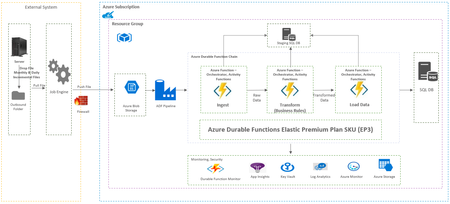
This blog is co-authored by Dr. Magesh Kasthuri, Distinguished Member of Technical Staff (Wipro) and Sanjeev Radhakishin Assudani, Azure COE Principal Architect (Wipro). This blog post aims to provide you with insights into how Azure Durable functions can be considered as an alternate design choice to build lightweight Azure native solution for data ingestion and transformation. While the solution discussed in this blog pertains to a healthcare industry customer, the design approach presented here is generic and applicable across industries. The scenario A leading healthcare provider planned to modernize Medicare Auto Enrollment Engine (AEE) and Premium Billing capabilities to enable a robust, scalable, and cost-effective solution across their Medicare business line. One of the key requirements was to build an integration layer to their healthcare administration platform into its database which will process the benefit enrollment and maintenance of hundreds of JSON files. Proposed solution will ingest, transform, and load the data in their Database platform on a daily incremental file and monthly audit file basis. The challenge was to identify a most cost effective ETL data engine solution in the real-world scenario to do complex processing in the integration layer yet lightweight. Below is the list of possible solutions identified: o Azure Data Bricks o Mulesoft APIs o Azure Logic Apps o Azure Durable Functions After careful evaluation, Azure Durable Function was chosen to build the integration layer. The following objectives were identified: Azure Durable functions offer modernized and scalable solution for building and managing serverless workflows Lightweight data jobs can be implemented using durable functions and avoid heavy compute intensive services when not needed. Optimized performance to complete the end-to-end enrichment process within hours. Solution components In today's data-driven world, the ability to efficiently handle ETL (Extract, Transform, Load) jobs is crucial for any organization looking to gain insights from their data. Azure provides a robust platform to develop native solutions for ETL jobs, utilizing a combination of Azure Data Factory (ADF) pipelines, Azure Durable Functions, Azure SQL Database, and Azure Storage. This article will guide you through the detailed process of developing an Azure native solution for ETL jobs, encompassing data load, ingestion, transformation, and staging activities. This solution approach avoids Azure Data Lake (ADLS 2) or Databricks to avoid cost bulge or heavy weight architecture and also helps you to define a lightweight reference architecture for high load data processing jobs. Architecture Overview The architecture for an Azure native ETL solution involves several components working together seamlessly. The key components include: Azure Data Factory (ADF) Pipeline: Orchestrates data flow and automates ETL processes. Azure Durable Functions: Handles ingestion and transformation tasks using C# and .NET code. Azure SQL Database: Used for data enrichment and final storage. Azure Storage: To store raw feed files, manage staging activities and temporary data storage. Application Insights & Monitoring: Provides observability and activity tracking. Azure Durable Function Monitor: It provides UI to debug, monitor and manage the orchestration instances. Azure Key Vault: To store secrets like keys, connection strings. Architecture Diagram Azure Data Factory (ADF) Pipeline ADF serves as the backbone of the ETL process. It orchestrates the entire data flow, ensuring that data is moved efficiently from one stage to another. ADF pipelines can be scheduled to run at specific intervals or triggered by events, providing flexibility in managing ETL workflows. Azure Blob Storage Azure Blob Storage acts as the initial landing zone for raw feed data. It is highly scalable and cost-effective, making it ideal for storing large volumes of data. Data is loaded into Blob Storage from various sources, ready for further processing. Azure Durable Functions Durable Functions are a powerful feature of Azure Functions that allow for long-running, stateful operations. Using C# and .NET code, Durable Functions can perform complex data ingestion and transformation tasks. They provide reliability and scalability, ensuring that data processing is efficient and fault tolerant. Azure SQL Database Azure SQL Database is used for data enrichment and final storage. After the transformation process, data is loaded into the SQL database where it can be enriched with additional metadata and made ready for analytics and reporting. It provides high performance, security, and availability. Azure Storage for Staging Activities During the ETL process, intermediate data needs to be temporarily stored. Azure Storage plays a crucial role in managing these staging activities. It ensures that data is available for subsequent processing steps, maintaining the integrity and flow of the ETL pipeline. Observability and Monitoring Application Insights Application Insights is an essential tool for monitoring the health and performance of your ETL solution. It provides real-time insights into application performance, helping to identify and troubleshoot issues quickly. By tracking metrics and logs, you can ensure that your ETL processes are running smoothly and efficiently. Activity Tracking Activity tracking is crucial for understanding the flow and status of data through the ETL pipeline. Logging and monitoring tools can provide detailed information about each step in the process, allowing for better visibility and control. This ensures that any anomalies or failures can be detected and addressed promptly. Durable Function Monitor This is an important tool to list, monitor and debug the orchestrations inside the Azure Durable Function. We can configure this as an extension in Visual Studio code. It helps to view the different instances of orchestrators and activity functions. It also shows the time taken to execute them, this is important for tracking the performance of the different steps in the ETL process. We can also view the Azure Durable Function in the form of a function graph. Kudu Logs This traces the execution of the different orchestrators, activity functions and the native functions. This helps to see the exceptions raised, or whether there are replay happening for the orchestrators, activity functions. Best Practices for Implementing the Solution Here are some best practices to ensure the successful implementation of your Azure native ETL solution: Design for Scalability: Ensure that your solution can handle increasing data volumes and processing demands by leveraging Azure's scalable services. Optimize Data Storage: Use appropriate data storage solutions for different stages of the ETL process, balancing cost and performance. Implement Robust Monitoring: Use Application Insights, Durable Function Monitor and other monitoring tools to track performance and detect issues early. Ensure Data Security: Implement strong security measures to protect sensitive data at rest and in transit. Automate and Schedule Pipelines: Use ADF to automate and schedule ETL pipelines, reducing manual intervention and ensuring consistency. Use Durable Functions for Complex Tasks: Leverage Azure Durable Functions for long running and stateful operations, ensuring reliability and efficiency. By following these guidelines and leveraging Azure's powerful tools and services, you can develop a robust and efficient ETL solution that meets your data processing needs. Azure provides a flexible and scalable platform, enabling you to handle large data volumes and complex transformations with ease. Embrace the power of Azure to unlock the full potential of your data.1.1KViews4likes1CommentDevelop modern connected apps with the MEC Accelerator and 5G Kit
Today, 5G enables new applications for scenarios that were previously out of reach. From smart roads that can notify of obstacles in the road in real time to smart airports that can identify runway issues before they threaten safety, a new breed of real-time and mission-critical applications is emerging. Developers can now start building their own MEC/Edge application by forking and evolving our open source MEC Application Solution Accelerator. This is an example application that offers a common foundation based on a light microservices architecture designed for the edge. It includes Kubernetes, docker containers, and Dapr framework. It also includes AI model inferencing capabilities with an example deep learning model that analyzes video coming from cameras, as well as MQTT event-driven communication following a publish/subscription pattern to raise events/alerts after detecting issues with the AI models. Who should attend? • Developers interested in building real-time and mission-critical applications for the edge with low latency. • Individuals interested in learning about AI model inferencing capabilities and deep learning models for analyzing video. • Professionals seeking to learn about light/fast event-driven communication between AI models events/alerts handlers. What will I learn? • How to build MEC/Edge applications using the open source MEC Application Solution Accelerator. • Understanding and get ready to get started on a light microservices and event-driven architecture, based on Kubernetes, Docker containers, Dapr framework and MQTT messaging broker for edge/mec applications with low latency. • The potential of 5G technology and how it enables new applications for previously unreachable scenarios. Pre-Register at: https://aka.ms/ModernConnectedApplications05.16 Watch Livestream at: https://aka.ms/ModernConnectedApplications5/151.9KViews0likes0Comments