aks
1 Topic
What’s new in AKS networking: Connectivity, performance, and observability
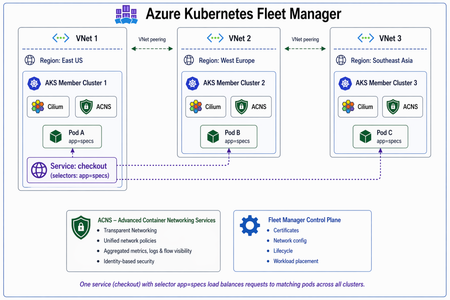
As organizations scale their cloud-native applications, networking requirements continue to evolve. AI and high-performance computing workloads demand high-throughput, low-latency connectivity, applications increasingly span multiple Kubernetes clusters and enterprises need greater control over how workload traffic is routed and isolated. At the same time, platform teams need deeper network visibility that is customizable without the complexity and cost of collecting unnecessary data. At Microsoft, our focus is to simplify these AKS networking challenges, enabling customers to build and scale AI applications without having to manage increasingly complex networking infrastructure. This November, container networking in Azure is introducing four capabilities designed to help customers build, scale, and operate the next generation of applications on AKS. These advancements address three key customer scenarios: · Connect distributed applications: Simplify connectivity and service discovery across Kubernetes clusters, making it easier to build and manage distributed applications. · Enable AI and specialized workloads: Support high-performance networking for distributed AI training and HPC, along with flexible network configurations for data-intensive and specialized applications. · Operate with customizable visibility and control: Gain deeper insights into application networking, troubleshoot issues faster, and manage observability costs through targeted telemetry collection. Together, these capabilities expand what customers can run on AKS while reducing the complexity of the underlying networking infrastructure. Connect distributed applications Cross-cluster networking for Azure Kubernetes Fleet Manager | Generally Available As enterprises scale their applications across multiple Kubernetes clusters, connecting services across cluster boundaries often requires additional networking infrastructure, complex configurations, and operational overhead. With the general availability of cross-cluster networking for Azure Kubernetes Fleet Manager, part of Advanced Container Networking Services, customers can connect workloads across AKS clusters without deploying and managing gateways or proxies. For example, an enterprise running applications across multiple AKS clusters can enable services to discover and communicate with each other as though they were running within a single cluster. Built on Cilium, this capability also extends network policy enforcement and observability across cluster boundaries. The result is simpler multi-cluster application architectures, reduced operational complexity, and greater visibility into application connectivity as environments scale. Learn more about cross-cluster networking at: https://learn.microsoft.com/en-us/azure/kubernetes-fleet/concepts-cross-cluster-networking Enable AI and specialized workloads Multi-NIC pods for AKS | Public Preview Traditional Kubernetes networking provides a single primary network interface for application traffic. However, enterprises running specialized workloads often need to separate different types of network traffic to meet their performance, connectivity, and isolation requirements. With Multi-NIC pods support in AKS, customers can attach multiple network interfaces to Kubernetes nodes and workloads, enabling greater control over how traffic is routed. For example, an enterprise running data-intensive applications can use separate network interfaces for application communication and storage traffic, helping isolate workloads and optimize network resource utilization. Multi-NIC pods give customers greater flexibility to design Kubernetes networking architectures around their application requirements, without having to manage additional networking components themselves. Learn more about Multi-NIC pods at: https://learn.microsoft.com/en-us/azure/aks/multiple-network-interfaces-for-pods-overview Managed support for DRANET for RDMA | Generally Available AI training, machine learning, and high-performance computing workloads require fast, efficient communication between GPUs and compute resources. Configuring and managing the specialized networking infrastructure needed for these workloads can introduce significant operational complexity. With Managed support for DRANET for RDMA NICs in AKS, we're simplifying access to high-throughput, low-latency networking through a managed experience that supports topology-aware resource allocation. For example, organizations running distributed AI training workloads can more easily provision RDMA networking resources to support accelerated communication between compute nodes, without taking on the complexity of managing the underlying networking configuration. This enables customers to focus on scaling their AI and HPC workloads while taking advantage of the performance capabilities of RDMA-enabled Azure infrastructure. Learn more about managed support for DRANET for RDMA at: https://learn.microsoft.com/en-gb/azure/aks/managed-support-for-dranet?tabs=add-ubuntu-rdma-node-pool Operate with customizable visibility and control Configurable dimensions in Advanced Container Networking Services observability | Public Preview Performance and connectivity are only part of operating cloud-native applications at scale. Platform, security, and SRE teams also need the right level of network visibility to troubleshoot applications, investigate threats, and meet compliance requirements. With configurable dimensions for container network observability in Advanced Container Networking Services, customers can now scope the traffic they care about and choose the level of detail to retain. For example, a security team investigating suspicious outbound traffic can retain the DNS query, source pod IP, and destination IP for the affected workload. A security engineer can collect detailed records for a failing namespace, while a compliance team can retain FQDN information for selected egress-facing applications. Customers can now also select network observations by Cilium security identity to deeply investigate unexpected outbound activity and filter logs with external destination IPs and destination port-distribution metrics. These capabilities help platform engineers understand outbound communication patterns and give application teams more context when investigating changes in how a service communicates. The result is persistent, actionable network visibility for security, troubleshooting, and compliance, with control over the scope and cost of the data collected. Learn more about configuring Container Network Logs at: https://learn.microsoft.com/en-us/azure/aks/container-network-observability-logs These announcements reflect our continued investment in making Azure Kubernetes networking simpler to consume while supporting an increasingly diverse set of workloads. Whether customers are connecting applications across clusters, isolating network traffic for specialized workloads, accelerating communication for AI and HPC applications, or building deeper observability, our focus remains the same: deliver the networking capabilities customers need, with less infrastructure to manage and greater flexibility to scale. We're excited to bring these capabilities to our customers and look forward to connecting with the cloud-native community at KubeCon and Ignite.51Views1like1Comment