ai
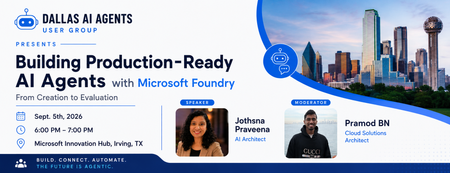
13 TopicsBuilding Production-Ready AI Agents with Microsoft Foundry
Excited to host the first event of the Dallas AI Agents User Group! 🚀 Building Production-Ready AI Agents with Microsoft Foundry Join us for a practical session exploring how to build, test, and evaluate production-ready AI agents using Microsoft Foundry. 🎤 Speaker: Jothsna Praveena — AI Architect 🎙️ Moderator: Pramod BN — Cloud Solutions Architect 📅 September 5, 2026 | 6:00–7:00 PM 📍 Microsoft Innovation Hub, Irving, TX Address: Building LC1, 7000 State Hwy 161, Irving, TX 75039 Register Here: https://luma.com/4kd3pukt Looking forward to an evening of learning, meaningful conversations, and community building around AI agents! #AgenticAI #AIAgents #MicrosoftFoundry #ArtificialIntelligence #DallasAI #MicrosoftAI #AICommunity47Views0likes0Comments
From AI PoC to Production: 7 Architecture Decisions Every Enterprise Must Get Right
Architecture Deep Dive Moving from an AI Proof of Concept to an enterprise-ready production workload requires much more than selecting the right model. AI is no longer just an experimentation topic. Across enterprises, teams are building copilots, RAG applications, AI agents, intelligent automation and domain-specific AI solutions. But there is a significant difference between making an AI Proof of Concept work and making an AI solution production-ready. A PoC asks: “Can we make AI do this?” Production asks much harder questions: “Can we make it secure, reliable, scalable, observable, governed and financially sustainable?” That is where architecture becomes critical. Microsoft’s Azure Well-Architected guidance for AI workloads highlights that AI systems introduce architectural considerations beyond traditional applications, including nondeterministic behavior, grounding data, model operations, testing, responsible AI and continuous evaluation. Here are seven architecture decisions I believe every enterprise should consider before moving an AI workload from PoC to production. 1. Start With the Business Outcome — Not the Model One of the most common mistakes is starting with: “Which AI model should we use?” The better question is: “What business problem are we solving?” Before selecting a model or Azure service, define: • The business outcome • The users • The expected experience • The measurable success criteria • Regulatory and compliance requirements • Data sensitivity • Expected scale For example: Instead of saying: “We want to build an enterprise chatbot.” Define the outcome: “We want employees to find accurate information from 500,000 internal documents in less than 5 seconds while respecting existing access permissions.” That single statement changes the architecture conversation completely. 2. Design the Data and Grounding Architecture First Enterprise AI is only as useful as the information it can access and trust. For many enterprise scenarios, the challenge isn't simply selecting a powerful model. The challenge is providing the model with the right context. This is where grounding and RAG architectures become important. A typical flow looks like: User → Application → Orchestration → Knowledge/Retrieval → Model → Response But an enterprise implementation also needs to consider: • Data ingestion • Chunking and enrichment • Metadata • Indexing • Access control • Data freshness • Source attribution • Retrieval quality • Auditability Microsoft's current AI architecture guidance explicitly treats the knowledge layer as a core architectural component and emphasizes enforcing data access policies and authorization within that layer. The key architectural question is therefore not: “Can the model answer the question?” It is: “Can the model answer the question using authorized, relevant and trustworthy enterprise data?” 3. Separate Intelligence, Inference, Knowledge and Tools AI applications are becoming more sophisticated. Modern architectures may involve models, agents, orchestration, enterprise data and external tools. Putting everything into one application layer quickly becomes difficult to secure, scale and operate. A better approach is to establish clear architectural boundaries. A useful conceptual model is: Client Layer ↓ Intelligence / Orchestration Layer ↓ Inference Layer ↓ Knowledge Layer ↓ Tools / Business APIs Each layer can have its own: • Identity • Security policies • Scaling strategy • Monitoring • Caching • Failure handling This separation becomes particularly important when moving from a simple chatbot to agentic AI applications. Microsoft's AI application design guidance recommends distinct client, intelligence, inference, knowledge and tools layers for intelligent applications. 4. Treat Security as an Architecture Principle — Not a Checklist AI introduces new security considerations. You need to think beyond traditional application security. Ask: • Who can access the AI application? • What data can the user retrieve? • Can the model access information the user cannot? • How are identities propagated across components? • How are prompts and responses protected? • How are AI tools authorized? • How are sensitive outputs detected? • How are activities audited? One particularly important principle is: The AI system should not become an alternative path around existing enterprise authorization. If an employee cannot access a document directly, the AI assistant should not expose that document through a generated response. Security therefore needs to exist across the entire AI architecture: Identity → Data → Retrieval → Model → Tools → Output 5. Design for Scale and Reliability Before You Need It A PoC might have: 10 users 100 documents 1 model 1 environment Production might have: 100,000 users Millions of documents Multiple models Multiple business applications Continuous availability requirements The architecture must therefore consider: • Horizontal scaling • Availability Zones • Regional resiliency • Load balancing • Model availability • Rate limiting • Failover • Caching • Capacity planning AI workloads also have unique infrastructure considerations. Inference capacity can become a bottleneck, and GPU-based workloads can introduce significant infrastructure costs. Microsoft's current Azure AI architecture guidance recommends designing for scalability and availability across the intelligence, orchestration, inference and knowledge layers. 6. Cost Must Be Designed Into the Architecture AI can create unexpected cost growth. A solution may work perfectly from a technical perspective and still fail the business case because of: • Token consumption • Model selection • GPU utilization • Storage • Data processing • Retrieval infrastructure • Logging • Network traffic • High-frequency inference Therefore, ask: “What is the expected cost per transaction?” Then model: Users × Requests × Tokens × Model Cost But don't stop there. Also evaluate: • Caching opportunities • Model routing • Smaller models for simpler tasks • Batch processing • GPU utilization • Resource scaling • Storage optimization Microsoft's Well-Architected guidance specifically highlights monitoring utilization and avoiding unnecessary AI infrastructure costs. The cheapest architecture isn't necessarily the best architecture. The goal is: Maximum business value per unit of AI spend. 7. Production Requires Continuous Evaluation and Observability Traditional applications usually monitor: CPU Memory Latency Errors Availability AI applications need more. You also need to understand: • Response quality • Grounding accuracy • Retrieval relevance • Hallucination rate • Model performance • Prompt effectiveness • Safety violations • User feedback • Token consumption • Cost per interaction AI is nondeterministic. The same input may not always produce exactly the same output. That means testing cannot simply end when the application goes live. Production evaluation becomes part of the architecture. Microsoft's guidance recommends extending observability to AI-specific quality metrics and supporting testing and evaluation with real production inputs. The Architecture Mindset Shift The biggest transition from PoC to production is not necessarily choosing a better model. It is changing the questions we ask. PoC thinking: “Can AI do it?” Production thinking: “Can the enterprise operate it safely and economically at scale?” That leads to a different architecture conversation: Business Outcome ↓ Data & Grounding ↓ Security & Identity ↓ AI Application Architecture ↓ Infrastructure & Scalability ↓ Observability & Governance ↓ Cost Optimization ↓ Continuous Evaluation My 7-Question Production Readiness Test Before approving an enterprise AI workload for production, I would ask: 1. What measurable business outcome are we delivering? 2. Can we trust and govern the data being used? 3. Can the AI respect existing identity and authorization boundaries? 4. Can every major component scale and recover from failure? 5. Can we measure AI quality—not just infrastructure health? 6. Do we understand the cost at production scale? 7. Can we continuously evaluate, improve and govern the solution? If the answer to several of these is “not yet”, the solution may still be a PoC. And that's perfectly fine. The objective isn't to rush an AI PoC into production. The objective is to build the architecture that makes production possible. Final Thought AI architecture is becoming less about: “Which model should we use?” And increasingly about: “How do we build an AI system that the enterprise can trust?” That is the real journey: PoC → Architecture → Production → Scale → Business Value The organizations that get this architecture right will be in a much stronger position to move from AI experimentation to sustainable enterprise AI adoption. What do you think is the biggest challenge when moving an enterprise AI solution from PoC to production — security, data, scalability, cost, or something else?56Views0likes0CommentsGovernance Is the New Bottleneck: What Agent 365 Means for Admins ?
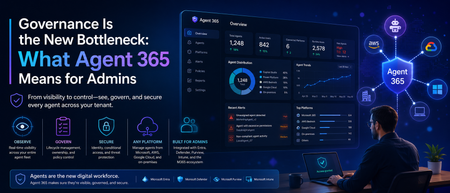
Hi all , following up on my last post about token limits, I wanted to write about something that's been on my mind a lot lately: the sheer number of agents quietly showing up across our tenant. Not just the ones we built deliberately in Copilot Studio, but ones people spun up in Power Platform, ones connected through Teams, and a few I genuinely couldn't trace back to an owner when I went looking. That's the moment this topic stopped being theoretical for me. For the last couple of years, the Microsoft AI conversation was mostly about capability -what can Copilot do, which model is better, how do I write a good prompt. That conversation hasn't gone away, but a second one has caught up to it fast: who's actually watching all of this. Microsoft's own 2026 Work Trend Index makes the shift explicit this isn't about saving a few minutes in Outlook anymore, it's about organizations redesigning how work gets divided between people and agents. And the moment agents start acting semi-independently across your tenant, "how many do we have, and what are they allowed to touch" becomes a real operational question, not a hypothetical one. That's exactly the gap Microsoft Agent 365 is built to close. It went generally available on May 1, 2026, alongside Microsoft 365 E7, and I think it's worth understanding properly especially if you're the one who ends up fielding the "wait, there's an agent doing what?" conversation. What Agent 365 Actually Is (and Isn't) The first thing worth clearing up: Agent 365 doesn't build agents. That's still Copilot Studio's job, or Foundry, or whatever platform your team is using. Agent 365 is the layer that sits on top of all of that it's a control plane, not a construction tool. Think of it less like "another AI product" and more like the admin and security backbone that was honestly missing from the picture until now. Microsoft frames it around three pillars: observe, govern, and secure. In practice, that means every agent in your tenant whether it was built in Copilot Studio, imported from AWS or Google Cloud, or even running locally on someone's Windows machine gets registered, gets its own identity through Microsoft Entra, and becomes something you can actually see and act on instead of just hoping it's behaving. That identity piece is the part I think gets underrated. Each agent gets its own Entra Agent ID, the same way a human user would. That's a meaningful shift it means conditional access policies, auditing, and compliance tooling that already exist for people can now extend to agents instead of treating them as some invisible background process. Why This Matters Right Now Here's the honest version of what's been happening across a lot of organizations, including bits of what I've seen firsthand: agent creation has gotten easy. Almost too easy. Between Copilot Studio, Power Platform, and now agentic mode built directly into Word, Excel, and PowerPoint, it doesn't take much for someone in a business unit to spin up something that's technically an AI agent with access to real data without IT or security ever being looped in. Microsoft has been fairly direct about this risk themselves, which I appreciated seeing in writing rather than just implied: the speed of agent development shows real value, but without guardrails, that pace turns into blind spots, lower ROI, and genuine security exposure. That's not vendor fear-mongering, that's just what happens when adoption outpaces oversight in any technology, and agents are no exception. What makes this particular moment different from past "shadow IT" waves is that agents don't just store or move data they can act on it. An agent with the wrong scope isn't just a compliance footnote, it's something that could send an email, modify a file, or trigger a workflow on its own. That's a different risk category than an unsanctioned spreadsheet sitting in someone's OneDrive. What You Actually Get With Agent 365 A few capabilities stood out to me as genuinely useful rather than just checkbox governance: The overview dashboard gives you a real-time view of your entire agent fleet total registered agents, active users, connected platforms, runtime hours, and risk signals, all in one place. Before this, getting even a rough headcount of "how many agents exist in our tenant" was a manual, frustrating exercise. Registry sync extends that visibility beyond Microsoft's own tools. It can pull in agents built on AWS Bedrock and Google Cloud, so you're not stuck with three different governance stories depending on where an agent happens to live. For organizations that are realistically never going to be 100% single-vendor, that matters. Lifecycle actions install, publish, block, unblock, delete, reassign ownership are now available directly from the registry. That's a big deal operationally. Before, tracking down who owned a rogue or abandoned agent could turn into an actual investigation. Now it's a few clicks. Local agent controls through Defender and Intune are rolling in too, extending management down to agents running on individual Windows endpoints, not just cloud-hosted ones. Given how much agent activity is starting to happen at the device level, this closes a gap that would've otherwise been a blind spot. Conditional access for agents, through Entra, means you can apply the same kind of dynamic, granular access policies to agents that you'd apply to a human user which is really the whole philosophical shift Agent 365 represents: agents aren't a separate, ungoverned category anymore, they're first-class identities in your tenant. What This Means for Admins, Practically If you're managing a tenant with any real Copilot or agent activity, here's where I'd actually start: Don't wait for "full autonomy" to engage. It's tempting to think governance can wait until agents are doing something more dramatic than they are today. Microsoft's own guidance pushes against that the advice is to establish visibility and guardrails early, while adoption is still accelerating, not after. Get a real inventory first. Before writing new policies, it's worth just knowing what already exists. I'd genuinely bet most tenants have more agents running than the admin team could name off the top of their head. The overview dashboard is the fastest way to close that gap. Loop in more than just IT. Agent 365 licensing and controls touch the M365 admin center, Entra, Defender, Purview, and Intune which means this isn't a single-team rollout. Security, compliance, and helpdesk all need to understand what's changing, especially the distinction between Frontier (preview, no production SLA) and GA (production-ready, supported). Understand the licensing model before you scope a rollout. Agent 365 is licensed per human user — the person who manages, sponsors, or is served by an agent rather than per agent. It's available standalone at $15 per user per month, or bundled into Microsoft 365 E7. Worth mapping that against your actual agent-using population rather than assuming it's a flat cost per bot. Treat this as incremental, not a one-time setup. Microsoft has said plainly that Agent 365's capabilities will keep evolving as adoption patterns and governance models mature. This isn't a project you finish and close out it's closer to how you'd think about identity and access management generally: ongoing, not a one-time rollout. The Bigger Shift Underneath All This What I find genuinely interesting about Agent 365 is what it signals about where Microsoft thinks this is all heading. They're not just selling a better Copilot anymore they're positioning Microsoft 365 as the place where AI-driven work gets governed, regardless of which vendor's model or platform an agent actually runs on. Whether that's the right long-term answer for every organization is a fair thing to debate. But the underlying problem it's solving that agents were multiplying faster than anyone's ability to see or control them is real, and I don't think it's specific to Microsoft shops. If your organization is building agents in Copilot Studio, experimenting with Foundry, or even just watching Copilot's agentic mode quietly take on more autonomous work in Word and Excel, this is worth getting ahead of. The teams that treat agent governance as a foundational layer now are going to have a much easier time scaling adoption later than the ones who bolt it on after something goes wrong. Curious whether others are already rolling out Agent 365, or still in the "let's figure out how many agents we actually have" phase I suspect a lot of us are somewhere in between. Would love to hear how your organization is approaching this. Cheers, and happy reading. Surya Vennapusa-MCT317Views0likes0CommentsToken Limit Exceeded? What's Actually Going On and What to Do About It ?
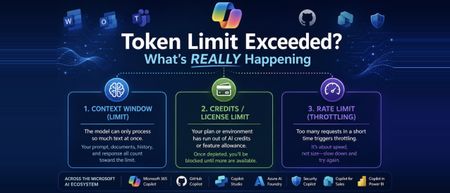
Hi All, Based on some recent experience across the organisation with token limit issues, I wanted to put my thoughts down and actually dig into what's happening under the hood, rather than just chalking it up to "we need a bigger plan." If you work anywhere near the Microsoft ecosystem these days, you're probably touching more AI tools than you realize. Copilot in Word and Excel, GitHub Copilot while you code, Copilot Studio if you're building agents, maybe Security Copilot or Copilot for Sales depending on your role, and increasingly Azure AI Foundry if your team is building anything custom. I work across a good chunk of this stack day to day, and at some point, almost everyone runs into the same wall: "Token limit exceeded." "You've reached your usage limit." "Upgrade to continue." The first instinct is usually to assume you did something wrong wrote too much, uploaded too big a file, or just need a fatter subscription. Sometimes that's the actual story. But honestly, often, that error message is standing in for three completely different problems that all happen to look identical from the outside. One is about how much text a model can physically process at once. One is about your license or credits running dry. And one has nothing to do with size at all it's just about how fast you're sending requests. Once you know which of these three, you're dealing with, the fix becomes obvious. Until then, "upgrade your plan" feels like the only lever you've got even when it isn't. This post walks through what a token is, why Microsoft's various Copilots each handle this differently, and what habits genuinely cut down on these interruptions instead of just throwing money at the problem. Part 1: So What Is a Token, Really? A token isn't a word, and it isn't a character it's somewhere in between. It's the small chunk of text a model's tokenizer breaks your input into before it can do anything with it. Take a word like "unbelievable." A tokenizer might split it into three pieces something like "un," "believ," and "able." Short, everyday words usually come out as a single token. But code, technical jargon, acronyms, and non-English text tend to fragment into a lot more tokens than you'd guess just by looking at the word count. This is why every AI tool has a ceiling on how much it can handle in one go, and that ceiling isn't measured in words or characters it's measured in tokens. Your prompt, any documents or emails it pulls in as context, the back-and-forth history of your conversation, and the response itself all draw from the same pool. Once that pool runs dry, something has to give: the tool truncates, rejects the request outright, or quietly summarizes older context to make room. The part that trips people up: token count doesn't map cleanly to word count. A short, dense paragraph full of code or acronyms can eat up more tokens than a much longer plain-English message. Part 2: Three Different Limits, One Confusing Error Message This isn't always obvious upfront, even to a lot of admins managing these tools: "token limit exceeded" is really a stand-in phrase for three separate limits, and they don't behave the same way. This isn't unique to Microsoft either every major AI platform bundles these same three things behind similarly vague error messages. Microsoft's stack just makes a good case study because so many of us touch multiple pieces of it in the same week. The context window is the ceiling on how much text a specific model can process in a single request everything from your prompt to retrieved documents to chat history. This is tied to the model itself, not your subscription. Swap from one model to another inside the same tool, and this ceiling can move without you doing anything differently. Your license, credits, or feature allowance is a completely separate thing. This is what Microsoft 365 Copilot plans track through AI credits and feature limits, and it's what Copilot Studio measures through Copilot credits at the environment level. A single action summarizing an inbox, generating an agent response, running an analysis deducts from this pool regardless of how small your actual prompt felt. Run out, and you get blocked, even if you're nowhere near any context window limit. The rate limit is about speed, not size. Copilot Studio, for instance, enforces quotas measured in requests per minute or per hour to keep the system stable under load. Send messages too quickly, which happens easily with automations, flows, or bots, and you can get throttled even with a tiny prompt and plenty of credits left. The reason this matters: a plan upgrade only ever fixes the second one. If you're actually running into the model's context window or getting rate-limited, paying for a bigger license won't change anything, and that mismatch is exactly where most of the frustration comes from. Part 3: How This Plays Out Across the Microsoft AI Stack The Microsoft ecosystem isn't one AI tool wearing different outfits it's genuinely several different systems, each handling tokens and limits in its own way. Here's a tour of the ones people run into most. Microsoft 365 Copilot (the one living inside Word, Excel, Outlook, Teams) doesn't work off a single published token number the way a developer tool would. Instead, it dynamically pulls together your prompt, recent chat history, and relevant snippets retrieved from Microsoft Graph your files, emails, and messages and quietly summarizes or drops older material to stay within bounds. Where this usually breaks isn't the context window at all; it's the AI credit and feature-limit system running out, often without much warning until you're mid-task. GitHub Copilot Chat is more like a traditional developer tool. It has a fixed, published token window tied to whichever model you've selected, and that limit applies consistently whether you're in the browser, VS Code, or the CLI. The failure mode here is usually a long conversation or a big multi-file context quietly creeping past that ceiling. Copilot Studio, where a lot of custom agent-building happens, runs on Copilot credits per interaction, plus its own requests-per-minute and requests-per-hour quotas at the environment level. If you're grounding an agent in SharePoint content, there's also a separate file-size ceiling to watch content over a certain size can get silently excluded from generative answers depending on your tenant's licensing. Azure AI Foundry (recently renamed to Microsoft Foundry, in case you've seen both names floating around) is where this gets more directly in your control. If your team is building custom applications on top of Azure OpenAI or other models in the Foundry catalog, which now includes everything from GPT to Phi to Claude to Llama, you're working with explicit, published context windows per model, and you're billed per token rather than per credit. It's a different mental model entirely: less "you hit a wall," more "you're paying by the word, so design accordingly." Security Copilot, if your org uses it for threat analysis and incident response, runs on its own capacity model pooled compute units at the tenant level rather than a simple per-user cap. It's easy to assume this behaves like M365 Copilot license limits; it doesn't. Copilot for Sales, embedded in Outlook and Teams for CRM-connected work, and Copilot in Power BI, which now goes beyond generating summaries to actually helping build and refine semantic models, both draw from their own feature-specific allowances layered on top of whatever base Microsoft 365 or Power Platform license you're on. And then there's the multi-model wrinkle that trips up teams the most: because tools like Copilot Studio and GitHub Copilot let you choose between GPT-based models, Claude, and others, the exact same prompt can have a different effective context window and a different token cost purely based on which model handled it that day. This is a big, underrated reason behind the "it worked fine yesterday, why not now" complaint. Part 4: What Actually Helps ? Some of this is genuinely outside your control, but a fair amount isn't. If you're just using these tools day to day, the single biggest habit shift is not letting conversations run forever. Long threads in Copilot Chat or Copilot Studio keep accumulating history, and that history eats into the same budget as whatever you're asking right now. Starting fresh periodically costs you nothing and buys back a lot of headroom. Large documents are worth splitting up before you feed them in, especially for SharePoint-grounded agents, where oversized files can get quietly excluded rather than cleanly rejected you won't necessarily know it happened unless you're looking for it. And it's worth resisting the urge to default to the heaviest, most capable model for every single task. Lighter models are usually faster, cheaper, and often sit under a more generous limit than the flagship ones, and most everyday tasks genuinely don't need the biggest model available. Before you go asking IT for a license upgrade, it's worth a quick sanity check on which limit you actually hit. If it's a rate limit, waiting a minute and retrying usually solves it outright. If it's a context window problem, trimming your prompt or starting a new session fixes it. An upgrade only helps if you've genuinely run out of credits or feature allowance, and that's worth confirming before you file the request. If you're on the building side Copilot Studio agents, Foundry applications, anything with RAG-style grounding a couple of things pay off quickly. Keep an eye on credit or token consumption proactively rather than discovering it's gone when the agent goes down mid-conversation. Be deliberate about what goes into system prompts and orchestration instructions, since those draw from the same budget as the end user's actual message, often invisibly to whoever's chatting with the agent. And spend real time getting chunk size right for knowledge sources too large and you're burning budget on irrelevant context, too small and the agent loses the thread. Part 5: Quick Checklist Before You Escalate Is this actually a context window problem -prompt, history, and attachments too big for the model in use? Have you genuinely run out of credits or feature allowance on your plan? Could this be a rate limit -too many requests too fast, especially from a flow or automation? Did the underlying model change since last time, quietly shifting the effective window? For Studio or Foundry work, is this a tenant or environment-level limit rather than something tied to you personally? Closing Thoughts Tokenization is one of those things that stays completely invisible right up until it isn't. Across a stack as sprawling as Microsoft's M365 Copilot, GitHub Copilot, Copilot Studio, Foundry, Security Copilot, and everything layered on top "token limit exceeded" almost never means one single thing. It means you've hit one of three very different walls, and each one needs a different response. If your team builds or maintains any of these tools, this is genuinely worth putting in front of people early. Most of the "why did this break" tickets in this space aren't about tokens at all. They're about nobody knowing which limit actually got hit, or where in this increasingly large ecosystem it happened. I'm curious how this shows up for others has your team standardized on one model across these tools, or are you juggling several depending on the task? I'd love to hear what patterns you've run into. Cheers, and happy reading. - By Surya Vennapusa, MCT2.3KViews3likes2CommentsHow can you stay competitive and relevant in an AI-Driven World?
In a world where AI tools evolve weekly and yesterday's skills can feel obsolete overnight, this blog offers a grounded, human-first guide for cloud and technology professionals who want to stay ahead not by chasing every trend, but by building the right foundations. Across six core themes, the post walks readers through understanding what AI truly changes in the workplace, committing to deliberate and structured learning through platforms like Microsoft Learn, getting hands-on with real Azure AI projects beyond just certifications, and doubling down on the human skills critical thinking, communication, and ethical judgment that AI simply cannot replicate. The blog also makes the case for community and network as a long-term career asset, and closes with a call to develop an AI mindset rooted in curiosity, adaptability, and a willingness to experiment and share openly. Whether you're a cloud architect, a security professional preparing for AZ-500 or SC-200, or simply someone navigating what this AI shift means for your career this post is written for you. Key Takeaways for Readers: Understand AI's real impact · Build a deliberate learning habit · Go hands-on with Azure AI tools · Strengthen human skills · Invest in community · Cultivate an AI-first mindset506Views2likes2CommentsThe Rise of vLLM in Modern Cloud Development: Revolutionizing AI Inference
Large Language Models (LLMs) are powerful but expensive to run in the cloud because they require large amounts of GPU memory. During inference, they generate text token-by-token and store intermediate results in a growing Key-Value (KV) cache. Traditional systems allocate this cache in large, contiguous memory blocks, which causes severe GPU memory fragmentation and waste—up to 80% of memory remains unused, limiting concurrency and throughput.1.2KViews0likes0CommentsMicrosoft AI Skills Navigator – What It Is and Why It Matters.
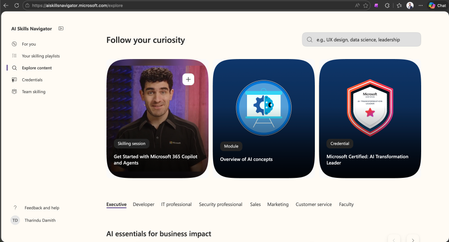
Microsoft AI Skills Navigator is a powerful, AI‑powered learning platform designed to help anyone build the skills they need to succeed in the AI era. It brings together training from Microsoft Learn, LinkedIn Learning, and GitHub into one unified space, making it easier for professionals, students, and organizations to build AI skills with clarity and confidence. [aiskillsna…rosoft.com] What Is Microsoft AI Skills Navigator? AI Skills Navigator is an agentic learning experience that uses artificial intelligence to create personalized, role-based skilling paths. It recommends content based on your goals, experience, and preferred learning style. You get access to videos, hands‑on labs, podcasts, expert‑led sessions, and curated playlists—all in one place. [techcommun…rosoft.com], [askai.glarity.app] It also brings together credentials from Microsoft, GitHub, and LinkedIn, helping you build both technical and human skills required for modern AI‑driven roles. [techcommun…rosoft.com] Key Features 1. Personalized Learning Paths The system analyzes your role, interests, and skill level to generate the most relevant training path. Whether you’re an IT professional, developer, security specialist, business leader, or student, it guides you to exactly what you need. [askai.glarity.app] 2. Unified Learning Experience The platform combines content from Microsoft, LinkedIn Learning, and GitHub so you don’t have to search across multiple websites. Everything is organized and easy to follow. [techcommun…rosoft.com] 3. Interactive and Human‑Enhanced Skilling AI Skills Navigator blends human‑led videos with real‑time AI coaching. These sessions feel like live classes and make learning faster and more engaging. [techcommun…rosoft.com] 4. AI‑Generated Playlists and Podcasts You can turn learning modules into podcasts or ask the system to generate a custom learning plan for your team. [youtube.com] 5. Accessible Worldwide The platform supports multiple languages and offers free resources, making AI skilling available to everyone. [askai.glarity.app] Benefits of Microsoft AI Skills Navigator 1. Saves Time Instead of browsing through hundreds of courses, you receive curated training that fits your needs right away. [techcommun…rosoft.com] 2. Helps You Stay Competitive AI is changing every industry. The platform helps you learn skills that are in high demand now and in the future. [askai.glarity.app] 3. Builds Confidence With AI Tools By learning concepts interactively and with AI coaching, you quickly develop confidence in using AI for work, projects, and decision‑making. [youtube.com] 4. Supports Teams and Organizations Leaders can create learning plans, track progress, and help teams adopt AI faster. This leads to better efficiency and improved business outcomes. [youtube.com] 5. One Place for Skills and Credentials You can learn, practice, and earn recognized certifications—all within one connected ecosystem. [techcommun…rosoft.com] Why It Matters Today With thousands of new AI tools launching each year, staying updated is challenging. AI Skills Navigator reduces the noise by giving you focused, relevant, and practical learning content. [techcommun…rosoft.com] It’s not just about learning technical skills. It’s about preparing to work confidently in an AI‑driven future. Thank you. Happy Learning.540Views3likes0CommentsHow We Built an AI Operations Agent Using MCP Servers and Dynamic Tool Routing
Modern operations teams are turning to AI Agents to resolve shipping delays faster and more accurately. In this article, we build a “two‑brain” AI Agent on Azure—one MCP server that reads policies from Blob Storage and another that updates order data in Azure SQL—to automate decisions like hazardous‑material handling and delivery prioritization. You’ll see how these coordinated capabilities transform a simple user query into a fully automated operational workflow516Views0likes0CommentsGetting Started with Copilot Studio: Your PAA & FAQ Guide
What is Microsoft Copilot Studio? Microsoft Copilot Studio is a low-code, graphical tool within the Power Platform used for building and conversational bots. It empowers users, even those without extensive technical backgrounds, to create sophisticated logic and connect to various data sources and services using prebuilt or custom plugins. Is Copilot Studio easy to use for beginners? Yes Copilot Studio is designed to be easy for beginners. You only need to describe the agent you want in plain language to start creating it. The platform uses a graphical, low-code interface that streamlines the process of defining instructions, knowledge sources (like documents), and conversation triggers, making it accessible to most users. What is the difference between Microsoft 365 Copilot and Copilot Studio? Microsoft 365 Copilot is an AI assistant that integrates across Microsoft 365 apps (Word, Excel, Teams, etc.) to enhance productivity. Copilot Studio, conversely, is a development platform used to build customised AI agents that are tailored to specific business goals or data sources. Copilot is the agent you use; Copilot Studio is the tool you use to build or extend agents. Do end-users need a specific license to use a Copilot I create? Yes, licensing for end-users depends on how and where the custom copilot is deployed. While development often requires a Power Platform or Azure subscription deploying the bot across an organization may require specific Copilot licenses for the end-users accessing the agent. Check the official Microsoft licensing documentation for your specific scenario. How can I add SharePoint data as a knowledge source for my Copilot? You can connect your Copilot agent to SharePoint data using the generative answers feature in Copilot Studio. The agent can search documents stored in a SharePoint document library. Be aware that there can sometimes be nuances with how attachments versus core document libraries are indexed, which the community is actively discussing in the forums. We hope this formatted FAQ helps you quickly find the information you need! If you have more questions, please use the discussion board to connect with the community.543Views0likes2CommentsWhy should One learn AI ?
One should learn because, Microsoft is deep in the AI race right now — investing heavily, pushing into new product categories, expanding infrastructure, and building tools for both developers and end-users. Here’s a detailed snapshot of where Microsoft is on AI in late-2025, highlighting what they’ve achieved, what they’re working on, what challenges they face, and what it means for users/organizations 1.AI is Now the Core of Microsoft’s Strategy Microsoft isn’t treating AI as an add-on — it’s embedded into everything: Windows Copilot: AI built directly into the OS. Microsoft 365 Copilot: Automates Office apps like Word, Excel, Outlook, and Teams. Azure AI Services: Enterprise-grade infrastructure to build, deploy, and scale AI securely. GitHub Copilot & Azure DevOps: AI-driven development and deployment. Learning AI in Microsoft’s stack means you’re aligning with their long-term direction — it’s where every Microsoft product is headed. 2.Unified Ecosystem for Building & Deploying AI When you learn Microsoft AI, you get exposure to a connected environment that simplifies the AI lifecycle: Stage Microsoft Tools/Platforms Data Ingestion Azure Data Factory, Synapse, Fabric Model Training Azure Machine Learning, Custom Models, Azure AI Foundry Orchestration Azure AI Studio, Logic Apps, Power Automate Deployment Azure Kubernetes Service (AKS), Azure Functions Integration Power Platform, Copilot Studio, Microsoft Graph API You can move from “idea -prototype - enterprise-scale app” without leaving the Microsoft ecosystem. 3.Enterprise-Grade Security & Compliance Microsoft has the most trusted AI compliance posture among hyperscalers: 1000+ security and compliance certifications Responsible AI framework (human oversight, privacy, transparency) Seamless Azure AD / Entra ID integration for secure access If you work with enterprise or gov customers, this is critical — they already rely on Microsoft’s compliance backbone. 4.Massive Career & Business Demand According to recent LinkedIn and IDC reports: 80% of Fortune 500 companies use Azure AI services. “AI + Microsoft Cloud” roles (like AI Engineer, M365 Copilot Admin, Azure AI Specialist) are growing 3x faster than traditional cloud roles. Microsoft certifications (e.g., AI-102, DP-100, AI-900) are among the top-requested by employers. Learning Microsoft AI directly translates to employability and consulting value. 5.Democratized AI — Even for Non-Coders Not everyone needs to be a data scientist: Copilot Studio (Power Platform) → Build custom copilots using natural language. Azure AI Foundry → Build intelligent agents visually. Fabric AI Integration → Analyze data and auto-generate insights in Power BI. Microsoft’s goal is to make AI “as easy as Excel” — so business users can innovate too. 6.Future-Proof Skillset Microsoft is working closely with OpenAI and others to lead in: Agentic AI (autonomous reasoning agents) Multimodal AI (text, image, voice) Edge + Cloud AI (Windows + Azure hybrid AI) Responsible AI governance tools By learning Microsoft AI now, you’re future-proofing yourself for this next generation of AI-native applications.61Views1like1Comment