ai
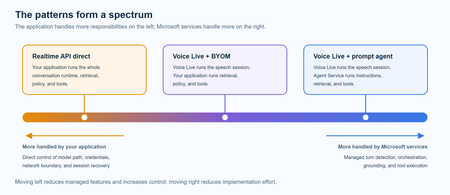
44 TopicsChoosing a real-time voice architecture on Microsoft Foundry: three enterprise patterns
A practical comparison of three real-time voice architectures on Microsoft Foundry, including implementation tradeoffs and four enterprise release gates for residency, networking, retrieval authorization, and tool credentials.720Views1like0CommentsModel Migration Process on Microsoft Foundry and Azure OpenAI
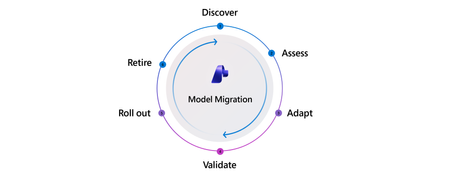
Every app built on an LLM will eventually move to a new model. The model you shipped may be retired, or a newer model may offer better quality, cost, or performance. Changing a model name in code from a retiring model such as gpt-4o to a newer one such as gpt-5.1 may take one line. That line hides a much larger migration. Model failures are often silent to the systems using the model and loud to users. Nothing crashes. Error rates stay flat. Every dashboard says the migration went fine. Meanwhile, responses change shape, summaries become longer and more hedged, JSON fields disappear, and tool calls fire in a different order. Users notice. Support queues grow. Downstream code that depended on the old behavior starts to break. A successful migration preserves the application's behavior or improves it in measurable ways. That requires a repeatable process to detect drift, adapt safely, and prove quality before broad rollout. The model migration process has six phases: Discover → Assess → Adapt → Validate → Roll out → Retire. This article explains what each phase looks like, which Microsoft Foundry tools support it today—including Azure OpenAI capabilities—and where teams still need to build around the platform. It then applies the process to a retail shopping assistant and points to additional resources in Go deeper at the end of this post! Why migrate now Every model has a retirement date. On Microsoft Foundry, generally available models typically ship with a retirement date about 18 months out, and older model families are actively replaced. For example, the model lifecycle and retirement schedule lists gpt-4o (2024-05-13) as retiring on October 1, 2026, with gpt-5.1 as its replacement. What happens at retirement depends on how you buy capacity: Standard, Global Standard, and Data Zone Standard (pay-as-you-go) deployments are auto-upgraded on a rolling, region-by-region schedule. You control the timing with versionUpgradeOption set to one of: OnceNewDefaultVersionAvailable, OnceCurrentVersionExpired, or NoAutoUpgrade. NoAutoUpgrade means the deployment stops working at retirement. Priority Processing follows the same path. Provisioned (PTU) deployments are not auto-upgraded. You migrate them yourself, either in-place (traffic moves over a 20–30 minute window with no downtime) or side-by-side (stand up the new deployment, test, shift traffic, delete the old one). Batch deployments follow the side-by-side path: deploy the new model, resubmit jobs, retire the old deployment. The developer problem is the same in every case: traffic eventually reaches a different model, but the platform cannot tell you whether the application still behaves as it did before. A responding endpoint does not prove that the app behaves correctly. A new model can change formatting, tone, tool-calling behavior, or JSON shape in ways that quietly break downstream code. When should I migrate? Start before the retirement date. Automatic upgrade handles the traffic transition for eligible deployments, but the team still owns behavioral validation. Provisioned deployments also require a manual migration. Microsoft typically makes a replacement available in Global Standard about 90 days before retirement, in provisioned regions about 30 days before retirement, and in standard regions about two weeks before retirement. That gives you time to evaluate the new model on your own terms. Retirement dates cannot be extended. You also do not need a deprecation notice to begin. If a newer model may improve quality, speed, or cost, run it through the process now. Waiting turns the switchover into a slow train wreck: responses drift, parsing becomes brittle, support tickets accumulate, and the team ends up debugging a model it did not choose on a date it did not pick. A deliberate migration makes the retirement date a formality and creates a process the team can reuse. Who this is for This process fits teams that own an LLM-powered feature inside a larger application and run migrations deliberately. It also applies to AI-native platform teams that centrally manage models for other application teams. The phases remain the same, though platform teams may run them faster and in parallel rather than in sequence. Fine-tuned workloads are out of scope here because they cannot be upgraded automatically, have separate training and deployment retirement schedules, and turn the Adapt phase into a distillation or retraining exercise rather than primarily prompt work. The six phases Phase Definition What success looks like Discover Learn that a model change is coming or needed. The team receives a timely, structured signal with the deprecation date, replacement model, and migration window. Assess Choose a target model and confirm that it is operationally available. The team understands the candidates and confirms capacity, region, and SKU before tuning starts. Adapt Replay the current workload on the new model, diagnose changes, and update prompts, parameters, tool definitions, output schemas, and calling code. The team runs side-by-side replay against real or representative traffic, can see the behavioral differences, and records every change. Validate Run the adapted workload against a quality rubric and decide whether it is safe to ship. The team has an evaluation suite that is affordable to run and trusted by application owners and reviewers. Roll out Promote the model through staged production exposure, monitor live behavior, and commit or roll back. Canary or weighted routing is in place, live quality is measured alongside latency and errors, and rollback remains possible. Retire Decommission the old deployment, free capacity, archive evaluation artifacts, and update internal documentation. The old SKU is gone, the deployment count falls, and the team carries what it learned into the next migration. Foundry tools at a glance Microsoft Foundry provide tools for each phase of the Model Migration Process. Phase Microsoft Foundry feature (including Azure OpenAI) Documentation Discover Model retirement schedule, lifecycle policy, Service Health alerts, and Models API lifecycleStatus Model retirement schedule Lifecycle policy Assess Model leaderboards and benchmarks for quality, safety, cost, throughput, and latency; trade-off charts; side-by-side comparison; suggested replacements Model leaderboards and benchmarks Side-by-side compare Adapt Prompt Optimizer in the Foundry Agent playground; agent optimization; simulator for synthetic data Prompt Optimizer Agent optimization Simulator Validate Azure AI Evaluation SDK with 30+ evaluators, LLM-as-judge, graders, and the portal evaluation wizard Azure AI Evaluation SDK Portal evaluation Roll out Automatic upgrade and versionUpgradeOption; provisioned in-place or side-by-side migration; continuous evaluation; Azure Monitor alerts Auto-upgrade with versionUpgradeOption Continuous evaluation Retire Models API to confirm 410 Gone; observability dashboard to track deployment count Models API Observability dashboard Breakdown of each phase 0. Prepare the test dataset Before starting the six phases, build a set of representative inputs, expected outputs, and agreed success criteria. This dataset gates the middle of the lifecycle: Adapt needs inputs for replay, and Validate needs ground truth and scoring criteria. Step 0 describes the workload rather than the candidate model, so it can begin during Discover, before the team selects a target. Build the dataset from captured production traffic or domain examples in .csv or .jsonl. If representative data is not available, use the simulator to generate synthetic inputs. Two practices determine whether this work pays off: Instrument capture before you need it. Production content capture is opt-in and never retroactive. Log prompts, responses, latency, and token counts now so the team has traffic to evaluate later. Freeze the dataset. Keep inputs, ground truths, and success criteria fixed throughout the migration. If they change, source and target results are no longer comparable. You also need an inventory of the model deployments your workload uses, including their deployment types (Standard, Provisioned, or Batch). For each source model, note its retirement date and suggested replacement from the Model retirement schedule. 1. Discover Discover begins when something forces the team to consider a model change: a deprecation notice, a new generally available model, a cost or latency problem, or a capability gap. The phase ends with a decision to begin migration or stay on the current model if it remains stable, performs well, and is not approaching retirement. Foundry tools. The model lifecycle and retirement schedule publishes retirement dates and suggested replacements. The Azure OpenAI model retirements documentation explains notification timing, including at least 60 days for generally available model retirements and at least 30 days for preview model retirements. It also explains how to configure Azure Service Health advisories and use the Models API for programmatic lifecycleStatus and deprecation checks. Those APIs provide the foundation for an internal discovery system. Where it breaks. Customers may learn about a retirement through email, a service health alert, or a production error. By the time the right team sees the signal, it may already be deep into the deprecation window and heading toward retirement. What your team provides. The schedule and Models API expose the data through a stable contract. Mature enterprises may add a thin notification layer that routes it to the right owners. 2. Assess The team chooses a candidate target model and confirms that it is usable: the correct region and SKU, enough quota, and availability alongside the current model so rollback remains possible. Assess also includes projecting monthly cost against historical traffic. Pricing structures change between model generations through reasoning tokens, cached input, structured-output overhead, and other factors. Those changes can move unit economics by 2x or more. For regulated workloads, compliance requirements such as BAA, FedRAMP, and regional Standard versus Global Standard availability may narrow the candidate list before quality testing begins. Foundry tools. Start with the replacement suggested in the retirement schedule, then build a shortlist with model benchmarks, which compare quality, safety, cost, throughput, and latency. Use trade-off charts such as quality versus cost and the side-by-side model comparison for up to three models. Compare context windows, feature support such as function calling, structured output, and vision, and available endpoints. Confirm SKU, region, quota, and upgrade mechanics in the model retirements documentation. Where it breaks. Teams face several plausible candidates, such as gpt-5.1, gpt-5.2, and a nano variant, without clear positioning between them. A selected model may be unavailable in the required region or SKU, a constraint that sometimes appears only after planning is underway. Historical traffic may also show that the new model costs substantially more, forcing an unplanned budget decision. What your team provides. Public benchmarks should filter the candidate list, not make the final decision. Confirm the shortlist against the team's own workload. Build the monthly cost view from token logs and current pricing. 3. Adapt Adapt is often the most time-consuming phase for embedded and product-facing workloads. Validate may take longer for regulated workloads. First, replay the existing workload on the new model without changing it. This isolates changes caused by the model. Diagnose shifts in verbosity, reasoning depth, structured-output adherence, tool-call shape, and latency. Then update the application until it recovers or improves on the previous behavior. Prompt editing is only one part of Adapt. A migration often changes four other surfaces: Parameters. temperature, top_p, max_tokens, and reasoning-effort controls may not map directly between generations. Some are unsupported by newer model families. Tool definitions. Argument names, descriptions, and required fields that reliably guided the old model may need clearer wording or tighter constraints. Output schemas. Structured-output behavior changes between models. A schema the old model followed loosely may need explicit constraints, or the new model may finally enforce it. Calling code. API and SDK differences, including Chat Completions versus Responses, streaming formats, and new or renamed request fields, can require code changes. Downstream parsers may also assume the old response shape. For agentic and workflow workloads, schema and tool-call changes can outweigh prompt changes. Foundry tools. Prompt Optimizer is available through the Optimize button below the system instructions field in the Agent playground. It restructures instructions, explains each change by paragraph, and supports iteration. For example, a team can add a constraint such as "keep the JSON schema exactly" and optimize again. It is a fast first pass for a prompt that would otherwise be rewritten by hand. For agent workloads, agent optimization tunes instructions, tools, and model selection together. Prompt Optimizer and agent optimization are available in Microsoft Foundry, not Azure OpenAI. When production data is unavailable, the simulator can generate synthetic and adversarial inputs. Where it breaks. Most migration time is spent in a manual diagnosis loop. Teams rerun prompts by hand, compare outputs by eye, and rarely record what changed or why. For agent builders, chat benchmarks may miss tool-call regressions such as extra fields, renamed arguments, or changed call sequences. Those problems appear only when the team replays real agent traces. Plan for three constraints: Start with the optimizers, then verify their output. They apply general practices in a single pass rather than fitting changes to the team's dataset. They tune instruction text, not tool definitions or output schemas. Copy the original prompt first because there is no version history, then evaluate the optimized prompt against the frozen dataset. Expect more manual work when moving between providers or model families. There is no "optimize for target model X" flow. Moving from one family to another, such as OpenAI to Claude, still requires deliberate prompt and schema translation. Record traffic before you need it. Replay is only as useful as the captured data. Existing traces are available as an evaluation source for agents today, while content capture is opt-in and never retroactive. Log prompts, responses, latency, and tokens now to prepare for the next Adapt phase. 4. Validate Run the adapted workload against a quality rubric on the frozen dataset. The rubric may combine rules, LLM-as-judge evaluation, human review, existing user-feedback signals, or a domain-specific scoring framework. Examples include a clinical summarization rubric for healthcare or a tool-call sequencing assertion for agents. Validation produces a pass-or-fail decision for production exposure. AI-native teams may run the same signal continuously on every commit rather than treating it as a one-time gate. The dataset is a dependency for both Adapt and Validate. Build and freeze it early, around Assess, even though its primary purpose belongs to this phase. Validation then has two touchpoints: Before Adapt, freeze the dataset and success criteria, then run the current model to establish the source baseline. After Adapt, run the target model against the same dataset and evaluators, compare it with the source baseline, and make the release decision. Prepare the evaluation runner early and apply the gate after Adapt. Both steps belong to Validate. Foundry tools. The Azure AI Evaluation SDK, installed with pip install azure-ai-evaluation, includes more than 30 evaluators. They cover grounding, relevance, retrieval, coherence, fluency, question answering, reference-based similarity, F1, BLEU, ROUGE, safety, agent behavior, and Azure OpenAI graders. Teams can also build custom LLM-as-judge evaluators for task-specific rubrics. The portal evaluation flow runs the same evaluators against model, agent, dataset, and trace targets. Run identical evaluators against source and target outputs on the frozen dataset so the results remain comparable. Measure the three dimensions used for sign-off: Quality: evaluator results Latency: leaderboard time to first token and throughput, plus operational latency from the workload Cost: (input tokens × input price) + (output tokens × output price) Where it breaks. Most teams do not have an evaluation suite. Teams that do often built it themselves and may not use platform evaluation tools. Regulated workloads add mandatory human review, which can become the bottleneck. For those teams, migrations often stall in Validate rather than Adapt. What your team provides. The evaluators are ready to run, but model workloads still require teams to curate a domain-relevant test set from production traffic. That is why Phase 0 pays for itself. 5. Roll out Promote the validated configuration in stages: non-production, then a canary or weighted percentage of production traffic, followed by broader exposure. Compare live latency, errors, and quality signals with the pre-migration baseline, then commit or roll back. Some workloads cannot expose a new model to customer traffic during testing, including flows involving protected health information or financial transactions. Use shadow or mirror mode instead: run the new model offline against production inputs and compare its outputs with the old model without affecting users. Foundry tools. Migration mechanics depend on the deployment SKU: Standard, Global Standard, and Data Zone Standard deployments upgrade automatically on a rolling schedule. Control timing with versionUpgradeOption: OnceNewDefaultVersionAvailable, OnceCurrentVersionExpired, or NoAutoUpgrade. Priority Processing follows the same path. Provisioned, Global Provisioned, and Data Zone Provisioned deployments migrate manually, either in place during a 20-to-30-minute Azure-managed traffic transition or through side-by-side deployments. Batch deployments migrate side by side. Deploy the new model, resubmit jobs, then retire the old deployment. Fine-tuned deployments do not upgrade automatically. They follow separate training and deployment retirement schedules, so plan retraining or distillation early. See the model retirements documentation for deployment-specific guidance. Use continuous evaluation to score a sample of production traffic in the Foundry Observability dashboard. Connect evaluation results to traces for root-cause analysis and configure Azure Monitor alerts for quality regressions. Where it breaks. Offline evaluation can miss production quality and latency regressions. Rollback decisions may also be forced by deprecation deadlines rather than evidence. What your team provides. Teams implement weighted routing between deployments in their application or gateway layer. They must also choose how long to keep the old deployment warm for rollback. Embedded copilot teams often target about 30 days. Design both mechanisms once and reuse them for future migrations. 6. Retire Retire is easy to forget. Decommission the old deployment, free its capacity, archive evaluation artifacts, update internal documentation, and communicate the change to downstream owners. That may include customer-facing documentation, marketing pages, support runbooks, and audit logs. Regulated workloads may need to retain artifacts for years. Retirement is also a governance step. Foundry tools. Use the Models API to confirm that the old version is retired through lifecycleStatus or 410 Gone. Use the observability dashboard to confirm that the active deployment count falls. Add useful production traces to the golden dataset so the next migration starts with better evidence. Where it breaks. Teams skip the phase. Zombie deployments accumulate, leaving teams with structural debris from migrations they never finished. What your team provides. The observability dashboard shows deployment count, but the team must decide which deployments still carry traffic. Create an explicit retirement ticket rather than relying on someone to remember. Embedded copilot teams also need to update public claims such as "powered by gpt-4o" after the model changes. Worked example: Zava's Shopping Assistant migrates from gpt-4o mini to gpt-5.x Zava is a fictional retailer used as a stand-in for a real customer story. The example reflects patterns observed in customer-facing embedded AI workloads. Zava's Shopping Assistant is one of the company's largest LLM workloads. It has two LLM stages: Per-review insight extraction identifies sentiment, attribute mentions, and defect signals across thousands of product reviews. Product-level summaries present those findings to shoppers on the product page. Together, the two stages account for a meaningful share of Zava's token volume. Discover Zava's central AI Platform team made gpt-5.x models available internally and notified feature teams. The Shopping Assistant team learned about the models through that channel and received a target migration window before gpt-4o mini's deprecation. Zava has an internal discovery layer built on the retirement schedule and Models API. Microsoft provides the underlying data, while Zava routes the signal to application owners. Assess The team compared gpt-5.4 nano, which offered lower latency and cost, with gpt-5.1 and gpt-5.2 using leaderboard trade-off charts. Selection remained difficult because of the rapid release cadence, unclear positioning between variants, and the lack of a behavioral benchmark for product question-and-answer workloads. Capacity planning required coordination with the AI Platform team. Both gpt-4o mini and the gpt-5.x candidate needed to remain available in the same regions so the team could roll back. Adapt The team ran its existing Shopping Assistant prompts against gpt-5.4 nano using a sanitized traffic sample. Customer queries were scrubbed of personally identifiable information before replay. The behavioral comparison found three problems: Summaries used more hedged language and sometimes contradicted the underlying review evidence, creating a shopper-trust risk. Insight counts varied across runs. The model sometimes extracted substantially more or fewer attribute mentions than gpt-4o mini, affecting downstream filtering. Latency varied more than expected on the synchronous product-page path. Prompt Optimizer helped restructure the summary prompt, but the team still diagnosed the differences manually. It built its own replay system and behavioral comparison on top of captured traffic. Reengineering took weeks and extended beyond prompts: parameters and downstream parsing for the insight-extraction output also changed. Validate The team scored outputs with Zava's Product Answer Quality (PAQ) rubric. Its nine criteria cover factual grounding, attribute accuracy, tone, and refusal behavior for questions outside the catalog. Zava implemented the rubric as custom evaluators in the Azure AI Evaluation SDK. Initial evaluations used unchanged prompts to isolate model behavior. The team reran them after each prompt change. Zava's QA team also completed a manual review, which the company requires for every new model used in a customer-facing workflow. The per-review insight extraction stage still has no automated evaluation, a gap the team has accepted for now. Roll out The validated configuration moved to non-production and then through staged exposure: employees first, followed by a small percentage of shoppers. The canary exposed latency regressions that offline evaluation had missed. The team rolled back the latency-sensitive synchronous product-page path while keeping the offline pregeneration path on the new model. Retire Retirement is not complete. The gpt-4o mini deployment remains warm for rollback. The team must resolve the synchronous-path latency regression before retiring it, which sends that code path back to Adapt. This split state is common. Retire can lag Roll out by weeks or months, and the old deployment remains visible in deployment-sprawl data. Lessons from the example Adapt consumed most of the schedule. Replay tooling, behavioral comparison, and prompt reengineering are the clearest opportunities for Microsoft to shorten migrations. Validate worked because Zava had invested in it. Most customers do not have an equivalent to PAQ. Making domain-specific evaluations cheaper to build would improve confidence in this phase. The migration is partially live and partially rolled back. The process must support split-state workloads rather than assuming a binary switch from old model to new. How to use this process The six phases can serve as a checklist and an interview script for teams creating or auditing a migration process. Documentation and process: Lead with the six phases. Most teams recognize them immediately. Investment priorities: Start with Adapt and Validate. Across customer stories, those phases consume the most time and confidence. Interviews and postmortems: For each phase, ask whether it happens, who owns it, which tool the team uses, where it failed last time, and what evidence would increase confidence. Metrics: Discover and Retire are the easiest phases to instrument through measures such as announcement reach and active deployment count. Adapt and Validate require purpose-built telemetry that most teams do not yet have. Go deeper Two companion resources turn the process into concrete implementation steps: Microsoft Learn guide: This article follows the six phases through identifying affected deployments, preparing a test dataset, adapting prompts, evaluating source and target models, and rolling out by deployment type. Foundry Models Accelerator: This community toolkit includes a deployment-inventory scanner, a feasibility and assessment playbook, code and API migration audit scripts, an A/B evaluation runner with golden datasets, and rollout guidance. It follows the same six-phase process. The Foundry Models Accelerator is a community-built toolkit provided as-is under the MIT License. It falls outside Microsoft Support. Always verify model availability and retirement dates against official documentation. Additionally, check out the Foundry Forgebook which hosts a plethora of recipes that walk through the required code changes to migrate from different source to target models, even across model families. The goal of a model migration is to change the model without changing your application’s behavior, or to change it measurably for the better. Lead with the six phases, invest first in Adapt and Validate phases, and treat the Retire phase as a governance step.749Views0likes0CommentsModel router updates: new regions, a refreshed model pool, and understanding the hill climb
Across Microsoft, "hill climbing" has become shorthand for how real AI progress happens: not in one dramatic leap, but through a disciplined loop. Microsoft AI defines the hill climb as an organization that continuously improves, cycle after cycle, through more compute, better data, and sharper evaluation. Reinforcement fine-tuning in Foundry defines it as improving the deployable model package one measured step at a time across quality, latency, and cost. Different altitudes, same premise: progress is not a one-shot decision. It's a loop. For most teams, the decision of what model to use when is made manually or with custom routing tools. A developer picks a model based on benchmarks, familiarity, or the last launch that made headlines, ships it, and revisits the choice only when something breaks. In an ecosystem where the frontier moves monthly, that decision goes stale fast. Model router in Foundry Models brings the hill climb to the selection layer. What's new: a bigger pool, in more places This release expands where teams can deploy model router, broaden the supported model pool, and delivers updates through a stable endpoint. Together, these changes help teams run production workloads in more locations, match a wider range of tasks to suitable models, and adopt supported updates without changing the application integration. A refreshed model pool. The supported model list now includes Anthropic Claude Opus 4.8 — a high-capability model built for complex reasoning and long-form generation, for scenarios that demand depth, structure, and quality — and the GPT-5.6 family. Just as importantly, the pool is pruned: gpt-5-chat, gpt-5.2-chat, gpt-5.3-chat, Deepseek-V3.1 have been removed from the model router as models reach the end of their lifecycle and are deprecated in Foundry. New region availability. The model router is now available in 28 regions for global standard and 21 data zone regions. For many organizations, inference requests must stay within specific geographic boundaries for regulatory, governance, or customer-trust reasons — and intelligent routing shouldn't force a compromise on that. Find the full list of regions here. The most important detail is what you don't have to do: these updates occur automatically*. The endpoint remains stable as the supported model pool is refreshed, so teams do not need to redeploy the model router to receive the update. Applications can continue using the same integration while the model router evaluates requests against the current supported pool. Teams should continue monitoring routing traces and application outcomes to confirm that quality, cost, latency, and governance requirements are met. *Models from Anthropic still need to be deployed separately before they can be routed to through the model router. Interested in hearing more about what's new to the model router? Tune in for the next episode of Model Mondays with Sanjeev Jagtap and Lee Stott, where they talk all things model router from evaluations to hill climbing. Sign up here to watch live or view the replay: Model Mondays - Spotlight On Model router in Microsoft Foundry | Microsoft Reactor The selection-layer hill climb At the selection layer, a step is a routing decision. Each one is a micro-optimization against your objective, and each one is instrumented: every response from the model router includes a model field showing which underlying model was selected, so the climb leaves a complete, auditable trail. Model router supports three parts of the optimization loop: A/B testing to compare two router configurations to understand quality, cost, and latency tradeoffs; model decomposition to use routing results to decompose a single-model application into a multi-model or multi-agent design, and continuous routing to keep the router in production for continuous per-request selection. Each pattern turns model choice into a measured, repeatable process rather than a fixed decision. 1. A/B Testing Question: Which model or routing strategy should I use in production? A/B testing helps teams compare candidate models, model families, or router configurations against the same workload. Representative traffic is sent to competing deployments, and teams compare quality, cost, latency, and governance outcomes. The goal is to understand tradeoffs and identify the model or routing strategy that best meets workload requirements before promoting it to production. 2. Model Decomposition Question: What work is my application actually doing? Model decomposition uses model router as a diagnostic tool. By deploying the model router against a representative workload and examining routing telemetry, teams can see how requests naturally separate into different task classes. Simple retrieval, classification, and summarization requests may route to smaller models, while reasoning, planning, and agentic workflows may require more capable models. The goal is not to choose a winner, but to understand the structure of the workload and uncover opportunities for optimization, specialization, or architectural improvements. 3. Route continuously Question: Why choose a single model at all? Route continuously is the pattern model router was designed for but is not limited to. Rather than treating model selection as a one-time decision, teams leave the model router in production and allow the best-fit model to be selected for each request. As the supported model pool, regional availability, and platform capabilities evolve, teams can continue using the same endpoint while evaluating whether updates improve workload outcomes. Model selection becomes an ongoing optimization process rather than a project that must be repeated every time the model landscape changes. Together, these patterns illustrate a broader shift: the model router is more than a model. It is a tool for the optimization loop itself, helping teams evaluate tradeoffs, understand workload behavior, test hypotheses, and continuously refine model selection as requirements evolve. Whether used to compare candidate models, decompose applications into specialized tasks, or automate per-request routing in production, model router turns model selection into an observable, measurable, and repeatable process. As the model landscape continues to change, that optimization loop becomes a durable advantage. Getting Started Ready to start your own hill climb? Whether you're exploring the model router for the first time, evaluating routing strategies against your workload, or building a long-term optimization practice, these resources can help you move from experimentation to production with Microsoft Foundry. What's new in model router? Sign up for the next Model Mondays episode for a deep dive into new features, optimization patterns, and the latest model router updates. How do I build agents with model router? Check out the Model Router Agents Lab and build agent experiences with routing, retrieval, web search, tool calling, and multi-agent patterns. How do I evaluate model router? Compare model router against baseline models using your own prompts, then review quality, cost, latency, and routing decisions with the Auto Evaluation Toolkit. How do I optimize model router for my workload? Start your hill-climbing journey with the Model Mastery workshop, where you'll test one optimization lever at a time and measure how each change impacts workload outcomes. How do I build a model router optimization playbook? Explore the Model Releases repository to track new capabilities, understand the optimization question behind each release, and try focused notebooks that demonstrate one optimization lever at a time.2.7KViews2likes0CommentsIntroducing GPT-transcribe and GPT-live-transcribe in Microsoft Foundry
A transcription model hears “account number 8-4-7-2” but returns “account number eighty-four seventy-two.” A single error can break a downstream automation workflow. Developers building voice applications need transcription models that can handle real-world audio conditions, natural speech patterns, and business-critical details, including codes, dates, addresses, account numbers, mixed-language conversations, specialized terminology, and quiet or low-volume speech. GPT-transcribe and GPT-live-transcribe do just that and are available in Microsoft Foundry today. Two updates to the audio model family designed to improve automatic speech recognition across asynchronous transcription and live streaming scenarios. Built for More Accurate Transcription in Real-World Audio GPT-transcribe is the highest accuracy ASR model from Open AI, designed for asynchronous speech-to-text transcription of completed audio files and batch workloads. It accepts audio input and returns text output, making it a strong fit for workflows that process recorded, uploaded, or submitted audio, including meeting recordings, voicemails, and media files. GPT-live-transcribe is designed for low-latency streaming transcription through the Realtime API. It supports real-time audio input and text output, helping developers build live experiences where speech needs to be transcribed continuously as audio arrives. This model also introduces “tunable latency” where developers can adjust the latency/accuracy trade-off for streaming. It is a strong fit for live captions, voice assistants, contact center workflows, accessibility experiences, field service applications, real-time intake, and monitoring systems. Together, these models give developers transcription options in Microsoft Foundry for stored audio and live voice interactions. Their text output can support downstream workflows such as search, summarization, routing, analytics, automation, and quality review. What’s New in Both Models The features of the new transcription models focus on improving transcription quality in real-world audio environments where speech can be brief, noisy, accented, quiet, domain-specific, or mixed across languages. Key capabilities include: Background noise: Helps isolate speech in noisy environments so transcription quality can remain more reliable when audio conditions are not controlled. Short utterances: Improves recognition of brief commands, confirmations, interruptions, and clipped speech that can be difficult to capture accurately. Alphanumeric perception: Strengthens transcription of IDs, codes, phone numbers, dates, addresses, account numbers, and mixed letter-number sequences. Domain terminology understanding: Improves recognition of specialized vocabulary used in product, workflow, industry, and business-process contexts. Codemix: Improves understanding when speakers switch between languages within a conversation or utterance. Context awareness: Uses topic hints and past conversation context to improve transcription accuracy and help maintain consistency. Accent robustness: Improves handling of regional accents, non-native accents, dialects, and varied speaking styles. Whispering: Improves recognition of quiet or low-volume speech, including whispered commands and private dictation. Live captioning and accessibility experiences: Generate real-time captions for meetings, events, media experiences, and assistive applications. Contact center and voice workflows: Capture spoken details as conversations happen, supporting routing, quality review, summarization, and downstream automation. Monitoring, analytics, and compliance workflows: Provide text visibility into ongoing spoken input so teams can analyze, review, and act on conversation data. Also Available: GPT-realtime-2.1 and GPT-realtime-mini-2.1 gpt-realtime-2.1 and gpt-realtime-mini-2.1 are also available in Microsoft Foundry for developers building speech-to-speech applications. Unlike GPT-transcribe and GPT-live-transcribe, which return text, these models accept audio and generate audio for low-latency conversational experiences over the Realtime API. gpt-realtime-2.1 focuses on interaction quality and robustness, while gpt-realtime-mini-2.1 provides a smaller, faster, and more cost-efficient option for high-volume deployments. Together with GPT-transcribe and GPT-live-transcribe, these realtime audio updates give developers more flexibility to build voice applications that need both accurate transcription and responsive spoken interaction, whether the experience is centered on capturing speech as text, responding with audio, or combining both patterns in a single workflow. Use Cases by Model GPT-transcribe Use GPT-transcribe when the application needs accurate text transcripts from recorded, uploaded, or submitted audio. It is a strong fit for meeting and call transcription, media transcription, customer support intake, voicemail and message processing, quality review, compliance workflows, and domain-specific transcription where short utterances, structured alphanumeric details, specialized terminology, accents, background noise, code-mixed speech, or quiet audio can affect downstream accuracy. GPT-live-transcribe Use GPT-live-transcribe when the application needs live streaming transcription with low latency. It is designed for real-time captions, accessibility experiences, contact center transcription, voice-enabled workflows, live monitoring, operational dashboards, and agent-assist scenarios where spoken input needs to become text continuously as the interaction unfolds. Pricing The following pricing example shows Global Standard rates by model and modality. Rates for GPT-realtime-2.1 and GPT-realtime-mini-2.1 are listed per 1 million tokens. GPT-transcribe and GPT-live-transcribe are listed per audio hour. Model Deployment Modality Input Cached Input Output GPT-realtime-2.1 Global Standard Audio $32.00 $0.40 $64.00 Text $4.00 $0.40 $24.00 Image $5.00 $0.50 -- GPT-realtime-mini-2.1 Global Standard Audio $10.00 $0.30 $20.00 Text $0.60 $0.06 $2.40 Image $0.80 $0.08 -- GPT-live-transcribe Global Standard Audio -- -- $1.02/hour GPT-transcribe Global Standard Audio -- -- $0.27/hour Getting Started Choose GPT-transcribe when your application processes complete audio files asynchronously, or GPT-live-transcribe when it needs text continuously as speech arrives. Try the models in Microsoft Foundry, then use the resources below to explore the Realtime API, follow the audio quickstart, compare available models, and review Azure OpenAI in Foundry Models documentation. For asynchronous transcription, submit a complete audio file to GPT-transcribe and process the returned transcript after the request completes. This pattern works well for recordings, voicemails, and uploaded media. For streaming transcription, open a Realtime API session with GPT-live-transcribe, send audio as it is captured, and handle incremental transcript events. This pattern supports live captioning and agent-assist experiences that need text during an active interaction. Refer to the linked quickstart and Realtime API documentation for current SDK setup, authentication, request schemas, and supported audio formats. Explore Microsoft Learn documentation to learn more: Use GPT Realtime API for speech and audio with Azure OpenAI in Foundry Models GPT Realtime audio quickstart Azure OpenAI in Foundry Models overview3.4KViews0likes0CommentsPost-Stream Refinement is now generally available in Microsoft Foundry
When we introduced Post-Stream Refinement in public preview earlier this year, it closed the oldest trade-off in real-time speech: you could finally keep instant streaming results and get a highly accurate final transcript, with no penalty to first-token latency. A second recognition pass runs in parallel with streaming and replaces each final segment with a more accurate version once the utterance completes. Today, Post-Stream Refinement reaches general availability for Azure AI Speech in Microsoft Foundry, backed by a production SLA. Just as important, it now ships with the capabilities production transcription actually depends on: diarization to preserve who said what, phrase lists for your product names and domain vocabulary, and a much wider footprint of 19 locales across 22 Azure regions. Everything you already know about Post-Stream Refinement still applies. The real-time contract is unchanged, your partial results stream exactly as before, and you enable refinement by setting a single property on your existing SpeechConfig. What changes at GA is that the refined transcript is now production-grade and speaker-aware. 📖 Read the Documentation What's new at general availability If you have already used Post-Stream Refinement in preview, here is exactly what changes at GA, and what stays the same. The streaming path and SDK contract are untouched; the refinement pass is now production-ready and gains speaker and vocabulary features. How Post-Stream Refinement works Real-time and final results serve different needs. Partial results must appear quickly so captions, voice interfaces, and agent turn-taking stay responsive. Final results need enough context to support storage, search, summarization, and business workflows. Post-Stream Refinement runs both at once: a fast streaming pass and a deeper refinement pass over the same audio, in parallel. Because the two passes share one input stream, enabling refinement does not require a second transcription job or a separate client pipeline. Your existing recognition events and partial-result handling stay exactly as they are. Speaker attribution with diarization New at GA, diarization is supported on the Post-Stream Refinement path, so the refined final transcript keeps its speaker labels. That makes the release a strong fit for meetings, contact centers, interviews, and any workflow where the transcript needs to identify who spoke, not just what was said. The refinement pass improves the wording, including proper nouns and named entities, while every utterance stays attributed to the right speaker. Phrase lists for your vocabulary Phrase lists let the recognizer prioritize the names and terms that matter to your application: product catalogs, medical and technical vocabulary, organization names, and acronyms that general speech models might not recognize consistently. At GA you can pair phrase lists with refinement so the second pass has both broad audio context and your domain vocabulary to draw on, which is where the largest accuracy gains on named entities show up. Quality impact In internal testing and partner evaluations across supported locales, Post-Stream Refinement reduced final-transcript word error rate by double-digit relative percentages compared with standard real-time transcription, with the largest gains on the hardest content: long utterances, proper nouns, and domain-specific speech. Pairing phrase lists with refinement improves named-entity accuracy further. Partial-result latency is unchanged; only the final transcript is refined. The refined final result may add a small amount of latency to the final segment because refinement happens after the segment audio is received. Partial results are unaffected. Supported languages and regions General availability supports 19 locales. You declare one locale per session, so the service is tuned to the language you expect. Alongside the Tier-1 languages, GA adds Indic locales, including Bengali, Marathi, Punjabi, and Telugu. Post-Stream Refinement is generally available in 22 Azure regions across the Americas, Europe, and Asia Pacific. Proven at Microsoft scale The technology behind Post-Stream Refinement already powers meeting transcription and Microsoft 365 Copilot experiences in Microsoft Teams, serving millions of users across meetings, webinars, and live events every day. General availability brings the same quality bar to every Azure AI Speech customer through a supported SDK integration, not a research prototype. Preview customers across industries, including automotive, consumer electronics, and aviation, reported positive gains in transcription quality, with the clearest improvements on the hardest content: proper nouns, long-form speech, and domain-specific audio. Several are now moving those workloads into production on the GA release. Get started Enabling Post-Stream Refinement is a small configuration change on your existing SpeechConfig. You will need: Speech SDK 1.50 or later. Earlier versions do not support the refinement path. A Speech resource in one of the supported regions listed above. The session locale you expect, set on the recognizer. Set the post-processing option to PostRefinement. The example below also shows the optional phrase list for your domain vocabulary. import azure.cognitiveservices.speech as speechsdk speech_config = speechsdk.SpeechConfig( subscription="YourSpeechKey", region="YourSpeechRegion") # Declare one locale for the session speech_config.speech_recognition_language = "en-US" # 1) Refine the final transcript (Post-Stream Refinement) speech_config.set_property( speechsdk.PropertyId.SpeechServiceResponse_PostProcessingOption, "PostRefinement") audio_config = speechsdk.AudioConfig(use_default_microphone=True) recognizer = speechsdk.SpeechRecognizer( speech_config=speech_config, audio_config=audio_config) # 2) (Optional) Phrase list for names, acronyms, and domain terms phrase_list = speechsdk.PhraseListGrammar.from_recognizer(recognizer) for term in ["Contoso", "Fabrikam", "Foundry", "OAuth"]: phrase_list.addPhrase(term) Your existing recognition events and partial-result handling remain unchanged. For speaker attribution, enable diarization through the established real-time diarization path; refinement applies to the final transcript while speaker labels are preserved. Choose the right release for your workload Post-Stream Refinement now has two paths. They are the same product family with a different feature boundary, so match the path to what your customer needs. Monolingual PSR — generally available Multilingual PSR — public preview Language selection One locale declared per session Automatic detection and code-switching in a single stream (open-range, no locale declared) Supported locales 19 locales, including Indic bn / mr / pa / te 25 languages / 29 locales, auto-detected Azure regions 22 Azure regions across the Americas, Europe, and Asia Pacific 6 Azure regions Phrase lists & diarization Supported Only diarization is supported Working across languages? If a single stream needs to handle multiple languages or code-switching without a declared locale, use Multilingual Post-Stream Refinement, now in public preview. For a known session locale with phrase lists and diarization, monolingual GA is the right path. Try Post-Stream Refinement Today Turn on higher-accuracy, language-aware transcription in your Azure AI Speech applications with a single configuration change. 📖 Read the Documentation We would love your feedback. Try Post-Stream Refinement in your applications and tell us how it improves your transcription quality.731Views0likes0CommentsFor the first time, real-time transcription goes multilingual
When we introduced Post-Stream Refinement earlier this year, it closed the oldest gap in real-time speech: you could finally get instant streaming results and a highly accurate final transcript, with no latency penalty. But it kept one hard requirement — you had to tell the service, up front, which single language to expect. Real-world speech does not work that way. People code-switch mid-sentence, product and brand names cross languages, and a global app serves users who simply speak differently from one session to the next. Today we remove that requirement. Multilingual Post-Stream Refinement enters public preview for Azure AI Speech in Microsoft Foundry, and for the first time ever a single real-time stream can transcribe multiple languages in one session — the spoken language is detected automatically, no locale is declared in advance, and the final transcript is refined for accuracy. Everything you already know about Post-Stream Refinement still applies; what changes is that the refinement pass itself is now multilingual. 📖 Read the Documentation What's New in This Release If you have already used Post-Stream Refinement, here is exactly what changes with the multilingual preview — and what stays the same: Quality Impact In internal testing and partner evaluations across Tier-1 locales, multilingual Post-Stream Refinement reduced word error rate (WER) by approximately 10% relative on average, with double-digit relative reductions on the hardest cases — long utterances, proper nouns, and multilingual or code-switched speech. Partial-result latency is unchanged; only the final transcript is refined. Gains are relative reductions versus the standard real-time model and vary by language, acoustic conditions, and content type. The refined final result may add a small amount of latency to the final segment; partial results are unaffected. Supported Languages and Regions The public preview supports 15 Tier-1 locales. Because language is detected automatically, a single stream can contain any mix of them: Available in these Azure regions: Real-World Impact Preview customers across industries — including travel, consumer electronics, automotive, aviation, and media — have reported positive gains in transcription quality. Customers testing multilingual and domain-specific audio have observed the clearest improvements on the hardest content: proper nouns, code-switching, and long-form speech. Several are actively validating the feature on their own audio ahead of general availability. Get Started Enabling multilingual Post-Stream Refinement is a small configuration change on your existing SpeechConfig. You will need: Speech SDK 1.50 or later. Earlier versions do not support the multilingual path. A Speech resource in one of the supported regions listed above. Auto-detect language configuration (open range) so the service identifies the language from the audio — no candidate list required. Set the post-processing option to PostRefinement and pass an open-range AutoDetectSourceLanguageConfig when you create the recognizer. Here is a complete, copy-paste Python example, including the optional end-of-utterance detection line: import azure.cognitiveservices.speech as speechsdk speech_config = speechsdk.SpeechConfig( subscription="YourSpeechKey", region="YourSpeechRegion") # 1) Refine the final transcript (Post-Stream Refinement) speech_config.set_property( speechsdk.PropertyId.SpeechServiceResponse_PostProcessingOption, "PostRefinement") # 2) Multilingual auto-detect - no candidate language list needed auto_detect_config = speechsdk.languageconfig.AutoDetectSourceLanguageConfig() audio_config = speechsdk.AudioConfig(use_default_microphone=True) recognizer = speechsdk.SpeechRecognizer( speech_config=speech_config, auto_detect_source_language_config=auto_detect_config, audio_config=audio_config) 💡 Tip: Refinement matters most for applications that store or process the final transcript — meeting notes, call analytics, compliance archives, AI summarization. If you only use partial results for a live display and discard them, your real-time UX (already fast) is unchanged, while any final transcript you keep improves. Try Multilingual Post-Stream Refinement Today Turn on higher-accuracy, language-aware transcription in your Azure AI Speech applications with a single configuration change. Available now in public preview in Microsoft Foundry. 📖 Read the Documentation We would love your feedback. Try Post-Stream Refinement in your applications and tell us how it improves your transcription quality.702Views0likes0CommentsFoundry IQ: Improve recall by up to 54% with knowledge bases
Foundry IQ: Improve recall by up to 54% with knowledge bases. Foundry IQ (Azure AI Search) has improved its agentic retrieval engine resulting in better answer quality and improved token cost savings. We compared standalone retrieval tools to knowledge bases using the challenging BrowseComp-Plus benchmark and found: Replacing single-shot RAG with a knowledge base improves evidence recall by up to 46%. Combining a smaller agent model with agentic retrieval improves evidence recall by up to 54% while controlling costs and increasing agent responsiveness. In both cases, the amount of retrieval tool calls your agent makes is reduced, resulting in 34% token cost savings.3.5KViews4likes1CommentAuto-Generated Rubric Evaluators: Building Context-Aware Evaluators for AI Agents
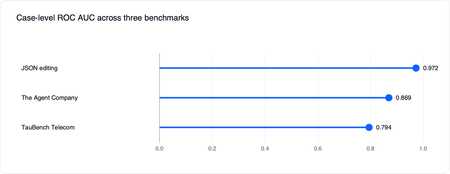
Authors: Shuo Qiu, Sydney Lister, Ilya Matiach, Ali Mahmoudzadeh, Salma Elshafey, José Santos, Vivek Bhadauria, Morteza Ziyadi, April Kwong Why Your Agent Needs a Task-Specific Evaluator Picture a customer-service agent for a telecom company. A customer messages in asking to switch plans and get a refund for last month's overcharge. The agent needs to verify the customer's identity and confirm the new plan before ending the conversation. Miss the verification step and you have a security incident. Those success criteria are specific to this one scenario. The auto-generated rubric evaluator is designed to help address this: use the context you already have to generate a task-specific rubric evaluator that returns a weighted score with per-dimension explanations, then can be reused across iterations. How We Validated Evaluator Quality We validate auto-generated rubric evaluators across four aspects: Verdict Validity — whether judgments on real cases reflect what a competent reviewer would conclude. Rubric Validity — whether generated rubrics capture the task requirements and failure modes. Manual Quality Inspection — whether judgments on real cases look right to a human reviewer. Reliability and Separability — whether judgments are stable across repeated runs and distinguish stronger from weaker candidate agents. Validation Results 1. Agreement with Trusted Reference Signals We first validate the auto-generated rubric evaluator end-to-end: we use the rubric generator to produce the rubric's dimensions, then the rubric evaluator scores each case against them. We use GPT-5.4 for both rubric generator and rubric evaluator. The first question is whether those end-to-end scores move with signals teams already trust. For example, does the rubric evaluator give lower scores to failed cases, and higher scores to successful ones? We start by choosing benchmarks the community already uses as reference points: Dataset What It Tests JSON Editing Deterministic structured-editing tasks where outputs can be checked exactly. TauBench Telecom Customer-service agent tasks requiring policy following, tool use, and task completion. The Agent Company Long-horizon workplace-agent tasks with multi-step tool use. We InspectAI’s 10-case subset. BFCL Multi-Turn Tool Calling Multi-turn function-calling behavior across realistic tool-use scenarios. LiveClawBench Open-ended web-agent tasks that require browsing, interaction, and judgment. Retail-Agent Customer Service Real production-style retail support conversations. We then ask the generation pipeline to generate rubric evaluators for each scenario, and measure the correlation between the evaluator's scores and the trusted reference signals. For the three datasets with per-case reference signals, we can directly check whether the evaluator gives higher scores to successful cases than failed ones. We then create traces from different candidate agents. In these experiments, each candidate agent uses the same task setup and prompt but a different underlying model, which gives us a controlled range of stronger and weaker agent behaviors. Because the evaluator returns a continuous score, we use receiver operating characteristic area under the curve (ROC AUC) when the trusted case-level signal can be read as success versus failure. It measures how often, when comparing a successful case with a failed case, the evaluator assigns the successful case the higher score. In these experiments, generated rubric evaluators align well with trusted signals at the case level, with ROC AUC of 0.794 on TauBench Telecom, 0.869 on The Agent Company, and 0.972 on JSON Editing. An important goal of evaluation is to score candidate agents that perform better on the reference signal also higher by the evaluator. This is more directly relevant when choosing among candidate agents, and it is a more forgiving test of alignment because aggregated scores are less sensitive to noise in individual judgments. We measure this with aggregate candidate-agent Spearman ρ, which checks whether the evaluator ranks candidate agents the same way as the oracle — a ρ of 1.0 means the evaluator's ranking is perfectly aligned with the oracle's, while 0 means no relationship. For BFCL and LiveClawBench, the oracle ranking comes from their official leaderboard scores. At the aggregate candidate-agent level, Spearman ρ ranges from 0.69 on The Agent Company to 0.98 on JSON Editing across all five benchmarks. Aggregation reduces per-case noise, so the candidate-agent ranking is the more relevant view when the goal is agent selection. 2. Rubric Quality on GDPVal GDPVal is a benchmark that measures how well AI models perform real-world, economically valuable work in sectors such as government, manufacturing, and technical services. This benchmark includes a rubric for each task, authored by a domain expert, which is useful for rubric-validity measurement. We ask the rubric generator to produce a rubric for each test case, then use a separate matching judge to match the generated dimensions to the expert dimensions. This gives us two metrics for rubric quality: Recall. For each annotated dimension, did at least one generated dimension express a similar requirement? Precision. For each generated dimension, did at least one annotated dimension express a similar requirement? Under this setup, the generated rubric achieved 72.1% recall and 86.4% precision against the expert dimensions on GDPVal tasks. 3. Manual Quality on Retail-Agent Conversations For a real-world retail-agent customer-service dataset, we generated a rubric with six dimensions, then graded 12 conversations over those dimensions, and manually inspected every case-by-dimension judgment. In this small sample (12 conversations), the reviewer disagreed with only one of the 72 case-by-dimension judgments. Most neutral cases involved applicability questions that the evaluator flagged inconsistently. Reliability and Separability Another key question is how reliable the evaluator's scores are. We look at two things: reliability (does the same case get the same score next time?) and separability (can the evaluator confidently rank two candidate agents against each other?). Reliability If you re-grade the same case tomorrow, do you get the same score? We measure this two ways: single-measure intraclass correlation, ICC(3,1) measures how much of the score variance comes from real case differences rather than repeat noise, and Kendall's W measures rank reliability across repeats — 1.0 means the evaluator ranks cases in the same order every time. On JSON Editing, single-measure intraclass correlation, ICC(3,1), is 0.852 and Kendall's W is 0.767, which means re-running the evaluator on the same case gives similar numbers under repeated runs in this experimental setup. TauBench Telecom shows similarly strong reliability, with ICC(3,1) of 0.85 and Kendall's W of 0.89 under the same recommended configuration. Separability Separability measures whether the score is decisive: when you put two candidate agents side by side, can the evaluator confidently say which one is better? We report mean pairwise bootstrap confidence, which measures ranking stability. For each pair of candidate agents, we resample cases and recompute each agent's mean evaluator score. The pair confidence is the fraction of bootstrap samples supporting the more common ordering: a value near 0.5 means the ordering is unstable, while a value near 1.0 means the evaluator consistently separates that pair. We average this across all candidate-agent pairs. The candidate-agent intervals are tight on JSON Editing and TauBench Telecom. Mean pairwise bootstrap confidence is 0.96 on JSON Editing dataset and 0.95 on TauBench Telecom dataset. Get Started The auto-generated rubric evaluator's results may vary depending on task design, input quality, and evaluation setup. Start with a clear, well-defined description for your evaluation in the prompt field, include as much high-quality context as possible, such as the agent definition and examples, and review the generated rubric carefully before using it. Run it against a small set of known-good and known-bad cases to understand how the score reflects different failure modes. Try the workflow in the Foundry portal and follow the rubric evaluator tutorial. For a demo that covers Rubric in the broader observability workflow, watch the Build breakout session From observability to ROI for AI agents on any framework. For the full set of Build observability announcements, read Build 2026: From observability to ROI for AI agents on any framework.903Views0likes0Comments
Now in Foundry: Command A+ (W4A4), Chandra OCR 2, and GLM-OCR
We are seeing two distinct trends this week. The first is around how low-bit quantization has developed to the point where large reasoning models can fit on a single accelerator with less quality loss. Second, a new wave of OCR-specialized vision-language models are redefining the accuracy-throughput frontier for document understanding. This week we are highlighting three Hugging Face models in Microsoft Foundry: Cohere Labs' Command A+ (W4A4), a 218B-parameter Sparse Mixture-of-Experts (MoE) reasoning model optimized for agentic, multilingual, and reasoning-heavy tasks; Datalab's Chandra OCR 2, a 5.3B vision-language model that converts images and PDFs to markdown, HTML, and JSON while preserving layout, with state-of-the-art results on the olmOCR benchmark and 90+ language coverage; and Z.ai's GLM-OCR, a 0.9B compact OCR model—roughly 6× smaller than Chandra OCR 2—built on the GLM-V encoder–decoder architecture that ranks first on OmniDocBench V1.5 while serving at high concurrency. Models of the week Cohere Labs: Command A+ (W4A4) Model Specs Parameters / size: 218B total, 25B active per token Context length: 128K input, 64K output Primary task: Text generation with vision input, reasoning, and tool use Why it's interesting Efficient, low compute deployment: Command A+ is designed to run on relatively minimal hardware for its size while maintaining high performance. It achieves this through advanced quantization and optimization techniques that reduce compute, latency, and cost. However, reasoning models are especially sensitive to quantization, as errors can accumulate over long decoding sequences. To mitigate this, the quantized student model is post-trained against the full-precision teacher’s output distribution, using fake quantization in the forward pass and straight-through estimators during backpropagation. CohereLabs recommends the W4A4 quantization for its strong balance of speed and latency. Multilingual, multimodal, and reasoning focused performance gains: Command A+ extends to 48 different languages (previously 23) and is built for complex reasoning and multimodal tasks with measureable improvements across document understanding, math reasoning, and enterprise QA workflows. Try it Test this prompt in the CohereLabs Hugging Face Space before deploying the model in Foundry: Sample prompt: You are Command, a legal AI for multinational contract review with access to CONTRACT_VAULT_QUERY and POLICY_TEMPLATE_RETRIEVAL tools. Analyze the input clause by first detecting language and classifying obligation type, then use CONTRACT_VAULT to find comparable {jurisdiction} clauses and retrieve the relevant policy template. Output structured JSON with obligation classification, comparative findings, risk assessment, and English recommendations with exact document citations. Include confidence scores, similarity metrics, and a reasoning trace showing each analysis step. Handle Polish/Japanese legal terminology accurately, preserve legal precision, and ensure all citations reference actual source documents. Use chain-of-thought reasoning, stay within 128K tokens, and never hallucinate references—state limitations explicitly when tools fail. Datalab: Chandra OCR 2 Model Specs Parameters / size: 5.3B Output formats: Markdown, HTML, and JSON Primary task: Document OCR (image-text-to-text) Why it's interesting State-of-the-art on the olmOCR benchmark: Chandra OCR 2 recieved 85.9% bench score on the olmOCR Benchmark and a 77.8% multilingual bench score (12% improvement over Chandra 1). Support for 90 world languages: Indic script, European languages, and languages that read right to left say substantial improvemtns based on Datalab’s internal benchmarking. View the full list of languages and the benchmark results here: Chandra 2 Language List Better complex layout understanding: Handles multi-level tables, nested structures, forms, math, and mixed handwriting with structured outputs (HTML/JSON/Markdown + bounding boxes), removing the need for post-OCR layout reconstruction. Take a look here: Try it Build an automated compliance intake pipeline using Chandra OCR 2 for structured extraction across complex, handwritten and form-based documents. In this scenario, you’re supporting a state election commission processing large volumes of candidate filings submitted as scanned forms or mobile-captured images. These documents often include mixed handwriting quality, checkbox selections, signatures, and structured fields that must be validated for compliance. Chandra OCR 2 can extract both printed and handwritten fields, identify form structure, and capture key elements such as candidate information, filing details, checkbox states, and signed declarations in a consistent JSON format. This structured output can then be passed into a compliance workflow to validate completeness, detect inconsistencies, and flag filings that require manual review. This approach helps streamline high-volume intake while improving accuracy and reducing manual processing across complex document types. Sample prompt: Extract all fields from this filing and return a structured JSON output including form type, candidate name, office sought, district, committee name, treasurer, filing date, checkbox states, and a transcription of the signed declaration. Include bounding boxes for each extracted field. Z.ai: GLM-OCR Model Specs Parameters / size: 0.9B Languages: Chinese, English, French, Spanish, Russian, German, Japanese, Korean Primary task: Document OCR (image-text-to-text) Why it's interesting High accuracy at a compact scale: GLM-OCR achieves a score of 94.62 on OmniDocBench V1.5, showing strong performance on tasks such as formula recognition, table extraction, and document parsing—even at sub-1B scale Designed for structured document understanding: The model performs well across complex document layouts, enabling extraction of tables, forms, and mixed text-image content Optimized training for consistency across tasks: Uses Multi-Token Prediction (MTP) and full-task reinforcement learning to improve stability and accuracy across diverse document types Efficient for real-world deployment: Its smaller footprint makes it well suited for scalable OCR pipelines where cost, latency, and throughput matter Try it Build a high-throughput document ingestion pipeline using GLM-OCR for structured extraction across diverse document types. Imagine you are operating a customer onboarding platform that processes identity documents, invoices, and proof-of-income statements across multiple languages. GLM-OCR can be used to extract key fields—such as names, ID numbers, dates, and addresses—and output them in a consistent structured format for downstream systems. The model’s compact footprint makes it well suited for scaling high-volume OCR workflows, enabling you to process large batches of documents efficiently while maintaining accuracy across layouts like tables, forms, and mixed text-image content. Sample prompt: Extract the following fields from this document and return a structured JSON output: full name, ID number, date of birth, address, document type, and expiration date. Ensure all fields match the document exactly, including formatting. Getting started Whether you are coming straight from the Hugging Face hub or are already in Microsoft Foundry, deploying new open models is getting simpler. You can deploy models on Foundry by browsing the Hugging Face collection in the model catalog or you can choose "Deploy on Microsoft Foundry" on the Hugging Face website, which brings you straight into Foundry with secure, scalable inference already configured. Read the documentation to learn more: Read Hugging Face on Azure docs Learn about one-click deployments from the Hugging Face Hub on Microsoft Foundry Explore models in Microsoft Foundry949Views0likes0CommentsEvaluate before you ship: introducing the Voice Live Evaluation Harness
You've built a voice agent on Azure Voice Live. It demos beautifully. Then a teammate asks the question that keeps every voice-agent team up at night: "How do we know it's actually good — across 200 customer calls, not the three we just listened to?" Until today, the honest answer was: put on headphones. Manual listening. Subjective scoring in a spreadsheet. No baseline, no regression signal, no way to defend a model swap with data. We're releasing the Voice Live Evaluation Harness to change that. It's an open-source, deployable evaluation pipeline that runs pre-recorded multi-turn audio through your Voice Live agent and scores every turn with the same evaluators built into Microsoft Foundry — automatically, repeatably, and in parallel. TL;DR Two flavors, one repo. Run the CLI harness locally against a Foundry project for fast iteration, or deploy the evaluation agent into your Azure subscription with the Azure Developer CLI (azd) for a fully-hosted evaluation backend. 13 built-in evaluators score every turn — intent resolution, task adherence, task completion, response completeness, tool-call accuracy, groundedness, and more — viewable per-turn and in aggregate inside the Foundry portal. Supports the three Voice Live modes you actually ship in — Semantic VAD, Push-to-Talk, and Foundry Agent mode — including multi-turn conversations with tool calls and grounding. Grows with your agent. Start with the sample datasets, then layer in audio collected from user testing and production traffic so your evaluation set matures alongside the agent. 🔗 Repo: microsoft-foundry/voicelive-evaluation · Docs: Evaluate Voice Live agents (preview) Why systematic evaluation matters for voice agents Text agents have a mature evaluation story. Voice agents don't — and the gaps actually matter more, because every voice failure happens in real time, in front of a customer, on a phone line you can't easily replay. The Voice Live Evaluation Harness closes that gap with four concrete capabilities: Establish a quality baseline. Run a representative audio dataset through your agent and get scores you can publish as your launch bar. Compare configurations side-by-side. Swap the underlying model (GPT-Realtime 1.5, Azure-Realtime, MAI-Transcribe-1.5), change the voice, tune VAD thresholds — and see exactly which knobs moved which scores. Catch regressions before users do. Wire it into CI and fail the build when intent resolution drops below your threshold. Optimize with data, not vibes. When task-completion drops, drill into the per-turn scores to see whether the agent failed to call the right tool, misunderstood intent, or generated an incomplete response. Keep iterating as production data rolls in. Start with the sample datasets, then grow your evaluation set with audio captured from internal testing, pilot users, and real production traffic. Re-run after every prompt tweak or model swap so the harness becomes a continuous quality signal — not a one-time launch checklist. How it works The pipeline is a five-stage loop: Audio Dataset. Multi-turn audio + expected behaviors in a simple JSONL schema. Four sample datasets ship in the repo (travel planning, complex data analytics, tool-calling tests, batch multi-conversation) so you can run end-to-end on day one. Voice Live API. Pick your Voice Live mode (Semantic VAD, PTT, or Foundry Agent), model, voice, and turn-detection settings via a JSON config file, then stream each turn of audio through the API — locally with the CLI harness, or, if you've deployed the evaluation agent, via the hosted Container App for long-running batches in your own subscription. Transcript + Response. Every turn produces an agent transcript, the model's response, and any tool calls it made — captured automatically for scoring. Foundry Evaluators. 13 built-in evaluators — powered by the same Foundry evaluator models (GPT-4.1-mini and o4-mini) used across Microsoft Foundry — judge every turn on intent resolution, task adherence, tool-call accuracy, groundedness, and more. Quality Scores. Per-turn and aggregate scores land in the Microsoft Foundry portal under your project's Evaluation tab — sortable, filterable, comparable across runs. Then loop. Audio captured from internal testing, pilots, and production traffic feeds back into the dataset — each pass makes the next evaluation more representative of what users actually do. What gets measured The accelerator ships 13 built-in evaluators out of the box, covering the dimensions that matter most for production voice agents: Category Evaluators Intent & task quality Intent Resolution · Task Adherence · Task Completion · Response Completeness Tool calling Tool Call Accuracy · Tool Call Parameter Validity · Tool Result Usage · Tool Call Success Content quality Groundedness · Relevance · Fluency · Coherence Conversational dynamics Turn-taking quality Every evaluator runs against the same Foundry evaluator models (GPT-4.1-mini and o4-mini) that power evaluation across the rest of Microsoft Foundry — so your voice-agent scores are directly comparable to your text-agent scores. Run the CLI locally against your existing Voice Live endpoint If you already have a Voice Live agent deployed and just want fast iteration on a laptop: git clone https://github.com/microsoft-foundry/voicelive-evaluation.git cd voicelive-evaluation/evaluation_harness python -m venv .venv && source .venv/bin/activate pip install -r requirements.txt cp .sample_env .env # Edit .env with your AZURE_VOICELIVE_ENDPOINT python voice_agent_evaluation.py \ --config configs/sample_vad_realtime.json The full walkthrough — dataset schema, configuration reference, score interpretation, and troubleshooting — is in the documentation. Get started Repo: microsoft-foundry/voicelive-evaluation Docs: How to evaluate Voice Live agents (preview) We'd love your feedback — try it, file issues, and tell us which evaluators you wish you had.501Views0likes0Comments