agentic ai
1 TopicThe Cloud Foundation for Safe Agentic AI
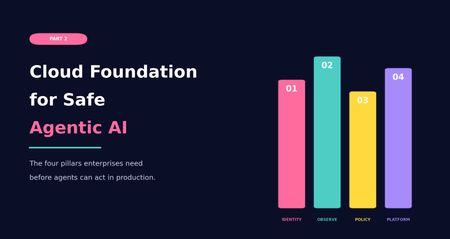
Why enterprise agents need more than a working prototype Most AI conversations start with the model. Which model should we use? Which framework? Which agent platform? Which demo can we build quickly enough to make the idea feel real? Those questions are not wrong, but they are rarely the first questions that matter in an enterprise environment. In real projects, the hard part usually appears after the first prototype works. The demo can answer a question, call a tool, retrieve a document, or update a record. Then someone asks whether it can be connected to production data, used by more teams, or allowed to trigger real actions. That is where the conversation changes. In the first part of this series, I looked at why many companies are less ready for agentic AI than they think. The blockers were practical and familiar: unclear business problems, immature processes, weak data foundations, and no clear owner when an AI system makes a poor recommendation or takes a wrong action. The message was simple: Before a company asks what agents can do, it needs to understand what it is ready to delegate. But business readiness is only the first layer. Even when the use case is clear, the process is understood, and leadership is aligned, another question appears. Is the platform ready to support agents safely? This is where Part 2 begins. Agentic AI does not behave like a normal application workload. A traditional application usually follows predefined paths. It receives a request, processes logic, returns a response, writes to a database, or calls an API. Agents introduce a different pattern. They reason over context, retrieve information, choose tools, trigger actions, interact with other services, and sometimes operate across multiple systems at once. That makes the surrounding cloud platform much more important. There is also a shadow AI angle to this. In many organizations, agent-like capabilities are already entering through SaaS platforms, vendor copilots, browser extensions, and productivity tools. These systems may not run inside the organization’s governed Azure subscriptions, but they can still interact with enterprise data and business workflows. If the official platform is not ready, teams will often find less governed ways to experiment anyway. That is not always malicious. Sometimes it is just people trying to solve their work with the tools available to them. The marketing analyst pasting customer data into a public chatbot because the official AI platform is six months away. The support team using a browser extension that summarizes tickets, without anyone realizing those tickets are also being sent to a third-party service. From a governance point of view, the effect is the same. Cloud readiness for agentic AI is not defined by access to cloud services or model endpoints alone. The real question is whether the platform can support controlled autonomy. Before enterprises can trust agents to act, the platform must be able to identify them, observe their behavior, restrict their permissions, enforce policy, and contain failure. Without that, an organization is not really deploying an intelligent assistant in a controlled way. It is introducing a workload that can interact with enterprise systems without anyone clearly watching what it does or being able to stop it. From business readiness to cloud readiness After the business foundation is clear, the next layer is the cloud foundation. A company may have a strong use case, executive support, and even a working prototype. But that does not mean it is ready to deploy agents in production. A prototype can run with broad access, manual supervision, loose logging, and a small group of test users. Production requires more discipline. It requires clear identity, controlled access, traceable activity, enforceable policy, and operational ownership. Cloud readiness for agentic AI comes down to four pillars, in this order: Identity-first architecture Observability Policy controls Platform constraints The order matters. 1. Identity-first architecture Identity comes first because nothing can be governed properly if it cannot be identified. In traditional cloud systems, we already learned this lesson with users, applications, service principals, managed identities, and workloads. Agents add another layer of non-human actors into the enterprise environment. If an agent can retrieve data, call tools, trigger workflows, or interact with business systems, it needs a clear identity. Without that foundation, governance becomes fragile. Teams may struggle to control what the agent can access, understand what it did, or determine who is accountable when something goes wrong. I have seen agents running in production where nobody could clearly say who owned them. They worked. Until they did not. Identity-first architecture means each agent or agentic workload should have a defined identity, ownership model, permission scope, and lifecycle. It should be clear whether the agent is acting on behalf of a user, acting as a service, or operating within a delegated boundary. This matters because permissions are not an implementation detail. They define the blast radius and accountability model of the system. In Azure environments, this is where Microsoft Entra ID and newer agent identity capabilities become important. As agents become more common across Azure AI Foundry, Copilot Studio, Microsoft 365, and custom frameworks, organizations need a way to understand which agents exist, who owns them, what they can access, and how their lifecycle is managed. Identity is not only about authentication. It is also about visibility, traceability, ownership, permission boundaries, and accountability. Agents should not remain hidden inside application logic or operate through shared identities. If they can retrieve data, call tools, or trigger actions, they need to be managed with the same care as any other production workload. 2. Observability Once identity is established, observability becomes the next pillar. Knowing that an agent exists is not enough. The platform must be able to show what the agent did. For normal applications, observability often focuses on service health, latency, failures, and resource usage. For agents, those signals still matter, but they are incomplete. Agent observability also needs to capture the execution path across model calls, retrieved context, orchestration steps, tool calls, policy decisions, approvals, denials, and final actions. This changes how we think about monitoring. With agentic systems, the question is not only whether a request succeeded or failed. Teams also need to understand the path that led to the outcome, the context used, the tools called, the policies applied, and the point where behavior changed. Without that visibility, it is difficult to investigate failures and improve reliability. This is also where observability starts to support governance, not just troubleshooting. Once teams can measure how agents behave, they can move toward KPI-based governance. That may include reliability, escalation rates, policy denials, grounding quality, tool-call failures, cost per interaction, latency, and business outcome metrics. Without this measurement layer, maturity remains mostly opinion-based. With it, governance becomes evidence-based. In Azure, Azure Monitor is the obvious starting point. Together with services such as Application Insights and Log Analytics, it provides the telemetry foundation needed to understand how AI workloads behave in production. For agentic systems, this usually requires combining platform telemetry with application-level traces from orchestration, retrieval, model calls, policy decisions, and tool execution. This visibility is what makes continuous improvement possible. It is also what allows governance to mature from “we think the agent is behaving correctly” to “we can measure how the agent behaves over time.” Small difference. Large consequence. 3. Policy controls The third pillar is policy controls. This comes after identity and observability because policy needs both. Identity defines who or what the rule applies to. Observability helps teams understand whether the rule is effective, bypassed, misconfigured, or too restrictive. Policy controls define the boundaries for what agents are allowed to do. They determine how agents access data, which tools they can use, which environments are in scope, when approval is required, and when an action or response should be blocked. The key point is simple: Prompts can guide behavior, but they are not a reliable enforcement layer. For enterprise systems, policy needs to be external, testable, auditable, and enforceable. This becomes especially important because agents may operate across multiple systems. An agent may retrieve information from one source, reason over the result, call a tool, update a ticket, send a message, or trigger a workflow. Each step may appear safe in isolation, while the full chain creates risk. Policy controls provide boundaries around that chain. In Azure, this starts at the cloud governance layer. Azure landing zones, management group structures, and Azure Policy can help define where AI workloads are deployed, how environments are separated, and which rules apply consistently across subscriptions. At runtime, Azure AI Content Safety can help detect harmful content, prompt attacks, unsafe interactions, or outputs that drift away from the intended task. For tool and API access, Azure API Management can also be used as a controlled gateway between agents and downstream systems. This can support centralized authentication, throttling, mediation, logging, and policy enforcement. It is not mandatory in every design, but it is a useful option when agents need governed access to APIs instead of direct backend connectivity. The goal is not to create friction for the sake of control. The goal is to make sure the agent operates inside boundaries that are defined outside the prompt and outside the model response. 4. Platform constraints The fourth pillar is platform constraints. This area often receives less attention early in the project, but it strongly shapes whether an agentic system can operate safely and reliably in production. These constraints include network isolation, private connectivity, data residency, regional availability, quota limits, model throughput, latency, logging retention, integration boundaries, cost behavior, and operational ownership. They may seem like implementation details during early design discussions, but they often determine whether the system can actually run in production. For agentic workloads, these constraints also shape where experimentation happens. Sandboxed environments, isolated subscriptions, limited tool access, and controlled test data can help teams evaluate agent behavior before exposing it to production systems. This becomes even more important when agents are allowed to generate code, call external tools, or execute actions that may not be fully trusted at design time. Platform constraints are where the earlier pillars meet implementation reality. Identity affects how agents connect to services. Observability affects logging cost, retention, and investigation capability. Policy affects routing, network design, tool exposure, and user experience. By the time an agentic system reaches production, these constraints are no longer background details. They become design boundaries. In Azure, this is where landing zone design, private networking, regional planning, quota management, cost management, and operational runbooks matter. Azure landing zones, private endpoints, private DNS, Azure Firewall, NSGs, and controlled network paths all influence whether the agent architecture can move from prototype to production without being redesigned halfway through. And yes, that redesign usually happens at the least convenient moment. Architecture has a sense of humor. Not a kind one. From principles to Azure capabilities The four pillars are not only architectural principles. They need to be translated into platform capabilities, operating practices, and governance controls. In practice, controlled agent deployment is rarely achieved by a single product or service. It requires multiple layers working together. Identity, monitoring, policy, networking, runtime safety, API exposure, and operational controls all play a part. Azure provides several services and patterns that can help implement these controls, but there is no fixed blueprint that applies to every organization. The right combination depends on the use case, regulatory requirements, existing landing zone design, integration landscape, and the level of autonomy expected from the agent. The examples below should be seen as a practical toolset, not as a mandatory checklist. Pillar Goal Example Azure capabilities Identity-first architecture Make agents visible, owned, permissioned, and governable as enterprise workloads. Microsoft Entra ID, Microsoft Entra Agent ID, managed identities, service principals, workload identities, access reviews, Conditional Access, Privileged Identity Management Observability Understand runtime behavior, trace execution paths, investigate failures, and improve reliability. Azure Monitor, Application Insights, Log Analytics, Azure AI Foundry tracing, diagnostic settings, distributed tracing, correlation IDs, application-level telemetry Policy controls Enforce boundaries around access, actions, content safety, APIs, and governance. Azure landing zones, management groups, Azure Policy, Azure AI Content Safety, Prompt Shields, Microsoft Purview, Azure API Management, RBAC, approval flows Platform constraints Operate within real cloud boundaries such as networking, region, quota, compliance, and operations. Azure landing zones, private endpoints, private DNS, private networking, Azure Firewall, NSGs, quota planning, regional architecture, cost management The purpose of this mapping is not to suggest that Azure has one single service for each pillar. It does not. The practical goal is to combine the right services and patterns so the platform can identify agents, monitor their behavior, enforce boundaries, and operate within known cloud constraints. Conclusion Agentic AI does not become enterprise-ready simply because a model is available, a prototype works, or a business sponsor is excited. The real question is whether the surrounding cloud foundation can support agents that act within boundaries the platform actually enforces. Together, these pillars move the discussion from building an agent to preparing the environment in which the agent can operate responsibly. That distinction is important. A prototype can rely on broad access, limited logging, and close manual supervision. A production system needs clearer boundaries around ownership, access, traceability, and control. This is also where the series moves naturally into Part 3. Once the business foundation is clear and the cloud foundation is in place, the next challenge is the design of the agent itself. The cloud foundation matters here because it provides the controlled environment in which agents can be tested, limited, and observed before they are trusted with broader enterprise access. For more advanced scenarios, that also includes sandboxing patterns for generated code, tool execution, and untrusted actions. In Part 3, I will move closer to implementation and look at how to design an enterprise-ready agent. That means defining the agent’s scope, grounding it with reliable knowledge, deciding which tools it can use, designing safe execution loops, adding human oversight where it matters, and thinking carefully about when a single agent is enough versus when multi-agent coordination is justified. That is where agentic AI starts becoming more than an idea. And, as usual, that is also where the architecture starts to matter. This article is part of my Agentic AI readiness series and was also published on Medium.128Views0likes0Comments