agent builder
35 Topics
Understand the Copilot Studio app-building harness
The first important distinction is that building an app is different from building a conversational agent. An app provides an interactive user interface. An agent reasons about a request and may use tools to accomplish a task. A workflow executes defined business logic. You can combine all three in a business solution. Component Responsibility Example Copilot Studio Apps User interface and application experience An employee service dashboard GitHub Copilot harness AI-powered building and orchestration runtime Planning multi-step tasks and generating app components Agent Reasoning and task execution Investigating a service request Workflow Repeatable business process Routing an approved request Data layer Stores and retrieves business information Requests, users, approvals, and status Connectors and APIs Integrates enterprise systems SharePoint, Microsoft Graph, or ServiceNow The GitHub Copilot harness in Copilot Studio is not the same thing as using the GitHub Copilot service. It is a Copilot Studio runtime for advanced reasoning and orchestration. Microsoft's documentation states that the normal Copilot Studio security, privacy, compliance, and data residency commitments continue to apply. 2. Before building: define the application properly One of the biggest mistakes is asking the builder to create an app with a vague prompt. For example: Weak prompt "Build an employee management app." This leaves too many decisions to the AI. It might generate an attractive interface but miss important business requirements. Instead, define these eight elements before generating the application. Element What to specify Business problem What problem does the application solve? Target users Who will use it? User journeys What tasks must users complete? Data model What entities, fields, and relationships are needed? UI requirements What screens, components, filters, and interactions are required? Business rules What validations and conditions must be enforced? Integrations What APIs, data sources, and systems are involved? Security Who can view, create, edit, approve, or delete records? Also define the acceptance criteria before generation. For example: Users can search requests by ID, owner, status, and date. Selecting a request opens its detailed view. Users can update permitted fields. Invalid status transitions are rejected. Loading, empty, and error states are handled. Changes are persisted to the intended data source. My recommendation: Write the requirements first, then build the app. Don't use repeated prompts to discover the business requirements while simultaneously generating the UI. 3. Step-by-step guide to building an app Step 1: Open the app-building experience Open copilot studio Step 2: Start with a complete application specification Let's use an example: an Enterprise AI Operations Dashboard. The app will help employees and administrators monitor AI automation requests, investigate failures, track processing time, and manage remediation. Start with a structured prompt. Master app-generation prompt You can adapt this prompt for your first build. Build a professional enterprise application called Enterprise AI Operations Dashboard. BUSINESS OBJECTIVE Create a centralized interface for monitoring AI automation requests, execution outcomes, failures, processing time, and remediation activities. TARGET USERS Operations analysts who monitor executions. Administrators who investigate failures. Managers who review operational performance. APPLICATION STRUCTURE Create the following pages: Overview Dashboard Total executions Successful executions Failed executions Success rate Average processing time Execution trend over time Recent failures Status distribution Execution Explorer Search by execution ID Filter by status, application, owner, and date Sort by execution time and duration Paginated or appropriately limited results Select an execution to open its details Execution Details Execution ID Application name Initiated by Start time and end time Duration Status Error summary Diagnostic information, when available Remediation history Remediation Center Display unresolved failures Allow authorized users to assign an owner Add investigation notes Update remediation status Record timestamps for changes Settings Configurable filters and display preferences Clear explanation of administrative permissions No destructive administrative actions without confirmation DATA MODEL Create a logical data model containing: Execution: ExecutionId ApplicationName InitiatedBy StartTime EndTime DurationSeconds Status ErrorSummary Environment RemediationStatus Remediation: RemediationId ExecutionId AssignedTo Notes Status CreatedAt UpdatedAt Define a relationship between Execution and Remediation. If a persistent data source is not configured, use clearly identified sample data. Do not present sample data as live production data. UI AND DESIGN Use a clean, modern enterprise dashboard with: Clear visual hierarchy Readable typography Consistent spacing Responsive layouts Accessible contrast Reusable UI components Summary cards Appropriate charts Searchable and filterable tables Clear loading, empty, success, and error states FUNCTIONAL REQUIREMENTS Search and filters must work. Dashboard metrics must be calculated from the underlying dataset. Selecting a row must display the corresponding execution details. Form inputs must be validated. Status changes must update the intended data source. Display clear error messages when operations fail. Prevent duplicate submissions where appropriate. Confirm potentially destructive actions. Preserve filters when navigating between related screens where feasible. SECURITY Respect the signed-in user's permissions. Do not expose secrets, access tokens, or sensitive diagnostic information. Do not rely on hiding a UI button as the only authorization control. Enforce authorization at the data source or API. Do not create external integrations without explicitly identifying their requirements. IMPLEMENTATION PROCESS First, summarize the proposed architecture, data entities, pages, and assumptions. Ask clarifying questions if a critical requirement is ambiguous. Then generate the first functional version of the application. After generation, test the primary user journeys and identify incomplete functionality. Clearly distinguish implemented features, simulated features, and integrations that still require configuration. This is a starting specification, not a guarantee that every requested capability will be generated correctly. Inspect the resulting application and verify its actual behavior. Step 3: Review the generated application Once the app preview appears, don't immediately ask for more features. First, inspect the application against the specification. Check: Does the navigation work? Are the pages connected logically? Do the tables display consistent data? Do the filters actually change the results? Are dashboard metrics calculated correctly? Does selecting a record open the correct details? Do forms validate required fields? Does saving actually persist the changes? Are the displayed integrations real or simulated? This distinction is essential: a functional-looking interface is not proof of a working backend. Microsoft's app-building experience provides an interactive preview and lets you refine the app through conversation. It also exposes the underlying code for inspection. 4. Technical prompting techniques for better apps This is where you can significantly improve the quality of generated applications. Technique 1: Build in controlled iterations Avoid asking the builder to implement every feature, integration, chart, and workflow in one enormous request. Use a sequence of targeted changes. Iteration 1: Application foundation "Review the generated application and identify missing requirements. Fix the navigation structure, page layout, data model, and core interactions before adding new features." Iteration 2: Data integrity "Review the application data model. Ensure each execution has a unique identifier, remediation records reference valid executions, and dashboard metrics are calculated from the underlying records. Identify any assumptions that require confirmation." Iteration 3: UI quality "Improve the visual hierarchy, spacing, typography, responsive behavior, table readability, and empty states. Preserve existing functionality and data relationships." Iteration 4: Functional behavior "Test search, filtering, sorting, record selection, form validation, and save operations. Fix broken interactions. Do not replace functional data operations with hardcoded sample results." Iteration 5: Error handling "Add appropriate handling for failed API requests, unavailable data, validation errors, empty results, and repeated submissions. Provide useful user-facing messages without exposing secrets or internal stack traces." Iteration 6: Final verification "Compare the application against the original requirements. List each requirement as implemented, partially implemented, or not implemented. Identify any feature that uses mock data or still needs external configuration." This approach makes failures easier to isolate and reduces the risk of breaking working functionality during a large rewrite. Technique 2: Specify behavior, not just appearance A prompt such as: "Add a modern search bar." defines appearance, not behavior. A better instruction is: "Add a search field above the execution table. Search across ExecutionId and ApplicationName. Apply the search when the user submits or after a short debounce. Combine the search with existing status and date filters. Show an empty state when no records match. Provide a clear-search action and preserve the selected sort order." The second instruction describes expected behavior, interaction, and edge cases. Technique 3: Define invariants An invariant is a condition that must remain true throughout the application. Examples: Every remediation record must reference an existing execution. Execution IDs must be unique. Failed executions must not be marked successful merely because a remediation note was added. A user cannot approve their own request if the business policy prohibits it. Dashboard metrics must use the same filtering rules as the displayed data. Failed writes must not display a false success notification. Add important invariants to the application specification and ask the builder to preserve them during modifications. Technique 4: Request minimal changes When fixing a specific problem, avoid asking the builder to regenerate the entire application. Instead, use an instruction such as: "Fix the execution table's date filter. Preserve the existing navigation, data model, styling, and other filters. Change only the logic needed to make the date filter work. Verify that it works independently and in combination with the status filter." This helps reduce unintended changes and makes troubleshooting easier. Technique 5: Ask for evidence of completion Don't accept a statement that a feature is complete without testing it. Ask: "Identify the implementation for this requirement, test the relevant user journey in the preview, and report any remaining limitation. If the functionality depends on an unconfigured API or connector, identify that dependency explicitly." Where the preview does not allow a test to be performed, request a clear statement of what remains unverified. 5. Underlying code: what to inspect Copilot Studio's app authoring experience includes a way to switch between the interactive preview and the underlying code. Use that capability to inspect the implementation rather than treating the generated UI as a black box. A. Component structure Look for whether the application separates responsibilities into logical components, such as: Navigation Dashboard cards Charts Data tables Search and filter controls Detail views Forms Notifications Loading and error states A large application that puts everything into one component can become difficult to maintain. Prompt: "Review the application structure and identify opportunities to separate repeated UI patterns into reusable components. Refactor only where the current authoring environment supports it, and preserve the existing behavior." B. State management Check how the app manages: Selected records Active filters Search terms Form values Loading states API errors Unsaved changes For example, changing the status filter should not unexpectedly clear the search term or cause the selected record to display stale data. Prompt: "Review state management for the search, filter, table, and detail views. Prevent stale selections, inconsistent filters, and UI updates that occur before a save operation succeeds." C. Data access Identify whether each data source is: Hardcoded sample data Local application state A configured connector A REST API A persistent business data source For production applications, ensure the data access layer has clear responsibilities and that failures are handled consistently. Prompt: "Identify every data source used by the application. Classify each as sample data, local state, or a live integration. Do not imply that data is persisted if it exists only in memory." D. Security Inspect the implementation for: Sensitive values embedded in client-side code Authorization implemented only through UI visibility Excessive data exposure Missing validation Unrestricted destructive operations Unclear handling of user identity Never place API secrets or privileged credentials in browser-accessible code. For sensitive operations, authorization must be enforced by the relevant backend or data source, not just by the interface. Important: Access to the app and access to its underlying data are separate concerns. Microsoft's documentation explains that apps use the signed-in user's identity when connecting to organizational data, and sharing an app does not automatically grant access to data the recipient otherwise cannot access. 6. Connecting the app to enterprise systems For a Microsoft enterprise scenario, you might need to connect the app to SharePoint, Dataverse, Microsoft Graph, Power Automate, or an internal API. The appropriate integration depends on the operation and the capabilities supported by the app-building environment. Requirement Possible integration Technical consideration Store business records Dataverse Define tables, relationships, permissions, and validation Read or update SharePoint items SharePoint connector or API Respect site and item permissions Retrieve Microsoft 365 information Microsoft Graph Configure authentication, consent, and least-privilege permissions Execute deterministic business logic Power Automate or an appropriate workflow Handle failures, retries, and duplicate requests Integrate a custom enterprise system REST API or supported connector Define authentication, schemas, and error contracts Use agent reasoning Copilot Studio agent Restrict tools and define clear instructions These are architecture options, not a claim that every integration is automatically configured by the app builder. Recommended architecture For an enterprise application, consider the following logical design: User ↓ Copilot Studio app and UI ↓ Approved application actions ↓ Connector, workflow, or API ↓ Business data source Where reasoning is required, the app can also invoke an appropriately configured agent. Keep responsibilities separate: UI: Collect input and display results. Business logic: Enforce validation and business rules. Agent: Handle tasks that benefit from reasoning. Workflow: Execute predictable, repeatable steps. Data source: Persist records and enforce applicable access controls. For example, an AI-generated remediation recommendation can be presented in the UI, but changing a production system should require an authorized action and the appropriate validation. 7. App testing: use a structured checklist Before publishing, test the main user journeys, not just the visual design. Test category Example test Functional Can the user create, view, and update a record? Validation Does the app reject a missing required field? Data integrity Does a remediation reference the correct execution? Filtering Do search and status filters work together? Error handling What happens when the API returns an error? Persistence Does the update remain after refreshing or reopening the app? Authorization Can an unauthorized user perform a restricted action? Accessibility Are controls labelled and keyboard-accessible? Responsive design Does the layout remain usable at narrower widths? Performance Does the interface remain responsive with realistic data volumes? Security Are secrets excluded from client-side code? Data integrity under failure Does a failed write avoid displaying a false success message? For each critical requirement, define an expected result and test it. For an application that modifies business data, also test repeated submissions, concurrent updates, and partial failures where applicable. 8. Optimize Copilot Credits and iteration time App creation, previewing, testing, and refinement can consume Copilot Credits. Microsoft documents usage-based billing for the app-building experience. These practices can help reduce unnecessary iterations. Write a complete specification first. Resolve critical questions about users, data, and business behavior before generation. Generate a minimum viable application. Start with the core pages and one complete user journey. Fix related problems together. Instead of making five separate requests for spacing, typography, card alignment, and table readability, group those visual changes into one clearly scoped request. Avoid unnecessary full rewrites. Ask for a targeted fix and explicitly preserve unrelated functionality. Separate requirements from optional enhancements. Finish the core user journey before adding animations, elaborate charts, and secondary features. Reuse a master specification. Keep the requirements, data model, and acceptance criteria in a reusable document so you don't need to reconstruct them for every iteration. Verify before requesting another change. Test the current result first. Otherwise, you may spend credits fixing an issue that no longer exists or introduce a new issue while fixing an old one. These are practical optimization strategies, not a guarantee of a particular percentage reduction in credit consumption. 9. Publishing and sharing the application Once the app has passed its tests: Review the final UI and application behavior. Confirm that sample data is clearly distinguished from live data. Verify configured connections and permissions. Test the intended user experience. Use the available publish action to publish the app. Share it with the intended users or groups. Verify access with an appropriately authorized test account. Document known limitations and outstanding integrations. The preview status matters. Microsoft explicitly notes that Apps in Copilot Studio is a preview feature, which may have restricted functionality and is not intended for production use. Therefore, don't assume that a successful preview or publishing action alone makes the application suitable for production. Confirm the current feature terms, organizational approval, and production-readiness requirements before deploying it for business-critical use. My final recommendation For your work with Copilot Studio, Power Platform, Cowork, MCP integrations, and enterprise automation, I would develop a reusable App Builder Playbook with five parts: A requirements template. A master app-generation prompt. A reusable set of UI and data-model refinement prompts. A testing and security checklist. A credit-optimization and publishing checklist. That gives you a repeatable engineering process instead of relying on trial-and-error prompting for every new app. The most important principle is this: use natural language to accelerate implementation, but use engineering discipline to verify the result.36Views0likes0CommentsHow to preserve document format and structure with Copilot Agent
Hi everyone, I was building a copilot agent that should be able to accept a document and then make changes to it before returning the new version of that document, which has the same format and structure as the original. What is the best way to accomplish this in copilot studio? So far, I have tried using a power automate flow and external tools but it seems that there is no free included tool that can achieve this task. All the document writing tools seem to be paid services requiring API keys. Is there an alternate free way of achieving this task? Thank you477Views0likes2Comments
Agent Credit Limits and Alerts - Copilot Studio
Hi everyone, We're evaluating the use of Agent Credit Limits and alert notifications in the Power Platform Admin Center as a way to control unexpected Copilot Credit consumption. Recently, we had an agent consume 668k Copilot Credits in just 3 days, which raised concerns about how quickly usage can grow before administrators become aware of it. My questions are: How frequently is Copilot Credit consumption evaluated against an agent's credit limit? Are alert notifications generated in near real-time, or are they dependent on the same reporting pipeline used by the consumption reports? If an agent reaches its configured credit limit, is it automatically turned off or blocked from further consumption? Given that consumption reports often appear to refresh hours later (or even the next day), can alerts also be delayed? If there is a reporting delay, is there a risk that an agent could significantly exceed the intended limit before administrators receive a notification? What is the recommended approach for preventing large unexpected consumption spikes in production? Has anyone successfully implemented a governance model that provides more immediate protection against runaway usage, or are the current credit limits and alerts primarily intended for retrospective monitoring? Thanks in advance for any guidance.265Views0likes3Comments
Help building an Agent Flow to access specific folders in Sharepoint
Hi all, I am building an agent that needs to access specific subfolders (based on folder identifier) and then analyse this folder against the instructions for the agent. The planned flow is: User enters folder identifier (e.g. Vehicle registration number) The CoPilot Studio Agent uses an Agent Flow to find the Registration number folder within the SharePoint repository (which contains many folders for different cars). The Agent Flow helps the agent access the specific car's folder. The agent runs the instructions for this specific car, analysing the subfolders (e.g. Insurance documents, fuel expense history) to return to the user the outcome of the analysis for each subfolder within that registration's folder. My issue is getting the SharePoint access Agent Flow to work. I have tried using CoPilot chat to assist, but it gives a million different ways to accomplish the same thing. I understand that I need to trigger the flow, using "CarReg" as the input. Then I can use Get Files (Properties Only) to return and filter by folders to find the car registration. But now I only have the folder names, and not the underlying files for my agent to use. Also, once I perform the filter to get the relevant folder, I have many options of passing this back to the agent, such as via HTML tables or Compose. Is there a preferred method? Thanks, H777102Views0likes1Comment
Copilot Studio + SharePoint: Markdown (.md) Files in Doc Libraries Supported as Knowledge Sources?
Hi all, We’ve been doing some deeper testing with Copilot Studio agents grounded in SharePoint knowledge sources, and I’m hoping to clarify whether what we’re seeing is a known limitation or an undocumented gap. Scenario A Copilot Studio agent uses SharePoint document libraries as a knowledge source The library contains Markdown (.md) files that are intentionally used as canonical design references The same .md files: ✅ Work well when uploaded directly to the agent ❌ Are not retrievable or citable when stored in a SharePoint library and added as a SharePoint knowledge source To help with grounding, we created modern SharePoint index pages that: Explain what the markdown collections are (Patterns, ADRs, Guardrails) Link directly to the canonical folders and files Explicitly state that the .md files are the source of truth The agent can: Discover and summarize the index pages correctly Understand that .md artifacts exist and where they live But it cannot: Read the content of the individual .md files Apply a specific pattern or ADR from those files in a design conversation Cite them as sources, even when permissions and search indexing are confirmed What We’ve Checked Permissions (agent user has access) Folder depth (kept shallow) Search results (markdown files appear in SharePoint search) SharePoint indexing status Work IQ enabled Same content works when attached directly to the agent This behavior also seems consistent with what others have reported here: Markdown works when uploaded directly Markdown retrieval degrades when hosted in SharePoint libraries Questions for the Product Team / Community Are Markdown (.md) files in SharePoint document libraries officially supported as Copilot Studio knowledge sources today? If yes, are there specific constraints (file size, rendering, parsing, indexing) that differ from Word/PDF? If no (or “not yet”), is this a known limitation on the roadmap? Is the recommended pattern to: Convert important markdown files into .aspx pages, or Use thin “index / summary” pages and keep markdown canonical until retrieval improves? We’re happy to adapt our information architecture — just trying to align with the intended platform direction rather than work against it. Thanks in advance for any guidance or clarification. This capability is extremely powerful, and clearer expectations here would help a lot of teams make the right design tradeoffs.4.2KViews15likes9Comments
Copilot Studio Agent Unable to Retrieve Usable DOCX/XLSX Content from OneDrive (and SharePoint)
Hi everyone, I'm building a Copilot Studio agent that needs to read and process Word (.docx) and Excel (.xlsx) files stored in OneDrive. The agent can successfully locate files and retrieve metadata, but it appears unable to retrieve Office files as usable binary content. I tested the behaviour using the OneDrive Get file content action: A text file (test.txt) was returned correctly and matched the original file contents exactly. A Word file (Test.docx) was returned beginning with the ZIP signature PK and contained recognisable DOCX entries such as [Content_Types].xml and _rels/.rels. However, the returned payload also contained large numbers of Unicode replacement characters (�). The returned content appears to be a text string rather than binary data or base64 content. Because Office files are ZIP-based binary formats, the returned payload cannot be reconstructed into a valid .docx or .xlsx file, preventing downstream libraries such as python-docx and openpyxl from opening the file. Is there any way to resolve this issue?824Views1like6CommentsUsing Dynamics 365 ERP MCP Server from a Standalone Copilot Studio Environment
We have a Copilot Studio environment that is not connected to Dataverse and is not linked to any Dynamics 365 Finance & Operations environment. We would like to use the Dynamics 365 ERP MCP Server from an agent in this Copilot Studio environment to retrieve data from F&O. Is this configuration supported? If so: What connection and authentication setup is required between Copilot Studio and the Dynamics 365 ERP MCP Server? Does the Copilot Studio environment need to be linked to the target F&O environment or Dataverse environment? Can the ERP MCP Server connect directly to F&O independently of the Copilot Studio environment? How is user authentication handled when the agent invokes MCP tools? Does the MCP connection use the authenticated user's F&O permissions, a service principal, or the connection owner's credentials? Are there any prerequisites, limitations, or recommended architectures for using the ERP MCP Server from a standalone Copilot Studio environment?111Views0likes0CommentsMCP (Model Context Protocol)
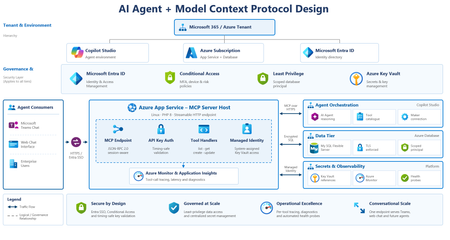
gave an AI agent write access to a production system. Not a demo. A real internal tool people depend on. It can now read, create, and update records - in plain language, from a chat window. Four things I learned building it with MCP (Model Context Protocol): 1. The tool description IS the interface. The agent doesn't read your code. It reads one sentence describing each tool, and decides from that alone whether to call it. Write "internal API test" → ignored forever. Write "creates and updates support tickets" → fires correctly. We spent 15 years designing UIs for humans. The design surface is now a sentence a model reads. 2. Agents can't click "Sign in." Any auth flow expecting a browser redirect silently breaks an agent connection. Machine access and human access need separate doors into the same house. 3. MCP errors don't mean what you think. My server returned success on every request -and the agent still failed. A "404" in MCP means session expired, not wrong URL. New protocol, new error vocabulary. 4. Least privilege stops being optional the moment an agent can write. A human with too many permissions makes occasional mistakes. An agent makes them at machine speed, confidently, while explaining why it was right. Why this matters: MCP turns "integrate AI into our systems" from a bespoke project into a standard interface. Expose capabilities, describe them clearly, and any compliant agent can use them. Same shift APIs caused 20 years ago - except the consumer isn't a program following rigid contracts. It's a model deciding at runtime what to call and why. The interfaces we built for humans aren't going away. They're just no longer the only way in. Activate to view larger image,101Views1like0Comments
Copilot Licensing questions
NOTE: I selected the CP Studio category here since it is involved in this question, but not exclusively. My question is about licensing requirements for: creating sharing using Copilot "custom" agents. I am guessing that the answers will be different depending on whether we are talking about declarative agents or agents from Copilot Studio (remembering that there also might be different answers for the pro-code developer level with the Agents Toolkit). So now I have three questions for each of three levels of agents! So let's do this. What licensing is required for each of these? Agent type Creation Sharing Using declarative agents Copilot Studio agents agents from the Studio Toolkit I also read one place where it suggested that sharing of some agents requires my organization to have the Copilot Studio tenant license to do the sharing, but it was not very clear. This is a big question! I hope someone can answer this. I have looked high and low and even asked Copilot a few times, but unfortunately, I received different answers. At least I am not asking about pricing! 😮 Thank you in advance for the answer.Solved312Views0likes3Comments