adaptive cloud
78 TopicsIntroducing Azure Local: cloud infrastructure for distributed locations enabled by Azure Arc
Today at Microsoft Ignite 2024 we're introducing Azure Local, cloud-connected infrastructure that can be deployed at your physical locations and under your operational control. With Azure Local, you can run the foundational Azure compute, networking, storage, and application services locally on hardware from your preferred vendor, providing flexibility to meet your requirements and budget.92KViews24likes27CommentsMicrosoft 365 Local is Generally Available
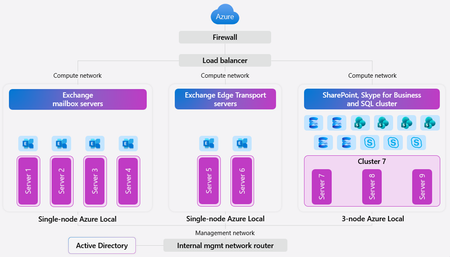
In today’s digital landscape, organizations and governments are prioritizing data sovereignty to comply with local regulations, protect sensitive information, and safeguard national security. This growing demand for robust jurisdictional controls makes the Microsoft Sovereign Cloud offering especially compelling, providing flexibility and assurance for complex requirements. For those with the most stringent needs, Azure Local enables data and workloads to remain within jurisdictional borders, supporting mission-critical workloads and now expanding to include Microsoft’s productivity solutions—so customers can securely collaborate and communicate within a sovereign private cloud environment. Today, we’re excited to announce the general availability of Microsoft 365 Local. Microsoft 365 Local is a deployment framework for enabling core collaboration and communication tools—including Exchange Server, SharePoint Server, and Skype for Business Server—on Azure Local. Built on a validated reference architecture using Azure Local Premier Solutions , it provides compatibility and support for sovereign deployments. Partner-led services provide guidance on sizing and configuration, ensuring a full-stack deployment including best practices for networking and security. Managing infrastructure across a wide range of workloads is simplified with Azure as your control plane, offering cloud-consistent, at-scale management capabilities. In the Azure portal, you get full visibility into your Microsoft 365 Local deployment across the servers and clusters. All hosts and virtual machines (VMs) are Arc-enabled out of the box, providing built-in visibility into connectivity, health, updates, and security alerts and recommendations. Microsoft 365 Local leverages Azure Local’s best-in-class sovereign and security controls, including Network Security Groups managed with Software Defined Networking enabled by Azure Arc, to isolate networks and secure access to infrastructure and workloads. Azure Local also uses a secure by default strategy by applying a security baseline of over 300 settings on both the host infrastructure and the VMs running the productivity workloads. These security baselines incorporate best practices for network security, identity management, privileged access, data protection, and more—helping organizations maintain compliance and reduce risk. Customers who want to take advantage of Azure as the control plane for Microsoft 365 Local can now benefit from a seamless cloud-based infrastructure management experience, including Azure services like Azure Monitor and Microsoft Defender for Cloud—available today with Microsoft 365 Local connected to Azure. For organizations with the most stringent jurisdictional requirements that need to operate Microsoft 365 Local in a fully disconnected environment, support for Azure Local disconnected operations will be available in early 2026. To learn more about Microsoft 365 Local, visit https://aka.ms/M365LocalDocs. If you’d like to connect with an authorized partner for consultation and deployment support, reach out to your Microsoft account team or visit https://aka.ms/M365LocalSignup.22KViews9likes6CommentsAnnouncing General Availability: Windows Server Management enabled by Azure Arc
Windows Server Management enabled by Azure Arc offers customers with Windows Server licenses that have active Software Assurances or Windows Server licenses that are active subscription licenses the following key benefits: Azure Update Manager Azure Change Tracking and Inventory Azure Machine Configuration Windows Admin Center in Azure for Arc Remote Support Network HUD Best Practices Assessment Azure Site Recovery (Configuration Only) Upon attestation, customers receive access to the following at no additional cost beyond associated networking, compute, storage, and log ingestion charges. These same capabilities are also available for customers enrolled in Windows Server 2025 Pay as you Go licensing enabled by Azure Arc. Learn more at Windows Server Management enabled by Azure Arc - Azure Arc | Microsoft Learn or watch Video: Free Azure Services for Non-Azure Windows Servers Covered by SA Powered by Azure Arc! To get started, connect your servers to Azure Arc, attest for these benefits, and deploy management services as you modernize to Azure's AI-enabled set of server management capabilities across your hybrid, multi-cloud, and edge infrastructure!20KViews10likes10CommentsEvolving Stretch Clustering for Azure Local
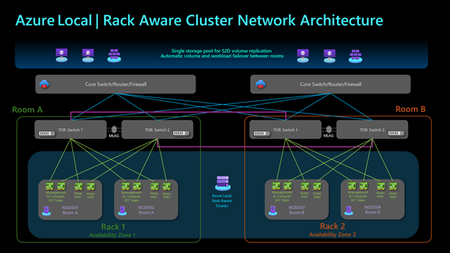
Stretched clusters in Azure Local, version 22H2 (formerly Azure Stack HCI, version 22H2) entail a specific technical implementation of storage replication that spans a cluster across two sites. Azure Local, version 23H2 has evolved from a cloud-connected operating system to an Arc-enabled solution with Arc Resource Bridge, Arc VM, and AKS enabled by Azure Arc. Azure Local, version 23H2 expands the requirements for multi-site scenarios beyond the OS layer, while Stretched clusters do not encompass the entire solution stack. Based on customer feedback, the new Azure Local release will replace the Stretched clusters defined in version 22H2 with new high availability and disaster recovery options. For Short Distance Rack Aware Cluster is a new cluster option which spans two separate racks or rooms within the same Layer-2 network at a single location, such as a manufacturing plant or a campus. Each rack functions as a local availability zone across layers from OS to Arc management including Arc VMs and AKS enabled by Azure Arc, providing fault isolation and workload placement within the cluster. The solution is configured with one storage pool to reduce additional storage replication and enhance storage efficiency. This solution delivers the same Azure deployment and management experience as a standard cluster. This setup is suitable for edge locations and can scale up to 8 nodes, with 4 nodes in each rack. Rack Aware Cluster is currently in private preview and is slated to public preview and general release in 2025. For Long Distance Azure Site Recovery can be used to replicate on-premises Azure Local virtual machines into Azure and protect business-critical workloads. This allows Azure cloud to serve as a disaster recovery site, enabling critical VMs to be failed over to Azure in case of a local cluster disaster, and then failed back to the on-premises cluster when it becomes operational again. If you cannot fail over certain workloads to cloud and require long distance of disaster recovery, like in two different cities, you can leverage Hyper-V Replica to replicate Arc VMs to the secondary site. Those VMs will become Hyper-V VMs on the secondary site, they will become Arc VMs once they fail back to the original cluster on the first site. Additional Options beyond Azure Local If the above solutions in Azure Local do not cover your needs, you can fully customize your solution with Windows Server 2025 which introduces several advanced hybrid cloud capabilities designed to enhance operational flexibility and connectivity across various environments. Additionally, it offers various replication technologies like Hyper-V Replica, Storage Replica and external SAN replication that enable the development of tailored datacenter disaster recovery solutions. Learn more from the Windows Server 2025 now generally available, with advanced security, improved performance, and cloud agility - Microsoft Windows Server Blog What to do with existing Stretched clusters on version 22H2 Stretched clusters and Storage Replica are not supported in Azure Local, version 23H2 and beyond. However, version 22H2 stretched clusters can stay in supported state in version 23H2 by performing the first step of operating system upgrade as shown in the following diagram to 23H2 OS. The second step of the solution upgrade to Azure Local is not applicable to stretched clusters. This provides extra time to assess the most suitable future solution for your needs. Please refer to the About Azure Local upgrade to version 23H2 - Azure Local | Microsoft Learn for more information on the 23H2 upgrade. Refer the blog on Upgrade from Azure Stack HCI, version 22H2 to Azure Local | Microsoft Community Hub. Conclusion We are excited to be bringing Rack Aware Clusters and Azure Site Recovery to Azure Local. These high availability and disaster recovery options allow customers to address various scenarios with a modern cloud experience and simplified management.16KViews16likes0Comments
What’s new in Azure Local: Cloud infrastructure for distributed locations enabled by Azure Arc
Today’s enterprises are navigating competing challenges: delivering AI-enabled digital experiences at the edge while also meeting growing demands for data sovereignty and regulatory compliance. Whether it’s a hospital needing local compute for patient care, or a government agency requiring full control over its infrastructure, the need for flexible, secure, and cloud scale solutions has never been greater. That’s why we introduced Azure Local—Microsoft’s solution for running Azure services and workloads at distributed locations, all managed through Azure Arc. With Azure Local, customers can deploy cloud-native and traditional applications on their own infrastructure while maintaining centralized visibility and control through the Azure portal. This approach is resonating: Microsoft has been named a Leader in the Gartner® Magic Quadrant™ for Distributed Hybrid Infrastructure every year since its inception. Azure Local is the foundation of Microsoft’s Sovereign Private Cloud, delivering Azure consistent services in customer controlled environments which meet strict data residency and compliance requirements. Read more about our recent Sovereign announcements here. See the Sovereign Private Cloud come to life here: Today, we’re so excited to tell you about the incredible new capabilities on Azure Local including support for external SAN storage, rack aware clustering, larger scale deployments, and more. Operate and scale with the power of the cloud Azure Local empowers organizations to operate and scale infrastructure with the power of the cloud, no matter where it’s deployed. From the Azure portal, customers can define and deploy infrastructure across distributed locations, apply one-click updates to entire clusters, and centrally monitor performance, health, and security. This cloud-based control plane ensures consistency and agility across environments—whether in datacenters, branch offices, or sovereign sites. NEW: Local Identity with Azure Key Vault (Preview) Azure Local now supports deployments without Active Directory using local identity with Azure Key Vault, currently in preview. This new option simplifies setup by removing the need for domain controllers, while still providing secure access and centralized secret management through Azure. Read the announcement here. Ready for all your apps, VMs and containers alike Azure Local is built to run all your applications—whether they’re virtual machines, containers, or Azure services. It offers full-featured, general-purpose VMs with cloud-consistent management, and includes Azure Kubernetes Service (AKS) built-in for modern containerized workloads. Customers can also deploy some of Azure’s most popular PaaS services like Azure Virtual Desktop, SQL Managed Instance, and Azure IoT Operations directly on Azure Local. With support for GPU-enabled nodes and Arc VM extensions, Azure Local is ready for everything from legacy line-of-business apps to AI-powered workloads. Migrate from VMware to Azure Local (Generally Available) Azure Migrate from VMware to Azure Local is now generally available, enabling customers to seamlessly move VMware virtual machines into their Azure Local infrastructure. This agentless migration path keeps data flows local, minimizes downtime, and simplifies onboarding with a cloud-consistent experience. Customers can discover, replicate, and migrate workloads using the Azure portal, with support for validated hardware and reference architectures. Azure Migrate unlocks a fast path to modernization for organizations consolidating legacy infrastructure. Read the announcement here. Customer Spotlight: How Publix Employees Federal Credit Union strengthened its disaster recovery strategy with Azure Loc... NEW: Microsoft 365 Local to meet your Private Sovereign Cloud needs (Generally Available) Microsoft 365 Local brings trusted productivity services like Exchange Server, SharePoint Server, and Skype for Business Server into customer-controlled environments, running directly on Azure Local infrastructure. Designed for those who need productivity tools in a private cloud environment, it leverages Azure Arc to provide a unified control plane for easy infrastructure management, simplified deployment, and streamlined updates. The solution features a validated reference architecture with certified hardware to ensure optimal performance and reliability, along with a hardened security baseline and robust controls to safeguard your infrastructure. It’s a key part of Microsoft’s Sovereign Private Cloud strategy, now generally available. Read the announcement here. Flexibility to meet your requirements Azure Local gives customers the flexibility to deploy infrastructure that fits their exact needs—whether that’s choosing from over 100 validated hardware platforms in the Azure Local catalog or operating in fully connected or disconnected environments. You can run Azure Local in public Azure regions or in Azure Government cloud, supporting both commercial and regulated workloads. Azure Local adapts to everything from retail edge sites to sovereign datacenters, disconnected oil rigs to connected manufacturing plants, all while maintaining a consistent Azure management experience. NEW: SAN Support (Preview) Azure Local now delivers greater infrastructure flexibility with expanded support for leading external SAN storage solutions, a capability that customers have long sought. Customers can now integrate their existing Fiber Channel-based SAN storage from leading vendors such as Pure Storage, NetApp, Dell, Lenovo, HPE, and Hitachi directly with Azure Local clusters. External storage support allows organizations to achieve high performance, scalability, and resilience while continuing to use their trusted storage infrastructure. It also enables consistent management across virtual machines, AKS clusters, and Arc-enabled services through the familiar Azure experience. Customers now have the freedom to modernize their environments while maximizing the value of their existing investments. Our customers are already exploring the impact this brings to enterprise customers. “We’re excited to partner with Microsoft and their trusted storage vendors to test external storage support for Azure Local,” said David McKenney, VP of Public Cloud Products at TierPoint. “This milestone gives customers greater flexibility to address performance, scalability, resilience, and investment protection needs. It reflects Microsoft’s ongoing dedication to making Azure Local the leading distributed cloud solution by listening to the needs of their customers and partners.” Support for more Storage protocols and other storage capabilities coming soon. Reach out to Microsoft or our storage partners to be part of this limited preview. NEW: Rack Aware Clusters (Preview) Rack aware clustering is now available in preview for Azure Local, enabling intelligent placement and resiliency across multi-rack deployments using one storage pool. This feature allows Azure Local to detect physical rack boundaries and distribute workloads accordingly, improving fault tolerance and minimizing impact from localized hardware failures. It’s especially valuable for larger deployments where high availability and service continuity are critical. Rack awareness integrates seamlessly with Azure Local’s update orchestration and VM placement logic, helping ensure infrastructure stays resilient at scale. Read the announcement here. NEW: Support for NVIDIA RTX PRO 6000 Blackwell Server Edition GPUs (Generally Available) Azure Local now supports the NVIDIA RTX PRO 6000 Blackwell Server Edition GPU, generally available for high-performance workloads including AI inferencing, simulation, and visualization. This enterprise-grade GPU delivers exceptional compute density and energy efficiency, making it ideal for deployments that require advanced acceleration. Customers can deploy this powerful GPU in new Azure Local solutions—including Dell AX-770, Lenovo ThinkAgile MX650a V4, and HPE ProLiant DL380 Gen 12. Read the announcement here. NEW: Azure Local for larger deployments (Preview) Azure Local now scales further, with instances of up to 10,000+ cores across 100+ nodes delivered as multiple integrated racks with disaggregated storage. This enables customers to run the same familiar Azure Arc-enabled infrastructure and services at significantly larger scale, supporting a greater variety of workloads and scenarios. This new capability is available now in preview. Contact your Azure account representatives to learn more. Secure by default Azure Local is built with security at its core, offering a hardened infrastructure stack aligned with Microsoft’s secure-by-default principles, built-in Microsoft Defender for Cloud integration, and trusted launch VMs. Every VM is Azure Arc-enabled, allowing customers to apply security baselines, monitor threats, and enforce policies using familiar Azure tools. These protections are automatically enabled, so customers can operate confidently from day one. Network segmentation (Generally Available) To protect and isolate your network traffic between VMs or logical networks, Azure Local now supports network security groups (NSGs), generally available as of the 2510 release. NSGs enable precise filtering of network traffic using policy-driven access controls by applying inbound and outbound allow/deny rules. Rules support the full five-tuple of source IP, source port, destination IP, destination port, and protocol, and are enforced within the virtual switch at the virtual port level. NSGs can be applied to both logical networks and individual network interfaces and can be managed using the Azure Portal for centralized policy management of your edge workloads. Read the announcement here. Get Started Today For new production deployments Azure Local is generally available for production use. Explore the solutions catalog to find hardware from your preferred vendor and read the deployment overview to get started today. For evaluation (virtual) Want to try out Azure Local but don’t have hardware? Get a dedicated Azure Local sandbox in one click with Azure Arc Jumpstart. All you need is an Azure subscription to get started. Thank you! As we mark the second year since announcing Azure Local, we want to extend a heartfelt thank you to our customers, partners, and community. It’s incredibly rewarding to see Azure Local continue to be the infrastructure of choice for enterprises seeking flexibility, security, and innovation at the edge. We’re excited to continue delivering the solutions you need to thrive in a rapidly evolving world. Thank you for trusting Azure Local to power your most important workloads—here’s to another year of partnership and progress! If you’re at Ignite this week, please come say hello at: Our session dedicated to Azure Local What’s new in Azure Local Our booth “Azure Arc and Azure Local” in the Cloud and AI Platforms neighborhood See everything going on with Adaptive Cloud on our Ignite website Adaptive Cloud @Ignite 2025 FAQ What is Azure Local? Azure Local is Microsoft’s full-stack infrastructure software that runs on validated hardware in your own facilities. It brings Azure capabilities to distributed or sovereign locations, so you can run virtual machines, containers, and select Azure services locally while maintaining a consistent management experience through Azure Arc. How are Azure Local and Private Sovereign Cloud related? Azure Local is the foundation and core product fueling Microsoft’s Private Sovereign Cloud offering. It enables customers to meet strict data residency and regulatory requirements by hosting workloads on-premises, disconnected or semi-connected, while still benefiting from Azure innovation and security. When should I use Azure Local? Use Azure Local when you need modern cloud capabilities in locations where connectivity is limited, data sovereignty is critical, or latency-sensitive applications must run close to where data is generated. It’s ideal for industries like manufacturing, retail, and government that require local control with Azure consistency.12KViews4likes3CommentsExtending Azure's AI Platform with an adaptive cloud approach
Authored by Derek Bogardus and Sanjana Mohan, Azure Edge AI Product Management Ignite 2024 is here, and nothing is more top of mind for customers than the potential to transform their businesses with AI wherever they operate. Today, we are excited to announce the preview of two new Arc-enabled services that extend the power of Azure’s AI platform to on-premises and edge environments. Sign up to join the previews here! An adaptive cloud approach to AI The goal of Azure’s adaptive cloud approach is to extend just enough Azure to customers’ distributed environments. For many of these customers, valuable data is generated and stored locally, outside of the hyperscale cloud, whether due to regulation, latency, business continuity, or simply the large volume of data being generated in real time. AI inferencing can only occur where the data exists. So, while the cloud has become the environment of choice for training models, we see a tremendous need to extend inferencing services beyond the cloud to enable complete cloud-to-edge AI scenarios. Search on-premises data with generative AI Over the past couple of years, generative AI has come to the forefront of AI innovation. Language models give any user the ability to interact with large, complex data sets in natural language. Public tools like ChatGPT are great for queries about general knowledge, but they can’t answer questions about private enterprise data on which they were not trained. Retrieval Augmented Generation, or "RAG", helps address this need by augmenting language models with private data. Cloud services like Azure AI Search and Azure AI Foundry simplify how customers can use RAG to ground language models in their enterprise data. Today, we are announcing the preview of a new service that brings generative AI and RAG to your data at the edge. Within minutes, customers can deploy an Arc extension that contains everything needed to start asking questions about their on-premises data, including: Popular small and large language models running locally with support for both CPU and GPU hardware A turnkey data ingestion and RAG pipeline that keeps all data completely local, with RBAC controls to prevent unauthorized access An out-of-the-box prompt engineering and evaluation tool to find the best settings for a particular dataset Azure-consistent APIs to integrate into business applications, as well as a pre-packaged UI to get started quickly This service is available now in gated private preview for customers running Azure Local infrastructure, and we plan to make it available on other Arc-enabled infrastructure platforms in the near future. Sign up here! Deploy curated open-source AI models via Azure Arc Another great thing about Azure’s AI platform is that it provides a catalog of curated AI models that are ready to deploy and provide consistent inferencing endpoints that can be integrated directly into customer applications. This not only makes deployment easy, but customers can also be confident that the models are secure and validated These same needs exist on the edge as well, which is why we are now making a set of curated models deployable directly from the Azure Portal. These models have been selected, packaged, and tested specifically for edge deployments, and are currently available on Azure Local infrastructure. Phi-3.5 Mini (3.8 billion parameter language model) Mistral 7B (7.3 billion parameter language model) MMDetection YOLO (object detection) OpenAI Whisper Large (speech to text) Google T5 Base (translation) Models can be deployed from a familiar Azure Portal wizard to an Arc AKS cluster running on premises. All available models today can be run on just a CPU. Phi-3.5 and Mistral 7B also have GPU versions available for better performance. Once complete, the deployment can be managed directly in Azure ML Studio, and an inferencing endpoint is available on your local network. Wrap up Sign up now to join either of the previews at the link below or stop by and visit us in person in the Azure Arc and Azure Local Expert Meet Up station in the Azure Infrastructure neighborhood at Ignite. We’re excited to get these new capabilities into our customers’ hands and hear from you how it’s going. Sign up to join the previews here6KViews7likes2CommentsAzure Local expands to sovereign-scale infrastructure with disaggregated deployments
As organizations accelerate digital transformation across datacenters, sovereign environments, and edge locations, infrastructure architectures must evolve to meet new operational and regulatory demands. The first feature update of Azure Local in CY 2026 (version 2604) marks a significant step forward—expanding Azure Local as a platform for sovereign private cloud infrastructure, introducing larger scale, disaggregated deployment architectures, expanded storage ecosystem partnerships, and simplified identity capabilities that unlock entirely new infrastructure scenarios from edge locations to enterprise-scale environments. This release is focused on enabling: Sovereign private cloud deployments at scale from single node up to multi-rack infrastructure Infrastructure modernization through SAN reuse and disaggregated architectures Simplified edge deployment without Microsoft Active Directory dependencies Faster lifecycle operations across deployment and update workflows Introducing disaggregated larger scale deployments using SAN storage Azure Local now supports a disaggregated infrastructure architecture, allowing customers to deploy compute and storage resources independently—while continuing to benefit from an Azure-consistent management and operational experience. This enables organizations to scale infrastructure more flexibly separating compute and storage to align with workload demands and long-term growth. This architecture enables: Independent scaling of compute nodes and storage infrastructure SAN‑only and hybrid storage architectures for Azure Local infrastructure and workloads Fibre Channel (FC) connectivity support beginning with 2604 (iSCSI coming soon) With disaggregated deployments and SAN storage, Azure Local clusters can now scale from a single node at the edge to multi-rack environments spanning beyond 16 nodes and up to thousands of nodes, addressing growing demand for large-scale deployments across sovereign, government, defense, and regulated environments. This unlocks new class of Azure -consistent infrastructure deployments at sovereign scale. This unlocks a new class of Azure-consistent infrastructure deployments at sovereign scale. This new capability is generally available with the release of Azure Local 2604. General Availability of SAN Support for Azure Local Support for attaching SAN storage to Azure Local was introduced as public preview back in November 2025. Today this brownfield expansion capability is generally available and allows external SAN devices to be introduced into already deployed Azure Local instances via Fibre Channel (FC)—supporting virtual machines, Kubernetes environments, and Azure Virtual Desktop workloads without requiring disruptive infrastructure changes or full system refresh. Azure Local instances now support the coexistence of Storage Spaces Direct volumes and external SAN volumes. Support for SAN-attached deployments allows organizations to: Reuse existing enterprise SAN investments Modernize infrastructure without replacing existing storage estates Manage rising disk costs associated with hyperconverged architectures Enable workload scenarios that depend on massive storage requirements These innovative capabilities supporting disaggregated deployments and SAN storage are supported by a strong ecosystem of hardware partners. DataON, Dell Technologies, Everpure, HPE, Hitachi Vantara, Lenovo and NetApp are working with Microsoft to deliver configurations, giving customers more flexibility in how they design and scale their infrastructure. General Availability of Local Identity with Azure Key Vault While disaggregated architectures primarily target sovereign and centralized datacenter deployments, Azure Local 2604 also introduces a major advancement for distributed and edge scenarios. With the General Availability of Local Identity with Key Vault, Azure Local can now be provisioned without infrastructure dependencies on Microsoft Active Directory, enabling simplified deployment in disconnected, air-gapped, and regulated environments. This simplifies deployment and adoption, by removing the need for extra hardware running domain controllers and removing the complexity of firewall configurations when installing in isolated network environments. Azure Local 2604 adds support for deploying rack-aware clusters using Local Identity with Azure Key Vault. This combines reduced requirements with the high availability that customers demand across manufacturing, energy, and other industries. This capability removes one of the key barriers to deploying Azure-consistent infrastructure in sovereign and edge environments. Pricing Changes Pricing for multi-rack and sovereign-scale deployments is being introduced as part of this release. Customers should connect with their Microsoft account team to learn more about pricing, configuration options, and early access programs as these offerings continue to actively evolve. Getting started Release 2604 is available for both existing and new Azure Local instances. Review the release note for Azure Local 2604 release here Learn more about disaggregated deployments here Learn more about SAN attach here Learn more about Local Identity with Azure Key Vault here. Learn more about hardware configurations that support disaggregated deployments using the solutions catalog or learn directly from our partners: o DataON: “DataON Premier Solutions for Azure Local provide a premium Azure Local experience that includes deployment, integration, training, and white glove service & support. Our goal is to not only get you up and running quickly but also to help your team to be confident in managing Azure Local.” o Dell Technologies: “Coming Soon, Dell Private Cloud–Microsoft enables a modern disaggregated architecture, simplifying operations across Dell PowerEdge compute, Dell PowerStore storage, and Azure Local.” “Available now, Dell PowerStore delivers high-performance, scalable, and resilient storage for Azure Local, with support for Dell Private Cloud coming soon to make it easier to streamline operations for storage, compute, and your Azure Local license.” o Everpure: “Azure Local now supports external storage with Everpure FlashArray, offering Azure Local customers unprecedented levels of scale, performance and efficiency with the added benefit of seamless hybrid cloud integration with Everpure Cloud in Azure.” o Hitachi Vantara: “Hitachi Vantara VSP and VSP One Block, fully validated to meet Microsoft's Azure Local storage requirements, deliver enterprise SAN reliability for Azure Local.” o HPE: “HPE ProLiant Compute Premier Solutions for Azure Local enable customers to gain full control over data residency, and accelerate innovation with industry-leading performance, security, and management automation.” “HPE Alletra Storage MP B10000 integrated with Azure Local delivers a unified, Azure managed experience with the simplicity of Azure Local plus the advanced data services of a modern enterprise storage platform.” o Lenovo: “Lenovo is expanding its Azure Local portfolio to support disaggregated infrastructure designs that deliver greater choice across compute and storage. The ThinkAgile Disaggregated Solution for Microsoft Azure Local with new compute-only configurations on ThinkAgile MX Series enables customers to integrate ThinkSystem DM, DS, and DG Series storage arrays or bring their own Azure Local validated third party SAN arrays into new or existing Azure Local environments, allowing fully disaggregated, independent scaling using enterprise class Lenovo solutions for sovereign private cloud deployments and emerging AI workloads.” o NetApp: “With Azure Local, NetApp delivers support across NetApp® AFF, ASA, and FAS systems.” Thank you! This first feature release of 2026 is packed with innovation for Azure Local, and we can’t wait for you to try it and share feedback. We are committed to listening to your feedback and delivering the next wave of capabilities in a continuously evolving world. Thank you to all our customers who trust Azure Local to run their business—and to our engineering partners for the incredible collaboration in building solutions together.4.9KViews7likes0Comments
Simplified access to Hotpatching enabled by Azure Arc for Windows Server 2025
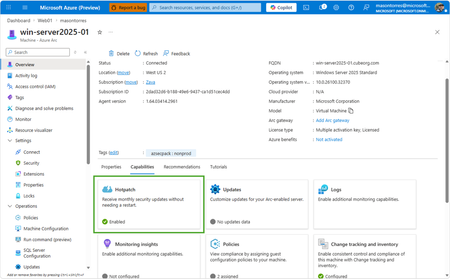
With Windows Server 2025, we introduced hotpatch enabled by Azure Arc, delivering security updates to Windows Server across hybrid and multicloud environments – minimizing downtime (no reboot), accelerating protection, and unifying patch management. We know that keeping your servers updated with the latest patches is one of the critical tasks that IT teams perform day-to-day. We want to make it simpler to install the latest operating system (OS) updates without rebooting machines after every installation. The resounding feedback we have received from you underscored the criticality of this feature in the lifecycle management and security of your infrastructure. We are now taking it one step further to reduce the friction to deploying these critical updates: hotpatch enabled by Azure Arc is now available at no additional cost for Windows Server 2025. Which machines are eligible for this offer? To use hotpatch for Windows Servers running on-premises or in multicloud environments, you must be using Windows Server 2025 Standard or Datacenter, and your server must be connected to Azure Arc. With this announcement, enabling and usage of the hotpatching service is available at no additional charge. Please take note that there are no charges for customers running on Azure IaaS, or Azure Local, wherein hotpatching is available as part of the functionality of Windows Server Datacenter: Azure Edition. This feature is already included both with Windows Server 2022 Datacenter: Azure Edition and Windows Server 2025 Datacenter: Azure Edition. How do I manage hotpatches enabled by Azure Arc for Windows Server 2025? If your Windows Server 2025 machines aren't already connected to Azure Arc, install the Azure Connected Machine agent — it takes just a few minutes per server and supports at-scale rollout via Group Policy, service principal, or Terraform. Once connected, enable Hotpatch from the Azure portal, Azure PowerShell, Azure CLI, or the REST API — just confirm Virtualization-based security (VBS is enabled) first. From there, use Azure Update Manager to schedule and monitor rollouts at scale. For instructions on how to enable hotpatch for Azure Arc-enabled machines using group policy or scripts, learn more here: https://aka.ms/ws-hotpatch For patch orchestration at scale, you can use Azure Update Manager to deliver hotpatches enabled by Azure Arc for Windows server 2025 machines. This enables greater uptime with fewer reboots and faster deployment of updates with easy patch orchestration. Alternatively, you can use APIs or other management tools to manage hotpatches. Centralized management of hotpatch updates across hybrid and multicloud environments enabled by Azure Arc Once your machines are connected to Azure Arc, you can also use the cloud-native services from Azure to manage your windows machines running on-prem. Azure Arc enables you to standardize security and governance across a wide range of resources so you can easily organize, govern and secure Windows, Linux, SQL servers, and Kubernetes clusters running across data centers, edge, and multi-cloud environments – using Azure services such as Azure Policy, Azure Monitor, Microsoft Defender and more. At no additional cost for machines attached to Azure Arc Basic inventory across on-prem and multi-cloud Tag your resources, organize them into resource groups, subscriptions, and management groups, and query at scale with Azure Resource Graph to unify your environments. Infra as Code (Bicep, Terraform) Infra as code for provisioning and management of resources. VM Self Service Perform lifecycle management such as (create, resize, update and delete) and power cycle operations such as (start, stop, and restart on VMware vCenter and System Center Virtual Machine Manager Virtual Machines. Hotpatch for Windows Server 2025 NEW Windows Server hot patching enables you to apply security updates without rebooting, keeping systems secure while maintaining continuous uptime. VM Management Administrate your servers anywhere using SSH for Azure Arc, Run Command, and Custom Script Extension. Mgmt. Services included for no additional costs with Windows Server Software Assurance or Extended Security Updates Azure Update Manager Provides a unified, centralized service to monitor, orchestrate, and automate patching across Azure, on‑prem, and multi‑cloud environments ensuring security, compliance, and minimal downtime at scale. Azure Machine Configuration (Policy) Policy‑driven auditing and enforcement of OS and application settings as code across Azure and hybrid machines—ensuring consistent, compliant state at scale. Including compliance policies like CIS Benchmark and WinRE Change Tracking & Inventory Real‑time visibility into configuration changes and system state across your fleet enabling faster troubleshooting, improved security, and continuous compliance at scale. VM insights from Azure Monitor Delivers a unified, pre‑built observability experience that provides real‑time performance, health, and dependency visibility across VMs—enabling faster troubleshooting, optimization, and capacity planning at scale. Windows Admin Center Unified, browser‑based management plane to securely manage Windows servers, VMs, and hybrid infrastructure from anywhere—simplifying operations and improving efficiency at scale. Best Practices Assessment Continuously evaluation your server configurations against Microsoft-recommended standards to proactively identify risks and provide actionable remediation guidance—improving security, performance, and operational health at scale. Frequently Asked Questions What are hotpatch updates? Hotpatch updates are monthly security updates that take effect without requiring you to restart the device. They contain a full set of security updates equivalent to the standard updates released the same day. What is the hotpatch update cycle? All eligible Windows Server 2025 machines enrolled in hotpatch are offered up to 8 monthly hotpatch updates in a calendar year in a quarterly cycle: Baseline month: In January, April, July, and October, devices install the monthly cumulative security update and must restart for the update to take effect. This update includes the latest security fixes, cumulative new features, and enhancements since the last baseline. Subsequent two months: Devices receive hotpatch updates, which only include security updates and don't require a restart for the update to take effect. These devices will catch up on features and enhancements with the next cumulative baseline month (quarterly). Will billing be stopped for existing enrolled machines? Yes, as of 15 th May 2026 all billing for hotpatch has been stopped for all existing machines enrolled in hotpatch. What action do we need to take if we have machines enrolled in hotpatch already? There is no additional action needed for machines that are currently enrolled in hotpatch. These machines will remain enrolled in hotpatch and receive hotpatch updates when available. I want all my Windows Server 2025 machines to get hotpatches. How do I do it? If you have Windows Server 2025 machines on-premises or on cloud (other than Azure) then you can enable hotpatch on them. To do so, ensure these machines have Virtualization Based Security enabled and are connected to Azure Arc and then you can use Azure Arc portal, Azure Update manager or APIs to enable hotpatch. Learn more: https://aka.ms/ws-hotpatch Is anything changing for Hotpatching on Azure? Hotpatch continues to be available on Azure for your Windows Server 2022 and Windows Server 2025 VMs when using Azure Edition. There is no fee associated with Hotpatching on Azure. Learn more here. Is there a community forum for Arc? Yes, you can join the Azure Arc Monthly Forum here: aka.ms/ArcServerForumSignup4.8KViews10likes5CommentsUpgrade Azure Local operating system to new version
11/14/2025 Revision The recommended upgrade paths have changed with the Azure Local 2510 release, and the information in this blog is now outdated. Please refer to the following release notes for the latest information: Azure Local release information Today, we’re sharing more details about the end of support for Azure Local, with OS version 25398.xxxx (23H2) on October 31, 2025. After this date, monthly security and quality updates stop, and Microsoft Support remains available only for upgrade assistance. Your billing continues, and your systems keep working, including registration and repair. There are several options to upgrade to Azure Local, with OS version 26100.xxxx (24H2) depending on which scenario applies to you. Scenario #1: You are on Azure Local solution, with OS version 25398.xxxx If you're already running the Azure Local solution, with OS version 25398.xxxx, there is no action required. You will automatically receive the upgrade to OS version 26100.xxxx via a solution update to 2509. Azure Local, version 23H2 and 24H2 release information - Azure Local | Microsoft Learn for the latest version of the diagram. If you are interested in upgrading to OS version 26100.xxxx before the 2509 release, there will be an opt-in process available in the future with production support. Scenario #2: You are on Azure Stack HCI and haven’t performed the solution upgrade yet Scenario #2a: You are still on Azure Stack HCI, version 22H2 With the 2505 release, a direct upgrade path from version 22H2 OS (20349.xxxx) to 24H2 OS (26100.xxxx) has been made available. To ensure a validated, consistent experience, we have reduced the process to using the downloadable media and PowerShell to install the upgrade. If you’re running Azure Stack HCI, version 22H2 OS, we recommend taking this direct upgrade path to the version 24H2 OS. Skipping the upgrade to the version 23H2 OS will be one less upgrade hop and will help reduce reboots and maintenance planning prior to the solution upgrade. After then, perform post-OS upgrade tasks and validate the solution upgrade readiness. Consult with your hardware vendor to determine if version 24H2 OS is supported before performing the direct upgrade path. The solution upgrade for systems on the 24H2 OS is not yet supported but will be available soon. Scenario #2b: You are on Azure Stack HCI, version 23H2 OS If you performed the upgrade from Azure Stack HCI, version 22H2 OS to version 23H2 OS (25398.xxxx), but haven’t applied the solution upgrade, then we recommend that you perform post-OS upgrade tasks, validate the solution upgrade readiness, and apply the solution upgrade. Diagram of Upgrade Paths Conclusion We invite you to identify which scenarios apply to you and take action to upgrade your systems. On behalf of the Azure Local team, we thank you for your continuous trust and feedback! Learn more To learn more, refer to the upgrade documentation. For known issues and remediation guidance, see the Azure Local Supportability GitHub repository.4.8KViews4likes10CommentsIgnite 2024: AKS enabled by Azure Arc - New Capabilities and Expanded Workload Support
Microsoft Ignite 2024 has been a showcase of innovation across the Azure ecosystem, bringing forward major advancements in AI, cloud-native applications, and hybrid cloud solutions. This year’s event featured key updates, including enhancements to AKS enabled by Azure Arc, which introduced new capabilities and expanded workload support. These updates reinforce the value and versatility that AKS enabled by Azure Arc brings to organizations looking to scale and optimize their operations. With these advancements, AKS Arc continues to support seamless management, increased scalability, and enhanced workload performance across diverse infrastructures. AKS Enabled by Azure Arc AKS enabled by Azure Arc brings the power of Azure’s managed Kubernetes service to any environment, providing consistent management and security across on-premises, edge, and multi-cloud deployments. It encompasses: AKS on Azure Local: A full-featured Kubernetes platform integrated with Azure Local for comprehensive container orchestration in hybrid setups. Notably, AKS on Azure Local has earned recognition as a leader in the 2024 Gartner Magic Quadrant for Distributed Hybrid Infrastructure, underscoring Microsoft's dedication to delivering comprehensive, enterprise-ready solutions for hybrid cloud deployments. AKS Edge Essentials: A lightweight version designed for edge computing, ensuring operational consistency on constrained hardware. AKS on Azure Local Disconnected Operations: It is now available on Azure Local Disconnected Operations. This latest addition to AKS enabled by Azure Arc portfolio is the support for fully disconnected scenario. It allows AKS enabled by Azure Arc to operate in air-gapped, isolated environments without the need for continuous Azure connectivity. It is crucial for organizations that require secure, self-sufficient Kubernetes operations in highly controlled or remote locations. With this support, businesses can maintain robust Kubernetes functionality while meeting stringent compliance and security standards. Key Features and Expanded Workload Support This year's Ignite announcements unveiled a series of public preview and GA features that enhance the capabilities of AKS enabled by Azure Arc. These advancements reflect our commitment to delivering robust, scalable solutions that meet the evolving needs of our customers. Below are the key highlights that showcase the enhanced capabilities of AKS enabled by Azure Arc: Edge Workload Azure IoT Operations - enabled by Azure Arc: Available on AKS Edge Essentials (AKS-EE) and AKS on Azure Local with public preview support. Azure IoT Operations in the management and scaling of IoT solutions. It provides robust support for deploying and overseeing IoT applications within Kubernetes environments, enhancing operational control and scalability. Organizations can leverage this tool to maintain seamless management of distributed IoT workloads, ensuring consistent performance and simplified scaling across diverse deployment scenarios. Azure Container Storage - enabled by Azure Arc: Available on both AKS Edge Essentials (AKS-EE) and AKS on Azure Local, this support enables seamless integration for persistent storage needs in Kubernetes environments. It provides scalable, reliable, and high-performance storage solutions that enhance data management and support stateful applications running in hybrid and edge deployments. This addition ensures that organizations can efficiently manage their containerized workloads with robust storage capabilities. Azure Key Vault Secret Store extension for Kubernetes: Now available as public preview on AKS Edge Essentials and AKS on Azure Local, this extension automatically synchronizes secrets from an Azure Key Vault to an AKS enabled by Azure Arc cluster for offline access, providing essential tools for proactive monitoring and policy enforcement. It offers advanced security and compliance capabilities tailored for robust governance and regulatory adherence, ensuring that organizations can maintain compliance with industry standards and best practices while safeguarding their infrastructure. Azure Monitor Pipeline: The Azure Monitor pipeline is a data ingestion solution designed to provide consistent, centralized data collection for Azure Monitor. Once deployed for AIO on AKS cluster enabled by Azure Arc, it enables at-scale telemetry data collection and routing at the edge. The pipeline can cache data locally, syncing with the cloud when connectivity is restored, and supports segmented networks where direct data transfer to the cloud isn’t possible. Built on OpenTelemetry Collector, the pipeline’s configuration includes data flows, cache properties, and destination rules defined in the DCR to ensure seamless data processing and transmission to the cloud. Arc Workload Identity Federation: Now available as public preview on AKS Edge Essentials and AKS on Azure Local, providing secure federated identity management to enhance security for customer workloads Arc Gateway: Now available as public preview for AKS Edge Essentials and AKS on Azure Local. Arc Gateway support on AKS enabled by Azure Arc enhances secure connectivity across hybrid environments, reducing required firewall rules and improving security for customer deployments. Azure AI Video Indexer - enabled by Azure Arc: Supported on AKS Edge Essentials and AKS on Azure Local. Arc-enabled Video Indexer enables comprehensive AI-powered video analysis, including transcription, facial recognition, and object detection. It allows organizations to deploy sophisticated video processing solutions within hybrid and edge environments, ensuring efficient local data processing with improved security and minimal latency. MetalLB - Azure Arc Extension: Now supported on AKS Edge Essentials and AKS on Azure Local, MetalLB ensures efficient load balancing capabilities. This addition enhances network resilience and optimizes traffic distribution within Kubernetes environments. Comprehensive AI and Machine Learning Capabilities GPUs for AI Workloads: Now AKS enabled by Azure Arc supports a range of GPUs tailored for AI and machine learning workloads with GPU Partitioning) and GPU Passthrough Virtualization support. These options enable robust performance for resource-intensive AI and machine learning workloads, allowing for efficient use of GPU resources to run complex models and data processing tasks. Arc-enabled Azure Machine Learning: Support on AKS on Azure Local, AML capabilities for running sophisticated AI models. Businesses can leverage Azure’s powerful machine learning tools seamlessly across different environments, enabling them to develop, deploy, and manage machine learning models effectively on-premises and at the edge. Arc-enabled Video Indexer: It extends Azure's advanced video analytics capabilities to AKS enabled by Azure Arc. Organizations can now process and analyze video content in real-time, harnessing Azure's robust video AI tools to enhance video-based insights and operations. This support provides businesses with greater flexibility to conduct video analysis seamlessly in remote or hybrid environments Kubernetes AI Toolchain Orchestrator (Kaito + LoRA + QLoRA): Fully validated and support for fine-tuning and optimizing AI models, Kaito, LoRA and QLoRA are designed for edge deployments such as AKS on Azure Local. This combination enhances the ability to run and refine AI applications effectively in edge environments, ensuring performance and flexibility. Flyte Integration: Now supported on AKS on Azure Local, Flyte offers a scalable orchestration platform for managing machine learning workflows. This capability enables teams to build, execute, and manage complex AI pipelines efficiently, enhancing productivity and simplifying the workflow management process. Enhanced Infrastructure and Operations Management Infrastructure as Code (IaC) with Terraform: Now supported on AKS on Azure Local for both Connected and Air-gapped scenario, providing streamlined deployment capabilities through code. This support enables teams to automate and manage their Kubernetes infrastructure at scale more efficiently with Terraform. Anti-affinity, Pod CIDR, Taints/Labels: Available on AKS on Azure Local, these features provide enhanced infrastructure capabilities by allowing refined workload placement and advanced network configuration. Anti-affinity rules help distribute pods across different nodes to avoid single points of failure, while Pod CIDR simplifies network management by allocating IP ranges to pods. Taints and labels offer greater control over node selection, ensuring that specific workloads run on designated nodes and enhancing the overall efficiency and reliability of Kubernetes operations. Optimized Windows Node Pool Management: AKS enabled by Azure Arc now includes the capability to enable and disable Windows node pools for clusters. This enhancement helps prevent unnecessary binary downloads, benefiting customers with low-speed or limited internet connection. It optimizes resource usage, reduces bandwidth consumption, and enhances overall deployment efficiency, making it ideal for environments with network constraints. Kubernetes Development AKS-WSL: With AKS-WSL, developers can set up a local environment that mimics the experience of working with AKS. This makes it easier for developers to write, debug, and test Kubernetes applications locally before deploying them to a full AKS cluster. AKS-WSL VSCode Extension: The Visual Studio Code extension for AKS-WSL allows developers to write, debug, and deploy Kubernetes applications locally, streamlining development workflows. This setup improves productivity by providing efficient tools and capabilities, making it easier to develop, test, and refine Kubernetes workloads directly from a local machine. Arc Jumpstart: Supported AKS Edge Essentials and AKS on Azure Local. Arc Jumpstart simplifies deployment initiation, providing developers with a streamlined way to set up and start working with Kubernetes environments quickly. It makes it easier for teams to evaluate and experiment with AKS enabled by Azure Arc, offering pre-configured scenarios and comprehensive guidance. By reducing complexity and setup time, Arc Jumpstart enhances the developer experience, facilitating faster prototyping and smoother onboarding for new projects in hybrid and edge settings. Conclusion Microsoft Ignite 2024 has underscored the continued evolution of AKS enabled by Azure Arc, bringing more comprehensive, scalable, and secure solutions to diverse environments. These advancements support organizations in running cloud-native applications anywhere, enhancing operational efficiency and innovation. We welcome your feedback (aksarcfeedback@microsoft.com) and look forward to ongoing collaboration as we continue to evolve AKS enabled by Azure Arc.4.6KViews5likes0Comments