GenAI
46 TopicsLeveraging the power of NPU to run Gen AI tasks on Copilot+ PCs
Thanks to their massive scale and impressive technical evolution, large language models (LLMs) have become the public face of Generative AI innovation. However, bigger isn’t always better. While LLMs like the ones behind Microsoft Copilot are incredibly capable at a wide range of tasks, less-discussed small language models (SLMs) expand the utility of Gen AI for real-time and edge applications. SLMs can run efficiently on a local device with low power consumption and fast performance, enabling new scenarios and cost models. SLMs can run on universally available chips like CPUs and GPUs, but their potential really comes alive running on Neural Processing Units (NPUs), such as the ones found in Microsoft Surface Copilot+ PCs. NPUs are specifically designed for processing machine learning workloads, leading to high performance per watt and thermal efficiency compared to CPUs or GPUs [1]. SLMs and NPUs together support running quite powerful Gen AI workloads efficiently on a laptop, even when running on battery power or multitasking. In this blog, we focus on running SLMs on Snapdragon® X Plus processors on the recently launched Surface Laptop 13-inch, using the Qualcomm® AI Hub, leading to efficient local inference, increased hardware utilization and minimal setup complexity. This is only one of many methods available - before diving into this specific use case, let’s first provide an overview of the possibilities for deploying small language models on Copilot+ PC NPUs. Qualcomm AI Engine Direct (QNN) SDK: This process requires converting SLMs into QNN binaries that can be executed through the NPU. The Qualcomm AI Hub provides a convenient way to compile any PyTorch, TensorFlow, or ONNX-converted models into QNN binaries executable by the Qualcomm AI Engine Direct SDK. Various precompiled models are directly available in the Qualcomm AI Hub, their collection of over 175 pre-optimized models, ready for download and integration into your application. ONNX Runtime: ONNX Runtime is an open-source inference engine from Microsoft designed to run models in the ONNX format. The QNN Execution Provider (EP) by Qualcomm Technologies optimizes inference on Snapdragon processors using AI acceleration hardware, mainly for mobile and embedded use. ONNX Runtime Gen AI is a specialized version optimized for generative AI tasks, including transformer-based models, aiming for high-performance inference in applications like large language models. Although ONNX Runtime with QNN EP can run models on Copilot+ PCs, some operator support is missing for Gen AI workloads. ONNX Runtime Gen AI is not yet publicly available for NPU; a private beta is currently out with an unclear ETA on public release at the time of releasing this blog. Here is the link to the Git repo for more info on upcoming releases microsoft/onnxruntime-genai: Generative AI extensions for onnxruntime Windows AI Foundry: Windows AI Foundry provides AI-supported features and APIs for Copilot+ PCs. It includes pre-built models such as Phi-Silica that can be inferred using Windows AI APIs. Additionally, it offers the capability to download models from the cloud for local inference on the device using Foundry Local. This feature is still in preview. You can learn more about Windows AI Foundry here: Windows AI Foundry | Microsoft Developer AI Toolkit for VS Code: The AI Toolkit for Visual Studio Code (VS Code) is a VS Code extension that simplifies generative AI app development by bringing together cutting-edge AI development tools and models from the Azure AI Foundry catalog and other catalogs like Hugging Face. This platform allows users to download multiple models either from the cloud or locally. It currently houses several models optimized to run on CPU, with support for NPU-based models forthcoming, starting with Deepseek R1. Comparison between different approaches Feature Qualcomm AI Hub ONNX Runtime (ORT) Windows AI Foundry AI Toolkit for VS code Availability of Models Wide set of AI models (vision, Gen AI, object detection, and audio). Any models can be integrated. NPU support for Gen AI tasks and ONNX Gen AI Runtime are not yet generally available. Phi Silica model is available through Windows AI APIs, additional AI models from cloud can be downloaded for local inference using Foundry Local Access to models from sources such as Azure AI Foundry and Hugging Face. Currently only supports Deepseek R1 and Phi 4 Mini models for NPU inference. Ease of development The API is user-friendly once the initial setup and end-to-end replication are complete. Simple setup, developer-friendly; however, limited support for custom operators means not all models deploy through ORT. Easiest framework to adopt—developers familiar with Windows App SDK face no learning curve. Intuitive interface for testing models via prompt-response, enabling quick experimentation and performance validation. Is processor or SoC independent No. Supports Qualcomm Technologies processors only. Models must be compiled and optimized for the specific SOC on the device. A list of supported chipsets is provided, and the resulting .bin files are SOC-specific. Limitations exist with QNN EP’s HTP backend: only quantized models and those with static shapes are currently supported. Yes. The tool can operate independently of SoC. It is part of the broader Windows Copilot Runtime framework, now rebranded as the Windows AI Foundry. Model-dependent. Easily deployable on-device; model download and inference are straightforward. As of writing this article and based on our team's research, we found Qualcomm AI Hub to be the most user-friendly and well-supported solution available at this time. In contrast, most other frameworks are still under development and not yet generally available. Before we dive into how to use Qualcomm AI Hub to run Small Language Models (SLMs), let’s first understand what Qualcomm AI Hub is. What is Qualcomm AI Hub? Qualcomm AI Hub is a platform designed to simplify the deployment of AI models for vision, audio, speech, and text applications on edge devices. It allows users to upload, optimize, and validate their models for specific target hardware—such as CPU, GPU, or NPU—within minutes. Models developed in PyTorch or ONNX are automatically converted for efficient on-device execution using frameworks like TensorFlow Lite, ONNX Runtime, or Qualcomm AI Engine Direct. The Qualcomm AI Hub offers access to a collection of over 100 pre-optimized models, with open-source deployment recipes available on GitHub and Hugging Face. Users can also test and profile these models on real devices with Snapdragon and Qualcomm platforms hosted in the cloud. In this blog we will be showing how you can use Qualcomm AI Hub to get a QNN context binary for models and use Qualcomm AI Engine to run those context binaries. The context binary is a SoC-specific deployment mechanism. When compiled for a device, it is expected that the model will be deployed to the same device. The format is operating system agnostic so the same model can be deployed on Android, Linux, or Windows. The context binary is designed only for the NPU. For more details on how to compile models in other formats, please visit the documentation here Overview of Qualcomm AI Hub — qai-hub documentation. The following case study details the efficient execution of the Phi-3.5 model using optimized, hardware-specific binaries on a Surface Laptop 13-inch powered by the Qualcomm Snapdragon X Plus processor, Hexagon™ NPU, and Qualcomm Al Hub. Microsoft Surface Engineering Case Study: Running Phi-3.5 Model Locally on Snapdragon X Plus on Surface Laptop 13-inch This case study details how the Phi-3.5 model was deployed on a Surface Laptop 13-inch powered by the Snapdragon X Plus processor. The study was developed and documented by the Surface DASH team, which specializes in delivering AI/ML solutions to Surface devices and generating data-driven insights through advanced telemetry. Using Qualcomm AI Hub, we obtained precompiled QNN context binaries tailored to the target SoC, enabling efficient local inference. This method maximizes hardware utilization and minimizes setup complexity. We used a Surface Laptop 13-inch with the Snapdragon X Plus processor as our test device. The steps below apply to the Snapdragon X Plus processor; however, the process remains similar for other Snapdragon X Series processors and devices as well. For the other processors, you may need to download different model variants of the desired models from Qualcomm AI Hub. Before you begin to follow along, please check the make and models of your NPU by navigating to Device Manager --> Neural Processors. We also used Visual Studio Code and Python (3.10.3.11, 3.12). We used the 3.11 version to run these steps below and recommend using the same, although there should be no difference in using a higher Python version. Before starting, let's create a new virtual environment in Python as a best practice. Follow the steps to create a new virtual environment here: https://code.visualstudio.com/docs/python/environments?from=20423#_creating-environments Create a folder named ‘genie_bundle’ store config and bin files. Download the QNN context binaries specific to your NPU and place the config files into the genie_bundle folder. Copy the .dll files from QNN SDK into the genie_bundle folder. Finally, execute the test prompt through genie-sdk in the required format for Phi-3.5. Setup steps in details Step 1: Setup local development environment Download QNN SDK: Go to the Qualcomm Software Center Qualcomm Neural Processing SDK | Qualcomm Developer and download the QNN SDK by clicking on Get Software (by default latest version of SDK gets downloaded). For the purpose of this demo, we used latest version available (2.34) . You may need to make an account on the Qualcomm website to access it. Step 2: Download QNN Context Binaries from Qualcomm AI Hub Models Download Binaries: Download the context binaries (.bin files) for the Phi-3.5-mini-instruct model from (Link to Download Phi-3.5 context binaries). Clone AI Hub Apps repo: Use the Genie SDK (Generative Runtime built on top of Qualcomm AI Direct Engine), and leverage the sample provided in https://github.com/quic/ai-hub-apps Setup folder structure to follow along the code: Create a folder named "genie_bundle" outside of the folder where AI Hub Apps repo was cloned. Selectively copy configuration files from AI Hub sample repo to 'genie_bundle' Step 3: Copy config files and edit files Copy config files to genie_bundle folder from ai-hub-apps. You will need two config files. You can use the PowerShell script below to copy the config files from repo to local genie folder created in previous steps. You also need to copy HTP backend config file as well as the genie config file from the repo # Define the source paths $sourceFile1 = "ai-hub-apps/tutorials/llm_on_genie/configs/htp/htp_backend_ext_config.json.template" $sourceFile2 = "ai-hub-apps/tutorials/llm_on_genie/configs/genie/phi_3_5_mini_instruct.json" # Define the local folder path $localFolder = "genie_bundle" # Define the destination file paths using the local folder $destinationFile1 = Join-Path -Path $localFolder -ChildPath "htp_backend_ext_config.json" $destinationFile2 = Join-Path -Path $localFolder -ChildPath "genie_config.json" # Create the local folder if it doesn't exist if (-not (Test-Path -Path $localFolder)) { New-Item -ItemType Directory -Path $localFolder } # Copy the files to the local folder Copy-Item -Path $sourceFile1 -Destination $destinationFile1 -Force Copy-Item -Path $sourceFile2 -Destination $destinationFile2 -Force Write-Host "Files have been successfully copied to the genie_bundle folder with updated names." After copying the files, you will need to make sure to change the default values of the parameters provided with template files copied. Edit HTP backend file in the newly pasted location - Change dsp_arch and soc_model to match with your configuration pdate soc model and dsp arch in HTP backend config files Edit genie_config file to include the downloaded binaries for Phi 3 models in previous steps Step 4: Download the tokenizer file from Hugging Face Visit the Hugging Face Website: Open your web browser and go to https://huggingface.co/microsoft/Phi-3.5-mini-instruct/tree/main Locate the Tokenizer File: On the Hugging Face page, find the tokenizer file for the Phi-3.5-mini-instruct model Download the File: Click on the download button to save the tokenizer file to your computer Save the File: Navigate to your genie_bundle folder and save the downloaded tokenizer file there. Note: There is an issue with the tokenizer.json file for the Phi 3.5 mini instruct model, where the output does not break words using spaces. To resolve this, you need to delete lines #192-197 in the tokenizer.json file. Download tokenizer files from the hugging face repo (Image Source - Hugging Face) Step 5: Copy files from QNN SDK Locate the QNN SDK Folder: Open the folder where you have installed the QNN SDK in step 1 and identify the required files. You need to copy the files from the below mentioned folder. Exact folder naming may change based on SDK version <QNN-SDK ROOT FOLDER>/qairt/2.34.0.250424/lib/hexagon-v75/unsigned <QNN-SDK ROOT FOLDER> /qairt/2.34.0.250424/lib/aarch64-windows-msvc <QNN-SDK ROOT FOLDER> /qairt/2.34.0.250424/bin/aarch64-windows-msvc Navigate to your genie_bundle folder and paste the copied files there. Step 6: Execute the Test Prompt Open Your Terminal: Navigate to your genie_bundle folder using your terminal or command prompt. Run the Command: Copy and paste the following command into your terminal: ./genie-t2t-run.exe -c genie_config.json -p "<|system|>\nYou are an assistant. Provide helpful and brief responses.\n<|user|>What is an NPU? \n<|end|>\n<|assistant|>\n" Check the Output: After running the command, you should see the response from the assistant in your terminal. This case study demonstrates the process of deploying a small language model (SLM) like Phi-3.5 on a Copilot+ PC using the Hexagon NPU and Qualcomm AI Hub. It outlines the setup steps, tooling, and configuration required for local inference using hardware-specific binaries. As deployment methods mature, this approach highlights a viable path toward efficient, scalable Gen AI execution directly on edge devices. Snapdragon® and Qualcomm® branded products are products of Qualcomm Technologies, Inc. and/or its subsidiaries. Qualcomm, Snapdragon and Hexagon™ are trademarks or registered trademarks of Qualcomm Incorporated.4.6KViews7likes2CommentsAI Toolkit Extension Pack for Visual Studio Code: Ignite 2025 Update
Unlock the Latest Agentic App Capabilities The Ignite 2025 update delivers a major leap forward for the AI Toolkit extension pack in VS Code, introducing a unified, end-to-end environment for building, visualizing, and deploying agentic applications to Microsoft Foundry, and the addition of Anthropic’s frontier Claude models in the Model Catalog! This release enables developers to build and debug locally in VS Code, then deploy to the cloud with a single click. Seamlessly switch between VS Code and the Foundry portal for visualization, orchestration, and evaluation, creating a smooth roundtrip workflow that accelerates innovation and delivers a truly unified AI development experience. Download the http://aka.ms/aitoolkit today and start building next-generation agentic apps in VS Code! What Can You Do with the AI Toolkit Extension Pack? Access Anthropic models in the Model Catalog Following the Microsoft, NVIDIA and Anthropic strategic partnerships announcement today, we are excited to share that Anthropic’s frontier Claude models including Claude Sonnet 4.5, Claude Opus 4.1, and Claude Haiku 4.5, are now integrated into the AI Toolkit, providing even more choices and flexibility when building intelligent applications and AI agents. Build AI Agents Using GitHub Copilot Scaffold agent applications using best-practice patterns, tool-calling examples, tracing hooks, and test scaffolds, all powered by Copilot and aligned with the Microsoft Agent Framework. Generate agent code in Python or .NET, giving you flexibility to target your preferred runtime. Build and Customize YAML Workflows Design YAML-based workflows in the Foundry portal, then continue editing and testing directly in VS Code. To customize your YAML-based workflows, instantly convert it to Agent Framework code using GitHub Copilot. Upgrade from declarative design to code-first customization without starting from scratch. Visualize Multi-Agent Workflows Envision your code-based agent workflows with an interactive graph visualizer that reveals each component and how they connect Watch in real-time how each node lights up as you run your agent. Use the visualizer to understand and debug complex agent graphs, making iteration fast and intuitive. Experiment, Debug, and Evaluate Locally Use the Hosted Agents Playground to quickly interact with your agents on your development machine. Leverage local tracing support to debug reasoning steps, tool calls, and latency hotspots—so you can quickly diagnose and fix issues. Define metrics, tasks, and datasets for agent evaluation, then implement metrics using the Foundry Evaluation SDK and orchestrate evaluations runs with the help of Copilot. Seamless Integration Across Environments Jump from Foundry Portal to VS Code Web for a development environment in your preferred code editor setting. Open YAML workflows, playgrounds, and agent templates directly in VS Code for editing and deployment. How to Get Started Install the AI Toolkit extension pack from the VS Code marketplace. Check out documentation. Get started with building workflows with Microsoft Foundry in VS Code 1. Work with Hosted (Pro-code) Agent workflows in VS Code 2. Work with Declarative (Low-code) Agent workflows in VS Code Feedback & Support Try out the extensions and let us know what you think! File issues or feedback on our GitHub repo for Foundry extension and AI Toolkit extension. Your input helps us make continuous improvements.2.4KViews4likes0CommentsBuild Smarter with Azure HorizonDB
By: Maxim Lukiyanov, PhD, Principal PM Manager; Abe Omorogbe, Senior Product Manager; Shreya R. Aithal, Product Manager II; Swarathmika Kakivaya, Product Manager II Today, at Microsoft Ignite, we are announcing a new PostgreSQL database service - Azure HorizonDB. You can read the announcement here, and in this blog you can learn more about HorizonDB’s AI features and development tools. Azure HorizonDB is designed for the full spectrum of modern database needs - from quickly building new AI applications, to scaling enterprise workloads to unprecedented levels of performance and availability, to managing your databases efficiently and securely. To help with building new AI applications we are introducing 3 features: DiskANN Advanced Filtering, built-in AI model management, and integration with Microsoft Foundry. To help with database management we are introducing a set of new capabilities in PostgreSQL extension for Visual Studio Code, as well as announcing General Availability of the extension. Let’s dive into AI features first. DiskANN Advanced Filtering We are excited to announce a new enhancement in the Microsoft’s state of the art vector indexing algorithm DiskANN – DiskANN Advanced Filtering. Advanced Filtering addresses a common problem in vector search – combining vector search with filtering. In real-world applications where queries often include constraints like price ranges, ratings, or categories, traditional vector search approaches, such as pgvector’s HNSW, rely on multiple step retrieval and post-filtering, which can make search extremely slow. DiskANN Advanced Filtering solves this by combining filter and search into one operation - while the graph of vectors is traversed during the vector search, each vector is also checked for filter predicate match, ensuring that only the correct vectors are retrieved. Under the hood, it works in a 3-step process: first creating a bitmap of relevant rows using indexes on attributes such as price or rating, then performing a filter-aware graph traversal against the bitmap, and finally, validating and ordering the results for accuracy. This integrated approach delivers dramatically faster and more efficient filtered vector searches. Initial benchmarks show that enabling Advanced Filtering on DiskANN reduces query latency by up to 3x, depending on filter selectivity. AI Model Management Another exciting feature of HorizonDB is AI Model Management. This feature automates Microsoft Foundry model provisioning during database deployment and instantly activates database semantic operators. This eliminates tens of setup and configuration steps and simplifies the development of new AI apps and agents. AI Model Management elevates the experience of using semantic operators within PostgreSQL. When activated, it provisions key models for embedding, semantic ranking and generation via Foundry, installs and configures the azure_ai extension to enable the operators, establishes secure connections, integrates model management, monitoring and cost management within HorizonDB. What would otherwise require significant manual effort and context-switching between Foundry and PostgreSQL for configuration, management, and monitoring is now possible with just a few clicks, all without leaving the PostgreSQL environment. You can also continue to bring your own Foundry models, with a simplified and enhanced process for registering your custom model endpoints in the azure_ai extension. Microsoft Foundry Integration Microsoft Foundry offers a comprehensive technology stack for building AI apps and agents. But building modern agents capable of reasoning, acting, and collaborating is impossible without connection to data. To facilitate that connection, we are excited to announce a new PostgreSQL connector in Microsoft Foundry. The connector is designed using a new standard in data connectivity – Model Context Protocol (MCP). It enables Foundry agents to interact with HorizonDB securely and intelligently, using natural language instead of SQL, and leveraging Microsoft Entra ID to ensure secure connection. In addition to HorizonDB this connector also supports Azure Database for PostgreSQL (ADP). This integration allows Foundry agents to perform tasks like: Exploring database schemas Retrieving records and insights Performing analytical queries Executing vector similarity searches for semantic search use cases All through natural language, without compromising enterprise security or compliance. To get started with Foundry Integration, follow these setup steps to deploy your own HorizonDB (requires participation in Private Preview) or ADP and connect it to Foundry in just a few steps. PostgreSQL extension for VS Code is Generally Available We’re excited to announce that the PostgreSQL extension for Visual Studio Code is now Generally Available. This extension garnered significant popularity within the PostgreSQL community since it’s preview in May’25 reaching more than 200K installs. It is the easiest way to connect to a PostgreSQL database from your favorite editor, manage your databases, and take advantage of built-in AI capabilities without ever leaving VS Code. The extension works with any PostgreSQL whether it's on-premises or in the cloud, and also supports unique features of Azure HorizonDB and Azure Database for PostgreSQL (ADP). One of the key new capabilities is Metrics Intelligence, which uses Copilot and real-time telemetry of HorizonDB or ADP to help you diagnose and fix performance issues in seconds. Instead of digging through logs and query plans, you can open the Performance Dashboard, see a CPU spike, and ask Copilot to investigate. The extension sends a rich prompt that tells Copilot to analyze live metrics, identify the root cause, and propose an actionable fix. For example, Copilot might find a full table scan on a large table, recommend a composite index on the filter columns, create that index, and confirm the query plan now uses it. The result is dramatic: you can investigate and resolve the CPU spike in seconds, with no manual scripting or guesswork, and with no prior PostgreSQL expertise required. The extension also makes it easier to work with graph data. HorizonDB and ADP support open-source graph extension Apache AGE. This turns these services into fully managed graph databases. You can run graph queries against HorizonDB and immediately visualize the results as an interactive graph inside VS Code. This helps you understand relationships in your data faster, whether you’re exploring customer journeys, network topologies, or knowledge graphs - all without switching tools. In Conclusion Azure HorizonDB brings together everything teams need to build, run, and manage modern, AI-powered applications on PostgreSQL. With DiskANN Advanced Filtering, you can deliver low-latency, filtered vector search at scale. With built-in AI Model Management and Microsoft Foundry integration, you can provision models, wire up semantic operators, and connect agents to your data with far fewer steps and far less complexity. And with the PostgreSQL extension for Visual Studio Code, you get an intuitive, AI-assisted experience for performance tuning and graph visualization, right inside the tools you already use. HorizonDB is now available in private preview. If you’re interested in building AI apps and agents on a fully managed, PostgreSQL-compatible service with built-in AI and rich developer tooling, sign-up for Private Preview: https://aka.ms/PreviewHorizonDB.1KViews4likes0CommentsWhy your LLM-powered app needs concurrency
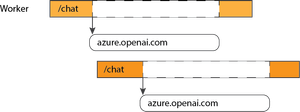
As part of the Python advocacy team, I help maintain several open-source sample AI applications, like our popular RAG chat demo. Through that work, I’ve learned a lot about what makes LLM-powered apps feel fast, reliable, and responsive. One of the most important lessons: use an asynchronous backend framework. Concurrency is critical for LLM apps, which often juggle multiple API calls, database queries, and user requests at the same time. Without async, your app may spend most of its time waiting — blocking one user’s request while another sits idle. The need for concurrency Why? Let’s imagine we’re using a synchronous framework like Flask. We deploy that to a server with gunicorn and several workers. One worker receives a POST request to the "/chat" endpoint, which in turn calls the Azure OpenAI Chat Completions API. That API call can take several seconds to complete — and during that time, the worker is completely tied up, unable to handle any other requests. We could scale out by adding more CPU cores, workers, or threads, but that’s often wasteful and expensive. Without concurrency, each request must be handled serially: When your app relies on long, blocking I/O operations — like model calls, database queries, or external API lookups — a better approach is to use an asynchronous framework. With async I/O, the Python runtime can pause a coroutine that’s waiting for a slow response and switch to handling another incoming request in the meantime. With concurrency, your workers stay busy and can handle new requests while others are waiting: Asynchronous Python backends In the Python ecosystem, there are several asynchronous backend frameworks to choose from: Quart: the asynchronous version of Flask FastAPI: an API-centric, async-only framework (built on Starlette) Litestar: a batteries-included async framework (also built on Starlette) Django: not async by default, but includes support for asynchronous views All of these can be good options depending on your project’s needs. I’ve written more about the decision-making process in another blog post. As an example, let's see what changes when we port a Flask app to a Quart app. First, our handlers now have async in front, signifying that they return a Python coroutine instead of a normal function: async def chat_handler(): request_message = (await request.get_json())["message"] When deploying these apps, I often still use the Gunicorn production web server—but with the Uvicorn worker, which is designed for Python ASGI applications. Alternatively, you can run Uvicorn or Hypercorn directly as standalone servers. Asynchronous API calls To fully benefit from moving to an asynchronous framework, your app’s API calls also need to be asynchronous. That way, whenever a worker is waiting for an external response, it can pause that coroutine and start handling another incoming request. Let's see what that looks like when using the official OpenAI Python SDK. First, we initialize the async version of the OpenAI client: openai_client = openai.AsyncOpenAI( base_url=os.environ["AZURE_OPENAI_ENDPOINT"] + "/openai/v1", api_key=token_provider ) Then, whenever we make API calls with methods on that client, we await their results: chat_coroutine = await openai_client.chat.completions.create( deployment_id=os.environ["AZURE_OPENAI_CHAT_DEPLOYMENT"], messages=[{"role": "system", "content": "You are a helpful assistant."}, {"role": "user", "content": request_message}], stream=True, ) For the RAG sample, we also have calls to Azure services like Azure AI Search. To make those asynchronous, we first import the async variant of the credential and client classes in the aio module: from azure.identity.aio import DefaultAzureCredential from azure.search.documents.aio import SearchClient Then, like with the OpenAI async clients, we must await results from any methods that make network calls: r = await self.search_client.search(query_text) By ensuring that every outbound network call is asynchronous, your app can make the most of Python’s event loop — handling multiple user sessions and API requests concurrently, without wasting worker time waiting on slow responses. Sample applications We’ve already linked to several of our samples that use async frameworks, but here’s a longer list so you can find the one that best fits your tech stack: Repository App purpose Backend Frontend azure-search-openai-demo RAG with AI Search Python + Quart React rag-postgres-openai-python RAG with PostgreSQL Python + FastAPI React openai-chat-app-quickstart Simple chat with Azure OpenAI models Python + Quart plain JS openai-chat-backend-fastapi Simple chat with Azure OpenAI models Python + FastAPI plain JS deepseek-python Simple chat with Azure AI Foundry models Python + Quart plain JS1.3KViews4likes0CommentsJS AI Build-a-thon Setup in 5 Easy Steps
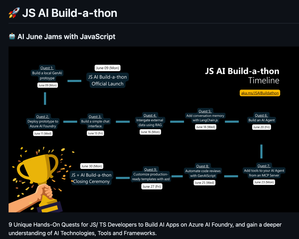
🔥 TL;DR — You’re 5 Steps Away from an AI Adventure Set up your project repo, follow the quests, build cool stuff, and level up. Everything’s automated, community-backed, and designed to help you actually learn AI — using the skills you already have. Let’s build the future. One quest at a time. 👉 Join the Build-a-thon | Chat on DiscordKickstart Your AI Development with the Model Context Protocol (MCP) Course
Model Context Protocol is an open standard that acts as a universal connector between AI models and the outside world. Think of MCP as “the USB-C of the AI world,” allowing AI systems to plug into APIs, databases, files, and other tools seamlessly. By adopting MCP, developers can create smarter, more useful AI applications that access up-to-date information and perform actions like a human developer would. To help developers learn this game-changing technology, Microsoft has created the “MCP for Beginners” course a free, open-source curriculum that guides you from the basics of MCP to building real-world AI integrations. Below, we’ll explore what MCP is, who this course is for, and how it empowers both beginners and intermediate developers to get started with MCP. What is MCP and Why Should Developers Care? Model Context Protocol (MCP) is a innovative framework designed to standardize interactions between AI models and client applications. In simpler terms, MCP is a communication bridge that lets your AI agent fetch live context from external sources (like APIs, documents, databases, or web services) and even take actions using tools. This means your AI apps are no longer limited to pre-trained knowledge they can dynamically retrieve data or execute commands, enabling far more powerful and context-aware behavior. Some key reasons MCP matters for developers: Seamless Integration of Tools & Data: MCP provides a unified way to connect AI to various data sources and tools, eliminating the need for ad-hoc, fragile integrations. Your AI agent can, for example, query a database or call a web API during a conversation all through a standardized protocol. Stay Up-to-Date: Because AI models can use MCP to access external information, they overcome the training data cutoff problem. They can fetch the latest facts, figures, or documents on demand, ensuring more accurate and timely responses. Industry Momentum: MCP is quickly gaining traction. Originally introduced by Microsoft and Anthropic in late 2024, it has since been adopted by major AI platforms (Replit, Sourcegraph, Hugging Face, and more) and spawned thousands of open-source connectors by early 2025. It’s an emerging standard – learning it now puts developers at the forefront of AI innovation. In short, MCP is transformative for AI development, and being proficient in it will help you build smarter AI solutions that can interact with the real world. The MCP for Beginners course is designed to make mastering this protocol accessible, with a structured learning path and hands-on examples. Introducing the MCP for Beginners Course “Model Context Protocol for Beginners” is an open-source, self-paced curriculum created by Microsoft to teach the concepts and fundamentals of MCP. Whether you’re completely new to MCP or have some experience, this course offers a comprehensive guide from the ground up. Key Features and Highlights: Structured Learning Path: The curriculum is organized as a multi-part guide (9 modules in total) that gradually builds your knowledge. It starts with the basics of MCP – What is MCP? Why does standardization matter? What are the use cases? – and then moves through core concepts, security considerations, getting started with coding, all the way to advanced topics and real-world case studies. This progression ensures you understand the “why” and “how” of MCP before tackling complex scenarios. Hands-On Coding Examples: This isn’t just theory – practical coding examples are a cornerstone of the course. You’ll find live code samples and mini-projects in multiple languages (C#, Java, JavaScript/TypeScript, and Python) for each concept. For instance, you’ll build a simple MCP-powered Calculator application as a project, exploring how to implement MCP clients and servers in your preferred language. By coding along, you cement your understanding and see MCP in action. Real-World Use Cases: The curriculum illustrates how MCP applies to real scenarios. It discusses practical use cases of MCP in AI pipelines (e.g. an AI agent pulling in documentation or database info on the fly) and includes case studies of early adopters. These examples help you connect what you learn to actual applications and solutions you might develop in your job. Broad Language Support: A unique aspect of this course is its multi-language approach – both in terms of programming and human languages. The content provides code implementations in several popular programming languages (so you can learn MCP in the context of C#, Java, Python, JavaScript, or TypeScript, as you prefer). In addition, the learning materials themselves are available in multiple human languages (English, plus translations like French, Spanish, German, Chinese, Japanese, Korean, Polish, etc.) to support learners worldwide. This inclusivity ensures that more developers can comfortably engage with the material. Up-to-Date and Open-Source: Being hosted on GitHub under MIT License, the curriculum is completely free to use and open for contributions. It’s maintained with the latest updates for example, automated workflows keep translations in sync so all language versions stay current. As MCP evolves, the course content can evolve with it. You can even join the community to suggest improvements or add content, making this a living learning resource. Official Resources & Community Support: The course links to official MCP documentation and specs for deeper reference, and it encourages learners to join thehttps;//aka.ms/ai/discord to discuss and get help. You won’t be learning alone; you can network with experts and peers, ask questions, and share progress. Microsoft’s open-source approach means you’re part of a community of practitioners from day one. Course Outline: (Modules at a Glance) Introduction to MCP: Overview of MCP, why standardization matters in AI, and the key benefits and use cases of using MCP. (Start here to understand the big picture.) Core Concepts: Deep dive into MCP’s architecture – understanding the client-server model, how requests and responses work, and the message schema. Learn the fundamental components that make up the protocol. Security in MCP: Identify potential security threats when building MCP-based systems and learn best practices to secure your AI integrations. Important for anyone planning to deploy MCP in production environments. Getting Started (Hands-On): Set up your environment and create your first MCP server and client. This module walks through basic implementation steps and shows how to integrate MCP with existing applications, so you get a service up and running that an AI agent can communicate with. MCP Calculator Project: A guided project where you build a simple MCP-powered application (a calculator) in the language of your choice. This hands-on exercise reinforces the concepts by implementing a real tool – you’ll see how an AI agent can use MCP to perform calculations via an external tool. Practical Implementation: Tips and techniques for using MCP SDKs across different languages. Covers debugging, testing, validation of MCP integrations, and how to design effective prompt workflows that leverage MCP’s capabilities. Advanced Topics: Going beyond the basics – explore multi-modal AI workflows (using MCP to handle not just text but other data types), scalability and performance tuning for MCP servers, and how MCP fits into larger enterprise architectures. This is where intermediate users can really deepen their expertise. Community Contributions: Learn how to contribute to the MCP ecosystem and the curriculum itself. This section shows you how to collaborate via GitHub, follow the project’s guidelines, and even extend the protocol with your own ideas. It underlines that MCP is a growing, community-driven standard. Insights from Early Adoption: Hear lessons learned from real-world MCP implementations. What challenges did early adopters face? What patterns and solutions worked best? Understanding these will prepare you to avoid pitfalls in your own projects. Best Practices and Case Studies: A roundup of do’s and don’ts when using MCP. This includes performance optimization techniques, designing fault-tolerant systems, and testing strategies. Plus, detailed case studies that walk through actual MCP solution architectures with diagrams and integration tips bringing everything you learned together in concrete examples. Who Should Take This Course? The MCP for Beginners course is geared towards developers if you build or work on AI-driven applications, this course is for you. The content specifically welcomes: Beginners in AI Integration: You might be a developer who's comfortable with languages like Python, C#, or Java but new to AI/LLMs or to MCP itself. This course will take you from zero knowledge of MCP to a level where you can build and deploy your own MCP-enabled services. You do not need prior experience with MCP or machine learning pipelines the introduction module will bring you up to speed on key concepts. (Basic programming skills and understanding of client-server or API concepts are the only prerequisites.) Intermediate Developers & AI Practitioners: If you have some experience building bots or AI features and want to enhance them with real-time data access, you’ll benefit greatly. The course’s later modules on advanced topics, security, and best practices are especially valuable for those looking to integrate MCP into existing projects or optimize their approach. Even if you've dabbled in MCP or a similar concept before, this curriculum will fill gaps in knowledge and provide structured insights that are hard to get from scattered documentation. AI Enthusiasts & Architects: Perhaps you’re an AI architect or tech lead exploring new frameworks for intelligent agents. This course serves as a comprehensive resource to evaluate MCP for your architecture. By walking through it, you’ll understand how MCP can fit into enterprise systems, what benefits it brings, and how to implement it in a maintainable way. It’s perfect for getting a broad yet detailed view of MCP’s capabilities before adopting it within a team. In essence, anyone interested in making AI applications more connected and powerful will find value here. From a solo hackathon coder to a professional solution architect, the material scales to your need. The course starts with fundamentals in an easy-to-grasp manner and then deepens into complex topics appealing to a wide range of skill levels. Prerequisites: The official prerequisites for the course are minimal: you should have basic knowledge of at least one programming language (C#, Java, or Python is recommended) and a general understanding of how client-server applications or APIs work. Familiarity with machine learning concepts is optional but can help. In short, if you can write simple programs and understand making API calls, you have everything you need to start learning MCP. Conclusion: Empower Your AI Projects with MCP The Model Context Protocol for Beginners course is more than just a tutorial – it’s a comprehensive journey that empowers you to build the next generation of AI applications. By demystifying MCP and equipping you with hands-on experience, this curriculum turns a seemingly complex concept into practical skills you can apply immediately. With MCP, you unlock capabilities like giving your AI agents real-time information access and the ability to use tools autonomously. That means as a developer, you can create solutions that are significantly more intelligent and useful. A chatbot that can search documents, a coding assistant that can consult APIs or run code, an AI service that seamlessly integrates with your database – all these become achievable when you know MCP. And thanks to this beginners-friendly course, you’ll be able to implement such features with confidence. Whether you are starting out in the AI development world or looking to sharpen your cutting-edge skills, the MCP for Beginners course has something for you. It condenses best practices, real-world lessons, and robust techniques into an accessible format. Learning MCP now will put you ahead of the curve, as this protocol rapidly becomes a cornerstone of AI integrations across the industry. So, are you ready to level up your AI development skills? Dive into the https://aka.ms/mcp-for-beginnerscourse and start building AI agents that can truly interact with the world around them. With the knowledge and experience gained, you’ll be prepared to create smarter, context-aware applications and be a part of the community driving AI innovation forward.8.5KViews4likes1CommentNew Generative AI Features in Azure Database for PostgreSQL
by: Maxim Lukiyanov, PhD, Principal PM Manager This week at Microsoft Build conference, we're excited to unveil a suite of new Generative AI capabilities in Azure Database for PostgreSQL flexible server. These features unlock a new class of applications powered by an intelligent database layer, expanding the horizons of what application developers can achieve. In this post, we’ll give you a brief overview of these announcements. Data is the fuel of AI. Looking back, the intelligence of Large Language Models (LLMs) can be reframed as intelligence that emerged from the vast data they were trained on. The LLMs just happened to be this technological leap necessary to extract that knowledge, but the knowledge itself was hidden in the data all along. In modern AI applications, the Retrieval-Augmented Generation (RAG) pattern applies this same principle to real-time data. RAG extracts relevant facts from data on the fly to augment an LLM’s knowledge. At Microsoft, we believe this principle will continue to transform technology. Every bit of data will be squeezed dry of every bit of knowledge it holds. And there’s no better place to find the most critical and up-to-date data than in databases. Today, we're excited to announce the next steps on our journey to make databases smarter – so they can help you capture the full potential of your data. Fast and accurate vector search with DiskANN First, we’re announcing the General Availability of DiskANN vector indexing in Azure Database for PostgreSQL. Vector search is at the heart of the RAG pattern, and it continues to be a cornerstone technology for the new generation of AI Agents - giving it contextual awareness and access to fresh knowledge hidden in data. DiskANN brings years of state-of-the-art innovation in vector indexing from Microsoft Research directly to our customers. This release introduces supports for vectors up to 16,000 dimensions — far surpassing the 2,000-dimension limit of the standard pgvector extension in PostgreSQL. This enables the development of highly accurate applications using high-dimensional embeddings. We’ve also accelerated index creation with enhanced memory management, parallel index building, and other optimizations – delivering up to 3x faster index builds while reducing disk I/O. Additionally, we're excited to announce the Public Preview of Product Quantization – a cutting-edge vector compression technique that delivers exceptional compression while maintaining high accuracy. DiskANN Product Quantization enables efficient storage of large vector volumes, making it ideal for production workloads where both performance and cost matter. With Product Quantization enabled, DiskANN offers up to 10x faster performance and 4x cost savings compared to pgvector HNSW. You can learn more about DiskANN in a dedicated blog post. Semantic operators in the database Next, we’re announcing the Public Preview of Semantic Operators in Azure Database for PostgreSQL – bringing a new intelligence layer to relational algebra, integrated directly into the SQL query engine. While vector search is foundational to the Generative AI (GenAI) apps and agents, it only scratches the surface of what’s possible. Semantic relationships between elements of the enterprise data are not visible to the vector search. This knowledge exists within the data but is lost at the lowest level of the stack – vector search – and this loss propagates upward, limiting the agent’s ability to reason about the data. This is where new Semantic Operators come in. Semantic Operators leverage LLMs to add semantic understanding of operational data. Today, we’re introducing four operators: generate() – a versatile generation operator capable of ChatGPT-style responses. is_true() – a semantic filtering operator that evaluates filter conditions and joins in natural language. extract() – a knowledge extraction operator that extracts hidden semantic relationships and other knowledge from your data, bringing a new level of intelligence to your GenAI apps and agents. rank() - a highly accurate semantic ranking operator, offering two types of state-of-the-art re-ranking models: Cohere Rank-v3.5 or OpenAI gpt-4.1 models from Azure AI Foundry Model Catalog. You can learn more about Semantic Operators in a dedicated blog post. Graph database and GraphRAG knowledge graph support Finally, we’re announcing the General Availability of GraphRAG support and the General Availability of the Apache AGE extension in Azure Database for PostgreSQL. Apache AGE extension on Azure Database for PostgreSQL offers a cost-effective, managed graph database service powered by PostgreSQL engine – and serves as the foundation for building GraphRAG applications. The semantic relationships in the data once extracted can be stored in various ways within the database. While relational tables with referential integrity can represent some relationships, this approach is suboptimal for knowledge graphs. Semantic relationships are dynamic; many aren’t known ahead of time and can’t be effectively modeled by a fixed schema. Graph databases provide a much more flexible structure, enabling knowledge graphs to be expressed naturally. Apache AGE supports openCypher, the emerging standard for querying graph data. OpenCypher offers an expressive, intuitive language well-suited for knowledge graph queries. We believe that combining semantic operators with graph support in Azure Database for PostgreSQL creates a compelling data platform for the next generation of AI agents — capable of effectively extracting, storing, and retrieving semantic relationships in your data. You can learn more about graph support in a separate blog post. Resources to help you get started We’re also happy to announce availability of the new resources and tools for application developers: Model Context Protocol (MCP) is an emerging open protocol designed to integrate AI models with external data sources and services. We have integrated MCP server for Azure Database for PostgreSQL into the Azure MCP Server, making it easy to connect your agentic apps not only to Azure Database for PostgreSQL, but to other Azure services as well through one unified interface. To learn more, refer to this blog post. New Solution Accelerator which showcases all of the capabilities we have announced today working together in one solution solving real world problems of ecommerce retail reimagined for agentic era. New PostgreSQL extension for VSCode for application developers and database administrators alike, bringing new generation of query editing and Copilot experiences to the world of PostgreSQL. And read about New enterprise features making Azure Database for PostgreSQL faster and more secure in the accompanying post. Begin your journey Generative AI innovation continues its advancement, bringing new opportunities every month. We’re excited for what is to come and look forward to sharing this journey of discovery with our customers. With today’s announcements - DiskANN vector indexing, Semantic Operators, and GraphRAG - Azure Database for PostgreSQL is ready to help you explore new boundaries of what’s possible. We invite you to begin your Generative AI journey today by exploring our new Solution Accelerator.1.9KViews3likes0CommentsAI Repo of the Week: Generative AI for Beginners with JavaScript
Introduction Ready to explore the fascinating world of Generative AI using your JavaScript skills? This week’s featured repository, Generative AI for Beginners with JavaScript, is your launchpad into the future of application development. Whether you're just starting out or looking to expand your AI toolbox, this open-source GitHub resource offers a rich, hands-on journey. It includes interactive lessons, quizzes, and even time-travel storytelling featuring historical legends like Leonardo da Vinci and Ada Lovelace. Each chapter combines narrative-driven learning with practical exercises, helping you understand foundational AI concepts and apply them directly in code. It’s immersive, educational, and genuinely fun. What You'll Learn 1. 🧠 Foundations of Generative AI and LLMs Start with the basics: What is generative AI? How do large language models (LLMs) work? This chapter lays the groundwork for how these technologies are transforming JavaScript development. 2. 🚀 Build Your First AI-Powered App Walk through setting up your environment and creating your first AI app. Learn how to configure prompts and unlock the potential of AI in your own projects. 3. 🎯 Prompt Engineering Essentials Get hands-on with prompt engineering techniques that shape how AI models respond. Explore strategies for crafting prompts that are clear, targeted, and effective. 4. 📦 Structured Output with JSON Learn how to guide the model to return structured data formats like JSON—critical for integrating AI into real-world applications. 5. 🔍 Retrieval-Augmented Generation (RAG) Go beyond static prompts by combining LLMs with external data sources. Discover how RAG lets your app pull in live, contextual information for more intelligent results. 6. 🛠️ Function Calling and Tool Use Give your LLM new powers! Learn how to connect your own functions and tools to your app, enabling more dynamic and actionable AI interactions. 7. 📚 Model Context Protocol (MCP) Dive into MCP, a new standard for organizing prompts, tools, and resources. Learn how it simplifies AI app development and fosters consistency across projects. 8. ⚙️ Enhancing MCP Clients with LLMs Build on what you’ve learned by integrating LLMs directly into your MCP clients. See how to make them smarter, faster, and more helpful. ✨ More chapters coming soon—watch the repo for updates! Companion App: Interact with History Experience the power of generative AI in action through the companion web app—where you can chat with historical figures and witness how JavaScript brings AI to life in real time. Conclusion Generative AI for Beginners with JavaScript is more than a course—it’s an adventure into how storytelling, coding, and AI can come together to create something fun and educational. Whether you're here to upskill, experiment, or build the next big thing, this repository is your all-in-one resource to get started with confidence. 🔗 Jump into the future of development—check out the repo and start building with AI today!From Concept to Code: Building Production-Ready Multi-Agent Systems with Microsoft Foundry
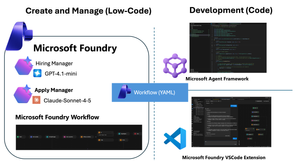
We have reached a critical inflection point in AI development. Within the Microsoft Foundry ecosystem, the core value proposition of "Agents" is shifting decisively—moving from passive content generation to active task execution and process automation. These are no longer just conversational interfaces. They are intelligent entities capable of connecting models, data, and tools to actively execute complex business logic. To support this evolution, Microsoft has introduced a powerful suite of capabilities: the Microsoft Agent Framework for sophisticated orchestration, the Agent V2 SDK, and integrated Microsoft Foundry VSCode Extensions. These innovations provide the tooling necessary to bridge the gap between theoretical research and secure, scalable enterprise landing. But how do you turn these separate components into a cohesive business solution? That is the challenge we address today. This post dives into the practical application of these tools, demonstrating how to connect the dots and transform complex multi-agent concepts into deployed reality. The Scenario: Recruitment through an "Agentic Lens" Let’s ground this theoretical discussion with a real-world scenario that perfectly models a multi-agent environment: The Recruitment Process. By examining recruitment through an agentic lens, we can identify distinct entities with specific mandates: The Recruiter Agent: Tasked with setting boundary conditions (job requirements) and preparing data retrieval mechanisms (interview questions). The Applicant Agent: Objective is to process incoming queries and synthesize the best possible output to meet the recruiter's acceptance criteria. Phase 1: Design Achieving Orchestration via Microsoft Foundry Workflows To bridge the gap between our scenario and technical reality, we start with Foundry Workflows. Workflows serves as the visual integration environment within Foundry. It allows you to build declarative pipelines that seamlessly combine deterministic business logic with the probabilistic nature of autonomous AI agents. By adopting this visual, low-code paradigm, you eliminate the need to write complex orchestration logic from scratch. Workflows empowers you to coordinate specialized agents intuitively, creating adaptive systems that solve complex business problems collaboratively. Visually Orchestrating the Cycle Microsoft Foundry provides an intuitive, web-based drag-and-drop interface. This canvas allows you to integrate specialized AI agents alongside standard procedural logic blocks, transforming abstract ideas into executable processes without writing extensive glue code. To translate our recruitment scenario into a functional workflow, we follow a structured approach: Agent Prerequisites: We pre-configure our specialized agents within Foundry. We create a Recruiter Agent (prompted to generate evaluation criteria) and an Applicant Agent (prompted to synthesize responses). Orchestrating the Interaction: We drag these nodes onto the board and define the data flow. The process begins with the Recruiter generating questions, piping that output directly as input for the Applicant agent. Adding Business Logic: A true workflow requires decision-making. We introduce control flow logic, such as IF/ELSE conditional blocks, to evaluate the recruiter's questions based on predefined criteria. This allows the workflow to branch dynamically—if satisfied, the candidate answers the questions; if not, the questions are regenerated. Alternative: YAML Configuration For developers who prefer a code-first approach or wish to rapidly replicate this logic across environments, Foundry allows you to export the underlying YAML. kind: workflow trigger: kind: OnConversationStart id: trigger_wf actions: - kind: SetVariable id: action-1763742724000 variable: Local.LatestMessage value: =UserMessage(System.LastMessageText) - kind: InvokeAzureAgent id: action-1763736666888 agent: name: HiringManager input: messages: =System.LastMessage output: autoSend: true messages: Local.LatestMessage - kind: Question variable: Local.Input id: action-1763737142539 entity: StringPrebuiltEntity skipQuestionMode: SkipOnFirstExecutionIfVariableHasValue prompt: Boss, can you confirm this ? - kind: ConditionGroup conditions: - condition: =Local.Input="Yes" actions: - kind: InvokeAzureAgent id: action-1763744279421 agent: name: ApplyAgent input: messages: =Local.LatestMessage output: autoSend: true messages: Local.LatestMessage - kind: EndConversation id: action-1763740066007 id: if-action-1763736954795-0 id: action-1763736954795 elseActions: - kind: GotoAction actionId: action-1763736666888 id: action-1763737425562 id: "" name: HRDemo description: "" Simulating the End-to-End Process Once constructed, Foundry provides a robust, built-in testing environment. You can trigger the workflow with sample input data to simulate the end-to-end cycle. This allows you to debug hand-offs and interactions in real-time before writing a single line of application code. Phase 2: Develop From Cloud Canvas to Local Code with VSCode Foundry Workflows excels at rapid prototyping. However, a visual UI is rarely sufficient for enterprise-grade production. The critical question becomes: How do we integrate these visual definitions into a rigorous Software Development Lifecycle (SDLC)? While the cloud portal is ideal for design, enterprise application delivery happens in the local IDE. The Microsoft Foundry VSCode Extension bridges this gap. This extension allows developers to: Sync: Pull down workflow definitions from the cloud to your local machine. Inspect: Review the underlying logic in your preferred environment. Scaffold: Rapidly generate the underlying code structures needed to run the flow. This accelerates the shift from "understanding" the flow to "implementing" it. Phase 3: Deploy Productionizing Intelligence with the Microsoft Agent Framework Once the multi-agent orchestration has been validated locally, the final step is transforming it into a shipping application. This is where the Microsoft Agent Framework shines as a runtime engine. It natively ingests the declarative Workflow definitions (YAML) exported from Foundry. This allows artifacts from the prototyping phase to be directly promoted to application deployment. By simply referencing the workflow configuration libraries, you can "hydrate" the entire multi-agent system with minimal boilerplate. Here is the code required to initialize and run the workflow within your application. Note - Check the source code https://github.com/microsoft/Agent-Framework-Samples/tree/main/09.Cases/MicrosoftFoundryWithAITKAndMAF Summary: The Journey from Conversation to Action Microsoft Foundry is more than just a toolbox; it is a comprehensive solution designed to bridge the chasm between theoretical AI research and secure, scalable enterprise applications. In this post, we walked through the three critical stages of modern AI development: Design (Low-Code): Leveraging Foundry Workflows to visually orchestrate specialized agents (Recruiter vs. Applicant) mixed with deterministic business rules. Develop (Local SDLC): Utilizing the VSCode Extension to break down the barriers between the cloud canvas and the local IDE, enabling seamless synchronization and debugging. Deploy (Native Runtime): Using the Microsoft Agent Framework to ingest declarative YAML, realizing the promise of "Configuration as Code" and eliminating tedious logic rewriting. By following this path, developers can move beyond simple content generation and build adaptive, multi-agent systems that drive real business value. Learning Resoures What's Microsoft Foundry (https://learn.microsoft.com/azure/ai-foundry/what-is-azure-ai-foundry?view=foundry) Work with Declarative (Low-code) Agent workflows in Visual Studio Code (preview) (https://learn.microsoft.com/azure/ai-foundry/agents/how-to/vs-code-agents-workflow-low-code?view=foundry) Microsoft Agent Framework(https://github.com/microsoft/agent-framework) Microsoft Foundry VSCode Extension(https://marketplace.visualstudio.com/items?itemName=TeamsDevApp.vscode-ai-foundry)7.6KViews1like0Comments
Orchestrating Multi-Agent Intelligence: MCP-Driven Patterns in Agent Framework
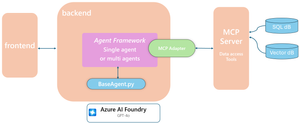
Building reliable AI systems requires modular, stateful coordination and deterministic workflows that enable agents to collaborate seamlessly. The Microsoft Agent Framework provides these foundations, with memory, tracing, and orchestration built in. This implementation demonstrates four multi-agentic patterns — Single Agent, Handoff, Reflection, and Magentic Orchestration — showcasing different interaction models and collaboration strategies. From lightweight domain routing to collaborative planning and self-reflection, these patterns highlight the framework’s flexibility. At the core is Model Context Protocol (MCP), connecting agents, tools, and memory through a shared context interface. Persistent session state, conversation thread history, and checkpoint support are handled via Cosmos DB when configured, with an in-memory dictionary as a default fallback. This setup enables dynamic pattern swapping, performance comparison, and traceable multi-agent interactions — all within a unified, modular runtime. Business Scenario: Contoso Customer Support Chatbot Contoso’s chatbot handles multi-domain customer inquiries like billing anomalies, promotion eligibility, account locks, and data usage questions. These require combining structured data (billing, CRM, security logs, promotions) with unstructured policy documents processed via vector embeddings. Using MCP, the system orchestrates tool calls to fetch real-time structured data and relevant policy content, ensuring policy-aligned, auditable responses without exposing raw databases. This enables the assistant to explain anomalies, recommend actions, confirm eligibility, guide account recovery, and surface risk indicators—reducing handle time and improving first-contact resolution while supporting richer multi-agent reasoning. Architecture & Core Concepts The Contoso chatbot leverages the Microsoft Agent Framework to deliver a modular, stateful, and workflow-driven architecture. At its core, the system consists of: Base Agent: All agent patterns—single agent, reflection, handoff and magentic orchestration—inherit from a common base class, ensuring consistent interfaces for message handling, tool invocation, and state management. Backend: A FastAPI backend manages session routing, agent execution, and workflow orchestration. Frontend: A React-based UI (or Streamlit alternative) streams responses in real-time and visualizes agent reasoning and tool calls. Modular Runtime and Pattern Swapping One of the most powerful aspects of this implementation is its modular runtime design. Each agentic pattern—Single, Reflection, Handoff, and Magnetic—plugs into a shared execution pipeline defined by the base agent and MCP integration. By simply updating the .env configuration (e.g., agent_module=handoff), developers can swap in and out entire coordination strategies without touching the backend, frontend, or memory layers. This makes it easy to compare agent styles side by side, benchmark reasoning behaviors, and experiment with orchestration logic—all while maintaining a consistent, deterministic runtime. The same MCP connectors, FastAPI backend, and Cosmos/in-memory state management work seamlessly across every pattern, enabling rapid iteration and reliable evaluation. # Dynamic agent pattern loading agent_module_path = os.getenv("AGENT_MODULE") agent_module = __import__(agent_module_path, fromlist=["Agent"]) Agent = getattr(agent_module, "Agent") # Common MCP setup across all patterns async def _create_tools(self, headers: Dict[str, str]) -> List[MCPStreamableHTTPTool] | None: if not self.mcp_server_uri: return None return [MCPStreamableHTTPTool( name="mcp-streamable", url=self.mcp_server_uri, headers=headers, timeout=30, request_timeout=30, )] Memory & State Management State management is critical for multi-turn conversations and cross-agent workflows. The system supports two out-of-the-box options: Persistent Storage (Cosmos DB) Acts as the durable, enterprise-ready backend. Stores serialized conversation threads and workflow checkpoints keyed by tenant and session ID. Ensures data durability and auditability across restarts. In-Memory Session Store Default fallback when Cosmos DB credentials are not configured. Maintains ephemeral state per session for fast prototyping or lightweight use cases. All patterns leverage the same thread-based state abstraction, enabling: Session isolation: Each user session maintains its own state and history. Checkpointing: Multi-agent workflows can snapshot shared and executor-local state at any point, supporting pause/resume and fault recovery. Model Context Protocol (MCP): Acts as the connector between agents and tools, standardizing how data is fetched and results are returned to agents, whether querying structured databases or unstructured knowledge sources. Core Principles Across all patterns, the framework emphasizes: Modularity: Components are interchangeable—agents, tools, and state stores can be swapped without disrupting the system. Stateful Coordination: Multi-agent workflows coordinate through shared and local state, enabling complex reasoning without losing context. Deterministic Workflows: While agents operate autonomously, the workflow layer ensures predictable, auditable execution of multi-agent tasks. Unified Execution: From single-agent Q&A to complex Magentic orchestrations, every agent follows the same execution lifecycle and integrates seamlessly with MCP and the state store. Multi-Agent Patterns: Workflow and Coordination With the architecture and core concepts established, we can now explore the agentic patterns implemented in the Contoso chatbot. Each pattern builds on the base agent and MCP integration but differs in how agents orchestrate tasks and communicate with one another to handle multi-domain customer queries. In the sections that follow, we take a deeper dive into each pattern’s workflow and examine the under-the-hood communication flows between agents: Single Agent – A simple, single-domain agent handling straightforward queries. Reflection Agent – Allows agents to introspect and refine their outputs. Handoff Pattern – Routes conversations intelligently to specialized agents across domains. Magentic Orchestration – Coordinates multiple specialist agents for complex, parallel tasks. For each pattern, the focus will be on how agents communicate and coordinate, showing the practical orchestration mechanisms in action. Single Intelligent Agent The Single Agent Pattern represents the simplest orchestration style within the framework. Here, a single autonomous agent handles all reasoning, decision-making, and tool interactions directly — without delegation or multi-agent coordination. When a user submits a request, the single agent processes the query using all tools, memory, and data sources available through the Model Context Protocol (MCP). It performs retrieval, reasoning, and response composition in a single, cohesive loop. Communication Flow: User Input → Agent: The user submits a question or command. Agent → MCP Tools: The agent invokes one or more tools (e.g., vector retrieval, structured queries, or API calls) to gather relevant context and data. Agent → User: The agent synthesizes the tool outputs, applies reasoning, and generates the final response to the user. Session Memory: Throughout the exchange, the agent stores conversation history and extracted entities in the configured memory store (in-memory or Cosmos DB). Key Communication Principles: Single Responsibility: One agent performs both reasoning and action, ensuring fast response times and simpler state management. Direct Tool Invocation: The agent has direct access to all registered tools through MCP, enabling flexible retrieval and action chaining. Stateful Execution: The session memory preserves dialogue context, allowing the agent to maintain continuity across user turns. Deterministic Behavior: The workflow is fully predictable — input, reasoning, tool call, and output occur in a linear sequence. Reflection pattern The Reflection Pattern introduces a lightweight, two-agent communication loop designed to improve the quality and reliability of responses through structured self-review. In this setup, a Primary Agent first generates an initial response to the user’s query. This draft is then passed to a Reviewer Agent, whose role is to critique and refine the response—identifying gaps, inaccuracies, or missed context. Finally, the Primary Agent incorporates this feedback and produces a polished final answer for the user. This process introduces one round of reflection and improvement without adding excessive latency, balancing quality with responsiveness. Communication Flow: User Input → Primary Agent: The user submits a query. Primary Agent → Reviewer Agent: The primary generates an initial draft and passes it to the reviewer. Reviewer Agent → Primary Agent: The reviewer provides feedback or suggested improvements. Primary Agent → User: The primary revises its response and sends the refined version back to the user. Key Communication Principles: Two-Stage Dialogue: Structured interaction between Primary and Reviewer ensures each output undergoes quality assurance. Focused Review: The Reviewer doesn’t recreate answers—it critiques and enhances, reducing redundancy. Stateful Context: Both agents operate over the same shared memory, ensuring consistency between draft and revision. Deterministic Flow: A single reflection round guarantees predictable latency while still improving answer quality. Transparent Traceability: Each step—initial draft, feedback, and final output—is logged, allowing developers to audit reasoning or assess quality improvements over time. In practice, this pattern enables the system to reason about its own output before responding, yielding clearer, more accurate, and policy-aligned answers without requiring multiple independent retries. Handoff Pattern When a user request arrives, the system first routes it through an Intent Classifier (or triage agent) to determine which domain specialist should handle the conversation. Once identified, control is handed off directly to that Specialist Agent, which uses its own tools, domain knowledge, and state context to respond. This specialist continues to handle the user interaction as long as the conversation stays within its domain. If the user’s intent shifts — for example, moving from billing to security — the conversation is routed back to the Intent Classifier, which re-assigns it to the correct specialist agent. This pattern reduces latency and maintains continuity by minimizing unnecessary routing. Each handoff is tracked through the shared state store, ensuring seamless context carry-over and full traceability of decisions. Key Communication Principles: Dynamic Routing: The Intent Classifier routes user input to the right specialist domain. Domain Persistence: The specialist remains active while the user stays within its domain. Context Continuity: Conversation history and entities persist across agents through the shared state store. Traceable Handoffs: Every routing decision is logged for observability and auditability. Low Latency: Responses are faster since domain-appropriate agents handle queries directly. In practice, this means a user could begin a conversation about billing, continue seamlessly, and only be re-routed when switching topics — without losing any conversational context or history. Magentic Pattern The Magentic Pattern is designed for open-ended, multi-faceted tasks that require multiple agents to collaborate. It introduces a Manager (Planner) Agent, which interprets the user’s goal, breaks it into subtasks, and orchestrates multiple Specialist Agents to execute those subtasks. The Manager creates and maintains a Task Ledger, which tracks the status, dependencies, and results of each specialist’s work. As specialists perform their tool calls or reasoning, the Manager monitors their progress, gathers intermediate outputs, and can dynamically re-plan, dispatch additional tasks, or adjust the overall workflow. When all subtasks are complete, the Manager synthesizes the combined results into a coherent final response for the user. Key Communication Principles: Centralized Orchestration: The Manager coordinates all agent interactions and workflow logic. Parallel and Sequential Execution: Specialists can work simultaneously or in sequence based on task dependencies. Task Ledger: Acts as a transparent record of all task assignments, updates, and completions. Dynamic Re-planning: The Manager can modify or extend workflows in real time based on intermediate findings. Shared Memory: All agents access the same state store for consistent context and result sharing. Unified Output: The Manager consolidates results into one response, ensuring coherence across multi-agent reasoning. In practice, Magentic orchestration enables complex reasoning where the system might combine insights from multiple agents — e.g., billing, product, and security — and present a unified recommendation or resolution to the user. Choosing the Right Agent for Your Use Case Selecting the appropriate agent pattern hinges on the complexity of the task and the level of coordination required. As use cases evolve from straightforward queries to intricate, multi-step processes, the need for specialized orchestration increases. Below is a decision matrix to guide your choice: Feature / Requirement Single Agent Reflection Agent Handoff Pattern Magentic Orchestration Handles simple, domain-bound tasks ✔ ✔ ✖ ✖ Supports review / quality assurance ✖ ✔ ✖ ✔ Multi-domain routing ✖ ✖ ✔ ✔ Open-ended / complex workflows ✖ ✖ ✖ ✔ Parallel agent collaboration ✖ ✖ ✖ ✔ Direct tool access ✔ ✔ ✔ ✔ Low latency / fast response ✔ ✔ ✔ ✖ Easy to implement / low orchestration ✔ ✔ ✖ ✖ Dive Deeper: Explore, Build, and Innovate We've explored various agent patterns, from Single Agent to Magentic Orchestration, each tailored to different use cases and complexities. To see these patterns in action, we invite you to explore our Github repo. Clone the repo, experiment with the examples, and adapt them to your own scenarios. Additionally, beyond the patterns discussed here, the repository also features a Human-in-the-Loop (HITL) workflow designed for fraud detection. This workflow integrates human oversight into AI decision-making, ensuring higher accuracy and reliability. For an in-depth look at this approach, we recommend reading our detailed blog post: Building Human-in-the-loop AI Workflows with Microsoft Agent Framework | Microsoft Community Hub Engage with these resources, and start building intelligent, reliable, and scalable AI systems today! This repository and content is developed and maintained by James Nguyen, Nicole Serafino, Kranthi Kumar Manchikanti, Heena Ugale, and Tim Sullivan.