data + storage
113 Topics
Understanding Storage Account replication downtime
I have a Storage account that's used as a CDN to host a lot of generally small files which occupy about 2GB. This is a small but critical part of our application which is used heavily by our app but which has no redundancy (it currently only has LRS replication). It's hosted in UK South and while Storage Accounts are very reliable, I'm concerned that if there's ever a regional outage there's nothing I'd be able to do. The requirements therefore are: Convert it from LRS to GZRS i.e. actively replicating from UK South to UK West. No app changes required to detect when the primary goes down and to switch to the secondary-this needs to be transparent. No or low downtime when the change is made. We need to be able to write to the secondary after failover. As a software company anything that limits our ability to push code changes is not acceptable, so RA-GZRS is off the table. After doing a bit of reading, I found the following warning in the docs: If you choose to perform a manual migration, downtime is required but you have more control over the timing of the migration process. https://learn.microsoft.com/en-us/azure/storage/common/redundancy-migration?tabs=portal#downtime-requirements This is typically light on detail and leaves some critical questions unanswered: Is there any way of estimating how long the downtime will be so I can appropriately set expectations of management and customers when scheduling the maintenance window needed? It specifically mentions manual migrations i.e. making the change through the Azure Portal, would making the change through IAC e.g. Bicep or Terraform be any different? Any input from anyone who's made any similar changes will also be appreciated. Edit: I've just checked and found that UK West still doesn't have Availability Zone support, is my best option for reducing the risk of this single point of failure to set the replication to GRS? https://learn.microsoft.com/en-us/azure/reliability/regions-list#azure-regions-list-1106Views0likes2Comments
PAAS resource metrics using Azure Data Collection Rule to Log Analytics Workspace
Hi Team, I want to build a use case to pull the Azure PAAS resources metrics using azure DCR and push that data metrics to log analytics workspace which eventually will push the data to azure event hub through streaming and final destination as azure postgres to store all the resources metrics information in a centralized table and create KPIs and dashboard for the clients for better utilization of resources. I have not used diagnose setting enabling option since it has its cons like we need to manually enable each resources settings also we get limited information extracted from diagnose setting. But while implementing i saw multiple articles stating DCR is not used for pulling PAAS metrics its only compatible for VM metrics. Want to understand is it possible to use DCR for PAAS metrics? Thanks in advance for any inputs.Solved141Views0likes2Comments
Azure support team not responding to support request
I am posting here because I have not received a response to my support request despite my plan stating that I should hear back within 8 hours. It has now gone a day beyond that limit, and I am still waiting for assistance with this urgent matter. This issue is critical for my operations, and the delay is unacceptable. The ticket/reference number for my original support request was 2410100040000309. And I have created a brand new service request with ID 2412160040010160. I need this addressed immediately.772Views1like7CommentsApplying DevOps Principles on Lean Infrastructure. Lessons From Scaling to 102K Users.
Hi Azure Community, I'm a Microsoft Certified DevOps Engineer, and I want to share an unusual journey. I have been applying DevOps principles on traditional VPS infrastructure to scale to 102,000 users with 99.2% uptime. Why am I posting this in an Azure community? Because I'm planning migration to Azure in 2026, and I want to understand: What mistakes am I already making that will bite me during migration? THE CURRENT SETUP Platform: Social commerce (West Africa) Users: 102,000 active Monthly events: 2 million Uptime: 99.2% Infrastructure: Single VPS Stack: PHP/Laravel, MySQL, Redis Yes - one VPS. No cloud. No Kubernetes. No microservices. WHY I HAVEN'T USED AZURE YET Honest answer: Budget constraints in emerging market startup ecosystem. At our current scale, fully managed Azure services would significantly increase monthly burn before product-market expansion. The funding we raised needs to last through growth milestones. The trade: I manually optimize what Azure would auto-scale. I debug what Application Insights would catch. I do by hand what Azure Functions would automate. DEVOPS PRACTICES THAT KEPT US RUNNING Even on single-server infrastructure, core DevOps principles still apply: CI/CD Pipeline (GitHub Actions) • 3-5 deployments weekly • Zero-downtime deploys • Automated rollback on health check failures • Feature flags for gradual rollouts Monitoring & Observability • Custom monitoring (would love Application Insights) • Real-time alerting • Performance tracking and slow query detection • Resource usage monitoring Automation • Automated backups • Automated database optimization • Automated image compression • Automated security updates Infrastructure as Code • Configs in Git • Deployment scripts • Environment variables • Documented procedures Testing & Quality • Automated test suite • Pre-deployment health checks • Staging environment • Post-deployment verification KEY OPTIMIZATIONS Async Job Processing • Upload endpoint: 8 seconds → 340ms • 4x capacity increase Database Optimization • Feed loading: 6.4 seconds → 280ms • Strategic caching • Batch processing Image Compression • 3-8MB → 180KB (94% reduction) • Critical for mobile users Caching Strategy • Redis for hot data • Query result caching • Smart invalidation Progressive Enhancement • Server-rendered pages • 2-3 second loads on 4G WHAT I'M WORRIED ABOUT FOR AZURE MIGRATION This is where I need your help: Architecture Decisions • App Service vs Functions + managed services? • MySQL vs Azure SQL? • When does cost/benefit flip for managed services? Cost Management • How do startups manage Azure costs during growth? • Reserved instances vs pay-as-you-go? • Which Azure services are worth the premium? Migration Strategy • Lift-and-shift first, or re-architect immediately? • Zero-downtime migration with 102K active users? • Validation approach before full cutover? Monitoring & DevOps • Application Insights - worth it from day one? • Azure DevOps vs GitHub Actions for Azure deployments? • Operational burden reduction with managed services? Development Workflow • Local development against Azure services? • Cost-effective staging environments? • Testing Azure features without constant bills? MY PLANNED MIGRATION PATH Phase 1: Hybrid (Q1 2026) • Azure CDN for static assets • Azure Blob Storage for images • Application Insights trial • Keep compute on VPS Phase 2: Compute Migration (Q2 2026) • App Service for API • Azure Database for MySQL • Azure Cache for Redis • VPS for background jobs Phase 3: Full Azure (Q3 2026) • Azure Functions for processing • Full managed services • Retire VPS QUESTIONS FOR THIS COMMUNITY Question 1: Am I making migration harder by waiting? Should I have started with Azure at higher cost to avoid technical debt? Question 2: What will break when I migrate? What works on VPS but fails in cloud? What assumptions won't hold? Question 3: How do I validate before cutting over? Parallel infrastructure? Gradual traffic shift? Safe patterns? Question 4: Cost optimization from day one? What to optimize immediately vs later? Common cost mistakes? Question 5: DevOps practices that transfer? What stays the same? What needs rethinking for cloud-native? THE BIGGER QUESTION Have you migrated from self-hosted to Azure? What surprised you? I know my setup isn't best practice by Azure standards. But it's working, and I've learned optimization, monitoring, and DevOps fundamentals in practice. Will those lessons transfer? Or am I building habits that cloud will expose as problematic? Looking forward to insights from folks who've made similar migrations. --- About the Author: Microsoft Certified DevOps Engineer and Azure Developer. CTO at social commerce platform scaling in West Africa. Preparing for phased Azure migration in 2026. P.S. I got the Azure certifications to prepare for this migration. Now I need real-world wisdom from people who've actually done it!113Views0likes0Comments
Mine your Azure backup data, it could save you 💰💡
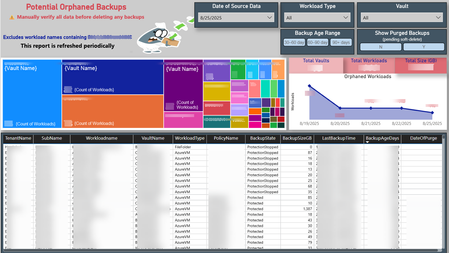
Your data has a story to tell. Mine it, decipher it, and turn it into actionable outcomes. 📊🔍 Azure backups can become orphaned in several ways (I'll dive into that in a future post). But here’s a key point: orphaned doesn’t always mean useless, hence the word “Potential” in the title of my Power BI report. Each workload needs to be assessed individually. If a backup is no longer needed, you might be paying for it - unnecessarily and unknowingly. 🕵️♂️💸 To uncover these hidden costs, I combined data from the Azure Business Continuity Center with a PowerShell script I wrote to extract LastBackupTime and other metadata. This forms the foundation of my report, helping visualize and track backup usage over time. This approach helped me identify forgotten one-time backups, VMs deleted without stopping the backup, workloads excluded due to policy changes, and backups left behind after resource migrations. If you delete unneeded backups and have soft-delete enabled, the backup size drops to zero and Azure stops charging for it. ✅🧹 💡 Do your Azure backups have their own untold story to tell? 📸 Here's a snapshot of my report that helped me uncover these insights 👇106Views0likes0CommentsAzure Storage
You've asked for something about Azure Storage, and there's a wealth of information both from your own work and from trusted external sources. Here's a tailored overview that blends your contributions with broader context: 🔹 What Is Azure Storage? Azure Storage [1] is Microsoft’s cloud-based solution for storing modern data workloads. It offers: High availability and durability through redundancy and geo-replication. Massive scalability to support everything from small apps to enterprise-scale systems. Security with built-in encryption and fine-grained access control. Global accessibility via REST APIs, SDKs, Azure CLI, and Azure Storage Explorer. Azure Storage supports multiple data services: Azure Blob Storage: For unstructured data like images, videos, and backups. Azure Files: Managed file shares accessible via SMB or NFS. Azure Queues: For message-based communication between components. Azure Tables: A NoSQL store for structured data. Azure Disks: Persistent block storage for Azure VMs. Azure Elastic SAN and Azure Container Storage: For advanced storage orchestration and container-native workloads. 🔹 Your Contributions on Azure Storage You've made significant contributions to the Azure community, especially through your blog and event series: In your MVP Contributions tracker, you’ve documented multiple sessions and blog posts covering: Types of Azure Storage (e.g., Blob, File, Queue, Table) [2] Cost optimization strategies for Azure Storage [2] Azure Files and file sharing capabilities [2] Your presentation A COMPREHENSIVE GUIDE TO AZURE COST MANAGEMENT dives into how Azure Storage fits into broader cloud cost strategies, emphasizing budget control, resource allocation, and ROI [3]. 🔹 Practical Use Cases Azure Storage is ideal for: Backup and disaster recovery with geo-redundant storage. Big data analytics using Data Lake Storage. Web and mobile app content delivery via Blob Storage. Enterprise file sharing with Azure Files. IoT and telemetry ingestion using Queues and Tables. Would you like help turning this into a blog post, presentation, or training module? I can also summarize your past Azure Storage sessions or help you prepare new ones. References [1] Introduction to Azure Storage - Cloud storage on Azure [2] MVP Contributions [3] A COMPREHENSIVE GUIDE TO AZURE COST MANAGEMENT109Views0likes0CommentsA Complete Guide to Azure Database Migration Strategies, Tools, and Best Practices
As organizations increasingly adopt cloud-first strategies, migrating databases to the cloud has become a crucial step toward scalability, security, and cost-efficiency. Microsoft Azure, with its powerful ecosystem, offers a range of services and tools to simplify and streamline this process. In this blog, we’ll explore Azure Database Migration, including its benefits, strategies, tools, and best practices. https://dellenny.com/a-complete-guide-to-azure-database-migration-strategies-tools-and-best-practices/177Views1like0Comments
Scaling Smart with Azure: Architecture That Works
Hi Tech Community! I’m Zainab, currently based in Abu Dhabi and serving as Vice President of Finance & HR at Hoddz Trends LLC a global tech solutions company headquartered in Arkansas, USA. While I lead on strategy, people, and financials, I also roll up my sleeves when it comes to tech innovation. In this discussion, I want to explore the real-world challenges of scaling systems with Microsoft Azure. From choosing the right architecture to optimizing performance and cost, I’ll be sharing insights drawn from experience and I’d love to hear yours too. Whether you're building from scratch, migrating legacy systems, or refining deployments, let’s talk about what actually works.209Views0likes1Comment
[newbie] Can I access files in a given storage account via the Azure Cloud Shell CLI filesystem?
Can I access "these" files "there", or are the filesystems completely separate? Or is there a CLI command to link the two? Thanks in advance for any insight you can provide.Solved170Views0likes2CommentsStorage Accounts - Networking
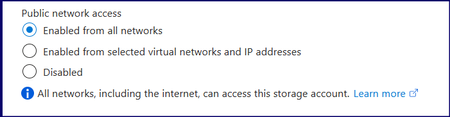
Hi All, Seems like a basic issue, however, I cannot seem to resolve the issue. In a nutshell, a number of storage accounts (and other resources) were created with the Public Network Access set as below: I would like to change them all to them all to Enabled from selected virtual networks and IP addresses or even Disabled. However, when I change to Enabled from selected virtual networks and IP addresses, connectivity from, for example, Power Bi to the Storage Account fails. I have added the VPN IP's my local IP etc. But all continue to fail connection or authentication. Once it is changed back to Enabled for All networks everything works, i.e. Power Bi can access the Azure Blob Storage and refresh successfully. I have also enabled 'Allow Azure services on the trusted services list to access this storage account'. But PBI fails to have access to the data. data Source Credentials error, whether using Key, Service Principal etc, it fails. As soon as I switch it back to Enable From All Networks, it authenticates straight away. One more idea I had was to add ALL of the Resource Instances, as this would white list more Azure services, although PBI should be covered by enabling 'Allow Azure services on the trusted services list to access this storage account'. I thought I might give it a try. Also, I created an NSG and used the ServiceTags file to create an inbound rule to allow Power BI from UK South. Also, I have created a Private Endpoint. This should all have worked but still can’t set it to restricted networks. I must be missing something fundamental or there is something fundamentally off with this tenant. When any of the two restrictive options are selected, do they also block various Microsoft services? Any help would be gratefully appreciated.324Views1like2Comments