Azure Application Gateway
56 TopicsAzure Web Application Firewall: WAF config versus WAF policy
In this blog, we will explore the feature variations when deploying Azure Web Application Firewall (WAF) on Azure Application Gateway using WAF config or WAF policy. We will also show how WAF policies differ between Azure WAF for Azure Front Door and Azure Application Gateway deployments.20KViews8likes3Comments
Protect against React RSC CVE-2025-55182 with Azure Web Application Firewall (WAF)
Please subscribe to this blog as we will be updating the suggested rules as new attack permutations are found. On December 3, 2025, the React team disclosed a critical remote code execution (RCE) vulnerability in React Server Components (RSC), tracked as CVE-2025-55182. The vulnerability allows an unauthenticated attacker to send a specially crafted request to an RSC “Server Function” endpoint and potentially execute arbitrary code on the server. This vulnerability affects applications using React RSC in the following versions: 19.0.0 19.1.0 19.1.1 19.2.0 Patched versions are available, and all customers are strongly encouraged to update immediately. About CVE-2025-55182 According to the React security advisory, the issue stems from unsafe deserialization within React Server Components, where server function payloads were not adequately validated. When exploited, an attacker can execute arbitrary code on the server without authentication. The NVD entry classifies this vulnerability as Critical, with a CVSS score of 10.0, due to its ease of exploitation and the potential impact on server-side execution. All organizations using React Server Components — or frameworks that embed RSC capabilities such as Next.js, React Router (RSC mode), Waku, @parcel/rsc, @vitejs/plugin-rsc, or rwsdk — should consider themselves potentially exposed until the relevant patches are applied. Azure WAF Mitigation to CVE-2025-55182 The primary and most effective mitigation for this vulnerability is to upgrade any unpatched React versions to the latest security-patched releases. Add a custom WAF rule to mitigate CVE-2025-55182 If you wish to apply a CVE-specific mitigation, you can create custom WAF rules tailored to detect this exploit pattern. The custom rules action is configured to Block, so we recommend validating them in a test or staging environment before enforcing it in production. Custom rules definition for WAF on Application Gateway and Application Gateway for Containers: "customRules": [ { "name": "cve202555182", "priority": 1, "ruleType": "MatchRule", "action": "Block", "matchConditions": [ { "matchVariables": [ { "variableName": "PostArgs" } ], "operator": "Contains", "negationConditon": false, "matchValues": [ "constructor", "__proto__", "prototype", "_response" ], "transforms": [ "Lowercase", "UrlDecode", "RemoveNulls" ] }, { "matchVariables": [ { "variableName": "RequestHeaders", "selector": "next-action" } ], "operator": "Any", "negationConditon": false, "matchValues": [], "transforms": [] } ], "skippedManagedRuleSets": [], "state": "Enabled" }, { "name": "cve202555182ver2", "priority": 100, "ruleType": "MatchRule", "action": "Block", "matchConditions": [ { "matchVariables": [ { "variableName": "PostArgs" } ], "operator": "Contains", "negationConditon": false, "matchValues": [ "constructor", "__proto__", "prototype", "_response" ], "transforms": [ "Lowercase", "UrlDecode", "RemoveNulls" ] }, { "matchVariables": [ { "variableName": "RequestHeaders", "selector": "rsc-action-id" } ], "operator": "Any", "negationConditon": false, "matchValues": [], "transforms": [] } ], "skippedManagedRuleSets": [], "state": "Enabled" } ], If your Azure WAF is configured with an older ruleset version, such as CRS 2.2.9, CRS 3.0, or CRS 3.1, adding this custom rule may fail. In this case, we strongly recommend upgrading your WAF policy to the next-generation WAF engine by moving to a newer ruleset: either the latest DRS 2.1 (preferred) or the previous CRS 3.2. Once upgraded, you can apply the custom rule described above. If upgrading your ruleset version is not an option, you can instead use the following alternative rule: "CustomRules": [ { "Name": "cve202555182", "Priority": 1, "RuleType": "MatchRule", "MatchConditions": [ { "MatchVariables": [ { "VariableName": "PostArgs" } ], "Operator": "Contains", "MatchValues": [ "constructor", "__proto__", "prototype", "_response" ], "Transforms": [ "Lowercase", "UrlDecode", "RemoveNulls" ] }, { "MatchVariables": [ { "VariableName": "RequestHeaders", "Selector": "next-action" } ], "Operator": "Regex", "MatchValues": [ "." ], "Transforms": [] } ], "Action": "Block" }, { "Name": "cve202555182ver2", "Priority": 2, "RuleType": "MatchRule", "MatchConditions": [ { "MatchVariables": [ { "VariableName": "PostArgs" } ], "Operator": "Contains", "MatchValues": [ "constructor", "__proto__", "prototype", "_response" ], "ATransforms": [ "Lowercase", "UrlDecode", "RemoveNulls" ] }, { "MatchVariables": [ { "VariableName": "RequestHeaders", "Selector": "rsc-action-id" } ], "Operator": "Regex", "MatchValues": [ "." ], "Transforms": [] } ], "Action": "Block" } ] Custom rules definition for WAF on Azure Front Door: "customRules": [ { "name": "cve202555182", "enabledState": "Enabled", "priority": 1, "ruleType": "MatchRule", "rateLimitDurationInMinutes": 1, "rateLimitThreshold": 100, "matchConditions": [ { "matchVariable": "RequestHeader", "selector": "next-action", "operator": "Any", "negateCondition": false, "matchValue": [], "transforms": [] }, { "matchVariable": "RequestHeader", "selector": "content-type", "operator": "Contains", "negateCondition": false, "matchValue": [ "multipart/form-data", "application/x-www-form-urlencoded" ], "transforms": [ "Lowercase" ] }, { "matchVariable": "RequestBody", "operator": "Contains", "negateCondition": false, "matchValue": [ "constructor", "__proto__", "prototype", "_response" ], "transforms": [ "Lowercase", "UrlDecode", "RemoveNulls" ] } ], "action": "Block", "groupBy": [] }, { "name": "cve202555182ver2", "enabledState": "Enabled", "priority": 2, "ruleType": "MatchRule", "rateLimitDurationInMinutes": 1, "rateLimitThreshold": 100, "matchConditions": [ { "matchVariable": "RequestHeader", "selector": "rsc-action-id", "operator": "Any", "negateCondition": false, "matchValue": [], "transforms": [] }, { "matchVariable": "RequestHeader", "selector": "content-type", "operator": "Contains", "negateCondition": false, "matchValue": [ "multipart/form-data", "application/x-www-form-urlencoded" ], "transforms": [ "Lowercase" ] }, { "matchVariable": "RequestBody", "operator": "Contains", "negateCondition": false, "matchValue": [ "constructor", "__proto__", "prototype", "_response" ], "transforms": [ "Lowercase", "UrlDecode", "RemoveNulls" ] } ], "action": "Block", "groupBy": [] } ] Built-in protection with Default Rule Set (DRS) 2.1 Azure WAF’s latest Default Rule Set, DRS 2.1, is able to detect some exploitation attempts related to CVE-2025-55182. In some cases, you may see detections raised by SQL injection rules, even though this CVE is not an SQL injection vulnerability. However, for full mitigation, it is required deploy the dedicated CVE-specific custom rules. You can find more information about Custom Rules on Azure WAF for Application Gateway here or for Azure Front Door here. Changelog 12/7/2025 23:30 PST - Updated custom rules to detect additional attack permutation 12/5/2025 17:45 PST - Updated custom rules to include additional transform "RemoveNulls".13KViews7likes1CommentIntroducing the Application Gateway WAF Triage Workbook
The new "Application Gateway WAF Triage" workbook is free of charge and it provides a convenient way to triage WAF events and identify false positives. It gives you the insights you need to better fine-tune your WAF policy. 28KViews6likes34Comments
Azure DDoS Standard Protection Now Supports APIM in VNET Integration
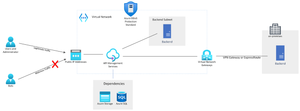
Azure DDoS Protection Standard provides enhanced DDoS mitigation features to defend against volumetric and protocol DDoS attacks, such as Adaptive real time tuning, always-on traffic monitoring, Azure DDoS Rapid Response support, cost protection telemetry, monitoring, and alerting. DDoS protection standard currently supports Public IPs in ARM based VNets such as Load Balancers, Bastion, Azure Firewall and Application Gateway. Now you can also protect your public IPs attached to VNet integrated Azure API Management (APIM) instances with Azure DDoS Protection Standard.11KViews5likes0Comments