.net core
83 Topics
What I Learned Contributing to .NET Runtime #135120 — Why More Developers Should Try Open Source
Contributing to the .NET Runtime was something I had wanted to try for a long time. Recently, I opened PR #135120 in the dotnet/runtime repository. https://github.com/dotnet/runtime/pull/135120 What surprised me most was not just the code change, but the engineering process behind making even a focused change in a large, production-grade open-source project. WHAT I LEARNED 1. Reading source code is a skill Before changing anything, I had to understand how the existing implementation worked and how the surrounding code was designed. 2. Tests tell a story Existing tests helped me understand the expected behavior and gave me confidence that the change was not breaking existing scenarios. 3. Small changes can require deep investigation A change that looks small from the outside can involve understanding implementation details, existing conventions, edge cases, and compatibility considerations. 4. Code review is part of the learning process A pull request is not simply code submitted for approval. It is an opportunity to learn from developers who know the codebase extremely well. 5. You do not have to be an expert before contributing This has probably been my biggest takeaway. I used to think I needed to understand the entire .NET Runtime before contributing to it. I don't. You can start with one problem, investigate it deeply, and learn along the way. MY QUESTION FOR THE .NET COMMUNITY For developers who have contributed to .NET, ASP.NET Core, EF Core, or other major open-source projects: What was your first contribution, and what did it teach you that you would not have learned from building your own applications? I would love to hear your experiences and advice for developers who are considering their first open-source contribution.19Views0likes0Comments
.NET 8.0.2 Update Causes ASP.NET Core MVC 'Index View Not Found' Error
Hello everyone, I recently updated to .NET https://github.com/dotnet/core/blob/main/release-notes/8.0/8.0.2/8.0.2.md?WT.mc_id=dotnet-35129-website and encountered an issue with my ASP.NET Core MVC application. After the update, the application began throwing an error related to the 'Index' view not being found. This issue was not present prior to the update. An unhandled exception has occurred while executing the request. System.InvalidOperationException: The view 'Index' was not found. The following locations were searched: /Views/Home/Index.cshtml /Views/Shared/Index.cshtml This error is generated by the Microsoft.AspNetCore.Diagnostics.DeveloperExceptionPageMiddleware and specifically indicates that the MVC framework is unable to locate the 'Index.cshtml' file in both the 'Home' and 'Shared' directories, where it traditionally searches for views. I've verified the existence of the 'Index.cshtml' file in the correct location and ensured that the routing configurations are set up correctly. This setup was working seamlessly before the update to .NET 8.0.2. Update: I was able to resolve this issue by uninstalling the .NET 8.0.2 updates. After reverting to the previous version, the application started working as expected without any errors. It appears that the .NET 8.0.2 update may have introduced a change or incompatibility affecting the way ASP.NET Core MVC applications locate views.36KViews3likes8CommentsEdm Model Generation Fails
Using an Azure ASP.NET MVC API from a Maui app, I am encountering the following error in the app when attempting to access the API. A few days ago, the initalization was working properly. The cloud app has been under further development, but the base api code has not been modified, only the response from the endpoints. The latest release NuGets are in use. What elements are being sought? System.TypeInitializationException: The type initializer for 'GeneratedEdmModel' threw an exception. ---> System.InvalidOperationException: Sequence contains no elements at System.Linq.ThrowHelper.ThrowNoElementsException() at System.Linq.Enumerable.First[TSource](IEnumerable`1 source) at SentryCloud.Models.Container.GeneratedEdmModel.CreateXmlReader()175Views0likes0CommentsDotnet core Oracle 23c SSL connection not working on Linux environment and works on Windows
Our data direct ADO.NET oracle driver is having an issue with SSL connection on Linux platform and the same connection is working on windows environment with Oracle23c server. Are there any known limitations with dotnet core on linux environment with SSL/TLS connections. Trace : InnerException: System.IO.IOException Message: Unable to read data from the transport connection: Connection reset by peer. Source: System.Net.Sockets Stack Trace at System.Net.Sockets.NetworkStream.Read(Span`1 buffer) at System.Net.Security.SslStream.EnsureFullTlsFrameAsync[TIOAdapter](TIOAdapter adapter) at System.Net.Security.SslStream.ReadAsyncInternal[TIOAdapter](TIOAdapter adapter, Memory`1 buffer) at System.Net.Security.SslStream.Read(Byte[] buffer, Int32 offset, Int32 count) The same application works on Windows environment.1KViews0likes4Comments
Trying to add new Type to Dotnet Runtime from github
Hi I'm trying to modify the .NET runtime from github.com/dotnet/runtime. I created a copy of the Dictionary class called Dictionary2 in these source code files: C:\rt5\src\libraries\System.Collections\ref\System.Collections.cs C:\rt5\src\libraries\System.Private.CoreLib\src\System\Collections\Generic\Dictionary.cs When I use dot peek from Jetbrains, Dictionary2 exists in my System.Collections.dll, but when I import System.Collections.dll in my main console C# application, Dictionary2 gives me compiler errors. Am, I missing some code somewhere? Can you guys help me out here? Thanks!361Views4likes2CommentsDo I need to upgrade Microsoft.AspNetCore.* NuGet packages after upgrading the .NET Runtime?
Hi, I'm encountering an issue with our SCA (Software Composition Analysis) scan, which reports several known vulnerabilities in .NET Core components. Specifically, the scan detects that the following packages are still on version 8.0.0, which are flagged as vulnerable: Microsoft.AspNetCore.Authorization Microsoft.AspNetCore.Components Microsoft.AspNetCore.Http.Connections.Client Microsoft.AspNetCore.SignalR.Client The scanner recommends upgrading these packages to version 8.0.15 to resolve the issues. To address this, I upgraded the .NET Runtime on our environment to version 8.0.15. However, the SCA scan still reports the same vulnerabilities, indicating that the vulnerable component versions have not changed. My question is: Do I also need to manually upgrade the corresponding NuGet package versions in the project to 8.0.15, or is upgrading the .NET Runtime alone sufficient to ensure these components are updated as well? Any clarification would be appreciated. Thank you!333Views0likes1Comment
[Suggestion 1][Allow Language Selection During .NET Installation]
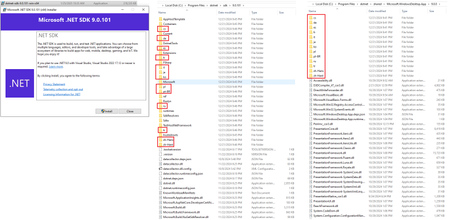
Hi, 1. Context: Currently, when installing the .NET SDK or runtime, multiple language resource folders are automatically included in the installation directory. 2. Problem: Many developers only require a single language, typically English and the additional localization files take up unnecessary disk space and clutter the installation directory. Currently, the installer does not provide an option to select which languages should be installed. Removing these manually is time-consuming and could potentially break application dependencies if done incorrectly. 3. Proposed Solution: Introduce an option in the .NET installer that allows users to select or deselect language packs during installation. This feature could be similar to the "Individual components" selection available in the Visual Studio Installer, where users can choose exactly what they need, ensuring a more streamlined installation. This would help: Reduce disk space usage. Improve installation customization. Provide a cleaner development environment. 4. What do you think about this suggestion ? Thank you for considering this request and I’m happy to provide additional details or insights if needed.334Views1like1CommentConnection between .NET and AUTOCAD ELECTRICAL
I want to connect .NET with Autocad Electrical . i am using , AutoCAD Electrical 2025.0.2 , Product Version : 22.0.81.0 , Built on: V.154.0.0 AutoCAD 2025.1.1 Visual Studio Community 2022 - 17.12.3 my system is x64 bit I am creating a console application in .NET 8.0 Runtime with C# language , Added dll accoremgd , acdbmgd, acmgd, Autodesk.AutoCAD.Interop . Also in .NET in Solution Explorer , in project references , i have made "Copy Local" property as False. using System; using Autodesk.AutoCAD.Interop; using Autodesk.AutoCAD.Runtime; using System.Runtime.InteropServices; using Autodesk.AutoCAD.ApplicationServices; namespace AutoCADElecDemo { class Program { static void Main(string[] args) { AcadApplication acadApp = null; const string progId = "AutoCAD.Application.25"; // Adjust for your AutoCAD version try { // Get a running instance of AutoCAD acadApp = GetActiveAutoCAD(progId); } catch (System.Exception ex) { Console.WriteLine($"Error initializing AutoCAD: {ex.Message}"); return; } try { // Ensure AutoCAD is visible acadApp.Visible = true; Console.WriteLine("AutoCAD is now running."); // Register for the BeginQuit event Application.BeginQuit += OnBeginQuit; // Keep the application running to monitor AutoCAD's state Console.WriteLine("Press Enter to exit..."); Console.ReadLine(); } catch (System.Exception ex) { Console.WriteLine($"An error occurred: {ex.Message}"); } finally { // Unregister the event handler before exiting Application.BeginQuit -= OnBeginQuit; } } static AcadApplication GetActiveAutoCAD(string progId) { try { var comObject = Marshal.GetActiveObject(progId); Console.WriteLine($"Connected to AutoCAD: {progId}"); return (AcadApplication)comObject; } catch (System.Exception ex) { Console.WriteLine($"Error accessing AutoCAD: {ex.Message}"); throw; } } static void OnBeginQuit(object sender, EventArgs e) { Console.WriteLine("AutoCAD is being closed."); } } } For above code, my application comes in break mode "Your app has entered a break state, but no code is currently executing that is supported by the selected debug engine (e.g. only native runtime code is executing)." and i am getting below error : System.IO.FileNotFoundException: 'Could not load file or assembly 'accoremgd, Version=25.0.0.0, Culture=neutral, PublicKeyToken=null' or one of its dependencies. The system cannot find the file specified.' dll path is also correct. i also tried same code with .NET Framework 4.7.2 and 4.8 targeting pack , but getting same error. How to load accoremgd.dll properly so that this application can use autocad accoremgd functions properly.470Views0likes2CommentsBest Way to Fill ACORD 23 Vehicle Insurance Certificates on Windows – Any Recommended Tools?
I frequently deal with insurance documentation and recently had to work with the ACORD 23 Vehicle Insurance Certificate. I’ve been using Windows 11 and was looking for the most efficient way to fill, edit, and save these forms digitally without printing them out. While browsing, I found AcordForm – it lets you view and understand various ACORD forms like the 23, 25, and more. It’s been helpful for referencing and understanding the format. However, I’d love some advice from the community: What’s the best Microsoft-supported tool for filling out ACORD PDF forms? Is Microsoft Edge’s PDF editor reliable enough, or should I be using Microsoft Word with PDF add-ins? Any integration tips with OneDrive or SharePoint for document storage?. Thanks in advance160Views0likes0Comments