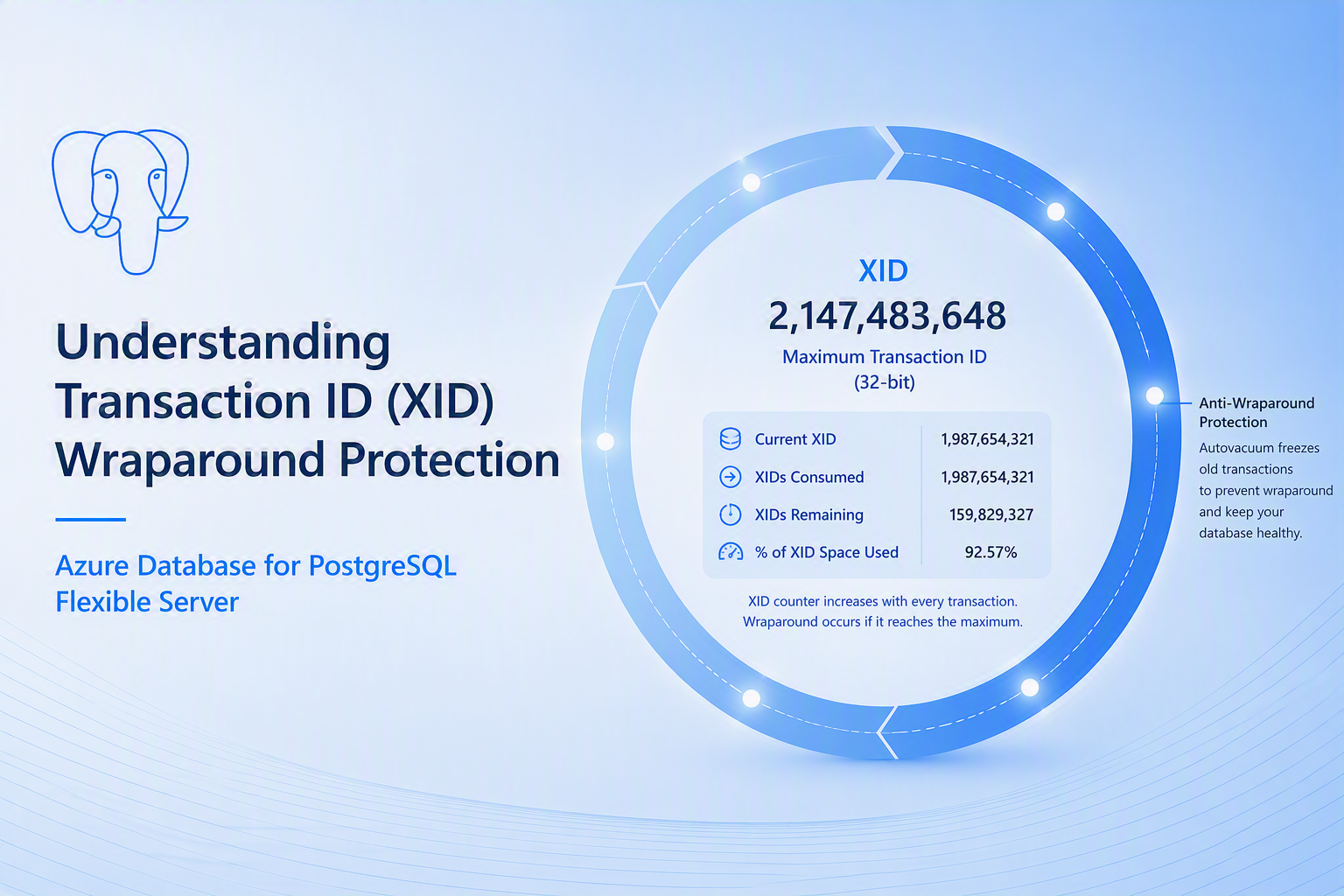
Why this topic?
Transaction wraparound is one of the most critical PostgreSQL issues because it can eventually cause the database to stop accepting write operations. Azure PostgreSQL flexible server includes autovacuum mechanisms and guidance to help prevent this situation
Introduction
PostgreSQL uses a Multi-Version Concurrency Control (MVCC) architecture to provide high concurrency and transaction isolation. Every transaction receives a unique Transaction ID (XID).
While this design enables excellent performance and consistency, XIDs are not unlimited. As a PostgreSQL server processes transactions over time, the transaction counter continues to increase. If older transaction IDs are not cleaned up through VACUUM operations, PostgreSQL can eventually encounter a transaction wraparound scenario.
When this happens, PostgreSQL may stop accepting write operations to prevent potential data corruption.
In Azure Database for PostgreSQL Flexible Server, understanding autovacuum and transaction ID management is essential for maintaining healthy databases and avoiding service disruptions.
What Is Transaction ID Wraparound?
Each transaction in PostgreSQL receives a 32-bit Transaction ID.
As transactions accumulate:
|
Transaction |
|
Transaction 1 |
|
Transaction 2 |
|
Transaction 3 |
|
... |
|
Transaction N |
The counter eventually reaches its maximum range and begins to wrap around.
If PostgreSQL cannot determine whether a transaction occurred before or after another transaction due to XID reuse, data visibility rules can break.
To prevent this situation, PostgreSQL relies on VACUUM operations to freeze older tuples.
How PostgreSQL Prevents Wraparound
VACUUM performs more than dead tuple cleanup.
It also:
- Advances relfrozenxid
- Freezes old tuples
- Prevents XID reuse issues
- Protects data visibility consistency
When tables become too old, PostgreSQL automatically triggers aggressive autovacuum operations known as: “Anti-Wraparound Autovacuum”.
These vacuum processes receive elevated priority because they protect the database from transaction ID exhaustion.
Common Symptoms
Server approaching wraparound conditions may observe:
database "mydb" must be vacuumed within XXXXX transactions
database is not accepting commands to avoid wraparound data loss
At this stage PostgreSQL enters a protection mode intended to prevent potential data integrity issues.
Identify Databases Approaching Wraparound
Run the following query:
SELECT datname, age(datfrozenxid) AS txid_age FROM pg_database
ORDER BY txid_age DESC;
Databases with the highest txid_age should be investigated first.
Calculate Remaining Transaction IDs
SELECT datname, age(datfrozenxid) AS txid_age, 2147483648 - 3000000 - age(datfrozenxid) AS remaining_xids FROM pg_database ORDER BY remaining_xids;The lowest remaining_xids value indicates the database closest to wraparound.
Find Tables Causing the Issue
SELECT c.relnamespace::regnamespace AS schema_name, c.relname, age(c.relfrozenxid) AS xid_age FROM pg_class c WHERE c.relkind='r' ORDER BY xid_age DESC;Tables with the highest XID age typically require urgent attention.
Common Autovacuum Blockers
- Long Running Transactions
Long-running transactions can prevent dead tuples from being removed.
SELECT pid, age(backend_xid) AS age_in_xids, now() - xact_start AS transaction_age, query
FROM pg_stat_activity WHERE backend_xid IS NOT NULL
ORDER BY age_in_xids DESC;
- Prepared Transactions
Prepared transactions may hold transaction horizons open.
SELECT * FROM pg_prepared_xacts;- Replication Slots
Unused replication slots can also delay cleanup.
SELECT slot_name, xmin FROM pg_replication_slots;Investigate slots with very old xmin values.
Monitoring Active Autovacuum Workers
SELECT pid, relid::regclass, phase, heap_blks_total, heap_blks_scanned
FROM pg_stat_progress_vacuum;
This view allows administrators to determine whether vacuum processes are progressing or blocked.
Flexible Server Best Practices
Enable Autovacuum
Never disable autovacuum globally.
Monitor Transaction Age
- XID age growth
- Autovacuum failures
- Long-running transactions
Tune Autovacuum
- Review below server parameters
- autovacuum_freeze_max_age
- autovacuum_max_workers
- autovacuum_vacuum_cost_limit
- autovacuum_vacuum_cost_delay
More details here
Investigate Azure Advisor Recommendations
Azure Advisor can provide guidance on:
- High database bloat
- Wraparound risk
- Vacuum-related maintenance concerns
More Details here
Conclusion
Transaction ID wraparound is one of the few PostgreSQL issues that can eventually bring a database to a read-only state if left unaddressed. Fortunately, PostgreSQL's autovacuum framework and Azure Database for PostgreSQL flexible server monitoring capabilities provide powerful tools for prevention.
By regularly monitoring transaction age, identifying vacuum blockers, and ensuring autovacuum keeps pace with workload growth, organizations can avoid wraparound emergencies and maintain healthy, performant databases.
References
https://learn.microsoft.com/azure/postgresql/troubleshoot/how-to-autovacuum-tuning

 Microsoft