Recent Discussions

Joining PC to domain breaks Windows
Hey all. We have a machine in our facility that is running Windows 10 IoT Enterprise LTSC 21H2, and for some reason whenever we try to add it to our domain, it breaks a few things. Windows Search no longer works, trying to run services.msc will accept the command but will take the box literally over 5 minutes just to open, takes other things longer to load than when not joined, sometimes it hangs up after rebooting when "applying computer settings" right before it logs in to where I have to unhook the network cable, etc. The first time we tried, we rebooted after joining domain and about 10 seconds into creating the new profile after it says "Hi", the entire screen went black. We waited and waited but nothing happened, so when we hit ctrl + alt + del, the screen came up, but if we hit task manager, it just goes black again and the cursor showed up. The only way I found around this was to ctrl + alt + del and log off, then log back in. After the first scare, we unjoined and waited until a later time when production was down. Second time seemed to yield the same results, but atleast that time we tried a few other things to see and it just wouldnt work. We unjoined and I started diving in a little more to see what I could do, and after googling and running through ChatGPT, it was finally determined to run an in-place repair install. Well last night I deleted everything regarding it out of AD including the computer, user, and the GPOs created for it and started from scratch. Joined to the domain and it had the same issues but I pushed through and then started the install. Once I got through, all of the issues were still there AND now when I tried to open the software, it was having a "EtherCAT subsystem not started" error. Spent hours referencing it to a similar machine just to find out that during that in-place install, it must have lost its assignment to one of the NICs, Nonetheless I finally got that fixed, but I want to know if anyone here has ever seen that before and if you have any suggestions for a fix? Ive done like....10-15 other machines in the past 3-4 months that have not had this problem, all with a mixture of Windows 10 AND Windows 11. Any advice?8Views0likes0CommentsDesign Advice: Building an IoT News/Social Media Ticker Screen (Storify News/RSS Aggregator)
Hello Community, I am working on an IoT hardware project aimed at building a standalone desktop display (or smart home gadget) that aggregates and streams live updates, news feeds, and social media summaries (similar to the concept of curated Storify News website stories). I want to implement this using a low-power microcontroller (like an ESP32 or a Raspberry Pi Pico W) paired with an e-Paper/e-Ink display to preserve battery life. I have a couple of hardware engineering questions: What are the best practices for power management and deep-sleep states when a device needs to wake up every 15–30 minutes via Wi-Fi to fetch text/JSON news payloads? Are there specific display driver ICs or e-ink modules that play most nicely with Azure IoT Hub or Azure Sphere if I want to scale this into a secure, managed device? I would love to hear any recommendations on component selection or power-saving schematics. Thanks!36Views1like2Comments
Microsoft rep insisting there is no Volume Licensing for Win IoT
Has anyone else ever had their Microsoft rep insist that the Windows IoT product can only be purchased with a new PC? We are trying to get the product SKU added to our Volume Licensing and this was Microsoft's response: "Windows IOT Enterprise LTSC cannot be added to volume licensing. Never has. Never will. It is an IOT OEM product only. I repeat it: the only option to obtain Windows IOT Enterprise LTSC is to purchase devices that have it pre-installed." Sharing links such as https://learn.microsoft.com/en-us/windows/iot/iot-enterprise/commercialization/licensing#volume-licensing and https://learn.microsoft.com/en-us/windows/iot/iot-enterprise/deployment/volume-license?pivots=windows11 is not changing their mind: "Public documentation can help interpret intent, but it cannot expand or override contractual usage rights under the MCA / Volume Licensing terms and the Windows IoT Enterprise EULA." So we're stuck having to revalidate our manufacturing fixtures every year or so, which is an incredibly expensive process. Has anyone else had Microsoft push back not against the use-case (ours should absolutely qualify) but the very notion that Volume Licensing is allowed at all?Solved170Views0likes5Comments
Can Admins Access IoT Edge Container Code Despite ACR Encryption?
If I deploy my Python application as an IoT Edge container, and the container is pulled from Azure Container Registry (which says all images are encrypted at rest), can someone with administrator access on the machine access the container and see my code?155Views0likes1Comment
Disable Windows Update in Windows 10 IoT Enterprise
I'm trying to disable the Windows Update service to stop it from running and downloading updates while our device is connected to the Internet. Our device is only connected on occasion and remains offline most of the time. I have tried multiple registry settings for the update service and related services, but as soon as it sees a connection they start back up. I found some group policy settings to stop update from automatically downloading and installing them. Is that the only way to keep updates from happening? Thanks, Josh538Views0likes4CommentsAnomalies IDs for Windows 10 IoT Enterprise LTSC 2021 for medical devices
Good day everyone, I am working in the medical device industry and we use Windows 10 IoT Enterprise LTSC 2021 as the operating system for our devices. To comply with medical device regulations, we need access to a comprehensive and tracked list of anomalies (bugs) with specific IDs for this version of the operating system. I have been unable to find this documentation on Microsoft's official website, but it is essential for: Completing software risk analysis Documenting known vulnerabilities as required by regulations (MDR, FDA, etc.) Maintaining the traceability required for certification processes We have regular licenses for the operating system and I would like to know: Is this documentation available for Windows 10 IoT Enterprise LTSC 2021 license holders? Is there a specific channel (OEM Partner Program, Commercial Support, or other) through which we can access this information? Is there a dedicated process for medical device manufacturers to obtain this documentation? Any guidance on how to proceed would be greatly appreciated. Thank you in advance for your support!199Views0likes2Comments 288Views0likes0Comments
Zigbee Dongle vs. Dedicated Gateway for Azure IoT: An Architecture Choice
Hello Azure IoT Community, I'm deep into the architecture phase of a large-scale smart building project, using Azure IoT Hub as our central command. We're incorporating numerous Zigbee-based sensors and actuators for energy and environment monitoring. A critical debate has emerged: should we rely on a centralized Zigbee USB dongle, or deploy distributed, dedicated Zigbee gateways like the OWON SEG-X5? This decision impacts system resilience, cloud integration efficiency, and long-term operational stability. The Core Trade-off: Simplicity vs. Resilience Option A: The Centralized Dongle Approach This model uses a USB dongle connected to a gateway server, which becomes the sole coordinator for the Zigbee network before relaying data to IoT Hub. The Appeal: Low initial cost and simplicity for prototyping. The Scalability Risk: This creates a Single Point of Failure (SPOF). If the host server needs maintenance or encounters an issue, the entire Zigbee network—and all dependent automations—go offline. For a commercial building, this is a critical operational risk. Option B: The Distributed Gateway Architecture This model employs dedicated, standalone Zigbee gateways (e.g., https://www.owon-smart.com/zigbee-gateway-zigbeeethernetble-seg-x5-product/) deployed across different zones or floors. Each forms its own robust mesh and connects directly to Azure IoT Hub. The Resilience Gain: Faults are isolated. One gateway’s maintenance affects only its zone. The Edge Intelligence Advantage: Modern gateways can process data and execute rules locally. For instance, a gateway can directly process inputs from a Zigbee Door/Window Sensor (DWS 312) and a Multi-Sensor (PIR 323) to trigger a local light switch, all without a round-trip to the cloud. This aligns perfectly with the Azure IoT Edge paradigm, ensuring responsiveness and offline operation. Streamlined Cloud Integration: Gateways like the SEG-X5 come with integrated MQTT API support, allowing them to send structured data directly to IoT Hub, simplifying device management and message routing in the cloud. A Practical Insight from an ODM Case Study Our experience as an IoT ODM manufacturer has shown this shift in practice. In a project akin to the Hotel Room Management case in our portfolio, the initial design using a central server with dongles presented reliability concerns. The final solution utilized distributed OWON SEG-X5 Zigbee Gateways in each hotel wing. These gateways managed all in-room devices—from Smart Sockets (WSP 406 series) and Light Switches (SLC series) to Thermostats (PCT 504)—locally. They used their MQTT API to send consolidated occupancy and energy data to the building's cloud platform (integrated with IoT Hub). The result was a system where guest room automation remained functional despite network fluctuations, and maintenance could be performed per wing without building-wide impact. Conclusion and Discussion For proof-of-concepts, dongles are sufficient. For production-grade, scalable deployments where uptime is critical, dedicated gateways provide the necessary architectural foundation. I'm keen to hear from the community: In your Azure IoT solutions, how have you integrated non-IP protocol devices like Zigbee? What strategies do you employ to balance edge processing with cloud analytics? For those using gateway architectures, how do you handle device provisioning and security at scale? If you're interested in the technical specifics of how Zigbee gateways interface with cloud platforms, including API structures and network design considerations, we've elaborated on these topics in a technical overview on our site: [https://www.owon-smart.com/news/zigbee-dongles-vs-gateways-how-to-choose-the-right-network-coordinator/ ]. Looking forward to a fruitful discussion.123Views0likes0Comments
Module identity fetch issue
I have registered an edge device[gateway] to Azure IoTHub using x509 self signed certificate. The device got registered fine and modules [edgeAgent,edgeHub] got deployed along with some custom edge modules- with deployment status 200, device and modules status reporting. The modules are running on the edge device but the modules keep restarting as they couldnt authenticate. edge Device registration is through x509 self signed certificate, with below properties in config.toml # Manual provisioning with x.509 certificates [provisioning] source = "manual" iothub_hostname = "REQUIRED_IOTHUB_HOSTNAME" device_id = "REQUIRED_DEVICE_ID_PROVISIONED_IN_IOTHUB" [provisioning.authentication] method = "x509" identity_cert = "REQUIRED_URI_OR_POINTER_TO_DEVICE_IDENTITY_CERTIFICATE" identity_pk = "REQUIRED_URI_TO_DEVICE_IDENTITY_PRIVATE_KEY" Logs from edgeHub: [INF] - Unable to authenticate client <deviceid>/<custom_edge_module> with cached service identity <deviceid>/<custom_edge_module> (Found: False). Resyncing service identity... <4> 2025-09-19 00:29:56.415 +00:00 [WRN] - Error while refreshing the service identity: <deviceid>/<custom_edge_module> OnBehalfOf: <deviceid> System.Collections.Generic.KeyNotFoundException: The given key '<deviceid>/<custom_edge_module>' was not present in the dictionary. at Microsoft.Azure.Devices.Edge.Hub.Core.DeviceScopeIdentitiesCache.RefreshServiceIdentityInternal(String refreshTarget, String onBehalfOfDevice, Boolean invokeServiceIdentitiesUpdated) in /mnt/vss/_work/1/s/edge-hub/core/src/Microsoft.Azure.Devices.Edge.Hub.Core/DeviceScopeIdentitiesCache.cs:line 187 device twin status: "deviceScope": "ms-azure-iot-edge://<devicescope>", "modelId": "", "status": "enabled", "statusUpdateTime": "0001-01-01T00:00:00.0000000Z", "lastActivityTime": "2025-09-19T00:47:10.0840495Z", "connectionState": "Connected", "cloudToDeviceMessageCount": 0, "authenticationType": "selfSigned", "x509Thumbprint": { "PrimaryThumbprint": "<thumbprint>" } Module identity twin of edgeHub: "modelId": "", "status": "enabled", "statusUpdateTime": "0001-01-01T00:00:00.0000000Z", "lastActivityTime": "2025-09-19T00:42:23.4967322Z", "connectionState": "Connected", "cloudToDeviceMessageCount": 0, "authenticationType": "sas", "x509Thumbprint": {} module identity twin of edgeAgent and other modules: "modelId": "", "status": "enabled", "statusUpdateTime": "0001-01-01T00:00:00.0000000Z", "lastActivityTime": "2025-09-19T00:54:15.6085296Z", "connectionState": "Disconnected", "cloudToDeviceMessageCount": 0, "authenticationType": "sas", "x509Thumbprint": {} The modules couldnt communicate to hub as they couldnt authenticate, where as the same modules works fine when the edge device is registered via shared access signature and send telemetry to iot hub. Please let me know where could the issue be for modules not able to communicate with iotHub129Views0likes0CommentsNetx Duo Question - NX_TCP_SOCKET and BSD fd_sets Functionality
Hi, I hope this is the correct place to ask this question. I'm looking at porting an existing application across to Duo, this app uses WEBSOCKETS/TLS/TCP within a BSD socket and makes use of the BSD fd_sets mechanism to detect receive data, ability to send data and loss of connection, sending multiple messages over a single socket. Using the Duo API's I need to use the NX_TCP_SOCKET based APIs, to gain WEBSOCKETS/TLS functionality but so far, I haven't spotted a bsd_fd_set equivalent mechanism for this socket type. Is there a similar feature available? The examples I've found don't persist a socket across multiple messages so don't need that feature. Any help/information on this appreciated. Many Thanks Wayne324Views1like1CommentConnecting PLC to Azure IoT Hub
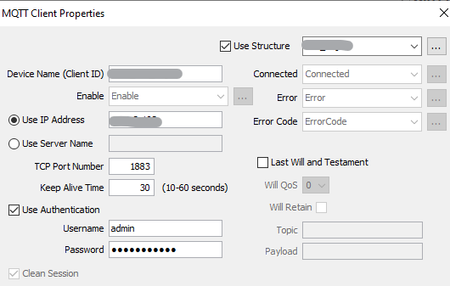
We have a client with an Automation Direct Productivity 3000 PLC. Looks like it has an MQTT client configuration that may allow us to connect directly to Azure IoT Hub, but we are struggling. We're waiting for the client to get a vendor resource to assist. Meanwhile. we're trying to figure out if that will work directly, or if we need something like IoT Edge to act as a protocol translator. Unsure if the device is able to utilize TLS 1.2 or not. The config screen looks like this (please ignore current settings): Do we need to use something like IoT Edge to convert the MQTT to use TLS? Any other advice for getting this up and running? Thank you, -Peter925Views0likes1CommentAll Azure IoT Central Applications completly broken
Dear community, I have big trouble regarding all Azure IoT Applications, which haven't been properly rendering since a couple of hours. Every link is broken and no data is shown as seen the screenshot below. We already tested different browser different tentants different computers No difference. Can anyone point out the reason for that or experiences similar issues right now? Best, Andy192Views3likes0Comments- 264Views0likes1Comment
Sensor to AZURE IoT Hub to ADLS to Power BI
Discovery & Resolution ? By creating this workflow, I found the following: Device sensor firmware published data once every 30 seconds. AZURE IoT Hub routed this data to ADL BLOB as JSON once every 2 minutes. Power BI Power Query failed to interpret JSON files. "extra characters at end of JSON input". The PBI PQ error occurred because each BLOB file contained four individual JSON expressions - one for each device sensor publication. This can be resolved by reformatting each JSON file as a single document by bracketing all four expressions as one […] and adding a comma to the end of the first three. It works, but it's sloppy. I did it manually. A simpler resolution is to synchronize timing of device sensor publications with IoT Hub routing to ADL BLOB so that each file contains only a single JSON expression. In other words, by publishing and routing to ADL at the same frequency - only one publication / JSON expression is contained per file. This avoids the PBI PQ failure, but I have doubts about its scalability. Do any of you have a better suggestion? Is it possible to configure the IoT Hub to wrap multiple JSON expressions as a single JSON document for routing to ADLS?135Views0likes0CommentsEdge Module Authentication
Hi Folks, I've made my first IoT Edge Module (container), its just based off: FROM ubuntu:oracular For now, but it seems to start up and run correctly. I've pushed the container into ACR and added it to my manifest which pushed it down to my edge gateway and its up and running. So far so good. Now, I want my application in that container to publish events to the edgeHub, and subscribe to properties set in IoT Central. I followed some of the guides, but have had no luck. Firstly - not much love for a rust application, but aside from that, I've resorted to jumping into the container and trying to use the mosquitto clients likes so: $ docker exec -ti <module_id> bash # mosquitto_sub -d \ -V mqttv311 \ -h edgeHub \ -p 8883 \ -i "${IOTEDGE_DEVICEID}/${IOTEDGE_MODULEID}" \ -u "${IOTEDGE_IOTHUBHOSTNAME}/${IOTEDGE_DEVICEID}/${IOTEDGE_MODULEID}/?api-version=2018-06-30" \ -P "${SAS_TOKEN}" \ -t "devices/${IOTEDGE_DEVICEID}/modules/${IOTEDGE_MODULEID}/messages/events" \ --cafile /etc/ssl/certs/IoTHubRootCA.pem \ -q 1 Client <device_id>/<module_id> sending CONNECT OpenSSL Error[0]: error:0A000086:SSL routines::certificate verify failed Error: Protocol error I just cant get it to validate the certs in the edgeHub. If I look at the edgeHub container it shows: $ docker logs -f edgeHub <4> 2025-06-30 06:52:23.276 +00:00 [WRN] - "TLS handshake failed., System.AggregateException: One or more errors occurred. (Authentication failed, see inner exception.)\n ---> System.Security.Authentication.AuthenticationException: Authentication failed, see inner exception.\n ---> Interop+OpenSsl+SslException: SSL Handshake failed with OpenSSL error - SSL_ERROR_SSL.\n ---> Interop+Crypto+OpenSslCryptographicException: error:0A000418:SSL routines::tlsv1 alert unknown ca\n --- End of inner exception stack trace ---\n at Interop.OpenSsl.DoSslHandshake(SafeSslHandle context, ReadOnlySpan`1 input, Byte[]& sendBuf, Int32& sendCount)\n at System.Net.Security.SslStreamPal.HandshakeInternal(SafeDeleteSslContext& context, ReadOnlySpan`1 inputBuffer, Byte[]& outputBuffer, SslAuthenticationOptions sslAuthenticationOptions)\n --- End of inner exception stack trace ---\n at System.Net.Security.SslStream.ForceAuthenticationAsync[TIOAdapter](Boolean receiveFirst, Byte[] reAuthenticationData, CancellationToken cancellationToken)\n --- End of inner exception stack trace ---, 0af563ac" That error suggests the edgeHub does not like the CA in my module ? I'm looking for any references to get the right CA's setup so that my translation app can publish events to the edgeHub container.201Views1like0CommentsAnomalies IDs for Windows 10 IoT Enterprise LTSC 2021 for medical devices
I am working in the medical device industry and we use Windows 10 IoT Enterprise LTSC 2021 as the operating system for our devices. To comply with medical device regulations, we need access to a comprehensive and tracked list of anomalies (bugs) with specific IDs for this version of the operating system. I have been unable to find this documentation on Microsoft's official website, but it is essential for: Completing software risk analysis Documenting known vulnerabilities as required by regulations (MDR, FDA, etc.) Maintaining the traceability required for certification processes We have regular licenses for the operating system and I would like to know: Is this documentation available for Windows 10 IoT Enterprise LTSC 2021 license holders? Is there a specific channel (OEM Partner Program, Commercial Support, or other) through which we can access this information? Is there a dedicated process for medical device manufacturers to obtain this documentation? Any guidance on how to proceed would be greatly appreciated. Thank you in advance for your support!189Views0likes0Comments
Need help with updating disconnected devices
hey, I am new to azure and IOT and I need help with knowing how to do this. The scenario is that: I have a set of Linux devices that can't be connected to the internet ever, these devices should be connected to another device (will have internet) which will act as parent to all these disconnected devices. The challenge is to update these child devices using Azure IOT, the updates will be deployed in the hub, and it has to passed to child devices via parent device and automatically needs to be installed in the child devices. The parent might not require this update or might. How will I do this? also I can't use any scripting mechanisms. Now when I surfed a bit through azure documentation, I found out that I can use device update for this, What I found was: 1) setup every device in IOT hub 2)set the device with internet as parent and others a child 3)set up MCC module in parent 4)Connect the devices physically (Lan or Wi-Fi) 5)Roll out updates Now I don't know whether this is true or not, it's just my understanding. I am having few doubts: 1)do we also add the child devices (disconnected devices in IOT hub), if yes what if we have 1000 devices? (I'm asking about scalability) 2)How do I actually physically connect the parent and child devices, do I just plug in Lan/Wi-Fi, or do I have to do anything else? 3)How to add MCC Module? 4)how does this actually works? is it feasible?161Views0likes0CommentsDesigning and developing for Unified Namespaces
I apologize if I am posting in the incorrect community. I would like to know if anyone has developed a Unified Namespace architecture and solution within Azure for IIOT without using third-party middleware such as ignition, high-byte, or HiveMQ. I am currently looking to use Azure IOT and ADF and Dynamics 365 as the ERP and MES.147Views0likes0CommentsIOT Central data export destination on waiting
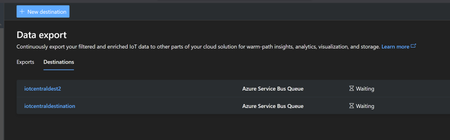
Hello. I have successfully created a demo sensor in iot central and now I would like to connect it to my service bus queue. I went to data export tab and create a new destination using the connection strings of my queue, it seemed ok but the destination is on "waiting" state since 10 hours. Is it normal? Can I check anything? Thanks Gianpaolo163Views0likes0CommentsRouting on IOT Edge
Hi, I have a problem that I have been dealing with for quite some time. Trying to put a "where" in a routing for AZIOT edge hub. have tested this which works. FROM /messages/* WHERE $connectionModuleId = 'noded' INTO BrokeredEndpoint("/modules/testjob/inputs/edgehub") . But what I want to do is a "where" against appProperties. I have tried every conceivable "syntax" for this?? Inserts an example message. { "message": { "systemProperties": { "contentType": "application/json", "contentEncoding": "UTF-8", "iothub-message-source": "deviceMessages", "iothub-enqueuedtime": "2017-05-08T18:55:31.8514657Z" }, "appProperties": { "processingPath": "{cold | warm | hot}", "verbose": "{true, false}", "severity": 1-5, "testDevice": "{true | false}" }, "body": "{\"Weather\":{\"Temperature\":50}}" } } Thanks for any help I can get. Can't find any documentation for this?322Views0likes1Comment



Events
Recent Blogs
- Keeping IoT fleets secure and up to date shouldn't mean shipping the full software image to every device, every time. With delta updates in Azure Device Update for IoT Hub, fleet operators can send o...Jun 08, 2026112Views1like0Comments
- Azure Sphere OS version 26.06 is now available in the Retail feed. This release includes updates to both the Azure Sphere OS and SDK. If your devices are connected to the internet, they will receive ...Jun 02, 202656Views0likes0Comments