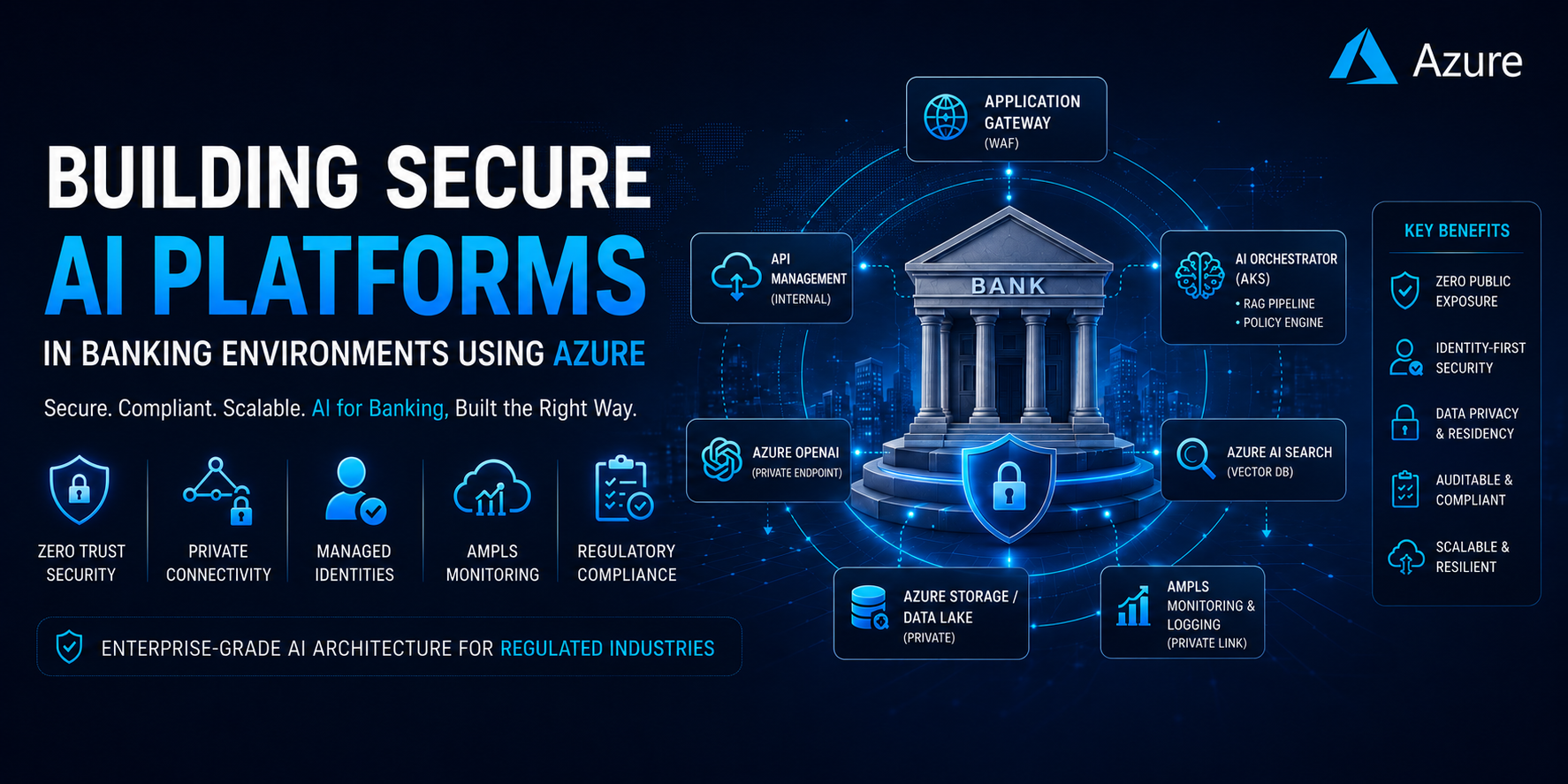
How do enterprise systems stay secure at scale? Enterprise Architecture, Security & Real-World Design
1. Introduction: AI in Banking Is Not Just a Model Problem
Modern banking institutions are no longer asking “Can we use AI?”
The real question is:
“Can we use AI without violating regulatory, security, and data residency constraints?”
Unlike public AI applications, banking systems must ensure:
- No public internet exposure
- Strict identity-based access control
- End-to-end auditability
- Data residency compliance
- Fully controlled inference pipelines
👉 In enterprise environments, AI success is driven by secure infrastructure—not just model accuracy.
2. Core Design Principle: Controlled Intelligence System
Every AI request must follow a security-enforced execution pipeline:
User Request
   ↓
Secure Edge (Application Gateway + WAF)
   ↓
API Governance Layer (API Management - Internal Mode)
   ↓
AI Orchestration Layer (AKS / App Services)
   ↓
Retrieval + Policy Layer (RAG + Guardrails)
   ↓
Private AI Services (Azure OpenAI)
   ↓
Observability Layer (AMPLS)
   ↓
Final Response
Key Insight:
This is not just an architecture—it is a controlled and auditable execution model.
3. Azure Enterprise AI Architecture (Production-Ready Pattern)
A real-world architecture used in banking environments:
4. Private Connectivity Model (Critical for Compliance)
Key components:
- Private Endpoints → Secure PaaS isolation
- Private DNS Zones → Controlled name resolution
- VNet Integration → Internal service communication
- Azure Firewall → Traffic inspection and control
⚠️ Common Production Failure:
- AKS pods fail to resolve Azure OpenAI private endpoint
- Root cause:
- Missing Private DNS links
- Incorrect VNet configuration
👉 This is one of the most frequent failures in enterprise AI deployments.
“Debugging Private Endpoint Failures”
Include:
- nslookup behavior in AKS
- DNS zone linking check
- VNet integration validation
- UDR / Firewall inspection
5. Identity-First Security Model (No Secrets Architecture)
Modern banking architectures eliminate static credentials entirely.
Authentication Flow:
AKS Workload → Managed Identity → Azure AD → Azure ServicesKey Principle:
👉 Identity is the new security perimeter.
Benefits:
- No API keys or secrets
- Simplified access management
- RBAC-based governance
- Fully auditable access
6. Secure AI Inference Pipeline
A production AI request flow:
def process_request(user_request):
    # 1. Authenticate user via Azure AD
    identity = authenticate_aad(user_request.token)
    if not identity or not identity.is_valid:
        return "ACCESS_DENIED"
    # 2. Enforce rate limiting per identity
    if not rate_limit(identity):
        return "RATE_LIMIT_EXCEEDED"
    # 3. Apply prompt security guardrails (injection protection)
    safe_prompt = apply_prompt_guardrails(user_request.prompt)
    # 4. Content safety filtering (PII / harmful content detection)
    if not content_filter(safe_prompt):
        return "CONTENT_BLOCKED"
    # 5. Retrieve secure RAG context
    context = retrieve_rag_context(
        query=safe_prompt,
        secure_mode=True
    )
    # 6. Build final prompt
    final_prompt = merge_prompt_and_context(safe_prompt, context)
    # 7. Call Azure OpenAI with circuit breaker protection
    response = circuit_breaker(
        lambda: call_openai(
            prompt=final_prompt,
            identity=ManagedIdentity()
        )
    )
    # 8. Validate and sanitize model output
    validated_output = sanitize(response)
    # 9. Log everything for audit + compliance (AMPLS / SIEM)
    log_to_ampls(
        identity=identity,
        request=user_request,
        response=validated_output
    )
    return validated_output
Security controls include:
- Prompt injection filtering
- Context grounding (RAG)
- Output sanitization
- Full audit logging
7. RAG Architecture: Enterprise AI Backbone
User Query → Embedding Model → Azure AI Search (Vector Store) → Context Retrieval → Azure OpenAI → Final ResponseWhy RAG is preferred in banking:
- No model retraining required
- Controlled data exposure
- Easier compliance validation
- Real-time knowledge updates
In banking systems, retrieval is not just about relevance—it is about controlled disclosure of sensitive context
8. Observability with AMPLS (A Critical Yet Overlooked Layer)
AI telemetry flows through:
Azure Services → Private Link → AMPLS → Log Analytics / App InsightsWhy this matters: Logs may contain:
- Sensitive financial data
- PII
- Prompt inputs
👉 AMPLS ensures telemetry remains private and compliant.
9. Regulatory Mapping: Banking Requirements to Azure Capabilities
| Requirement | Azure Implementation |
|---|---|
| No public exposure | Private Endpoints |
| Identity-based security | Azure AD + Managed Identity |
| Audit compliance | Log Analytics + AMPLS |
| Data protection | Customer-Managed Keys (CMK) |
| Network isolation | VNet + Firewall |
| Access governance | RBAC + PIM |
10. Real-World Production Challenges
Common failure points in enterprise AI systems:
- DNS Misconfiguration – Private endpoints fail resolution
- Latency Chains – Excessive service hops
- OpenAI Rate Limits – High enterprise load
- Identity Propagation Issues – Cross-subscription failures
- Observability Gaps – Missing distributed tracing
11. Enterprise Architecture Best Practices
- Design with zero-trust principles
- Treat AI as a distributed system, not a single component
- Centralize governance using API Management
- Never expose AI services publicly
- Use identity everywhere—no secrets
- Separate:
- Control Plane (governance)
- Data Plane (inference execution)
12. Azure Service Mapping (Quick Reference)
| Layer | Azure Services |
|---|---|
| Edge Security | Application Gateway (WAF) |
| API Layer | API Management |
| Compute | AKS / App Services |
| AI Services | Azure OpenAI |
| Retrieval | Azure AI Search |
| Data | Azure Storage / SQL |
| Identity | Azure AD + Managed Identity |
| Networking | Private Link + VNet |
| Observability | AMPLS + Log Analytics |
13. Common Failure Patterns
| Issue | Root Cause |
|---|---|
| AI endpoint unreachable | DNS / Private endpoint misconfig |
| Data leakage risk | Missing prompt filtering |
| High latency | Over-layered architecture |
| Unauthorized access | Identity misconfiguration |
| Poor response quality | Weak RAG implementation |
14. Final Thought
In enterprise banking AI systems:
Models are replaceable. Architecture is not.
The real challenge is designing a system where AI is:
- Secure
- Controlled
- Observable
- Fully compliant

 Microsoft