Forum Discussion

Discussion - Updating our interface with Fluent touches
- Jul 14, 2020
Thank you so much for all your feedback on the overall design of the new version of Edge, as it is invaluable to our getting the experience right. A common thread through this feedback has been a lot of discussion about the definition of “Fluent” design, and how it should apply to Microsoft products, so we wanted to share an update to provide some clarity. As opposed to a specific or static set of design rules, Fluent is intended to be an ever-evolving design system across Microsoft products. As the world around us continues to evolve, including devices, interaction models, user habits and expectations, the Microsoft design system must also evolve to meet the changing needs of our users. This means Fluent will not necessarily always represent everything that it did several years ago when the look and feel of the legacy version of Edge was first developed. You can learn more about the current direction of Fluent by visiting the Fluent Design System Page, which provides a summary of the design system as a whole, as well as how it applies to different platforms, applications and controls across Microsoft.
If you browse through the Fluent guidance at the link above, you’ll note that the new version of Edge is aligned with the current direction Fluent is going, and we will continue to evolve along with the design system and Microsoft as a whole. While Edge may be one of the first to put some of these new Fluent elements into practice, you will continue to see other products across the company update to reflect this direction as well. For example, you’ll notice that the latest Fluent designs are characterized by rounded corners across objects and controls, and the new version of Edge is consistent with that guidance. Another example is that there isn't a pivotal focus on transparency in the latest Fluent designs, and surfaces of the new version of Edge reflects this.
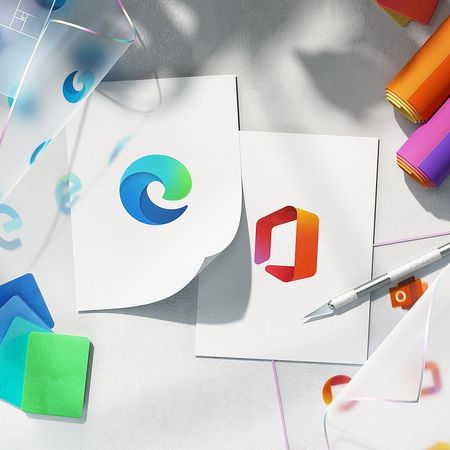
This is not to say we will never consider incorporating such aspects into our designs going forward, or perhaps offering options to customize the look and feel, but there are no plans to incorporate these elements into the default experience for all users at this time. However, there are other design investments on our roadmap to continue aligning with the broader Fluent direction, such as updating icons and illustrations across the product. Please continue to send your feedback on the overall Edge look and feel, including preferences and pain points, as we are always open to learning more and updating our direction based on the needs of our users.
- The Microsoft Edge Team


1 - I absolutely want to all Microsoft software follow the fluent design (Edge, code etc).
2 - I thing the first thing you have to follow is the theme of the OS himself, you are a Microsoft product so it's normal for edge to have a design who is in total match with Windows 10 (sorry mac and linux but it's the truth)
But i will finish on this, majority of your user are user who :
1 - Hate Google (my case)
2 - Use All your other services so it's normal they use edge
3 - Want to have something different than chrome (my case).
So i will ask you Please don't listen to those who want another copy paste of chrome and have your own identity as a browser.

Wittycat, I share your anti-Google perspective, but with Chrome at 75% - 80% market share, for Edge to gain users, it needs to attract existing Chrome users. Even if Edge took 100% of Firefox and Opera users, which it won't (because many of those users are passionate supporters of the browser they use and won't change), Edge would still be only a minority player in the browser space if it can't attract a large portion of Chrome users. This means it needs to appeal to people who are, at a minimum, most familiar with Chrome and don't hate Google as their reason for choosing a browser.
 jdr_lzvDec 20, 2020Brass Contributor
GraniteStateColin So are you suggesting that you just want to be a Chrome clone? Actually, it looks like the goal is to be a "prettier" Chrome. Why not try to be better? Why not aim higher? I don't think just being prettier is going to draw many away from Chrome. Forget Chrome, do what is BEST for Microsoft Office! Focus on a better fit for other Microsoft products.
- HotCakeXDec 20, 2020MVPThere is no official word saying that Edge is going to be like Chrome. so far the evidence shows that Edge is taking all the good things Chrome has and also has added lots of features that are exclusive to Edge only.
- pneenkoalabearDec 21, 2020Steel ContributorBut the whole point of Edge switching to Chromium was to have a browser that required less development and maintenance. I don't think it'll get any more features even though I wish I could replace some of my extensions with functionality built into Edge. It doesn't look like Edge will diverge much more.
- jdr_lzvNov 07, 2020Brass Contributor
GraniteStateColinSo why not focus EDGE on user Configuration and Flexibility. If you are just making a prettier Chrome, you are offering NOTHING to me. Include a standard Microsoft file-menu bar (like in every other Office program) and I will use Edge in a heartbeat. You don't have to make it where EVERYONE has to use the file-menu bar, you could make it an option. OPTIONS!!!! I, and very many people I know and work with, have at least two giant monitors on my desktop computer. Why does my browser have to conform to a cell-phone size screen?????????? OPTIONS!!!! Why it that so hard for Microsoft to grasp!!! Why does Microsoft insist that everyone and I mean EVERYONE in computer land is exactly the same?? It is also what Google does. Why not be BETTER than Google? Or at least try?????? Are programmers capable of making an optional standard Microsoft Menu bar really so hard to find???????????????????????????? Good grief. Do Microsoft Edge designers/managers never look outside of their own desires? Do none of them use other Microsoft products? Do none of them ever use a desktop computer? Someone should inform them that there are MILLIONS of desktop computers out there--why completely abandon all of them to produce browsers for cell phones? Yes produce something for cell phones but don't abandon desktops. OPTIONS!!!!! I assume it comes down to management by narrow minded internally focused people with no knowledge or desire to know what users want/need. Their view is the only view. Even Apple is returning to smaller screen iPhones.
- WittycatNov 07, 2020Steel Contributor
jdr_lzv oh yes it's true too, it would be nice too to have an universal menu, but it's more in the windows commentary hub, to ask this improvement, and when (if) they do it, after ask edge to implement it.
On the other hand they maybe already have this function in head, but want to attract user and after update after update modify little by little the interfaces.
But in my case i will ask first integration with windows 10 and after an interface who is more like Microsoft and not like Google
- GraniteStateColinNov 07, 2020Steel Contributor
jdr_lzv, I have nothing against options, unless they mar the UX with added complexity for all users or bog down development, which they often do. Keep in mind that EVERY SINGLE OPTION needs to be tested and maintained with each new change to the browser. That means the more options, the slower overall development of new features. Given a choice between options and features, I'll usually choose features.
Recent new features I value and wouldn't want to live without include: Collections (not so new now), Inking on web pages (still not back to what we had in Legacy Edge, but getting there), Open/Run directly from file link (w/o having to save it first), Profiles (critical to supporting multiple work clients and keeping my personal stuff in its own account), Syncing by profile. Also, not quite there yet, but pretty sure I'm going to become addicted to the new Vertical Tabs -- those really shine on a larger monitor.
To your point on screen size, I use a laptop, a cell phone (recently switched to the Microsoft Surface Duo dual screen phone), and a desktop computer with 3 monitors (all different sizes), including the main one a 40" 4k screen. I use Edge as my main browser on all of them. I strongly agree with the importance of the browser working at all sizes. As far as I'm concerned it does. I don't think I've ever thought, "Edge doesn't work on my desktop/laptop, so I'm going to switch to Chrome or Firefox." On the contrary, I prefer Edge to both of those on my larger monitors. MS is clearly thinking about bigger screens, or Collections and Vertical Tabs wouldn't be on their feature list at all.
I don't see any specifics in your feedback here for what you'd like MS to do differently. Are you just asking for the return of a menu bar, like we had in IE? Very few programs still use menu bars...
- jdr_lzvNov 08, 2020Brass Contributor
GraniteStateColinHi Colin, no question you have good points. And yes, in part I'd like to see a standard MS Office type menu bar. However, I'm not sure I understand your comment "Very few programs still use menu bars..." I look at the software I on my computer from many sources and most use menu bars. The list is long--MS Office programs (Word, Excel, PowerPoint, Outlook, OneNote etc, but also statistical software (SAS), Google Earth, several file management programs, multiple back up programs, a bunch of games, my antivirus software, my computer optimization software, several photo editing programs, my address book software, my scanning programs, my accounting software, my pdf editing software, my drawing software, blu-ray burning software, tax software, my graphing package, my database manager., and on and on and on. The advantage of an standard menu system is that I can pretty much figure out the program and find options/solutions just because the interfaces are similarly organized. I just don't understand, why not make a browser with at least the option to have the same menu system as so many, many other programs. I've tried Edge and Chrome (and some other browsers), nothing I see in their interface offers any significant advantage over traditional IE. It is just different. I don't really need different. Maybe others do, which is great--just give some options to those of us that don't need different. I suppose you are going to tell me that the next generation of all these programs are going to do away with menu bars and any semblance of operational similarity. I guess I need to learn the Chrome interface so I will know how to use future versions of Word and Excel. Unless of course, Microsoft decides that they don't want Word and Excel to have the same interface as each other and certainly not with the Microsoft's browser. As someone else suggested, maybe Google and the Microsoft's Edge team can get into auto design next.
