Blog Post
Announcing Native NVMe in Windows Server 2025: Ushering in a New Era of Storage Performance
I don't understand this post. Windows had native NVMe support since Windows 8.1 (and Windows 7 with a patch applied). Since Windows Server is based on the same codebase, Windows Server 2008R2/2012R2 onwards had support too. I can install Windows 11/Windows Server 2025 on a NVMe drive today and get full speed no problem.
Can someone explain this for me? Is that any different than what we already have today? I'm lost...
- RozinhaKDec 21, 2025Copper Contributor
It supports, but is not native; it's like a translation layer from NVMe to SCSI.
For example, if you search for 'Device Manager' in the Windows Start menu (Or Windows + X>Device Manager) and open 'Storage Controllers' or 'Disk Drive', then go to 'Details' > 'Driver Class', the 'Value' will appear as 'SCSI Adapter'.
On the other hand, if Win 11/Server has the 'fix' for NVMe enabled, it will appear as 'NVMe Disk'.
- Kevin256Dec 21, 2025Copper Contributor
Oh, got it! I appreciate your explanation, RozinhaK.
Knowing that makes me wonder why MS wouldn't implement NVMe support properly when it debuted on the OS 12 years ago. This company relies too much on legacy tech, even when it could start on the right track from the beginning. Sad!
- Squall_LeonhartDec 21, 2025Copper Contributor
msahci and stornvme implement sata and nvme command sets as SCSI rather than native.
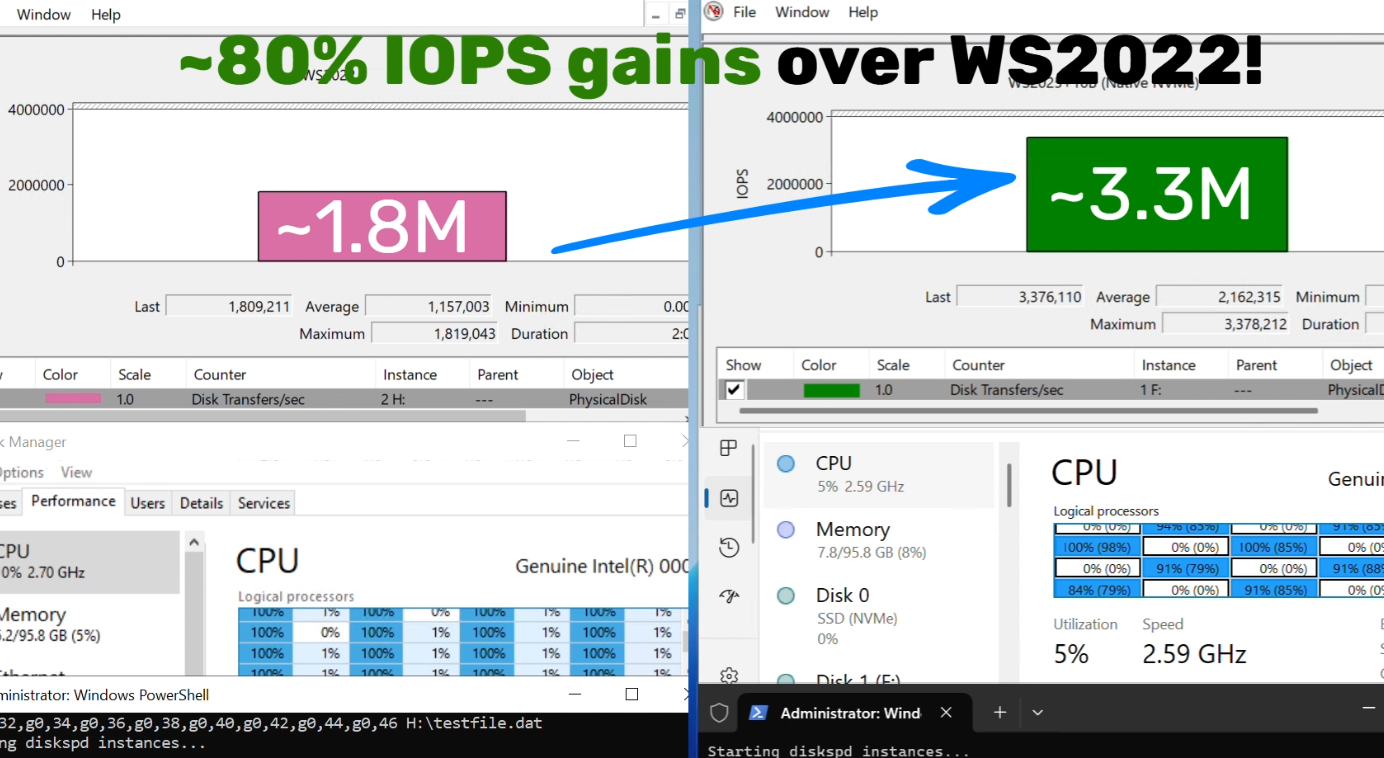
Reading more than the title would have answered the question, and theres even pictures available to keep your attention span.
- Kevin256Dec 21, 2025Copper Contributor
I read all the article, not just the title.
I could be missing something, so, respectfully, help me here: If NVMe commands are translated to SCSI/SATA ones, why Windows always had huge gains when using it on NVMe drives? That translation should bottleneck performance and other capabilities.
If Microsoft took this long to embrace a "new" storage technology properly and all that we had until now was inefficient code running (simulating the new tech), with many other problems occurring on Windows 11 every month, no wonder Linux is eating the desktop space bit by bit... In this case, this news is a decade late, and it's not news at all.