Updated May 12, 2025
Version 3.0
Miceile Barrett Microsoft
MicrosoftMicrosoft
Why „The Next Generation of File & Folder Sharing“ misses the reality of Enterprise Users
A critical perspective from real-world operations in a global company.
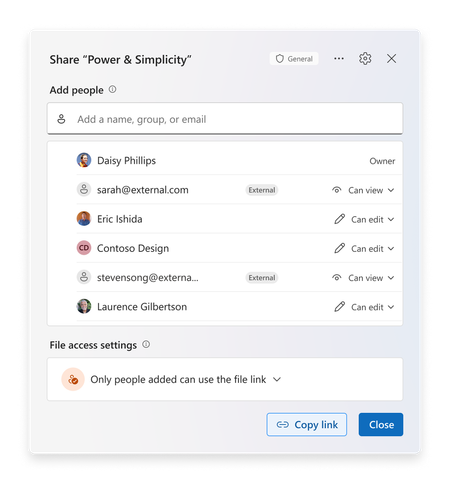
Microsoft is rolling out The Next Generation of File & Folder Sharing with the intention of modernizing and simplifying collaboration in SharePoint and OneDrive. While the ambition is understandable, the feature set overlooks a fundamental issue that has existed for years: SharePoint users do not understand the SharePoint permission model — and they do not have the time to learn it.
The core problem:
Ø Users don’t understand permissions, and they never will in their daily workload
Ø In a global enterprise, employees operate under constant pressure. They manage customers, projects, deadlines, compliance requirements, and operational tasks.
Ø What they cannot do is invest time in understanding a complex permission architecture that even experienced administrators need time to navigate.
The result is predictable and happens every single day:
Ø Users break permission inheritance even when it is completely unnecessary.
Ø They share links with people who already have access.
Ø They create redundant or conflicting permissions without realizing it.
Ø They fragment folder structures because they „just need to share something quickly.“
And IT ends up cleaning up the chaos afterwards.
This is not user error.
This is a system design problem.
New sharing features don’t solve the issue — they amplify it.
Every new sharing option adds more complexity:
Ø More choices
Ø More UI elements
Ø More decision points
Ø More potential for misconfiguration
Ø More ways to accidentally break inheritance
Ø More cleanup work for administrators
Users do not want to choose between „specific people“, „organization-wide“, „existing access,“ or „anyone with the link.“
They simply want one thing: Person X should be able to see the file.
The system forces them into decisions they neither understand nor want to make.
The reality in a global company: We restrict what we can — but sharing still spirals out of control
We apply policies.
We restrict external sharing.
We train users.
We document best practices.
And still, every week:
Ø Someone shares a folder with 200 people who already have access.
Ø Someone else breaks inheritance because they think it’s “required.”
Ø Another person creates a link that unintentionally generates a new permission layer.
Ø And the site ends up with a patchwork of unique permissions, limited access entries, and inconsistent inheritance.
This is not a training problem.
It is a design mismatch between the system and the real world.
What is actually needed: fewer options, more clarity, more automation
Instead of adding more sharing features, SharePoint needs:
Ø A radically simplified permission model
Ø Fewer options, fewer decision points, less complexity.
Ø Automatic detection of redundant sharing
Ø „This user already has access. Do you still want to create a new permission?“
Ø Warnings before breaking inheritance
Ø „Breaking inheritance will create complex permissions. Are you sure?“
Ø A clear, visual permission dashboard
Ø No technical jargon. No hidden layers.
Ø A „Safe Sharing Mode“ for end users
Ø Preventing them from unintentionally damaging permission structures.
Conclusion: The new functionality ignores how users actually work
The vision behind The Next Generation of File & Folder Sharing is modern and ambitious.
But it does not address the real issue:
Ø Users do not understand the SharePoint permission model — and they do not have the time to understand it.
Ø As long as the system depends on end users making complex permission decisions, every new sharing feature will increase confusion, not reduce it.
Ø A modern collaboration platform should reduce cognitive load, not increase it.

I totally agree. Sometimes, the best way to share is simply to copy the direct link. Not from the action or button but from the "..." the the details pane. You know the one that is under the activities that may be really hard to reach.
I see the same permissions breaking issue daily. Even worse, permissions are granted to a file, folder and site when adding this person to the site membres was the right thing to do.

OR, if we were on any part of the internet that Microsoft had not intentionally ruined, right-click on the URL at the top of the screen, and click "copy". The fact that there is any discussion here to be had is a sign of the inherent ridiculousness. URLs were invented in the 1990s and Microsoft is the only company that hasn't been able to learn this fine, simple technology, and its customers are the only people who have un-learned it while working with MS products. IMHO this change is a move towards acknowledging reality, which is that the basic technology ("a link") could have been working fine all along, had it not been mangled and evaded for so many years.