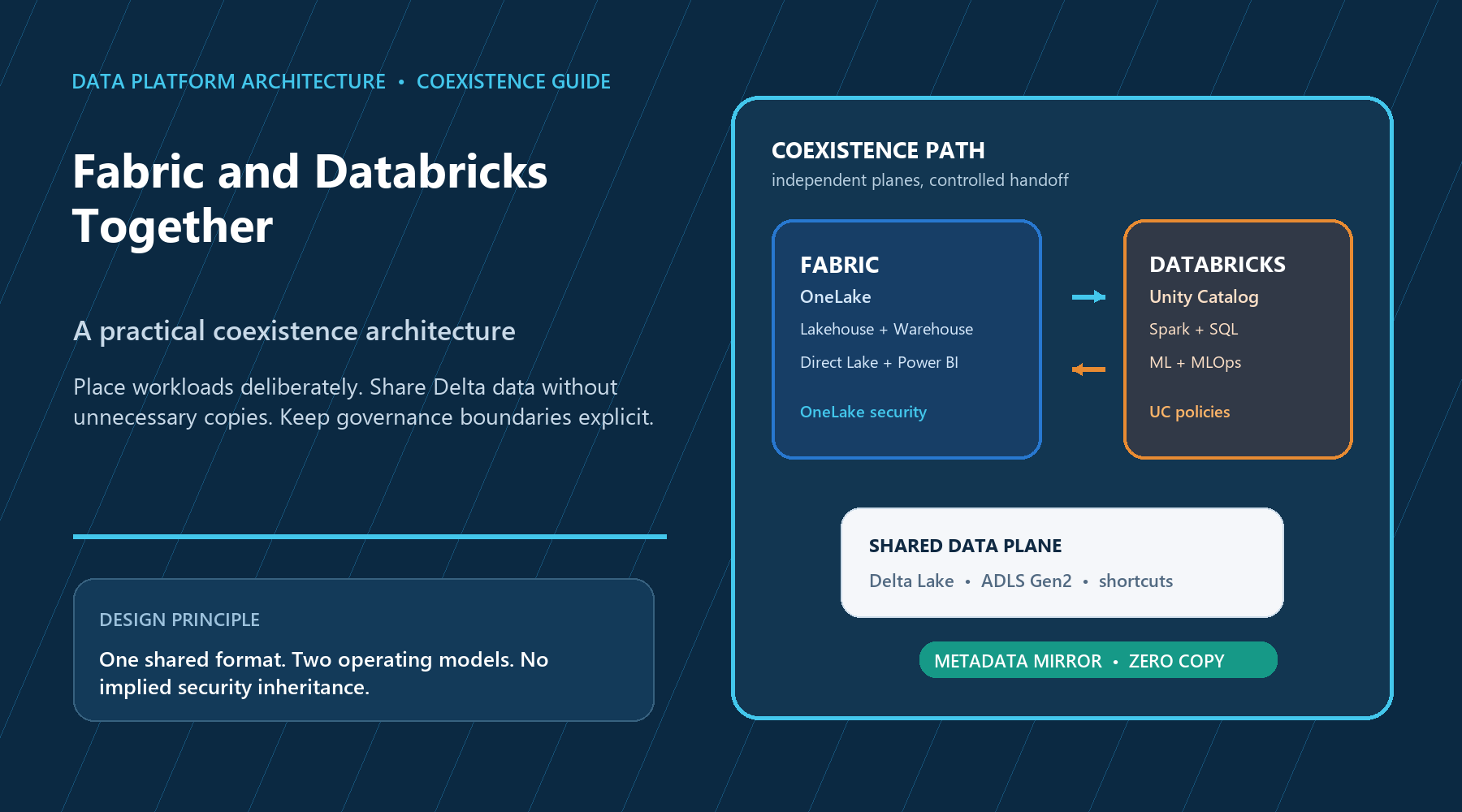
Fabric and Databricks Together
Fabric and Azure Databricks overlap, but optimize different operating experiences. Fabric integrates OneLake, engineering, warehousing, real-time analytics, and Power BI as SaaS. Databricks combines Spark and SQL engineering, Unity Catalog, and a mature ML lifecycle. Delta Lake and ADLS Gen2 enable coexistence; Fabric metadata mirroring and OneLake shortcuts can expose Databricks tables without copying their files. The hard work is assigning ownership, security, compatibility, and service objectives at every handoff.
Place workloads by operating responsibility
Use Fabric where the product is a governed analytical experience—especially T-SQL marts, semantic models, Direct Lake, and Power BI. Use Databricks where the product is an engineering or ML execution system—especially complex Spark estates, feature engineering, training, and Unity Catalog-governed pipelines. Both can do more; this is a starting boundary, not an exclusivity rule. Add the second platform only when a clear handoff avoids duplicated work.
A common brownfield pattern keeps Bronze, Silver, and Gold engineering in Databricks and mirrors selected, BI-ready Gold schemas to Fabric. Fabric then owns its SQL endpoint, semantic model, reports, and consumer permissions. Create a physical Fabric Gold copy only when it changes the contract: security minimization, star-schema reshaping, incompatible Delta features, source isolation, recoverable snapshots, or measured performance value.
Shared Delta data does not merge identity, governance, runtime, or cost controls.Use metadata mirroring with precise expectations
The mirrored Azure Databricks catalog capability is GA. Fabric represents selected Unity Catalog metadata, creates a read-only SQL analytics endpoint, and reaches the existing Delta files through shortcuts; it does not replicate the table data or create a write path. Supported additions and deletions can appear from seconds to minutes, and endpoint synchronization adds another clock. Mirroring is analytical access, not event transport or a guaranteed-latency replication service.
Treat prerequisites as security gates. Unity Catalog must be enabled; a metastore administrator must enable external data access, which is off by default. The connection principal needs explicit USE CATALOG, USE SCHEMA, SELECT, and EXTERNAL USE SCHEMA. EXTERNAL USE SCHEMA is not included in ALL PRIVILEGES or automatically granted to a schema owner. Use a non-personal identity, mirror the minimum useful Gold surface, and run post-deployment discovery, row-count or watermark, SQL, semantic, and deny-user probes.
Keep security and catalog boundaries separate
Unity Catalog permissions, row filters, column masks, and ABAC policies do not carry into Fabric. Configure Fabric workspace, item, and OneLake permissions independently, and map business-intent Entra groups into both systems. If required policy cannot be reproduced safely, publish a physically curated table whose rows and columns already satisfy the consumer contract. Preserve both lineage domains and record the handoff; public documentation does not promise automatic end-to-end stitching.
For firewall-protected external ADLS Gen2, separate two identities. OAuth or a service principal authorizes Databricks and Unity Catalog discovery. Fabric Workspace Identity traverses the storage firewall through trusted workspace access and needs least-privilege data-plane authorization. Trusted workspace access is GA but requires F capacity, is unavailable on Trial, and uses an Azure Storage resource-instance rule. The documented path does not support generalizing mirroring to Databricks workspace storage behind a firewall.
Make Delta and BI compatibility a release gate
A shared Delta format is a contract, not universal compatibility. Test column mapping, deletion vectors, liquid clustering, type widening, protocol versions, names, and data types through every intended engine. The Fabric SQL analytics endpoint supports name-mode column mapping but not ID mode. Fabric Runtime 1.3 is GA; Runtime 2.0 is public preview with newer Spark and Delta versions. Pin producers and block unreviewed protocol upgrades.
Direct Lake still requires semantic design, well-maintained tables, capacity, and concurrency testing. Verify grain, keys, relationships, measures, row-level security, file layout, framing after changes, cold and warm latency, and the selected Direct Lake mode. Zero-copy avoids one storage copy and replication pipeline; it does not eliminate Fabric capacity, source reads, producer compute, network, monitoring, or governance cost.
Coexistence decision checklist
One owner should accept each producer, consumer, network, security, semantic, incident, and cost contract. Deploy definitions, bind environment-specific connections, start the mirrored item, and verify runtime state; a successful pipeline deployment alone does not prove data is serving.
|
Decision |
Production evidence |
|
Placement |
Primary platform and one-sentence handoff rationale; authoritative Gold contract named |
|
Security |
Least-privilege principals, firewall rule, Fabric policy mapping, allow and deny personas tested |
|
Data |
Runtime/protocol manifest; every engine passes schema evolution and feature tests |
|
Consumption |
SQL and Direct Lake readiness, semantic ownership, scale, concurrency, and fallback verified |
|
Operations |
Start/probe release steps, lag and failure telemetry, rollback, cost owner, and copy review date |
Conclusion
Fabric and Databricks coexist cleanly when shared data does not blur platform boundaries. Start with a small set of curated Gold tables. Prove identity, denial, metadata freshness, Delta compatibility, Direct Lake behavior, monitoring, deployment, and rollback. Expand by owned data product, not catalog volume. The goal is to minimize duplicate work while giving every workload, policy, service objective, and bill a clear owner.

 Microsoft