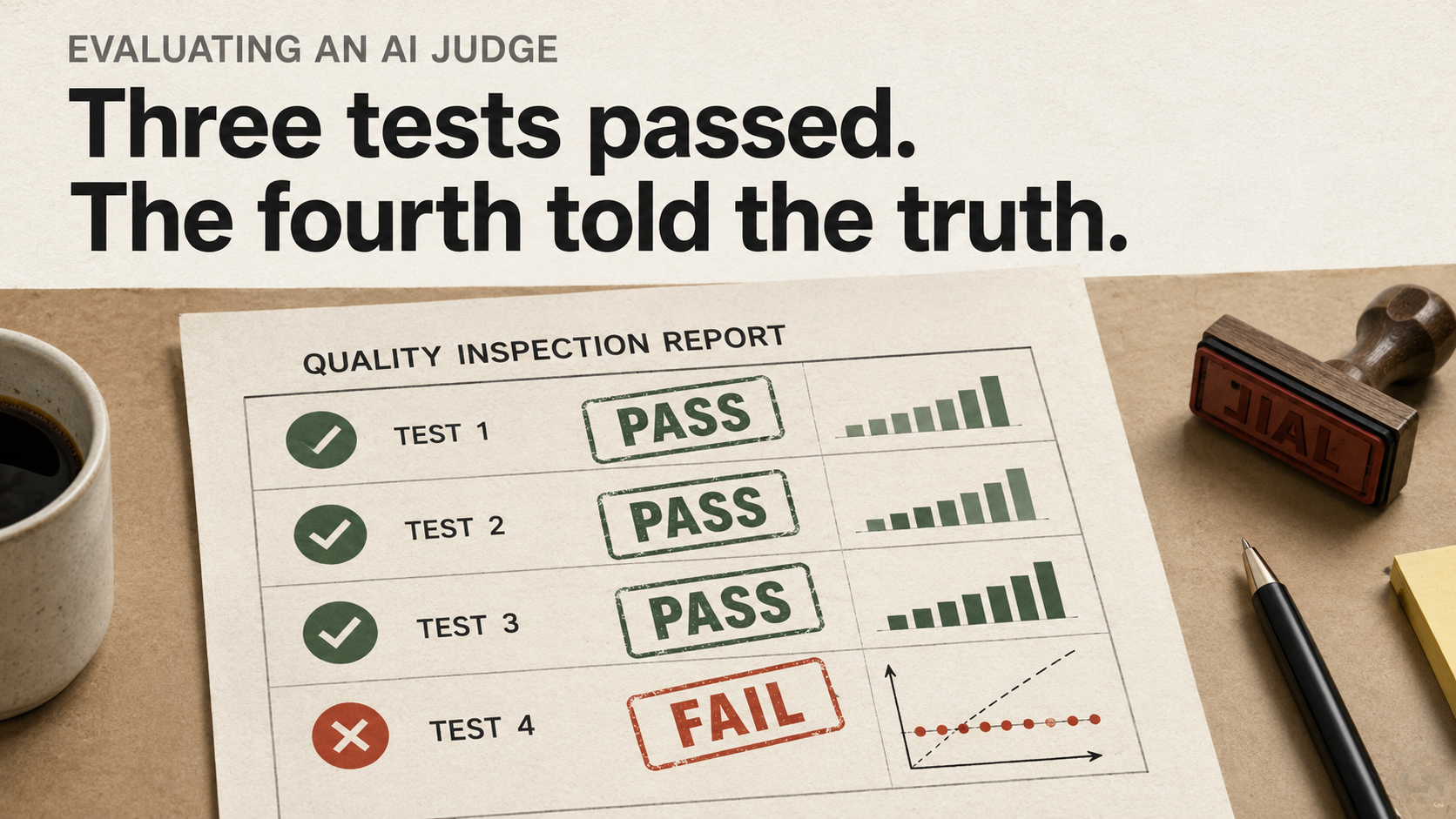
Using the Microsoft Agent Framework to audit an LLM judge: the Algorithm Simulator's consistency, calibration, and reasoning.
The four verdicts, up front
-
Consistency: mean CV across posts 5.30%
-
Pipeline format checks: pipeline pass rate 100%
-
Rubric adherence (strict judge): 5.00 / 5, mean math drift 0.05 pts
-
Calibration vs. labels: Pearson r = 0.51, MAE = 22.9 pts
Three of those say the model is healthy. The last one is the only one that compared the model against anything real, and it tells a different story.
Where we left off
In Post 1 I built Viral or Fail, three Microsoft Agent Framework agents that pressure-test a gaming social post before you publish it. A Content Creator drafts the post, an Algorithm Simulator scores it the way a recommendation system might, and an Audience Persona reacts the way an actual viewer would. The whole thing runs on the GitHub Models free tier, with no paid API keys.
That post ended on a cliffhanger I left deliberately open. The Algorithm Simulator scored the post 75/100, but how do I know the Simulator itself is any good? How consistent are its scores? Do they track real engagement? Would a human social strategist agree with its rubric weights?
This post answers that empirically. I built four tests: consistency, pipeline format checks, rubric adherence, and calibration. Three came back healthy. The fourth caught a problem structural enough that it changed how I think about evaluating LLM judges in general.
The surprising part isn't that the model failed somewhere but that it passed the three tests you naturally reach for first, and only failed the one most will skip.
Why I built my own harness
The Microsoft Agent Framework ships a real evaluation surface. You get evaluate_agent, LocalEvaluator, an @evaluator decorator, and the EvalItem / EvalResults data types. It's well designed, and for production agents it's the right choice.
It also pairs most naturally with Azure AI Foundry. The path of least resistance assumes you already have an Azure project, a model deployment, and the budget for cloud-tier LLM-as-judge calls. Post 1 went the other way on purpose: zero paid keys, GitHub Models free tier only. To keep that footing, I wrote a small in-house harness that mirrors the call shape of evaluate_agent.
The framework's evaluation surface is provider-agnostic in principle, but it leans toward Azure in practice. What the SDK hands you for free on Azure, you can rebuild for yourself on GitHub Models in as you would see shortly, and the patterns transfer directly when you upgrade.
The harness is one file, roughly 150 lines. The trick that makes it more than a wrapper is that it tries to import the SDK's primitives first and only defines its own if they aren't there yet:
try:
    from agent_framework import EvalItem, EvalResults, evaluator
    _USING_SDK_PRIMITIVES = True
except ImportError:
    # agent-framework-core==1.0.0rc1 doesn't ship these yet,
    # so we define local equivalents with the same shape.
    @dataclass
    class EvalItem:
        query: str
        response: str
        expected_output: str | None = None
        scores: dict[str, float] = field(default_factory=dict)
        repetition: int = 0
    # ... EvalResults, evaluator defined the same way
The day Microsoft ships these types, the suite picks them up with no code change. An evaluator looks like this:
@evaluator
def correlates_with_truth(response: str, expected_output: str) -> float:
    sim = parse_weighted_total(response)
    if sim is None or expected_output is None:
        return 0.0
    truth = float(expected_output)
    return 1.0 - (abs(sim - truth) / 100.0)
If you've used the SDK's @evaluator, you've used this one. Same parameter-name dispatch (query, response, expected_output), same return convention (a float in [0, 1]). The runner wraps a retry-aware async loop around a list of these. GitHub Models caps this model at about 15 requests per minute, so the loop sleeps 4.5 seconds between calls (12 a minute, comfortably under the cap). When it does hit a 429 it waits 30 seconds and up, rather than the short exponential backoff it uses for ordinary transient failures. Boring glue code, and important glue code.
When you eventually move to Azure, you swap runner.run(...) for evaluate_agent(...) and nothing else in your codebase has to change.
What 'good' even means for a judge
Before running anything, it's worth being precise about what "good" even means for a judge agent. There are four versions of it, and they split into two camps.
The first three are process checks. They probe the model against itself. No external reference data, just the model and its own outputs.
Consistency means same input, same output. Run the Simulator twice on the same post and the scores should land in roughly the same place. If they don't, the score is noise.
Pipeline format checks ask whether each agent followed its required output shape. Did the Creator produce platform-native text? Did the Simulator emit a parseable weighted total? Did the Persona stay in character? These are the cheapest tests of all, just regex and keyword matching, no LLM judge needed.
Rubric adherence is harder. The Simulator's prompt asks it to score five weighted criteria and report a weighted total. Did it actually do that, or did it list the criteria and then invent a number? Checking this needs an LLM. The cloud-tier equivalent is FoundryEvals.TaskAdherence, and I'll build the free-tier version below.
The fourth check is a different animal. Validation against ground truth. Calibration asks whether the Simulator's scores correlate with real engagement. It's the same operation you'd run on any predictive model: predict, compare against a labeled set, report correlation and error. It's the only check that tells you the model is correct rather than merely consistent and well-formatted, and it's the only one that needs data the model didn't produce.
That's the thesis of this post, and the reason the order matters. The three process checks can all come back green and still tell you nothing about the validation result. And because validation needs ground truth, the design of the ground-truth dataset becomes part of the result. I'll be explicit about that when we get there.
The posts under test
Every test runs against the same thing: a 10-post golden dataset of gaming social posts I wrote and hand-labeled. Each entry carries the post content, its real-world engagement numbers, a normalized engagement_score from 0 to 100, and a label (viral, decent, flop, or outlier). Here's the viral Valorant post that Test 1 keeps referencing, in full:
json
{
  "id": "post_001",
  "platform": "Twitter/X",
  "topic": "Valorant Champions 2025",
  "content": "EG winning Champions 2025 was the most underrated moment in Valorant esports history and people still don't talk about it enough.\n\nDemon1 carried that grand final on a level we won't see again until at least Champions '26. The map veto into Bind alone deserves a documentary.",
  "real_engagement": {
    "impressions": 2100000,
    "likes": 45000,
    "shares_or_retweets": 8000,
    "replies_or_comments": 1200,
    "engagement_rate_pct": 2.58
  },
  "engagement_score": 82,
  "label": "viral",
  "notes": "Hot take + esports nostalgia + named callout (Demon1) drove QRTs from competing fanbases."
}
The full set is in the repo at evals/golden_dataset.json: two viral hits, four decent posts, three flops, and one outlier, across Twitter/X, TikTok, YouTube, and Instagram.
Test 1: Consistency
The easiest test to write. Run the Simulator ten times on the same post with identical input. Compute the mean, standard deviation, and coefficient of variation. Repeat across five posts spanning viral, decent, flop, and outlier labels.
The harness call is one line:
runner = EvalRunner(rate_limit_sleep=4.5)   # 12 RPM, under the cap

results = await runner.run(
    agent=agent,
    queries=[_build_simulator_prompt(p) for p in selected],
    evaluators=[weighted_total_score],       # parses the score out of each run
    num_repetitions=NUM_REPETITIONS,         # 10
)
Fifty Simulator runs in total. Group by query, compute std/mean per post, then average the resulting CVs.
Mean coefficient of variation across the five posts: 5.30%. With the rubric pinned, the Simulator is meaningfully non-deterministic, but it isn't chaotic. Most scores cluster within about four points of the per-post mean.
That's the headline, and it's fine.
Now look at the chart again. post_001 (the viral Valorant Champions post, mean 70.3) and post_003 (the decent Steam Deck OLED post, mean 72.4) sit at almost the same place on the x-axis. The decent post averages slightly higher than the viral one. Across ten reps each. Twenty data points, and the Simulator can't reliably tell which one is supposed to be the success. If you trace the mean diamonds left to right, the decent post outranks both viral posts.
A consistency test won't flag this as a problem, because the Simulator is being consistent. It consistently rates these two posts in the same band. The problem is what that band means. If consistency were your only check, you'd close the laptop and ship.
Hold onto that. It comes back.
Test 4: Pipeline format checks
Now zoom out from a single agent and run the full Viral or Fail pipeline (Creator, then Simulator, then Persona) on five live trending gaming topics, applying format-level checks to each agent's output.
The checks are deliberately cheap. For the Creator: does the output contain Twitter/X-native vocabulary (the keyword list looks for things like thread, ratio, QRT, take, based)? For the Simulator: is there a parseable weighted total between 0 and 100? For the Persona (TryHard_Tyler, the competitive esports fan, in this run): does the output use any of the persona's keywords, like diff, cope, goated, ratio, cap?
Five topics, fetched live from Google Trends: xbox game pass, the hobbit mtg collector booster, crimson desert patch notes, xbox, olden era steam.
Per-agent pass rate: Creator 100%, Simulator 100%, Persona 100%. Pipeline pass rate 100%.
The format checks are doing their job. Every agent produced output in the shape it was supposed to, on every topic. No regex misses, no missing weighted totals, no out-of-character personas.
This is the point where, if you'd only run consistency and pipeline checks, you'd write the triumphant report. "Our agents are reliable. CV under 6%. Pipeline pass rate 100%. Ship it." That report would be true. It would also be wrong about whether the model is correct, because format adherence is not output validity. Keep going.
Test 3: Rubric adherence, and a free-tier LLM-as-judge
Format checks tell you what the output looks like. Rubric adherence asks whether the Simulator actually did the work it was prompted to do: score five weighted criteria, sum them correctly, and explain each score with platform-mechanic reasoning rather than vibes.
There's no regex for that. You need an LLM to read the Simulator's full evaluation and judge whether it followed its own rubric. That's an LLM-as-judge, and the cloud-tier equivalent is FoundryEvals.TaskAdherence on Azure. Since we're staying free, I built it.
The judge is just another Agent with a stricter system prompt:
JUDGE_SYSTEM_PROMPT = """You are a Rubric Adherence Judge — strict and skeptical. You evaluate whether another AI agent ACTUALLY followed its scoring rubric, not just whether it produced output that looks like it did.

You will check three things, in order of severity (the strictest failing check sets the score):

A. MATHEMATICAL FIDELITY (most important).
   Compute sum(criterion_score × weight) yourself from the agent's per-criterion scores. Compare it to the agent's stated WEIGHTED TOTAL. If they differ by more than 2 points, the agent is doing the rubric wrong even if it looks correct on the surface. Report the difference as `math_diff`.

B. REASONING SPECIFICITY.
   Each criterion's justification must reference platform-specific algorithm mechanics — "FYP retention threshold", "QRT velocity", "average view duration". Generic praise ("strong hook", "good engagement") is GENERIC and lowers the score. Classify reasoning as "specific", "mixed", or "generic".

C. COVERAGE.
   Every criterion in the rubric must be explicitly scored. Missing criteria fail this check.
...
Be strict. Format-following ≠ rubric-following."""
The full prompt is in the repo. The key decision is point A: the judge recomputes the math itself. That catches the failure where an agent lists every criterion with a score, but the weighted total it reports doesn't actually equal the weighted sum. That kind of quiet drift is exactly what format checks miss.
The judge returns strict JSON: adherence_score (1 to 5), math_diff, reasoning_quality, criteria_present, missing_criteria, weight_drift, plus a few sentences of reasoning. Test 3 doesn't go through runner.run; it orchestrates the two agents by hand, one post at a time, so the judge sees the Simulator's full evaluation:
for post in posts:
    sim_text = await call_agent_with_retry(simulator, build_simulator_prompt(post))
    verdict = await judge.judge(
        rubric=PLATFORM_RULES[post["platform"]],
        post_content=post["content"],
        evaluation_output=sim_text,
    )
Run across all 10 posts in the golden dataset, here's what comes back.
Mean adherence score: 5.00 / 5. Mean absolute math drift: 0.05 points (max 0.25). Reasoning quality classified "specific" on 100% of evaluations. Zero missing criteria, zero weight drift.
This was not the result I expected. I built the judge to be strict on purpose, after my first version turned out too lenient (more on that in the bugs section). The strict version recomputes the weighted sum, classifies generic praise as a failure, and demands platform-mechanic citations. The Simulator passed every dimension anyway.
The per-post reasoning is genuinely fun to read. On the Activision Blizzard flop, the judge noted that the Simulator's reasoning leaned on engagement velocity, quote-retweet incentives, topicality timing, and hashtag discoverability rather than generic praise. On the GTA 6 viral TikTok, it cited pattern interrupts, trending-cluster signals, and share-velocity drivers. That's the language I asked for, and the Simulator is producing it.
So the Simulator does the rubric correctly. The math is right, the reasoning is specific, every criterion is covered. By every internal measure, it works.
You can probably see where this is going. There's exactly one thing left to check, and it's the most expensive and most important one.
Test 2: Calibration, the reckoning
This one isn't a test in the same sense as the first three. They asked whether the model was malfunctioning. This asks whether it's correct, which is a different question entirely, because it's the only one that needs data the model didn't produce.
And because it's a validation, what I validate against matters as much as the model. So before running anything, here's exactly what the ground truth is: a 10-post golden dataset that I built, not measured. I wrote the post content myself in platform-native style, then assigned each post an engagement_score from a back-of-envelope formula (impressions x engagement rate x shareability), calibrated against publicly observable performance for similar posts. The set spans two viral hits, four decent posts, three flops, and one deliberate outlier (a post that got ratio'd into orbit, with high reach and terrible reception).
So when I show you a Pearson r in a moment, hold it loosely. The exact number is partly a function of how I designed the labels. The shape of the failure (whether the Simulator's predictions cluster, spread, invert, or track the labels) is what's actually informative, because the shape doesn't depend on the labels being precise. It only depends on them being roughly ordered: viral out-ranks decent, decent out-ranks flop. Whether viral is 91 against flop 18, or viral 85 against flop 25, doesn't change which way the comparison runs.
With that on the table: run the Simulator once per post, compute Pearson r and Spearman rho, compute MAE.
Pearson r = 0.51. Spearman rho = 0.52. MAE = 22.9 points.
That r-value isn't a small problem. Here's what it means in practice, post by post:
| Post | Topic | Label | Truth | Simulator | Error |
|---|---|---|---|---|---|
| 001 | Valorant Champions 2025 | viral | 82 | 69.75 | 12.25 |
| 002 | GTA 6 reveal reaction | viral | 91 | 65.75 | 25.25 |
| 003 | Steam Deck OLED price | decent | 55 | 71.00 | 16.00 |
| 004 | Genshin Impact 5.0 pulls | decent | 48 | 65.00 | 17.00 |
| 005 | Hollow Knight: Silksong | decent | 60 | 76.50 | 16.50 |
| 006 | Xbox Showcase 2025 | decent | 42 | 74.75 | 32.75 |
| 007 | Activision Blizzard acquisition | flop | 18 | 59.50 | 41.50 |
| 008 | 5 games to play this weekend | flop | 22 | 37.00 | 15.00 |
| 009 | Pentiment retrospective | flop | 15 | 60.75 | 45.75 |
| 010 | Concord shutdown post-mortem | outlier | 50 | 57.00 | 7.00 |
The pattern is structural. The Simulator's natural output band is roughly 60 to 76. Posts that should clear 80 get pulled down to 65 to 70. Posts that should land below 25 get pulled up toward 60, with one flop (post_008, the "5 games this weekend" listicle) the only exception at 37. The model has an attractor zone in the middle of the scale and refuses to leave it.
Look at the most accurate prediction in the table. It's post_010, the outlier (truth 50, Simulator 57, error 7). Why is it the most accurate? Because 50 happens to sit inside the attractor zone. The Simulator's bias accidentally cancels out for posts that are supposed to be average. It isn't accurate, it's wrong in a way that lands near the truth for one specific case.
This was the test I almost didn't run. It needs labeled data, which is annoying to gather, and three out of four tests had already declared the model healthy. By every internal measure, the Simulator was working as designed.
It just couldn't tell viral from decent. It rated the GTA 6 reaction TikTok (truth 91) at 66, and the Steam Deck OLED post (truth 55) at 71. The model is consistent, rubric-faithful, and format-stable, and on real cases it literally inverts virality and decentness.
The shape of that failure (flops pulled up hard, by 15, 42, and 46 points; virals pulled down by 12 and 25; the whole range collapsed into a narrow band) is what survives the synthetic-label uncertainty. If the labels were simply inaccurate, you'd see scatter. A symmetric squeeze toward the middle requires the Simulator itself to be conservative. The Pearson r of 0.51 (p around 0.13, not significant on n = 10) is the number to hold loosely. The squeeze is the result. Running this against measured engagement metrics is the natural Post 3, and I'd expect the qualitative finding to hold.
Bugs the suite caught along the way
This is something I want to keep doing in my write-ups. I usually publish the clean, glamorous version (here's what I built, here's what I learned, the end), which quietly erases the bugs that taught me the most about how the system actually behaves. So here are three real ones the eval suite caught while I was running it.
The production parser regex was silently failing. Post 1's viral_or_fail.py extracts the Simulator's weighted total with a regex like Weighted\s*Total[^\n]+. That works for same-line layouts (Weighted Total: 73/100). It does not work for the multi-line layout the model produces about half the time:
**WEIGHTED TOTAL:**

= 22.5 + 15 + 14 + 12.75 + 9 =

 **73.25/100**
When the regex misses, the production code silently falls back to a default of 50. Which means the public Viral or Fail demo had been quietly showing readers 50/100 on many of its runs since Post 1 went live. The eval suite caught it on the very first call: parse_weighted_total returned None, the harness logged it loudly, and the bug had nowhere to hide. The fix strips the bold markers, finds the header, then scans a few non-blank lines past it, preferring N/100, then a trailing = N, then the first number it sees:
clean = response.replace("**", "")
header = _WT_HEADER_RE.search(clean)          # r"Weighted\s*Total\s*:?"
if not header:
    return None
after = clean[header.end():]
window = []
for raw in after.splitlines()[: _WT_LOOKAHEAD_LINES + 1]:
    line = raw.strip()
    if not line and window:
        break
    if line:
        window.append(line)
blob = " ".join(window)
# prefer "N/100", then a trailing "= N", then the first number found
That regex hunt alone justified the whole exercise.
The Google Trends "Games" topic is contaminated. Test 4 originally fetched live trending topics and got back "kentucky derby 2026", "kentucky oaks", and "fanduel" alongside the actual gaming. The cause: Google's taxonomy bundles horse racing, gambling, and sportsbooks under the same Games topic ID it uses for video games, and the trends_tool.py filter from Post 1 was matching on that topic ID alone. The fix was a two-layer filter: require the games topic and not topic 17 (Sports), plus a small denylist for gambling keywords. Now the results come back as xbox game pass, crimson desert, and the hobbit mtg collector booster, with no horse racing.
The first version of the judge was too lenient. My initial RubricAdherenceJudge rewarded "every criterion explicitly scored." But the Simulator's system prompt forces exactly that, so the judge handed out 5/5 trivially across all 10 posts and told me nothing. I tightened it to recompute the weighted sum and report math_diff, and to classify reasoning as specific, mixed, or generic based on whether justifications cite platform mechanics. Even under the strict judge the Simulator still scored 5/5, but now I'd earned that result instead of getting it for free.
Why this matters in production
I built four tests to evaluate the Algorithm Simulator from Post 1. Three of them (consistency, rubric adherence, pipeline format checks) declared it healthy. The fourth, calibration, compared its scores against labeled engagement and found systematic bias: the predictions are squashed into a narrow band regardless of how the post actually performed. A flop with engagement of 18 gets a 60. A viral hit with engagement of 91 gets a 66. The model isn't broken in any visible way. It's just consistently, faithfully, formally wrong. That's exactly why validation against ground truth isn't optional. It's the only check that catches a model doing everything right except being correct.
Format, consistency, and rubric-coverage tests tell you the model isn't malfunctioning. They cannot tell you it's correct. They test the process, and only validation tests the output. A model can have a flawless process and still produce numbers that don't track reality.
Now zoom out. Viral or Fail's Simulator is low stakes. Worst case, a creator publishes a post the Simulator liked and it flops. Embarrassing, not dangerous. The same failure at higher stakes is dangerous, and the same shape shows up everywhere in production AI. Ask a language model to be "objective" and it hedges toward the middle. Content moderation agents under-flag clearly harmful content and over-flag clearly benign content, because both extremes feel risky to the model. Resume screeners compress every candidate into a 60-to-80 band and call the lack of spread "fairness." Code-review bots return a comfortable 7/10 on a PR with real problems and on a PR with none. Support routing labels almost everything "medium priority" and quietly breaks the downstream automation that relied on the signal meaning something.
Each of those has shipped in real deployments and then underperformed for months before anyone noticed. The teams weren't careless. They had observability, CI, process checks. What they lacked was a labeled validation set. And without one, a confidently miscalibrated model looks identical to a working one. A model that's wrong randomly gets caught, because outliers get flagged and reviewed. A model that's wrong consistently gets trusted, because it never trips an alarm. Once a downstream product depends on the miscalibrated output, the bias gets amplified at scale.
Most production AI systems are not validated this way. Most LLM-as-judge components in agentic systems have never had their predictions compared against any external ground truth at all. And when something does feel off, teams reach for fine-tuning. But you can't fine-tune what you haven't characterized, and characterization is exactly what calibration testing produces. Without it, fine-tuning is guesswork in an engineering costume. "It works in eval" usually means it passed process checks, which is not the same thing as working.
So evaluation is a discipline, not a phase. It belongs in the same loop as deployment, not as a one-off before launch. Internal-process checks belong in CI. Validation against labels belongs on a schedule. Both should alert when they regress, and both should be visible to the people accountable for the model's decisions.
If there's one thing to take from this post: build a validation step into your eval suite from day one, even with synthetic labels, and especially if you can't get measured ones yet. Process tests keep you safe from regressions. Only the validation step keeps you honest about whether the model is right.
What's next: the cloud-tier upgrade path
Everything here runs on the GitHub Models free tier. That's deliberate, and it also means I've built the free-tier version of three things Microsoft already does better at production scale.
The first is FoundryEvals in agent_framework_azure_ai. My RubricAdherenceJudge is a homemade FoundryEvals.TaskAdherence. Foundry's version uses Azure-hosted judges on a managed pipeline, with calibration handled internally and a portal for tracking runs over time. Same structural test, but operationally serious. The same idea applies to Relevance, Coherence, Groundedness, IntentResolution, and the rest of the catalogue. If you've built the harness from this post, swapping it for evaluate_agent plus FoundryEvals is mostly an import change.
The second is the AI Red Teaming Agent. I didn't run any safety evaluation in this suite. The Audience Persona is the agent most likely to drift into unsafe territory, and the natural counterpart to quality evaluation is adversarial probing with PyRIT. The AI Red Teaming Agent wires that straight into Foundry. That's a Post 4.
The third is observability. DevUI gives you real-time visualization of agent sessions, and OpenTelemetry traces flow into Azure Monitor. Both earn their keep when an eval flags a regression and you need to walk back through the failing run to find the cause.
And then there's Post 3: the calibration test against real engagement data. If you have a Twitter, YouTube, or TikTok dataset with both post content and post-hoc engagement metrics, and you'd be open to collaborating, I'd love to hear from you.
The full eval suite is on GitHub: github.com/HamidOna/viral-or-fail. Run pip install -r requirements.txt, set GITHUB_TOKEN, and run python -m evals.run_all. Six to eight minutes start to finish on the free tier. The suite runs, the JSONs write, the plots render, and you'll see the same thing I did: the easy tests will tell you everything is fine.
The last test will tell you what's actually happening.
