Gen AI telemetry forces us to think differently about the data we collect. End-users can accidentally or purposefully include PII, PHI, or other personal details in prompts and responses, and since we cannot easily peer inside a model, the inputs and outputs are often the best diagnostic data we have.
Azure Monitor meets a broad range of industry and regulatory compliance standards. Even so, we made a conscious choice to make application log discovery inclusive and accessible within your Azure Subscription and Tenant. The standard Azure "Reader Role" empowers your enterprise to debug, diagnose issues, and view business events generated from telemetry. Gen AI telemetry such as prompts, responses, system instructions, and tool calls is fundamentally different from standard diagnostic logs and thus may require tighter access controls.
While we're working on creative approaches to scrub sensitive content from text-heavy Gen AI logs, the reality is that doing so at scale is costly and will never be 100% effective. From a security standpoint, the only surefire way to protect this telemetry is to not collect it in the first place. But that "raw material" is exactly what meaningful evaluations require and without evaluations, your ability to "hill climb" and iterate your agent is limited. The next most secure option is to collect it and lock it down to a small group of people.
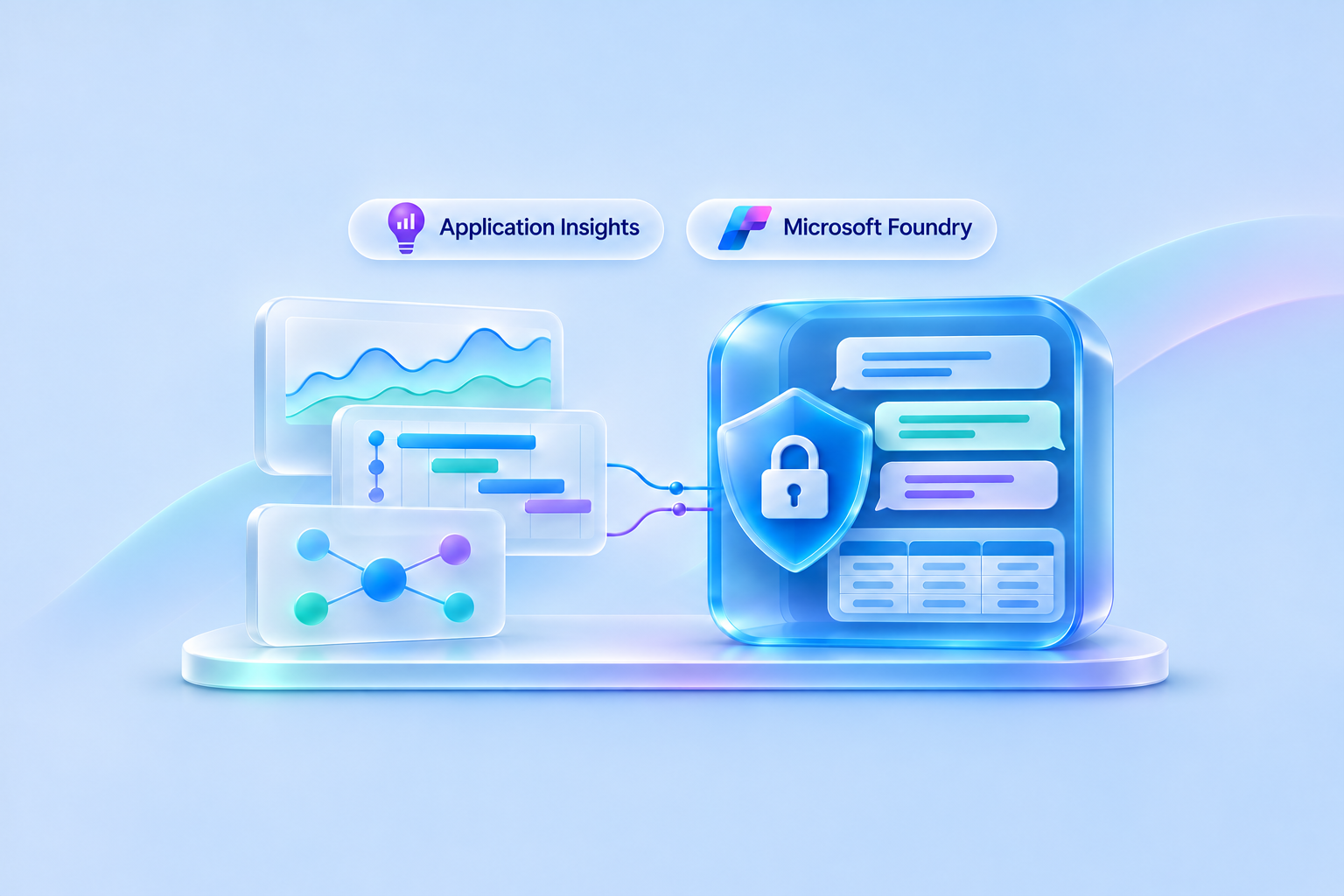
To address this, Application Insights now captures Gen AI content in its own table, AppGenAIContent, that you can mark as protected and govern independently from the rest of your telemetry. The attributes, schema, and setup are all in our documentation so instead of walking through the mechanics, let's talk about why this matters and how to use it.
How this might look in practice
A separate, protected table lets you match access to sensitivity instead of applying one policy to everything. In practice, that might look like:
- A small security or compliance team holds standing access to the protected Gen AI content, because reviewing sensitive data is part of their job and tightly audited.
- Developers across Azure Monitor and Foundry work without standing access and request time-boxed, need-to-know access when investigating a specific incident, granted for the investigation and revoked when it's closed.
- The rest of your observability data stays open, so day-to-day debugging over requests, dependencies, and traces is unchanged.
Because the access boundary lives at the table level, you get this separation without fragmenting the rest of your monitoring.
Looking forward: the trust boundary is shifting
We're moving into an agentic world where reasoning happens over your logs. An agent, such as the Azure Copilot Observability Agent, can investigate an incident, read the Gen AI content, correlate it across signals, and explain root cause without a human ever seeing the raw, sensitive data underneath.
That's a meaningful shift. The trust boundary is no longer only which people can see this data. It becomes which agents can reason over it, under what constraints, and what they're allowed to surface and to whom (though to be clear, when you use Azure Copilot’s Observability agent today, it only has access to the exact data you do).
Separating and protecting Gen AI content is the first concrete step toward that model: a clean, governed place where sensitive content lives, access is controlled, and the agents acting on your behalf inherit the same guardrails your people do.
Get started
Your Gen AI content is already routed to the AppGenAIContent table, so you can lock it down today: configure the table as protected and set Gen AI data to stop flow to the old table locations. If you do nothing, Gen AI data will stop flowing to the old table upon General Availability (planned for December), though there is a way to postpone it for up to a year if you need more time. Learn more.

 Microsoft