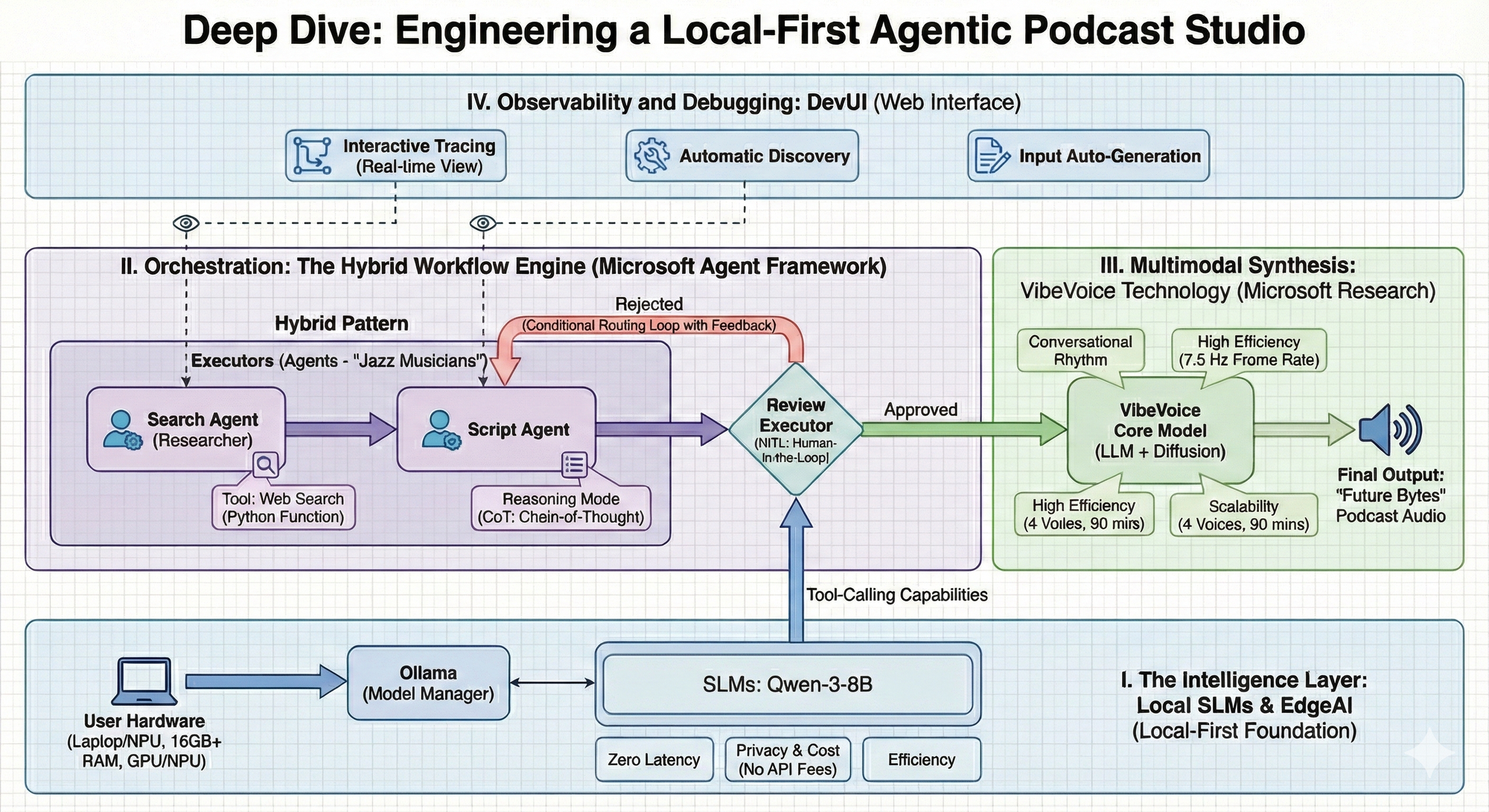
The transition from standalone Large Language Models (LLMs) to Agentic Orchestration marks the next frontier in AI development. We are moving away from simple "prompt-and-response" cycles toward a paradigm where specialized, autonomous units—AI Agents—collaborate to solve complex, multi-step problems. As a Technology Evangelist, my focus is on building these production-grade systems entirely on the edge, ensuring privacy, speed, and cost-efficiency.
This technical guide explores the architecture and implementation of The AI Podcast Studio. This project demonstrates the seamless integration of the Microsoft Agent Framework, Local Small Language Models (SLMs), and VibeVoice to automate a complete tech podcast pipeline.
I. The Strategic Intelligence Layer: Why Local-First?
At the core of our studio is a Local-First philosophy. While cloud-based LLMs are powerful, they introduce friction in high-frequency, creative pipelines. By using Ollama as a model manager, we run SLMs like Qwen-3-8B directly on user hardware.
1. Architectural Comparison: Local vs. Cloud
Choosing the deployment environment is a fundamental architectural decision. For an agentic podcasting workflow, the edge offers distinct advantages:
| Dimension | Local Models (e.g., Qwen-3-8B) | Cloud Models (e.g., GPT-5.2) |
|---|---|---|
| Latency | Zero/Ultra-low: Instant token generation without network "jitter". | Variable: Dependent on network stability and API traffic. |
| Privacy | Total Sovereignty: Creative data and drafts never leave the local device. | Shared Risk: Data is processed on third-party servers. |
| Cost | Zero API Fees: One-time hardware investment; free to run infinite tokens. | Pay-as-you-go: Costs scale with token count and frequency of calls. |
| Availability | Offline: The studio remains functional without an internet connection. | Online Only: Requires a stable, high-speed connection. |
2. Reasoning and Tool-Calling on the Edge
To move beyond simple chat, we implement Reasoning Mode, utilizing Chain-of-Thought (CoT) prompting. This allows our local agents to "think" through the podcast structure before writing. Furthermore, we grant them "superpowers" through Tool-Calling, allowing them to execute Python functions for real-time web searches to gather the latest news.
II. The Orchestration Engine: Microsoft Agent Framework
The true complexity of this project lies in Agent Orchestration—the coordination of specialized agents to work as a cohesive team. We distinguish between Agents, who act as "Jazz Musicians" making flexible decisions, and Workflows, which act as the "Orchestra" following a predefined score.
1. Advanced Orchestration Patterns
Drawing from the WorkshopForAgentic architecture, the studio utilizes several sophisticated patterns:
- Sequential: A strict pipeline where the output of the Researcher flows into the Scriptwriter.
- Concurrent (Parallel): Multiple agents search different news sources simultaneously to speed up data gathering.
- Handoff: An agent dynamically "transfers" control to another specialist based on the context of the task.
- Magentic-One: A high-level "Manager" agent decides which specialist should handle the next task in real-time.
III. Implementation: Code Analysis (Workshop Patterns)
To maintain a production-grade codebase, we follow the modular structure found in the WorkshopForAgentic/code directory. This ensures that agents, clients, and workflows are decoupled and maintainable.
1. Configuration: Connecting to Local SLMs
The first step is initializing the local model client using the framework's Ollama integration.
# Based on WorkshopForAgentic/code/config.py
from agent_framework.ollama import OllamaChatClient

# Initialize the local client for Qwen-3-8B
# Standard Ollama endpoint on localhost
chat_client = OllamaChatClient(
    model_id="qwen3:8b",
    endpoint="http://localhost:11434"
)
2. Agent Definition: Specialized Roles
Each agent is a ChatAgent instance defined by its persona and instructions.
# Based on WorkshopForAgentic/code/agents.py
from agent_framework import ChatAgent

# The Researcher Agent: Responsible for web discovery
researcher_agent = client.create_agent(
        name="SearchAgent",
        instructions="You are my assistant. Answer the questions based on the search engine.",
        tools=[web_search],
)

# The Scriptwriter Agent: Responsible for conversational narrative

generate_script_agent = client.create_agent(
        name="GenerateScriptAgent",
        instructions="""
        You are my podcast script generation assistant. Please generate a 10-minute Chinese podcast script based on the provided content.
The podcast script should be co-hosted by Lucy (the host) and Ken (the expert). The script content should be generated based on the input, and the final output format should be as follows:

            Speaker 1: ……
            Speaker 2: ……
            Speaker 1: ……
            Speaker 2: ……
            Speaker 1: ……
            Speaker 2: ……
        """
)
3. Workflow Setup: The Sequential Pipeline
For a deterministic production line, we use the WorkflowBuilder to connect our agents.
# Based on WorkshopForAgentic/code/workflow_setup.py
from agent_framework import WorkflowBuilder

# Building the podcast pipeline

search_executor = AgentExecutor(agent=search_agent, id="search_executor")
gen_script_executor = AgentExecutor(agent=gen_script_agent, id="gen_script_executor")
review_executor = ReviewExecutor(id="review_executor", genscript_agent_id="gen_script_executor")

# Build workflow with approval loop
# search_executor -> gen_script_executor -> review_executor
# If not approved, review_executor -> gen_script_executor (loop back)
workflow = (
    WorkflowBuilder()
    .set_start_executor(search_executor)
    .add_edge(search_executor, gen_script_executor)
    .add_edge(gen_script_executor, review_executor)
    .add_edge(review_executor, gen_script_executor)  # Loop back for regeneration
    .build()
)
IV. Multimodal Synthesis: VibeVoice Technology
The "Future Bytes" podcast is brought to life using VibeVoice, a specialized technology from Microsoft Research designed for natural conversational synthesis.
- Conversational Rhythm: It automatically handles natural turn-taking and speech cadences.
- High Efficiency: By operating at an ultra-low 7.5 Hz frame rate, it significantly reduces the compute power required for high-fidelity audio.
- Scalability: The system supports up to 4 distinct voices and can generate up to 90 minutes of continuous audio.
V. Observability and Debugging: DevUI
Building multi-agent systems requires deep visibility into the agentic "thinking" process. We leverage DevUI, a specialized web interface for testing and tracing:
- Interactive Tracing: Developers can watch the message flow and tool-calling in real-time.
- Automatic Discovery: DevUI auto-discovers agents defined within the project structure.
- Input Auto-Generation: The UI generates input fields based on workflow requirements, allowing for rapid iteration.
VI. Technical Requirements for Edge Deployment
Deploying this studio locally requires specific hardware and software configurations to handle simultaneous LLM and TTS inference:
- Software: Python 3.10+, Ollama, and the Microsoft Agent Framework.
- Hardware: 16GB+ RAM is the minimum requirement; 32GB is recommended for running multiple agents and VibeVoice concurrently.
- Compute: A modern GPU/NPU (e.g., NVIDIA RTX or Snapdragon X Elite) is essential for smooth inference.
Final Perspective: From Coding to Directing
The AI Podcast Studio represents a significant shift toward Agentic Content Creation. By mastering these orchestration patterns and leveraging local EdgeAI, developers move from simply writing code to directing entire ecosystems of intelligent agents. This "local-first" model ensures that the future of creativity is private, efficient, and infinitely scalable.
Download sample Here
Resource
- EdgeAI for Beginners - https://github.com/microsoft/edgeai-for-beginners
- Microsoft Agent Framework - https://github.com/microsoft/agent-framework
- Microsoft Agent Framework Samples - https://github.com/microsoft/agent-framework-samples

 Microsoft