Shipping is no longer just about deploying code.
Consider a team introducing a new checkout experience. The code is already in production, but the team wants to expose it to a small audience, gradually increase availability, monitor the results, and retain the ability to turn it off if something goes wrong.
Feature flags make that possible without requiring another deployment.
As feature flags become increasingly central to how software is released and operated, we saw an opportunity to evolve how they’re represented in Azure App Configuration.
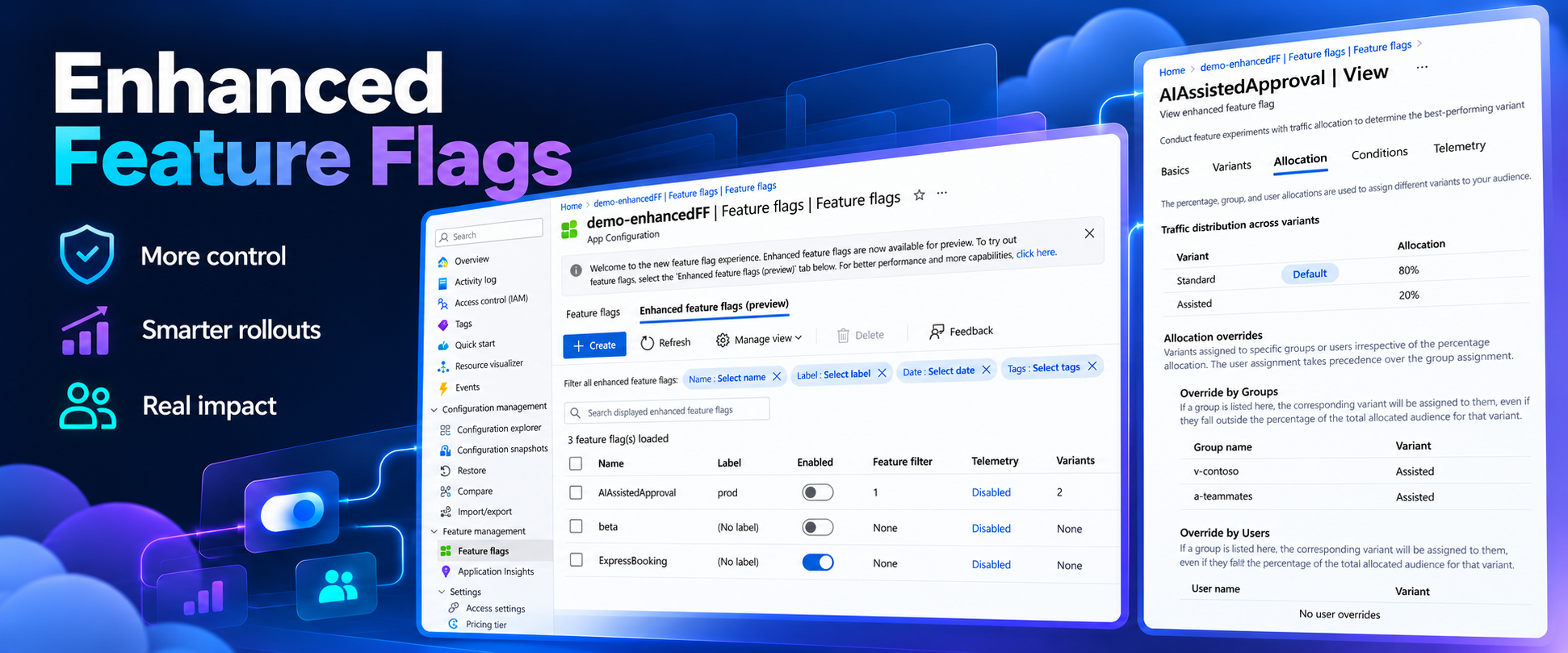
Enhanced Feature Flags are available in public preview, with a dedicated resource model designed specifically for feature management.
Why rethink the feature flag resource model?
Consider a team preparing to launch a new check out experience. The release manager needs to control when the feature becomes available but shouldn’t necessarily have permission to modify payment settings or other application configuration.
With traditional feature flags sharing the same key-value resource and permission model as application configuration, separating these responsibilities isn’t possible. Similarly existing SDKS and tooling simplify feature flag management; the underlying APIs still treat flags as specially formatted configuration entries rather than resources with their own defined structure.
These are not challenges with feature evaluation itself. They're challenges with how feature flags are represented, managed, and governed.
Enhanced Feature Flags address this by introducing a purpose-built resource model, with dedicated APIs and separate access control.
What changes with Enhanced Feature Flags?
The new model introduces several important improvements.
1. Feature management gets its own security boundary
Feature flags often change application behavior in production, and the people responsible for those changes may not be the same people responsible for application configuration.
With Enhanced Feature Flags, organizations can grant access to feature flag resources independently of configuration key-values. A team responsible for feature rollout, for example, can manage flags without also receiving permission to modify unrelated application settings.
This creates a clearer security boundary for applying least privilege access to feature management.
2. Feature flags get a dedicated API surface
Previously, managing feature flags through configuration APIs required clients and automation to understand specific naming conventions, content types, and serialized feature definitions.
Enhanced Feature Flags expose dedicated APIs for creating, querying, updating, and deleting flags.
The benefit isn't simply another API. Tools and deployment workflows can now work directly with a resource designed for feature management instead of interpreting a feature flag stored as configuration.
3. Validation moves closer to the source
Enhanced Feature Flags have a defined resource schema that Azure App Configuration can validate when a flag is created or updated. Malformed definitions can be rejected before they are stored, providing consistent validation across clients and tooling.
Existing feature management capabilities continue to work
Enhanced Feature Flags build on the feature management capabilities already available in Azure App Configuration, including targeting, variants, allocation, and telemetry.
Applications can continue using their existing feature evaluation logic with supported versions of the App Configuration provider libraries.
And importantly, existing key-value-based feature flags remain supported. Teams can evaluate the new model alongside their current flags, rather than treating this preview as a mandatory migration.
See Enhanced Feature Flags in action
Watch this short demo to learn how granular role-based access control enables teams to manage feature releases independently while keeping application configuration protected.
A foundation for what comes next
Enhanced Feature Flags solve concrete management and governance challenges today, but the opportunity goes further.
Giving feature flags their own resource model creates room for feature management to evolve independently from general application configuration, with deeper investments in areas such as automation, governance, targeting, and connecting feature delivery to application outcomes.
The longer-term opportunity is to make managing a feature throughout its lifecycle as natural as developing and deploying it.
Enhanced Feature Flags are available now in public preview in Azure App Configuration. If you're building a new application or evolving your feature management workflows, explore the new resource model and let us know what you think.
We want Enhanced Feature Flags to provide the foundation for the next generation of feature management in Azure App Configuration, and your feedback will help shape where we take it next.
- Learn about Enhanced Feature Flags
- Explore the Enhanced Feature Flags REST API
- Share feedback with the Azure App Configuration team
#Azure #AzureAppConfiguration #FeatureFlags #FeatureManagement #DeveloperExperience

 Microsoft