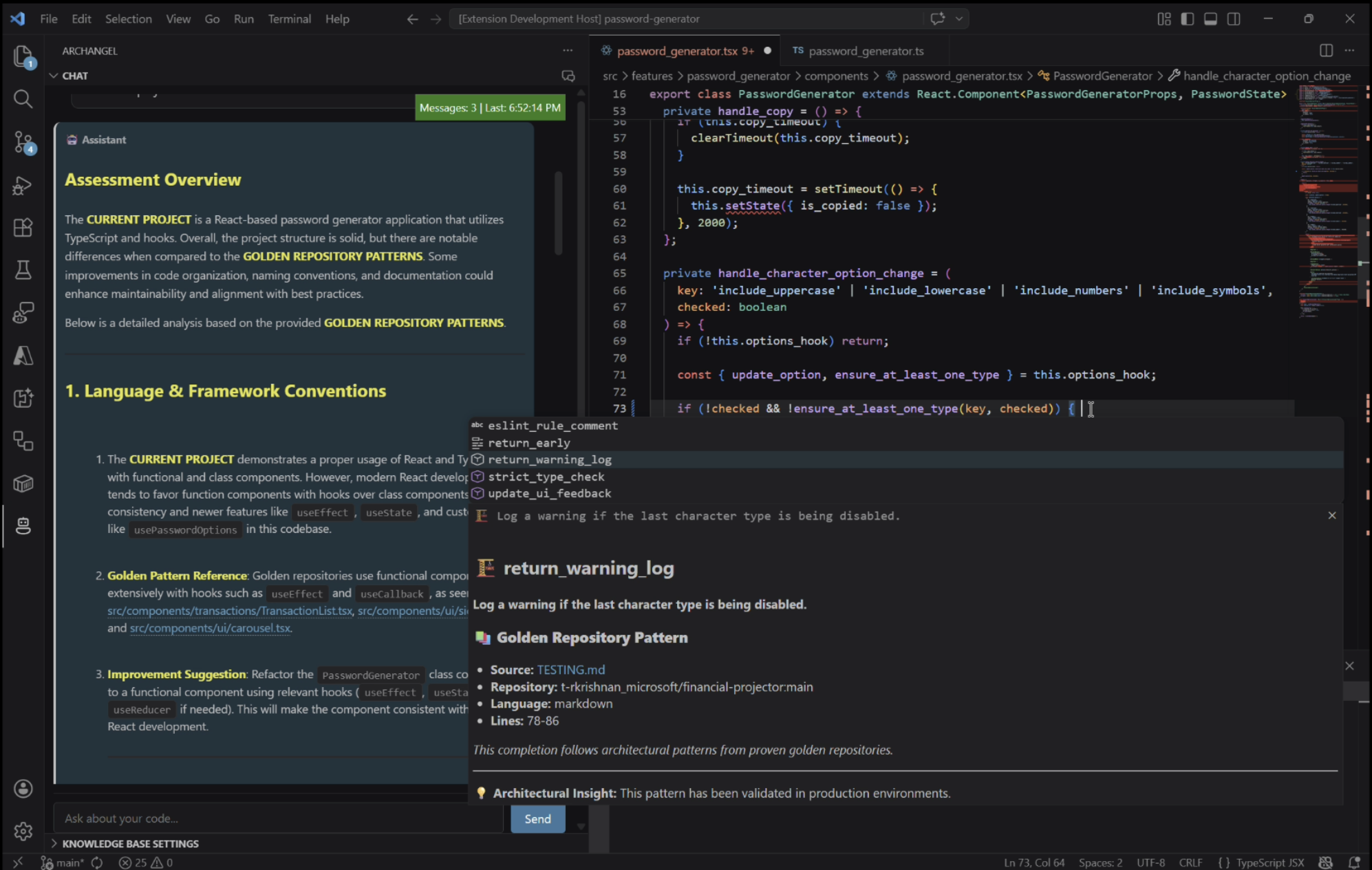
AI is transforming the SDLC at speed but there's a quieter question following close behind. If the code is being written for your junior developers, when do they learn the skills to become senior ones and how can they use these tools without losing understanding of what they've made? Most tools try to solve this by catching issues after the commit, but by then the teaching moment is already gone. What if your developers could learn why something is wrong and how to fix it, as they write it?
ArchAngel is built around a simple idea: What if your team’s best engineering practices could exist directly inside the IDE and guide developers as they work? It turns your team's collective wisdom into a mentor that scales to every new hire, every sprint, every repo.
GitHub Copilot has led to great strides in reducing developer toil. It allows teams to move faster, automate repetitive work, and spend more time on higher-level design decisions that drive real impact. As these capabilities evolve, especially with more agentic workflows, developers now have even more powerful ways to generate and iterate on code.
The next challenge for engineering teams isn’t adoption. It’s how to make the most of these capabilities while maintaining strong engineering standards, consistency, and shared understanding across teams. Even with powerful tools in place, teams still face familiar challenges. Standards are often spread across repositories, documentation, and conversations. Best practices evolve over time but aren’t always easy to discover or apply consistently. Reviews can become repetitive, and senior engineers spend a lot of time reinforcing patterns rather than focusing on system design.
AI accelerates development, but it doesn’t automatically understand how your team builds software, the architectural decisions, trade-offs, and conventions that make systems consistent over time. Technically correct code doesn't mean its organisationally aligned.
__________________________________________________________________
The Solution:
ArchAngel is built for and by developers. It provides a developer driven, AI coding assistant that teaches without taking autonomy. Rather than waiting for devs to commit their code to pick up issues, ArchAngel sits beside through the coding process to guide and provide iterative live feedback. By connecting ArchAngel to your project bases, ArchAngel can be grounded in your 'golden repositories'; The agreed best practices, existing approved repos and organisational standards. ArchAngel can also generate Code Style and Wiki Docs for a quick look summary guide to your best practices, prompting further research.
Let's define the tech stack behind this and what makes ArchAngel work:
- Semantic Kernel and Microsoft Agent Framework (MAF) - Semantic Kernel is a lightweight, open-source development kit that lets you easily build AI agents and integrate the latest AI models. MAF is an orchestration framework that is used to create agents and conversation history to create and support iterative design. Served via Foundry.
- Language Server Protocol (LSP) - LSP allows you to invoke ArchAngel from any IDE. For VSCode, command palette is used to invoke certain functionality for ArchAngel such as document generation.
- SQLite - Store your search database locally with SQLite.
- Config - Setup just like your other dev tools. For VScode, simply load your base repos into archangel.json, authenticate with github and run the "Index from config file" in your command palette.
__________________________________________________________________
Meet Priya: A Senior Software Engineer
Responsibilities:
-
Design & build scalable software — Architect and deliver high-quality, maintainable systems from concept through to production.
-
Drive engineering excellence — Lead code reviews, enforce best practices, and champion CI/CD, testing, and observability standards.
-
Mentor junior engineers — Coach and develop less experienced team members, fostering technical growth and a collaborative culture.
-
Collaborate cross-functionally — Work with Product, Design, and stakeholders to translate business needs into robust technical solutions.
-
Innovate & improve continuously — Stay ahead of industry trends, reduce technical debt, and drive adoption of tools and processes that elevate team productivity.
Meet Joe: A Junior Software Engineer
Responsibilities:
- Write and maintain clean code — Develop, test, and debug features under guidance from senior engineers, following established coding standards.
- Learn the codebase & tech stack — Ramp up quickly on existing systems, tools, and workflows to become a productive contributor.
- Participate in code reviews — Submit code for review and actively learn from feedback, while reviewing peers' work to build technical judgement.
- Collaborate with the team — Contribute to sprint ceremonies, ask questions, flag blockers early, and communicate progress clearly.
- Invest in personal growth — Pursue learning through documentation, certifications, pair programming, and internal knowledge-sharing sessions.
A day in the life
Priya is responsible for Joe's development and guiding him to progress his career, however, Priya is extremely busy and she is managing two other junior devs. So reviewing each junior's code to identify the architectural antipatterns and documentation decisions that deviate from best practice, takes time away from the senior work she brings most value to.
Enter ArchAngel
New hire/Junior joins 4 months into the project with no clue what repos are being used as an example? The dev team used ArchAngel to create Code Style and Wiki Docs so the junior can at a glance view a few of the standards from the repos. The dev team also has the 'golden repos' linked in the ArchAngel config file, so now all the junior has to do is clone, index and start coding. The junior devs use ArchAngel in their VSCode IDE and receive feedback and critique that is educational directly in their IDE as they code, before anything is committed for formal review. Repository informed chat, code completions and docs make onboarding, learning and guiding junior devs an asynchronous task. Giving Priya some breathing room and improving the quality of the PRs her juniors produce!
The ArchAngel's educational, constructive criticism and repository-backed way of reviewing code can also be an asset to learn the PR process itself! Learning what ArchAngel looks out for each time, helps to teach juniors to look out for it themselves in PRs and how to critique it with possible alternatives.
__________________________________________________________________
Example Architecture:
- Project Repo: Your project repository, where your team syncs your config files. Setup for success at a team level.
- Cloud Environment: Where ArchAngel's brainpower comes from. Secure, scale, monitor and govern with the Azure platform to align organisationally.
- User Environment: Where you and your teams code, build and create the software that powers the business. Fit to your dev team and extend to your tools.
- Golden Repos: Your golden base of knowledge. This is the indexed and cited source of your coding standards, the team's guiding principle knowledge and the codebases that your team is striving to match at a code quality and standards level.
Next Steps: Making ArchAngel For You
Configure + Customise ArchAngel to suit your development environment!
- VNETs (Virtual Networks) enable secure networking configurations within a cloud environment. Enabling your resources and any tools you wish to setup to communicate in secure channels.
- Microsoft Foundry - Engage Foundry's full toolset to make ArchAngel customisable and compliant for your organisation.
- API Management (AI Gateway) - Use AI Gateway and APIM to secure, scale, monitor and govern your agents and connections to Microsoft Foundry.
- LSP (Language Server Protocol) - Add custom event and event handlers through the LSP channels across IDEs.
- Customisable Document Generation - Refine the prompts that are used to create the documents and format as you wish! The base version is a skimmed document with a few snippets as source designed to be simple to extend.
Find the github repo here: rohitmadhavk/ArchAngel: An education coding assistant to help junior devs learn best practice

 Microsoft