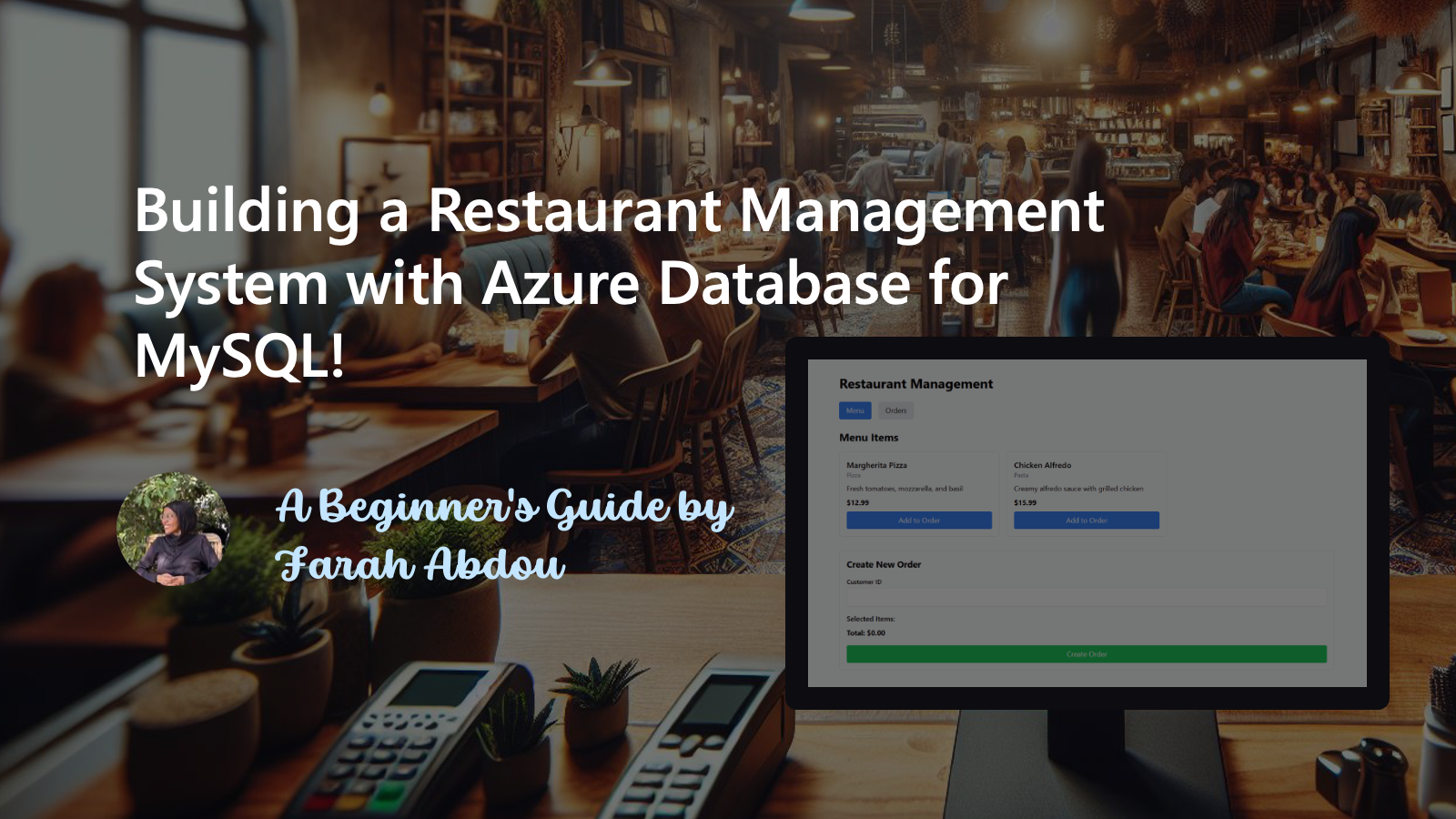
In this hands-on tutorial, we'll build a Restaurant Management System using Azure Database for MySQL. This project is perfect for beginners looking to understand cloud databases while creating something practical.
Updated Dec 03, 2024
Version 2.0

This tutorial is incredibly detailed and helpful for anyone looking to build a structured restaurant database on Azure. The inclusion of the GitHub repository makes it very easy to follow along. I found the section on implementing stored procedures for daily sales particularly useful for real-time data tracking. Do you think adding a separate table for 'Seasonal Discounts' would impact the performance of the order_items join in a high-traffic environment?

Thank you so much Jack36 for the kind words! I'm really glad you found the stored procedures section useful, real-time sales tracking is definitely one of the most practical features for restaurant operators.
Great question about the Seasonal Discounts table! The short answer is: no, it shouldn't noticeably impact performance if designed correctly. Here's why:
Adding a normalized seasonal_discounts table (with columns like discount_id, discount_name, percentage, start_date, end_date, and optionally a category_id or item_id foreign key) is actually the recommended approach rather than embedding discount logic directly into order_items. The key is to ensure proper indexing on the join columns. For example:
CREATE TABLE seasonal_discounts (
    discount_id INT PRIMARY KEY AUTO_INCREMENT,
    item_id INT,
    discount_percentage DECIMAL(5,2),
    start_date DATE,
    end_date DATE,
    FOREIGN KEY (item_id) REFERENCES menu_items(item_id)
);

CREATE INDEX idx_discount_item ON seasonal_discounts(item_id);
CREATE INDEX idx_discount_dates ON seasonal_discounts(start_date, end_date);
In a high-traffic environment, the additional JOIN to seasonal_discounts would be a simple indexed lookup, which MySQL handles very efficiently. The real performance concerns in JOIN-heavy queries come from missing indexes and full table scans, not from the number of tables itself. As long as the foreign keys and date-range columns are properly indexed, the optimizer will use ref or range lookups that execute in near-constant time.