Organizations that treat governance as an enabler, not a brake, will be better positioned to scale AI agents responsibly.
A familiar pattern emerges whenever a new technology enters the enterprise: the business sees opportunity, IT sees complexity, security sees risk, and governance sees a problem. Soon, someone says, “We need a policy before anyone can use this.”
That instinct is understandable, but it can become a trap. When governance becomes synonymous with waiting, the business rarely stops innovating; it finds another path. We saw this with cloud services, mobile devices, applications, and data. AI agents will be no different. Governance should not be the brake on agent adoption, it should be the permission slip.
Why the Governance Model Must Change
Adoption is already ahead of governance
Microsoft research on agent adoption and security found that 42% of organizations had deployed at least some agents, 78% were concerned about agent cybersecurity, and 76% of leaders expected employees to manage agents within two to three years. The exact figures will change as adoption matures, but the pattern is clear: organizations are moving toward agents while many are still deciding how those agents should be governed.
That creates a choice. Organizations can try to slow adoption until governance catches up, or they can build governance that makes responsible adoption possible. The second approach is more durable because governance is too important to reduce to a gate at the end of the process.
The limits of governance as a gate
The traditional model is sequential:
- Someone requests permission to use a new technology.
- Security, architecture, legal, compliance, and IT review the request.
- After several handoffs, someone makes a decision.
This model can work when technology adoption is centralized and the number of deployments is manageable. Agents challenge that assumption. If thousands of employees can create, configure, or use agents, every agent cannot be treated as a bespoke technology project. The scale changes the economics of governance. Organizations need guardrails that operate across an entire agent population.
Governance as a Framework
Instead of asking, “How do we approve every agent?” ask, “What conditions must be true for an agent to operate safely?”
Inventory it. Identify it. Own it. Scope it. Watch it. Retire it.
These lifecycle steps become the conditions for participation. An agent may not need a committee meeting every time it is created, but the organization must be able to answer:
- Inventory: What is the agent, and where does it operate?
- Identity: What identity does it use?
- Ownership: Who sponsors and owns it?
- Scope: What can it access and do?
- Data: What information does it depend on?
- Observation: How is its activity monitored and understood?
- Protection: How are threats and sensitive data handled?
- Lifecycle: When should the agent be reviewed, expire, or be retired?
That is governance as infrastructure, not governance as paperwork.
The permission slip has conditions
A permission slip is not permission to do anything. It is permission to operate within defined boundaries. For AI agents, those boundaries should include:
- Known identity: Every agent has an identifiable identity.
- Clear accountability: Every agent has a named sponsor and owner.
- Least-privilege access: Access is limited to what the agent needs.
- Protected data: The agent uses information with appropriate access, classification, and protection.
- Operational visibility: Activity, connections, and changes can be understood.
- Integrated security: Threat detection and data protection are part of the operating environment.
- Defined lifecycle: The agent can be reviewed, expired, and retired.
These are not barriers to adoption. They are the conditions that make adoption governable.
Designing Governance for Scale
The goal is manageable risk—not zero risk
No technology adoption model eliminates risk. The executive question is whether the organization can understand and manage the risk it accepts. That requires moving from “Agents are risky, so we must control them” to “Agents have predictable governance requirements, so we will build those requirements into how they operate.”
This creates a healthier relationship among stakeholders. The business gets a clear path to adoption. IT gains visibility. Security gains enforceable boundaries. Information governance becomes part of the operating model. Leadership gains measurable controls.
Good governance makes “yes” easier
The better the governance framework becomes, the easier it is to approve responsible use. Under a gate-based model, an employee who wants to create an agent hears, “Let’s review it.” Under a framework-based model, the answer can be:
- Yes, provided the agent has an identity, an owner, scoped access, approved data sources, appropriate monitoring, and a defined lifecycle.
The organization is not saying, “Do not build it.” It is saying, “Here is how to build it responsibly.” That distinction matters.
Guardrails should be reusable
If every agent requires a new interpretation of security policy, the governance team becomes the bottleneck. Reusable controls turn governance from a series of one-off decisions into a scalable operating system.
- Gate model: One agent, one review, one decision.
- Framework model: One control framework, thousands of governed agents.
The second model resembles how mature IT organizations already govern identities, devices, applications, and data. The goal is not to inspect everything manually forever. It is to create enough structure for the environment to remain visible, accountable, and controlled at scale.
Connecting Governance to the Fifth Lifecycle
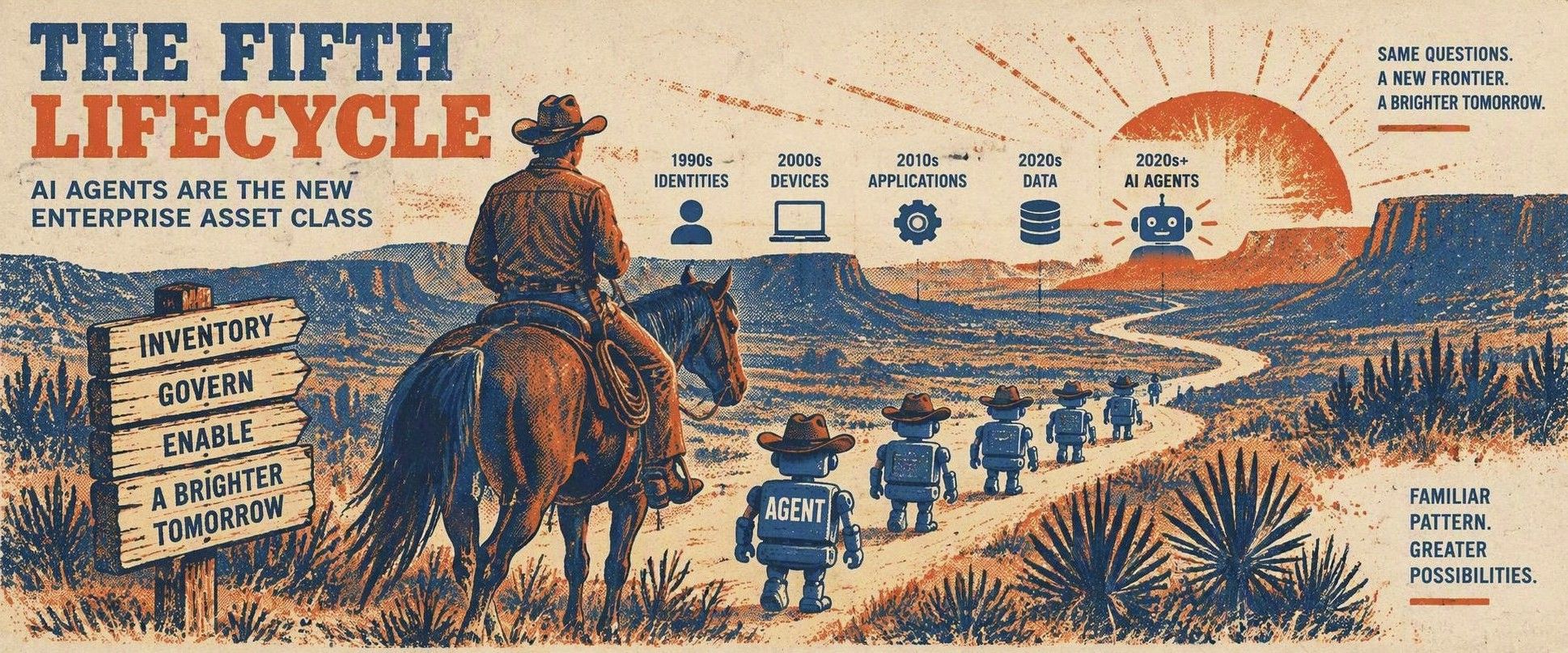
The first three articles in this series established a progression:
- Article 1: Agents are the fifth enterprise asset class.
- Article 2: The governance questions have not changed.
- Article 3: Agent governance depends on the data underneath it.
The next connection is straightforward: governance is what allows the lifecycle to operate at scale.
- Inventory without ownership is not governance.
- Ownership without scope is not governance.
- Scope without observation is not governance.
- Observation without retirement is not governance.
The controls must work together. That is the difference between having a policy and having a governance system.
Use durable principles, not predictions
IT cannot know exactly what the technology landscape will look like five years from now, but the governance model still needs to work. The most durable controls are therefore principle-based:
- Every asset needs an identity.
- Every asset needs accountability.
- Every asset needs appropriate scope.
- Every asset needs observation.
- Every asset needs protection.
- Every asset needs an exit.
These principles survive changes in implementation and give the organization room to innovate without restarting the governance conversation whenever the technology changes.
Make the Permission Slip Visible
Employees should not have to guess what they are allowed to build. Business leaders should not have to guess what IT will permit. Security should not discover agents only after deployment. A mature agent program makes the path explicit:
- What employees may build.
- What data they may use.
- What access they may request.
- Who must own the agent.
- How the agent will be monitored and protected.
- What happens when it reaches the end of its useful life.
That is what a permission slip looks like in an enterprise: not a signature on paper, but a defined path to responsible action.
The real choice is governed or unmanaged adoption
The choice is not governance versus innovation. It is governed adoption versus unmanaged adoption. People will find ways to use AI. The strategic question is whether those uses become part of an environment the organization can understand, secure, and improve—or another layer of technology operating outside the control plane.
Do not build a wall around agents. Build a control plane around them.
Governance Earns the Right to Say Yes
The phrase “permission slip” communicates two ideas at once: you may proceed, and there are conditions. That is the relationship enterprise governance should have with agent adoption. The posture should not be, “No, because we do not understand this yet.” It should be, “Yes—and here is the framework that lets us do it responsibly.” This shift is essential as agents move from experiments into everyday business operations.
Identity, devices, applications, and data all needed governance. Agents need it too—not to stop the organization from moving, but to make movement possible without sacrificing visibility, accountability, or control. So do not ask, “How do we stop employees from creating agents?” Ask, “What must be true for us to let them do it confidently?” Then build those conditions. That is governance doing its real job: not the brake, but the permission slip.
This is the fourth article in a series exploring the “fifth lifecycle” of enterprise IT: governing AI agents alongside identity, devices, applications, and data.

 Microsoft